
Life, 1916-04-13 · page 29 of 46
Life — April 13, 1916 — page 29: what you’re looking at
What you’re looking at
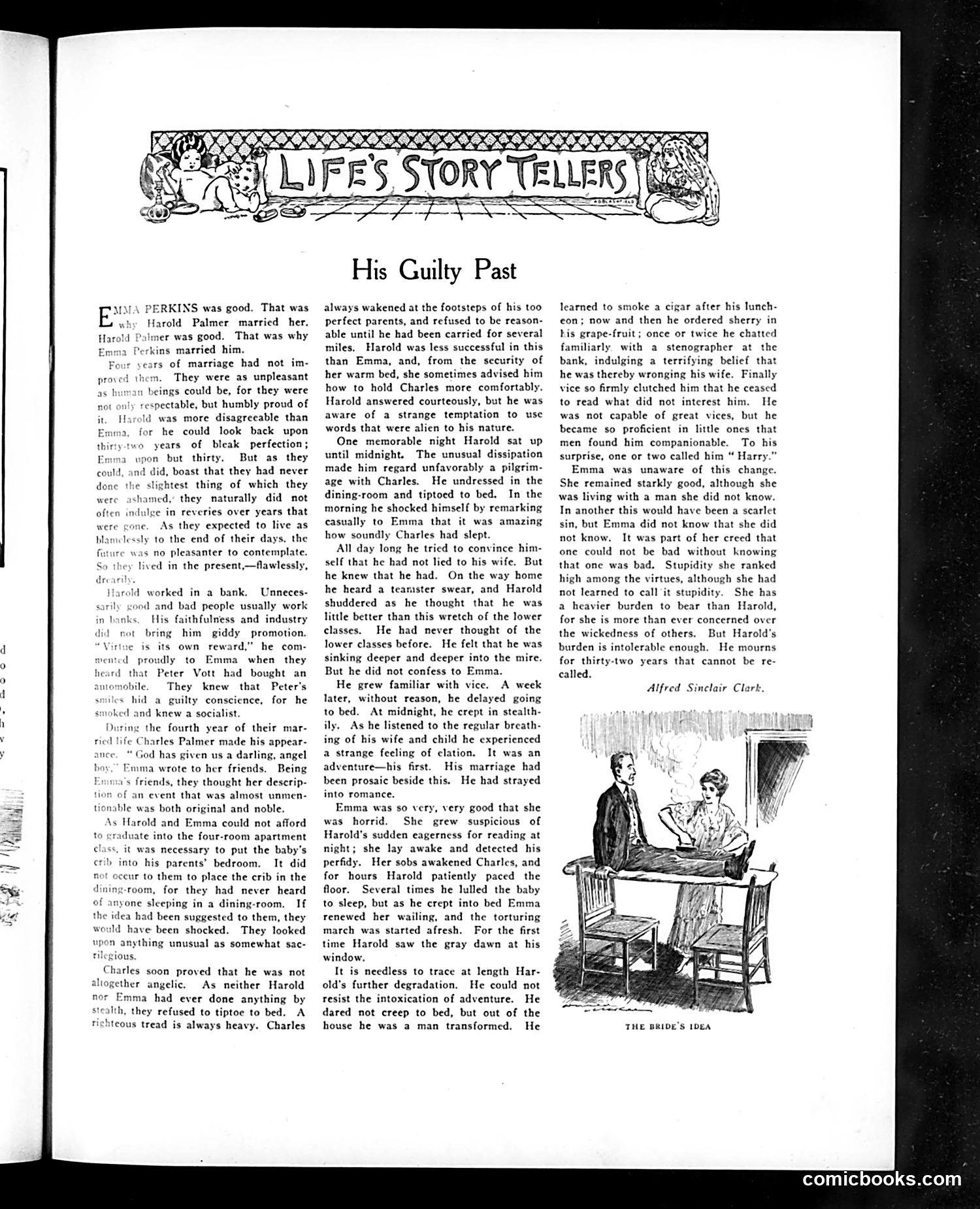
This is a satirical story (not a cartoon) by Alfred Sinclair Clark mocking Victorian morality and hypocrisy. Harold and Emma Palmer are a relentlessly "perfect" married couple—so rigid in their righteousness they won't even allow a baby's crib in the dining room, considering it improper. The satire centers on Harold's minor "transgression": one night, exhausted, he undresses in the dining room and lies about it to Emma. This small dishonesty becomes his gateway to "vice." He experiences a thrill from sneaking to bed at night—framing basic human spontaneity as moral degradation. The joke is the absurdity of such rigid propriety: Harold's "guilty conscience" over a tiny fib reveals how suffocating and unnatural their perfect facade truly is. Emma, being "so very, very good," becomes "horrid"—her suspicion and tears over his innocent behavior expose how their sanctimonious lifestyle corrupts actual human connection and family peace. The story critiques early 20th-century middle-class respectability as psychologically damaging performance art.
📄 Transcribed text from this page (OCR, searchable)
Machine-transcribed from the original scan — historical spelling and the odd misread are preserved.
MMA PERKINS was good. That was E why Harold Palmer married her. Harold mer was good. That was why Emma Perkins married him. r years of marriage had not im- d n. They were as unpleasant beings could be, for they were respectable, but humbly proud of ld was more disagreeable than for he could look back upon years of bleak perfection; upon but thirty, But as they did, boast that they had never htest thing of which they were ashamed, they naturally did not often indulge in reveries over years that were gone. As they expected to live as blamclessly to the end of their days, the fut was no pleasanter to contemplate. lived in the present,—flawlessly 1 worked in a bank. Unneces- ‘ood and bad people usually work His faithfulness and industry bring him giddy promotion. is its own reward,” he com- proudly to Emma when they heard that Peter Vott had bought an They knew that Peter's a guilty conscience, for he smoked and knew a socialist During the fourth year of their mar- ried life Charles Palmer made his appear- ance jod has given us a darling, angel Emma wrote to her friends. Being v's friends, they thought her descrip- » of an event that was almost unmen- tionable was both original and noble. As Harold and Emma could not afford to graduate into the four-room apartment lass, it was necessary to put the baby’s crib into his parents’ bedroom. It did not oceur to them to place the crib in the dining-room, for they had never heard yone sleeping in a dining-room. If the idea had been suggested to them, they would have been shocked. They looked upon anything unusual as somewhat sac- ri . automobile. smiles hid Charles soon proved that he was not logether angelic, As neither Harold nor Emma had ever done anything by stealth, they refused to tiptoe to bed. A richteous tread is always heavy. Charles KKK His Guilty Past always wakened at the footsteps of his too perfect parents, and refused to be reason- able until he had been carried for several miles. Harold was less successful in this than Emma, and, from the security of her warm bed, she sometimes advised him how to hold Charles more comfortably. Harold answered courteously, but he was aware of a strange temptation to use words that were alien to his nature. One memorable night Harold sat up until midnight. The unusual dissipation made him regard unfavorably a pilgrim- age with Charles. He undressed in the dining-room and tiptoed to bed. In the morning he shocked himself by remarking casually to Emma that it was amazing how soundly Charles had slept. All day long he tried to convince him- self that he had not lied to his wife. But he knew that he had. On the way home he heard a teamster swear, and Harold shuddered as he thought that he was little better than this wretch of the lower classes. He had never thought of the lower classes before. He felt that he was sinking deeper and deeper into the mire. But he did not confess to Emma. He grew familiar with vice. A week later, without reason, he delayed going to bed. At midnight, he crept in stealth- ily, As he listened to the regular breath- ing of his wife and child he experienced a strange feeling of clation. It was an adventure—his first. His marriage had been prosaic beside this. He had strayed into romance. Emma was so very, very good that she was horrid. She grew suspicious of Harold's sudden eagerness for reading at night; she lay awake and detected his perfidy, Her sobs awakened Charles, and for hours Harold patiently paced the floor. Several times he lulled the baby to sleep, but as he crept into bed Emma renewed her wailing, and the torturing march was started afresh. For the first time Harold saw the gray dawn at his window, It is needless to trace at length Har- old's further degradation. He could not resist the intoxication of adventure. He dared not creep to bed, but out of the house he was a man transformed. He learned to smoke a cigar after his lunch- eon; now and then he ordered sherry in bis grape-fruit; once or twice he chatted familiarly with a stenographer at the bank, indulging a terrifying belief that he was thereby wronging his wife. Finally vice so firmly clutched him that he ceased to read what did not interest him. He was not capable of great vices, but he became so proficient in little ones that men found him companionable. To his surprise, one or two called him “ Harry.” Emma was unaware of this change. She remained starkly good, although she was living with a man she did not know. In another this would have been a scarlet sin, but Emma did not know that she did not know. It was part of her creed that one could not be bad without knowing that one was bad. Stupidity she ranked high among the virtues, although she had not learned to call it stupidity. She has a heavier burden to bear than Harold, for she is more than ever concerned over the wickedness of others. But Harold's burden is intolerable enough. He mourns for thirty-two years that cannot be re- called. Alfred Sinclair Clark, THE BRIDE'S IDEA comicbooks.com