
A complete issue · 45 pages · 1916
Life — March 30, 1916
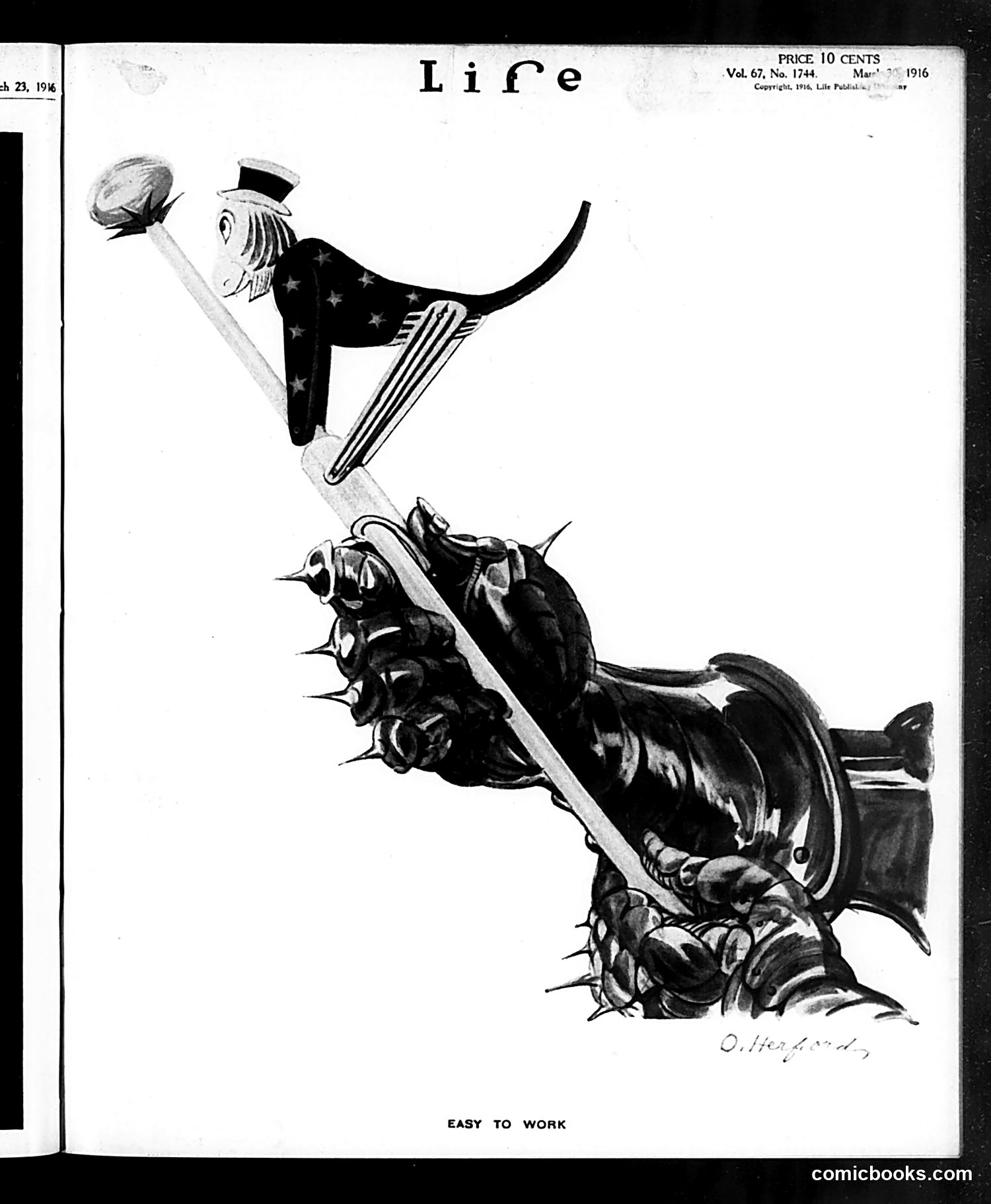
This March 1916 *Life* cartoon depicts Uncle Sam (identifiable by his starred jacket and top hat) balanced atop a thorny plant or thistle, juggling what appears to be a baseball. The figure's precarious position—standing on spikes while performing a difficult balancing act—visually represents the cartoon's satirical title. The cartoon likely comments on the complexity of American politics or policy at that moment. The thistle's spikes suggest difficulties or dangers, while the juggling act implies Uncle Sam is managing multiple competing demands simultaneously. Without additional context about March 1916 events, the specific political reference remains unclear, though it may relate to presidential politics or foreign policy challenges of that era.
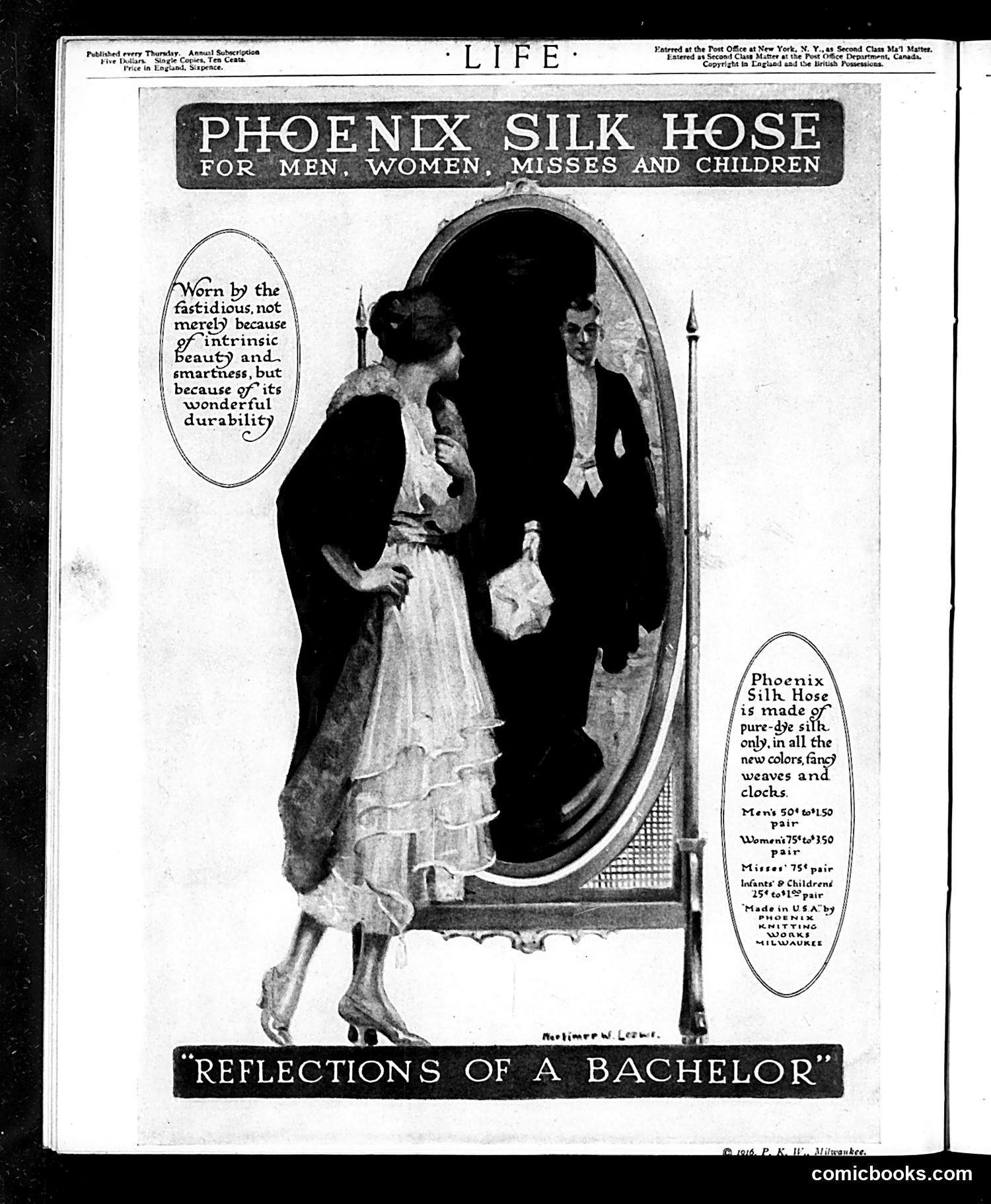
This is a straightforward product advertisement rather than political satire. The page promotes Phoenix Silk Hose for "men, women, misses and children," featuring an illustrated woman in 1910s-era dress admiring herself in a mirror alongside a man in formal attire. The caption "Reflections of a Bachelor" plays on the title of a popular contemporary novel, using mild romantic humor to associate the product with desirability and refinement. The advertisement emphasizes the hose's durability and availability in fashionable colors and weaves. Pricing and manufacturer information (Phoenix Knitting Company, Milwaukee) appear in the lower text box. This represents typical early 20th-century consumer advertising that linked commercial products to aspirational lifestyle imagery and contemporary literary references.
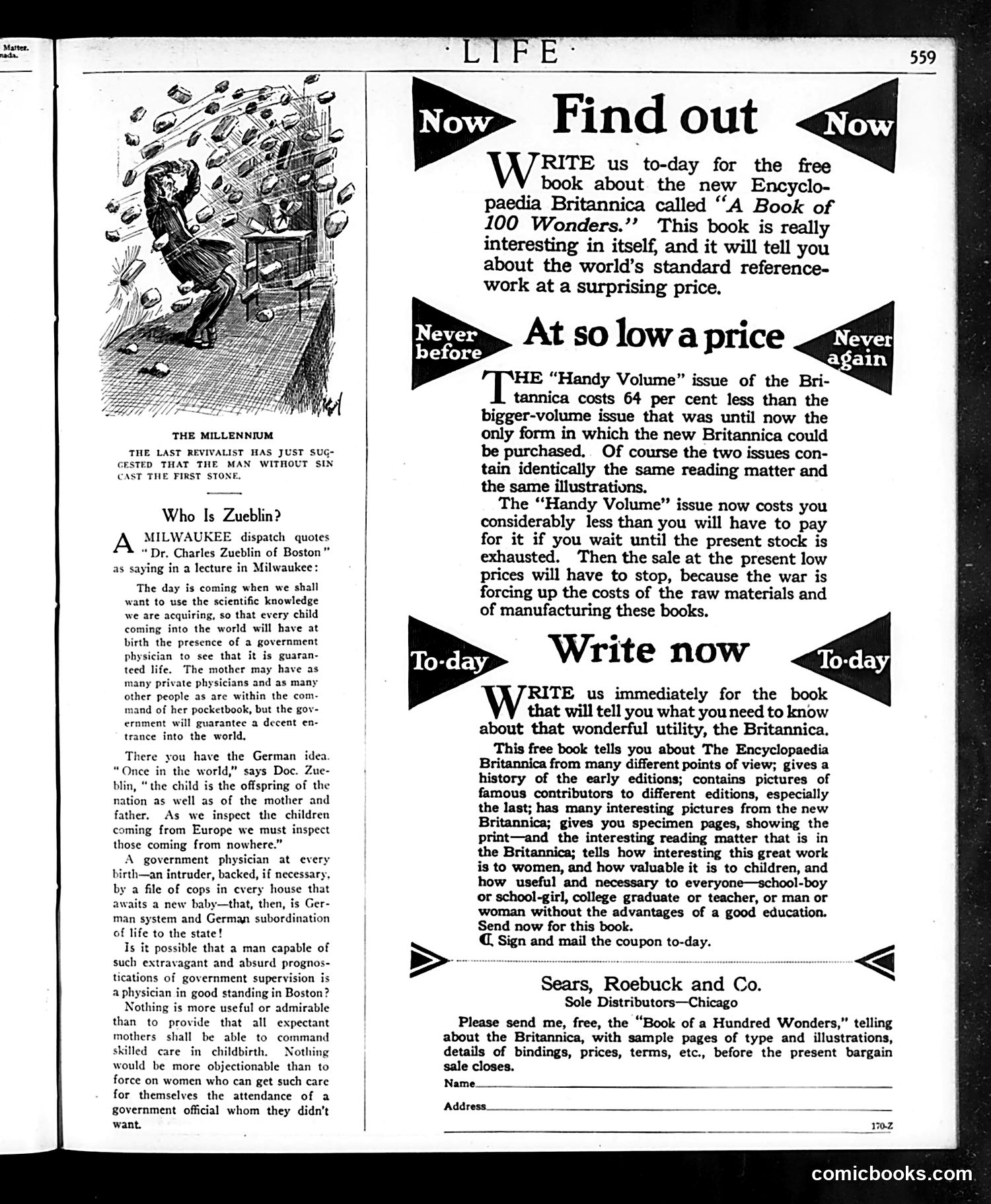
This page contains a political cartoon titled "The Millennium" depicting a figure being pelted with objects while holding a book. The accompanying article "Who Is Zueblin?" discusses Dr. Charles Zueblin of Boston, who apparently advocated for radical government oversight—including government physicians at every birth and centralized child-rearing. The cartoon satirizes this utopian vision, showing the chaos that would result from such extreme state control. The text quotes Zueblin's vision mockingly, then presents counter-arguments about the impracticality and danger of such "extravagant and absurd" government supervision. The page primarily features advertising for Encyclopedia Britannica's "Book of 100 Wonders," but the cartoon critiques progressive-era proposals for expanded government authority over citizens' lives.
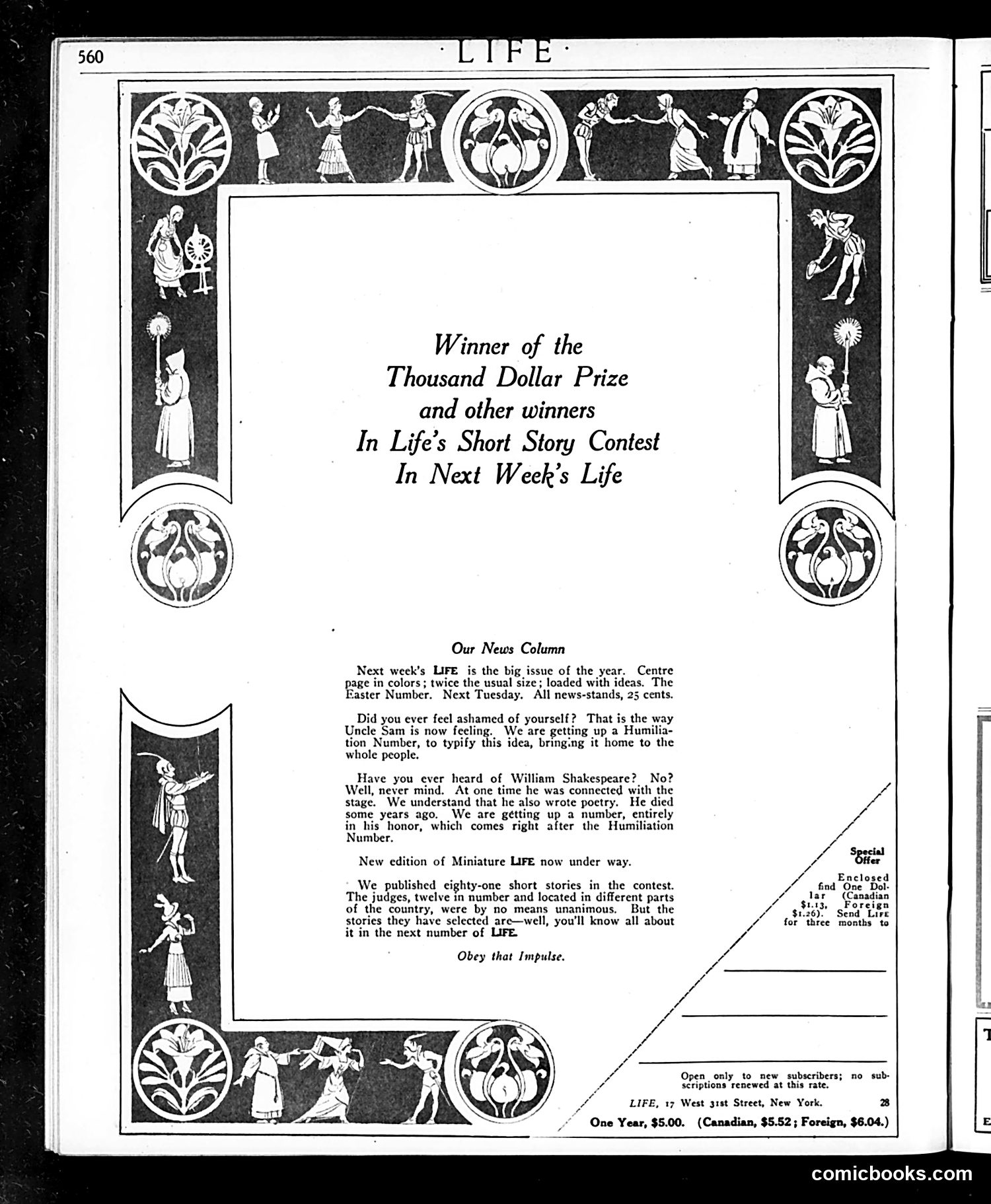
This page announces winners of Life's Short Story Contest, offering a thousand-dollar prize. The decorative art nouveau border features classical figures and theatrical imagery, reflecting the magazine's aesthetic sophistication. The "Our News Column" section references two timely topics: 1. **Uncle Sam's "Humiliation Number"** — appears to address American shame or embarrassment over an unspecified current event, suggesting editorial criticism of U.S. policy or conduct. 2. **William Shakespeare reference** — the magazine announces a special Shakespeare-themed issue, capitalizing on literary prestige while maintaining satirical tone through the phrase "never mind" regarding Shakespeare's dramatic works. The overall tone is self-promotional while gently mocking readers' cultural awareness. The page emphasizes Life's editorial ambitions beyond mere entertainment.
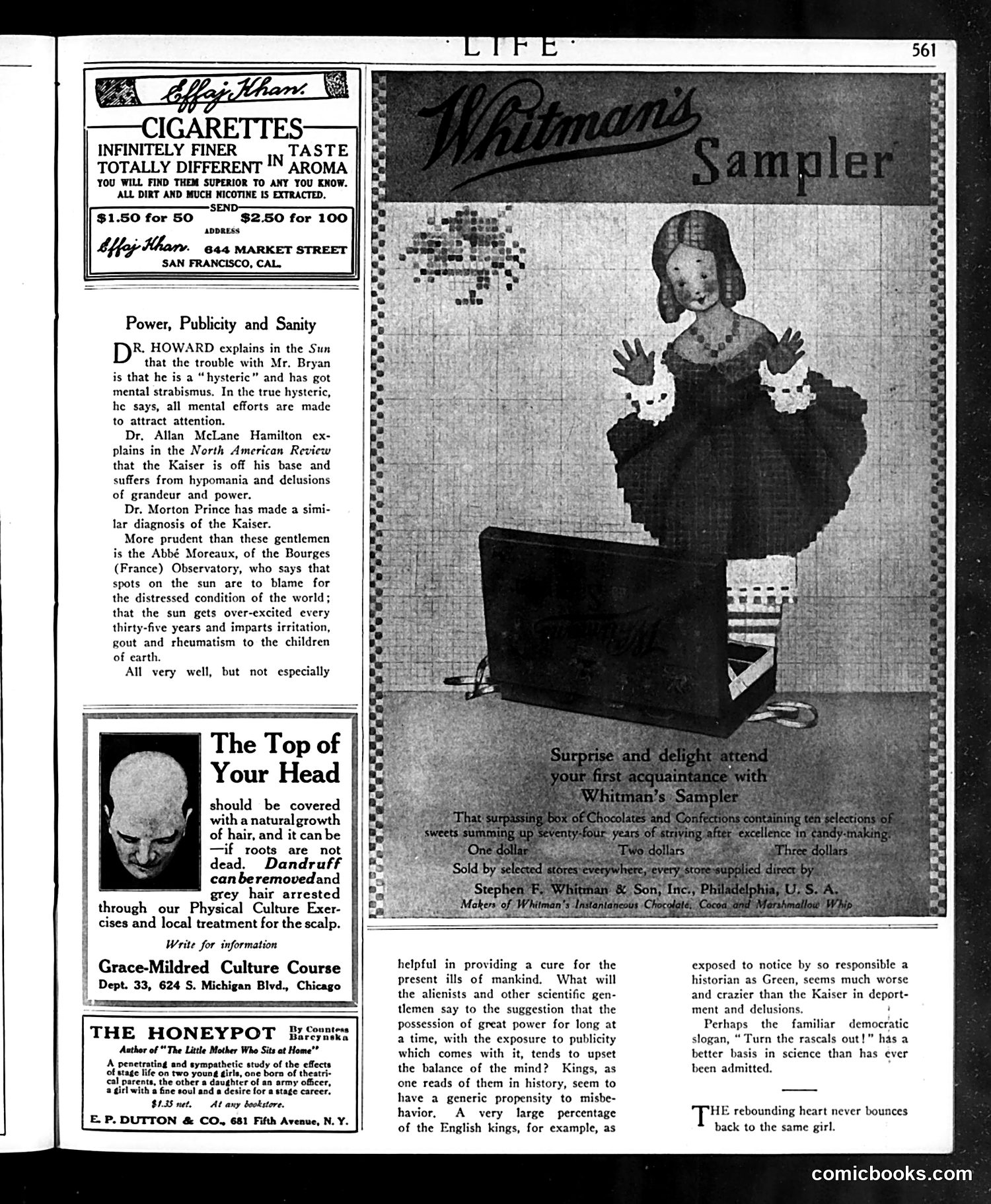
This page is primarily **advertising and miscellaneous content** rather than political satire. The dominant feature is a Whitman's Sampler chocolate advertisement showing a woman in 1920s dress emerging from a decorative box, promoting chocolate assortments at various price points ($1-$3). The left side contains unrelated advertisements (Alfs Khors cigarettes, hair growth treatment) and a brief article titled "Power, Publicity and Sanity" discussing mental health diagnoses of political figures like Bryan and the Kaiser—suggesting critics overpathologize leaders' behavior for attention. The page's scattered content reflects Life's format as a general-interest magazine mixing editorial commentary with commercial advertising, typical of early 20th-century publications.
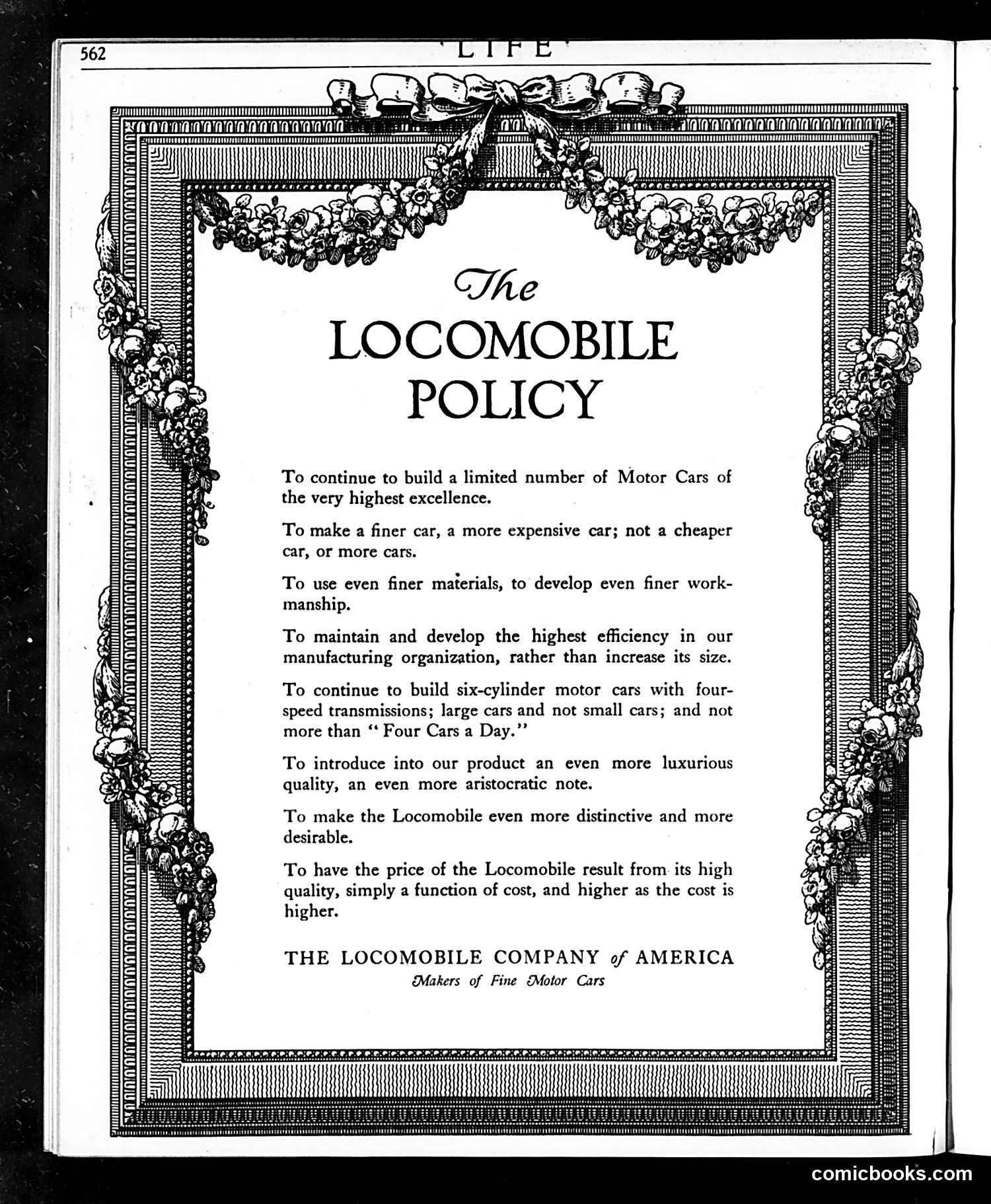
This page is **not a cartoon or satire** — it's a straightforward advertisement for the Locomobile Company of America. The ornate decorative border frames their company policy statement, which emphasizes luxury positioning rather than mass production. The key points reveal Locomobile's market strategy in the early automotive era: they deliberately limit production ("Four Cars a Day"), focus on quality over quantity, use premium materials, maintain six-cylinder engines and four-speed transmissions, and price accordingly. The statement that higher prices reflect higher quality — "the cost is higher" — explicitly rejects competing in the budget market. This reflects the pre-Model T luxury car segment, before Ford's mass-production revolution fundamentally altered the industry.
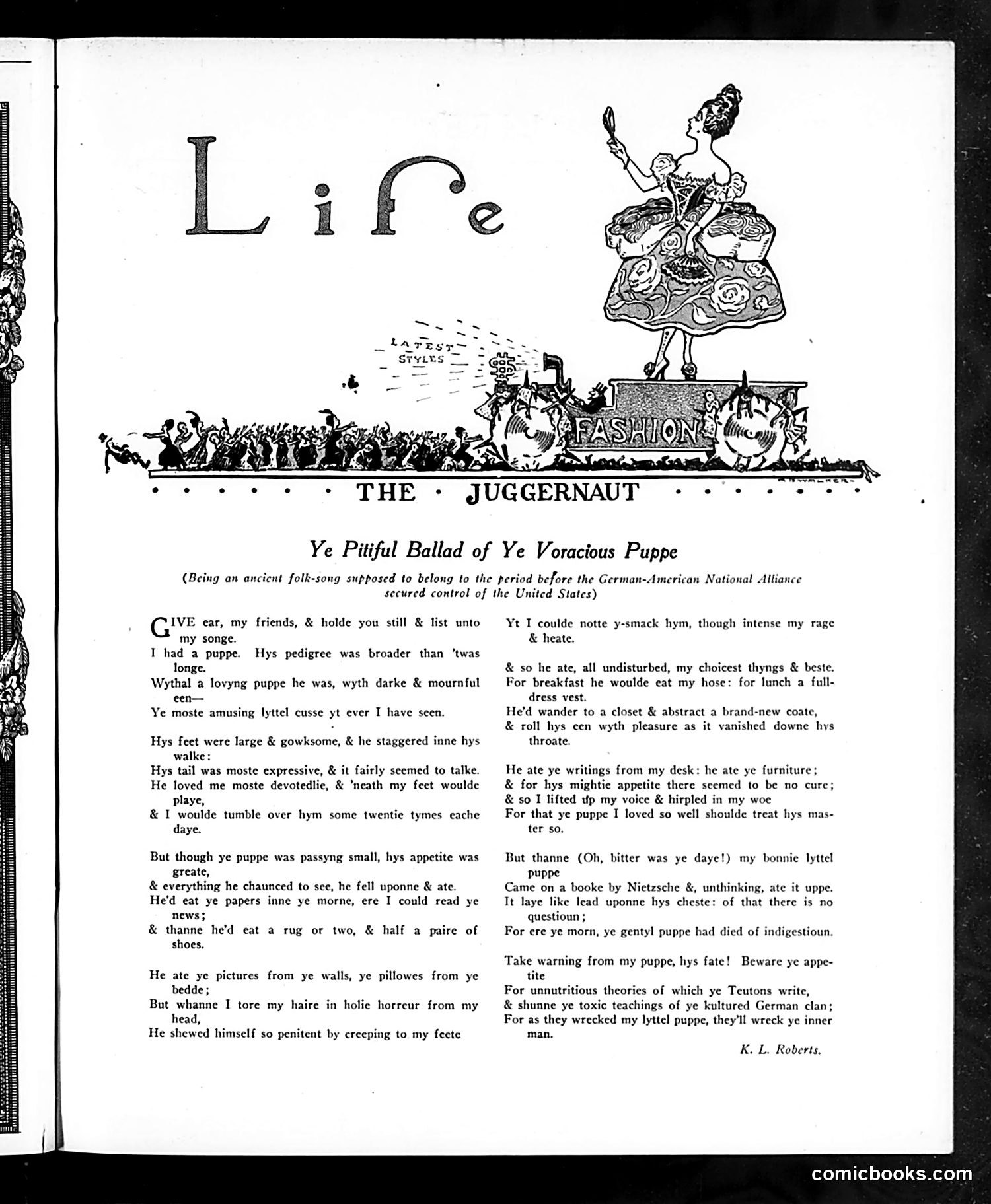
This page satirizes German-American cultural influence in pre-WWI America through an elaborate mock-ballad. The illustration shows a fashionably-dressed woman riding atop a juggernaut (a powerful, unstoppable force) labeled "FASHIONS," crushing crowds beneath. The poem, attributed to K.L. Roberts, humorously recounts owning a destructive dachshund puppy—a transparent metaphor for German culture. The puppy devours everything (papers, furniture, writings, even Nietzsche), representing how German ideas and fashions were consuming American society. The subtitle explicitly frames this as commentary on the "German-American National Alliance" and its influence before America entered WWI. The satire mocks both blind adoption of German culture and anxieties about foreign domination of American taste and values.
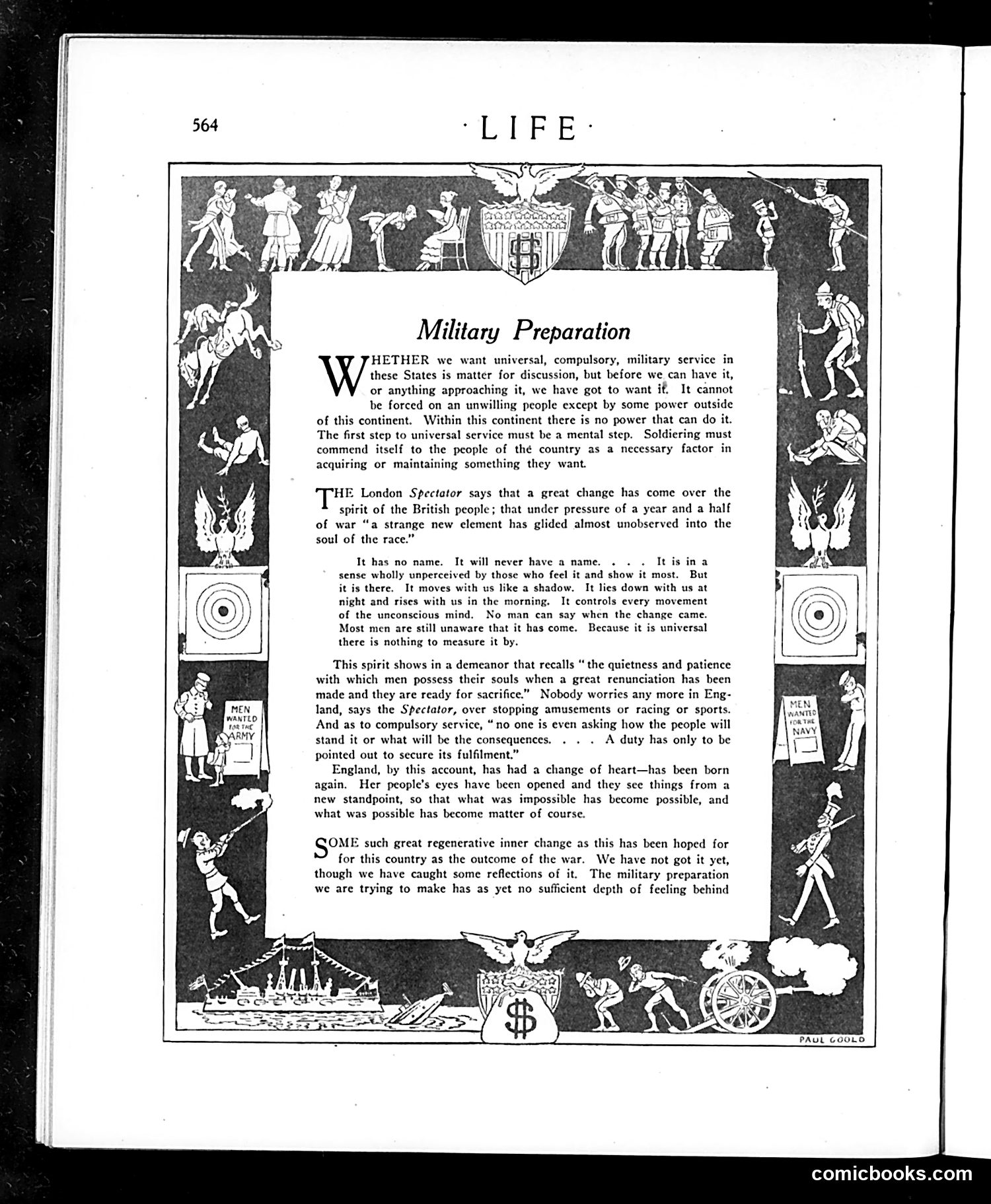
This page argues for compulsory military service in America, framed as necessary national preparation. The text cites the *London Spectator* on how war transformed British society—instilling duty and sacrifice while reducing interest in "amusements or racing or sports." The decorative border by Paul Gould contains military and patriotic imagery: soldiers, sailors, ships, and weapons alongside classical figures and athletic scenes. The argument suggests that *forced* military service would produce spiritual renewal—a "change of heart"—claiming England achieved this through wartime necessity. However, the author admits America hasn't yet experienced comparable transformation despite military preparations. This represents early 20th-century pro-militarism rhetoric, advocating conscription as morally beneficial, not merely practical.
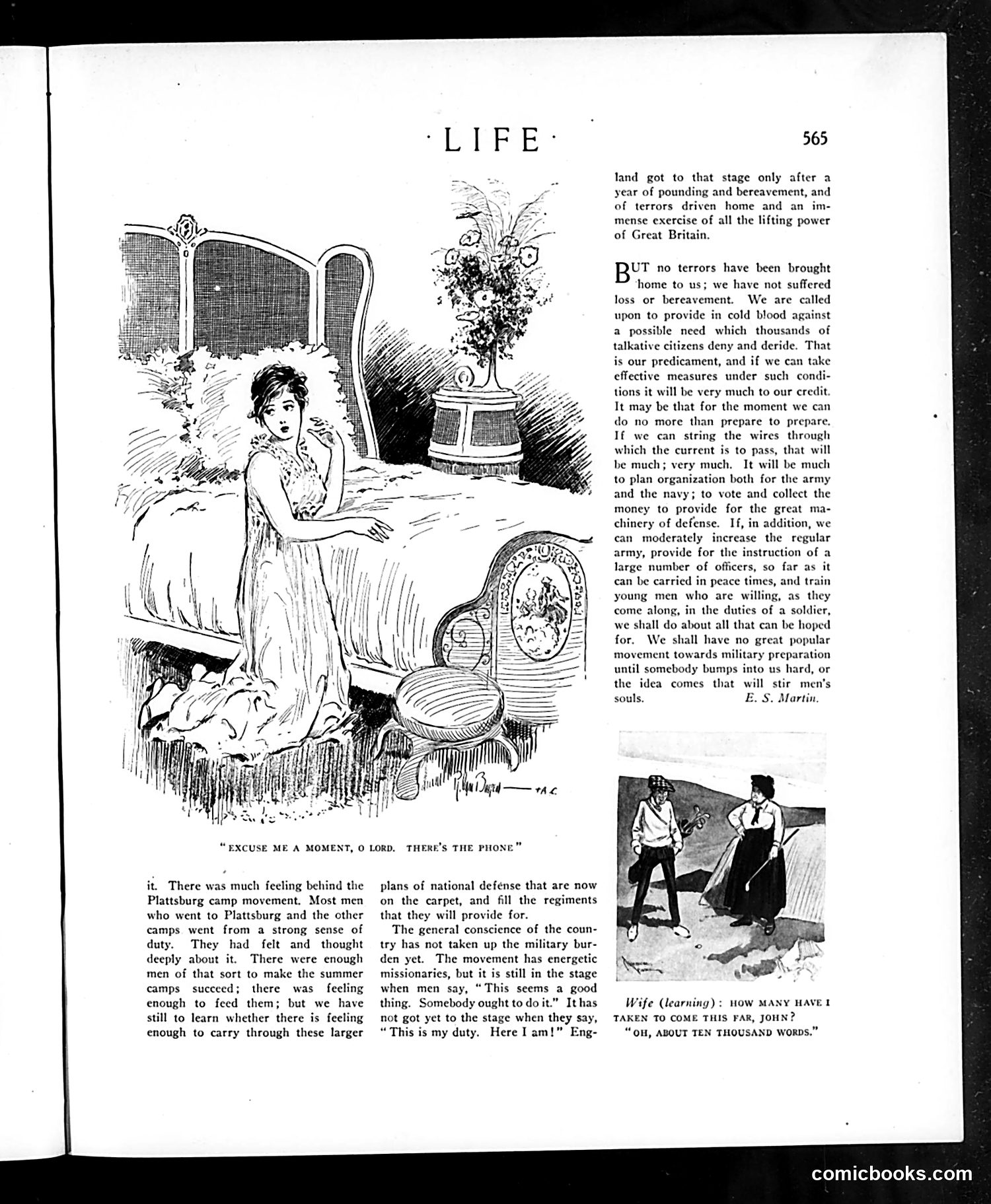
**Main Cartoon**: Shows a woman lounging indoors saying "Excuse me a moment, O Lord. There's the phone." This satirizes the era's emerging telephone culture and women's social lives—the humor lies in treating a phone call as more urgent than prayer, mocking both modern distraction and perhaps the trivialization of religious devotion. **Bottom Cartoon**: Depicts a wife asking her husband "How many have I taken to come this far, John?" He replies "Oh, about ten thousand words." This jokes about marital communication—the wife has walked ten thousand words' worth of distance while her husband talked, satirizing male verbosity and inattentiveness to spouses. Both cartoons use domestic scenarios to mock modern social behavior.
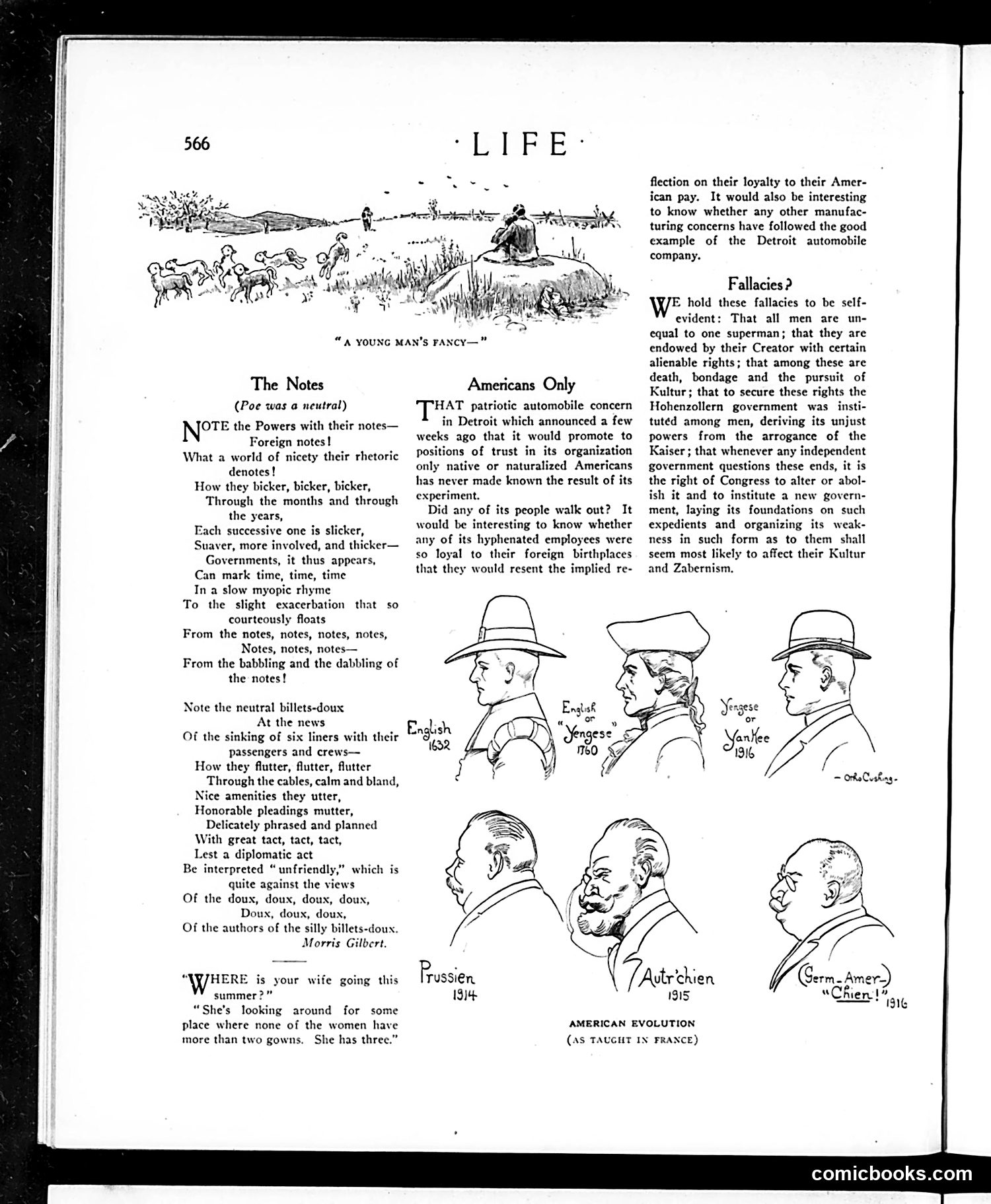
This 1916 *Life* magazine page contains political satire about World War I diplomacy. The bottom cartoon, titled "American Evolution (As Taught in France)," shows six profile sketches labeled with years tracking how France perceived American attitudes: from "English" (1914) through "Vengese" positions (1915-1916), culminating in a "Germ-Amer" or German-American figure (1916). The satire mocks American neutrality and suspected pro-German sympathies among hyphenated Americans. The text discusses a Detroit automobile company promoting "native or naturalized Americans" to management positions—criticizing it as suspect loyalty-testing during wartime. The upper sketch shows peasants with livestock, illustrating "A Young Man's Fancy"—likely commenting on wartime agricultural concerns. Overall, the page reflects American anxieties about divided loyalties and debates over neutrality versus Allied support.
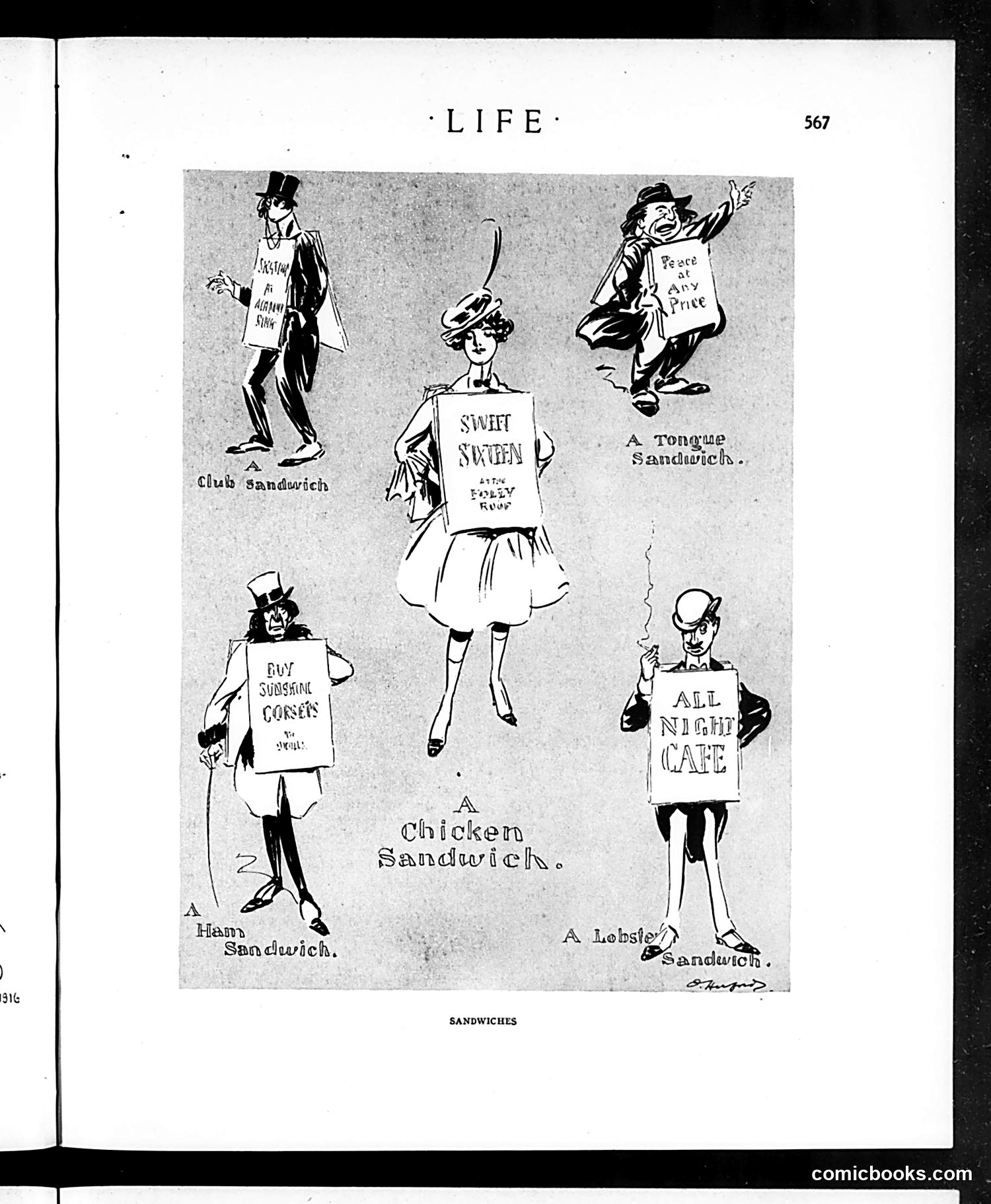
This is a humorous illustration showing various sandwich types personified as human figures wearing sandwich-themed signs. Each character represents a different sandwich variety: - Club Sandwich - Swift Swiften (with Folly River) - Tongue Sandwich - Ham Sandwich - Chicken Sandwich - Lobster Sandwich - All Night Cafe - Peace at Any Price The satire appears to be social commentary, with sandwich types dressed as dandies and working-class figures. The "Peace at Any Price" and "All Night Cafe" signs suggest commentary on contemporary social establishments or attitudes, though the specific historical references are unclear without additional context. The style is typical of early 20th-century Life magazine's lighthearted visual humor combining food culture with social observation.
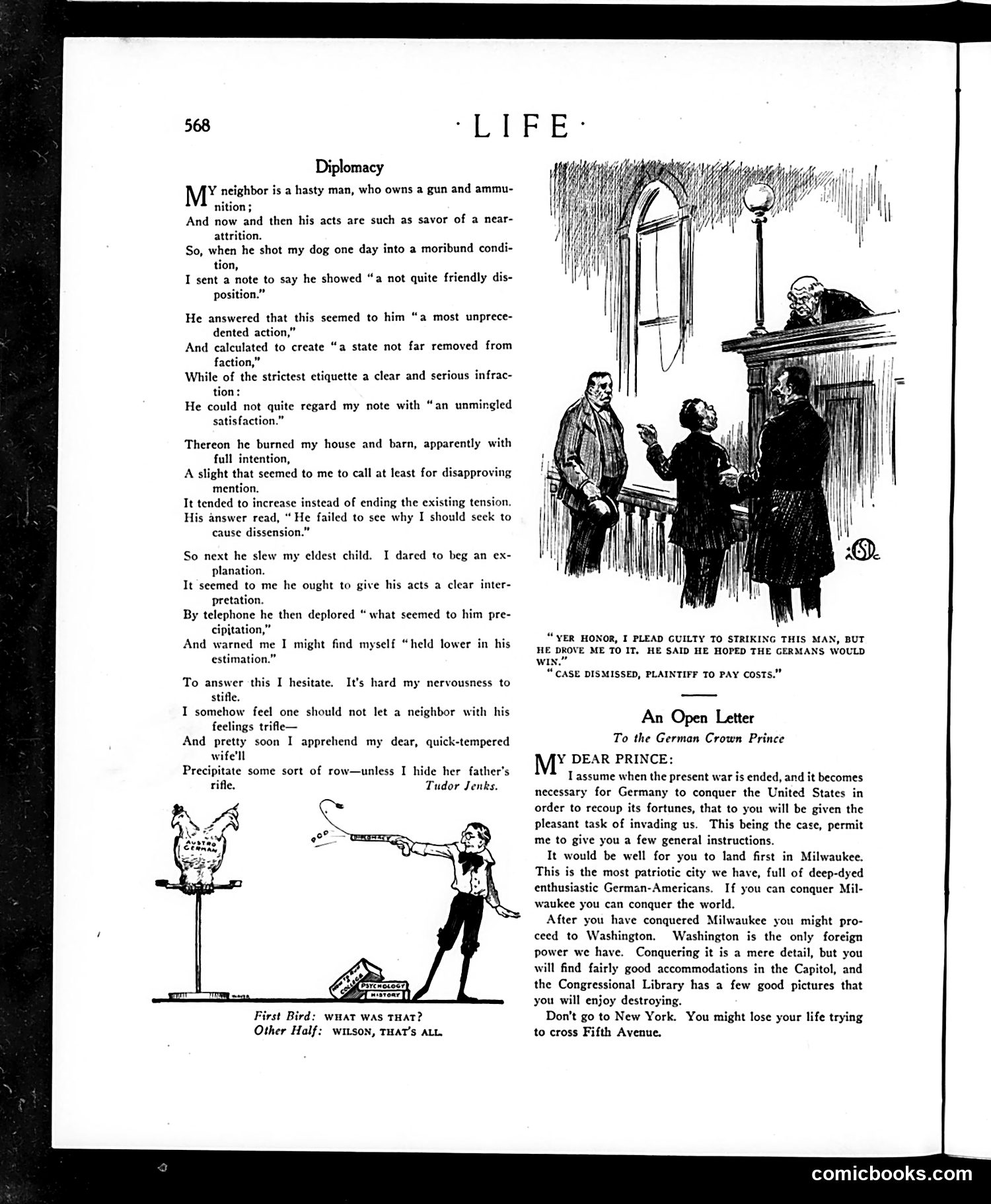
This page contains two pieces of WWI-era satire: **"Diplomacy"** (left): A poem by Tudor Jenks mocking a neighbor who shot the narrator's dog, then claimed this was justified diplomacy rather than an unfriendly act. The satire targets how nations excuse aggressive actions through euphemistic language—a direct jab at German justifications for their wartime conduct. **"An Open Letter to the German Crown Prince"** (right): Mock-serious advice on conquering America, sarcastically suggesting Milwaukee (a German-American stronghold) as an entry point, then Washington, with jokes about the Capitol and Congressional Library. The cartoon above shows a domestic dispute being arbitrated, captioned with a plea of guilt but blame-shifting ("he drove me to it"). This parallels how Germany justified its actions during the war. Both pieces ridicule German diplomatic excuses and aggression.
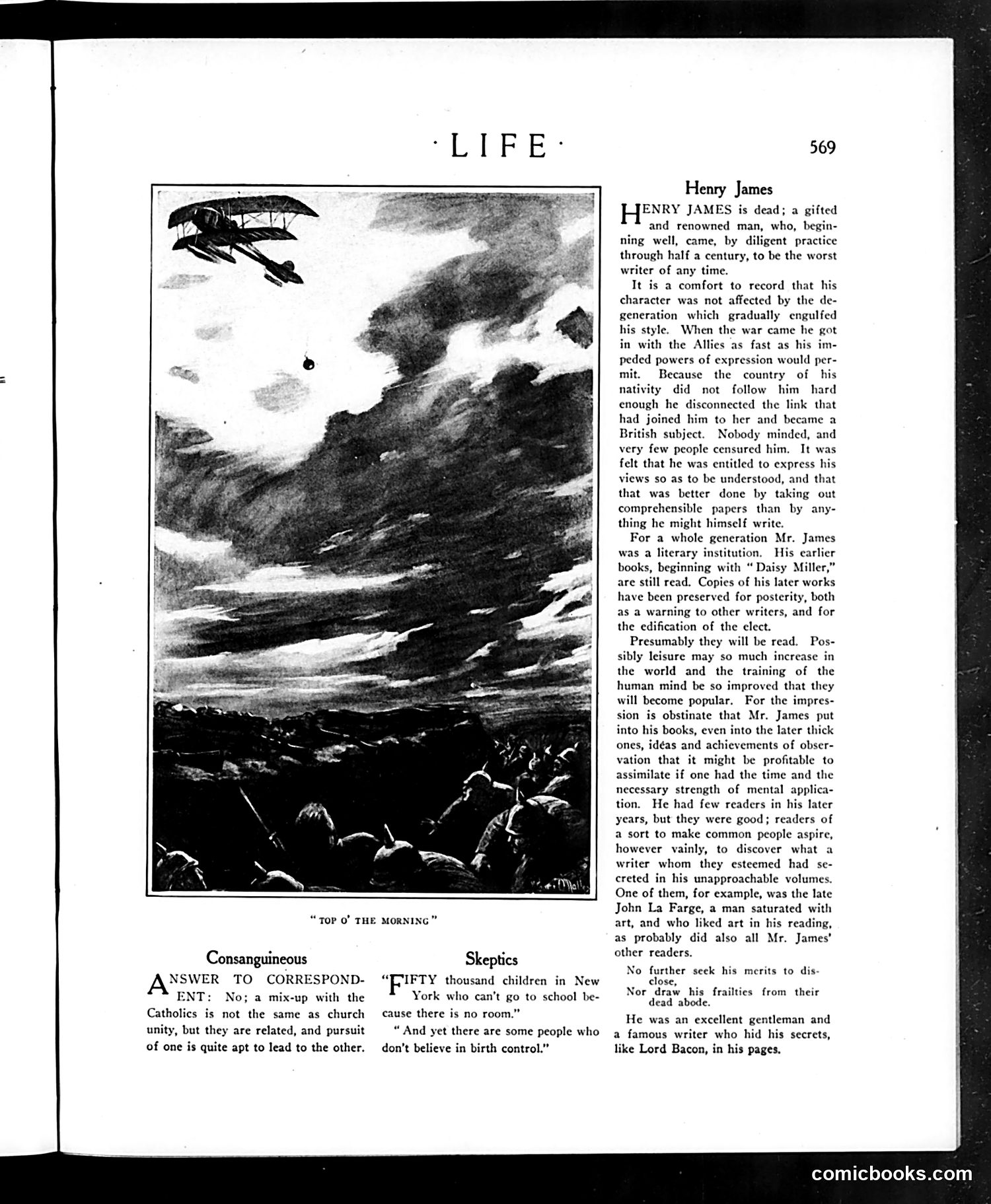
**Main Content:** An obituary/tribute to Henry James following his death, praising his literary achievements while acknowledging his complex relationship with his audience and his adopted British nationality. **The Illustration:** Titled "Top o' the Morning," the image depicts an early airplane in flight over a dramatic landscape with stormy skies. This appears to be a separate illustration unrelated to the James obituary—likely contemporary commentary on aviation technology or military concerns (the plane's design suggests early WWI-era aircraft). **Bottom Section:** Two brief satirical items mock social contradictions—one about Catholic-Protestant relations, another mocking birth control skeptics despite overpopulation concerns in New York schools. These are typical Life magazine social commentary pieces. The page represents early 20th-century American literary and social criticism through satire.
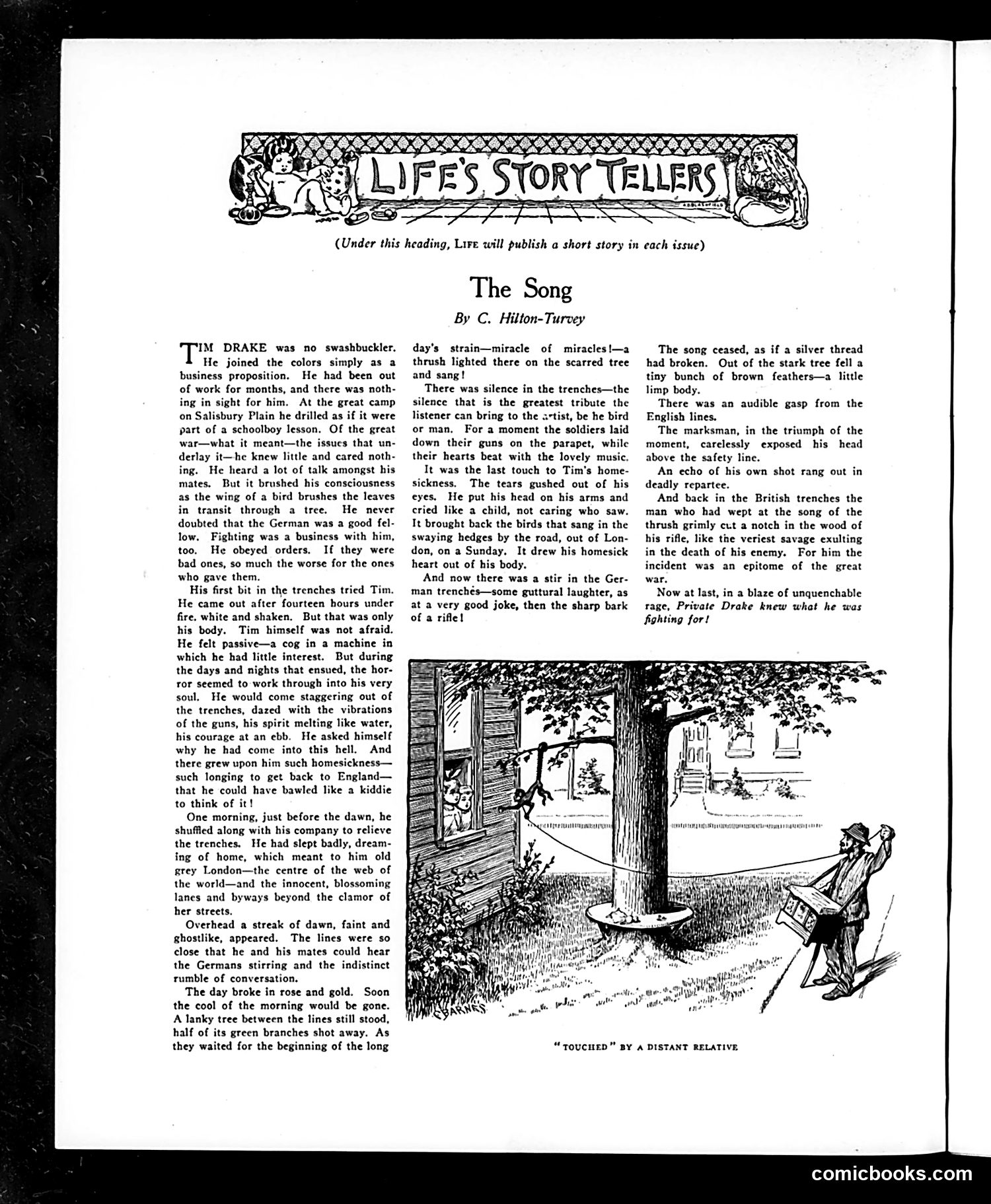
This is a **short story**, not a political cartoon. It depicts a World War I scene where Tim Drake, a British soldier in the trenches, hears a bird singing during the brutal fighting. The song provides him a moment of emotional escape from the horrors of war—memories of home, London, peace. The illustration shows a soldier sitting outside a cottage, apparently back home or in a moment of respite. The story's point appears to be about **how beauty and nature can provide solace during wartime**, offering soldiers brief psychological relief from trauma and homesickness. This represents a common WWI literary theme: the contrast between natural innocence and industrial warfare's brutality.
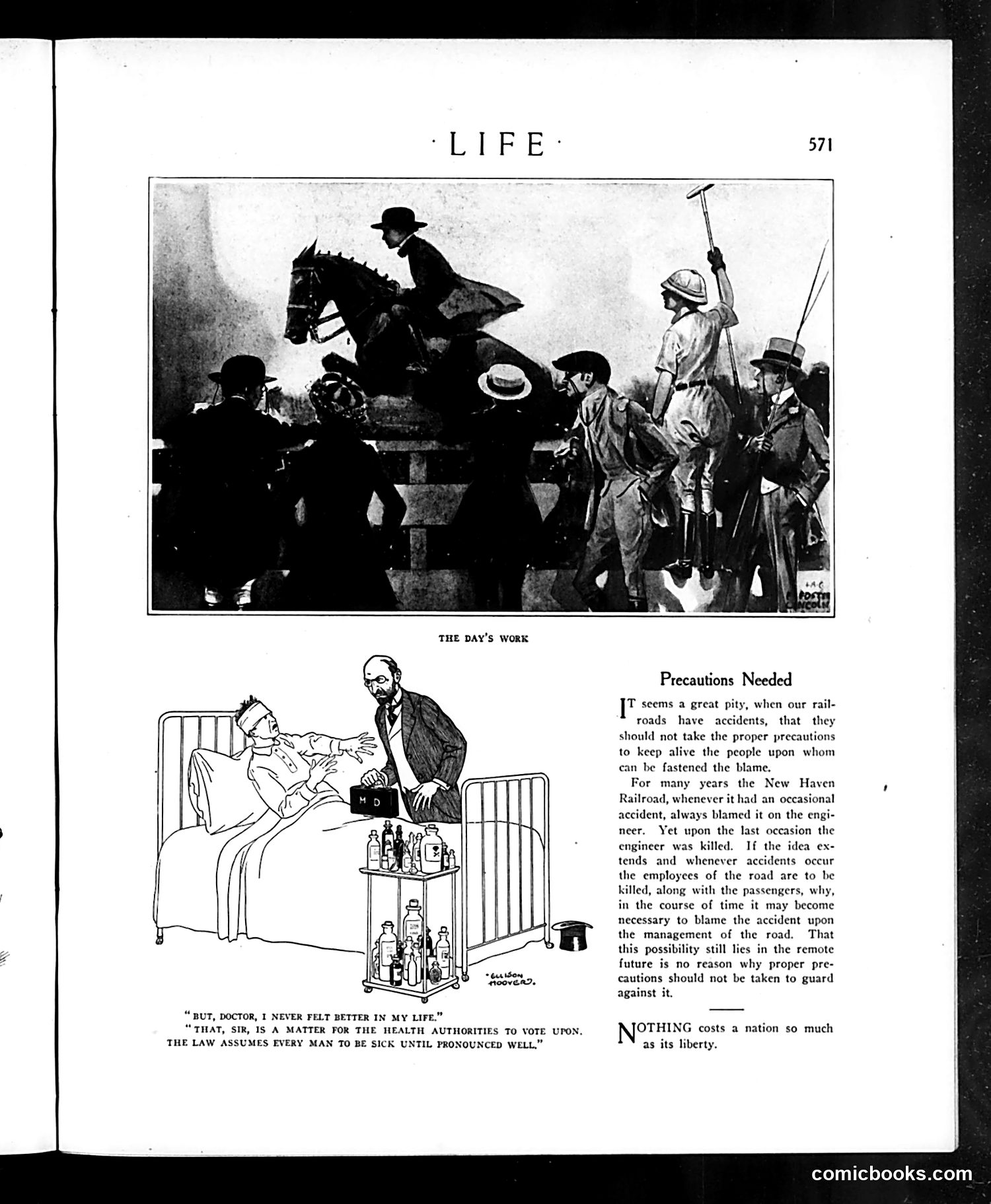
This page contains two distinct pieces: **Top image ("The Day's Work"):** A satirical illustration showing what appears to be a public event or gathering, possibly depicting labor, social activity, or civic participation from the early 20th century. **Bottom cartoon and article ("Precautions Needed"):** The cartoon depicts a doctor attending to a bedridden patient. The caption quotes the patient saying he's never felt better, with the doctor responding that health authorities should vote on whether he's well. The accompanying article criticizes railroad companies—specifically the New Haven Railroad—for blaming engineers for accidents rather than implementing proper safety precautions. The article argues that if employees are killed in accidents, the company bears responsibility. The satirical point: institutions avoid accountability by scapegoating workers instead of taking preventive measures. This reflects Progressive Era concerns about worker safety and corporate negligence.
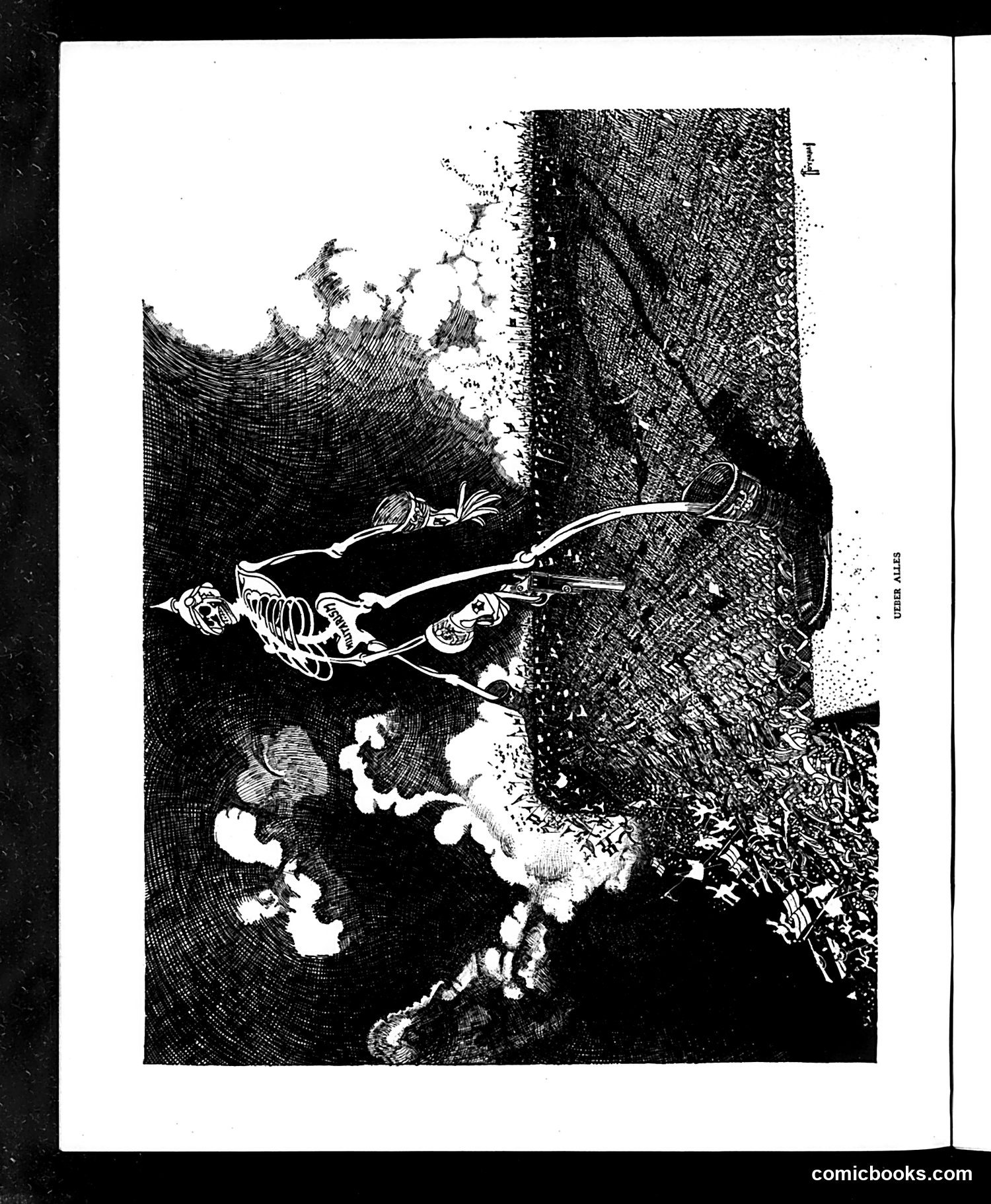
I can see this is a black and white satirical illustration, but the image quality and orientation make it difficult to read the specific details with certainty. The artwork appears to show skeletal or death-themed figures in an dramatic scene with dynamic cross-hatching characteristic of early 20th-century satirical artwork. However, without being able to clearly read any accompanying text, caption, or title on this page, I cannot confidently identify which specific political figures or events are being referenced, or explain the satirical point to a modern reader. The OCR text only provides "comicbooks.com," which is a website source rather than content from the original publication. To accurately explain this cartoon's meaning and context, I would need clearer visibility of the caption, title, publication date, and any identifying labels in the image itself.
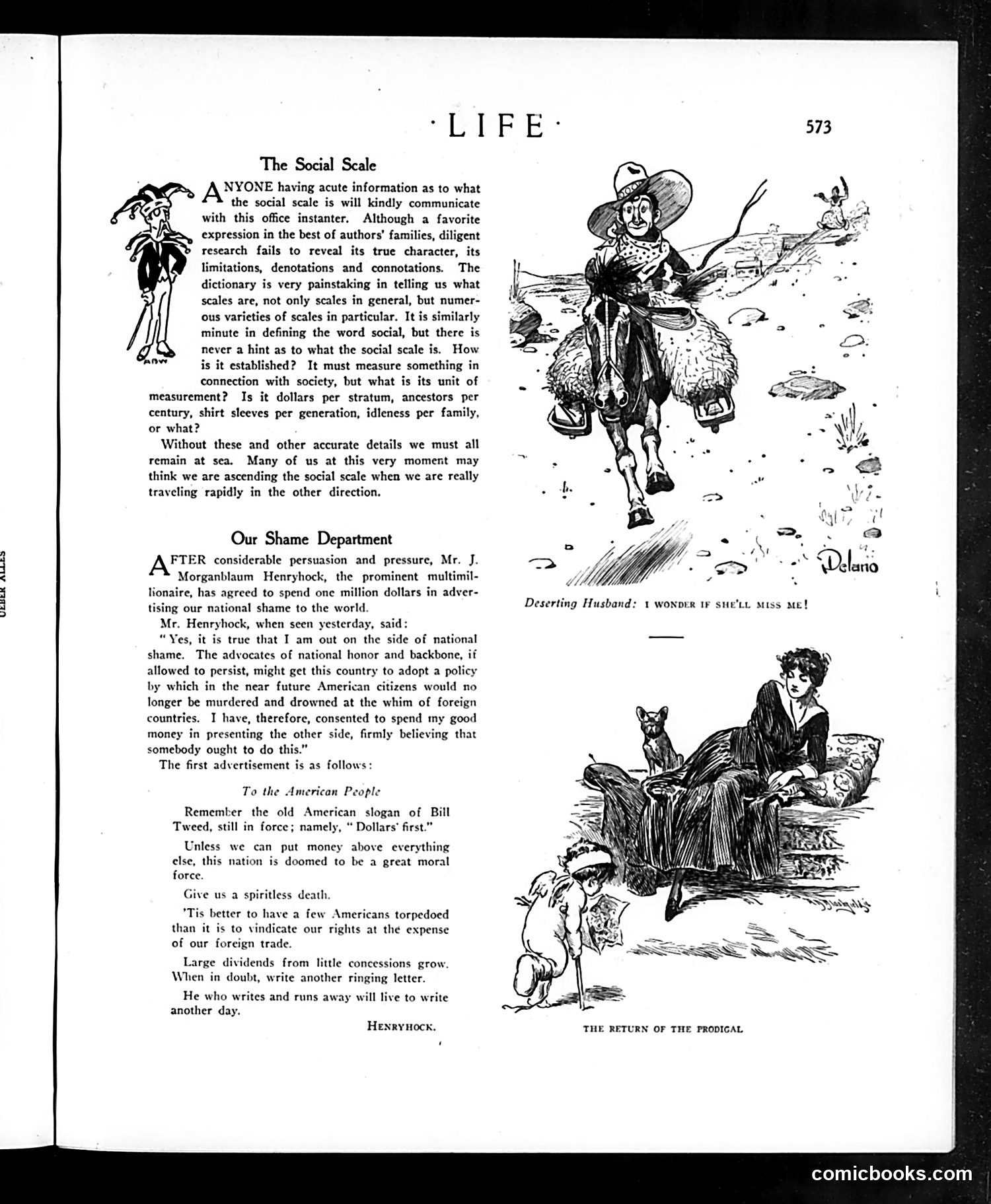
This satirical page mocks American moral priorities circa World War I era. "Our Shame Department" features a fictional millionaire, "J. Morganblaum Henryhock," who allegedly pays to advertise America's shameful prioritization of profit over principle. The satire attacks pacifist arguments and isolationist business interests that opposed U.S. entry into WWI. The fake advertisement parodies the Bill Tweed political machine ("Dollars first"), implying wealthy Americans would tolerate citizens being "torpedoed" (German U-boat attacks on American ships) rather than risk trade. The phrase "spiritless death" sarcastically suggests moral bankruptcy. The top section satirizes the vague concept of "social scale"—suggesting Americans can't agree whether status derives from wealth, ancestry, or laziness. Two small cartoons illustrate domestic themes: a wife watching her departing husband ("wonder if she'll miss me") and "The Return of the Prodigal," depicting reconciliation, offer lighter humor contrasting the serious political commentary.
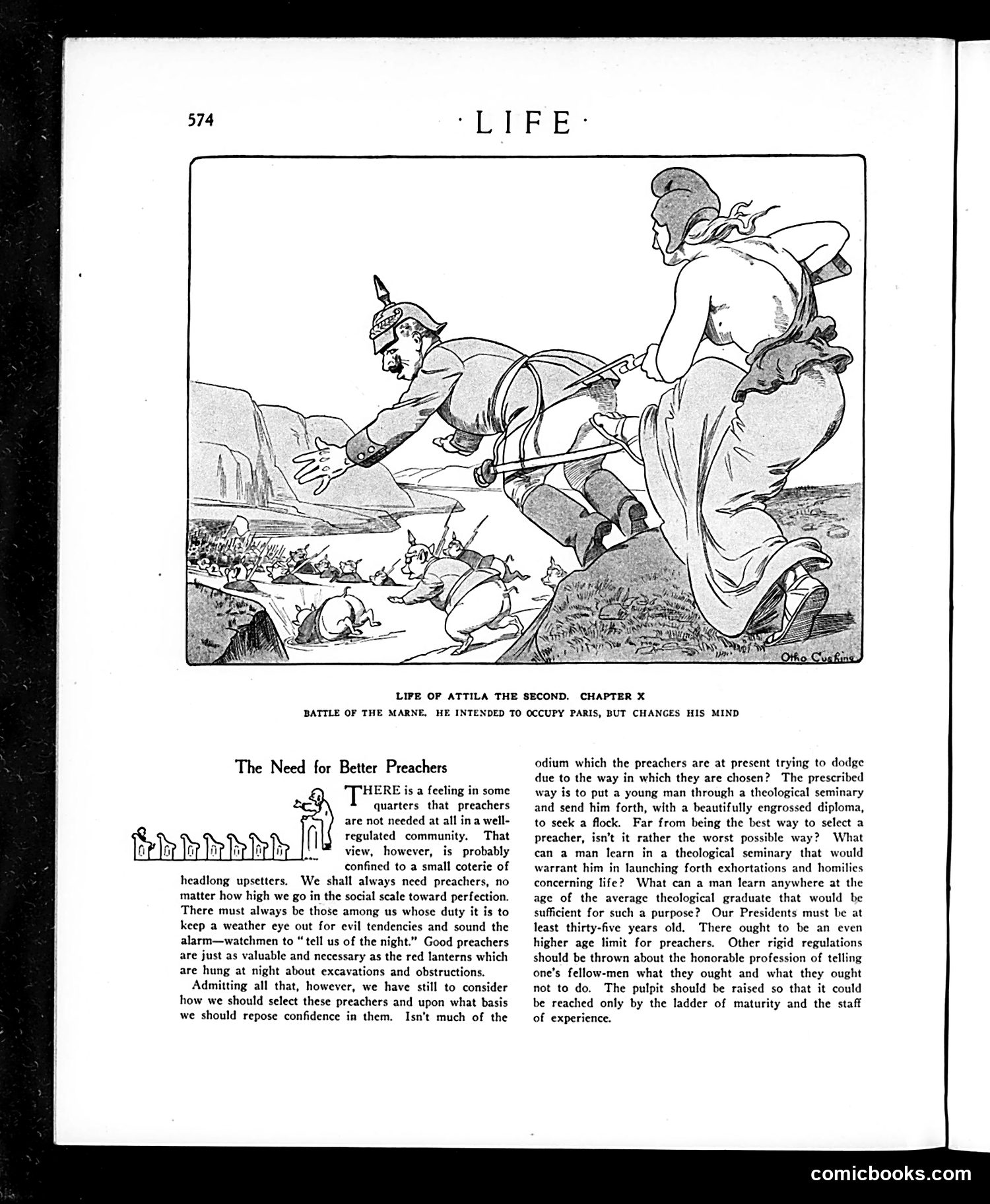
**The Cartoon (Top):** The illustration depicts "Attila the Second" at the Battle of the Marne, referencing German Kaiser Wilhelm II during World War I. The caption humorously notes he "intended to occupy Paris, but changes his mind"—a satirical jab at Germany's failed invasion of France. The figure on horseback with Prussian military dress and the smaller caricatures below likely represent German forces retreating or faltering in their campaign. **The Article (Bottom):** "The Need for Better Preachers" critiques how clergy are selected and credentialed in America. The author argues that theological seminary training alone is insufficient preparation for guiding congregations on life matters. He proposes stricter age requirements (suggesting preachers should be at least 35, like U.S. Presidents) and emphasizes that "maturity" and "experience" matter more than formal diplomas. This reflects early-20th-century debates about professional standards and institutional authority.
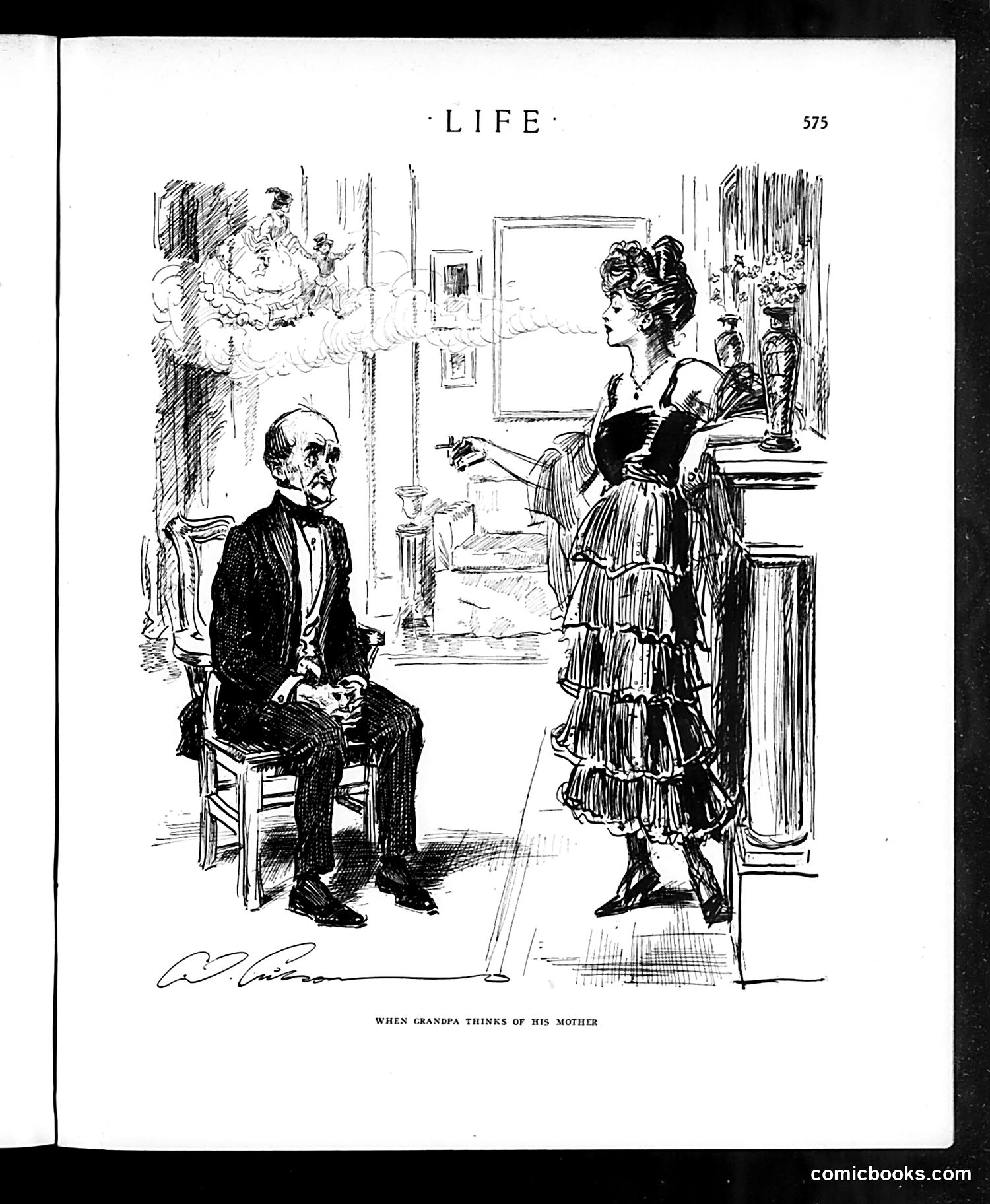
This single-panel cartoon depicts an elderly man seated, lost in thought, while a fashionably dressed woman stands nearby in an elegant interior. The title suggests the man is nostalgically remembering his mother. The humor likely plays on the contrast between the woman's modern appearance (her elaborate, tiered dress and contemporary styling suggest early 20th century fashion) and the man's elderly, somewhat worn appearance. The joke appears to center on the generational gap and how an aging man's idealized memory of his mother contrasts with present-day reality—perhaps suggesting that his mother was nothing like this elegant woman, or that his romanticized memories don't match reality. The cartoon gently mocks sentimental nostalgia.
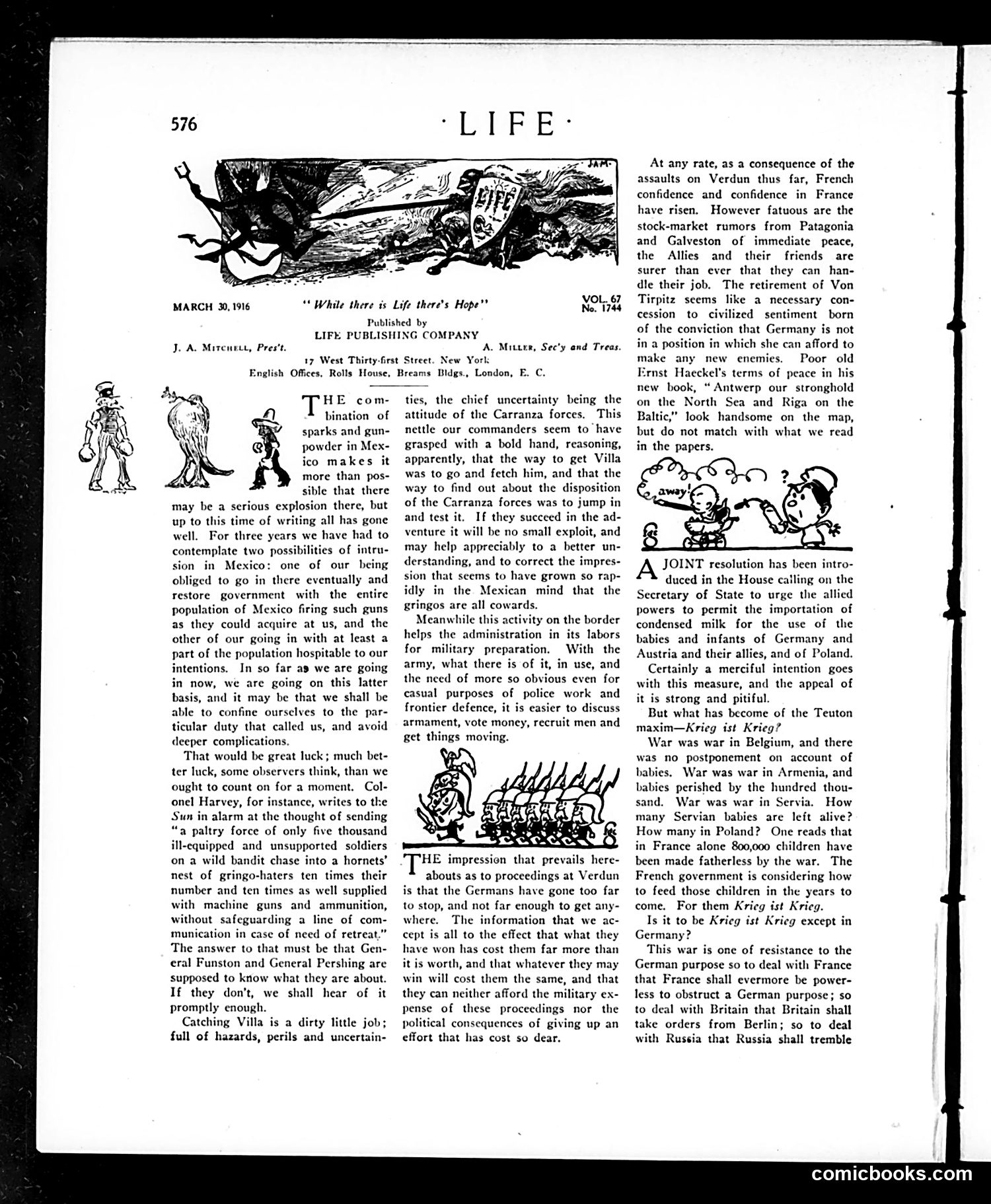
This page addresses three contemporary military situations during World War I: **Mexico/Villa:** The article discusses U.S. military operations against Mexican revolutionary Pancho Villa, expressing cautious optimism about General Pershing's expedition while acknowledging the risks of sending 5,000 troops into hostile territory. The cartoons (depicting figures in various poses) appear to illustrate the complexity and hazards of this "dirty little job." **Military Preparedness:** The author argues that border activity paradoxically helps the U.S. government justify increased military spending and recruitment—a silver lining to the conflict. **Verdun:** The article analyzes the grueling Western Front battle, concluding that German gains cost far more than strategically worthwhile, strengthening Allied confidence. The retirement of German Admiral Von Tirpitz is noted as a concession to "civilized sentiment"—suggesting growing international pressure on Germany's conduct. The overall tone is cautiously optimistic about Allied prospects while acknowledging genuine military and diplomatic uncertainties.
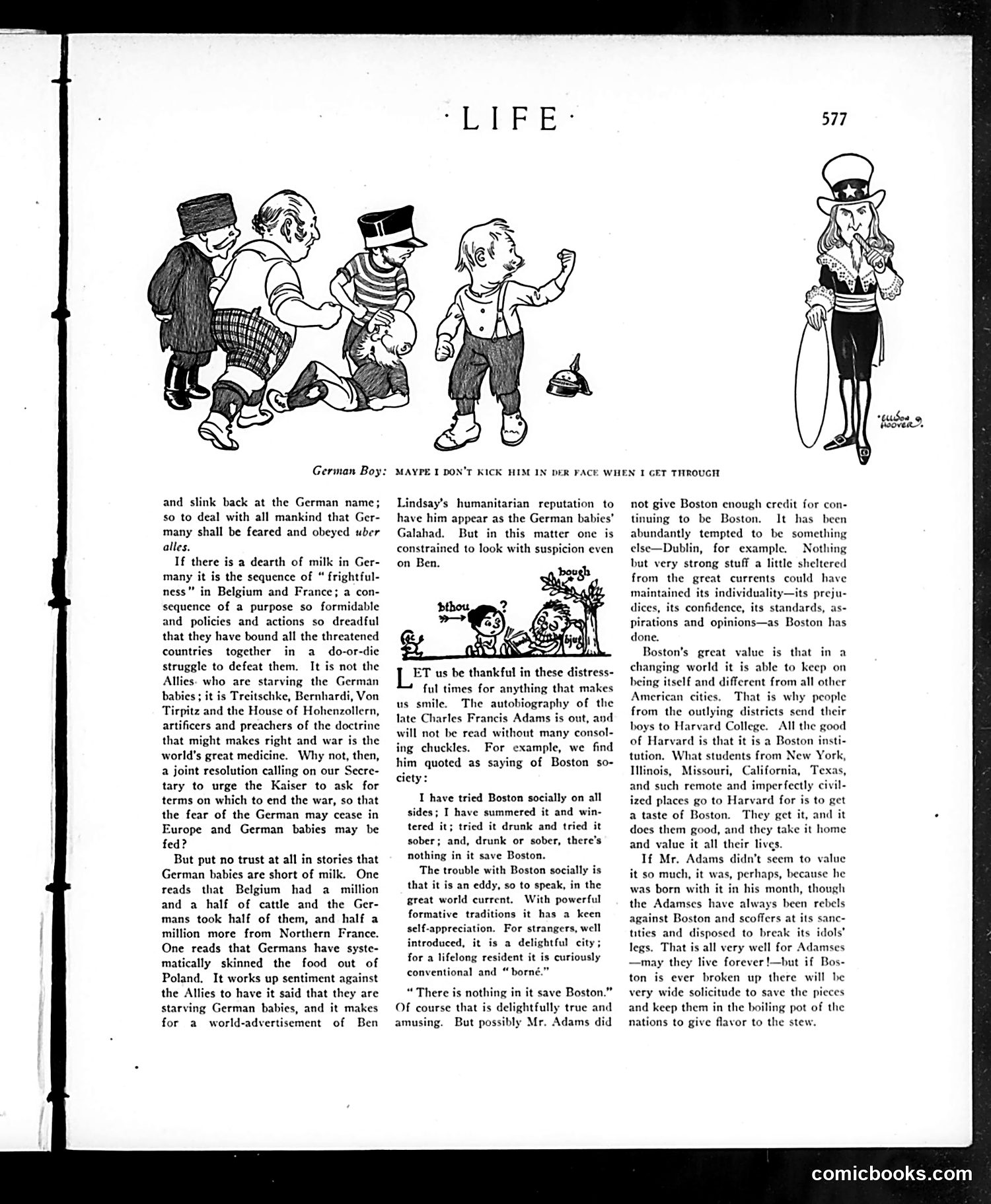
This page contains two distinct pieces of satirical commentary: **Top Cartoon:** Depicts a German boy among other children with the caption "Maybe I don't kick him in der face when I get through." This is anti-German propaganda from World War I, playing on American anxieties about German militarism and aggression. The cartoon satirizes claims of German suffering (starving babies) by suggesting German culture itself—represented by thinkers like Treitschke and Von Tirpitz—is responsible for the war's devastation. **Boston Essay:** The main text discusses Charles Francis Adams's autobiography, quoting his dismissal of Boston society as having "nothing in it save Boston." The author defends Boston's value as a unique, self-preserving American institution that maintains its identity despite pressure to modernize. It argues Boston's insularity—its "eddy" status removed from world currents—is precisely what makes it valuable, especially for Harvard College's formative influence on students from across America. Both pieces reflect early 20th-century American cultural concerns: wartime jingoism and provincial pride in established institutions.
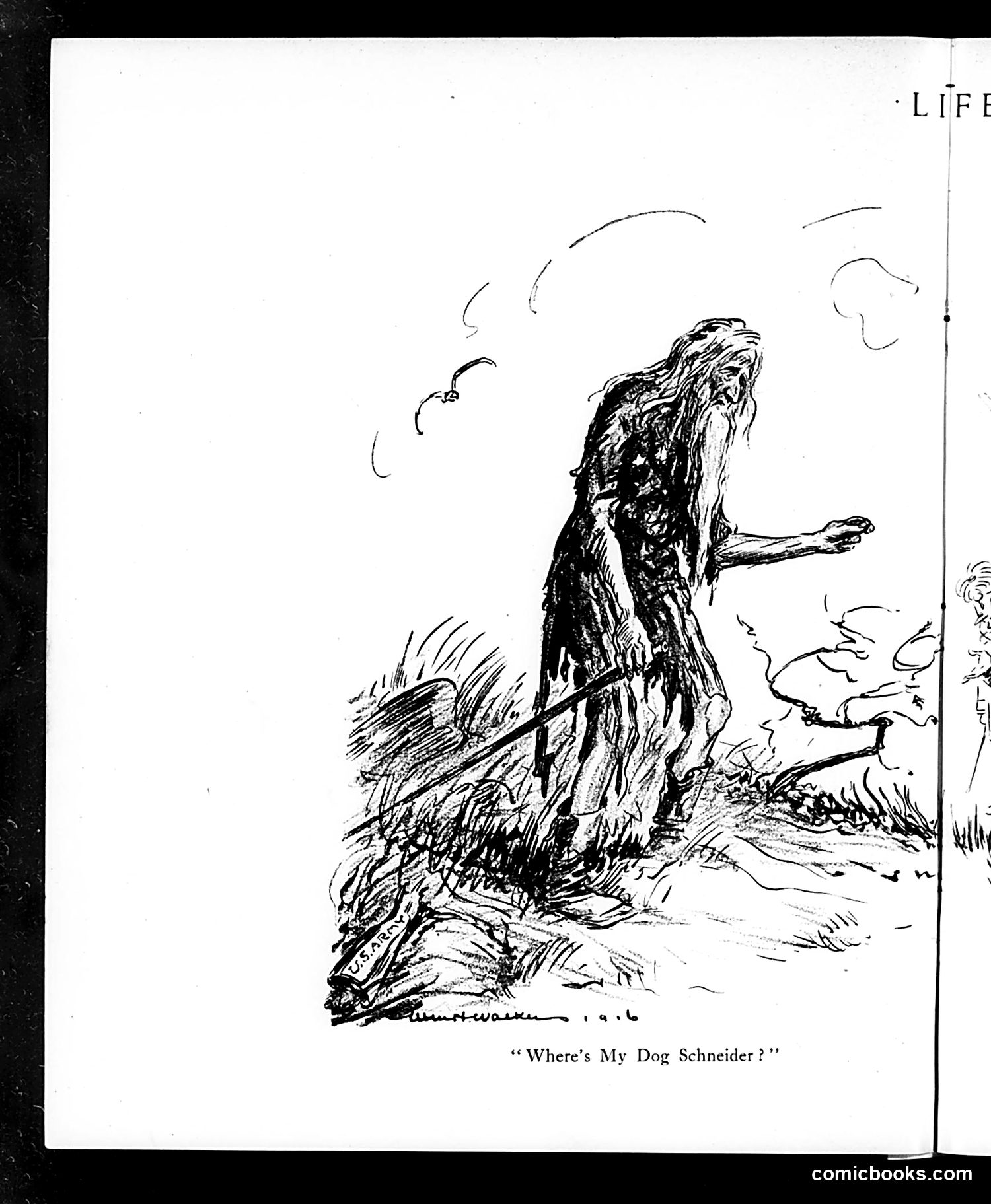
This cartoon depicts an elderly, disheveled figure gesturing frantically and asking "Where's My Dog Schneider?" The drawing style and signature suggest early 20th-century origin from *Life* magazine. The cartoon appears to be a satirical reference to a contemporary person or public figure, likely someone known for a pet dog named Schneider. Without additional context from the magazine's date or surrounding articles, I cannot definitively identify who this figure represents or what specific event or scandal prompted the joke. The humor seems to rely on the reader's recognition of the person and their lost dog—a topical reference that would have been readily understood by *Life's* contemporary audience but requires historical knowledge to fully interpret today.
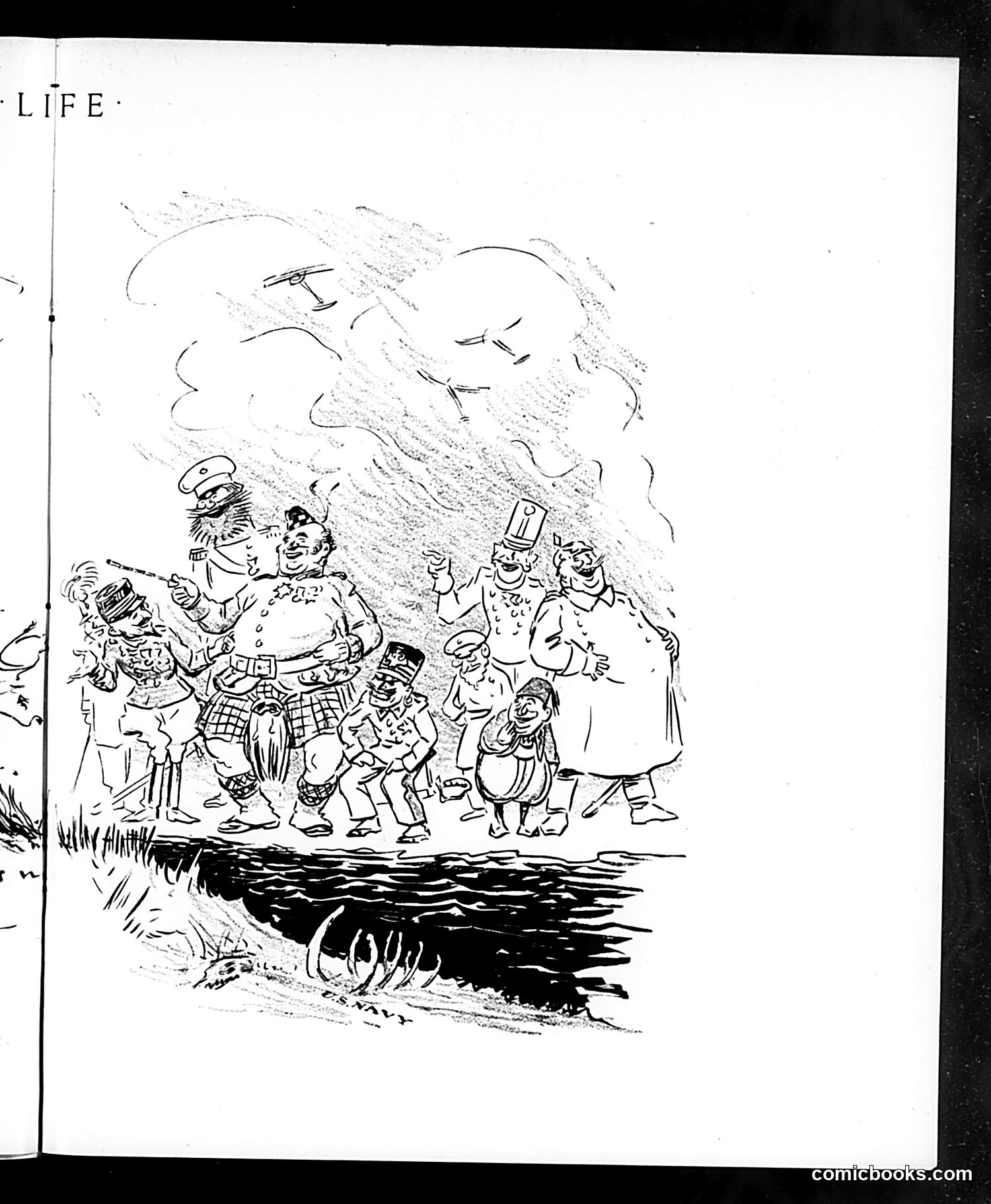
This page from *Life* magazine shows a satirical cartoon depicting a group of figures in period costume (appearing to be 19th century) gathered near a dark body of water. The figures wear various hats and formal attire, holding what appear to be documents or certificates. The cartoon seems to satirize politicians or officials engaged in some form of ceremonial or bureaucratic activity. The contrasting imagery—formal, well-dressed figures against the dark, murky water below—suggests irony or critique. However, without additional context, captions, or visible text identifying specific political figures or events, the precise satirical target remains unclear. The cartoon likely commented on contemporary political practices or public figures of *Life*'s publication era, but determining which requires additional historical documentation.
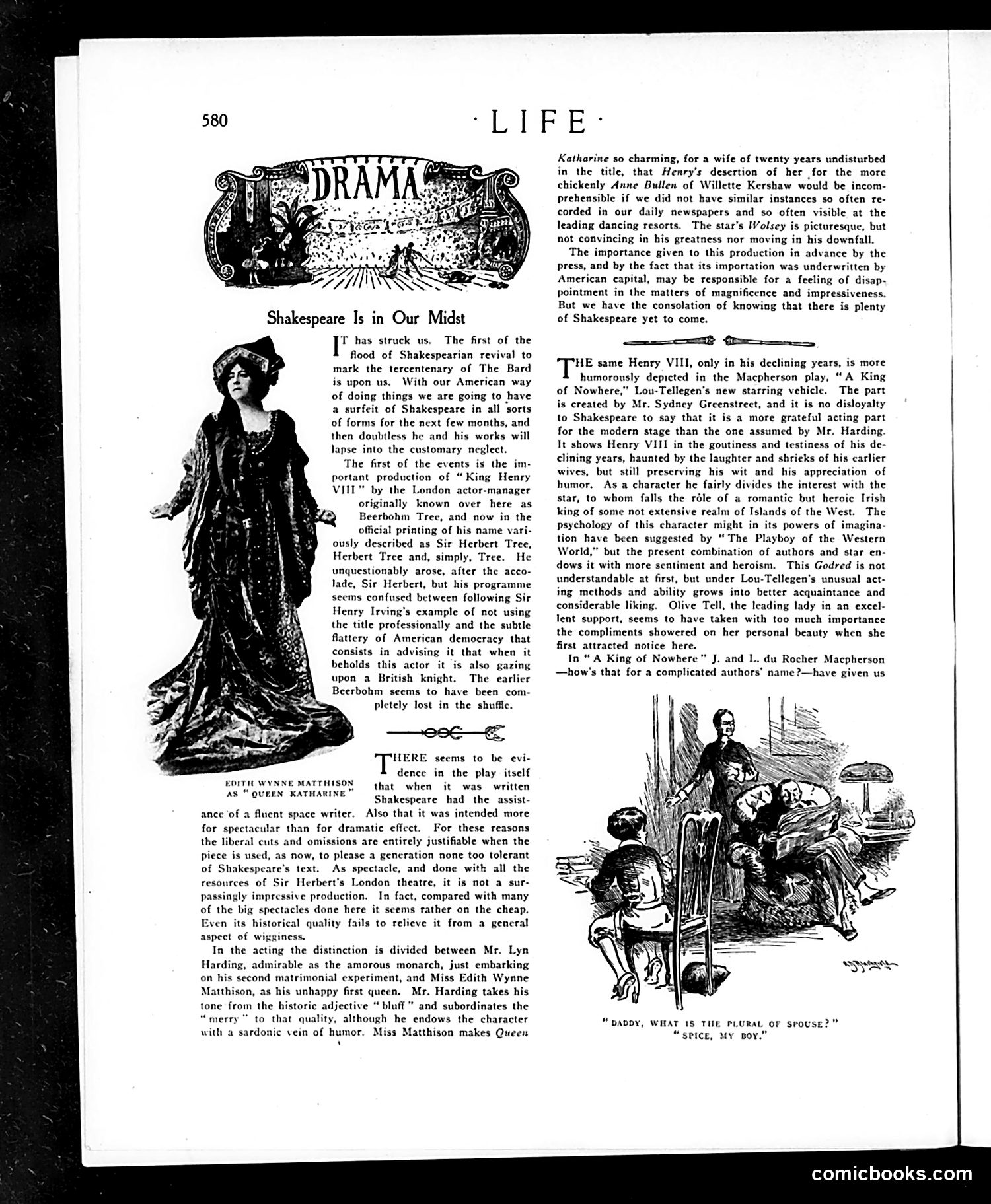
This page reviews two competing 1916 Henry VIII theatrical productions marking Shakespeare's tercentenary. The main critique concerns Sir Herbert Beerbohm Tree's London import of "King Henry VIII"—a lavishly staged but ultimately disappointing spectacle. The reviewer praises actors Lyn Harding (as Henry) and Edith Wynne Matthison (as Queen Katharine) but finds the production overwrought and historically "wiggly." The accompanying illustration shows Matthison in costume as Queen Katharine. The page contrasts Tree's production unfavorably with Lou Tellegen's concurrent "A King of Nowhere," which the reviewer considers a more dramatically satisfying interpretation of aging Henry VIII, played by Sydney Greenstreet. The satirical angle targets American over-investment in importing British theatrical prestige during the Shakespeare tercentenary celebration.
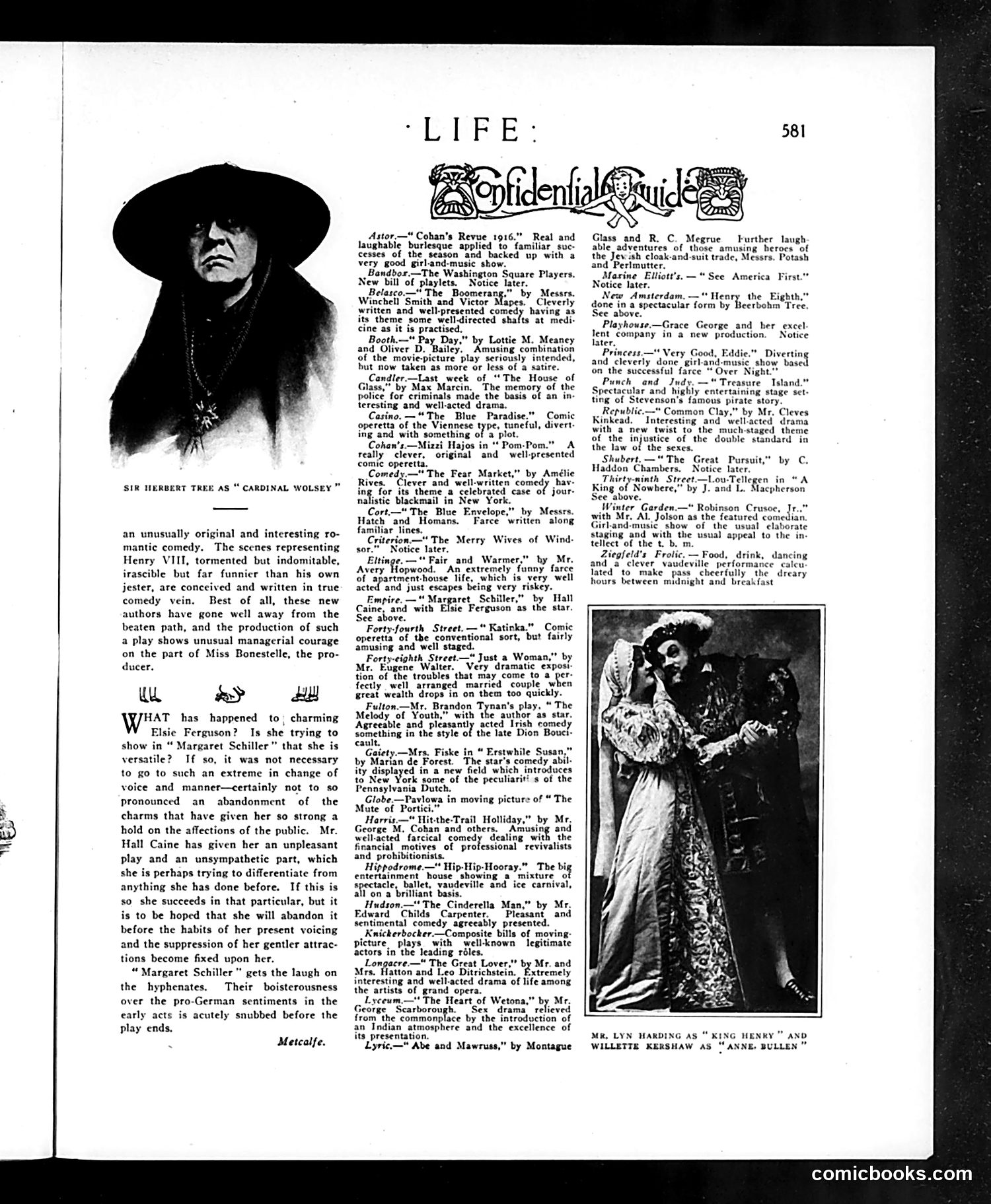
This page from Life magazine contains theater reviews discussing Broadway productions from 1916. The left side features a portrait photograph of Sir Herbert Tree as "Cardinal Wolsey," a Shakespearean character role. The main critical commentary addresses actress Elsie Ferguson's performance in "Margaret Schiller," where the reviewer expresses concern that she has adopted an unpleasant voice and manner to demonstrate versatility. The critic hopes she will abandon these affectations before they become habitual, suggesting her appeal lies in her natural charm rather than dramatic range. A notable satirical jab targets "Margaret Schiller" itself: the reviewer notes the play mocks "hyphenates"—apparently German-American sympathizers—by ridiculing their pro-German sentiments in early acts. This reflects the anti-German sentiment prevalent in America during World War I (1914-1918), before U.S. entry in 1917. The remainder consists of capsule reviews of other Broadway shows, including comedies, operettas, and farces typical of the 1916 theatrical season.
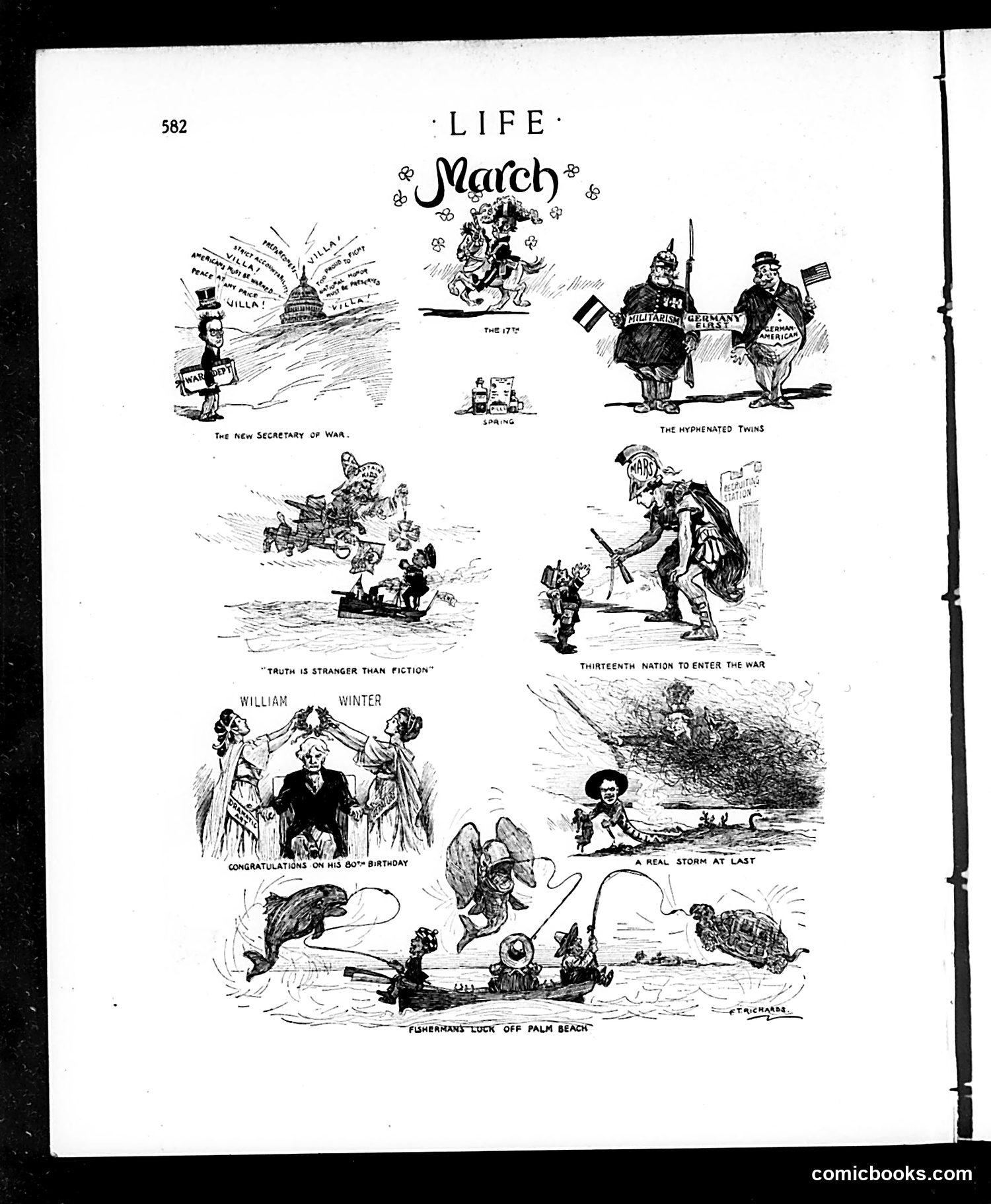
This page presents WWI-era political cartoons satirizing American neutrality and international tensions. "The New Secretary of War" depicts a bewildered figure amid chaos—likely critiquing U.S. military preparedness. "The Hyphenated Twins" shows figures labeled "Militarism" and "Germany" as mirror images, mocking German-Americans' divided loyalties. "Thirteenth Nation to Enter the War" shows Uncle Sam being drawn into conflict. "Truth is Stranger Than Fiction" depicts war's chaotic reality. "William Winter" (likely the cartoonist crediting himself) congratulates someone on their birthday. "A Real Storm at Last" and "Fisherman's Luck off Palm Beach" appear to be lighter satirical pieces about weather and leisure, possibly social commentary on privileged Americans' detachment from wartime concerns. The overall theme critiques American neutrality politics and the inevitability of war involvement.
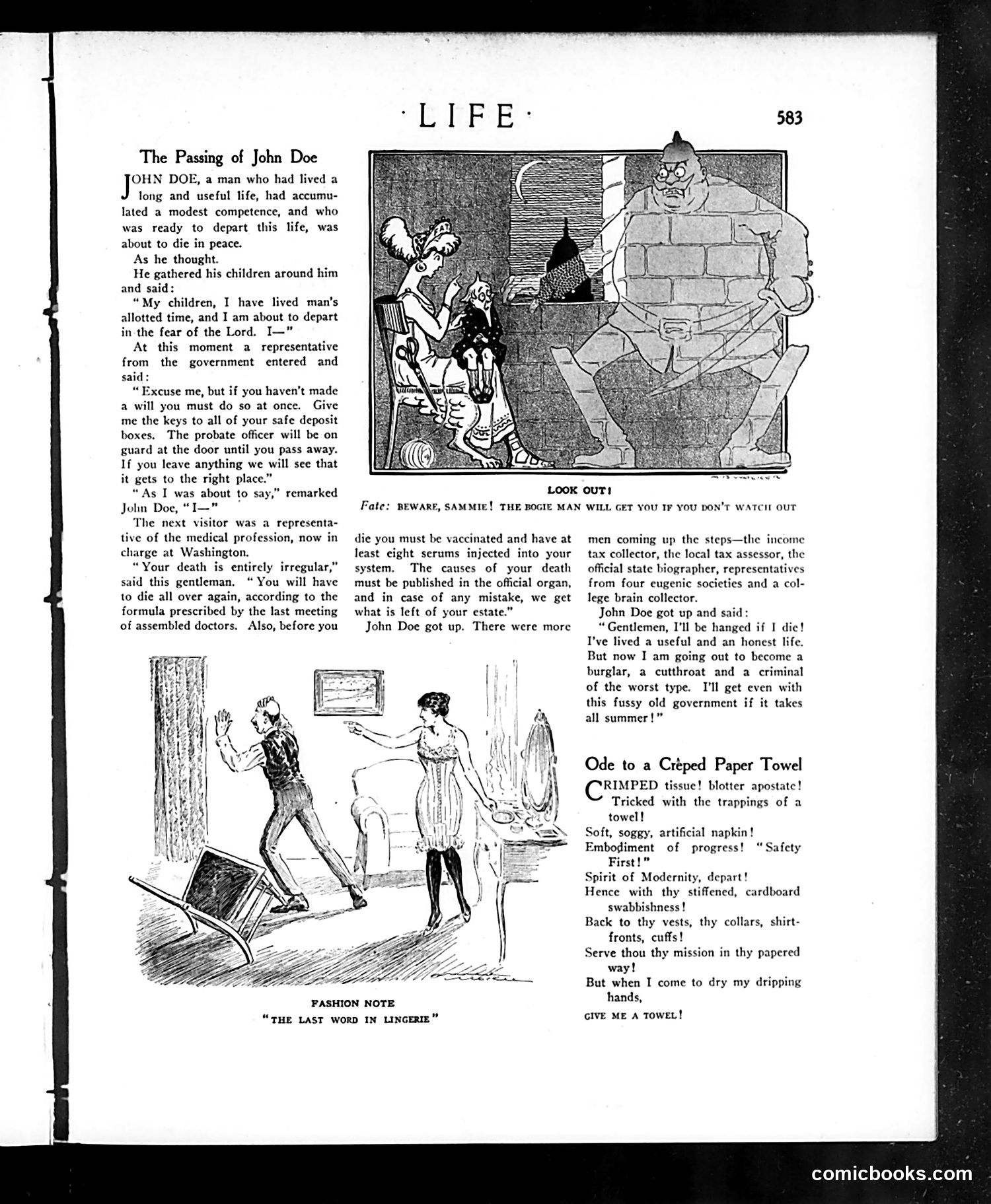
This cartoon mocks early 20th-century American bureaucratic expansion. An elderly man named John Doe, ready to die peacefully, is interrupted by successive government officials: a probate officer seizing his assets, a medical representative imposing vaccination and autopsy requirements, an income tax collector, a state biographer, and eugenics society representatives—each demanding control over his death. The joke: faced with such invasive government intrusion into his most private moment, John Doe abandons his honest life and declares he'll become a criminal instead, figuring he might as well "get even" with this "fussy old government." The satire targets Progressive Era reforms—mandatory vaccination, income taxation, medical regulation, and eugenic pseudoscience—portraying them as collectively suffocating individual liberty. The cartoon argues that excessive government intervention drives law-abiding citizens toward lawlessness.
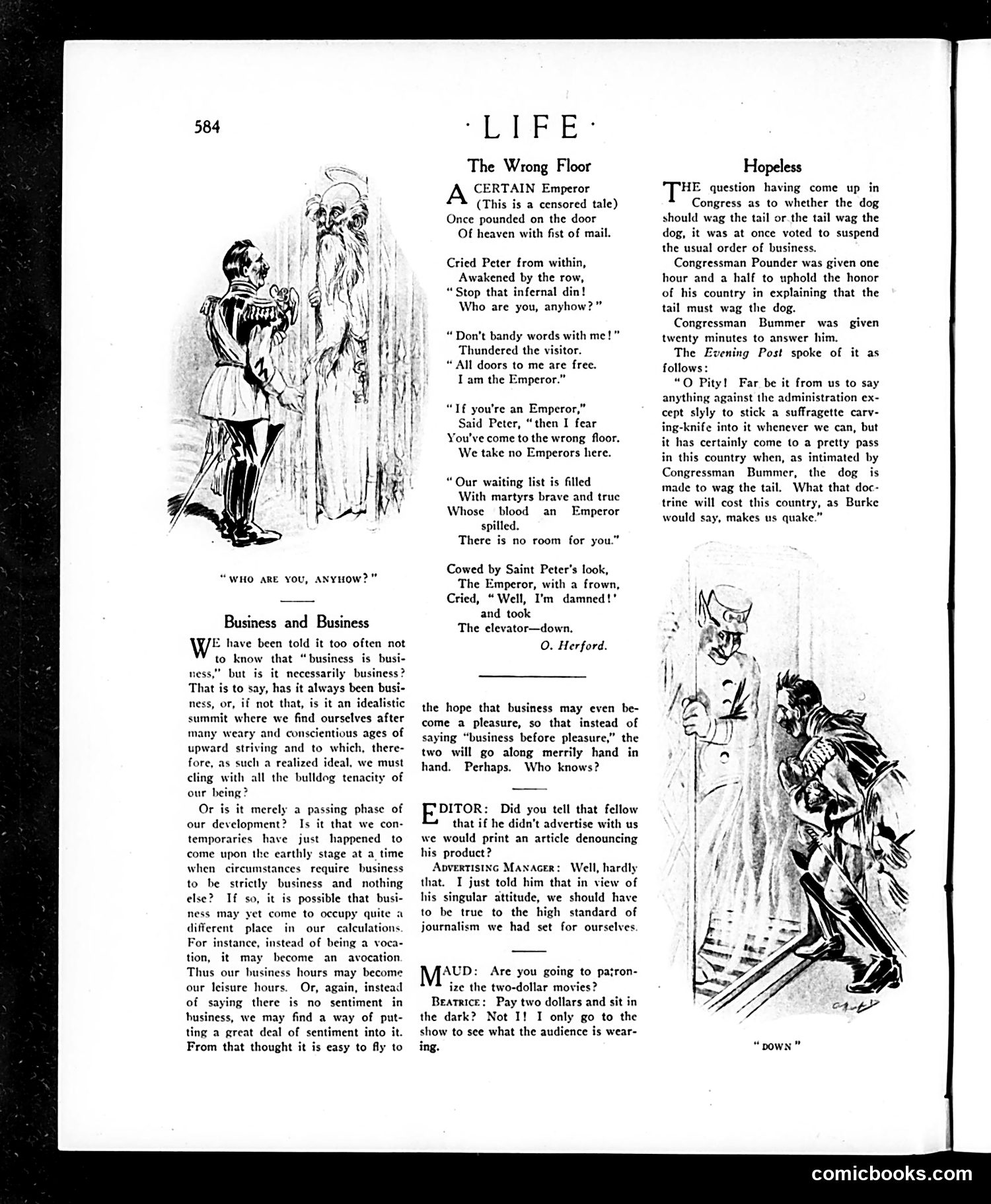
**"The Wrong Floor"** is a religious allegory criticizing imperial power. An Emperor pounds on heaven's door but Saint Peter turns him away—heaven's waiting list is full of martyrs killed by emperors. The Emperor, accustomed to unlimited authority ("all doors to me are free"), is humbled and damned to the elevator down. This satirizes the notion that worldly power and tyranny have no place in the afterlife, inverting earthly hierarchies. **"Business and Business"** is a philosophical essay questioning whether cut-throat capitalism ("business is business") is inevitable or merely a temporary phase. The author suggests sentiment and pleasure might someday coexist with business rather than opposing it—an idealistic critique of ruthless Industrial Age economics. **"Hopeless"** mocks congressional absurdity: Congress suspends business to debate whether a dog wags its tail or the tail wags the dog—an obviously pointless question. The satirical newspaper editorial exaggerates this triviality while sneering at government incompetence, typical of *Life's* political humor.
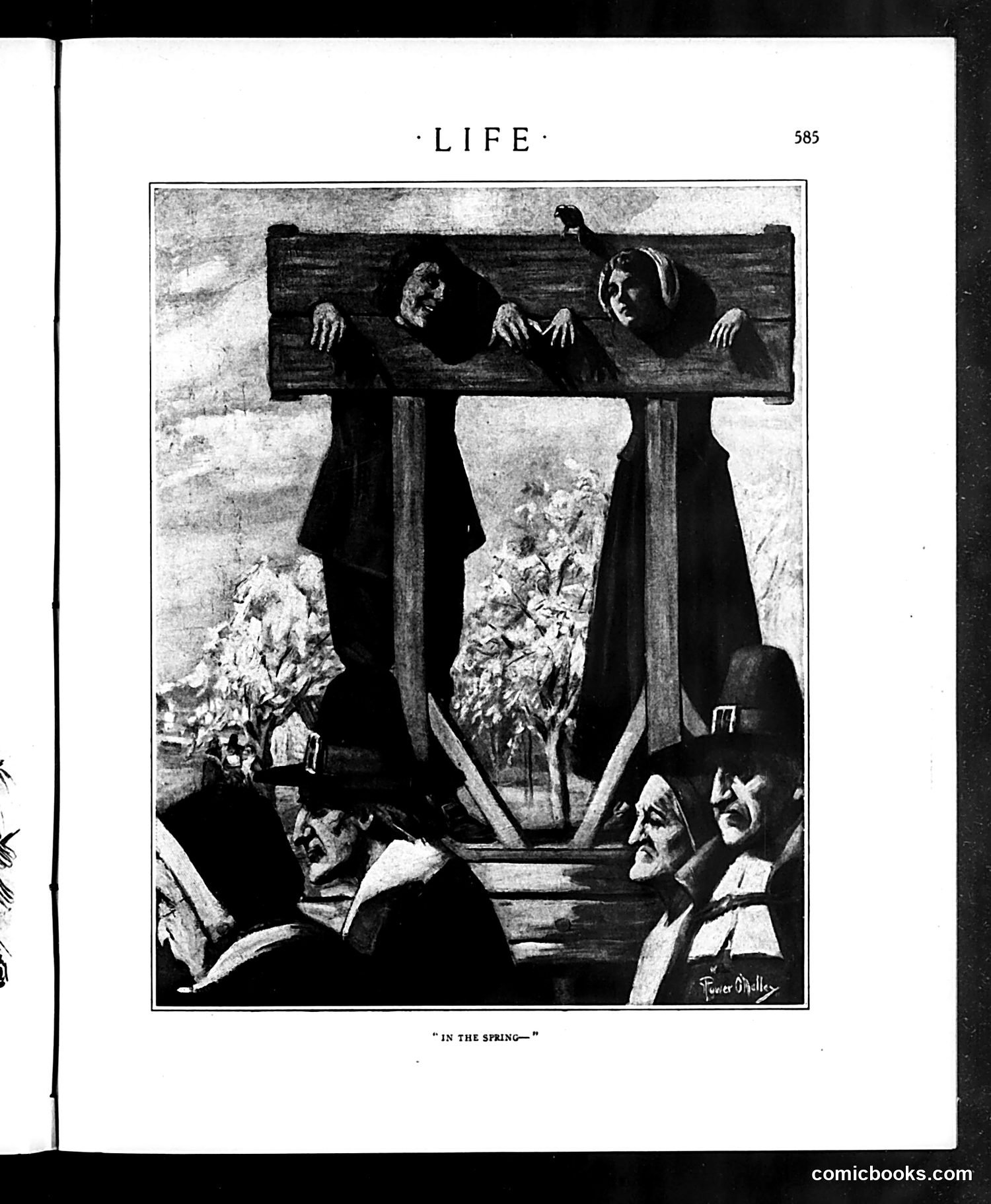
This satirical cartoon depicts a gallows with three executed figures displayed in the crossbeam, while observers below—appearing to be working-class men—watch the scene. The title "In the Spring—" suggests seasonal renewal, but the image inverts this optimistic notion by showing death and execution. The cartoon likely critiques capital punishment or class-based justice, using the gallows as a symbol of state violence. The contrast between the cheerful season and the grim spectacle emphasizes the satire. The artist (signed "Fewer Helly") appears to be commenting on social inequality—the distinction between the executed and the witnessing spectators suggests commentary on who bears the consequences of the law versus who administers it. Without additional context, the specific historical event or individuals referenced remains unclear.
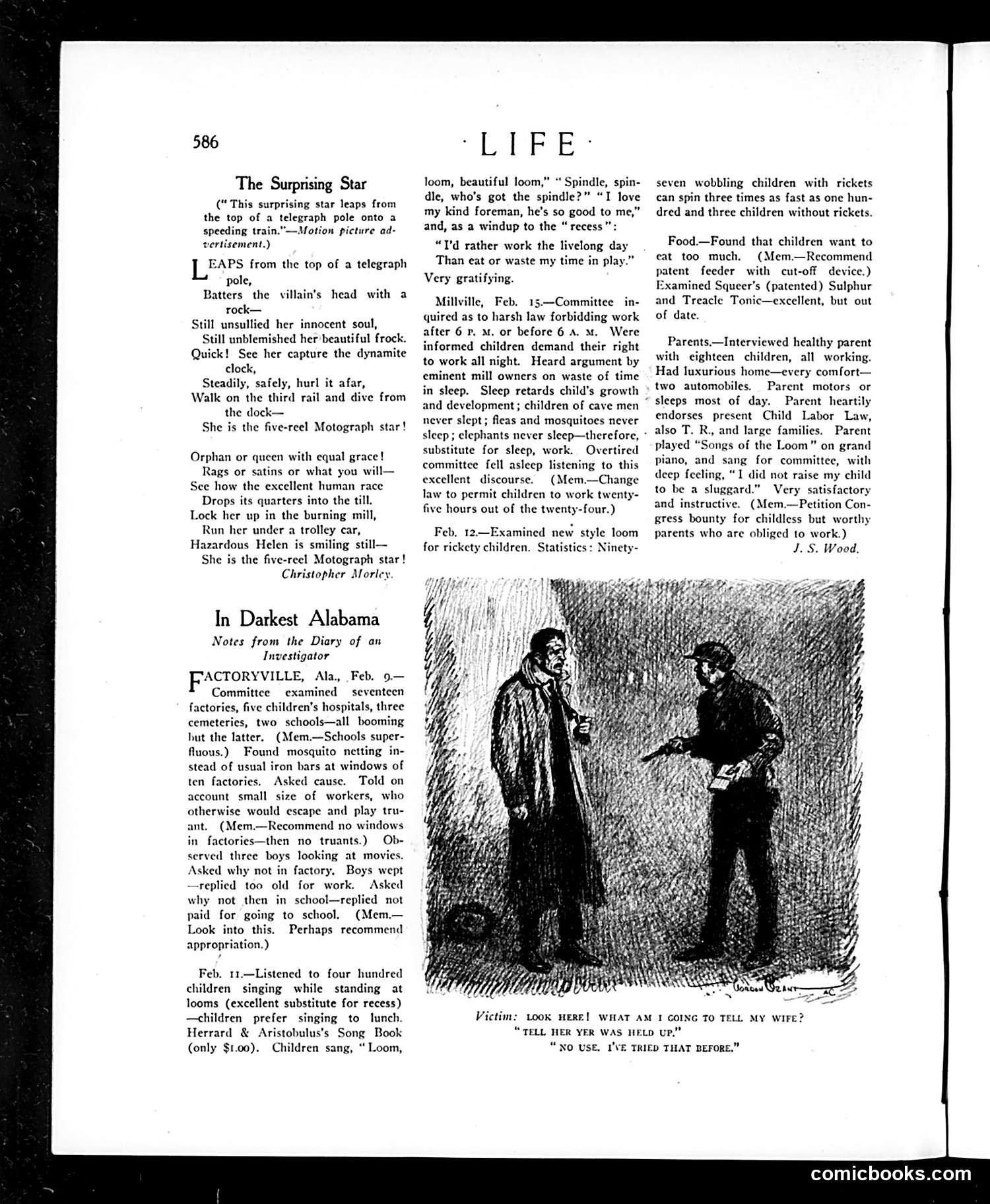
**"The Surprising Star"** satirizes melodramatic silent films, mocking their absurd plots where heroines perform increasingly dangerous stunts (leaping from telegraph poles, escaping burning mills, surviving trolley cars) while remaining pristine. The poem ridicules how audiences pay money to watch these implausible scenarios, while the female star endures abuse for entertainment. **"In Darkest Alabama"** is brutal satire of child labor conditions and the rationalizations used to justify them. An investigator documents a factory town where children work in mills instead of attending school, and mill owners argue children *prefer* work to rest or food. The "committee" proposes absurd "solutions" (no windows to prevent truancy, eliminating sleep). The final note about a wealthy parent with eighteen working children driving automobiles exposes how owners profit while children suffer. **The cartoon** shows a robbery victim unable to tell his wife he was robbed because he's used that excuse before—implying habitual victimization or dishonesty. The page critiques both entertainment exploitation and industrial child abuse as moral failures.
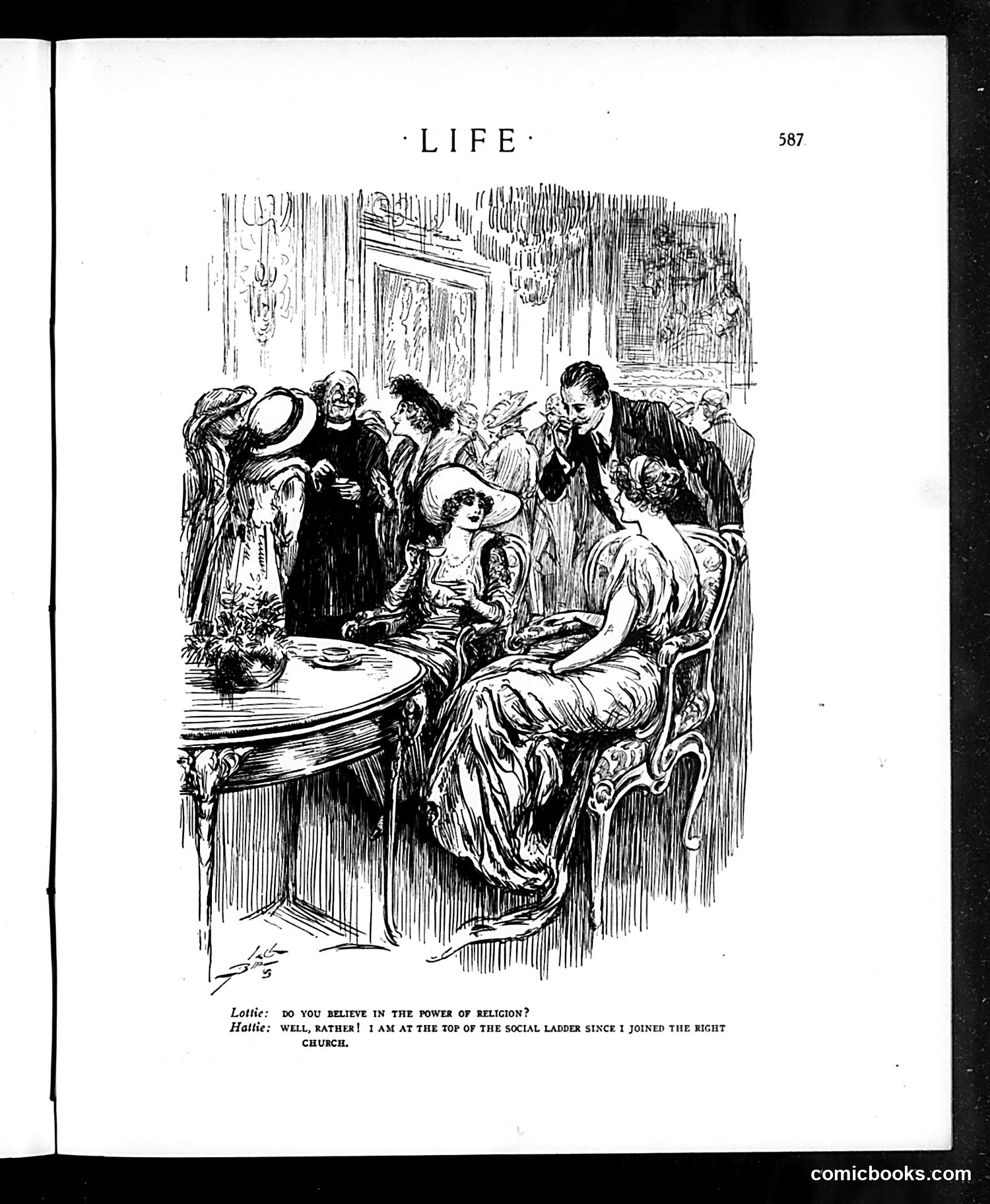
This *Life* magazine cartoon satirizes social climbing through religious affiliation. Two fashionably dressed women sit at a table in what appears to be an elegant social gathering. One woman (Lottie) asks another (Hallie) whether she believes in religion's power. Hallie responds that she doesn't particularly believe, but has joined "the right church" because it's put her "at the top of the social ladder." The satire targets the hypocrisy of using religious membership purely for social advancement rather than genuine faith. The elegant setting and fashionable dress emphasize that this is about upper-class social positioning. The cartoon mocks those who view church attendance as a status symbol or networking opportunity rather than a spiritual commitment.
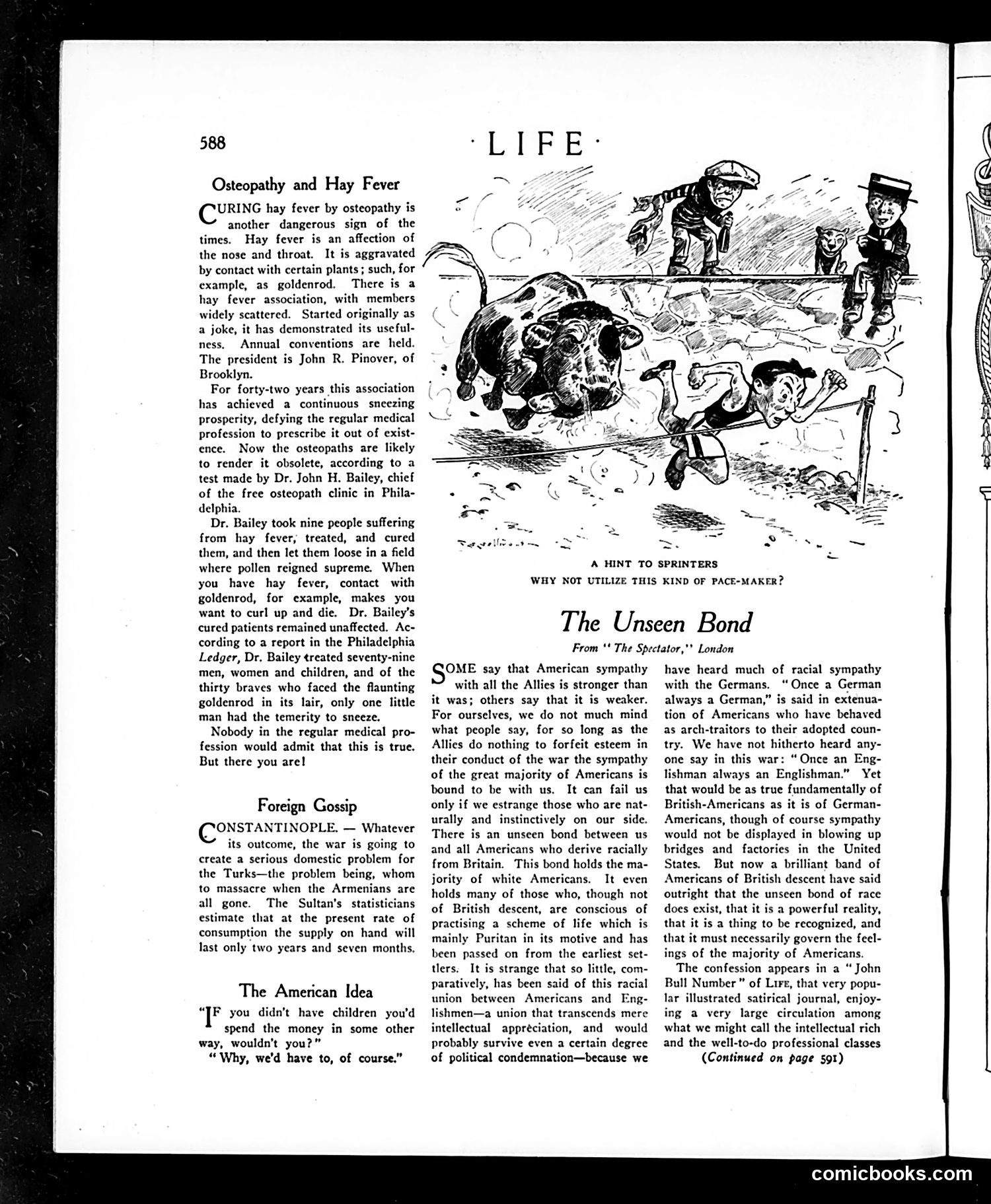
This page contains three distinct pieces of social commentary: **"Osteopathy and Hay Fever"**: Satirizes medical quackery, mocking osteopaths' claims to cure hay fever when orthodox medicine cannot. The text expresses skepticism that Dr. Bailey genuinely cured hay fever patients. **"A Hint to Sprinters" cartoon**: The illustration shows a horse-drawn cart racing with men clinging to it as a "pace-maker." This is visual satire about sprinting techniques, likely mocking an absurd athletic training method. **"The Unseen Bond"** (reprinted from London's *Spectator*): Wartime commentary (WWI context evident) arguing that Americans share an ethnic/racial bond with Britain that naturally aligns them with the Allies. It references German-Americans' loyalty questions while asserting Anglo-American cultural continuity from Puritan settlers. This reflects period racial ideology and pro-British propaganda aimed at American sympathy during the war. The page reflects early-20th-century American attitudes: skepticism toward alternative medicine, casual satire of physical culture, and racialized arguments about national allegiance.
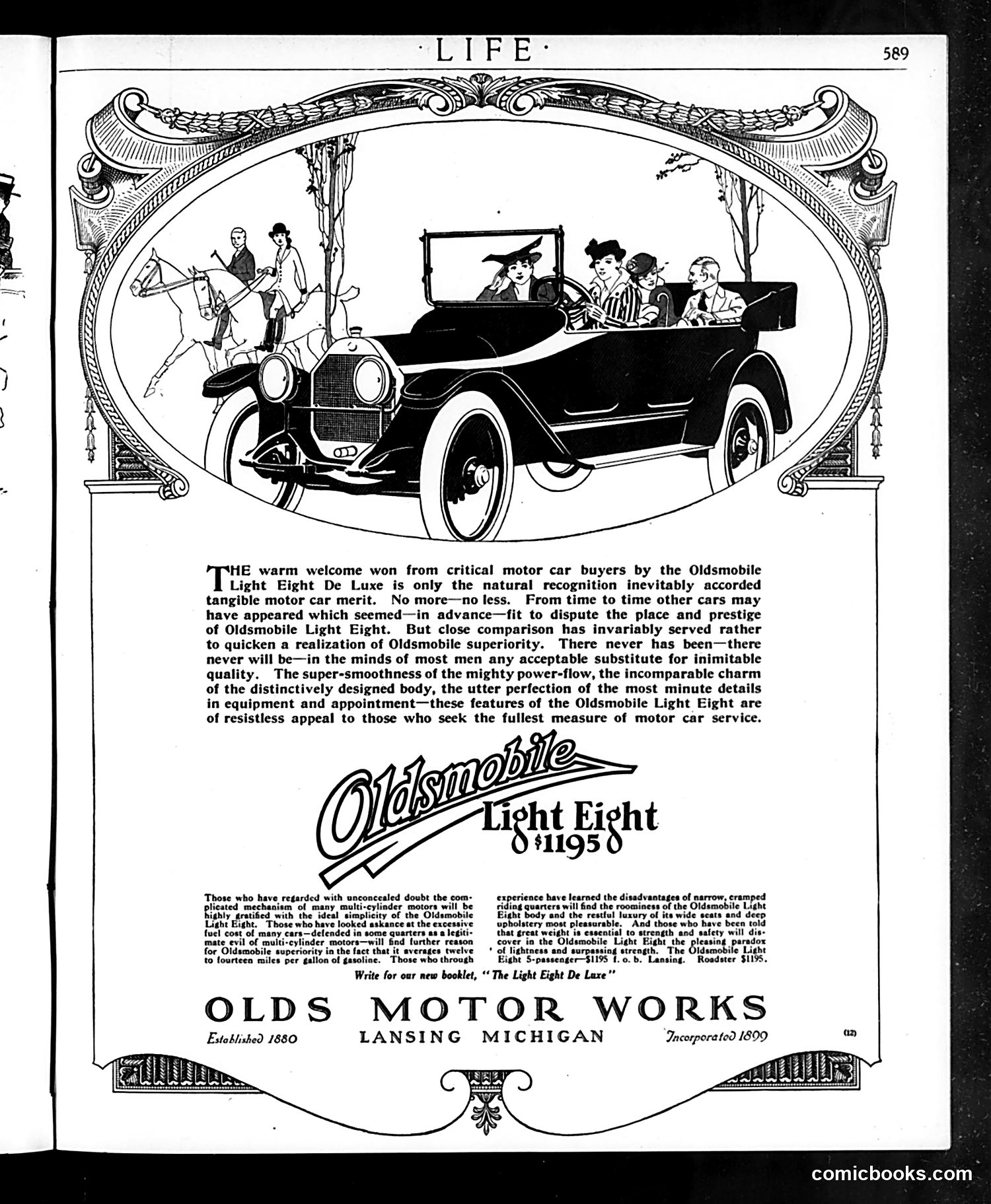
This page is **primarily an automobile advertisement**, not a political cartoon. It appeared in *Life* magazine (page 589) and promotes the Oldsmobile Light Eight De Luxe. The illustration shows a stylized 1920s car with well-dressed passengers, contrasted with horseback riders in the background—a visual metaphor suggesting the automobile's superiority over outdated transportation. The advertisement's rhetoric emphasizes quality, smoothness, and reliability, positioning the Oldsmobile against unnamed competitors ("other cars may have appeared"). The copywriting employs superlatives ("inimitable quality," "resistless appeal") typical of early 20th-century advertising. The price ($1195) and manufacturing details (Lansing, Michigan; established 1880) ground the pitch in legitimacy and American manufacturing heritage. **For modern readers**: This represents pre-Depression consumer marketing aimed at middle-class buyers, using aspirational imagery and competitive claims to justify premium pricing—advertising conventions still recognizable today, though the car itself is now a historical artifact.
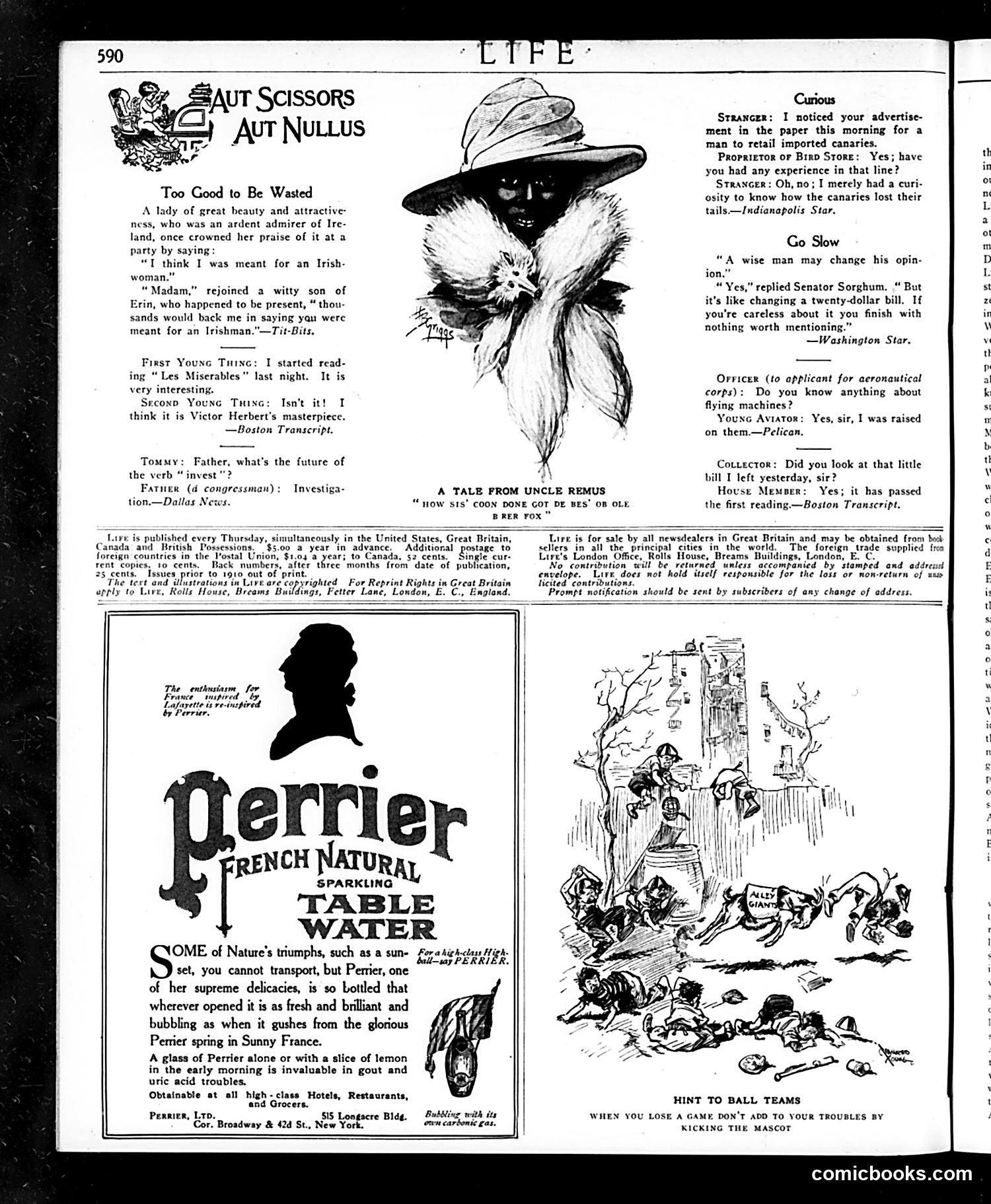
This page from *Life* magazine contains humor pieces and advertisements typical of early 20th-century satirical journalism. The **"Aut Scissors / Aut Nullus"** section features brief comic exchanges. "Too Good to Be Wasted" mocks Irish stereotypes through a lady praising Ireland, with a witty Irishman retorting she's "meant for an Irishman" as an insult. Other jokes target common targets: a bird-store owner selling tailless canaries, Senator Sorghum's complaint about changing opinions like defaced currency, and a congressman defining "invest" as "investigation"—likely satirizing political corruption or wasteful spending. **"A Tale from Uncle Remus"** references the famous Joel Chandler Harris folk tales featuring African American characters in dialect, popular but now recognized as deeply problematic. The **Perrier advertisement** occupies the lower left, promoting French sparkling water as a cure for gout and uric acid. The cartoon at bottom—"Hint to Ball Teams"—shows baseball players abusing their mascot, with text advising against this superstitious practice. The page reflects *Life*'s mix of social satire, period advertising, and casual racism typical of the era.
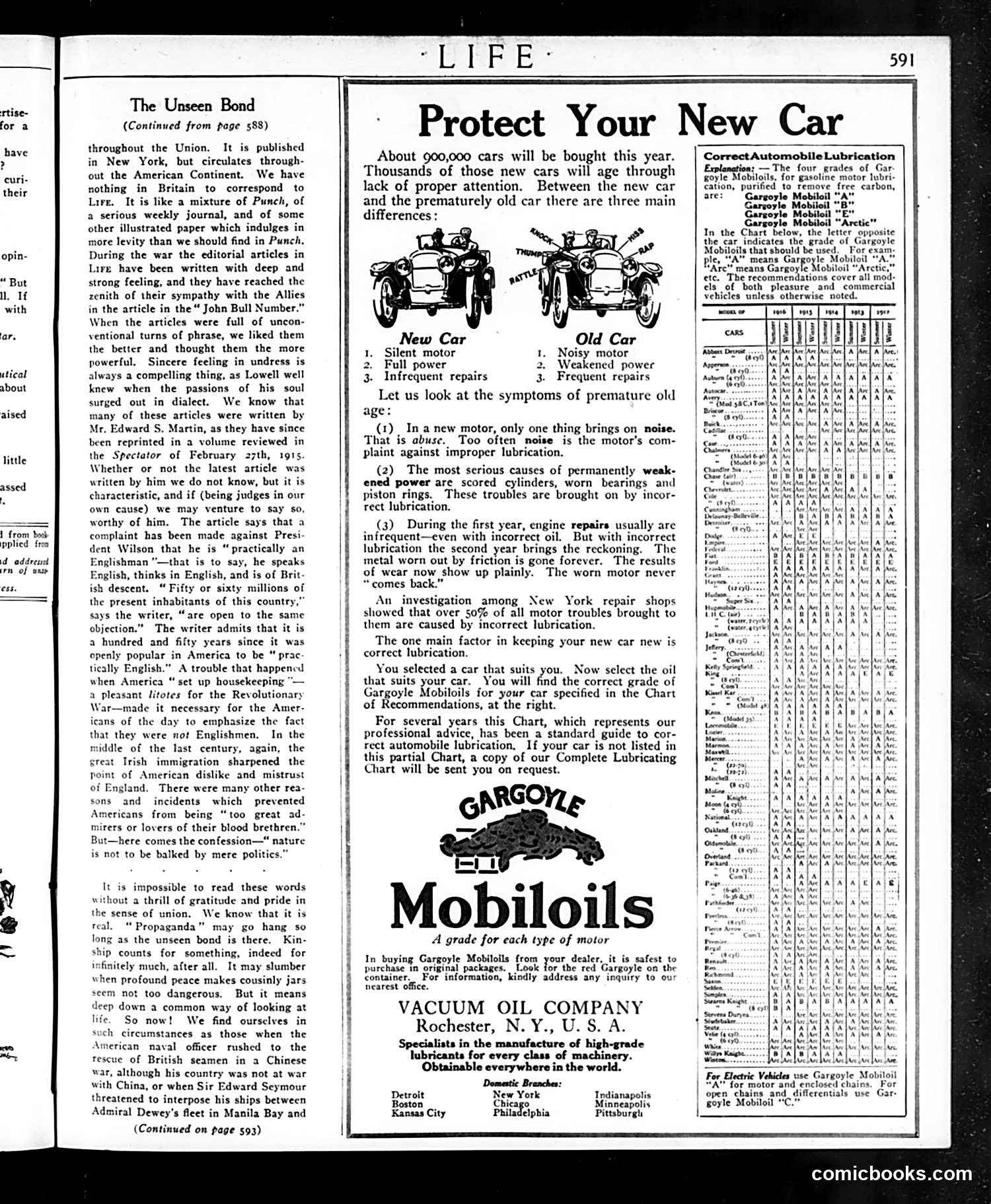
This page contains a continuation of a political article titled "The Unseen Bond" discussing Anglo-American kinship, followed by a full-page advertisement for Gargoyle Mobiloils motor lubricants. **The Article**: The text defends President Wilson against charges of being "practically an Englishman" by arguing that millions of Americans share British heritage and cultural ties. The author suggests that despite historical tensions (the Revolutionary War, Irish immigration), a natural kinship persists between the nations—evidenced by instances like American naval officers aiding British seamen in China. **The Advertisement**: The right side promotes proper car maintenance, specifically correct lubrication, to preserve new automobiles. It includes a comparison chart of "New Car" versus "Old Car" symptoms and recommends Gargoyle Mobiloils products by the Vacuum Oil Company. **Context**: The page reflects early 20th-century American attitudes regarding Anglo-American relations and the importance of proper automobile maintenance during the early motorcar era.
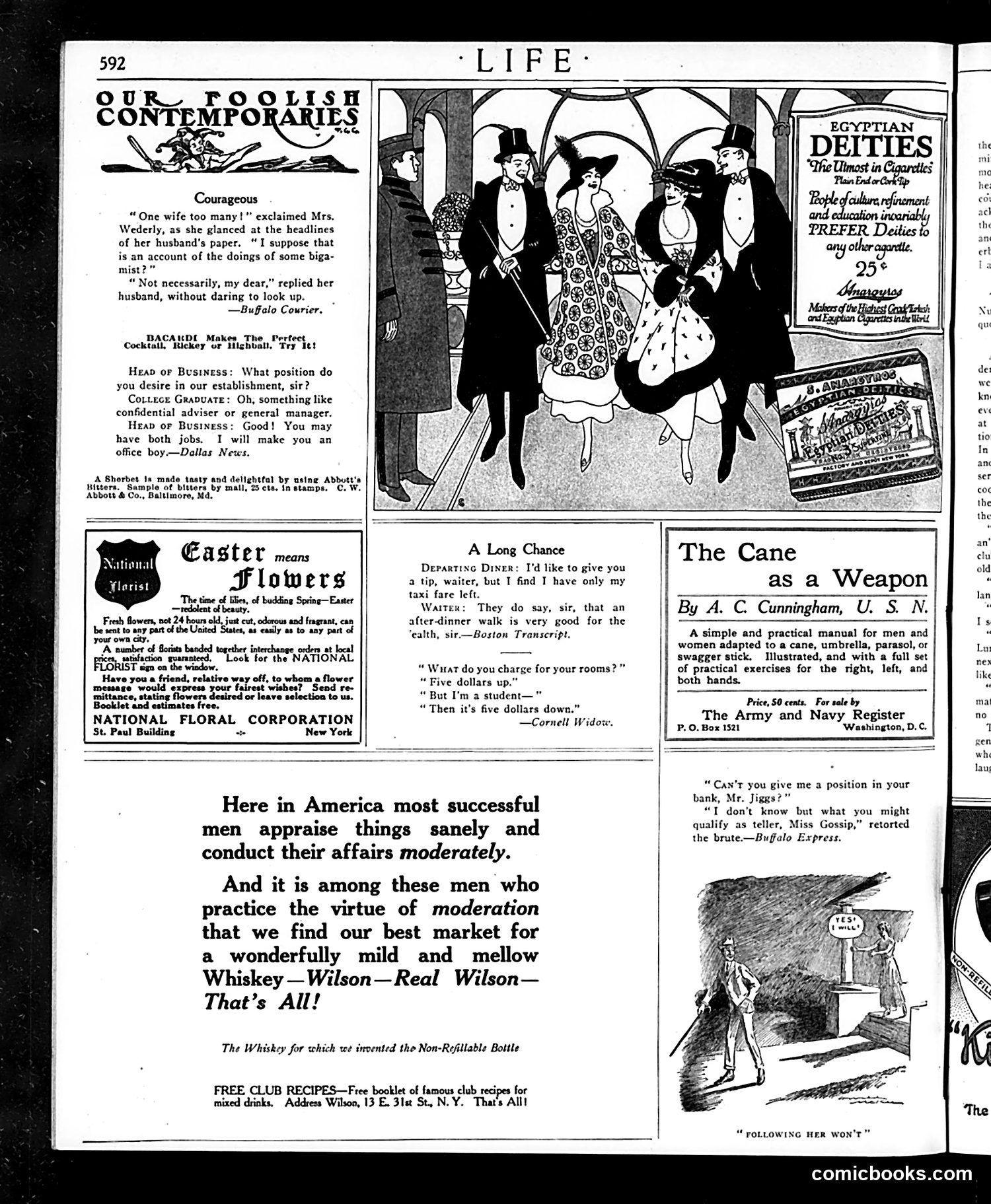
This is primarily a **humor and advertising page** from Life magazine (likely early 20th century, based on style and Prohibition-era whiskey ads). **The Cartoons/Jokes:** The page contains several short humorous anecdotes: 1. A wife sees "one wife too many" in headlines—her husband nervously suggests it's about a bigamist, not him 2. A college graduate applying for jobs gets offered "office boy" despite requesting management positions—satirizing overqualified youth 3. A diner tries tipping with only taxi fare; the waiter sarcastically suggests a walk aids digestion 4. A student balks at five-dollar room rates; told they're "five dollars down" for students **The Advertising:** The page is dominated by ads: flowers, whiskey (Wilson brand, emphasizing "moderation"), a manual on using canes as weapons, and Egyptian cigarettes. **Historical Context:** These brief jokes reflect early 20th-century concerns: class mobility, economic struggle, and gender dynamics. The humor is gentle, observational rather than biting.
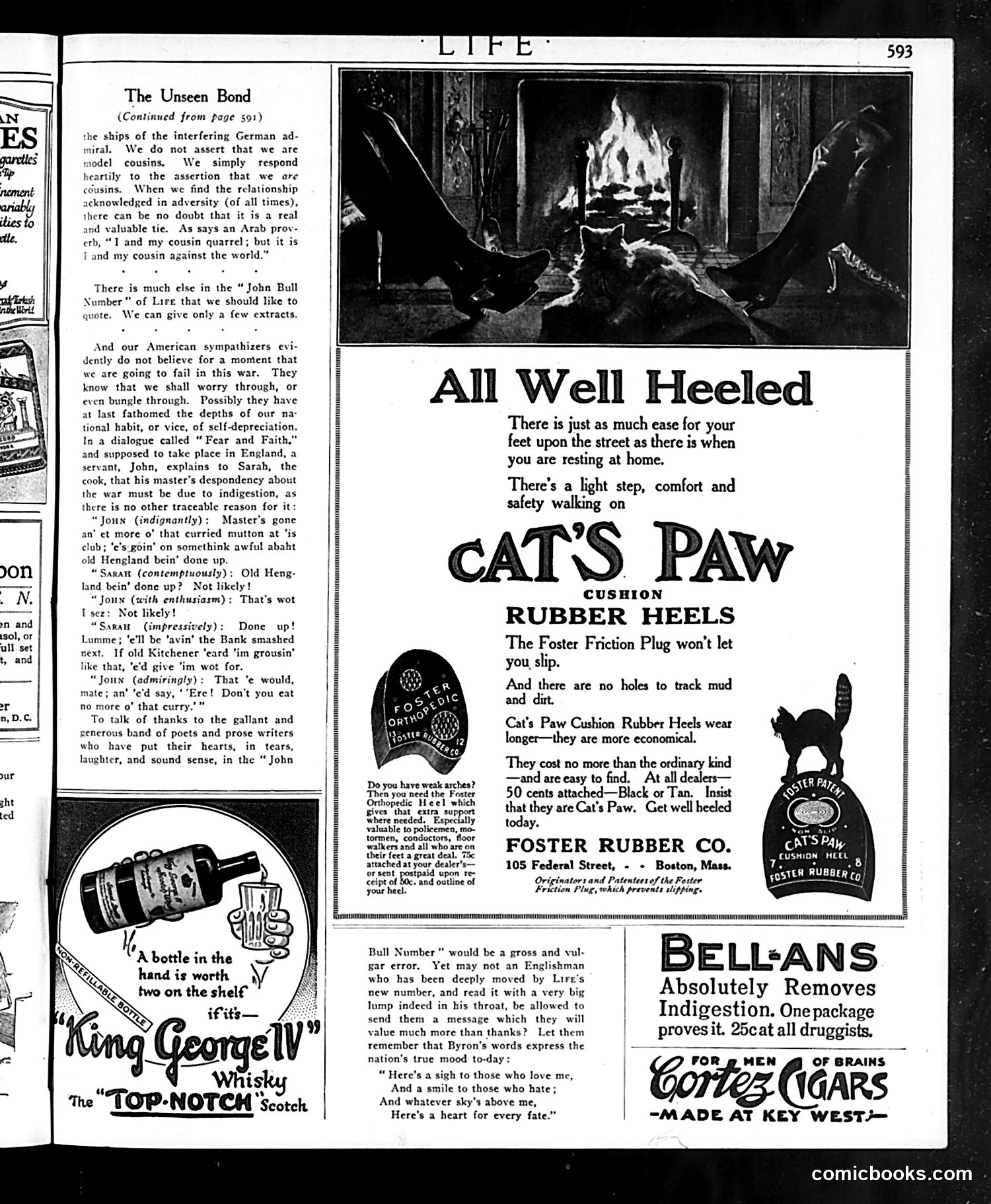
This page is primarily **advertising**, with a secondary essay section titled "The Unseen Bond." The essay discusses Anglo-American relations during World War I, arguing that despite being "quarreling cousins," Britain and America share a genuine bond strengthened by adversity. It quotes an Arab proverb and includes a dialogue between English servants (John and Sarah) where John worries about England's war prospects, but Sarah dismissively attributes his gloom to indigestion rather than legitimate concern—a humorous way of suggesting unfounded pessimism. The advertisements include: - **King George IV Whisky** ("Top-Notch" Scotch) - **Cat's Paw Cushion Rubber Heels** (shoe soles with friction plugs to prevent slipping) - **Bell-ans** (indigestion remedy) - **Cortez Cigars** (made in Key West) The ads and essay's humor both reflect WWI-era American attitudes: confidence in eventual Allied victory and genteel British stoicism about wartime hardships.
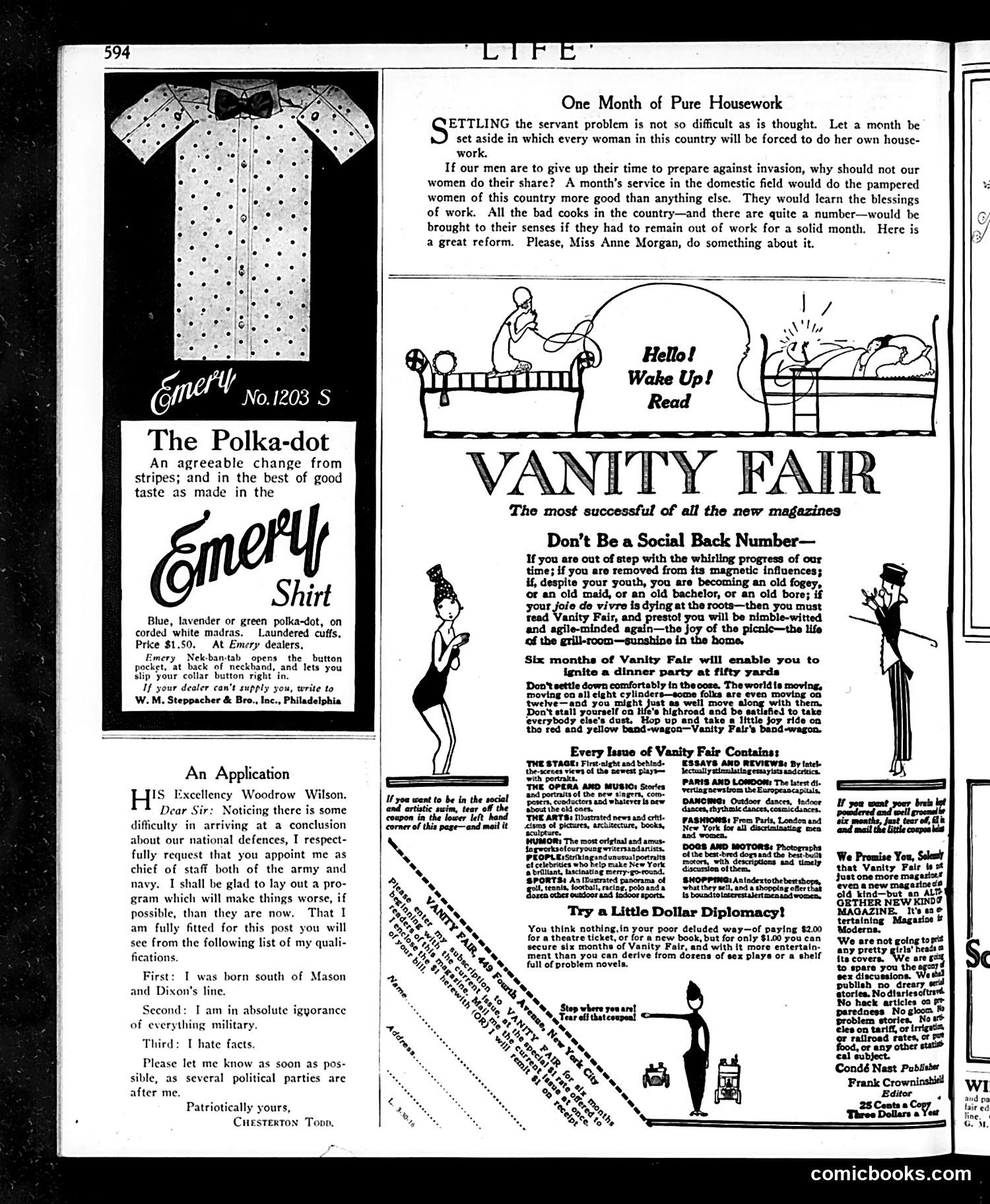
This Life magazine page (page 594) combines satirical opinion pieces with advertising and Vanity Fair magazine promotion. **"One Month of Pure Housework"** argues that privileged women should be forced to do their own housework for a month as a patriotic service—paralleling men's military preparation. The piece sarcastically suggests this would teach them "the blessings of work" and improve bad cooks. This reflects early 20th-century class attitudes: domestic labor was seen as character-building for the wealthy, while servants were viewed as a solvable "problem." **"An Application"** is a humorous letter to President Woodrow Wilson from someone offering himself as military chief of staff—despite being ignorant of military matters, born south of the Mason-Dixon line (implying regional bias), and hating facts. It satirizes unqualified appointees and political patronage systems of the era. Both pieces reflect wartime anxieties (likely WWI period) and satirize privilege, incompetence, and gender expectations typical of Life's comedic approach.
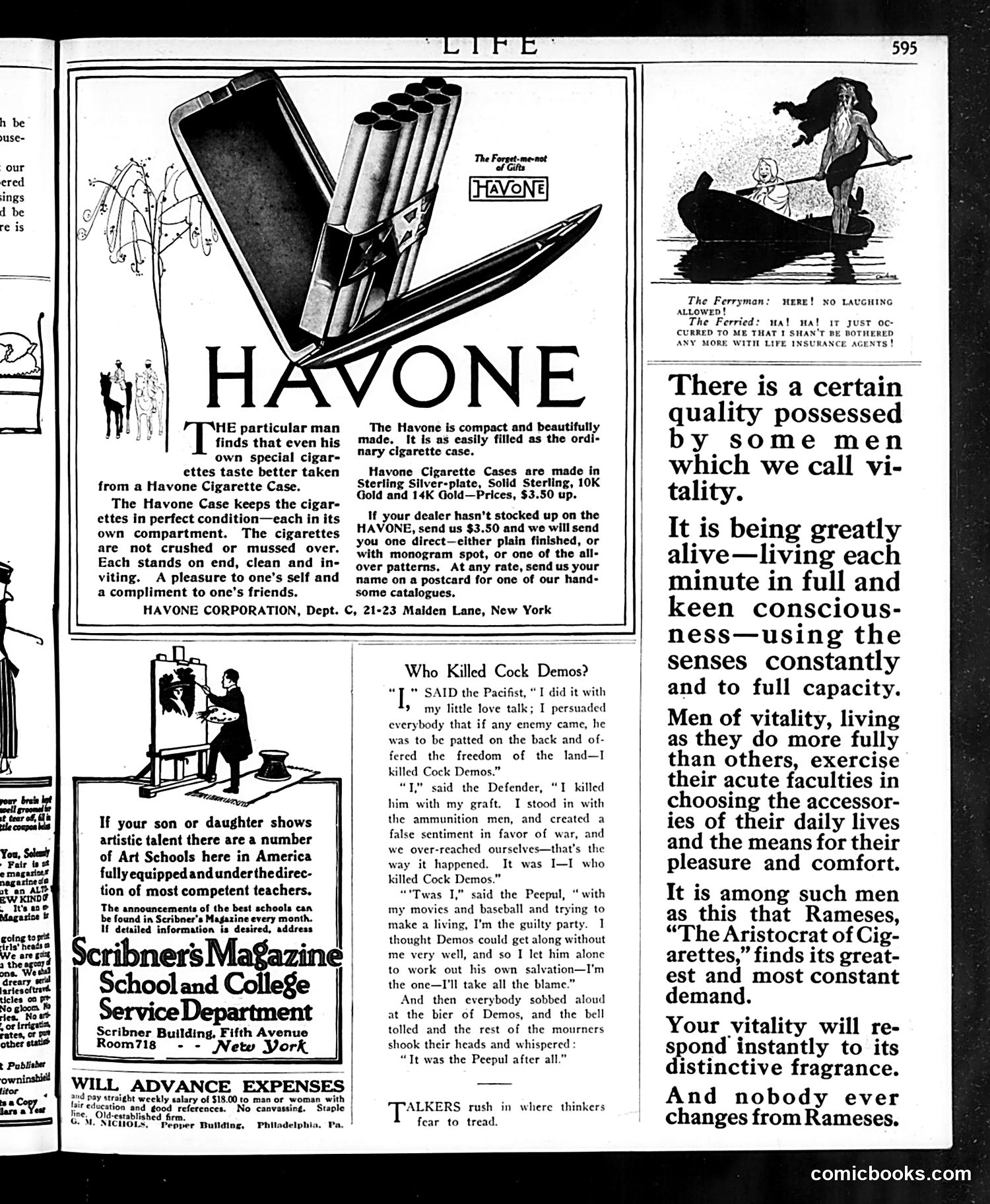
This satirical piece uses a murder mystery structure to critique three forces that Life's editors believed undermined democratic participation ("Cock Demos," or democracy itself) in early 20th-century America. The **Pacifist** claims responsibility through naive idealism—advocating appeasement and non-resistance. The **Defender** represents militaristic corruption, profiteering from war while manipulating sentiment. Most notably, the **Peepul** (common people) accepts blame for apathy and distraction—prioritizing entertainment and survival over civic engagement. The final chorus's ironic conclusion—"It was the Peepul after all"—suggests that ordinary citizens bear ultimate responsibility for democratic decay, whether through passivity or misdirected energies. This reflects post-WWI anxieties about mass culture, war profiteering, and citizen disengagement. The cartoon critiques all parties while implicitly calling for renewed public vigilance and participation in democracy.
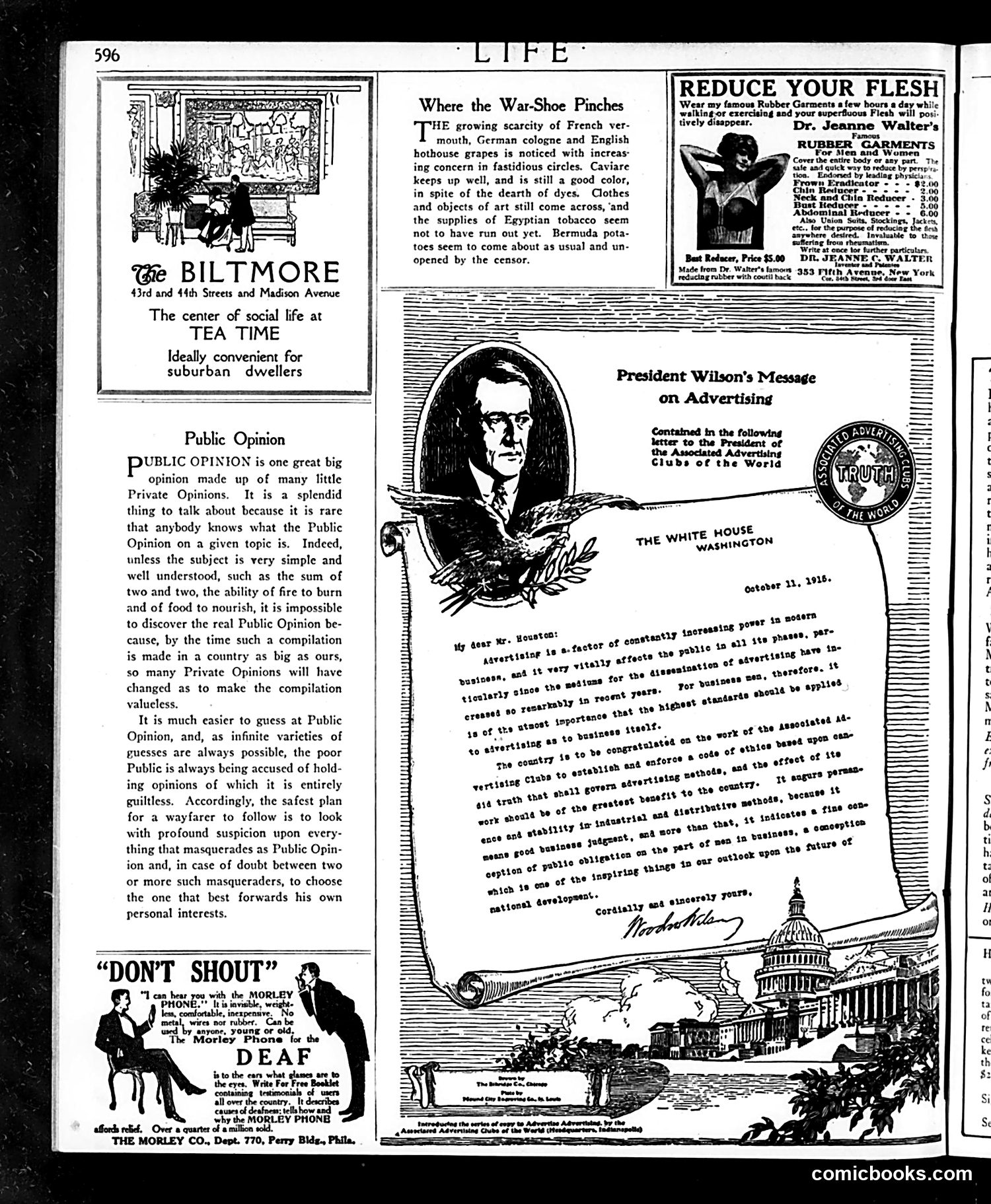
**Main Content: President Wilson's Message on Advertising** The centerpiece is a formal letter from President Woodrow Wilson (dated October 11, 1918) endorsing advertising as patriotic during WWI. Wilson argues advertising educates the public, supports business, and serves national interests. The letter is framed with an eagle and Capitol building, presenting advertising as a civic duty aligned with American values. **Context**: This appears during WWI (note references to wartime scarcity: French vermouth, German cologne, censored goods). Wilson's endorsement legitimized advertising as essential to the war effort and economic stability—a significant propaganda moment linking commercial interests to patriotism. **Surrounding Content**: The page includes advertisements for weight-reduction garments and hearing aids, plus an essay on "Public Opinion" arguing citizens should trust their private interests over mass opinion claims. **Satire**: The juxtaposition—an earnest presidential endorsement of advertising sandwiched among dubious health product ads—may suggest irony about whose interests advertising truly serves, though this is subtle.
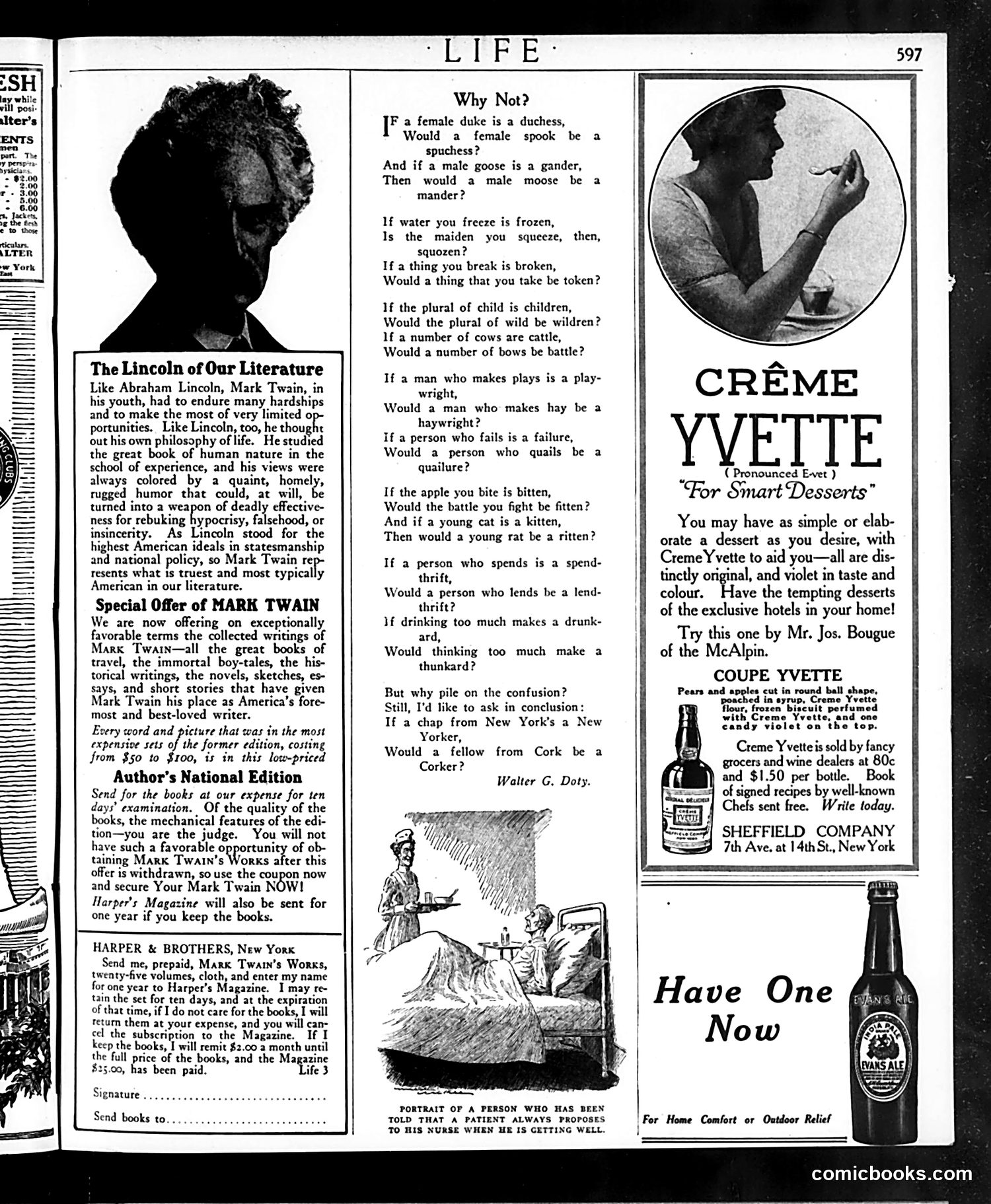
This page primarily contains **advertising and promotional content** for Mark Twain's collected works, along with two distinct pieces of humor. **The main feature** is a publisher's pitch comparing Twain to Lincoln as an American literary figure—emphasizing his humble origins, folk wisdom, and use of humor as social critique. **"Why Not?"** is a wordplay puzzle by Walter G. Doty that extends English grammatical logic to absurd conclusions (if a female duke is a duchess, would a female spook be a "spuchess"?). This playful linguistic humor was typical of early 20th-century magazine satire. **The cartoon** at bottom shows a woman's portrait labeled as depicting someone told that patients propose to nurses during recovery—a gentle joke about romantic expectations in hospital settings. The remainder consists of **product advertisements** for Crème Yvette dessert liqueur and Evans Ale, typical of Life magazine's revenue model.
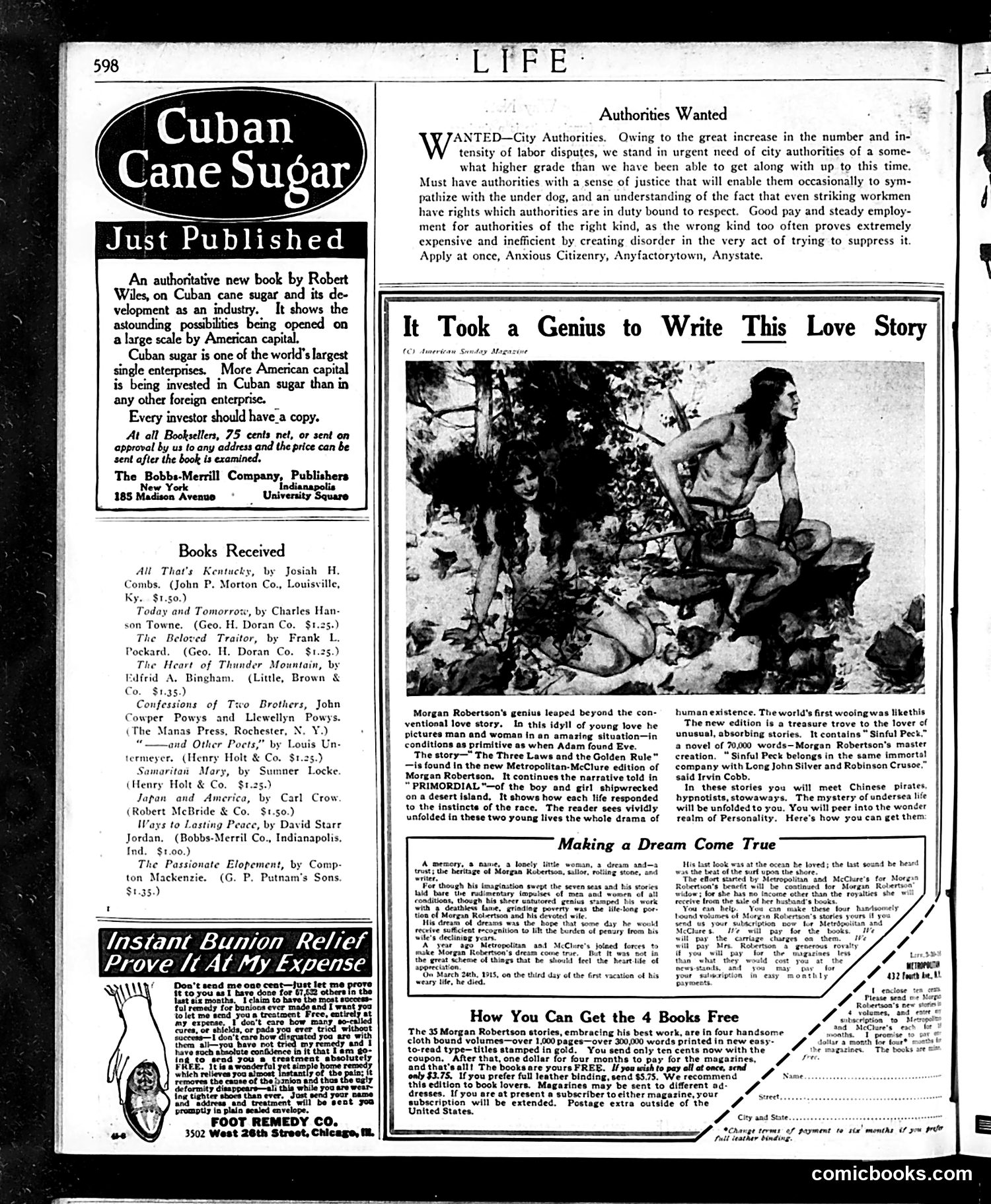
This page is primarily **advertising and book reviews**, not political satire. The main content includes: **"Authorities Wanted" (top)**: A satirical classified ad criticizing city authorities' ineffectiveness during labor disputes. It humorously "advertises" for better-quality police/officials who understand workers' rights and can suppress disorder without brutality—a pointed critique of how authorities were mishandling the era's intense labor conflicts and strikes. **Featured Content**: An advertisement for Morgan Robertson's newly published romantic novel, with an illustration showing a couple in primitive conditions. The copy emphasizes Robertson's "genius" in depicting human relationships. **Books Received section**: Standard literary reviews listing contemporary titles. **Bottom advertisement**: A bunion remedy ad using a common early-20th-century sales technique ("prove it at my expense"). The satire is mild and localized—the "Authorities Wanted" piece reflects genuine Progressive Era frustrations with police brutality toward strikers, but it's gentle mockery rather than harsh political cartooning.
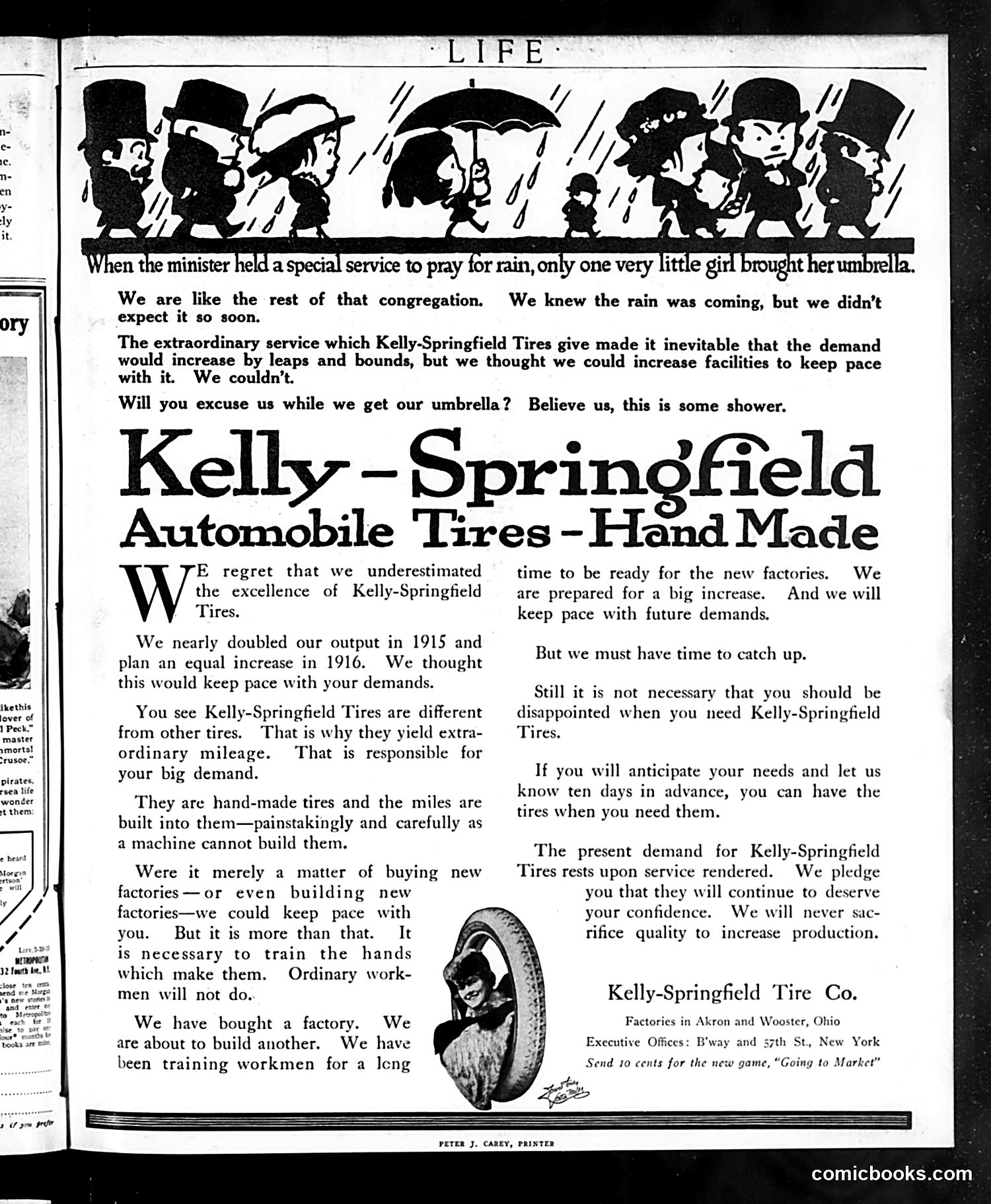
This is primarily a **corporate apology advertisement**, not political satire. The opening cartoon shows people at a church service praying for rain—only one girl brings an umbrella, establishing the joke: demand for Kelly-Springfield Tires has arrived so unexpectedly fast that the company is unprepared, like an unbelieving congregation caught in a downpour. The ad's core message: Kelly-Springfield's tires are so excellent that demand has massively exceeded their production capacity. Rather than admit failure, the company frames this as a *compliment*—they've underestimated customer enthusiasm. The company explains they cannot simply build new factories because tire-making requires specially trained craftsmen ("hand-made"), not ordinary workmen. They promise customers can avoid disappointment by ordering ten days in advance, and pledge they'll never sacrifice quality for speed. This reflects early 20th-century manufacturing challenges and marketing strategy: turning a supply shortage into evidence of superior product quality.
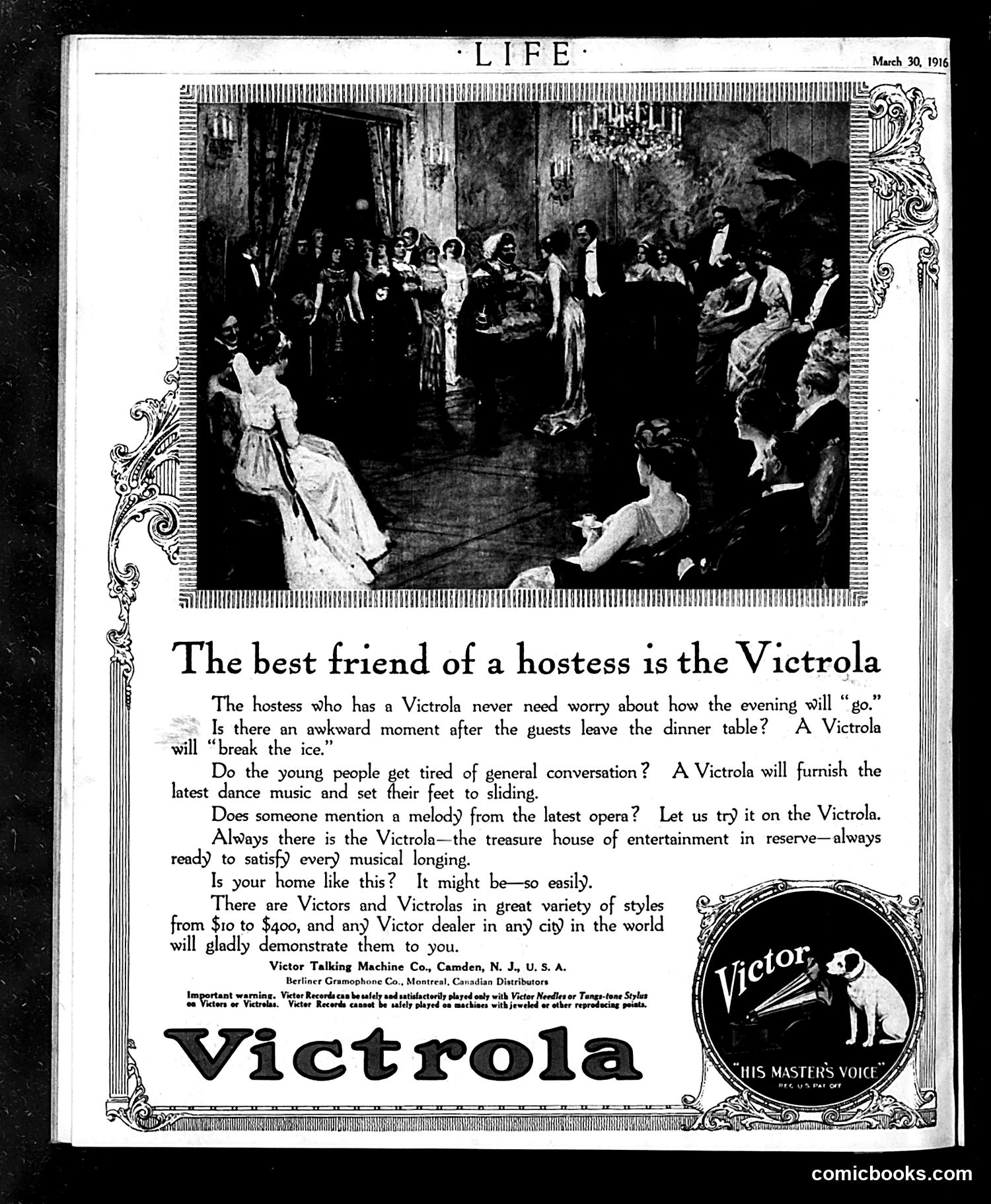
This is primarily a **product advertisement**, not political satire. It promotes the Victrola (a phonograph/record player) by Victor Talking Machine Co., dated March 30, 1916. The illustrated scene shows an elegant dinner party where a Victrola solves social awkwardness: it provides dance music when conversation lags, supplies opera melodies on demand, and generally ensures entertainment flows smoothly throughout an evening. The "joke" or pitch is that hosting becomes effortless with a Victrola—it's the hostess's solution to any uncomfortable moment. The advertisement appeals to middle-to-upper-class aspirations by depicting formal evening entertainment and suggesting the device enables social success. The price range ($10–$400) and the "His Master's Voice" logo (the famous Victor trademark featuring a dog) are period-authentic details. This represents early 20th-century consumer marketing targeting domestic entertaining and the novelty of recorded music as a status symbol and practical household necessity.
I can see this is a page from Life magazine dated what appears to be "30, 1916" (likely June 30, 1916 based on the format). The page shows decorative Art Nouveau-style borders and ornamental designs typical of the publication's format from that era. However, the main content area is almost entirely black or heavily darkened, making it impossible to discern any cartoon images, text, or satirical content clearly. Without being able to see the actual cartoon(s) or read the accompanying text reliably, I cannot identify specific figures, political references, or explain the satire intended. This appears to be a scanning or reproduction issue that has rendered the page content illegible.