
Life, 1916-03-30 · page 21 of 45
Life — March 30, 1916 — page 21: what you’re looking at
What you’re looking at
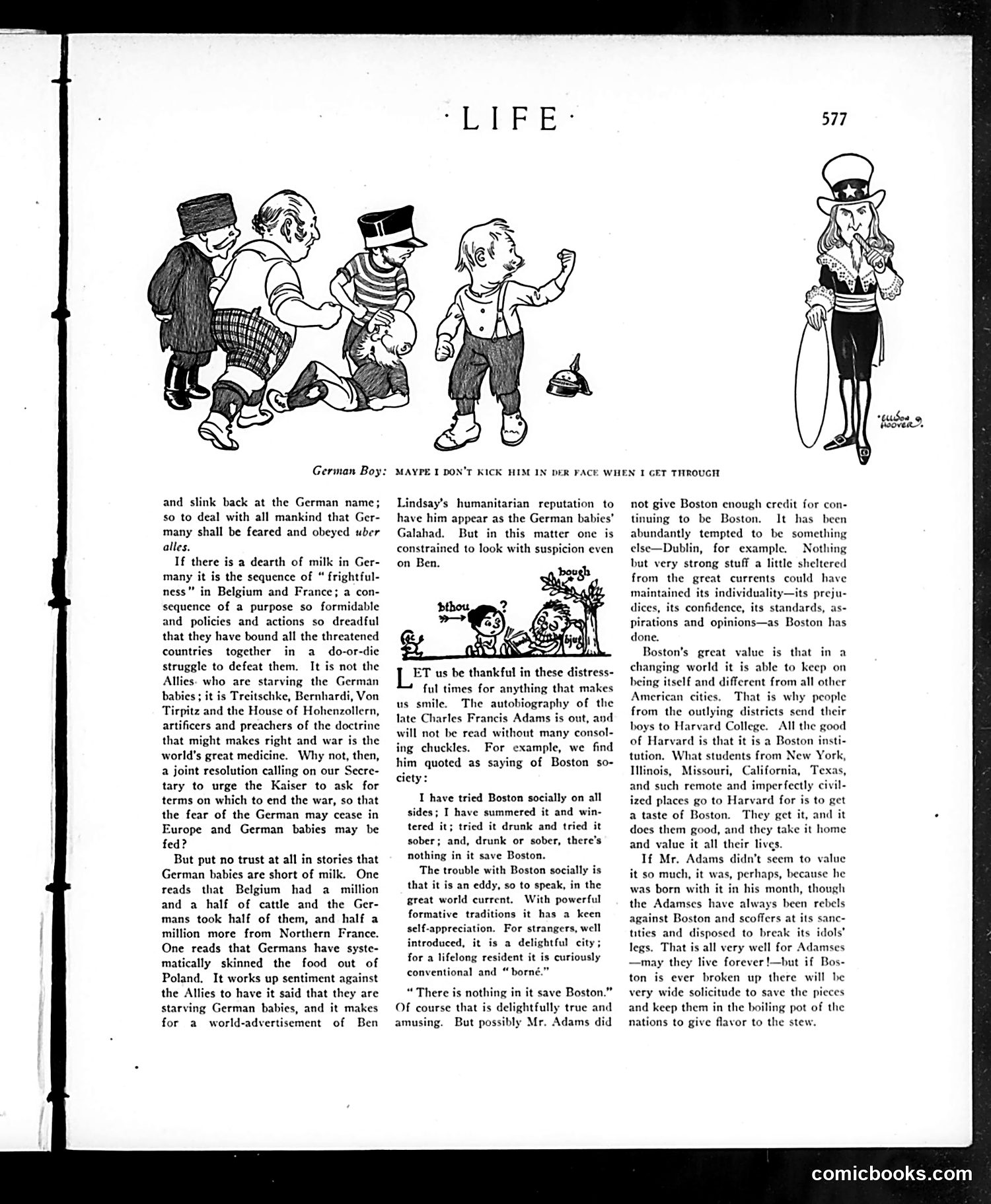
This page contains two distinct pieces of satirical commentary: **Top Cartoon:** Depicts a German boy among other children with the caption "Maybe I don't kick him in der face when I get through." This is anti-German propaganda from World War I, playing on American anxieties about German militarism and aggression. The cartoon satirizes claims of German suffering (starving babies) by suggesting German culture itself—represented by thinkers like Treitschke and Von Tirpitz—is responsible for the war's devastation. **Boston Essay:** The main text discusses Charles Francis Adams's autobiography, quoting his dismissal of Boston society as having "nothing in it save Boston." The author defends Boston's value as a unique, self-preserving American institution that maintains its identity despite pressure to modernize. It argues Boston's insularity—its "eddy" status removed from world currents—is precisely what makes it valuable, especially for Harvard College's formative influence on students from across America. Both pieces reflect early 20th-century American cultural concerns: wartime jingoism and provincial pride in established institutions.
📄 Transcribed text from this page (OCR, searchable)
Machine-transcribed from the original scan — historical spelling and the odd misread are preserved.
German Boy: and slink back at the German name; so to deal with all mankind that Ger- many shall be feared and obeyed uber alles. If there is a dearth of milk in Ger- many it is the sequence of “ frightful- ness” in Belgium and France; a con- sequence of a purpose so formidable and policies and actions so dreadful that they have bound all the threatened countries together in a do-or-die struggle to defeat them. It is not the Allies. who are starving the German babies ; it is Treitschke, Bernhardi, Von Tirpitz and the House of Hohenzollern, artificers and preachers of the doctrine that might makes right and war is the world’s great medicine. Why not, then, a joint resolution calling on our Secre- tary to urge the Kaiser to ask for terms on which to end the war, so that the fear of the German may cease in Europe and German babies may be fed? But put no trust at all in stories that German babies are short of milk. One reads that Belgium had a_ million and a half of cattle and the Ger- mans took half of them, and half a million more from Northern France. One reads that Germans have syste- matically skinned the food out of Poland. It works up sentiment against the Allies to have it said that they are starving German babies, and it makes for a world-advertisement of Ben MAYPE I DON'T KICK HIM IN DER FACE WHEN I GET THROUGH Lindsay’s humanitarian reputation to have him appear as the German babies’ Galahad. But in this matter one is constrained to look with suspicion even ET us be thankful in these distress- ful times for anything that makes us smile. The autobiography of the late Charles Francis Adams is out, and will not be read without many consol- ing chuckles. For example, we find him quoted as saying of Boston so- ciety: I have tried Boston socially on all sides; I have summered it and win- tered it; tried it drunk and tried it sober; and, drunk or sober, there's nothing in it save Boston. The trouble with Boston socially is that it is an eddy, so to speak, in the great world current. With powerful formative traditions it has a keen self-appreciation. For strangers, well introduced, it is a delightful city; for a lifelong resident it is curiously conventional and “ borné.” “There is nothing in it save Boston.” Of course that is delightfully true and amusing. But possibly Mr. Adams did not give Boston enough credit for con- tinuing to be Boston. It has been abundantly tempted to be something else—Dublin, for example. Nothing but very strong stuff a little sheltered from the great currents could have maintained its individuality—its preju- dices, its confidence, its standards, as- pirations and opinions—as Boston has done. Boston's great value is that in a ging world it is able to keep on being itself and different from all other American cities, That is why people from the outlying districts send their boys to Harvard College. All the good of Harvard is that it is a Boston insti- tution. What students from New York, Illinois, Missouri, California, Texas, and such remote and imperfectly civil- ized places go to Harvard for is to get a taste of Boston. They get it, and it does them good, and they take it home and value it all their li If Mr. Adams didn’t seem to value it so much, it was, perhaps, because he was born with it in his month, though the Adamses have always been rebels against Boston and scoffers at its sanc- tities and disposed to break its idols’ legs. That is all very well for Adamses —may they live forever!—but if Bos- ton is ever broken up there will be very wide solicitude to save the pieces and keep them in the boiling pot of the nations to give flavor to the stew. comicbooks.com