
Life, 1916-03-30 · page 14 of 45
Life — March 30, 1916 — page 14: what you’re looking at
What you’re looking at
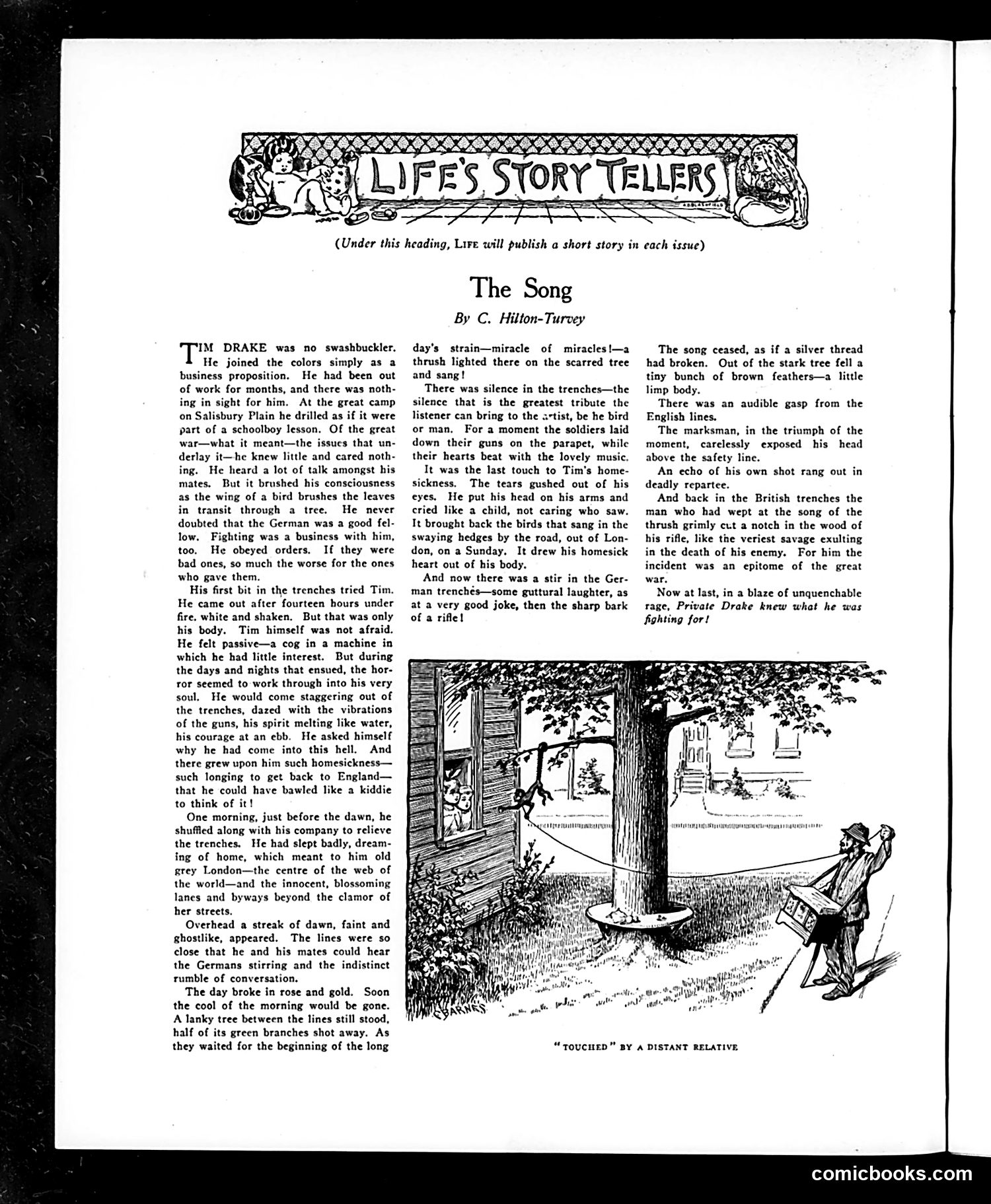
This is a **short story**, not a political cartoon. It depicts a World War I scene where Tim Drake, a British soldier in the trenches, hears a bird singing during the brutal fighting. The song provides him a moment of emotional escape from the horrors of war—memories of home, London, peace. The illustration shows a soldier sitting outside a cottage, apparently back home or in a moment of respite. The story's point appears to be about **how beauty and nature can provide solace during wartime**, offering soldiers brief psychological relief from trauma and homesickness. This represents a common WWI literary theme: the contrast between natural innocence and industrial warfare's brutality.
📄 Transcribed text from this page (OCR, searchable)
Machine-transcribed from the original scan — historical spelling and the odd misread are preserved.
XK RNR (Under this heading, Lire will publish a short story in each issue) IM DRAKE was no swashbuckler. He joined the colors simply as a business proposition. He had been out of work for months, and there was noth- ing in sight for him. At the great camp on Salisbury Plain he drilled as if it were part of a schoolboy lesson. Of the great war—what it meant—the issucs that un- derlay it—he knew little and cared noth- ing. He heard a lot of talk amongst his mates. But it brushed his consciousness as the wing of a bird brushes the leaves in transit through a tree, He never doubted that the German was a good fel- low. Fighting was a business with him, too. He obeyed orders. If they were bad ones, so much the worse for the ones who gave them. His first bit in the trenches tried Tim. He came out after fourteen hours under fire. white and shaken. But that was only his body. Tim himself was not afraid. He felt passive—a cog in a machine in which he had little interest. But during the days and nights that ensued, the hor- ror seemed to work through into his very soul. He would come staggering out of the trenches, dazed with the vibrations of the guns, his spirit melting like water, his courage at an ebb. He asked himself why he had come into this hell. And there grew upon him such homesickness— such longing to get back to England— that he could have bawled like a kiddie to think of it! One morning, just before the dawn, he shuffled along with his company to relieve the trenches. He had slept badly, dream- ing of home, which meant to him old grey London—the centre of the web of the world—and the innocent, blossoming lanes and byways beyond the clamor of her streets. Overhead a streak of dawn, faint and ghostlike, appeared. The lines were so close that he and his mates could hear the Germans stirring and the indistinct rumble of conversation. The day broke in rose and gold. Soon the cool of the morning would be gone. A lanky tree between the lines still stood, half of its green branches shot away. As they waited for the beginning of the long The Song By C. Hilton-Turvey day's strain—miracle of miracles!—a thrush lighted there on the scarred tree and sang! There was silence in the trenches—the silence that is the greatest tribute the listener can bring to the artist, be he bird or man. For a moment the soldiers laid down their guns on the parapet, while their hearts beat with the lovely music, Tt was the last touch to Tim's home- sickness, The tears gushed out of his eyes. He put his head on his arms and cried like a child, not caring who saw. Tt brought back the birds that sang in the swaying hedges by the road, out of Lon- don, on a Sunday, It drew his homesick heart out of his body. And now there was a stir in the Ger- man trenchés—some guttural laughter, as at a very good joke, then the sharp bark of a rifle! ete! The song ceased, as if a silver thread had broken. Out of the stark tree fell a tiny bunch of brown feathers—a little limp body. There was an audible gasp from the English lines. The marksman, in the triumph of the moment, carelessly exposed his head above the safety line. An echo of his own shot rang out in deadly repartee. And back in the British trenches the man who had wept at the song of the thrush grimly cut a notch in the wood of his rifle, like the veriest savage exulting in the death of his enemy. For him the incident was an epitome of the great war. Now at last, in a blaze of unquenchable rage, Private Drake knew what he was fighting for! “TOUCHED” BY A DISTANT RELATIVE comicbooks.com