
Life, 1916-03-30 · page 20 of 45
Life — March 30, 1916 — page 20: what you’re looking at
What you’re looking at
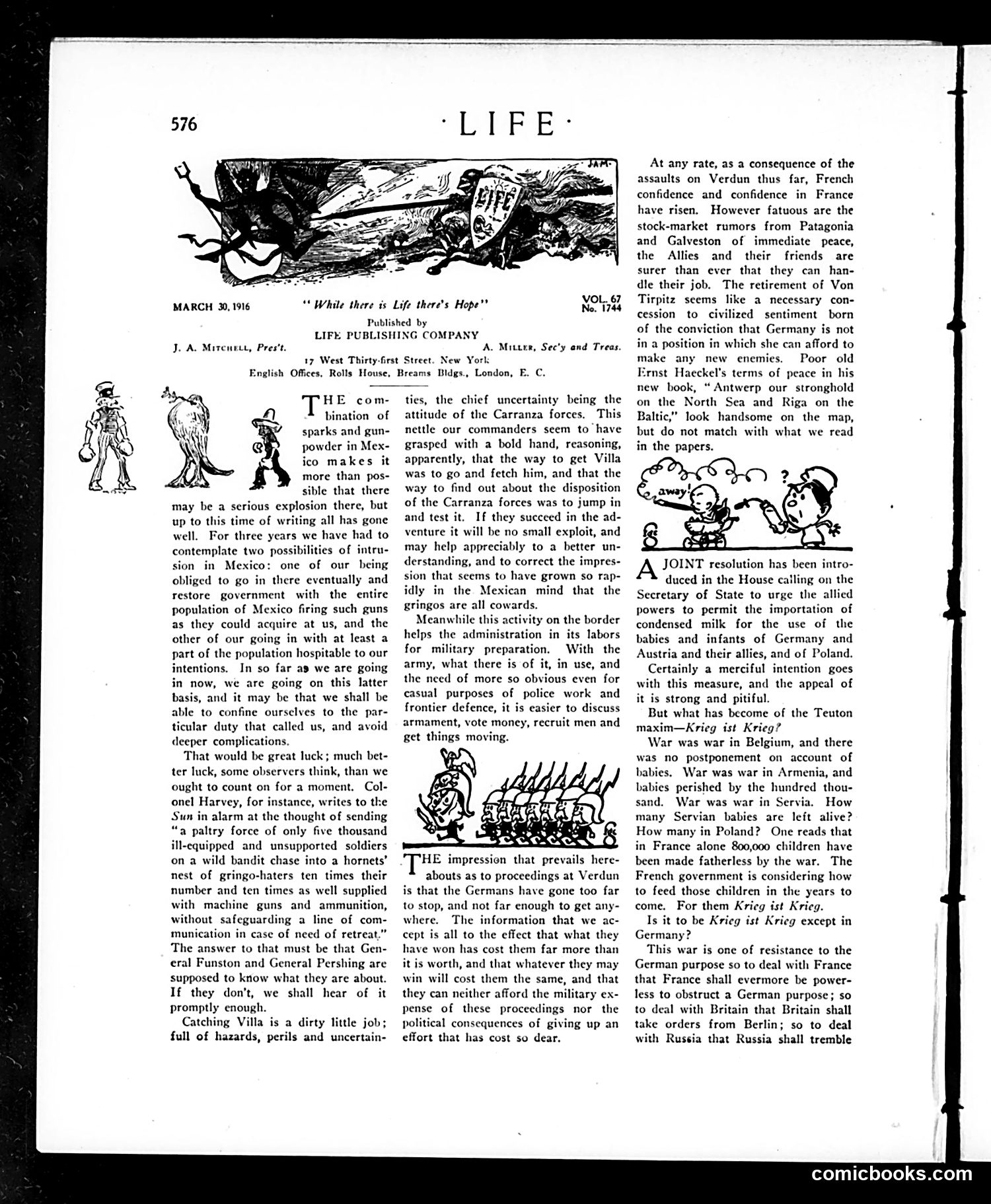
This page addresses three contemporary military situations during World War I: **Mexico/Villa:** The article discusses U.S. military operations against Mexican revolutionary Pancho Villa, expressing cautious optimism about General Pershing's expedition while acknowledging the risks of sending 5,000 troops into hostile territory. The cartoons (depicting figures in various poses) appear to illustrate the complexity and hazards of this "dirty little job." **Military Preparedness:** The author argues that border activity paradoxically helps the U.S. government justify increased military spending and recruitment—a silver lining to the conflict. **Verdun:** The article analyzes the grueling Western Front battle, concluding that German gains cost far more than strategically worthwhile, strengthening Allied confidence. The retirement of German Admiral Von Tirpitz is noted as a concession to "civilized sentiment"—suggesting growing international pressure on Germany's conduct. The overall tone is cautiously optimistic about Allied prospects while acknowledging genuine military and diplomatic uncertainties.
📄 Transcribed text from this page (OCR, searchable)
Machine-transcribed from the original scan — historical spelling and the odd misread are preserved.
MARCH 30, 1916 “While there is Life there's Hope’” No, 1744 Published by LIFE PUBLISHING COMPANY J. A. Mitcunte, Pres't. 17 West Thirty-first Street. A. Miturr, Sec'y and Treas. New York English Offices, Rolls House, Breams Bldgs., London, E. C. HE com- bination of sparks and gun- powder in Mex- ico makes it more than pos- sible that there may be a serious explosion there, but up to this time of writing all has gone well. For three years we have had to contemplate two possibilities of intru- sion in Mexico: one of our being obliged to go in there eventually and restore government with the entire population of Mexico firing such guns as they could acquire at us, and the other of our going in with at least a part of the population hospitable to our intentions. In so far ay we are going in now, we are going on this latter basis, and it may be that we shall be able to confine ourselves to the par- ticular duty that called us, and avoid deeper complications. That would be great luck; much bet- ter luck, some observers think, than we ought to count on for a moment. Col- onel Harvey, for instance, writes to the Sun in alarm at the thought of sending “a paltry force of only five thousand ill-equipped and unsupported soldiers on a wild bandit chase into a hornets’ nest of gringo-haters ten times their number and ten times as well supplied with machine guns and ammunition, without safeguarding a line of com- munication in case of need of retreat,” The answer to that must be that Gen- eral Funston and General Pershing are supposed to know what they are about. If they don't, we shall hear of it promptly enough. Catching Villa is a dirty little job; full of hazards, perils and uncertain- ties, the chief uncertainty being the attitude of the Carranza forces. This nettle our commanders seem to have grasped with a bold hand, reasoning, apparently, that the way to get Villa was to go and fetch him, and that the way to find out about the disposition of the Carranza forces was to jump in and test it. If they succeed in the ad- venture it will be no small exploit, and may help appreciably to a better un- derstanding, and to correct the impres- sion that seems to have grown so rap- idly in the Mexican mind that the gringos are all cowards, Meanwhile this activity on the border helps the administration in its labors for military preparation. With the army, what there is of it, in use, and the need of more so obvious even for casual purposes of police work and frontier defence, it is easier to discuss armament, vote money, recruit men and get things moving. 'HE impression that prevails here- abouts as to proceedings at Verdun is that the Germans have gone too far to stop, and not far enough to get any- where. The information that we ac- cept is all to the effect that what they have won has cost them far more than it is worth, and that whatever they may win will cost them the same, and that they can neither afford the military ex- pense of these proceedings nor the political consequences of giving up an effort that has cost so dear. At any rate, as a consequence of the assaults on Verdun thus far, French confidence and confidence in France have risen. However fatuous are the stock-market rumors from Patagonia and Galveston of immediate peace, the Allies and their friends are surer than ever that they can han- dle their job. The retirement of Von Tirpitz seems like a necessary con- cession to civilized sentiment born of the conviction that Germany is not in a position in which she can afford to make any new enemii Poor old Ernst Haeckel’s terms of peace in his new book, “Antwerp our stronghold on the North Sea and Riga on the Baltic,” look handsome on the map, but do not match with what we read in the papers. JOINT resolution has been intro- duced in the House calling on the Secretary of State to urge the allied powers to permit the importation of condensed milk for the use of the babies and infants of Germany and Austria and their allies, and of Poland. Certainly a merciful intention goes with this measure, and the appeal of it is strong and pitiful. But what has become of the Teuton maxim—Krieg ist Krieg? War was war in Belgium, and there was no postponement on account of babies. War was war in Armenia, and babies perished by the hundred thou- sand. War was war in Servia. How many Servian babies are left alive? How many in Poland? One reads that in France alone 800,000 children have been made fatherless by the war. The French government is considering how to feed those children in the years to come. For them Krieg ist Krieg. Is it to be Krieg ist Krieg except in Germany? This war is one of resistance to the German purpose so to deal with France that France shall evermore be power- less to obstruct a German purpose; so to deal with Britain that Britain shall orders from Berlin; so to deal with Russia that Russia shall tremble comicbooks.com