
Life, 1916-03-30 · page 13 of 45
Life — March 30, 1916 — page 13: what you’re looking at
What you’re looking at
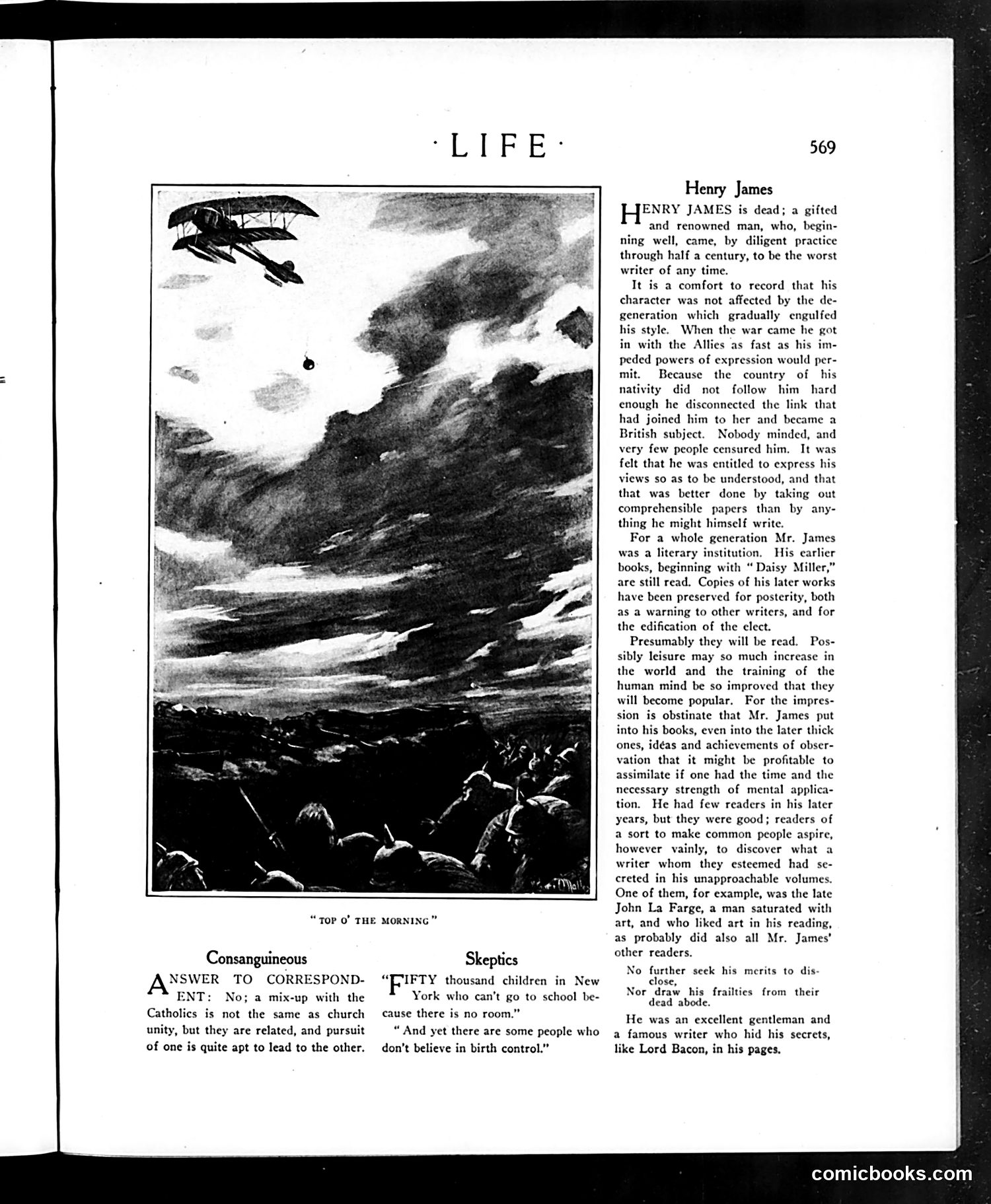
**Main Content:** An obituary/tribute to Henry James following his death, praising his literary achievements while acknowledging his complex relationship with his audience and his adopted British nationality. **The Illustration:** Titled "Top o' the Morning," the image depicts an early airplane in flight over a dramatic landscape with stormy skies. This appears to be a separate illustration unrelated to the James obituary—likely contemporary commentary on aviation technology or military concerns (the plane's design suggests early WWI-era aircraft). **Bottom Section:** Two brief satirical items mock social contradictions—one about Catholic-Protestant relations, another mocking birth control skeptics despite overpopulation concerns in New York schools. These are typical Life magazine social commentary pieces. The page represents early 20th-century American literary and social criticism through satire.
📄 Transcribed text from this page (OCR, searchable)
Machine-transcribed from the original scan — historical spelling and the odd misread are preserved.
A ely “Top oO’ THE MORNI Consanguineous SWER TO CORRESPOND- ENT: No; a mix-up with the Catholics is not the same as church unity, but they are related, and pursuit of one is quite apt to lead to the other. Skeptics FTY thousand children in New York who can't go to school be- cause there is no room.” “And yet there are some people who don’t believe in birth control.” 569 Henry James ENRY JAMES is dead; a gifted and renowned man, who, begin- ning well, came, by diligent practice through half a century, to be the worst writer of any time. It is a comfort to record that his character was not affected by the de- generation which gradually engulfed his style. When the war came he got in with the Allies as fast as his im- peded powers of expression would per- mit. Because the country of his nativity did not follow him hard enough he disconnected the link that had joined him to her and became a British subject. Nobody minded, and very few people censured him. It was felt that he was entitled to express his views so as to be understood, and that that was better done by taking out comprehensible papers than by any- thing he might himself write. For a whole generation Mr. James was a literary institution, His earlier books, beginning with “Daisy Miller,” are still read. Copies of his later works have been preserved for posterity, both as a warning to other writers, and for the edification of the clect. Presumably they will be read. Pos- sibly leisure may so much increase in the world and the training of the human mind be so improved that they will become popular. For the impres- sion is obstinate that Mr. James put into his books, even into the later thick ones, idéas and achievements of obser- vation that it might be profitable to assimilate if one had the time and the necessary strength of mental applica- tion. He had few readers in his later years, but they were good; readers of a sort to make common people aspire, however vainly, to discover what a writer whom they esteemed had se- creted in his unapproachable volumes. One of them, for example, was the late John La Farge, a man saturated with art, and who liked art in his reading, as probably did also all Mr. James’ other readers. No further seek his merits to dis- close, Nor draw his frailties dead abode. from their He was an excellent gentleman and a famous writer who hid his secrets, like Lord Bacon, in his pages. comicbooks.com