
Life, 1916-03-30 · page 32 of 45
Life — March 30, 1916 — page 32: what you’re looking at
What you’re looking at
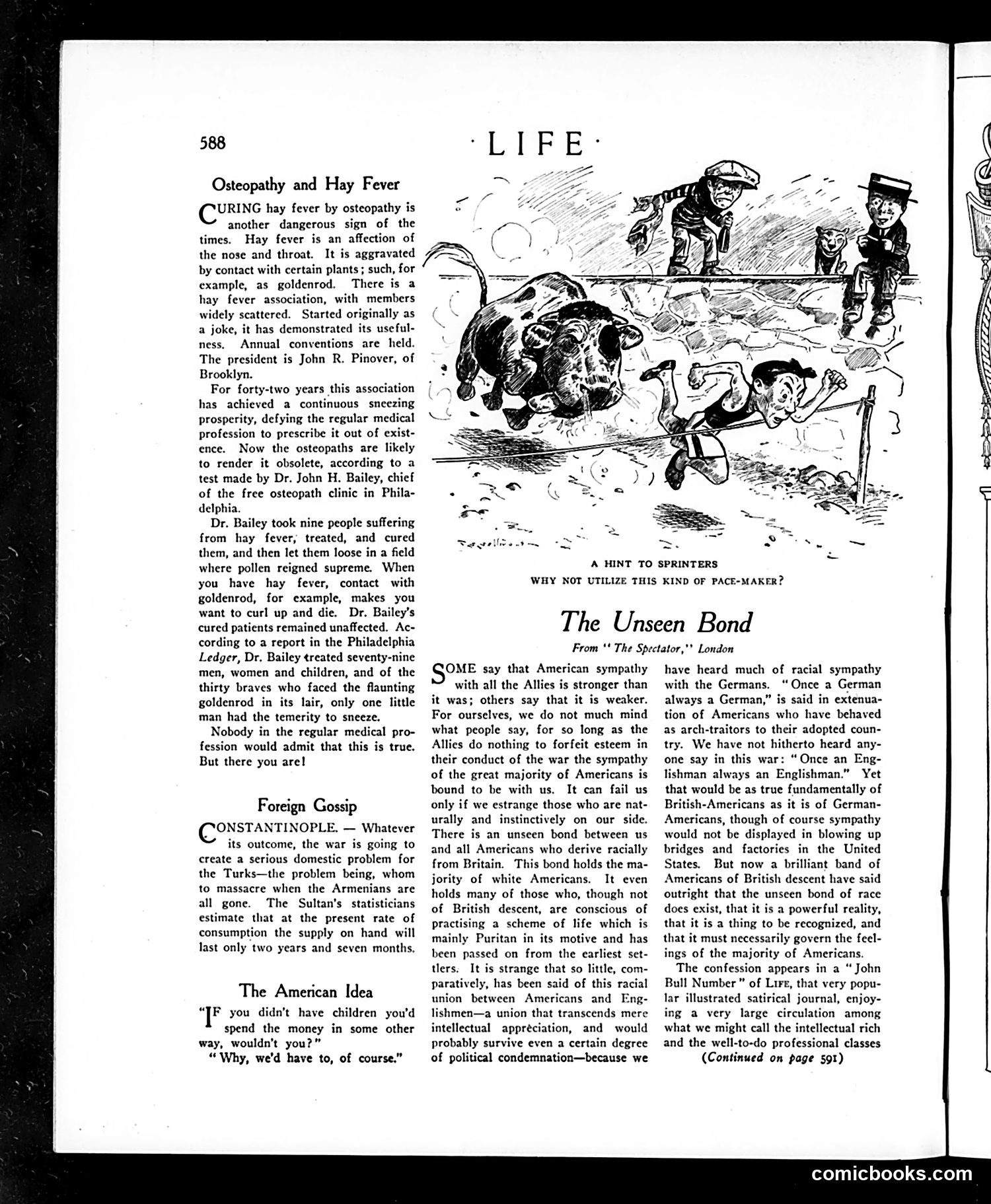
This page contains three distinct pieces of social commentary: **"Osteopathy and Hay Fever"**: Satirizes medical quackery, mocking osteopaths' claims to cure hay fever when orthodox medicine cannot. The text expresses skepticism that Dr. Bailey genuinely cured hay fever patients. **"A Hint to Sprinters" cartoon**: The illustration shows a horse-drawn cart racing with men clinging to it as a "pace-maker." This is visual satire about sprinting techniques, likely mocking an absurd athletic training method. **"The Unseen Bond"** (reprinted from London's *Spectator*): Wartime commentary (WWI context evident) arguing that Americans share an ethnic/racial bond with Britain that naturally aligns them with the Allies. It references German-Americans' loyalty questions while asserting Anglo-American cultural continuity from Puritan settlers. This reflects period racial ideology and pro-British propaganda aimed at American sympathy during the war. The page reflects early-20th-century American attitudes: skepticism toward alternative medicine, casual satire of physical culture, and racialized arguments about national allegiance.
📄 Transcribed text from this page (OCR, searchable)
Machine-transcribed from the original scan — historical spelling and the odd misread are preserved.
588 Osteopathy and Hay Fever CURING hay fever by osteopathy is another dangerous sign of the times. Hay fever is an affection of the nose and throat. It is aggravated = by contact with certain plants ; such, for example, as goldenrod. There is a hay fever association, with members widely scattered. Started originally as a joke, it has demonstrated its useful- ness. Annual conventions are held. The president is John R. Pinover, of Brooklyn. For forty-two years this association has achieved a continuous sneezing prosperity, defying the regular medical profession to prescribe it out of exist- ence. Now the osteopaths are likely to render it obsolete, according to a test made by Dr. John H. Bailey, chief of the free osteopath clinic in Phila- delphia. Dr. Bailey took nine people suffering from hay fever, treated, and cured them, and then let them loose in a field where pollen reigned supreme. When you have hay fever, contact with goldenrod, for example, makes you want to curl up and die. Dr. Bailey's cured patients remained unaffected. Ac- cording to a report in the Philadelphia Ledger, Dr. Bailey ¢reated seventy-nine men, women and children, and of the thirty braves who faced the flaunting goldenrod in its lair, only one little man had the temerity to sneeze. Nobody in the regular medical pro- fession would admit that this is true. But there you are! Foreign Gossip ONSTANTINOPLE, — Whatever \ its outcome, the war is going to create a serious domestic problem for the Turks—the problem being, whom to massacre when the Armenians are all gone. The Sultan's statisticians estimate that at the present rate of consumption the supply on hand will last only two years and seven months. The American Idea “IF you didn’t have children you'd spend the money in some other way, wouldn’t you?” “Why, we'd have to, of course.” A HINT TO SPRINTERS WHY NOT UTILIZE THIS KIND OF PACE-MAKER? The Unseen Bond From “' The Spectator,"* London OME say that American sympathy with all the Allies is stronger than it was; others say that it is weaker. For ourselves, we do not much mind what people say, for so long as the Allies do nothing to forfeit esteem in their conduct of the war the sympathy of the great majority of Americans is bound to be with us. It can fail us only if we estrange those who are nat- urally and instinctively on our side. There is an unseen bond between us and all Americans who derive racially from Britain. This bond holds the ma- jority of white Americans. It even holds many of those who, though not of British descent, are conscious of practising a scheme of life which is mainly Puritan in its motive and has been passed on from the earliest set- tlers. It is strange that so little, com- paratively, has been said of this racial union between Americans and Eng- lishmen—a union that transcends mere intellectual appreciation, and would probably survive even a certain degree of political condemnation—because we have heard much of racial sympathy with the Germans. “Once a German always a German,” is said in extenua- tion of Americans who have behaved as arch-traitors to their adopted coun- try. We have not hitherto heard any- one say in this war: “Once an Eng- lishman always an Englishman.” Yet that would be as true fundamentally of British-Americans as it is of German- Americans, though of course sympathy would not be displayed in blowing up bridges and factories in the United States. But now a brilliant band of Americans of British descent have said outright that the unseen bond of race does exist, that it is a powerful reality, that it is a thing to be recognized, and that it must necessarily govern the feel- ings of the majority of Americans. The confession appears in a “ John Bull Number” of Lire, that very popu- lar illustrated satirical journal, enjoy- ing a very large circulation among what we might call the intellectual rich and the well-to-do professional classes (Continued on page s9t) comicbooks.com