
Life, 1916-03-30 · page 24 of 45
Life — March 30, 1916 — page 24: what you’re looking at
What you’re looking at
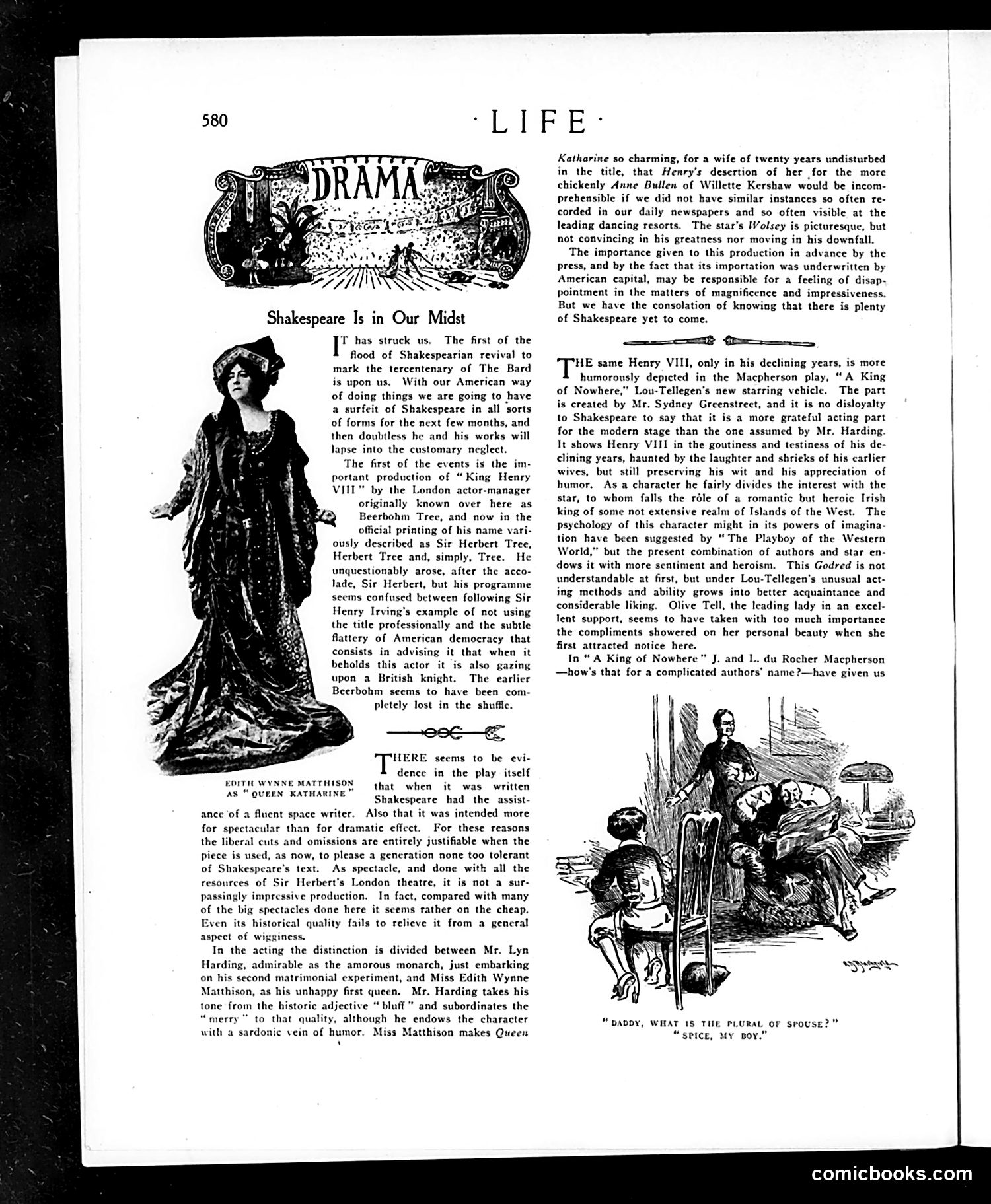
This page reviews two competing 1916 Henry VIII theatrical productions marking Shakespeare's tercentenary. The main critique concerns Sir Herbert Beerbohm Tree's London import of "King Henry VIII"—a lavishly staged but ultimately disappointing spectacle. The reviewer praises actors Lyn Harding (as Henry) and Edith Wynne Matthison (as Queen Katharine) but finds the production overwrought and historically "wiggly." The accompanying illustration shows Matthison in costume as Queen Katharine. The page contrasts Tree's production unfavorably with Lou Tellegen's concurrent "A King of Nowhere," which the reviewer considers a more dramatically satisfying interpretation of aging Henry VIII, played by Sydney Greenstreet. The satirical angle targets American over-investment in importing British theatrical prestige during the Shakespeare tercentenary celebration.
📄 Transcribed text from this page (OCR, searchable)
Machine-transcribed from the original scan — historical spelling and the odd misread are preserved.
Shakespeare Is in Our Midst The first of the flood of Shakespearian revival to mark the tercentenary of The Bard T has struck us. is upon us. With our American way of doing things we are going to have a surfeit of Shakespeare in all sorts of forms for the next few months, and then doubtless he and his works will lapse into the customary neglect. The first of the events is the im- portant production of “King Henry VIIL" by the London actor-manager originally known over here as Beerbohm Tree, and now in the official printing of his name vari- ously described as Sir Herbert Tree, Herbert Tree and, simply, Tree. He unquestionably arose, after the acco- lade, Sir Herbert, but his programme seems confused between following Sir Henry Irving's example of not using the title professionally and the subtle flattery of American democracy that consists in advising it that when it beholds this actor it is also gazing upon a British knight. The earlier Beerbohm seems to have been com- pletely lost in the shuffic. 28-5, HERE seems to be evi- dence in the play itself when it was written Shakespeare had the assist- ance of a fluent space writer. Also that it was intended more for spectacular than for dramatic effect. For these reasons the liberal cuts and omissions are entirely justifiable when the piece is used, as now, to please a generation none too tolerant of Shakespeare's text. As spectacle, and done with all the resources of Sir Herbert's London theatre, it is not a sur- passingly impressive production. In fact, compared with many of the big spectacles done here it scems rather on the cheap. Even its historical quality fails to relieve it from a general aspect of wigginess. In the acting the distinction is divided between Mr. Lyn Harding, admirable as the amorous monarch, just embarking on his second matrimonial experiment, and Miss Edith Wynne Matthison, as his unhappy first queen. Mr. Harding takes his tone from the historic adjective “ bluff" and subordinates the “merry” to that quality, although he endows the character with a sardonic vein of humor, Miss Matthison makes Queen EDITH WYNNE MATTHISON that AS “QUEEN KATHARINE” “LIFE - Katharine so charming, for a wife of twenty years undisturbed in the title, that Henry’s desertion of her for the more chickenly Anne Bullen of Willette Kershaw would be incom- prehensible if we did not have similar instances so often re- corded in our daily newspapers and so often visible at the leading dancing resorts. The star's Wolsey is picturesque, but not convincing in his greatness nor moving in his downfall. The importance given to this production in advance by the Press, and by the fact that its importation was underwritten by American capital, may be responsible for a feeling of disap- pointment in the matters of magnificence and impressiveness. But we have the consolation of knowing that there is plenty of Shakespeare yet to come. == f=, 'HE same Henry VIII, only in his declining years, is more humorously depicted in the Macpherson play, “A King of Nowhere,” Lou-Tellegen’s new starring vehicle. The part is created by Mr. Sydney Greenstrect, and it is no disloyalty to Shakespeare to say that it is a more grateful acting part for the modern stage than the one assumed by Mr. Harding. It shows Henry VIII in the goutiness and testiness of his de- clining years, haunted by the laughter and shrieks of his carlier wives, but still preserving his wit and his appreciation of humor, As a character he fairly divides the interest with the star, to whom falls the rdle of a romantic but heroic Irish king of some not extensive realm of Islands of the West. The psychology of this character might in its powers of imagina- tion have been suggested by “ The Playboy of the Western World,” but the present combination of authors and star en- dows it with more sentiment and heroism. This Godred is not understandable at first, but under Lou-Tellegen’s unusual act- ing methods and ability grows into better acquaintance and considerable liking. Olive Tell, the leading lady in an excel- lent support, seems to have taken with too much importance the compliments showered on her personal beauty when she first attracted notice here. In “ A King of Nowhere” J. and L.. du Rocher Macpherson —how’'s that for a complicated authors’ name ?—have given us “DADDY, WHAT IS THE PLURAL OF Spouse?” “spice, sty Boy.’ comicbooks.com