
Life, 1916-03-30 · page 12 of 45
Life — March 30, 1916 — page 12: what you’re looking at
What you’re looking at
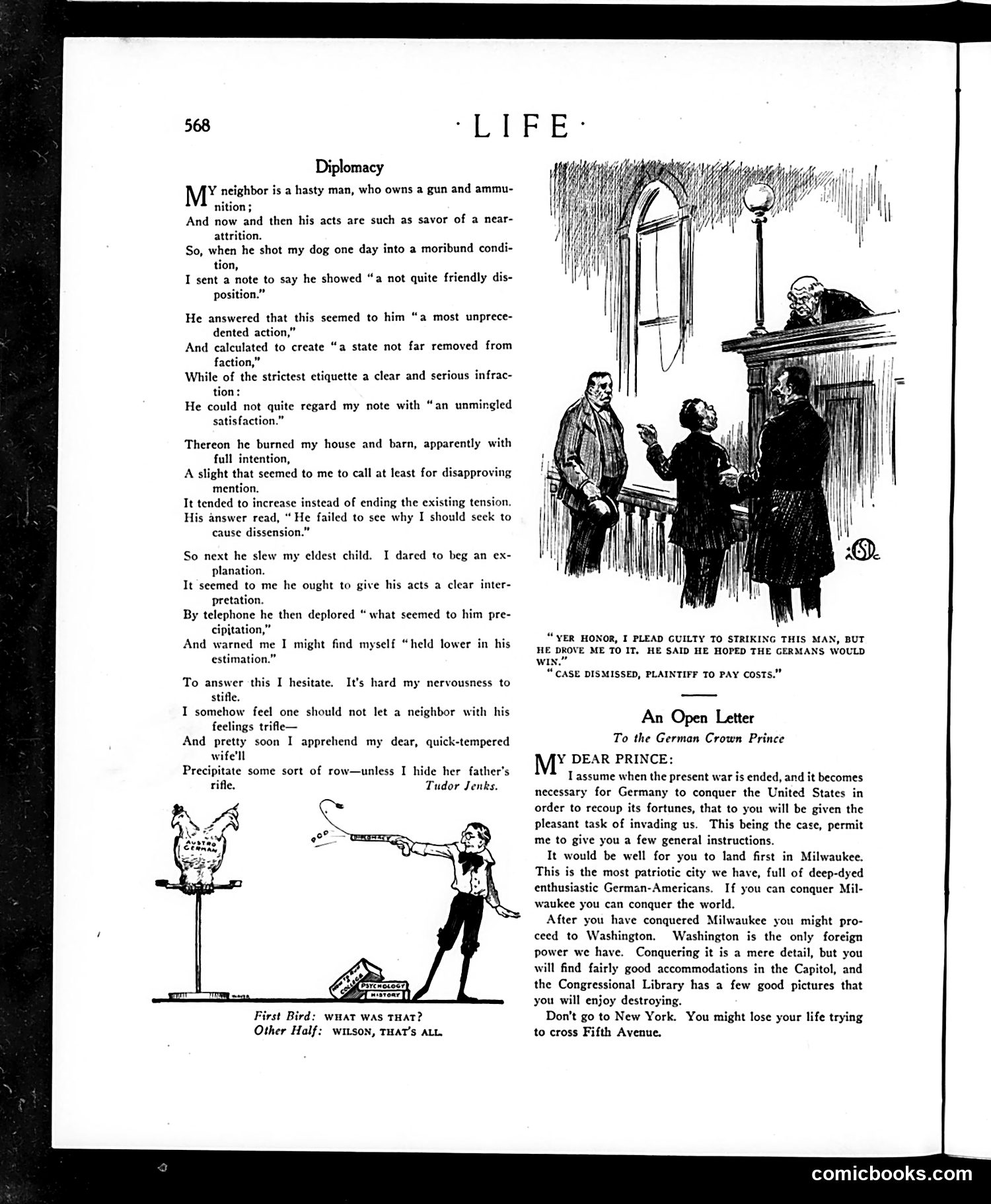
This page contains two pieces of WWI-era satire: **"Diplomacy"** (left): A poem by Tudor Jenks mocking a neighbor who shot the narrator's dog, then claimed this was justified diplomacy rather than an unfriendly act. The satire targets how nations excuse aggressive actions through euphemistic language—a direct jab at German justifications for their wartime conduct. **"An Open Letter to the German Crown Prince"** (right): Mock-serious advice on conquering America, sarcastically suggesting Milwaukee (a German-American stronghold) as an entry point, then Washington, with jokes about the Capitol and Congressional Library. The cartoon above shows a domestic dispute being arbitrated, captioned with a plea of guilt but blame-shifting ("he drove me to it"). This parallels how Germany justified its actions during the war. Both pieces ridicule German diplomatic excuses and aggression.
📄 Transcribed text from this page (OCR, searchable)
Machine-transcribed from the original scan — historical spelling and the odd misread are preserved.
568 Diplomacy M* neighbor is a hasty man, who owns a gun and ammu- nition ; And now and then his acts are such as savor of a near- attrition. | So, when he shot my dog one day into a moribund condi- tion, | I sent a note to say he showed “a not quite friendly dis- position.” He answered that this seemed to him “a most unprece- dented action,” And calculated to create “a state not far removed from faction,” While of the strictest etiquette a clear and serious infrac- tion: He could not quite regard my note with “an unmingled satisfaction.” Thereon he burned my house and barn, apparently with full intention, A slight that seemed to me to call at least for disapproving mention, It tended to increase instead of ending the existing tension. His answer read, “He failed to see why I should seck to cause dissension.” So next he slew my eldest child. I dared to beg an ex- planation. It seemed to me he ought to give his acts a clear inter- pretation. By telephone he then deplored “ what seemed to him pre- cipitation,” And warned me I might find myself “held lower in his estimation.” To answer this I hesitate. It's hard my nervousness to stifle. I somehow feel one should not let a neighbor with his feelings trifle— And pretty soon I apprehend my dear, quick-tempered wife'll Precipitate some sort of row—unless I hide her father’s Tudor Jenks. First Bird: WHAT WAS THAT? Other Half: witson, THAT's ALL. “LIFE: “CASE DISMISSED, PLAINTIFF TO PAY COSTS.” An Open Letter To the German Crown Prince 'Y DEAR PRINCE: T assume when the present war is ended, and it becomes necessary for Germany to conquer the United States in order to recoup its fortunes, that to you will be given the pleasant task of invading us. This being the case, permit me to give you a few general instructions. It would be well for you to land first in Milwaukee. This is the most patriotic city we have, full of deep-dyed enthusiastic German-Americans. If you can conquer Mil- waukee you can conquer the world. After you have conquered Milwaukee you might pro- ceed to Washington. Washington is the only foreign power we have. Conquering it is a mere detail, but you will find fairly good accommodations in the Capitol, and the Congressional Library has a few good pictures that you will enjoy destroying. Don't go to New York. You might lose your life trying to cross Fifth Avenue. comicbooks.com