
Life, 1916-03-30 · page 30 of 45
Life — March 30, 1916 — page 30: what you’re looking at
What you’re looking at
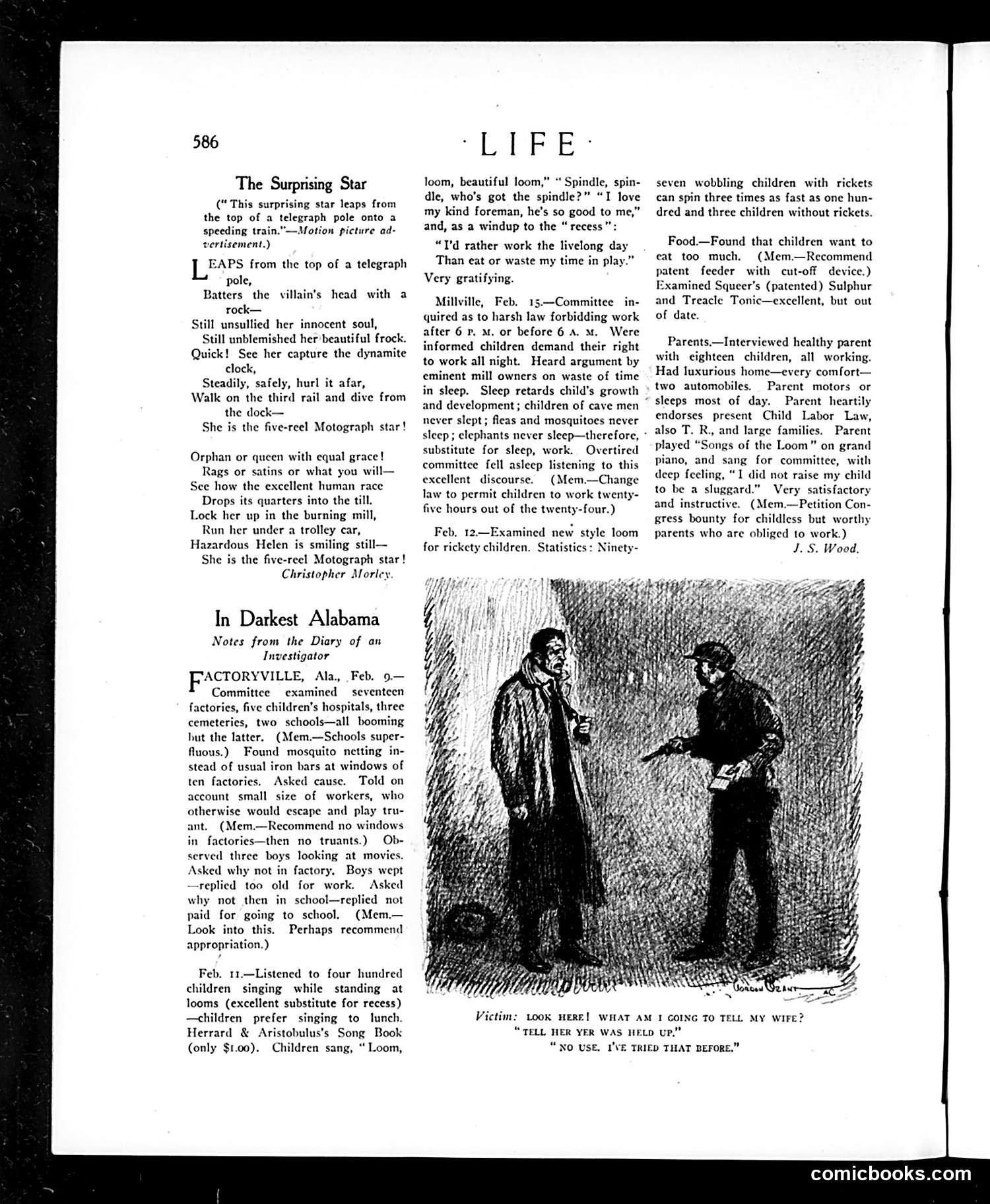
**"The Surprising Star"** satirizes melodramatic silent films, mocking their absurd plots where heroines perform increasingly dangerous stunts (leaping from telegraph poles, escaping burning mills, surviving trolley cars) while remaining pristine. The poem ridicules how audiences pay money to watch these implausible scenarios, while the female star endures abuse for entertainment. **"In Darkest Alabama"** is brutal satire of child labor conditions and the rationalizations used to justify them. An investigator documents a factory town where children work in mills instead of attending school, and mill owners argue children *prefer* work to rest or food. The "committee" proposes absurd "solutions" (no windows to prevent truancy, eliminating sleep). The final note about a wealthy parent with eighteen working children driving automobiles exposes how owners profit while children suffer. **The cartoon** shows a robbery victim unable to tell his wife he was robbed because he's used that excuse before—implying habitual victimization or dishonesty. The page critiques both entertainment exploitation and industrial child abuse as moral failures.
📄 Transcribed text from this page (OCR, searchable)
Machine-transcribed from the original scan — historical spelling and the odd misread are preserved.
586 The Surprising Star (“ This surprising star leaps from the top of a telegraph pole onto a speeding train."—Motion picture ad- vertisement.) EAPS from the top of a telegraph pole, Batters the rock— Still unsullied her innocent soul, Still unblemished her beautiful frock. Quick! See her capture the dynamite clock, Steadily, safely, hurl it afar, Walk on the third rail and dive from the dock— She is the five-reel Motograph star! villain’s head with a Orphan or queen with equal grace ! Rags or satins or what you will— See how the excellent human race Drops its quarters into the till. Lock her up in the burning mill, Run her under a trolley car, Hazardous Helen is smiling still— She is the five-reel Motograph star! Christopher Morley. In Darkest Alabama Notes from the Diary of an Investigator FAcTORYVILLE, Ala. Feb. 9.— Committee examined seventeen five children’s hospitals, three , two schools—all booming hut the latter. (Mem.—Schools super- fluous.) Found mosquito netting in- stead of usual iron bars at windows of ten factories. Asked cause. Told on account small size of workers, who otherwise would escape and play tru- ant. (Mem.—Recommend no windows in factories—then no truants.) Ob- served three boys looking at movies. Asked why not in factory, Boys wept —replicd too old for work. Asked why not then in school—replied not paid for going to school. (Mem— Look into this. Perhaps recommend appropriation.) Feb. 11.—Listened to four hundred children singing while standing at looms (excellent substitute for recess) —children prefer singing to lunch. Herrard & Aristobulus’s Song Book (only $1.00). Children sang, “Loom, “LPF E ° loom, beautiful loom,” “ Spindle, spin- dle, who’s got the spindle?” “I love my kind foreman, he’s so good to me,” and, as a windup to the “recess”: “Y'd rather work the livelong day Than eat or waste my time in play.” Very gratifying. Millville, Feb. 15.—Committee in- quired as to harsh law forbidding work after 6 rp, M. or before 6 A. M. Were informed children demand their right to work all night. Heard argument by eminent mill owners on waste of time in sleep. Sleep retards child’s growth and development ; children of cave men never slept; fleas and mosquitoes never sleep; elephants never sleep—therefore, substitute for sleep, work. Overtired committee fell asleep listening to this excellent discourse. (Mem.—Change law to permit children to work twenty- five hours out of the twenty-four.) Feb, 12.—Examined new style loom for rickety children. Statistics : Ninety- Victim: * sleeps most of day. seven wobbling children with rickets can spin three times as fast as one hun- dred and three children without rickets. Food.—Found that children want to eat too much. (Mem—Recommend patent feeder with cut-off device.) Examined Squeer’s (patented) Sulphur and Treacle Tonic—excellent, but out of date. Parents.—Interviewed healthy parent with eighteen children, all working. Had luxurious home—every comfort— two automobiles. Parent motors or Parent heartily endorses present Child Labor Law, also T. R., and large families. Parent played “Songs of the Loom” on grand piano, and sang for committee, with deep feeling, “I did not raise my child to be a sluggard.” Very satisfactory and instructive. (Mem.—Petition Con- gress bounty for childless but worthy parents who are obliged to work.) J.S. Wood, LOOK HERE! WHAT AM I GOING TO TELL MY WIFE? “TELL HER YER WAS HELD UP,”” “NO USE, I'VE TRIED THAT BEFORE.” comicbooks.com