
A complete issue · 44 pages · 1916
Life — January 27, 1916
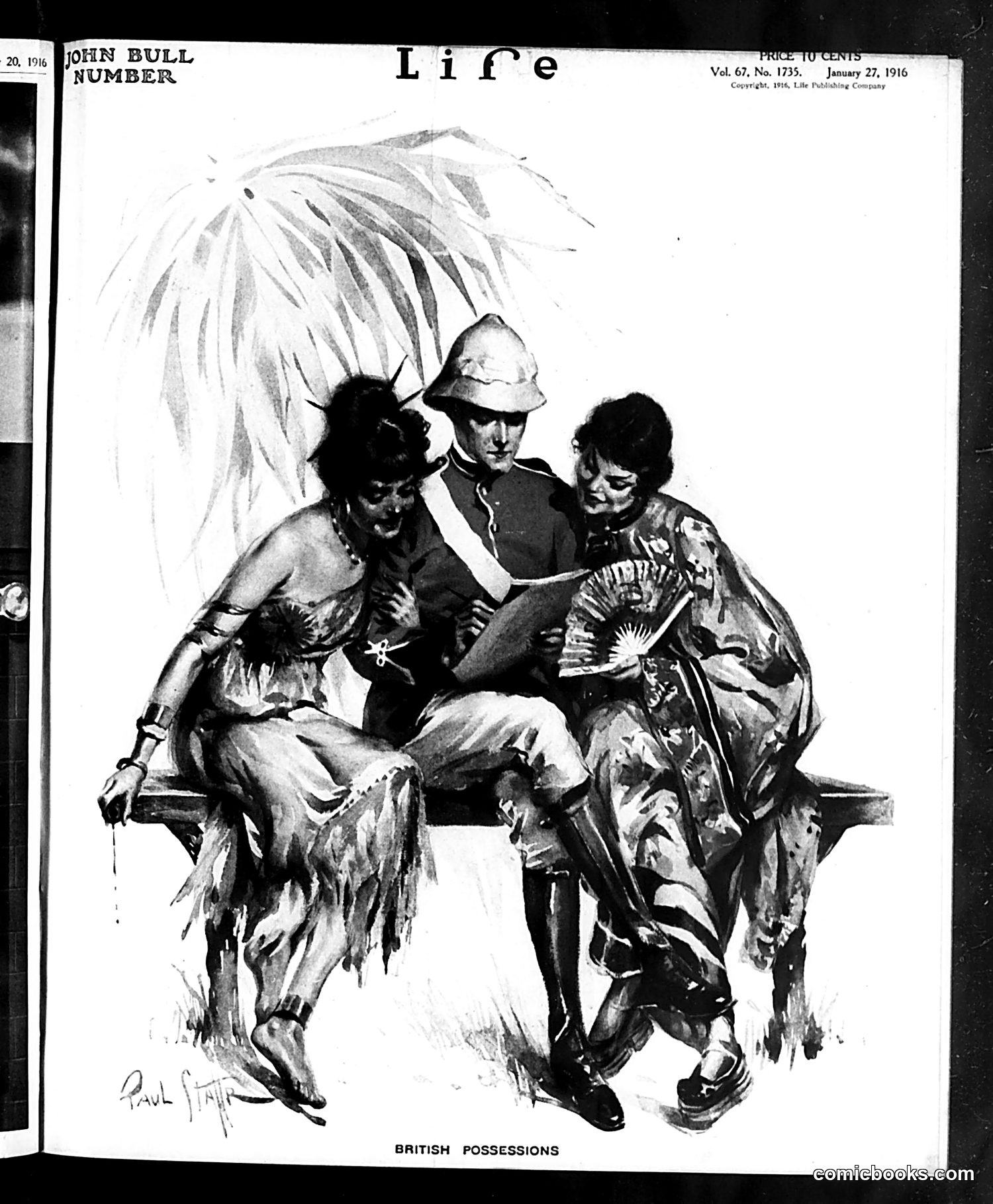
This cartoon satirizes British imperial rule during World War I. A British soldier in a pith helmet sits between two figures representing British colonial possessions—likely India (left) and another Asian territory (right), depicted in exoticized, stereotypical dress. The figures appear to be offering or showing the soldier documents or maps. The satire critiques how Britain was leveraging its empire during the war, possibly addressing the extraction of resources, troops, or financial support from colonies to support the war effort. The title "British Possessions" emphasizes that these territories were treated as property to be exploited rather than as peoples with agency. The cartoon reflects contemporary debates about imperial obligation and wartime mobilization.
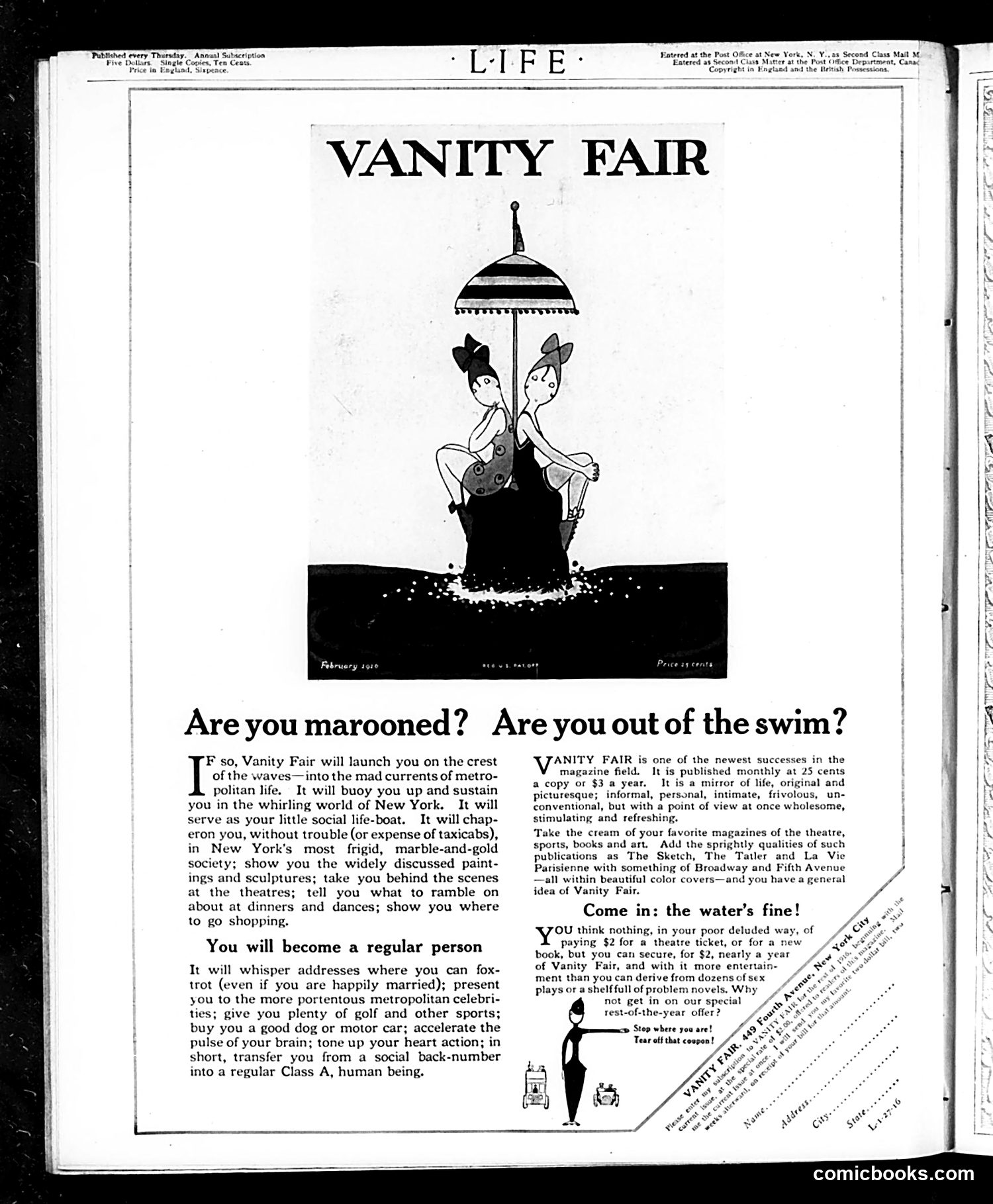
This is a **magazine advertisement**, not political satire. It promotes *Vanity Fair* magazine to potential subscribers using humorous social commentary typical of 1920s advertising. The cartoon depicts two fashionable figures sharing a striped umbrella, appearing to emerge from water—illustrating the phrase "Are you marooned? Are you out of the swim?" The ad uses this metaphor to suggest that without *Vanity Fair*, readers are socially isolated and culturally behind. The magazine promises to keep subscribers current on theater, sports, art, fashion, and high society—essential knowledge for maintaining social status among the "metropolitan life" crowd. The humor relies on equating magazine subscription with social competence and class standing—a common advertising strategy of the era emphasizing aspiration and social anxiety.
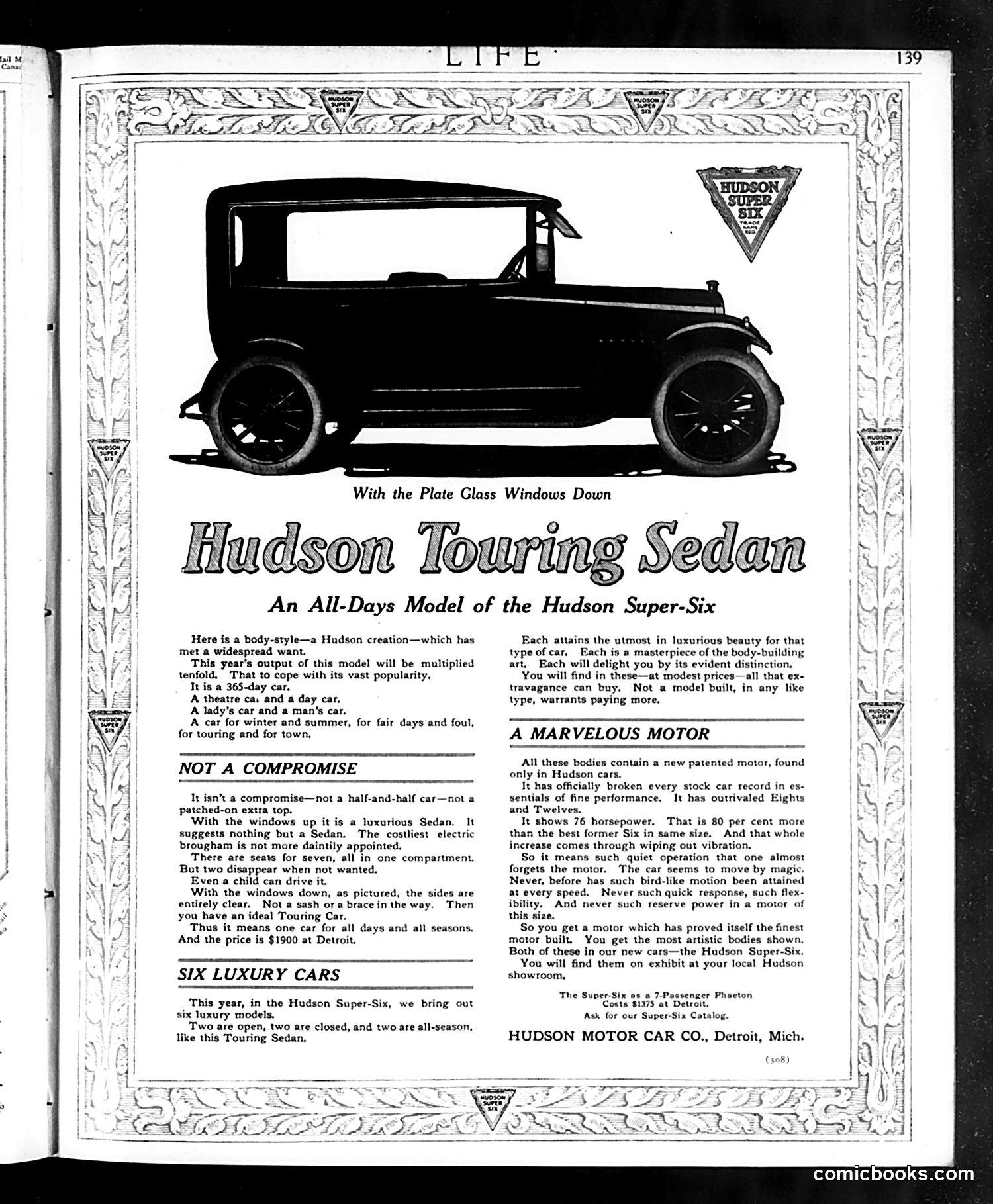
This is **not a cartoon or satire page** — it's a straightforward automobile advertisement for the Hudson Super-Six Touring Sedan, published in *Life* magazine (page 139). The ad promotes Hudson Motor Car Company's luxury vehicle line, emphasizing that the Super-Six is "not a compromise" but a full-featured sedan suitable for all seasons and purposes. Key selling points include: - A new patented motor with 76 horsepower - Plate glass windows that lower completely - Six luxury body styles (two open, two closed, two all-season models) - Superior engineering and quiet operation The text uses *Life*'s characteristic witty tone, but this is commercial advertising, not political or social satire. The page exemplifies how major corporations purchased ad space in the magazine during the 1920s-30s.
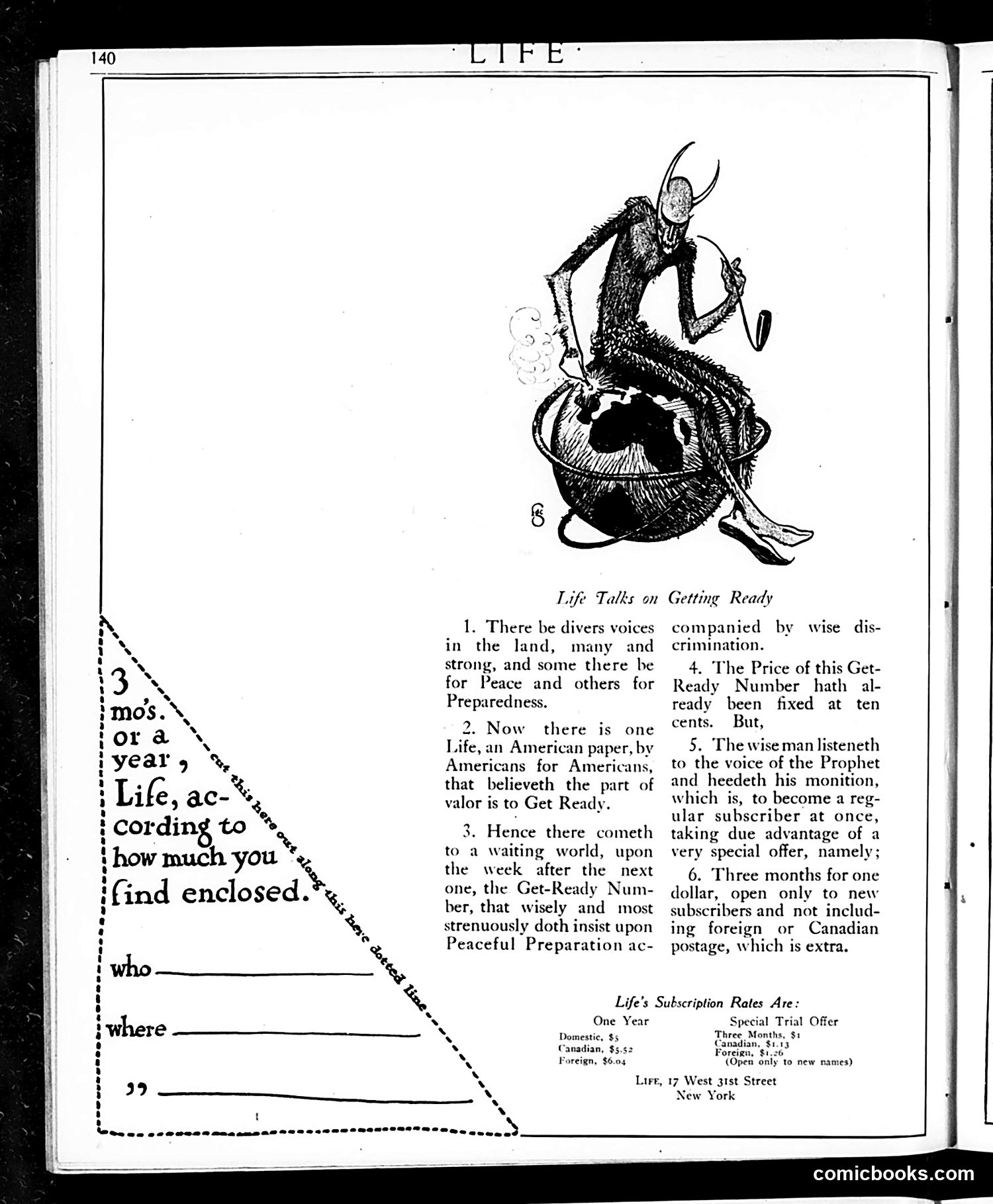
This page is primarily a **subscription advertisement** for *Life* magazine, not political satire. The illustration depicts a grotesque demon or devil figure emerging from a cauldron, labeled as commentary on "Life Talks on Getting Ready." The accompanying text discusses *Life*'s editorial position favoring "Peaceful Preparation" and "Get Ready" — likely referencing American military preparedness, a contentious political issue in the 1910s during World War I. The demon imagery appears designed to suggest danger or threat justifying preparedness. The left side contains a subscription coupon offering three-month trials or yearly subscriptions at various prices for domestic, Canadian, and foreign readers. This is fundamentally **promotional material** rather than political cartoon commentary, though the "Get Ready" messaging reflects contemporary debates about American military readiness.
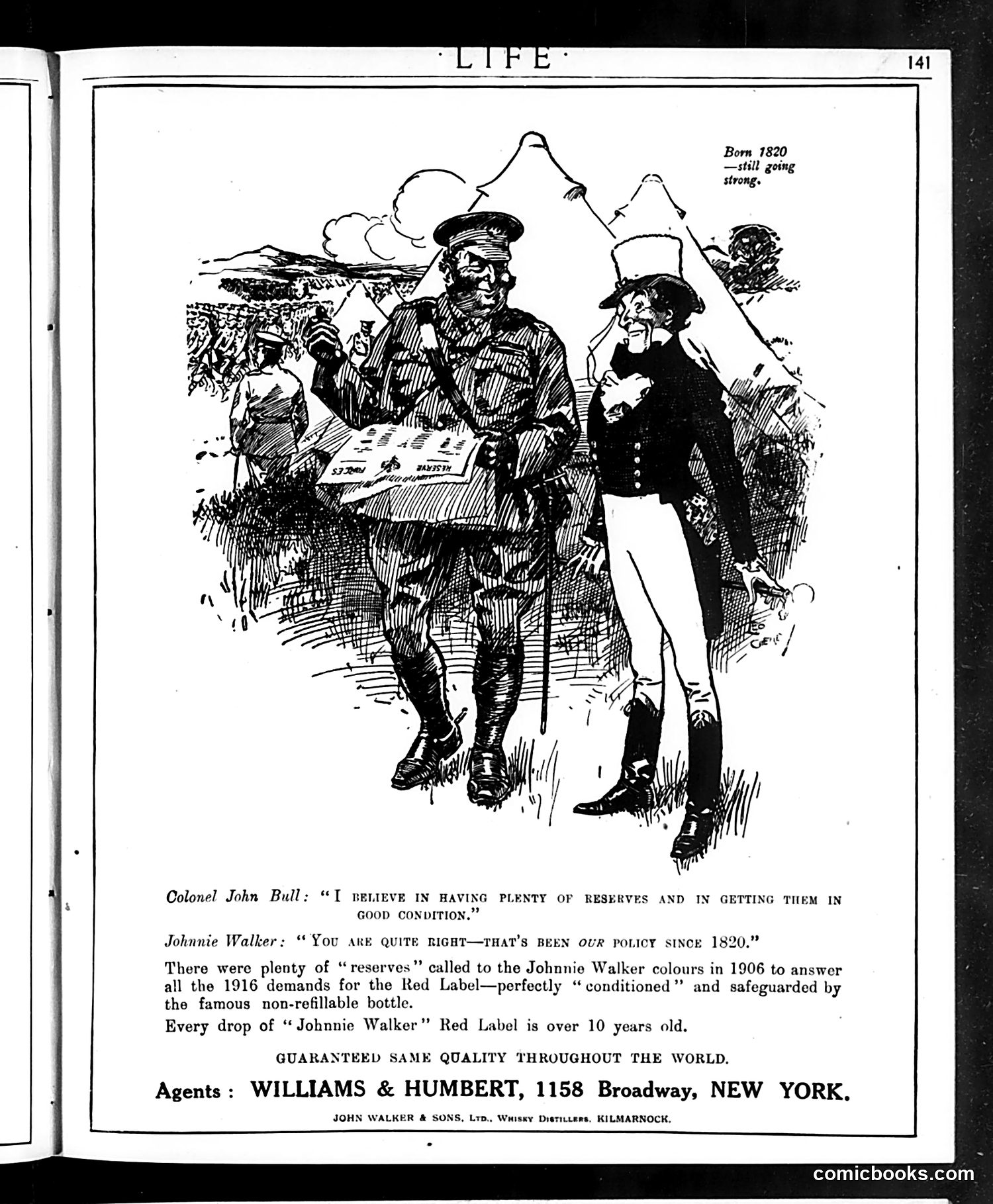
This page is **primarily a whisky advertisement** for Johnnie Walker using political satire. The cartoon depicts two figures in conversation: Colonel John Bull (personification of Britain, left) and Johnnie Walker (right, appearing as a thin man in formal dress). Bull states he believes in maintaining "reserves" in "good condition"—a double meaning referencing both military preparedness and whisky aging. Walker responds that this has been "our policy since 1820," suggesting the brand's reliability and longevity. The advertisement claims Johnnie Walker Red Label reserves from 1906 were perfectly preserved to meet 1916 demands, implying the product's consistent quality. The satire plays on contemporary wartime concerns about reserves and preparedness while marketing whisky as time-tested and dependable. The text notes the brand is "over 10 years old."
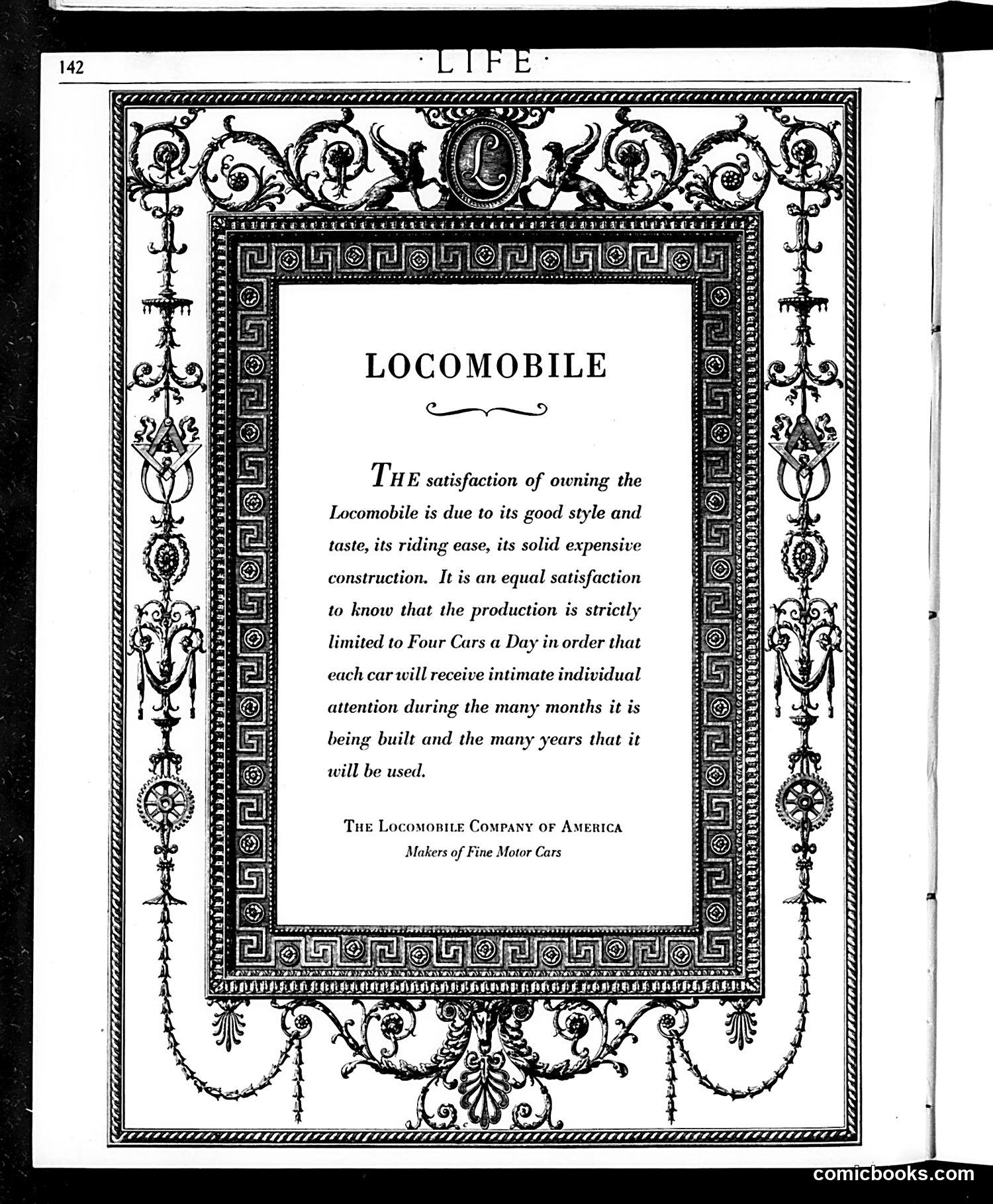
This page is **not a cartoon or satire**—it's a **luxury automobile advertisement** for the Locomotile Company of America, disguised as editorial content in *Life* magazine. The ad emphasizes exclusivity and craftsmanship: Locomotile owners enjoy "good style and taste" and "riding ease," with "solid expensive construction." The key selling point is **limited production—"Four Cars a Day"**—suggesting each vehicle receives meticulous attention. For modern readers: this represents early 1900s luxury marketing targeting wealthy elites. The ornate decorative border mimics fine art or literature pages, positioning automobile ownership as a mark of refined taste rather than mere transportation. The scarcity claim (four cars daily) was a common exclusivity strategy used to justify premium pricing and appeal to status-conscious buyers.
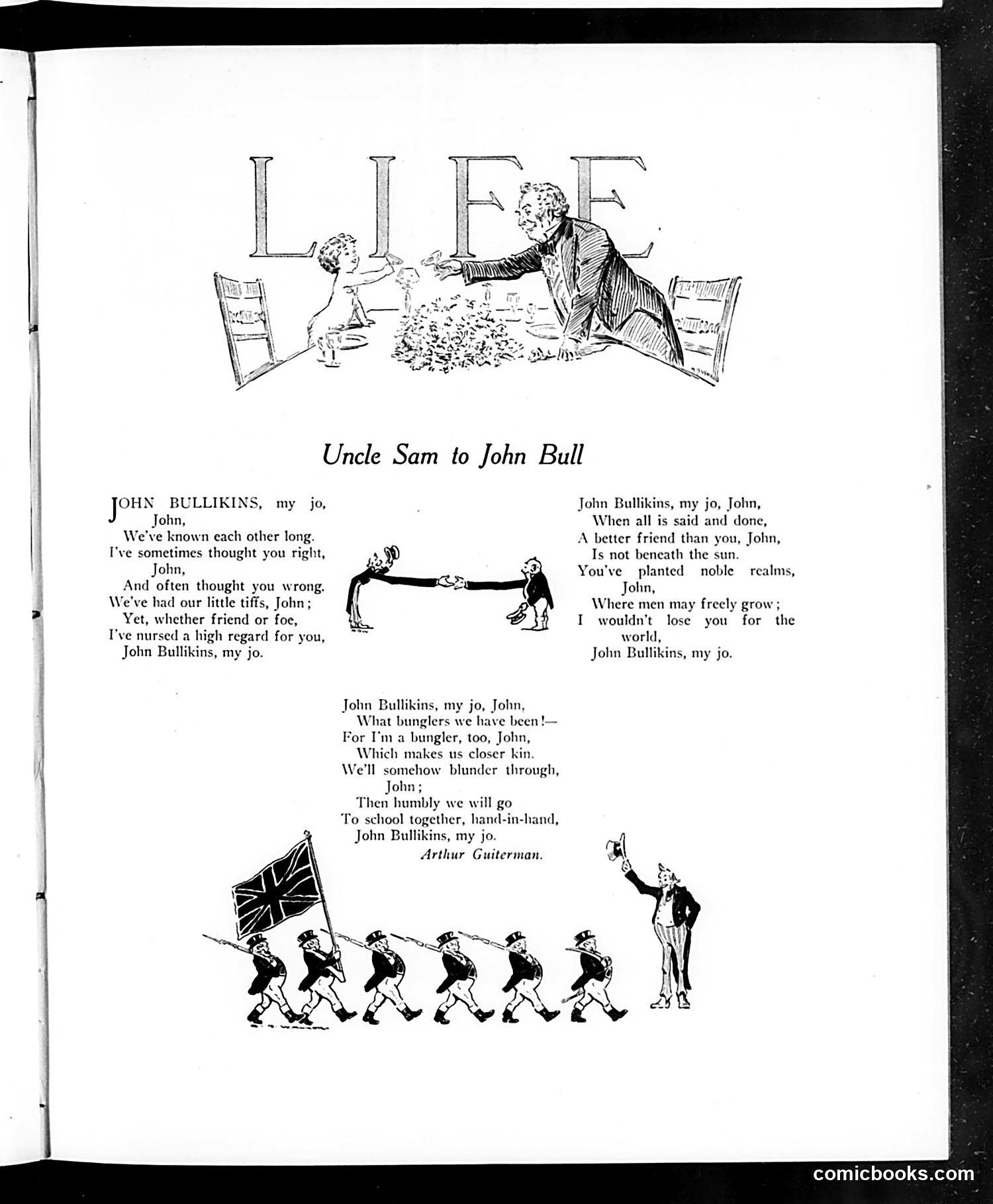
This page presents a poem by Arthur Guiterman addressing "John Bullikins" (a diminutive, mocking name for John Bull, the personification of Britain). The illustrations show Uncle Sam (representing America) and John Bull as figures with a long shared history—acknowledging past disagreements ("thought you wrong") while affirming their deep bond. The satire's point: despite Anglo-American tensions, the two nations are fundamentally allied ("a better friend than you, John, / Is not beneath the sun"). The final image of schoolchildren marching with a British flag under Uncle Sam's direction suggests America and Britain moving forward together, hand-in-hand, as partners rather than rivals. The tone is affectionate teasing rather than hostile—acknowledging quarrels while celebrating kinship.
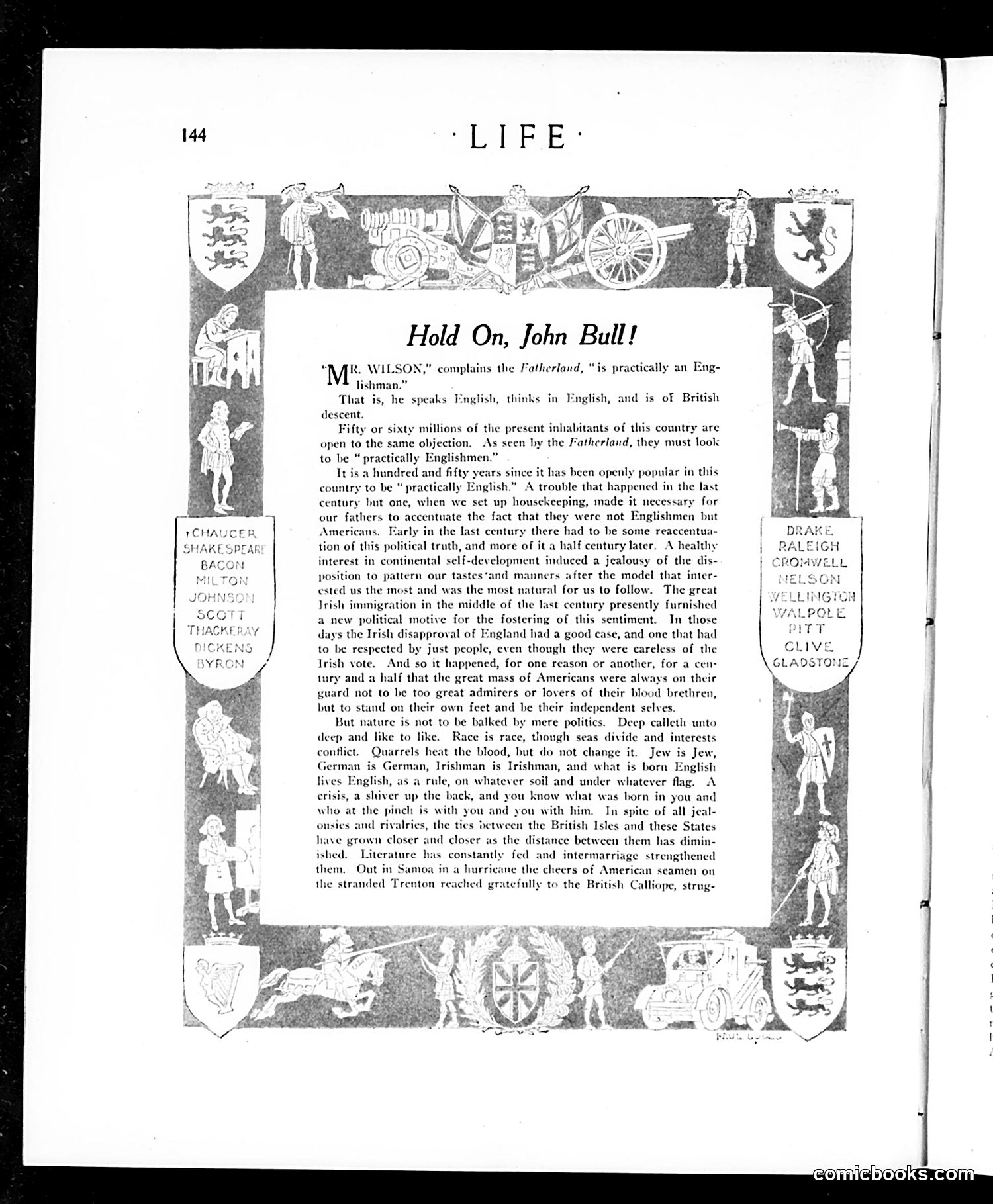
This satirical piece addresses Irish-American identity and Anglo-American relations. Mr. Wilson (the U.S. President, circa 1910s) claims the "Fatherland" produces "practically an Englishman"—someone English-speaking of British descent. The text argues that millions of Americans, though of British descent, should not be considered English but rather independent Americans. It critiques both British expectations of cultural loyalty and American anxiety about divided allegiances. The decorative border features heraldic shields and historical figures (names visible include Chaucer, Shakespeare, Bacon, Johnson, Scott, Dickens, Byron, Drake, and others)—representing English cultural heritage the piece ironically invokes while asserting American independence from it. The "John Bull" reference (British national symbol) emphasizes the central tension: Britain should "hold on" and accept American autonomy.
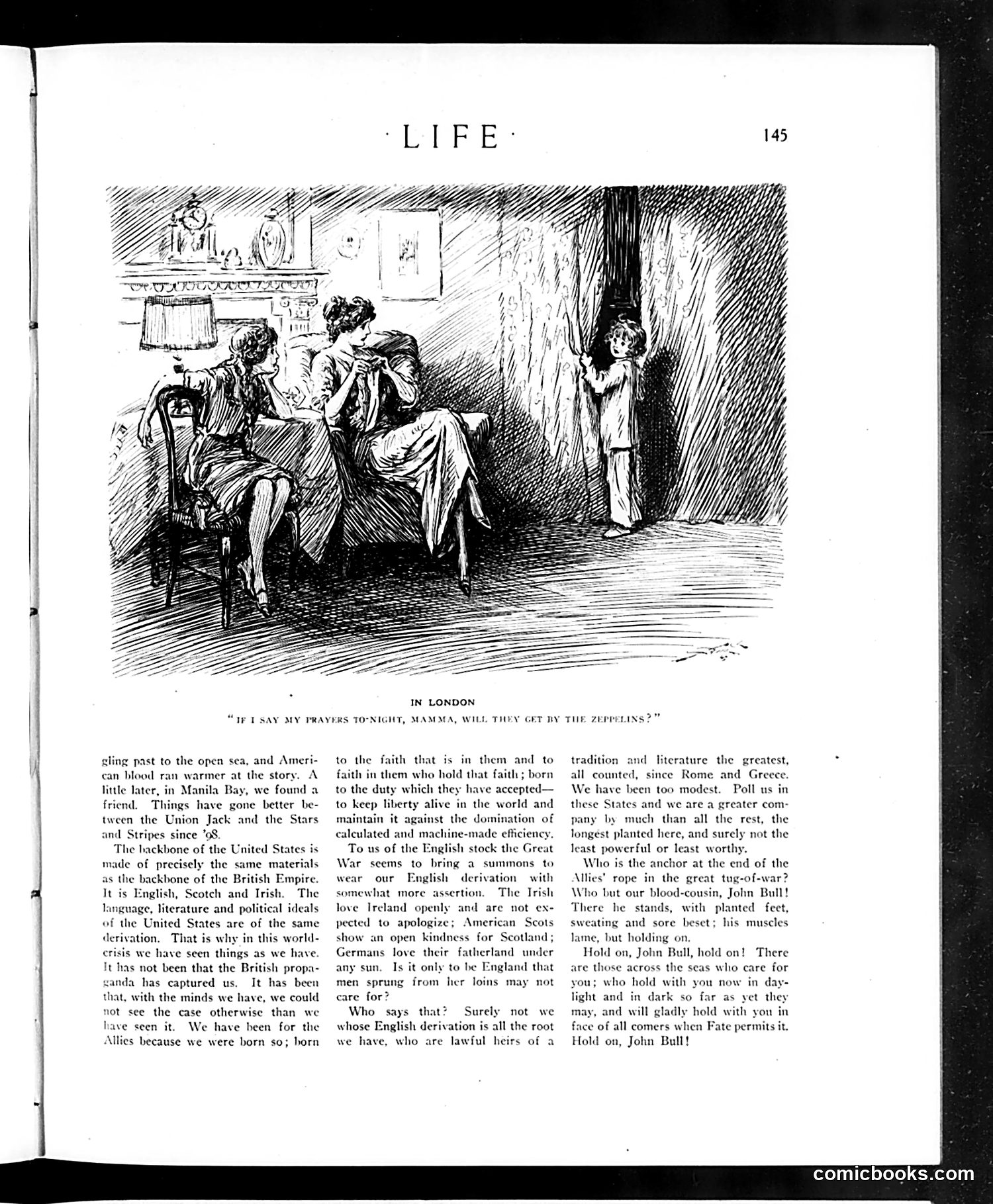
This page features a satirical illustration captioned "IN LONDON: 'IF I SAY MY PRAYERS TO-NIGHT, MAMMA, WILL THEY GET BY THE ZEPPELINS?'" The cartoon depicts a domestic scene with two adult women and a child in what appears to be an English home during World War I. The child's anxious question about prayers reaching heaven despite German Zeppelins (airships conducting bombing raids) darkly satirizes the wartime anxiety affecting British civilians. The accompanying text discusses English heritage and identity, contrasting British character with other nations while addressing wartime sacrifices. The satire targets how even innocent childhood faith becomes shadowed by modern warfare's horrors—specifically aerial bombardment, a relatively novel threat that terrorized British civilian populations during WWI.
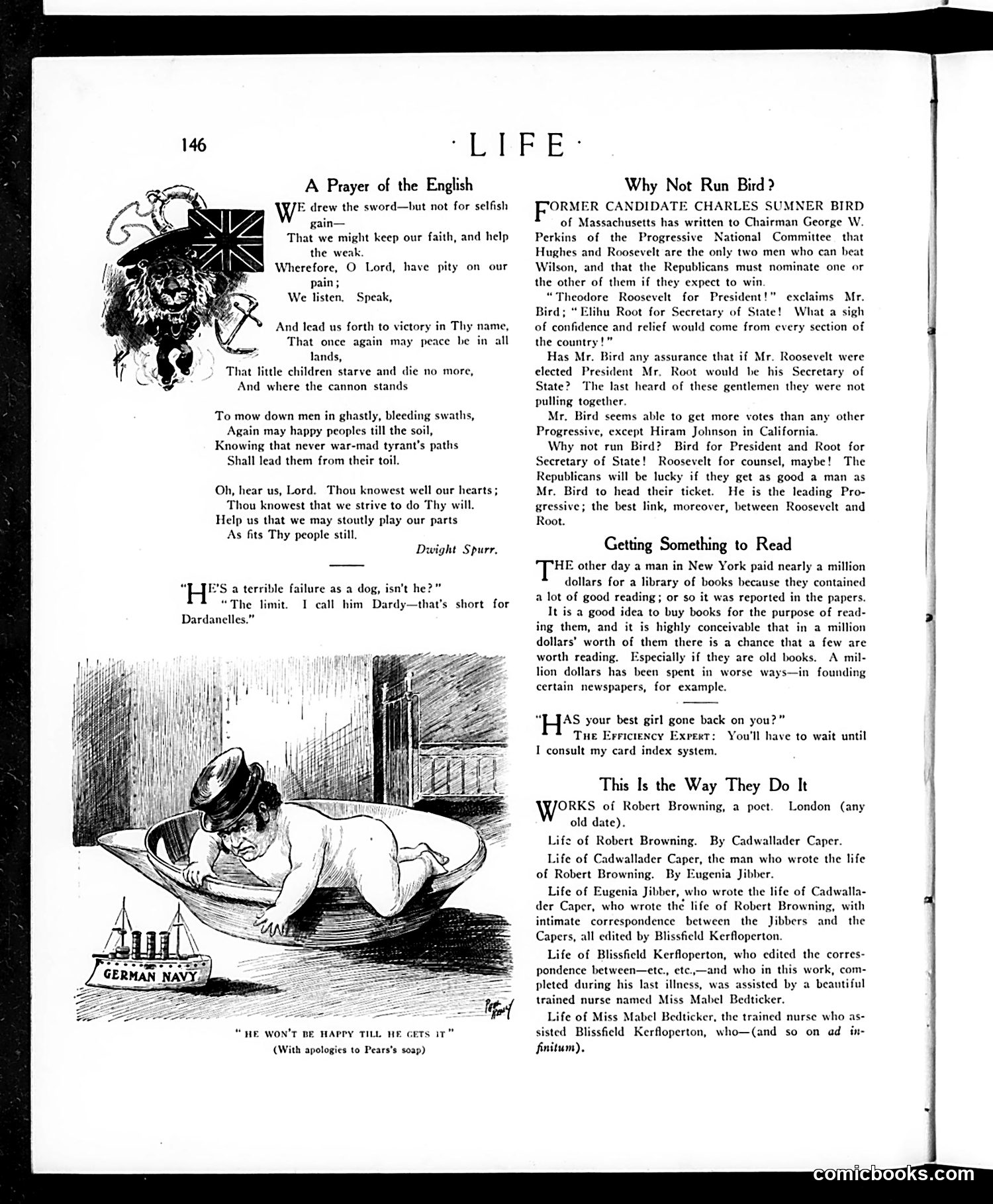
**Main Content:** This page contains several unrelated satirical pieces typical of Life magazine's format. **Key Items:** 1. **"A Prayer of the English"** - A patriotic poem with ornamental British emblem, likely from WWI era based on martial language ("drew the sword"). 2. **"Why Not Run Bird?"** - Political satire discussing Charles Sumner Bird as a potential Progressive Party presidential candidate alongside Theodore Roosevelt. The piece sarcastically questions whether Bird could be Roosevelt's running mate, mocking both the Progressive Party's prospects and Bird's political viability. 3. **Dog cartoon** - A small sketch captioned "He won't be happy till he gets it" (referencing Pears soap), showing a dog in water—unrelated humor. 4. **Book reviews section** - "Getting Something to Read" and "This Is the Way They Do It" discuss literature purchases and biographies of Robert Browning. The page reflects early 20th-century American political commentary and literary discussion.
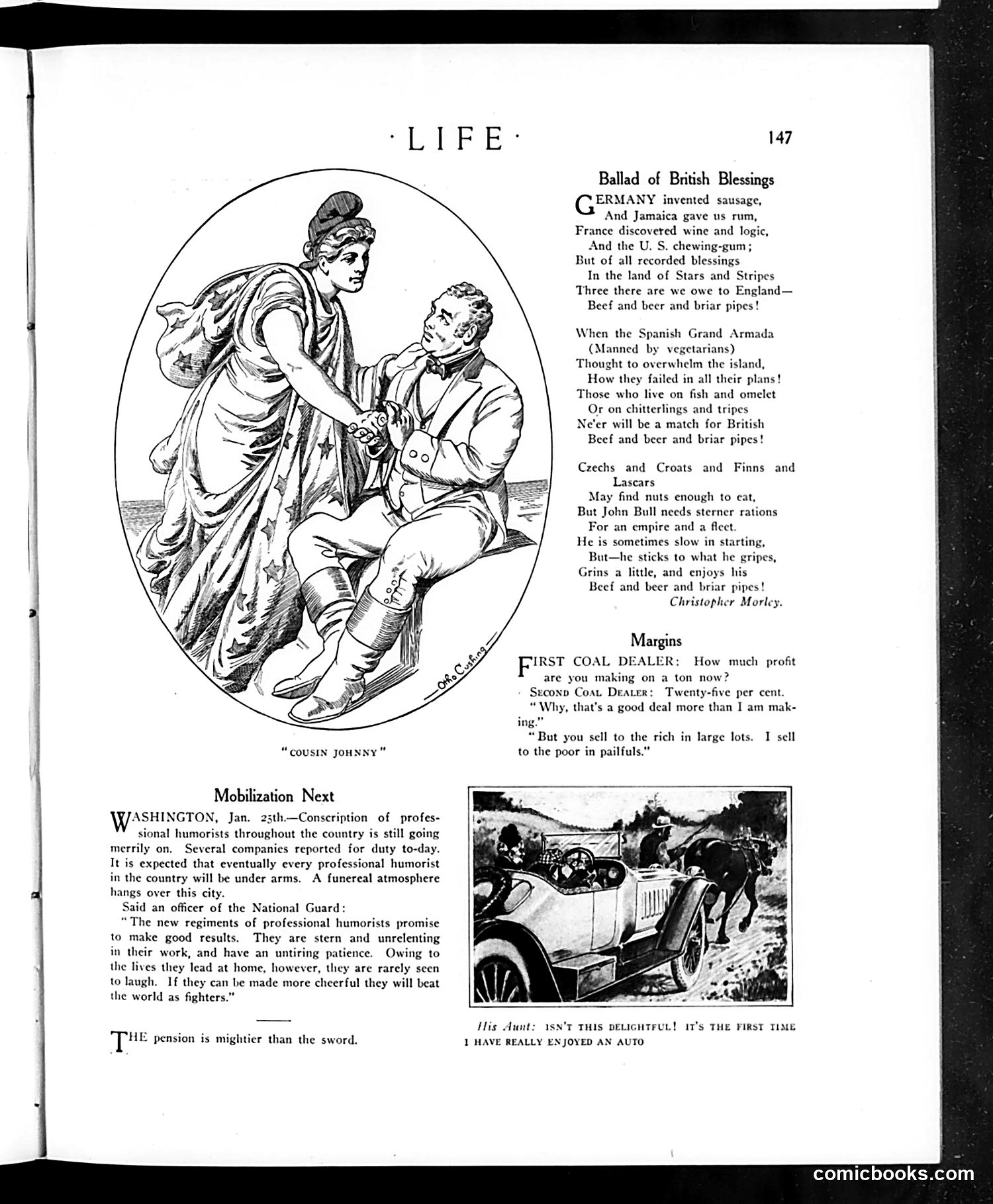
This page contains satirical content about British national identity and WWI preparations. **"Ballad of British Blessings"** (by Christopher Morley) is a poem celebrating British staples—beef, beer, and briar pipes—as superior to other nations' contributions. It mocks various countries (Germany's sausage, Jamaica's rum, France's wine) while asserting these three items as Britain's greatest gifts to civilization. The poem includes a jab at vegetarians who opposed the Spanish Armada. **"Cousin Johnny"** illustration depicts Britannia (female figure) with a British soldier, likely representing the relationship between Britain and America during WWI. **"Mobilization Next"** section reports on American conscription of professional humorists, treating the topic ironically—suggesting even comedians will be drafted for the war effort. The overall message celebrates British culture while acknowledging coming American military involvement in World War I.
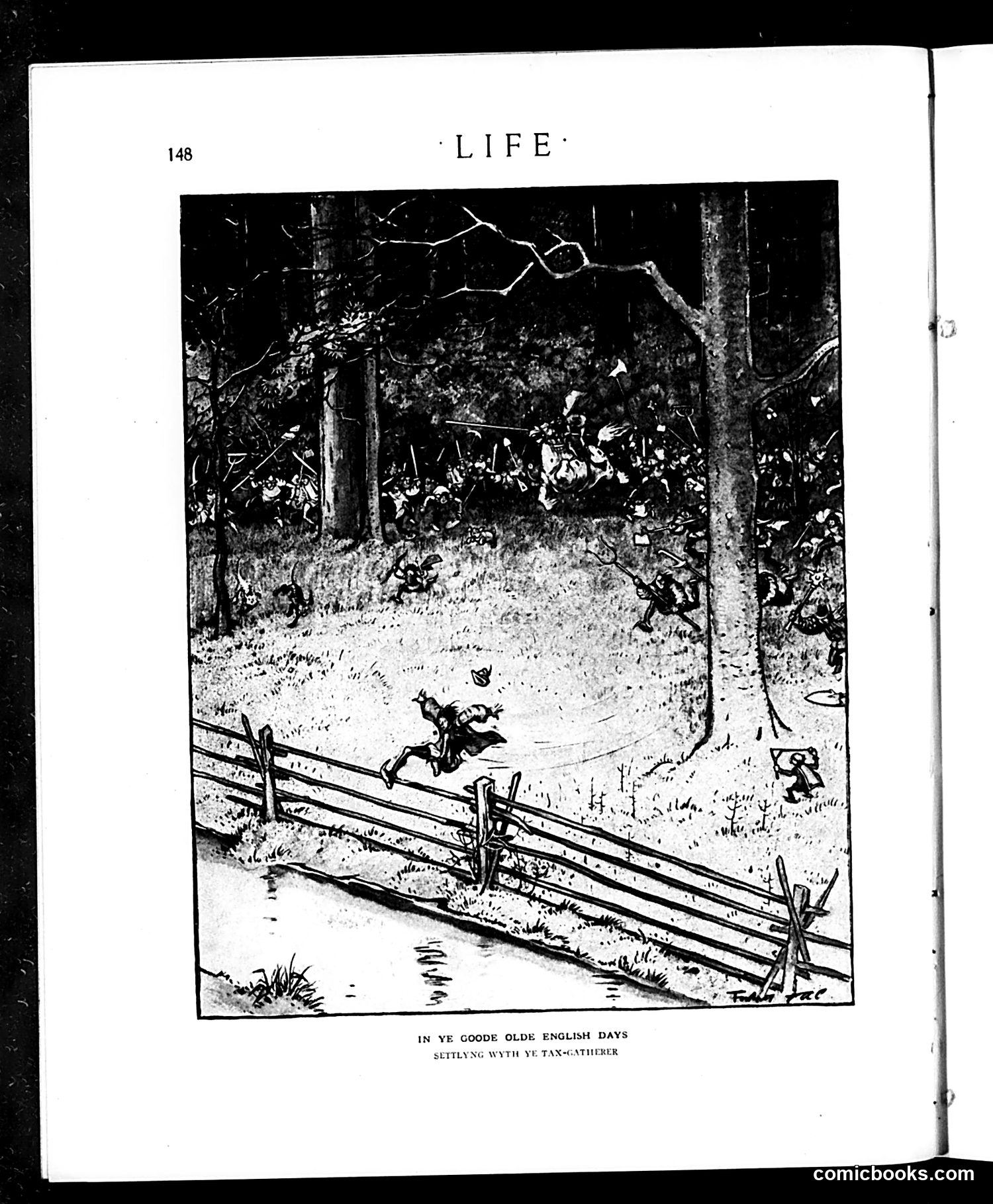
This illustration depicts a colonial-era hunting scene titled "In Ye Goode Olde English Days: Settling with Ye Tax-Gatherer." The image shows a figure being thrown or falling from a fence in a wooded clearing, apparently being violently ejected by colonists. The satire likely references 18th-century American colonial resistance to British taxation—specifically, the violent opposition to tax collectors sent from England. By framing this as "olde English days," the cartoonist uses historical irony to comment on how settlers resorted to physical force against tax enforcement, suggesting this was an established "tradition" of English resistance to unwanted taxation rather than purely American rebellion. The crude humor mocks both the tax-gatherer's misfortune and the colonists' rough methods of protest.
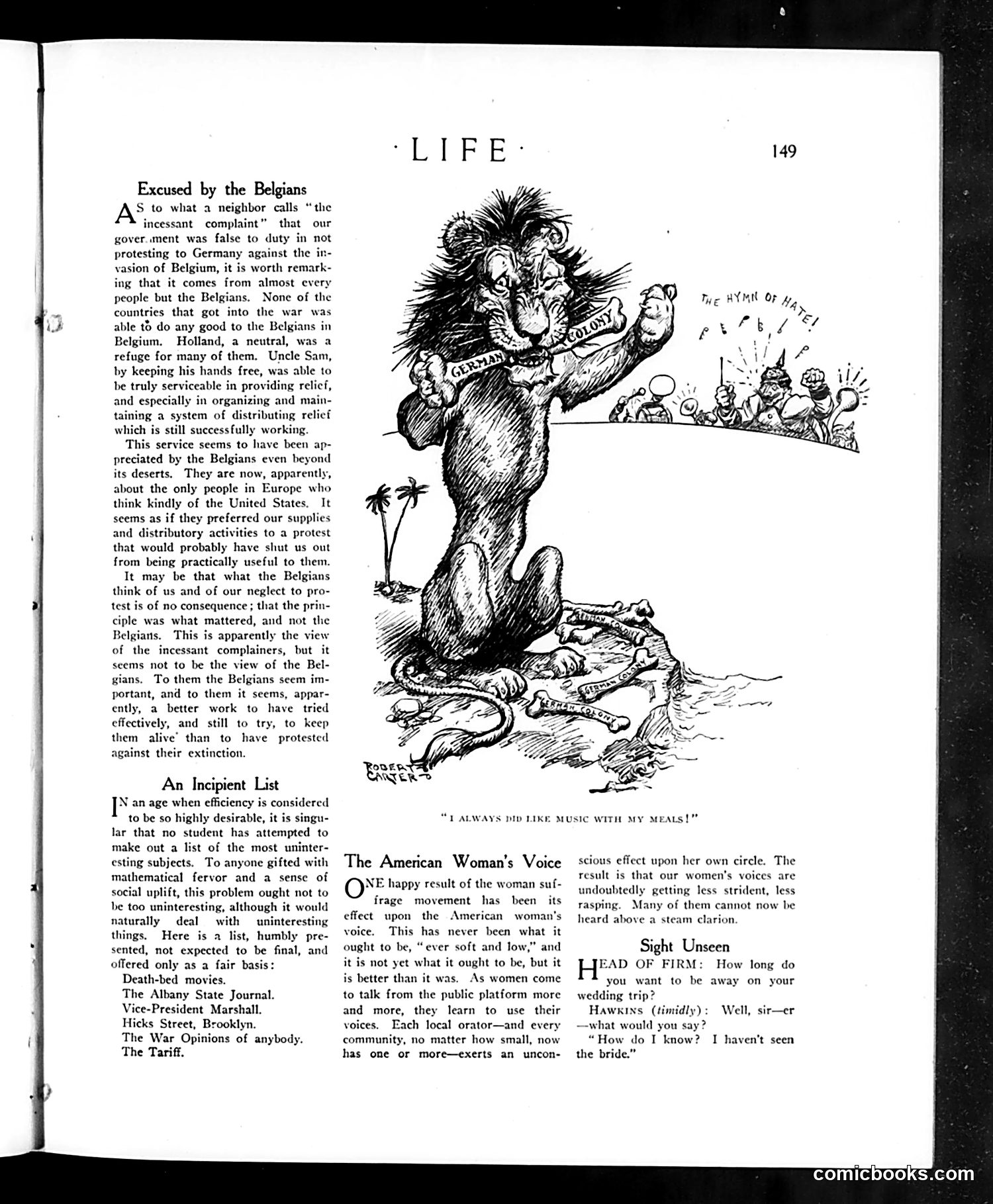
This page from *Life* magazine features a satirical cartoon depicting **Germany as a grotesque ape or beast** wearing a spiked military helmet (Prussian "Pickelhaube"), labeled "GERMANY." The creature clutches a bloody club and stands over corpses. Tiny figures representing various nations appear on a platform above, with text reading "THE WRATH OF HELL!" The cartoon critiques **German military aggression during World War I**, portraying Germany as a savage, destructive force. The scattered bodies and weapons at the beast's feet symbolize war casualties and destruction caused by German invasion and warfare. The surrounding article discusses **Belgian neutrality and America's humanitarian response**, praising Belgium's relief efforts while criticizing those who complained about American aid distribution—reflecting wartime divisions over U.S. involvement.
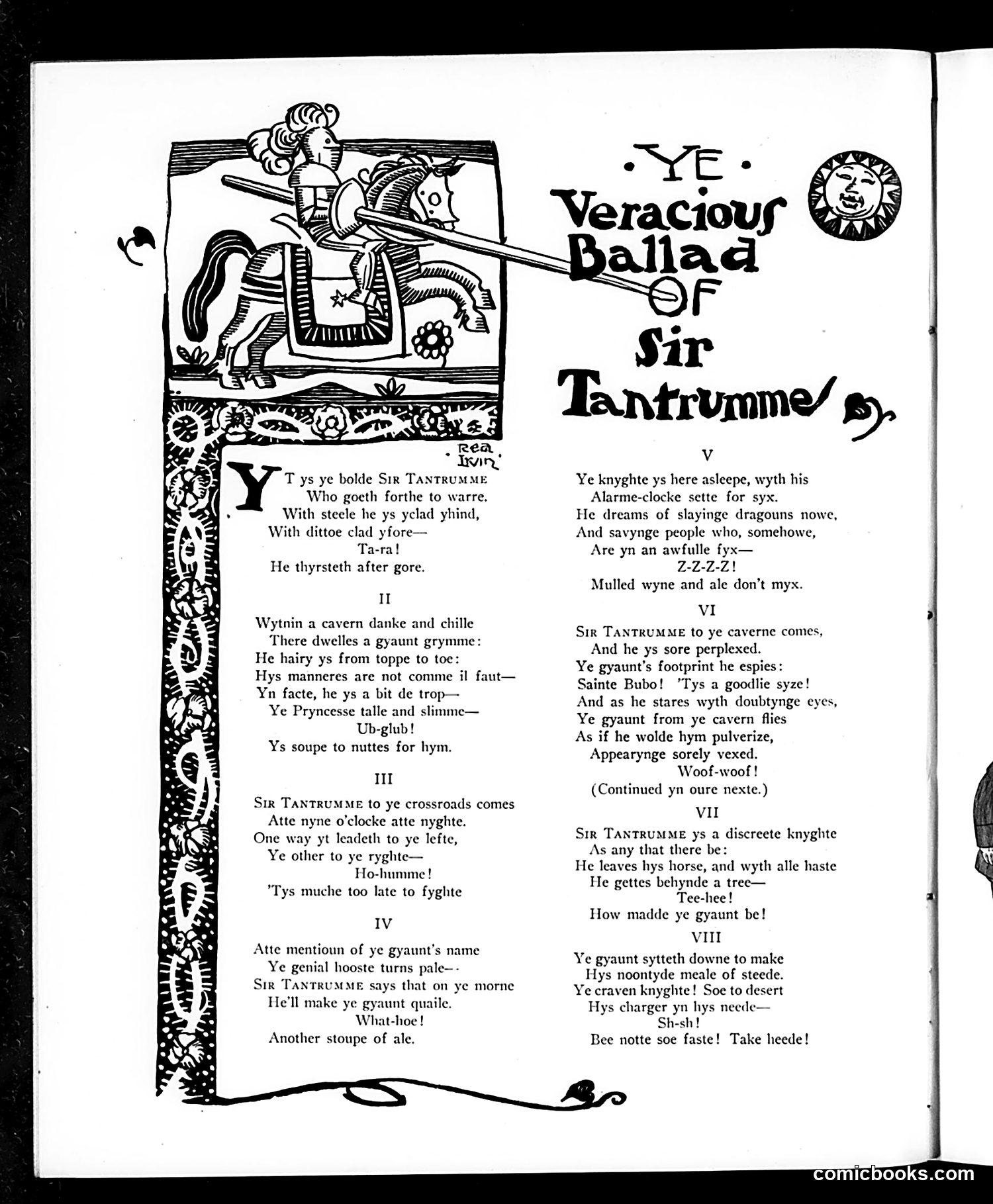
This is a mock-medieval ballad in deliberately archaic and fractured English, presented as humorous light verse. The page features an ornate decorative border and a woodcut-style illustration of an armored knight on horseback. The narrative appears to be satirical mockery of knightly behavior and masculine bluster. Sir Tantrumme—whose name itself suggests temperamental outbursts ("tantrums")—is portrayed as incompetent and vain: he gets lost traveling, encounters a grotesque cavern-dwelling creature, loses his horse, and generally fails at heroic quests. The exaggerated medieval dialect and over-the-top adventures parody chivalric romance conventions. This is essentially comedic satire of knightly pretension, likely appealing to Life magazine's educated audience familiar with medieval literature tropes.
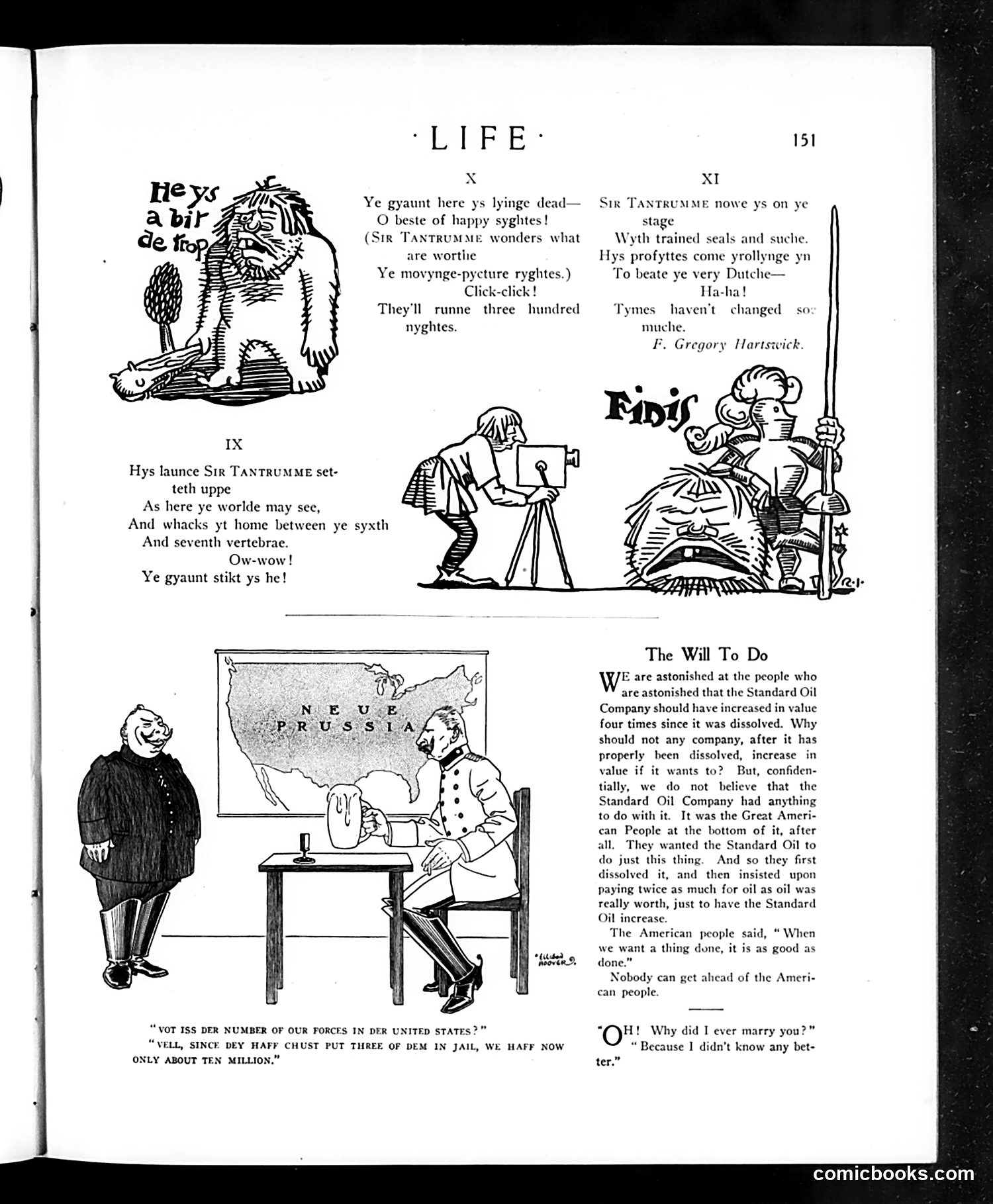
This page contains several satirical cartoons mocking early 20th-century topics: **Top sections (IX-XI):** Mock-Medieval pastiche mocking Sir Tantrumme, a fictional character representing someone prone to childish outbursts. The archaic language and exaggerated illustrations parody medieval literature. **Center cartoon:** Shows two figures discussing a map of "Neue Prusssia" (New Prussia), likely satirizing German imperial ambitions or expansion rhetoric during this era. **"The Will To Do":** A prose piece mocking the Standard Oil Company's increased post-dissolution value, sarcastically praising American business ingenuity. The joke is that dissolving a monopoly somehow made it wealthier—absurd but apparently factual, exemplifying American capitalism's resilience. **Bottom cartoon:** A German-accented joke about military conscription in the United States. The overall theme criticizes American big business, German militarism, and imperial politics.
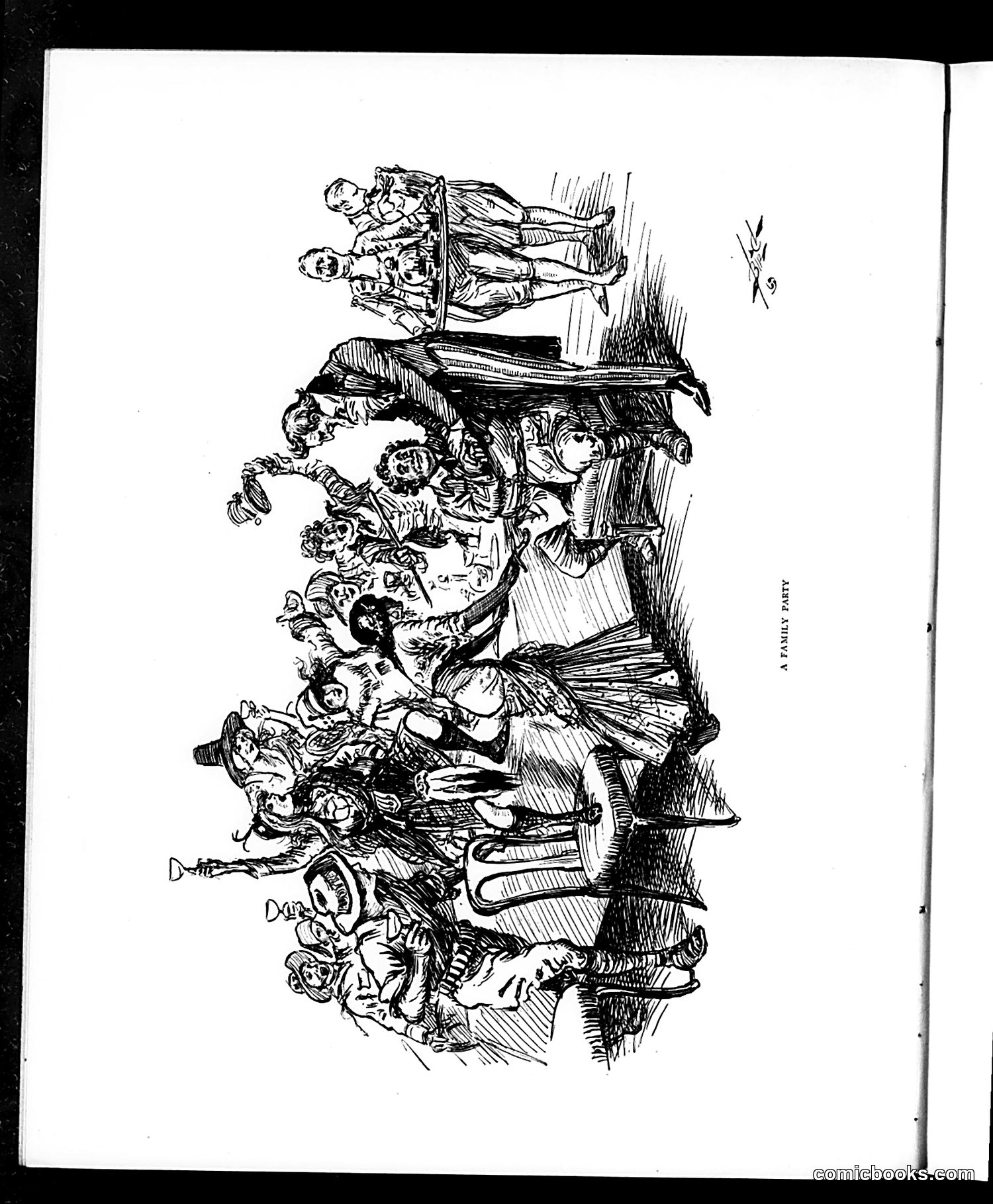
This satirical illustration depicts a Victorian-era family gathering turned upside down—literally. The image shows multiple figures stacked or layered in an inverted composition, with adults and children in various states of disarray. The title "A Family Party" suggests this is social satire commenting on domestic life, likely mocking either chaotic family gatherings or perhaps critiquing Victorian family structures and expectations. The inverted perspective creates visual comedy while the crowded, tangled arrangement of figures emphasizes confusion or disorder within the family unit. Without additional context from Life magazine's publication date, the specific satirical target remains unclear, though the humor appears to target middle-class domestic life and family dynamics of the period.
This page presents a WWI short story contest entry set in the trenches of France. The narrative depicts Irish Guards soldiers, including the decorated hero Sergeant O'Reilly (recently awarded the Victoria Cross), preparing for a trench raid. The story's irony lies in contrasting O'Reilly's celebrated heroism with the sardonic realism of fellow soldiers Finnessy and Moloney. While the press romanticizes O'Reilly's valor and the public celebrates him at Buckingham Palace and in his village, his comrades cynically discuss how medals attract girls and joke about carrying him into enemy trenches despite his small stature. The climactic moment arrives at "five o'clock"—the signal for an assault following a artillery barrage. As soldiers prepare to go "over the top," Finnessy and Moloney argue over who will rescue O'Reilly if he falls, revealing the grim reality beneath wartime heroics: daily casualty-producing trench raids. The story exemplifies how Life magazine presented WWI—acknowledging genuine bravery while depicting soldiers' dark humor as coping mechanism for industrial slaughter.
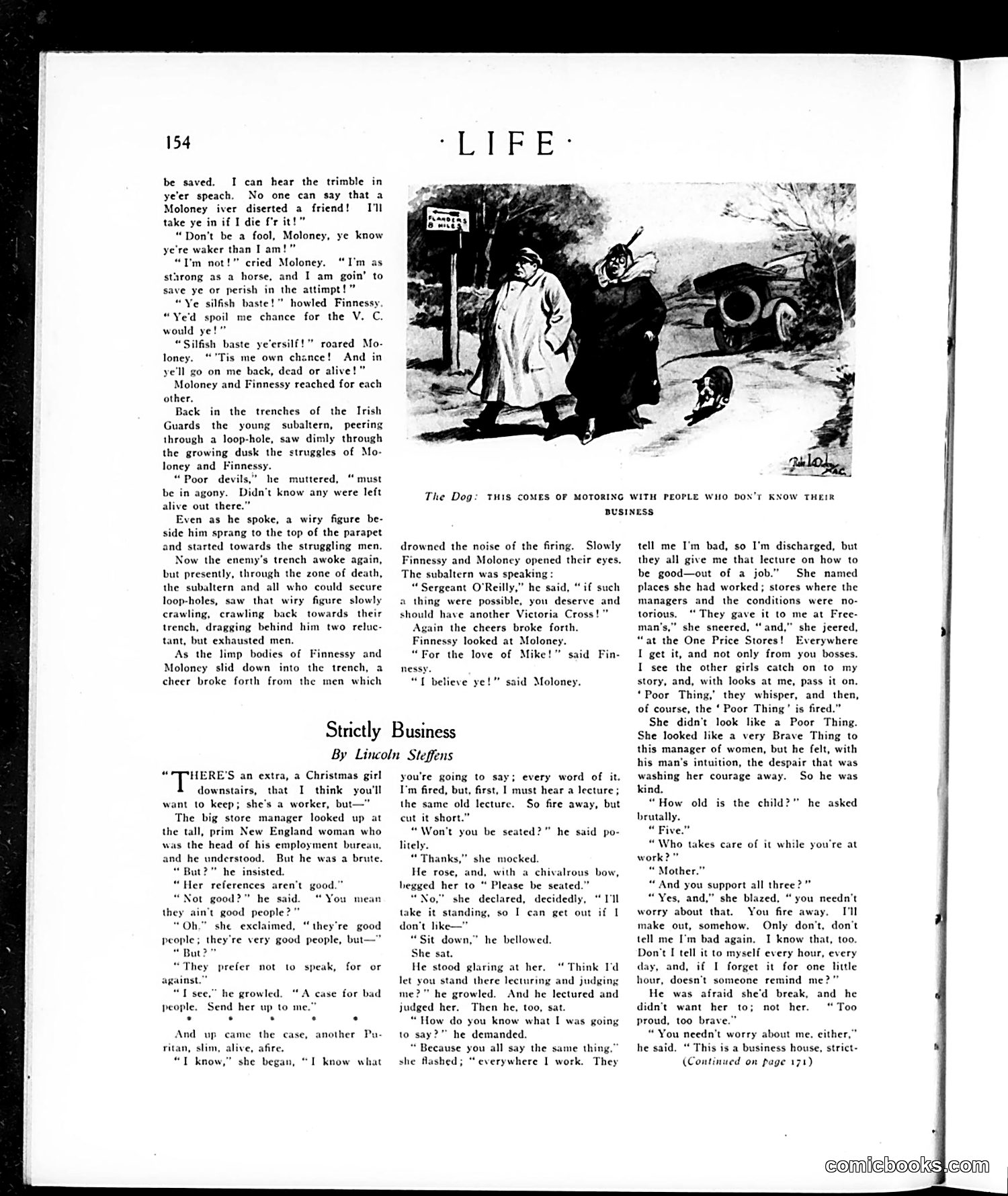
This page contains two distinct pieces of fiction satirizing social hierarchies and workplace injustice in early 20th-century America. **Top section:** A WWI trench narrative depicting Irish soldiers (Moloney and Finnessy) where pride and desire for military honors (the Victoria Cross) nearly override comradeship. The satire critiques how institutional recognition can corrupt human bonds. **"Strictly Business" (by Lincoln Steffens):** A story about a store manager and female employee. The woman is repeatedly fired despite good character, receiving identical patronizing lectures about self-improvement at every job. The satire exposes how employers use moral lectures to justify poor working conditions and low wages while blaming workers for their circumstances. The woman's observation that other workers spread her "Poor Thing" story reveals how systemic exploitation is normalized and perpetuated among the working class itself. The cartoon depicts a motorist with people unfamiliar with driving—a joke about incompetence causing problems.
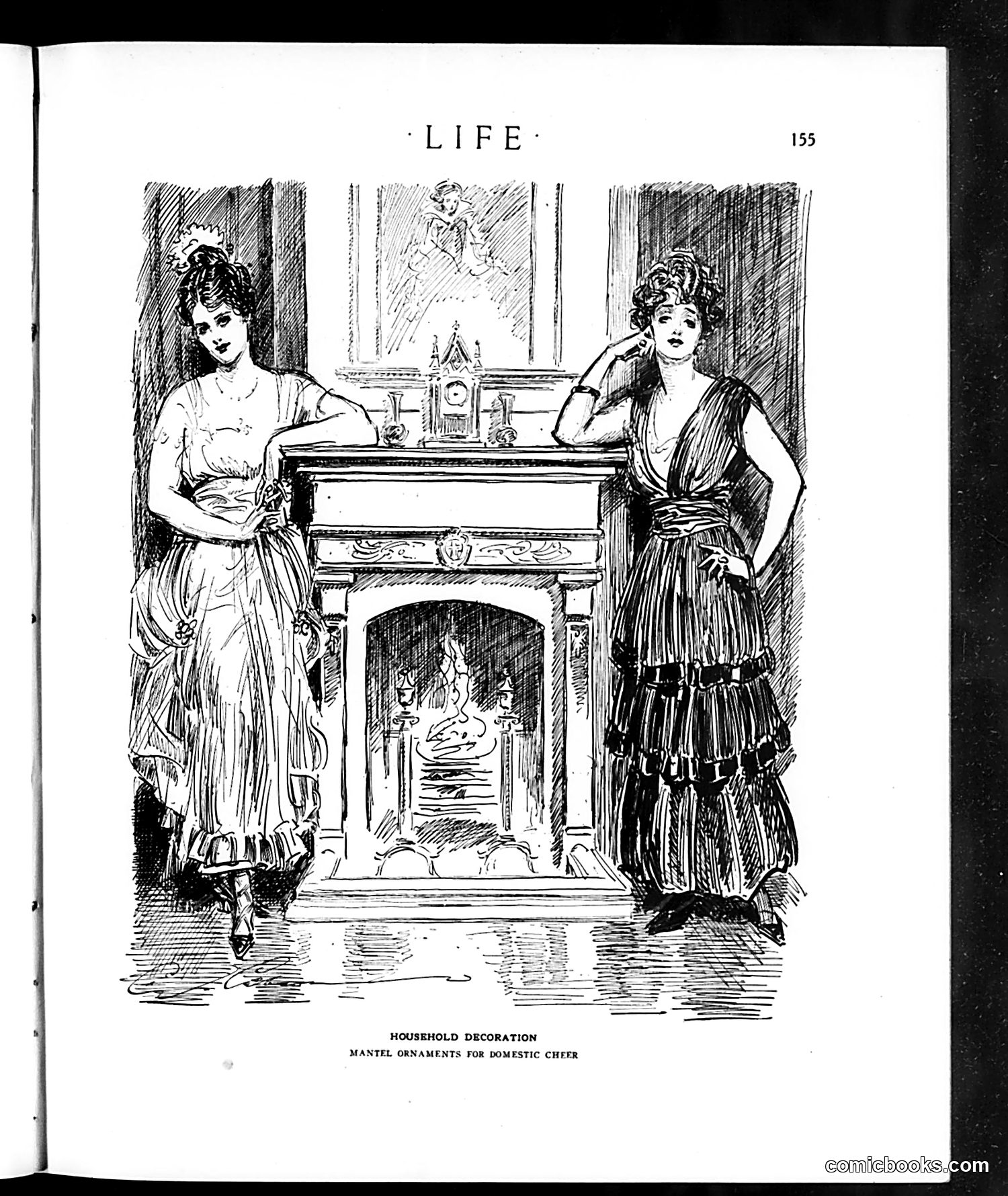
This page from *Life* magazine presents a satirical illustration about household interior decoration. The caption "Mantel Ornaments for Domestic Cheer" is the joke: it depicts two fashionably dressed women positioned on either side of an ornate fireplace mantel, as if they themselves were decorative objects. The satire targets Victorian-era attitudes toward women in domestic spaces—suggesting that women's primary role was aesthetic rather than functional. By literally presenting women as "ornaments," the illustration mockingly critiques how society displayed and valued women primarily for their appearance in the home, rather than as autonomous individuals. The sketch's fine detail emphasizes the women's elaborate clothing and posed elegance, reinforcing how they're being treated as decorative pieces rather than people.
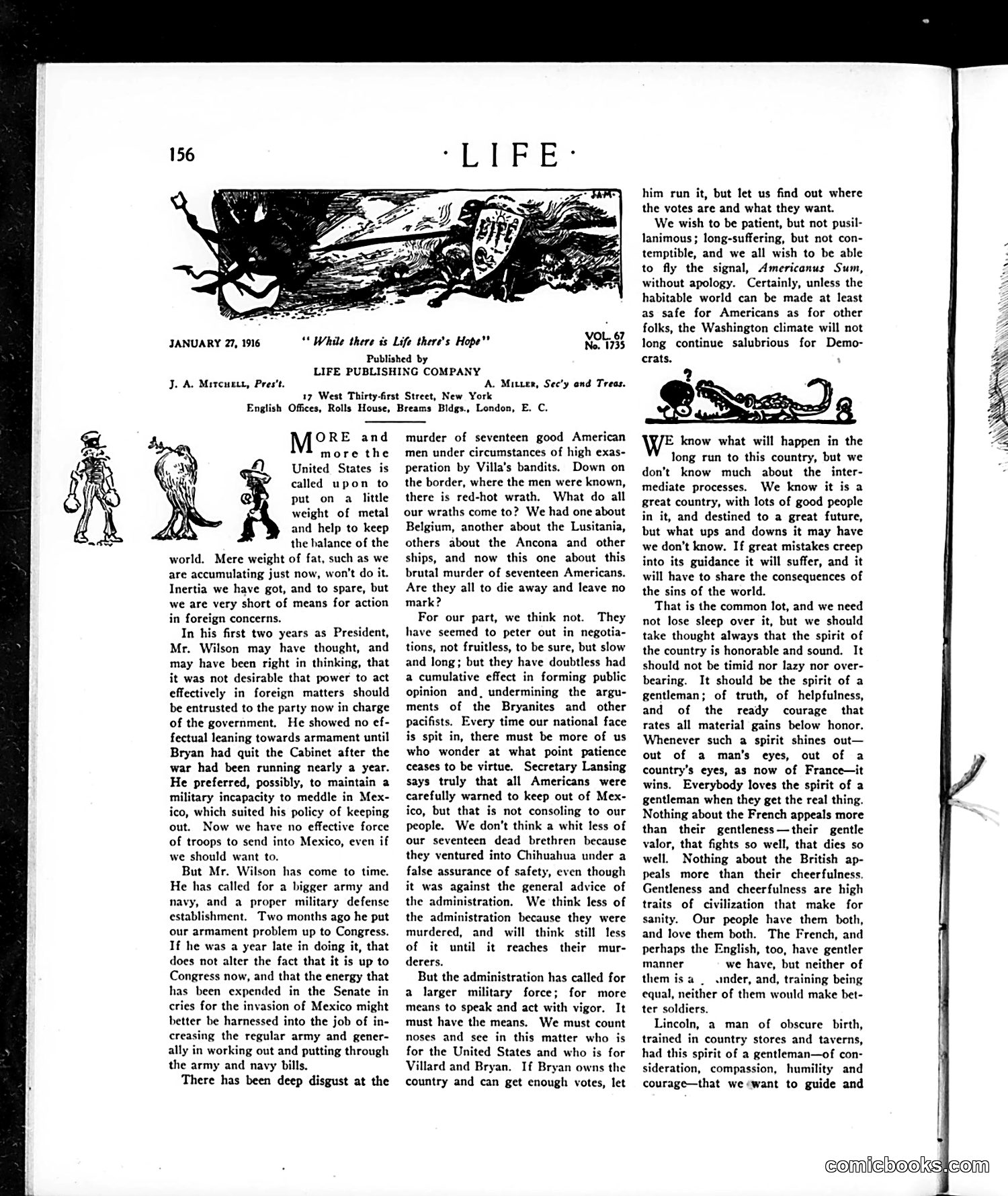
This page addresses America's military preparedness amid foreign crises. The editorial criticizes President Wilson for initially resisting armament while foreign incidents—the sinking of the *Lusitania*, the *Ancona*, and now the murder of seventeen Americans in Chihuahua by Pancho Villa's forces—tested American patience. The author praises Wilson's recent call for expanded military forces but argues Congress must act decisively. The piece attacks pacifists, particularly William Jennings Bryan (Wilson's former Secretary of State who resigned over the *Lusitania* response) and Oswald Garrison Villard, for counseling restraint. The core argument: America must maintain moral authority and national dignity ("Americanus Sum"—"I am American") by responding forcefully to these outrages, not through endless negotiation but through military capability and willingness to use it. The editorial frames military strength as necessary for preserving both honor and effective foreign policy.
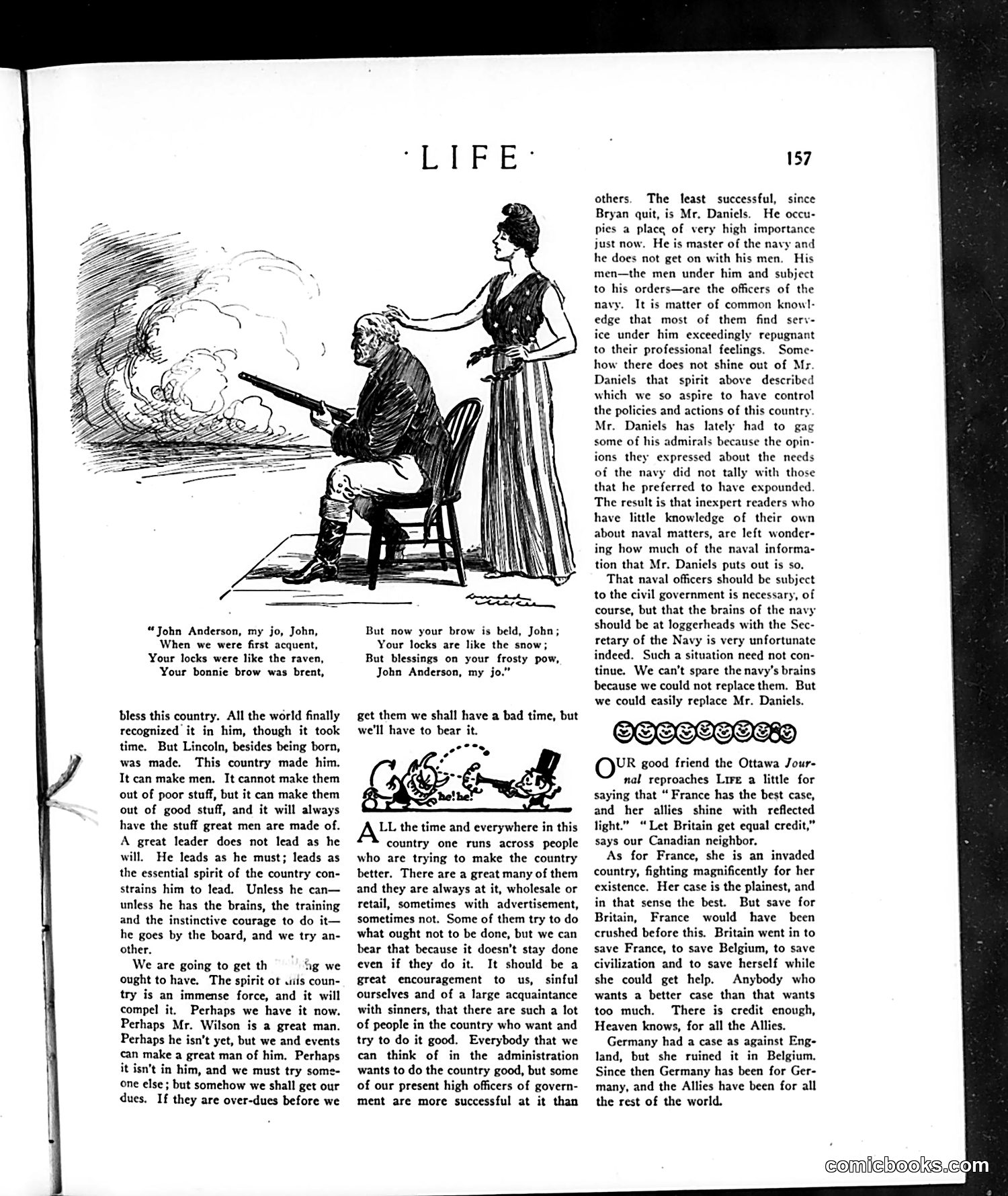
This page critiques **Josephus Daniels**, Secretary of the Navy under President Wilson. The cartoon shows an elderly man (representing aging naval leadership or experience) seated while a woman stands beside him—likely symbolizing the Navy itself or national maritime interests being neglected. The text directly attacks Daniels as "the least successful" administrator, accusing him of: - Poor relations with naval officers who find service under him "exceedingly repugnant" - Gagging admirals who disagreed with his naval policy opinions - Creating conflict between civilian government control and naval expertise The accompanying poem uses the Scottish ballad "John Anderson, My Jo" to evoke nostalgia for vigorous leadership, contrasting youthful vigor with present decline. **The satire's point**: Daniels, though well-intentioned, lacks the essential leadership quality to command respect. The magazine argues he should be replaced because "we could easily replace Mr. Daniels" but couldn't replace the Navy's institutional knowledge he's alienating.
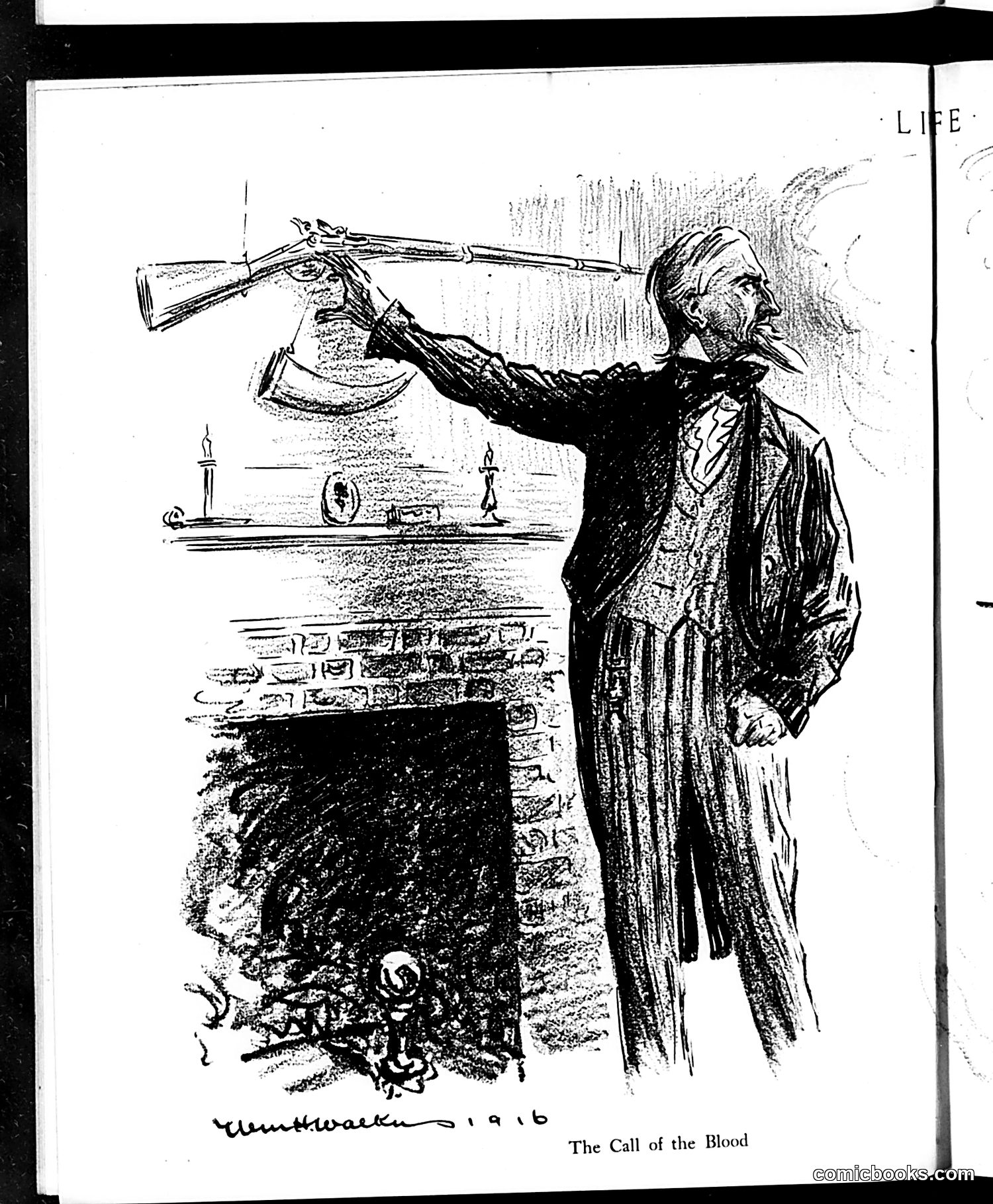
This Life magazine cartoon depicts a man in formal dress holding a telescope/spyglass, gazing toward a distant scene with Egyptian hieroglyphics and military imagery. The title "The Call of the Blood" suggests ancestral or national duty. The 1916 date and militaristic imagery indicate this likely addresses **World War I recruitment or patriotic duty**. The Egyptian elements may reference either historical empire or suggest colonial/imperial connections. The figure appears to be a gentleman being summoned by ancestral or national obligation—"the call of the blood"—to military service or patriotic action. The cartoon satirizes how appeals to heritage, legacy, and national pride were used to motivate men toward military engagement during WWI, critiquing such emotional manipulation of duty and obligation.
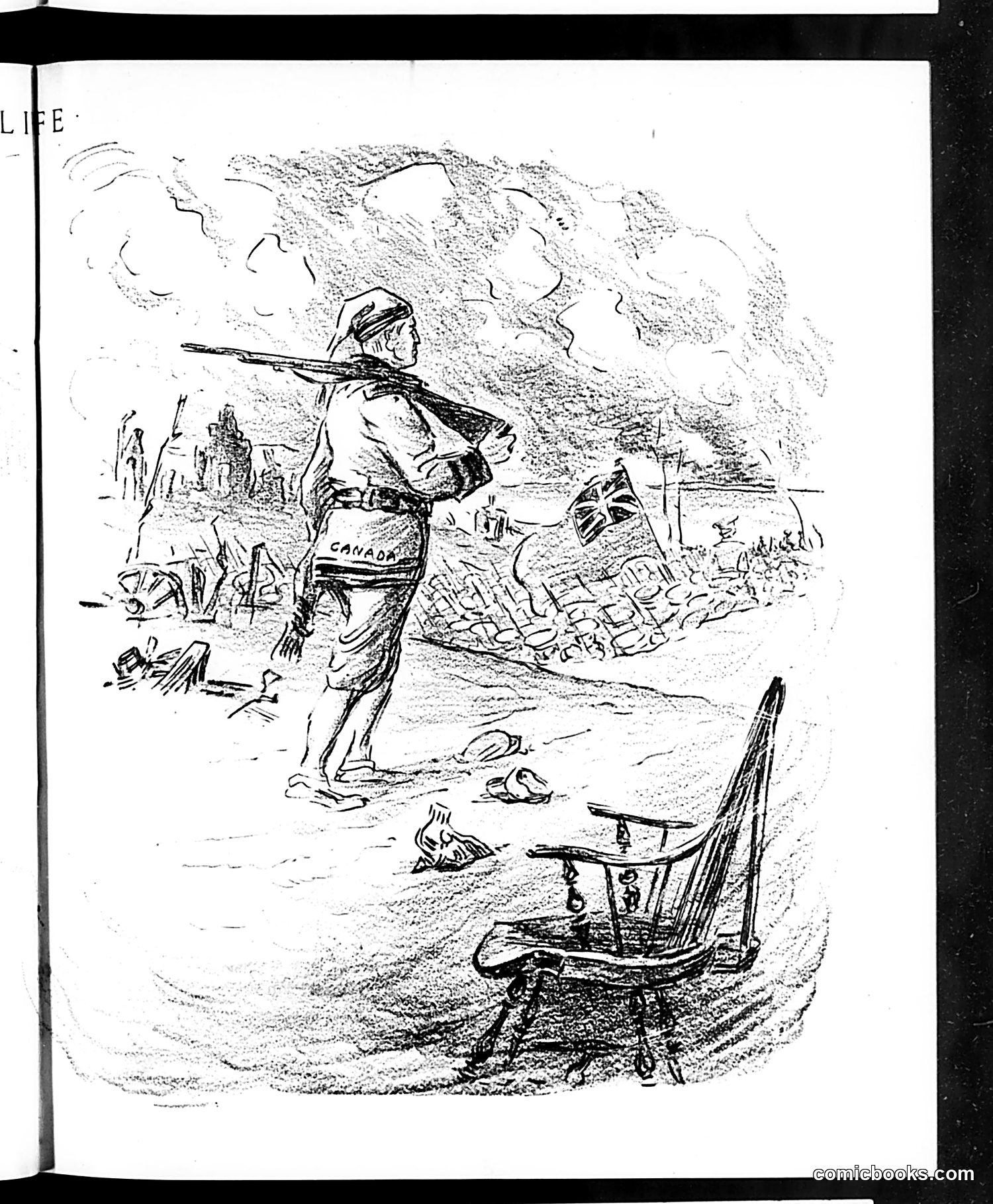
This cartoon depicts a Canadian soldier standing guard over a devastated battlefield. The soldier wears a uniform labeled "CANADA" and holds a rifle, surveying destruction that includes ruins, debris, and what appears to be a destroyed chair in the foreground. The image likely comments on Canada's military involvement and sacrifice, probably during World War I or II. The stark contrast between the armed, vigilant soldier and the complete desolation surrounding him emphasizes the enormous human and material costs of warfare. The empty chair is particularly poignant—suggesting absence, loss of life, or the abandonment of civilian existence. The satire critiques the devastating toll of war while highlighting Canada's significant military commitment and sacrifice during the conflict.
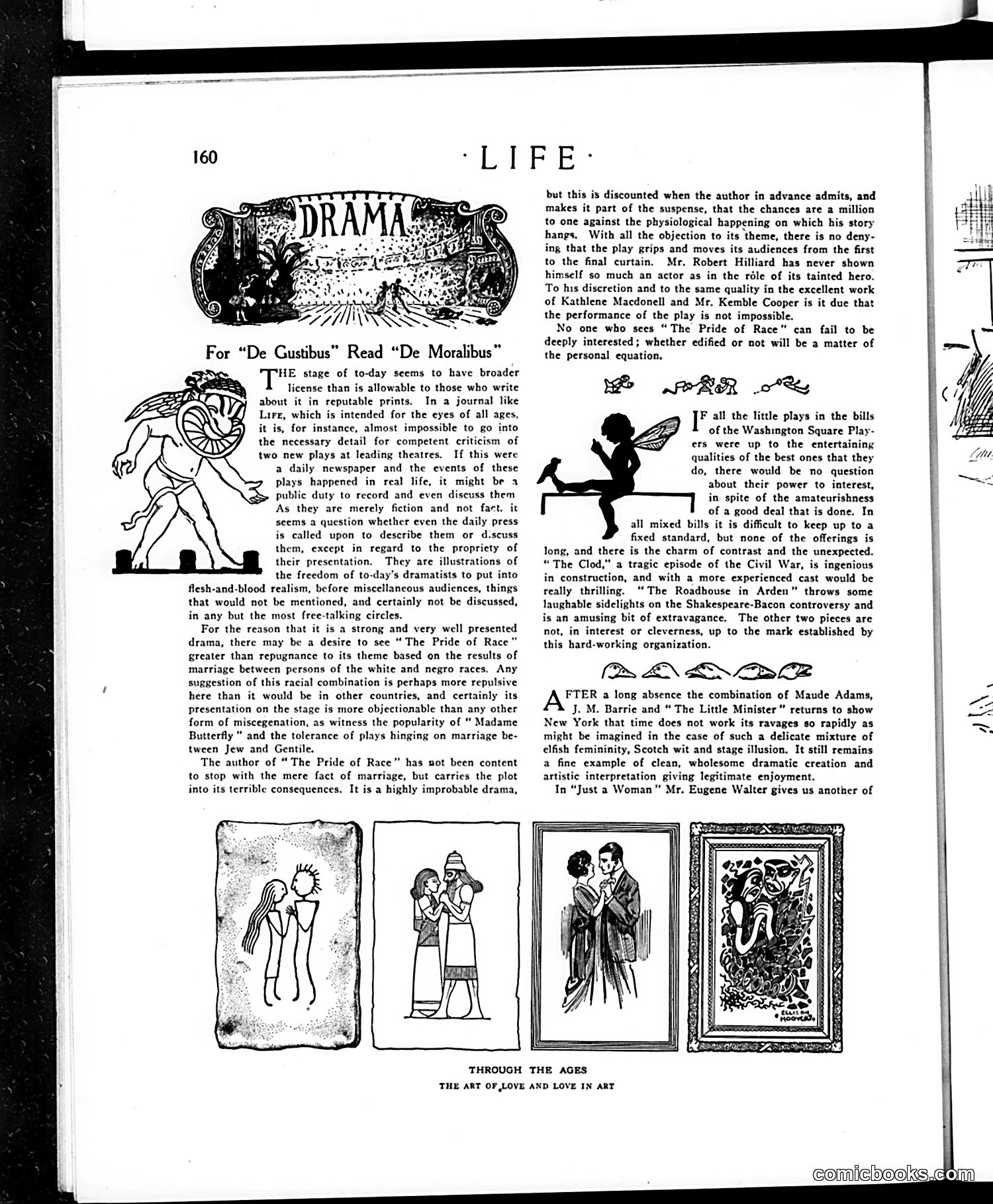
This page critiques contemporary Broadway plays, notably "The Pride of Race." The central satire concerns theatrical censorship and morality standards of the early 1900s. **Key Points:** The author argues that stage presentations face stricter moral scrutiny than newspaper reporting of identical events in real life. "The Pride of Race" depicts miscegenation (interracial marriage between white and Black characters)—a taboo subject that provokes particular American revulsion compared to other nations. **The Satire's Point:** Life's critic highlights the hypocrisy: audiences accept "Madame Butterfly" (white-Asian romance) and Jewish-Gentile marriages, yet viscerally reject Black-white relationships on stage. The title "De Gustibus/De Moralibus" (Latin: "About Taste/About Morals") suggests taste arguments mask actual racial prejudice. Despite objections to its "terrible consequences" plot, the critic acknowledges the play powerfully grips audiences—evidence the dramatic quality transcends its controversial subject matter. The accompanying illustrations appear to satirize romantic/artistic depictions through history, reinforcing the critique of selective moral standards.
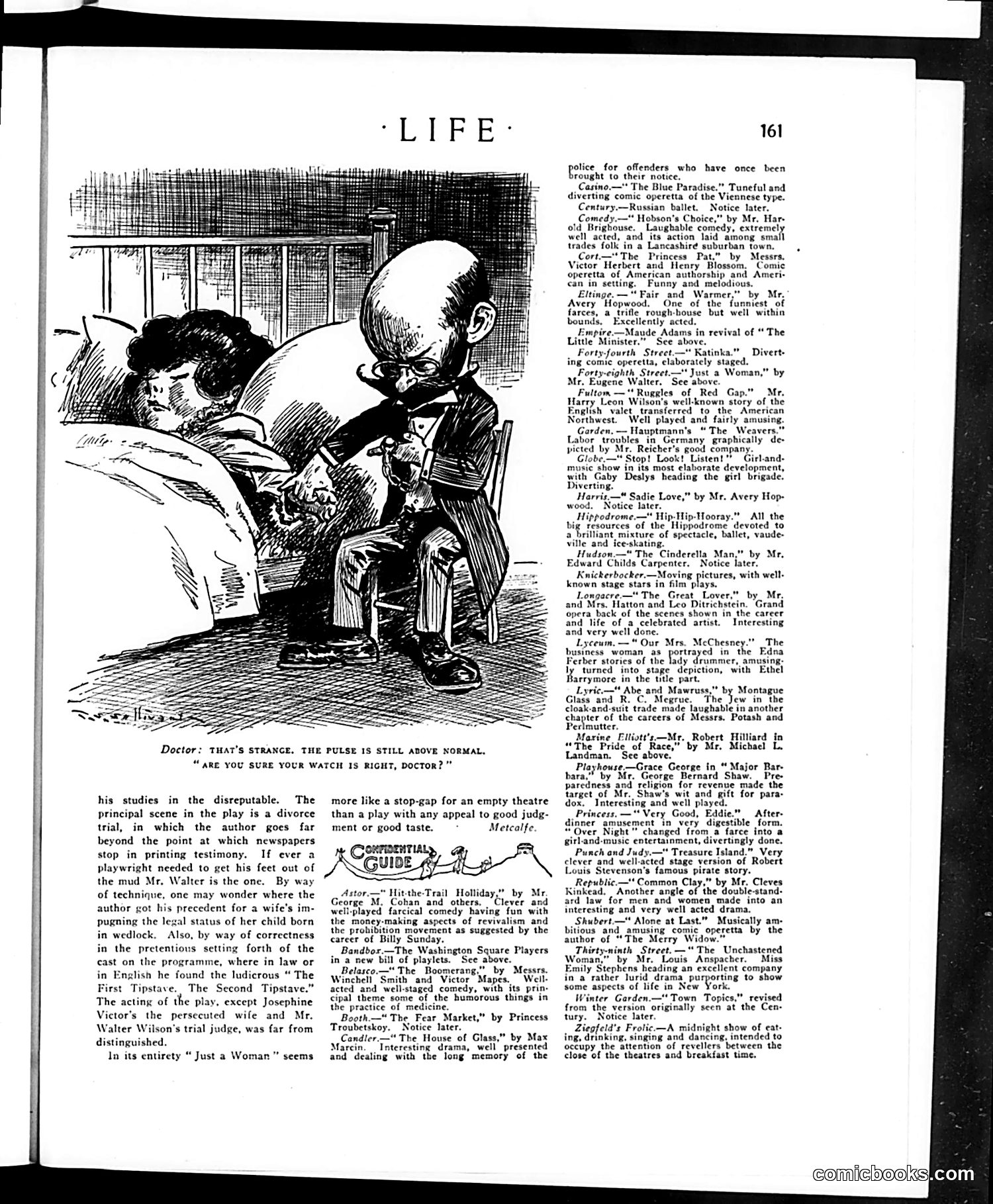
This single-panel cartoon depicts a doctor examining a patient in bed. The doctor, checking the patient's pulse, remarks that it remains "above normal," to which a companion (likely a family member) questions whether the doctor's watch is functioning correctly. **The Satire:** The joke relies on a double meaning of "watch." The companion interprets the doctor's concern about the patient's elevated pulse as potentially stemming from an inaccurate timepiece—a deliberately obtuse, literal misreading. This creates humor through willful misunderstanding: the doctor is using "watch" as a verb (to observe/monitor), while the companion pretends he meant the noun (the timepiece). **The Point:** This is gentle satirical humor about miscommunication and the absurdity of taking things too literally—a common comedic device in early 20th-century magazines. The illustration's style and the page's context (among theater reviews) suggest this appeared in *Life* magazine circa 1910s, when such wordplay-based humor was popular.
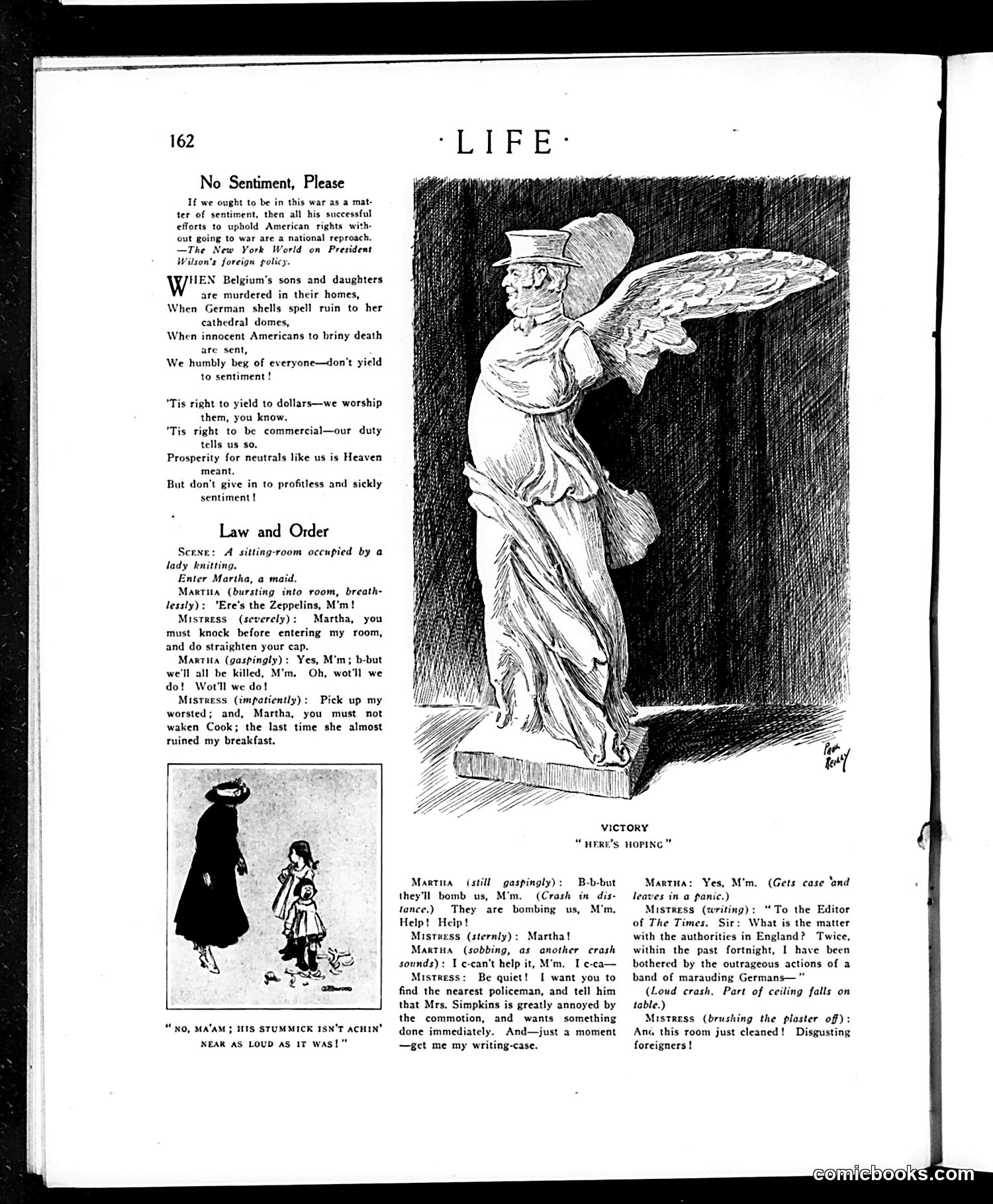
This page satirizes American neutrality during World War I through two pieces: **"No Sentiment, Please"** attacks the hypocrisy of those claiming America should stay neutral while prioritizing profit. It mocks the argument that commercial interests (worshipping dollars) matter more than moral outrage over Belgian atrocities, German attacks on civilians, and American deaths at sea. The piece ridicules the contradiction: if sentiment shouldn't drive policy, why does financial self-interest? **"Law and Order"** uses dark comedy to mock British priorities during the Blitz-like Zeppelin raids. A mistress remains obsessed with domestic propriety—hat straightening, not waking the cook—while bombs fall around them. When her room is damaged, she's angered not by the bombing but by the mess to her freshly-cleaned space. She complains to authorities about "marauding Germans" as if it's a minor inconvenience. Both pieces mock those who prioritize commercial neutrality and social convention over genuine human suffering during wartime.
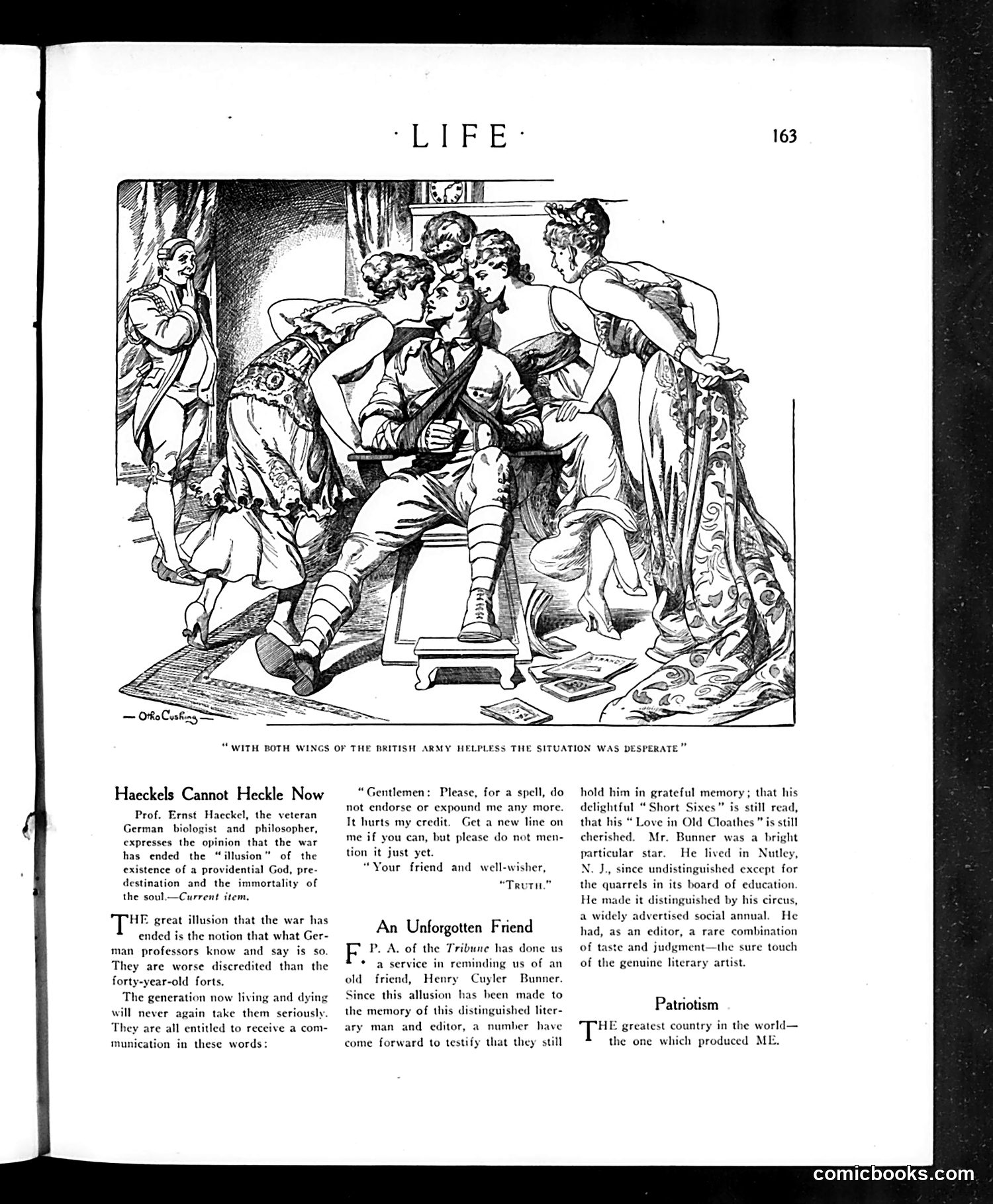
The top cartoon satirizes German military propaganda. The illustration shows a seminude woman surrounded by soldiers, captioned "WITH BOTH WINGS OF THE BRITISH ARMY HELPLESS THE SITUATION WAS DESPERATE"—mocking overwrought German war narratives by presenting an absurdly sexualized scenario as their idea of military crisis. Below, "Haeckels Cannot Heckle Now" attacks German intellectual credibility post-WWI. Prof. Ernst Haeckel, a prominent German biologist-philosopher, is ridiculed for claiming the war disproved God's existence. Life argues that German academics have been so thoroughly discredited by their wartime propaganda that future generations won't take them seriously. The satirical "communication" tells German intellectuals to stop endorsing anything—their credibility is destroyed. The remaining sections memorialize American literary editor Henry Cuyler Bunner and include a patriotic quip ("greatest country in the world—the one which produced ME"), reflecting post-war American confidence.
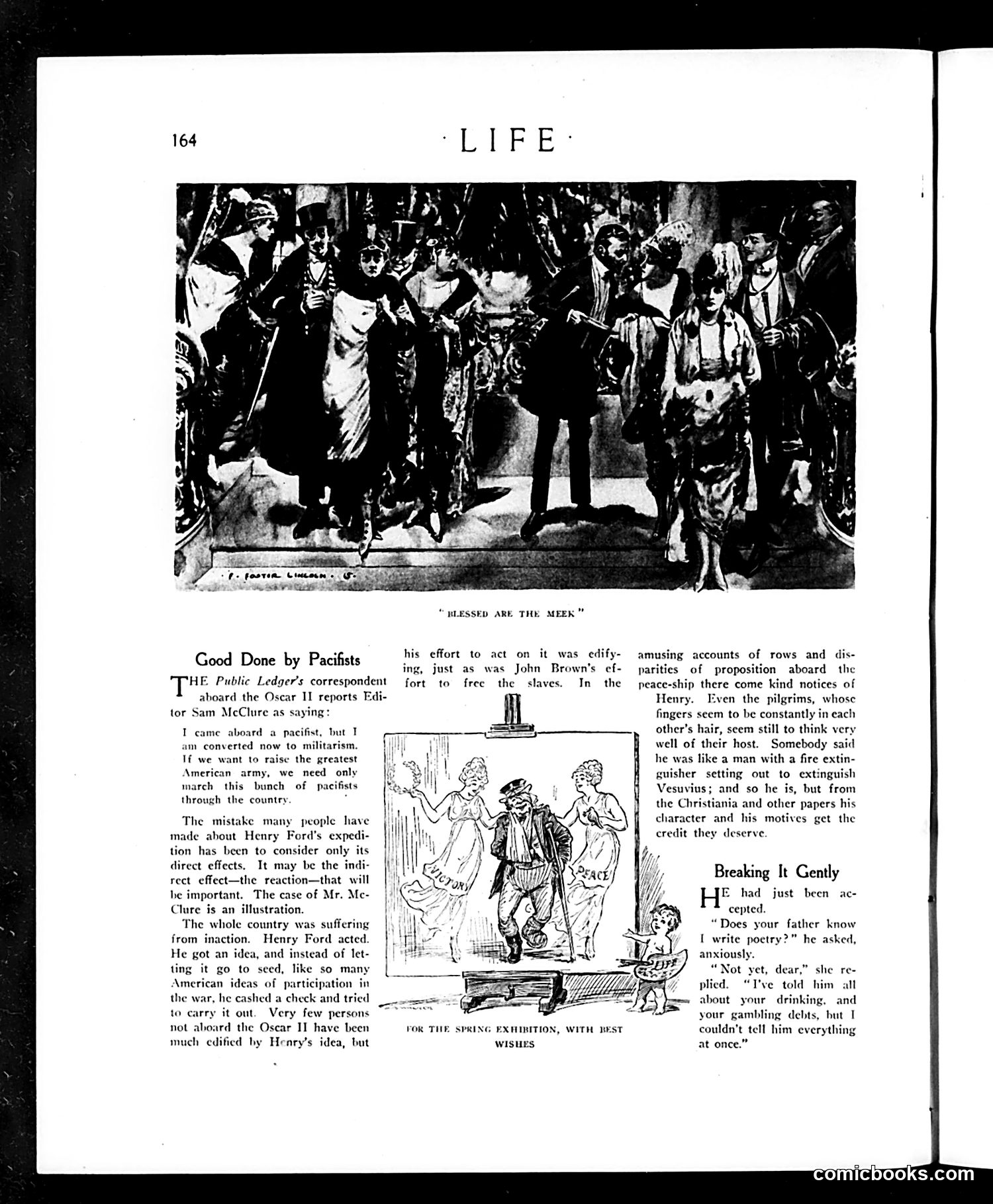
**Main Article: "Good Done by Pacifists"** This piece satirizes Henry Ford's 1915 "Peace Ship" (Oscar II), where Ford sent pacifists to Europe attempting to stop World War I. The article mocks the expedition's ineffectiveness while grudgingly acknowledging Ford's sincere effort. Editor Sam McClure's ironic claim that seeing pacifists convinced him of militarism's necessity is the central joke—the pacifists' very presence backfired, accidentally arguing *for* military preparedness. The comparison to John Brown (anti-slavery radical) suggests the pacifists are equally misguided zealots. **Cartoon: "For the Spring Exhibition, With Best Wishes"** This untitled cartoon appears to depict three allegorical female figures—likely representing Wisdom, Peace, and Justice or similar virtues—presenting or blessing a male figure (unclear if specific person). The artistic style is typical of 1910s editorial cartooning with classical allegorical conventions. **Overall Context:** The page reflects pre-WWI American debate about pacifism versus military intervention, with Life magazine taking a skeptical stance toward pacifist activism.
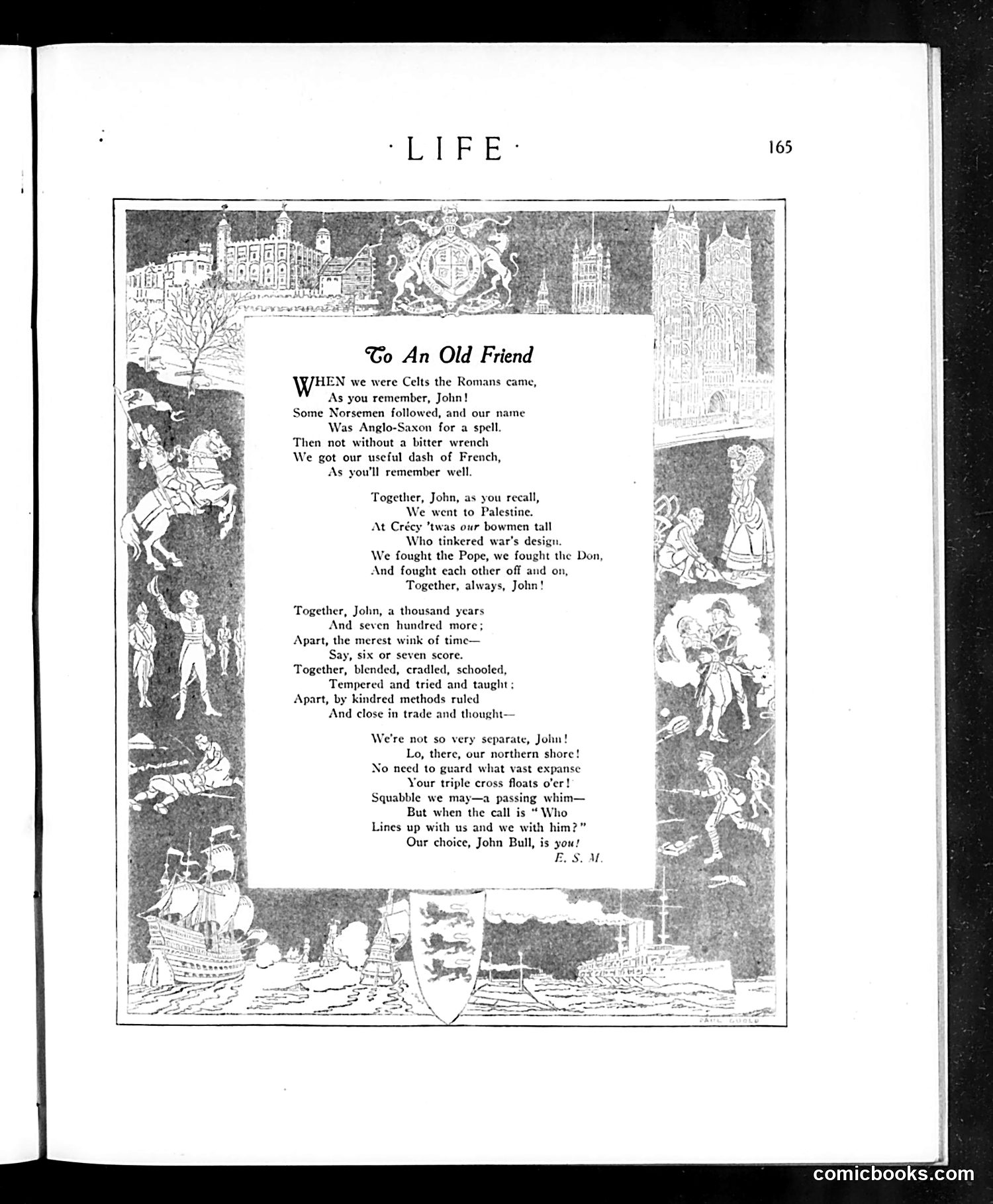
This poem addresses "John" (John Bull, the personification of Britain) and appears to be an appeal for Anglo-American solidarity, likely from the World War I era. The piece traces shared English-speaking heritage through centuries of mutual history: Roman and Norman invasions, the Crusades, medieval conflicts like Crécy, and religious/political struggles. The satirical argument suggests that despite occasional disagreements ("squabble we may"), the fundamental kinship between Britain and America (represented by the speaker) is undeniable. The decorative border depicts historical scenes reinforcing this narrative of shared civilization. The poem's point: when global conflict demands choosing allies, America should naturally stand with Britain ("John Bull") based on centuries of cultural and historical connection. This appears to be propaganda encouraging American support for Britain during WWI, framed as an appeal to ancient friendship rather than present politics.
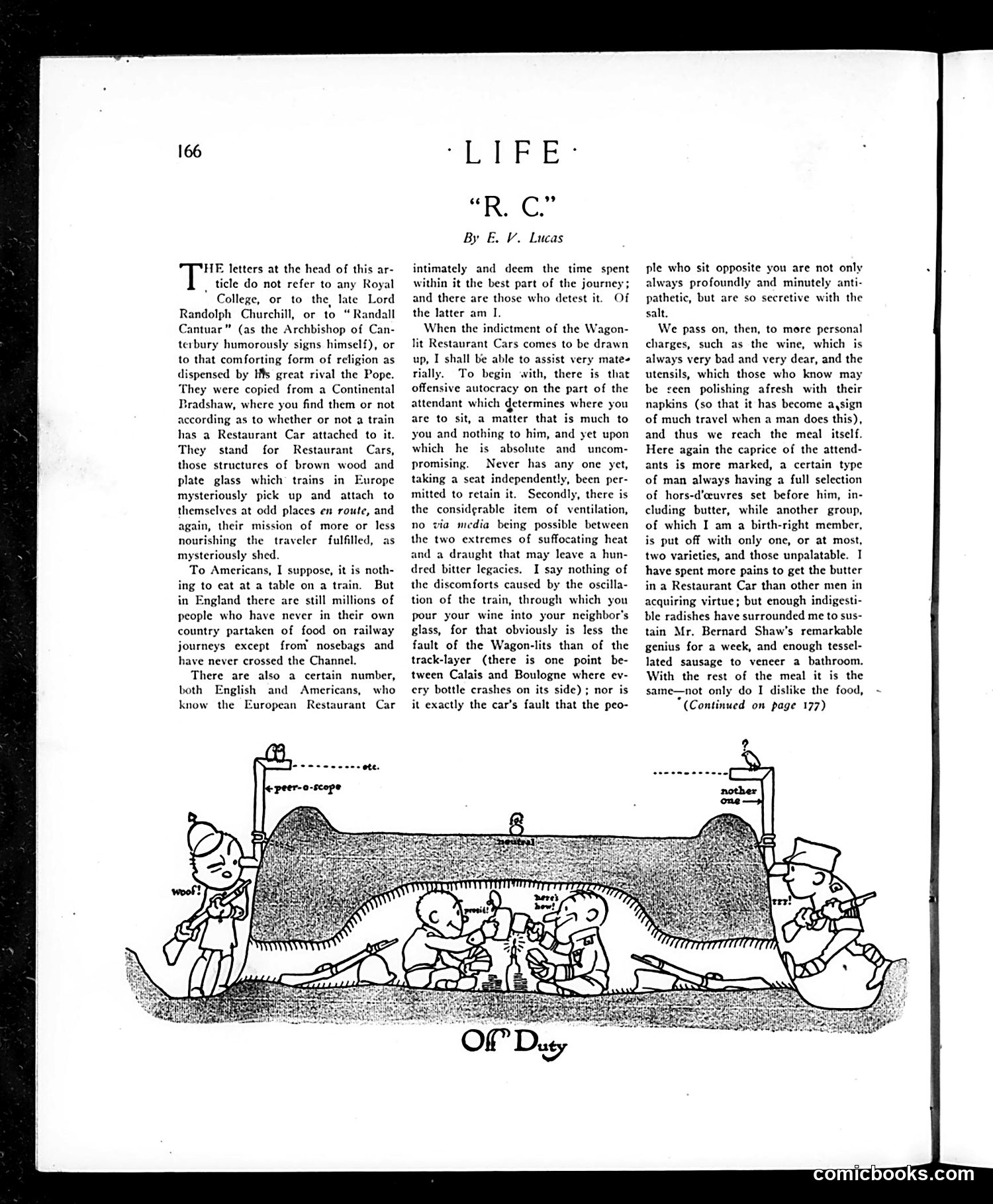
This page satirizes European railway dining cars through E.V. Lucas's humorous essay. The title "R.C." doesn't refer to royalty or religion, but to "Restaurant Cars"—the mysterious dining compartments attached to continental trains. Lucas's complaint is whimsical but pointed: he attacks the authoritarian attendants who dictate seating, the impossible ventilation (either stifling or drafty), poor wine service, and inconsistent meal quality. He notes the social indignity of having wine spilled on neighbors due to train oscillation, and the peculiar discrimination in hors d'oeuvres distribution. The cartoon below shows tiny figures dining inside a train car depicted as a large horizontal vessel, visually emphasizing the cramped, absurd nature of rail dining. The illustration titled "Of Duty" is unclear without the continuation, but supports Lucas's satirical portrait of Continental travel's minor torments—a genteel complaint about European modernization and its discomforts.
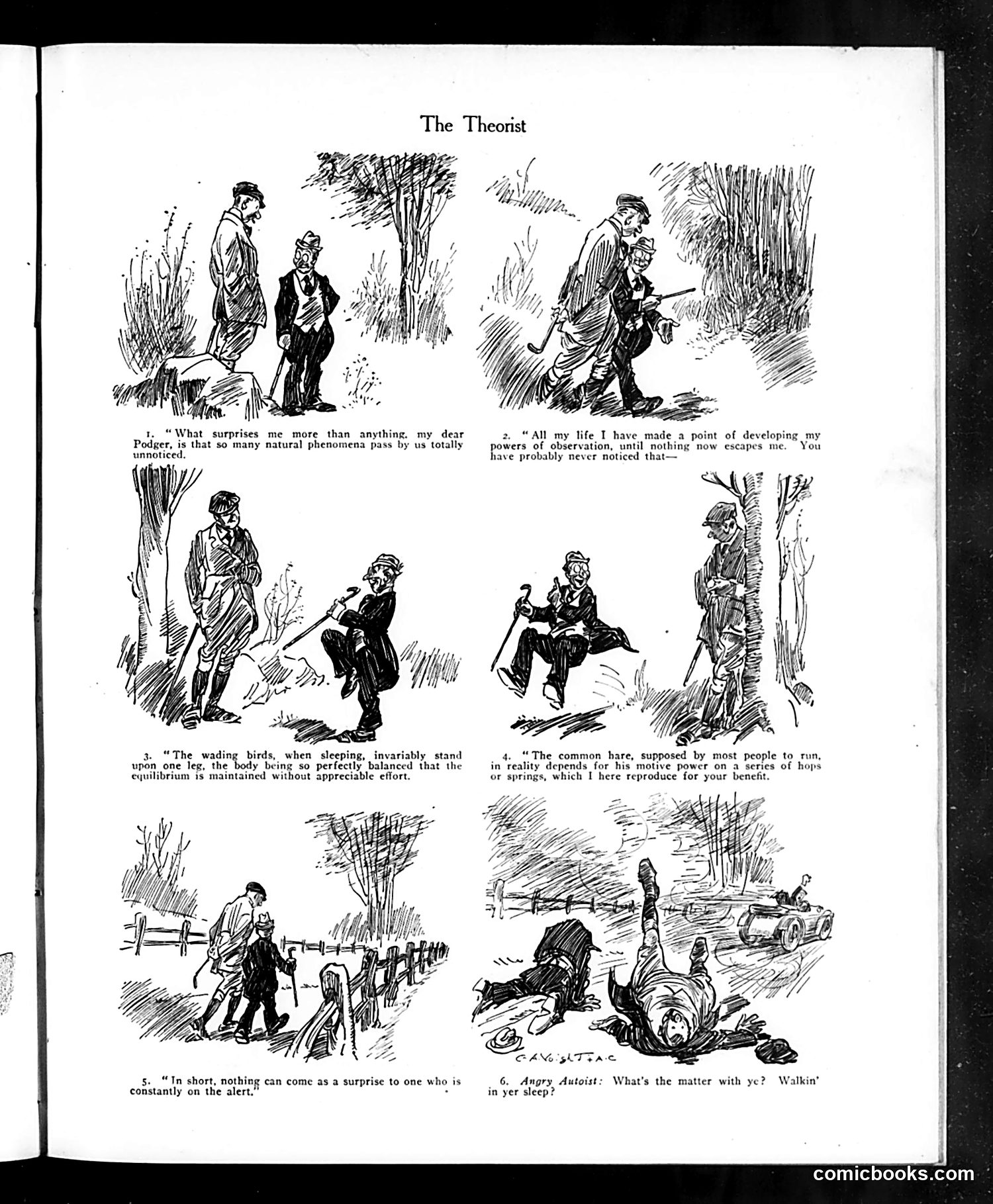
This six-panel comic satirizes pedantic know-it-alls who bore others with ostentatious displays of observation. A pompous character lectures his companion "Podger" about nature—wading birds balancing on one leg, hares hopping rather than running—smugly claiming his developed powers of observation mean "nothing can come as a surprise." The satire culminates when, despite this boastful claim to perfect alertness, the theorist is struck by an automobile while sleepwalking, with an angry driver demanding "What's the matter with ye? Walkin' in yer sleep?" The joke: The self-proclaimed observer of everything misses the most obvious danger before him. It mocks intellectuals who parade specialized knowledge while lacking common sense or awareness of practical reality.
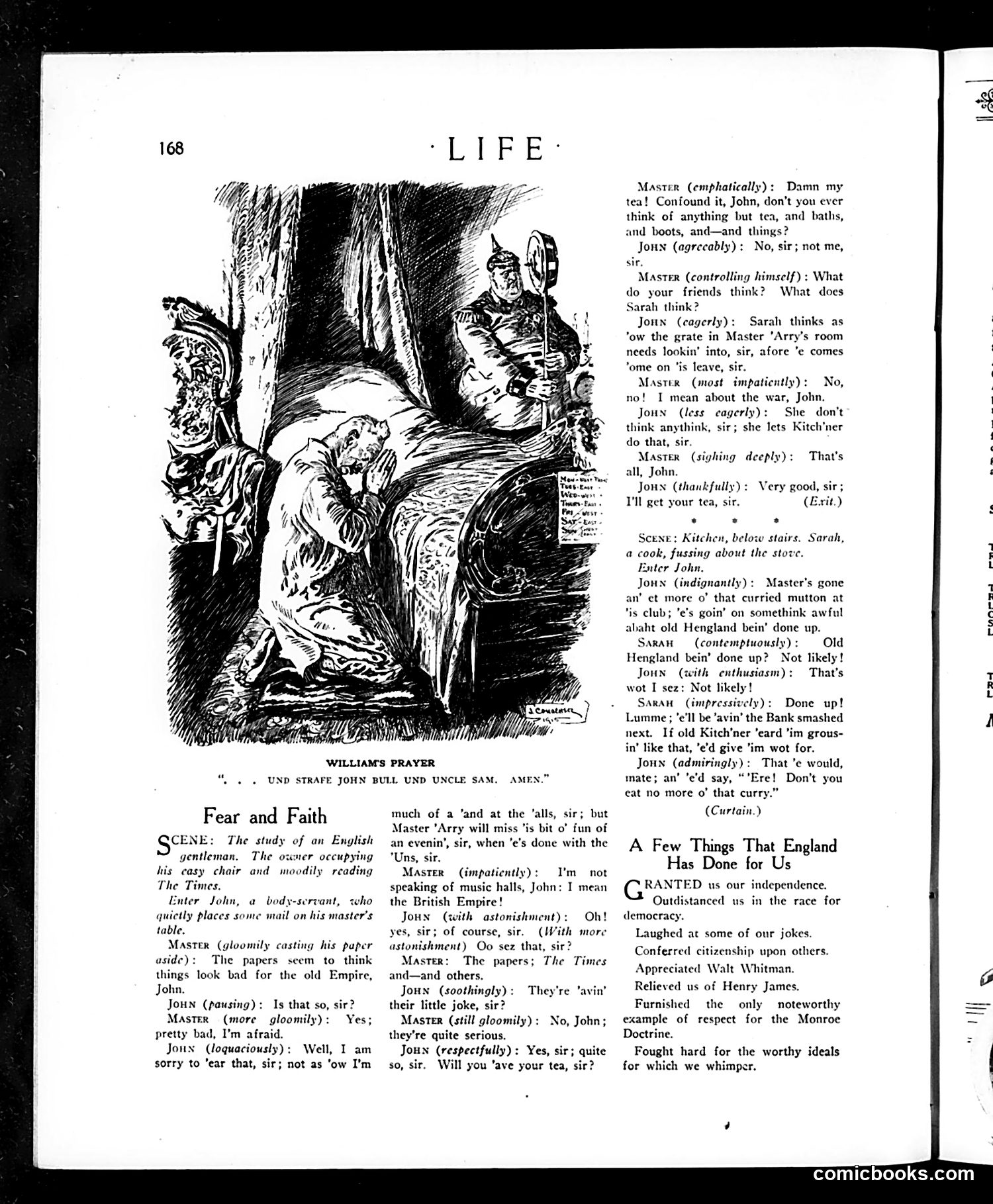
This two-scene sketch satirizes British anxiety during World War I. The title references the German prayer "Gott strafe England" ("God punish England"), establishing the threat context. **Scene 1:** A worried English gentleman reads that the Empire faces serious trouble. His servant John repeatedly misunderstands, assuming the Master means entertainment venues or household concerns—not the war itself. John's obliviousness suggests ordinary British working-class citizens remain unbothered by wartime fears. **Scene 2:** Downstairs, John and Sarah (the cook) discuss the Master's anxiety with contempt. Sarah dismisses worry by invoking faith in "Kitch'ner" (Lord Kitchener, the military leader), suggesting the public trusts military leadership implicitly. **The satire's point:** While elites fret over Empire collapse, ordinary Britons either don't grasp the stakes or maintain stubborn confidence—a commentary on class divisions and working-class fatalism during wartime. The closing list mocks American criticism of Britain as hypocritical, given Britain's actual wartime sacrifices.
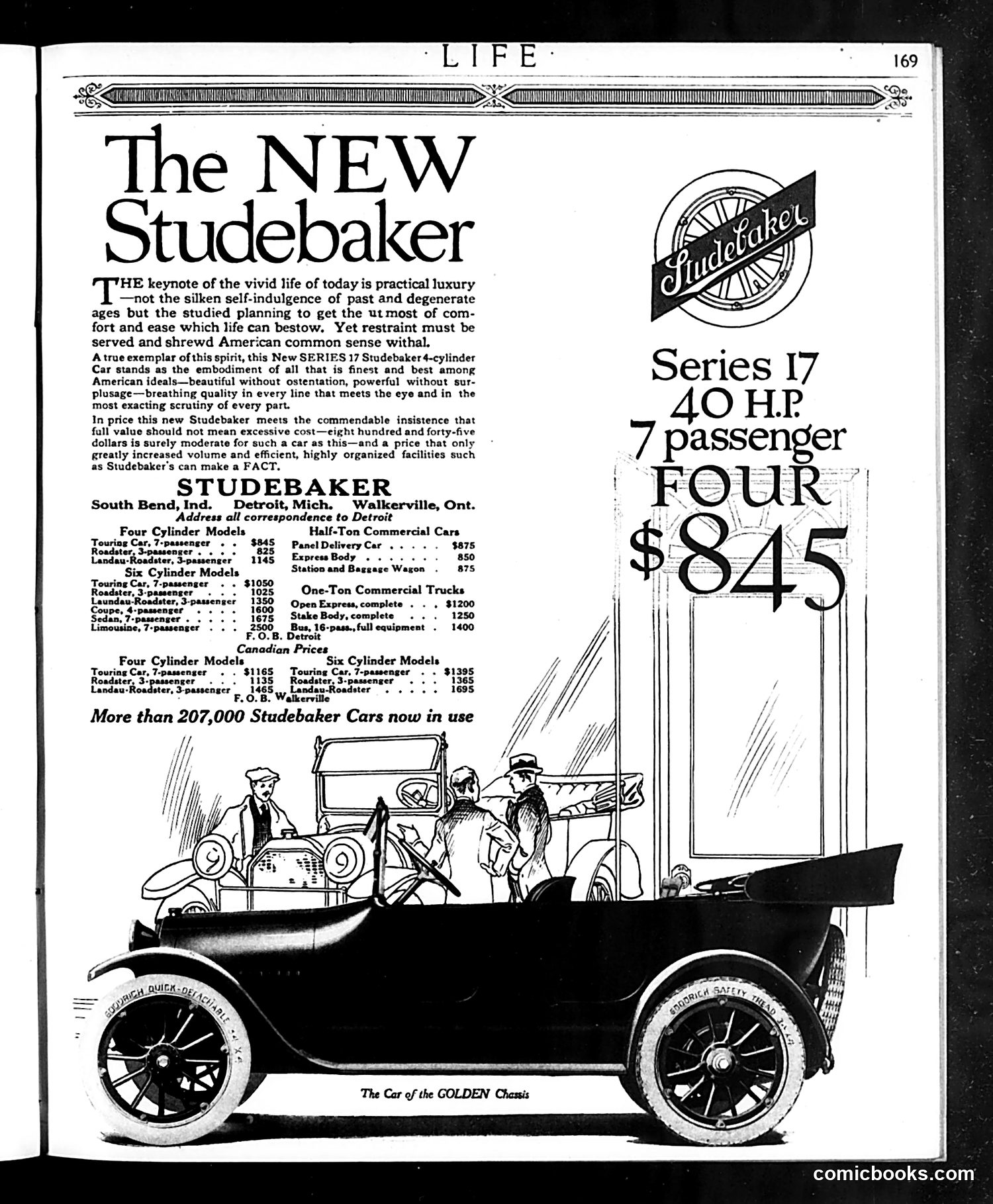
This is primarily a **car advertisement**, not political satire. It appears from an early 20th-century *Life* magazine promoting the new Studebaker Series 17. The ad's rhetoric frames automobile ownership within contemporary values: "practical luxury" represents modern American ideals—combining comfort with restraint and "shrewd American common sense." The car is positioned as embodying American virtues: "beautiful without ostentation, powerful without surplusage." The illustration shows well-dressed figures (a family or social group) in the open-air automobile, depicting aspirational middle-class leisure and mobility. The $845 price point is presented as remarkably affordable given the car's quality—a claim supported by boasting "207,000 Studebaker Cars now in use," suggesting proven reliability and value. This reflects the era's optimism about automobiles as democratic luxury goods, not merely wealthy indulgences. The "GOLDEN Chassis" designation emphasizes premium construction.
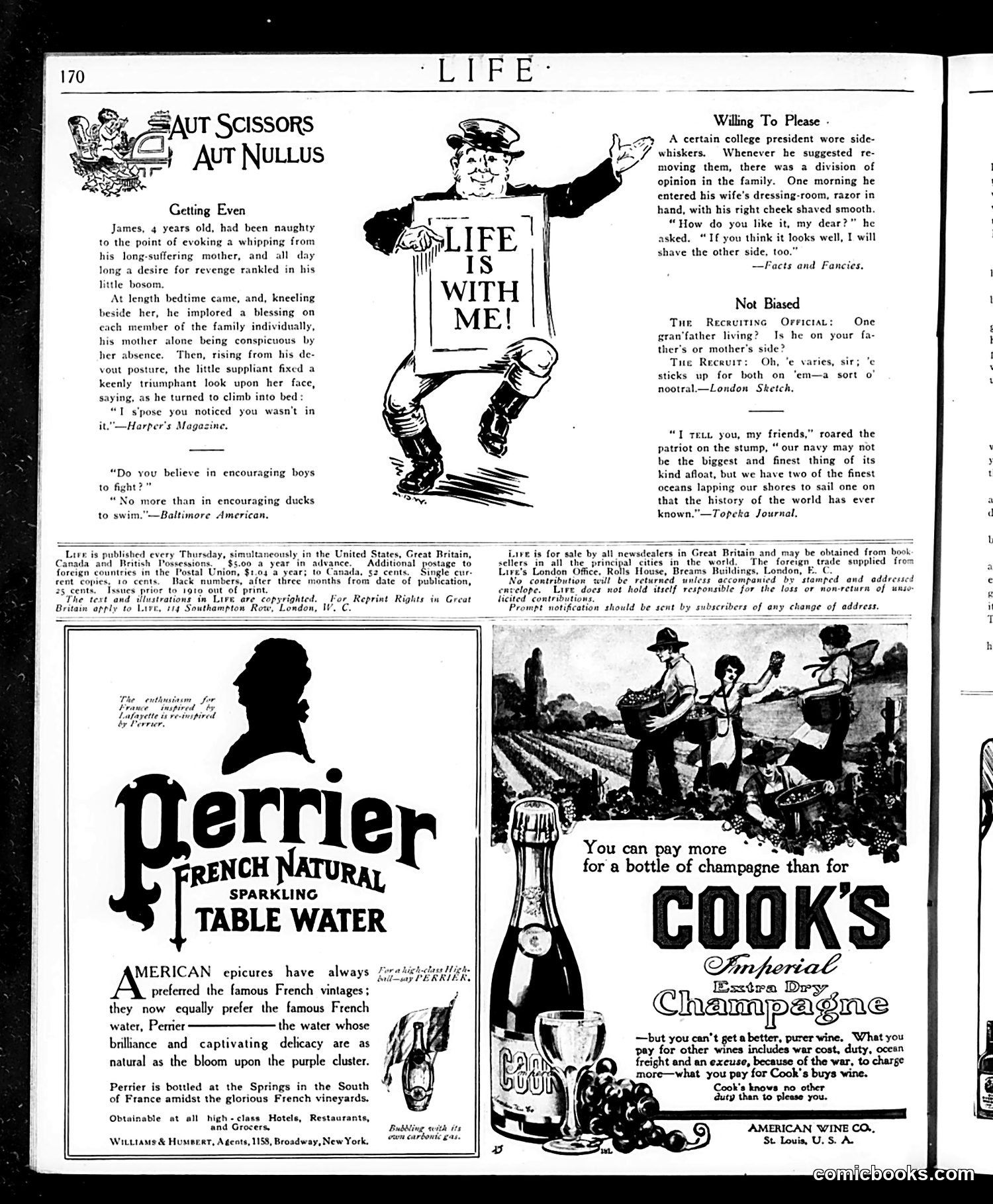
This page contains humor pieces and advertisements from *Life* magazine, likely from the World War I era. The humor section ("Aut Scissors, Aut Nullus") presents brief jokes and anecdotes, including a story about a four-year-old boy who, punished by his mother, takes revenge by pointedly excluding her from his bedtime prayers—a child's witty form of retaliation. The central cartoon shows a man holding a sign reading "LIFE IS WITH ME!" while skiing or performing an acrobatic pose, likely celebrating the magazine itself or the carefree attitude *Life* promoted. The advertisements dominate the lower half: Perrier sparkling water appeals to "American epicures" by emphasizing its French origins, and Cook's Imperial Champagne makes a patriotic economic argument—that Cook's wine offers better value than competitors, implying other producers inflated prices due to wartime "duty" and shipping costs. The page reflects early 20th-century American consumer culture and wartime economic concerns.
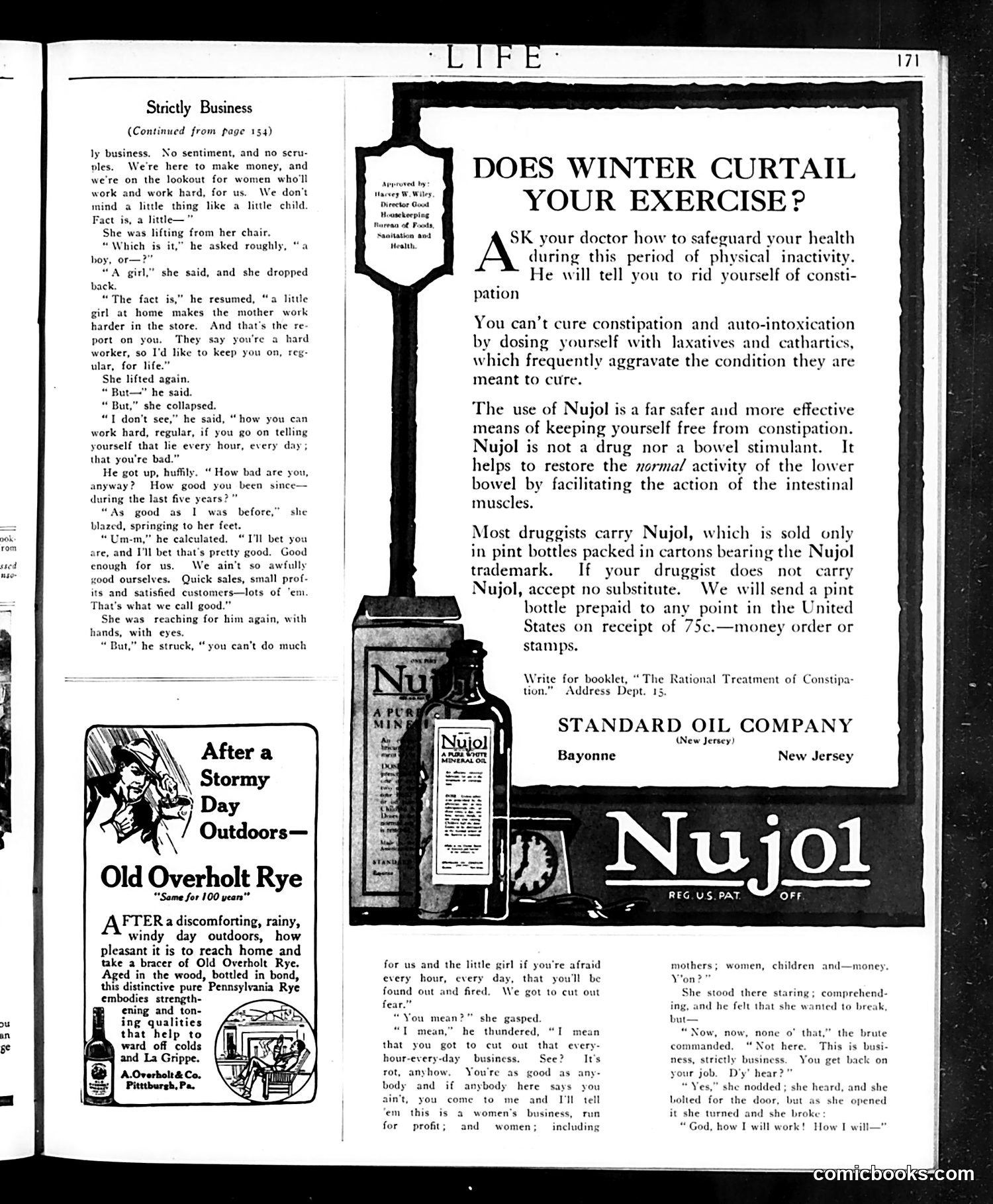
This page contains a story excerpt ("Strictly Business," continued from an earlier section) depicting an interaction between a hard-nosed male employer and a working-class female employee who appears to suffer from self-doubt and shame about her circumstances. The employer's monologue criticizes her psychological self-punishment ("that lie every hour, every day; that you're bad") while paradoxically maintaining a cold, profit-driven stance. He tells her that her anxiety about being "found out" undermines her value as a worker—yet his "kindness" is purely instrumental: keeping her productive serves the business. The satire appears aimed at exposing the hypocrisy of industrial-era capitalism: employers present themselves as benevolent while reducing human dignity to labor output. The woman's emotional breakdown at the story's end underscores the psychological toll of this system on vulnerable workers, particularly women. The page also includes period advertising (Old Overholt Rye whiskey, Nujol laxative) typical of 1920s Life magazine.
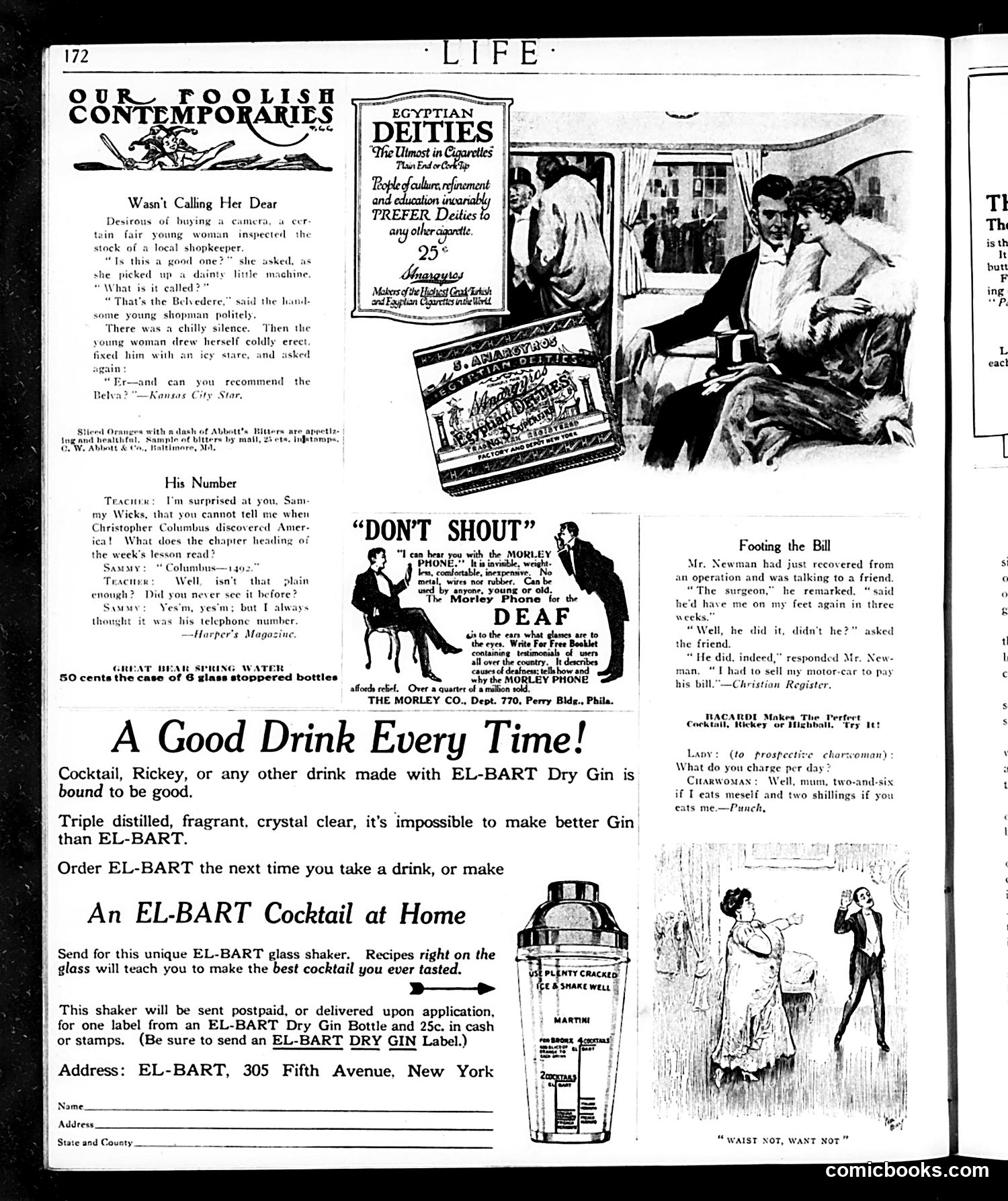
This page mixes satirical humor columns with period advertisements, typical of Life magazine's format. **The Humor:** - "Wasn't Calling Her Dear": A shopkeeper's innocent product name ("Belvedere") offends a customer who misunderstands it as a personal slight. - "His Number": A student confuses Columbus's discovery date (1492) with a telephone number—likely poking fun at the growing prevalence of telephones in everyday life. - "Footing the Bill": Dark humor about medical costs; a man recovers from surgery but must sell his car to pay the surgeon. **The Advertisements:** The page features multiple ads for products now historically notable: Egyptian Deities cigarettes, Morley Phone (an ear device), El-Bart Dry Gin (sold during Prohibition, suggesting grey-market distribution), and Hacardi cocktail mixers. These ads reflect pre-Prohibition or immediate post-Prohibition America's casual alcohol marketing. The small domestic humor strips ("Waist Not, Want Not") were Life's signature satire format, mocking middle-class social awkwardness and consumer culture.
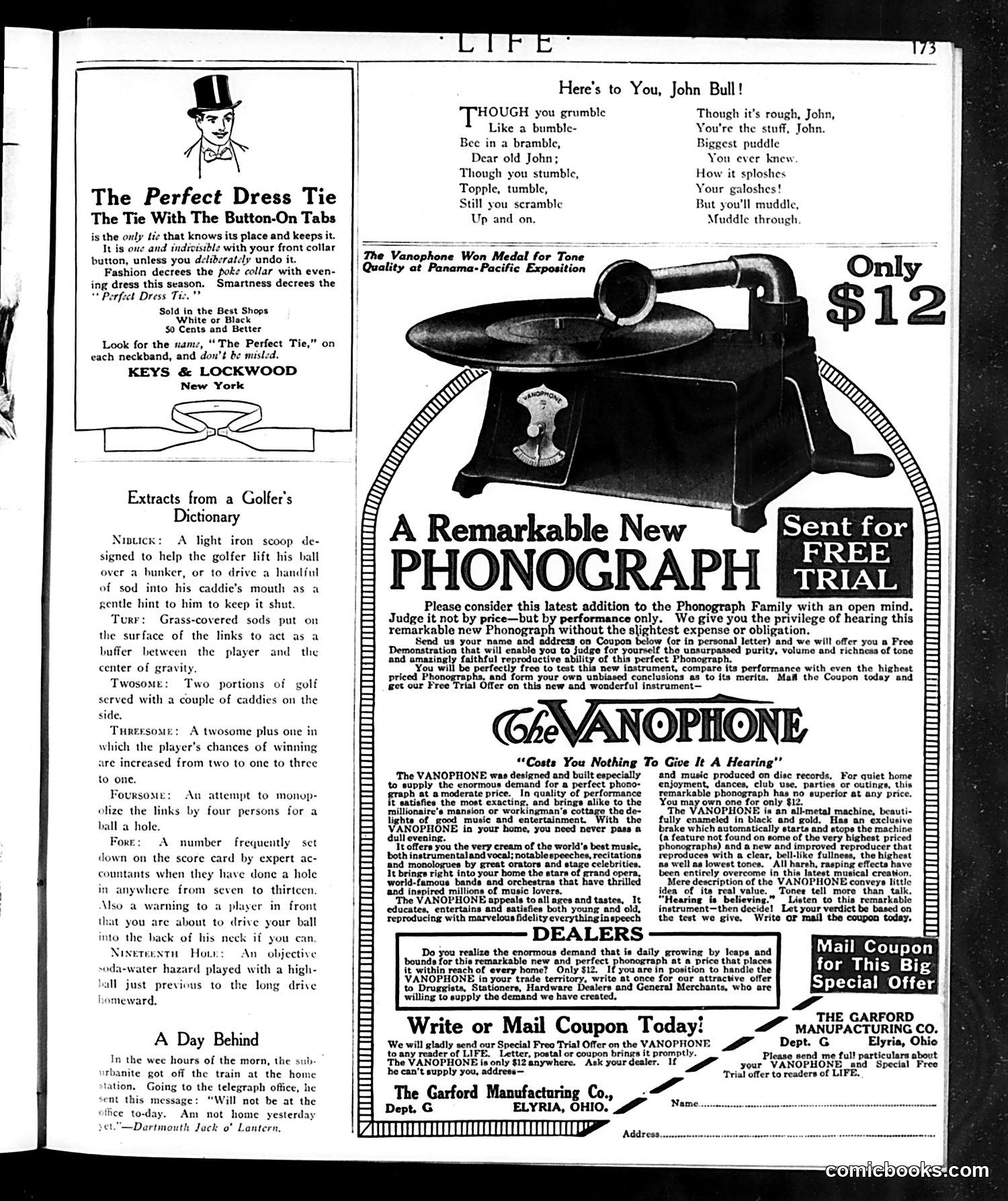
This page combines advertisements and humor typical of early 20th-century Life magazine. **The main advertisements** promote two products: "The Perfect Dress Tie" (featuring a gentleman in top hat) and the "Vanophone" phonograph, priced at $12, which won a medal at the Panama-Pacific Exposition. **The humorous content** includes: 1. **"Extracts from a Golfer's Dictionary"** — satirical definitions mocking golf terminology and player behavior, presenting golf as pretentious and occasionally violent (references to hitting caddies). 2. **"A Day Behind"** — a brief joke about a telegraph operator arriving home late, creating a paradoxical message. 3. **"Here's to You, John Bull!"** — a poem celebrating British resilience during World War I (the reference to "muddle through" suggests wartime struggle), with a somewhat patronizing but affectionate tone toward British determination. The page primarily functions as advertising space interspersed with light satirical humor targeting leisure activities and consumer products of the era.
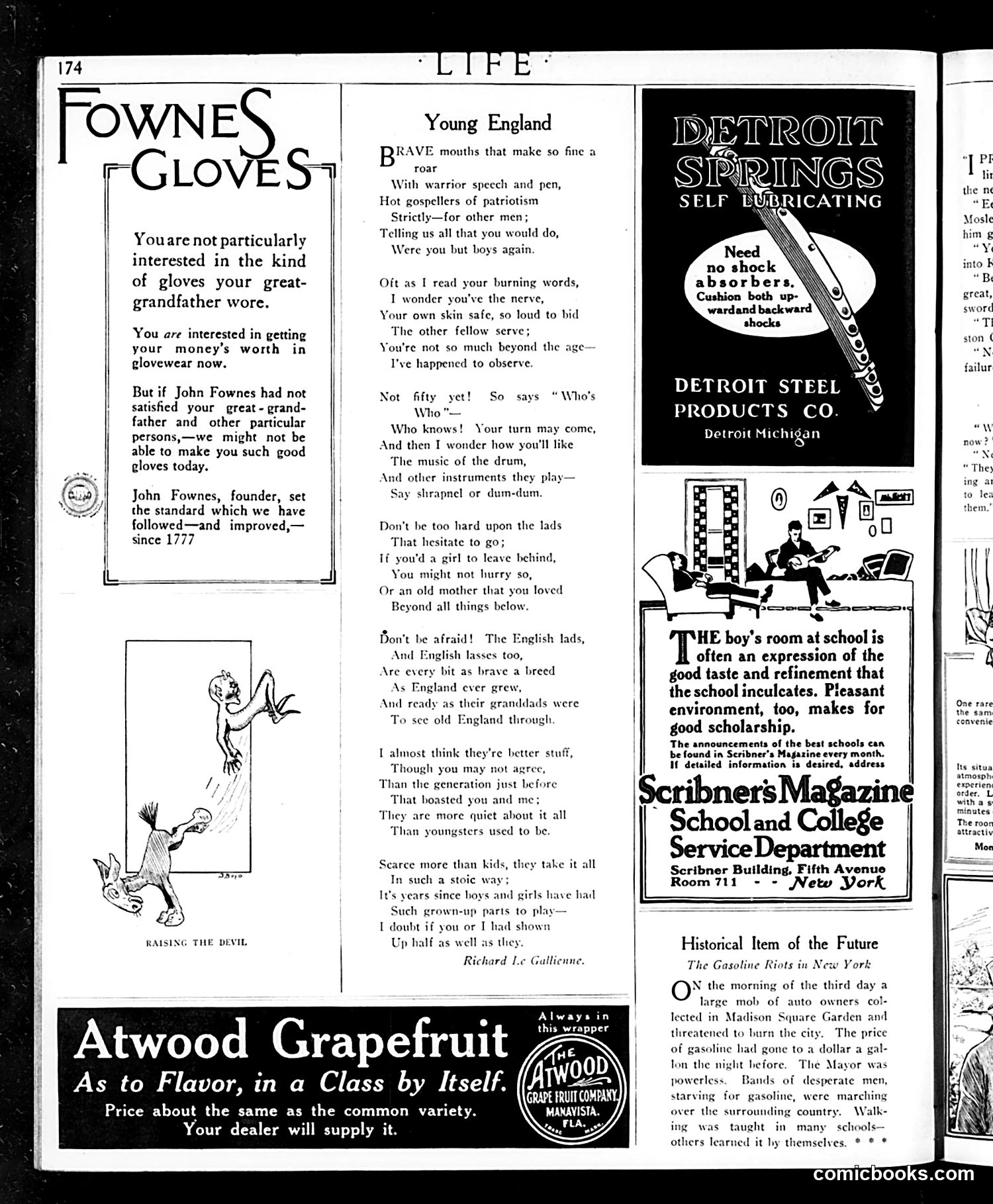
This page contains a satirical poem titled "Young England" by Richard Le Gallienne addressing older British men who enthusiastically advocate for war (likely WWI) while safely remaining civilians. The poem's central irony: these aging "hot gospellers of patriotism" urge young men to fight ("Telling us all that you would do, / Were you but boys again") without personal sacrifice. Le Gallienne defends the younger generation, arguing they display greater courage and stoicism than their elders, performing their duty "more quiet about it all / Than youngsters used to be." He questions whether the older generation—the poem's actual audience—would have shown such bravery when young. The accompanying cartoon "Raising the Devil" (bottom left) visually reinforces this theme: it depicts youthful mischief-making in contrast to the serious patriotic rhetoric being demanded of actual youth. The page is primarily editorial/literary content with surrounding period advertisements (gloves, grapefruit, school services).
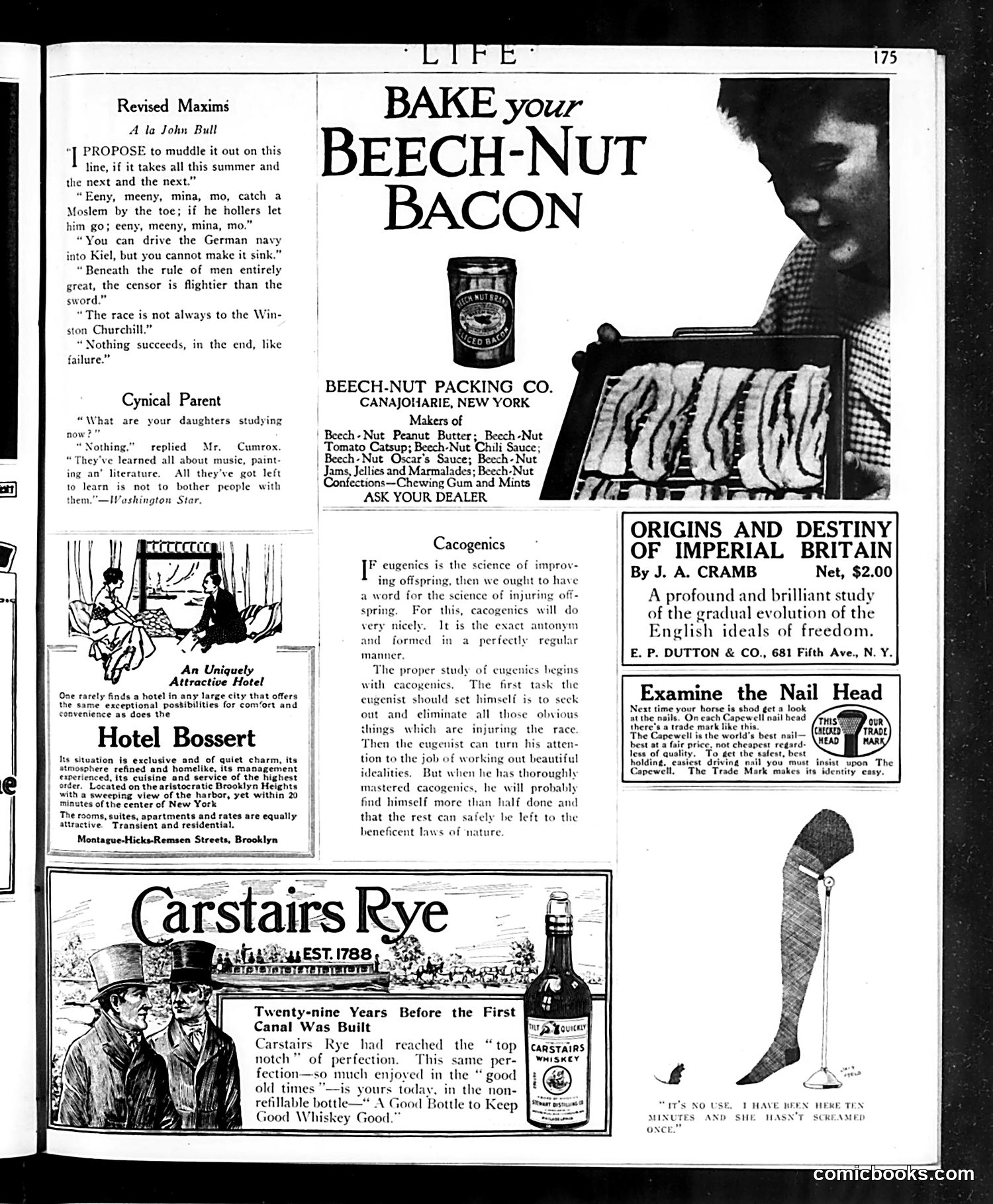
This page (175) is primarily **advertisements and miscellaneous content** rather than political satire. The "Revised Maxims" section at top appears to satirize **WWI-era political rhetoric**, parodying famous quotes by altering them. References to "the German navy," "Kiel," and "Winston Churchill" suggest this is from the World War I period. The section mocks grandiose war statements—replacing Churchill's actual quote with "Winston Churchill" as a joke about failed military strategy. The "Cynical Parent" cartoon jokes about daughters learning nothing of practical value. The remainder consists of **period advertisements**: Beech-Nut bacon/food products, Hotel Bossert in Brooklyn, Carstairs Rye whiskey (established 1788), a book on British imperial evolution, Capewell horseshoe nails, and a cartoon showing a woman being shod like a horse—a dark joke about marriage/domestic servitude. The page reflects early 20th-century advertising alongside mild social commentary about war and gender roles, typical of Life magazine's satirical-but-commercial format.
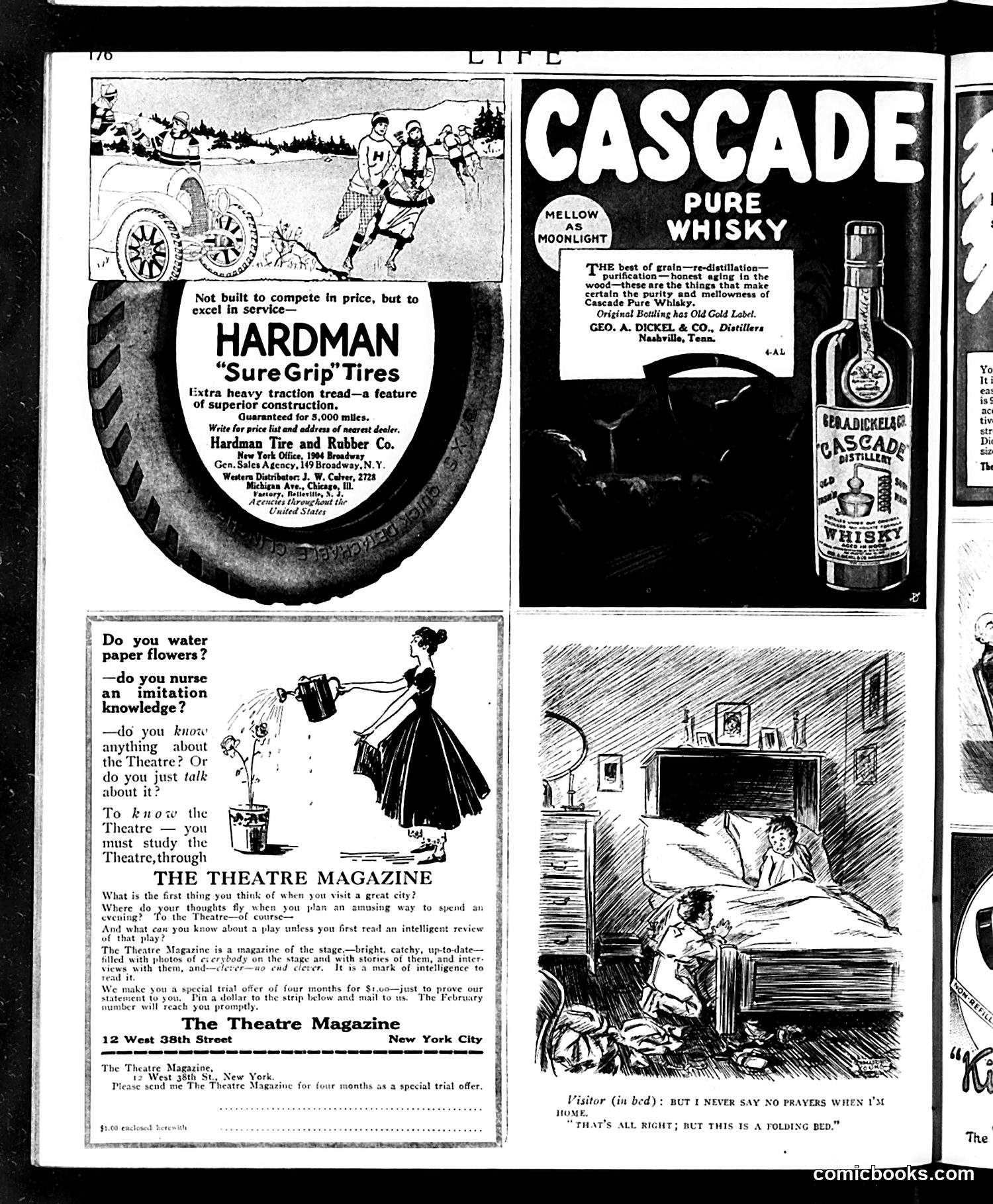
This page is primarily **advertising** from circa 1920s America, with one cartoon joke at bottom. **The Advertisements:** - **Hardman Tires**: Promotes "Sure Grip" tires with vintage car imagery; standard product ad - **The Theatre Magazine**: Social commentary disguised as marketing—mocks people who pretend knowledge about theater without actually studying it ("do you nurse an imitation knowledge?"). Positions reading their magazine as a mark of intelligence - **Cascade Pure Whisky**: Emphasizes quality distillation and aging; notably published during Prohibition era (1920-1933), suggesting either pre-Prohibition stock or gray-market distribution **The Cartoon (bottom):** A guest in a folding bed says he never prays at home. The host responds that prayers are necessary *in a folding bed*—implying the bed is so unstable/dangerous that divine intervention is required. It's physical humor about cheap, unreliable furniture. The page reflects 1920s consumer culture, class anxieties about appearing cultured, and the contradictions of Prohibition-era alcohol advertising.
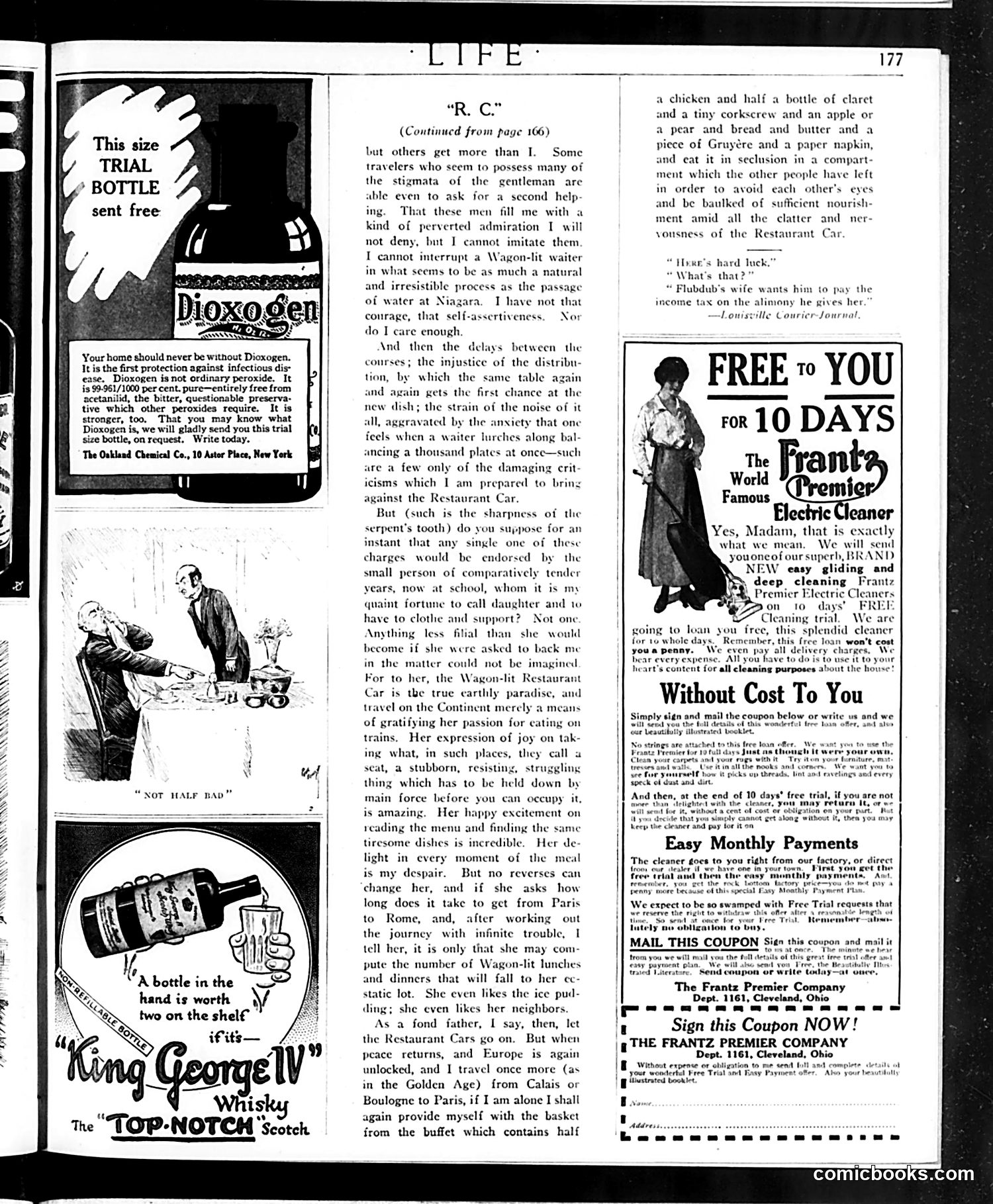
This page combines advertisements with a satirical article about European train dining. The main text is a continuation of a piece criticizing the Wagon-lit (luxury European train) Restaurant Car—mocking its pretensions, inefficient service, and crowded dining experience. The author complains about delays between courses, unequal service, and the anxiety of waiters balancing excessive plates. The satire's humor lies in the author's admission that despite all his complaints, his young daughter *loves* the Restaurant Car experience, finding joy in every mediocre meal and stuffy moment. This reversal—the curmudgeonly father versus the delighted child—undercuts his criticism. The page also includes vintage advertisements for Dioxogen (antiseptic peroxide), King George IV Whisky, and the Frantz Premier Electric Cleaner, typical of 1920s-era Life magazine marketing.
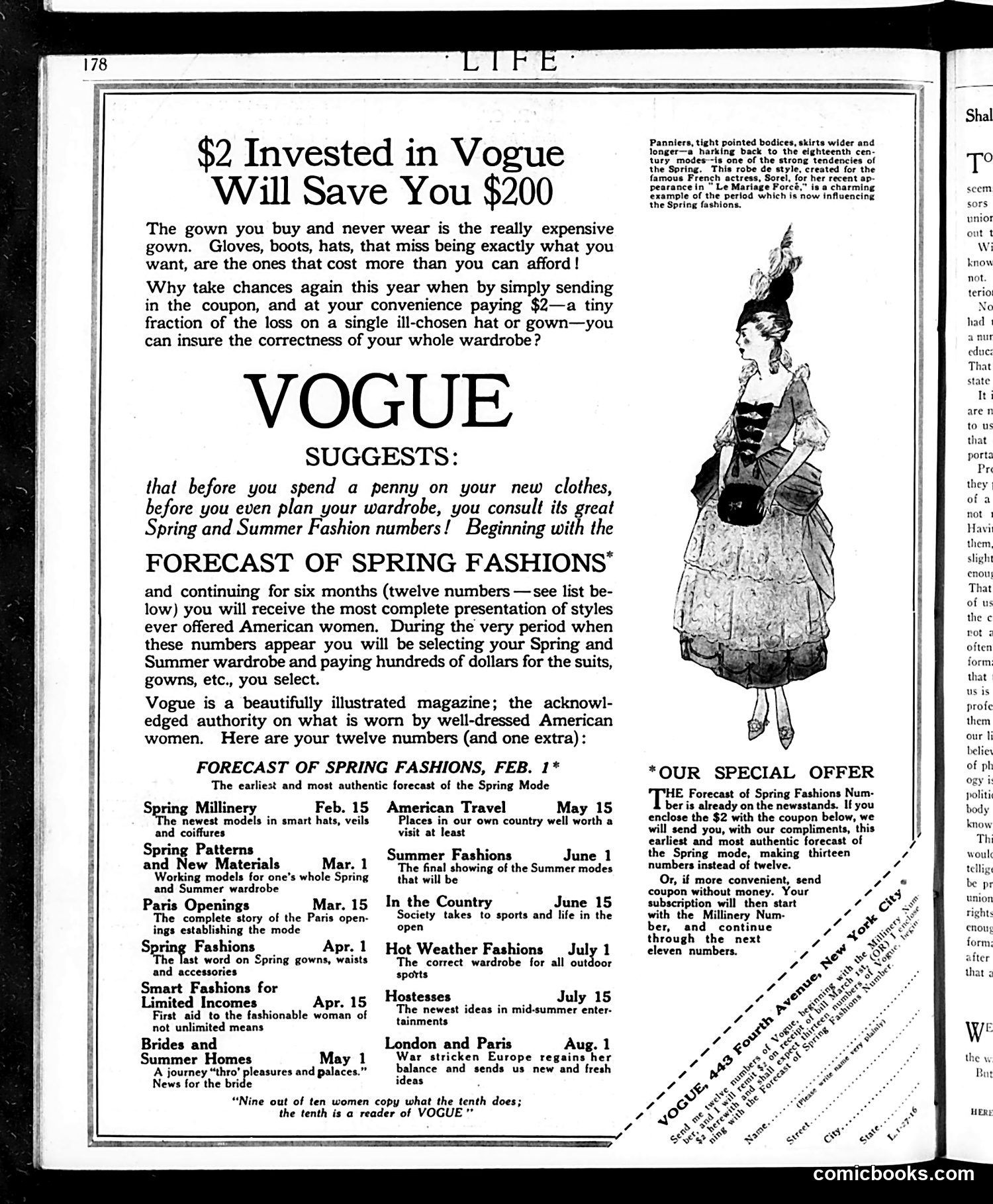
This is a **full-page advertisement for Vogue magazine**, not political satire. It's from the early 20th century (likely 1910s-1920s based on fashion references and WWI mention). The ad uses a common sales strategy: arguing that a $2 subscription to Vogue will prevent costly fashion mistakes, ultimately "saving" readers $200 by ensuring they buy the right clothes. The illustrated figure on the right shows period fashion with eighteenth-century influences ("panniers, tight pointed bodices"). The key selling point is the "Forecast of Spring Fashions"—twelve monthly issues covering seasonal trends from Paris openings to summer entertaining. The famous tagline states: "Nine out of ten women copy what the tenth does; the tenth is a reader of VOGUE." This reflects early advertising's appeal to female consumers' anxieties about appearing fashionable and well-dressed. The inclusion of "War stricken Europe" (WWI reference) suggests this ran during wartime, adding timeliness to European fashion authority.
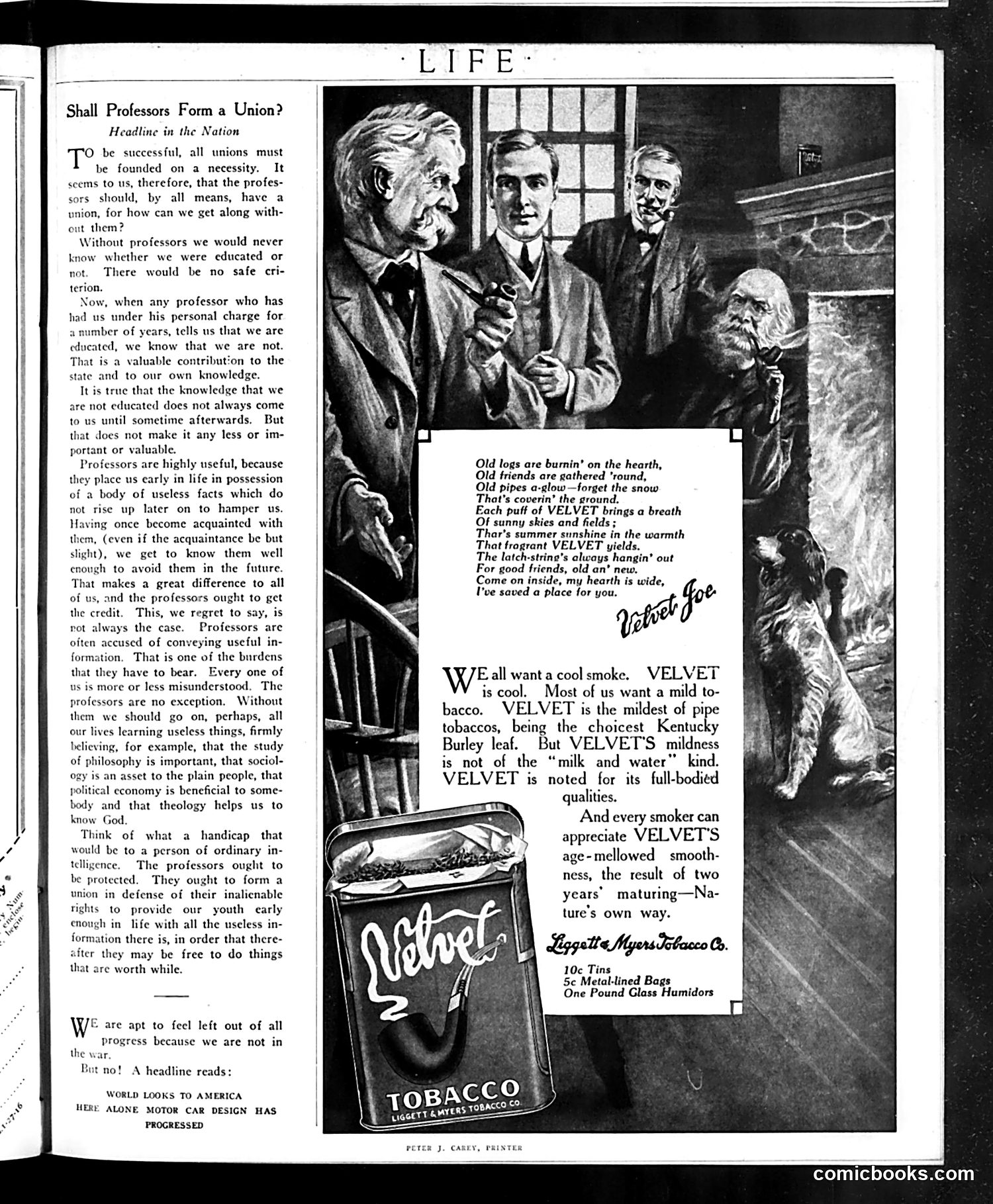
**The Main Article: "Shall Professors Form a Union?"** This is satirical commentary on a contemporary proposal (referenced in *The Nation* headline) for professors to unionize. The author uses mock-serious logic to argue professors *should* form a union—but the joke is that he systematically insults academia. He claims professors are "useful" because they teach students "useless facts" early in life, so students can avoid them later. The satire suggests professors deserve protection not for educating people, but for making education pointless enough that students learn to ignore intellectual pursuits like "philosophy" and "political economy." The accompanying illustration shows four older male professors in academic dress, apparently in earnest discussion—presented as the objects of this backhanded mockery. **The Advertisement:** A Velvet tobacco ad occupies the right side, featuring nostalgic imagery of old men smoking pipes by a hearth—completely unrelated to the article's content.
This is a cigarette advertisement from *Life* magazine (January 27, 1916). The image shows an elegantly gloved hand holding a cigarette, with text claiming that "at good places you don't need to mention the name / Just ask for the best cigarette." The ad uses prestige marketing—suggesting the product is so well-known and superior that establishments will understand what you want without naming it. The formal attire and refined imagery appeal to an upscale audience. A circular logo/emblem appears at the bottom, though the specific brand name isn't clearly legible in this reproduction. This reflects early-20th-century luxury consumer advertising tactics that relied on implied exclusivity and social status rather than direct product identification.