
Life, 1916-01-27 · page 18 of 44
Life — January 27, 1916 — page 18: what you’re looking at
What you’re looking at
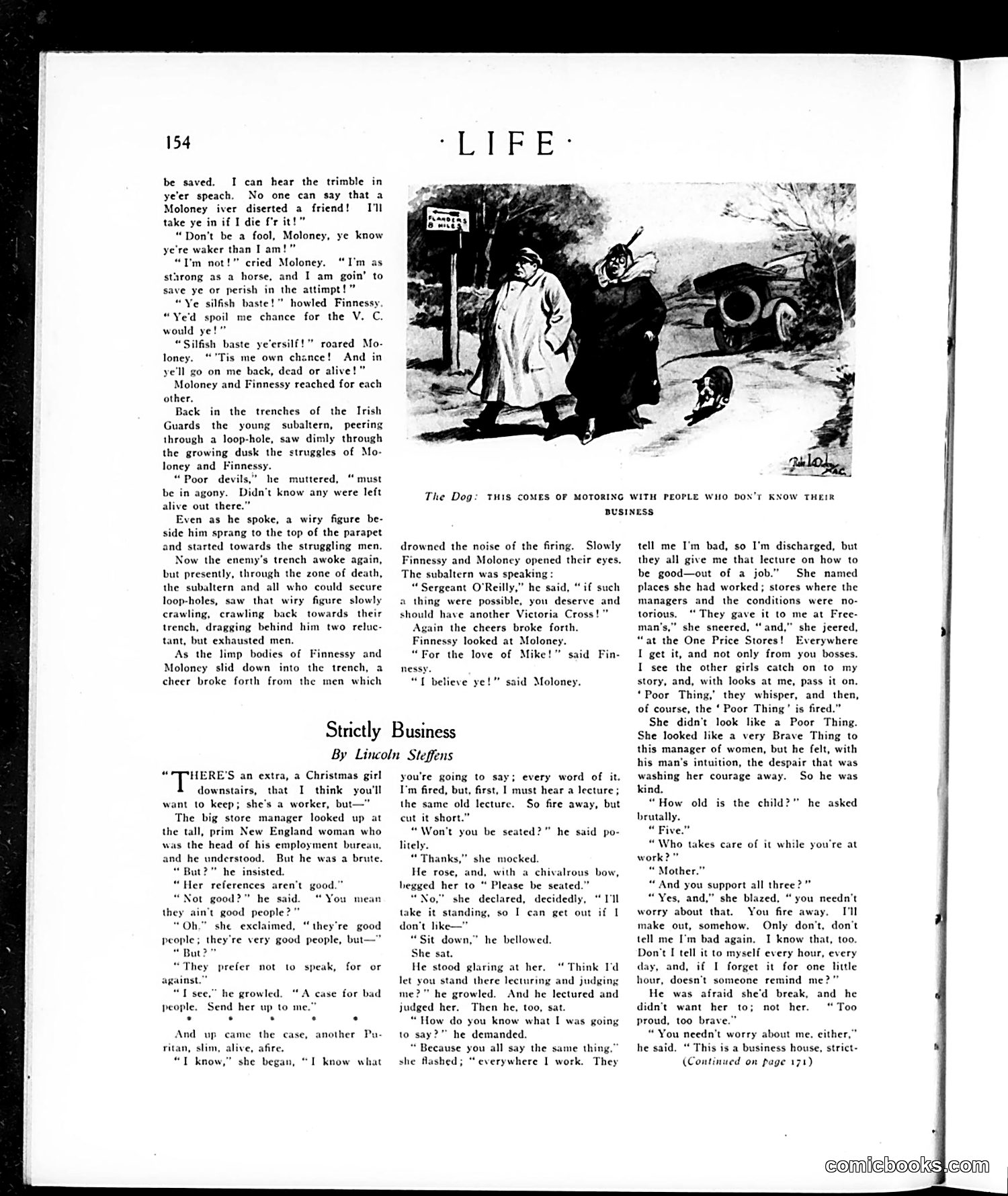
This page contains two distinct pieces of fiction satirizing social hierarchies and workplace injustice in early 20th-century America. **Top section:** A WWI trench narrative depicting Irish soldiers (Moloney and Finnessy) where pride and desire for military honors (the Victoria Cross) nearly override comradeship. The satire critiques how institutional recognition can corrupt human bonds. **"Strictly Business" (by Lincoln Steffens):** A story about a store manager and female employee. The woman is repeatedly fired despite good character, receiving identical patronizing lectures about self-improvement at every job. The satire exposes how employers use moral lectures to justify poor working conditions and low wages while blaming workers for their circumstances. The woman's observation that other workers spread her "Poor Thing" story reveals how systemic exploitation is normalized and perpetuated among the working class itself. The cartoon depicts a motorist with people unfamiliar with driving—a joke about incompetence causing problems.
📄 Transcribed text from this page (OCR, searchable)
Machine-transcribed from the original scan — historical spelling and the odd misread are preserved.
154 be saved. I can hear the trimble in ye'er speach. No one can say that a Moloney iver diserted a friend! I'l take ye in if I die f'r it!” “Don’t be a fool, Moloney, ye know ye're waker than I am!” “I'm not!" cried Moloney, “I'm a sthrong as a horse, and I am goin’ to save ye or perish in the attimpt!” “Ye silfish baste! howled Finnessy “Ye'd spoil me chance for the V. C. would ye!” “Silfish baste ye'ersilf!” roared Mo- loney. “Tis me own chance! And in ye'll go on me back, dead or alive!” Moloney and Finnessy reached for each other. Back in the trenches of the Irish Guards the young subaltern, peering through a loop-hole, saw dimly through the growing dusk the struggles of Mo- loney and Finnessy. “Poor devils,” he muttered, “ must be in agony. Didn't know any were left alive out there.” Even as he spoke, a wiry figure be- side him sprang to the top of the parapet and started towards the struggling men, Now the enemy's trench awoke again, but presently, through the zone of death, the subaltern and all who could secure loop-holes, saw that wiry figure slowly crawling, crawling back towards their trench, dragging behind him two reluc- tant, but exhausted men. As the limp bodies of Finnessy and Moloney slid down into the trench, a cheer broke forth from the men which Strictly The Dog: TiS COMES OF MOTORING WITH PEOPLE WiI0 DON’T KNOW THEIR BUSINESS drowned the noise of the firing. Slowly Finnessy and Moloney opened their eyes. The subaltern was speaking : Sergeant O'Reilly,” he said, “if such a thing were possible, you deserve and ould have another Victoria Cross! Again the cheers broke forth. Finnessy looked at Molone “For the love of Mike!” said Fin- nessy. “T believe ye!” said Moloney. Business By Lincoln Steffens “HERE'S an extra, a Christmas girl downstairs, that I think you'll want to keep; she’s a worker, but—" The big store manager looked up at the tall, prim New England woman who was the head of his employment bureau, and he understood. But he was a brute. But?" he insisted. Her references aren't good.” Not good?” he said. “You me ain't good people?” “Oh.” she exclaimed, “they're good people; they're very good people, but—" “But?” “They prefer not to speak, for or against.” “TL see,” he growled. “A case for bad people, Send her up to me.” And up came the case, another Pa- ritan, slim, alive, afire. “I know,” she began, “I know what you're going to say; every word of it. I'm fired, but, first, | must hear a lecture; the same old lecture. So fire away, but cut it short.” Won't you be seated?" he said po- Titely. Thanks,” she mocked. He rose, and, with a chivalrous bow, hegged her to “ Please be seated “No,” she declared, decidedly, “I'll take it standing, so I can get out if 1 don't like—" “Sit down,” he bellowed. She sat. He stood glaring at her. “Think I'd let you stand there lecturing and judging me?" he growled. And he lectured and judged her. Then he, too, sat. “How do you know what I was going to say?" he demanded. * Because you all say the same thing, she Aashed; “everywhere I work. They tell me I'm bad, so I'm discharged, but they all give me that lecture on how to be good—out of a job.” She named places she had worked; stores where the managers and the conditions were no- torious. “They gave it to me at Free- man’s,” she sneered, “and,” she jeered, “at the One Price Stores! Everywhere I get it, and not only from you bosses. I see the other girls catch on to my story, and, with looks at me, pass it on. ‘Poor Thing,’ they whisper, and then, of course, the ‘ Poor Thing’ is fired.” She didn't look like a Poor Thing. She looked like a very Brave Thing to this manager of women, but he felt, with his man’s intuition, the despair that was washing her courage away. So he was kind. “How old is the child?” he asked brutally. “ Five.” “Who takes care of it while you're at work?” * Mother.” “ And you support all three?” “Yes, and,” she blazed, “ you needn't worry about that. You fire away. I'll make out, somehow, Only don't, don’t tell me I'm bad again. I know that, too. Don’t [ tell it to myself every hour, every day, and, if I forget it for one little hour, doesn't someone remind me?” He was afraid she'd break, and he didn’t want her to; not her. “Too proud, too brave.” “You needn't worry about me, either,” he said. “ This is a business house, strict- (Continued om page 171) comichoo! conn