
Life, 1916-01-27 · page 25 of 44
Life — January 27, 1916 — page 25: what you’re looking at
What you’re looking at
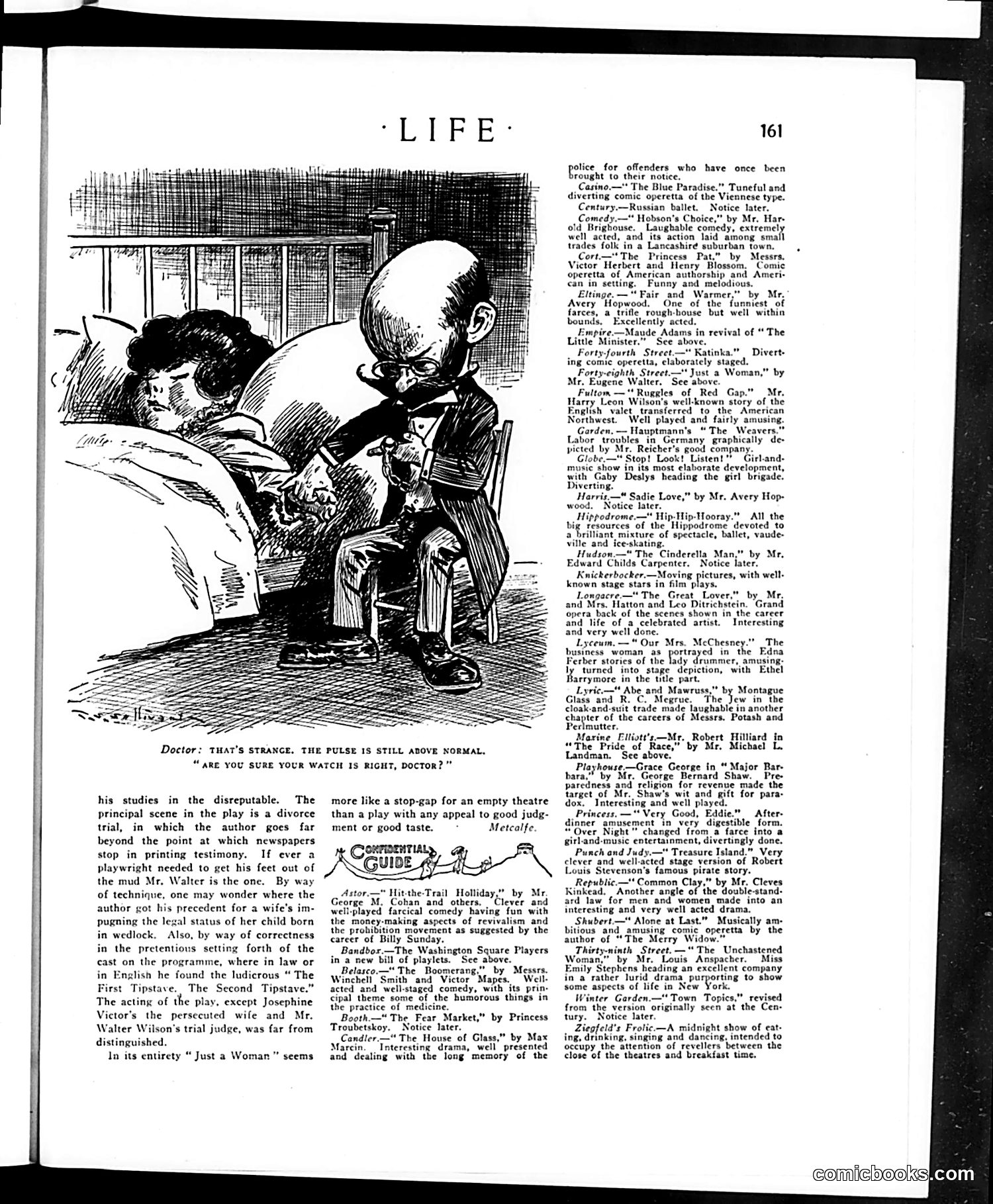
This single-panel cartoon depicts a doctor examining a patient in bed. The doctor, checking the patient's pulse, remarks that it remains "above normal," to which a companion (likely a family member) questions whether the doctor's watch is functioning correctly. **The Satire:** The joke relies on a double meaning of "watch." The companion interprets the doctor's concern about the patient's elevated pulse as potentially stemming from an inaccurate timepiece—a deliberately obtuse, literal misreading. This creates humor through willful misunderstanding: the doctor is using "watch" as a verb (to observe/monitor), while the companion pretends he meant the noun (the timepiece). **The Point:** This is gentle satirical humor about miscommunication and the absurdity of taking things too literally—a common comedic device in early 20th-century magazines. The illustration's style and the page's context (among theater reviews) suggest this appeared in *Life* magazine circa 1910s, when such wordplay-based humor was popular.
📄 Transcribed text from this page (OCR, searchable)
Machine-transcribed from the original scan — historical spelling and the odd misread are preserved.
Doctor: THAT'S STRANGE. THE PULSE 1S STILL ABOVE NORMAL, “ARE YOU SURE YOUR WATCH IS RIGHT, DOCTOR?” his studies in the disreputable. The principal scene in the play is a divorce trial, in which the author goes far beyond the point at which newspapers stop in printing testimony. If ever a playwright needed to get his feet out of the mud Mr. Walter is the one. By way of technique, one may wonder where the author got his precedent for a wife's im- pugning the legal status of her child born in wedlock. Also, by way of correctness in the pretentious setting forth of the cast on the programme, where in law or in English he found the ludicrous “ The First Tipstave. The Second Tipstave.” The acting of the play, except Josephine Victor's the persecuted wife and Mr. Walter Wilson's trial judge, was far from distinguished. In its entirety “ Just a Woman" seems more like a stop-gap for an empty theatre than a play with any appeal to good judg- ment or good taste. Metcalfe. CG ine. * Astor.—" Hit-the-Trail Holliday,” by Mr. George M. Cohan and others, Clever and well-played farcical comedy having fun with the money-making aspects of revivalism and the prohibition movement as suggested by the career of Billy Sunday. Bandbor.—The Washington Square Players in a new bill of playlets. See above. Belasco.—" The Boomerang.” by Messrs. Winchell Smith and Victor Mapes, We acted and well-staged comedy, with its prin- cipal theme some of the humorous things in the practice of medicine. Booth.—“ The Fear Market,” by Princess Troubetskoy. Notice later. Candler.—“ The House of Glass,” by Max Marcin. “Interesting drama, well’ presented and dealing with the long’ memory of the 161 Police, for offenders who have once been ought to their notice, Casino.—* The Blue Paradise.” Tuneful and diverting comic operetta of the Viennese type. Century.—Russian ballet. Notice later. Comedy.—" Hobson's Choice,” by Mr. Hare old Brighouse. Laughable comedy, extreme! well acted, and its action laid among small trades folk in a Lancashire suburban town, Cort—"The Princess Pat,” by Messrs. Victor Herbert and Henry Blossom, Comic operetta of American authorship and Ameri- can in setting. Funny and melodious. Eltinge.—“ Fair and Warmer," by Mr, Avery Hopwood, One of the funniest of farces, a trifle rough-bouse but well within bounds, xcellently acted. Empire-—Maude Adams in revival of The Little Minister.” See above. Forty-fourth Street.—" Katinka.” ing comic operetta, elaborately staged. Forty-eighth Street." Just. a Woman,” by Mr. Eugene Walter. See above. Fultom —“'Ruggles of Red Gap.” Mr. Harry Leon Wilson's well-known story of the English valet transferred to the American Northwest. Well played and fairly amusing. Garden, — Hauptmann's “The Weavers.” Labor troubles in Germany graphically de- picted by Mr. Reicher's good company. Globe.—"* Stop! Look! Listen!” Girland- music show in its most elaborate development, with Gaby Deslys heading the girl brigade, Diverting. Harris.— Sadie Love, wood. ‘otice later. Hippodrome.—" Hip-Hip-Wooray.” All. the big resources of the Hippodrome devoted to a brilliant mixture of spectacle, ballet, vaude- ville and ice-skating. Hudson.—" The Cinderella Man," by Mr. Edward Childs Carpenter. Notice later. Knickerbocker.—Moving pictures, with well- known stage stars in film plays. Longacre-— The Great. Lover," by Mr. and Mrs. Hatton and Leo Ditrichstein. Grand opera back of the scenes shown in the career and life of a celebrated artist. Interesting and very well done. Lyceum, —" Our Mrs, McChesney.” The business woman as portrayed in the Edna Ferber stories of the lady drummer, amusing- ly turned into stage depiction, with Ethel Barrymore in the title part. Divert by Mr. Avery Hop- Lyric Glass and R. C. Megrue. The Jew in the cloak-and-suit trade made laughable in another chapter of the careers of Messrs. Potash and Perlmutter. Marine Filistt's—Mr. Robert din “The Pride of Race,” by Mr, Michael L. Landman. See above. Playhouse —Grace George in “Major Bar- bara,” by Mr. George Bernard Shaw. Pre- paredness and religion for revenue made the target of Mr. Shaw's wit and gift for para~ dox. Interesting and well played. Princess. —" Very Good, Eddi dinner amusement in very digestible form. “ Over Night" changed from a farce into girl-and-music entertainment, divertingly done. Punch and Judy.—" Treasure Island.” Very clever and well-acted stage version of Robert Louis Stevenson's famous pirate story. Republic.—* Common Clay,” by Mr. Cleves Kinkead. Another angle of the double-stand- ard law for men and women made into an interesting and very well acted drama. Shubert—" Alone at Last.” Musically am- bitious and, amusing comic operetta by the author of “The Merry Widow.” Thirty-ninth Street. —“ The Unchastened Woman,” by Mr. Louis Anspacher. Miss Emily Stephens heading an excellent company in a rather lurid drama purporting to show some aspects of life in New York. Winter Garden.—"' Town Topics,” revised from the version originally seen at the Cen- tury. Notice later. Ziegfeld's Frolic—A midnight show of eat- ing, drinking, singing and dancing, intended to occupy the attention of revellers between the close of the theatres and breakfast time. Abe.and Mawruss,”* by Montague