
Life, 1916-01-27 · page 30 of 44
Life — January 27, 1916 — page 30: what you’re looking at
What you’re looking at
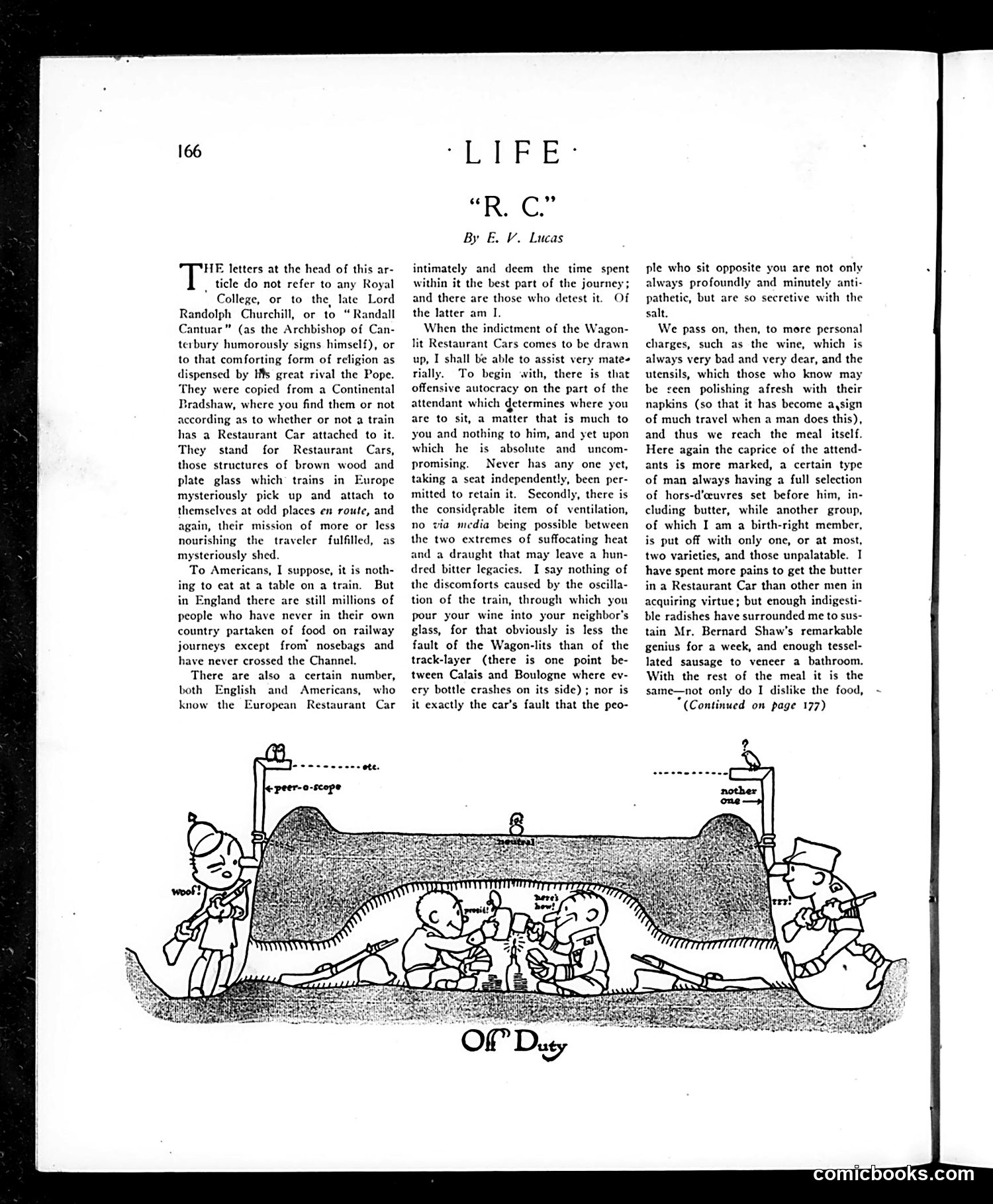
This page satirizes European railway dining cars through E.V. Lucas's humorous essay. The title "R.C." doesn't refer to royalty or religion, but to "Restaurant Cars"—the mysterious dining compartments attached to continental trains. Lucas's complaint is whimsical but pointed: he attacks the authoritarian attendants who dictate seating, the impossible ventilation (either stifling or drafty), poor wine service, and inconsistent meal quality. He notes the social indignity of having wine spilled on neighbors due to train oscillation, and the peculiar discrimination in hors d'oeuvres distribution. The cartoon below shows tiny figures dining inside a train car depicted as a large horizontal vessel, visually emphasizing the cramped, absurd nature of rail dining. The illustration titled "Of Duty" is unclear without the continuation, but supports Lucas's satirical portrait of Continental travel's minor torments—a genteel complaint about European modernization and its discomforts.
📄 Transcribed text from this page (OCR, searchable)
Machine-transcribed from the original scan — historical spelling and the odd misread are preserved.
HE letters at the head of this ar- , ticle do not refer to any Royal College, or to the, late Lord Randolph Churchill, or to “ Randall Cantuar” (as the Archbishop of Can- terbury humorously signs himself), or to that comforting form of religion as dispensed by Hs great rival the Pope. They were copied from a Continental Pradshaw, where you find them or not according as to whether or not a train has a Restaurant Car attached to it. They stand for Restaurant Cars, those structures of brown wood and plate glass which trains in Europe mysteriously pick up and attach to themselves at odd places en route, and again, their mission of more or less nourishing the traveler fulfilled, as mysteriously shed. To Americans, I suppose, it is noth- ing to eat at a table on a train. But in England there are still millions of people who have never in their own country partaken of food on railway journeys except from’ nosebags and have never crossed the Channel. There are also a certain number, both English and Americans, who know the European Restaurant Car intimately and deem the time spent within it the best part of the journey; and there are those who detest it. Of the latter am I. When the indictment of the Wagon- lit Restaurant Cars comes to be drawn up, I shall be able to assist very mates tially. To begin with, there is that offensive autocracy on the part of the attendant which determines where you are to sit, a matter that is much to you and nothing to him, and yet upon which he is absolute and uncom- promising. Never has any one yet, taking a seat independently, been per- mitted to retain it. Secondly, there is the considerable item of ventilation, no via media being possible between the two extremes of suffocating heat and a draught that may leave a hun- dred bitter legacies. I say nothing of the discomforts caused by the oscilla- tion of the train, through which you pour your wine into your neighbor's glass, for that obviously is less the fault of the Wagon-lits than of the track-layer (there is one point be- tween Calais and Boulogne where ev- ery bottle crashes on its side) ; nor is it exactly the car’s fault that the peo- ple who sit opposite you are not only always profoundly and minutely anti- pathetic, but are so secretive with the salt. We pass on, then, to more personal charges, such as the wine, which is always very bad and very dear, and the utensils, which those who know may be seen polishing afresh with their napkins (so that it has become a,sign of much travel when a man does this), and thus we reach the meal itself. Here again the caprice of the attend- ants is more marked, a certain type of man always having a full selection of hors-d’cuvres set before him, in- cluding butter, while another group, of which I am a birth-right member, is put off with only one, or at most, two varieties, and those unpalatable. I have spent more pains to get the butter in a Restaurant Car than other men in acquiring virtue; but enough indigesti- ble radishes have surrounded me to sus- tain Mr. Bernard Shaw's remarkable genius for a week, and enough tessel- lated sausage to veneer a bathroom. With the rest of the meal it is the same—not only do I dislike the food, “(Continued on page 177) comicbooks.com