
Life, 1916-01-27 · page 28 of 44
Life — January 27, 1916 — page 28: what you’re looking at
What you’re looking at
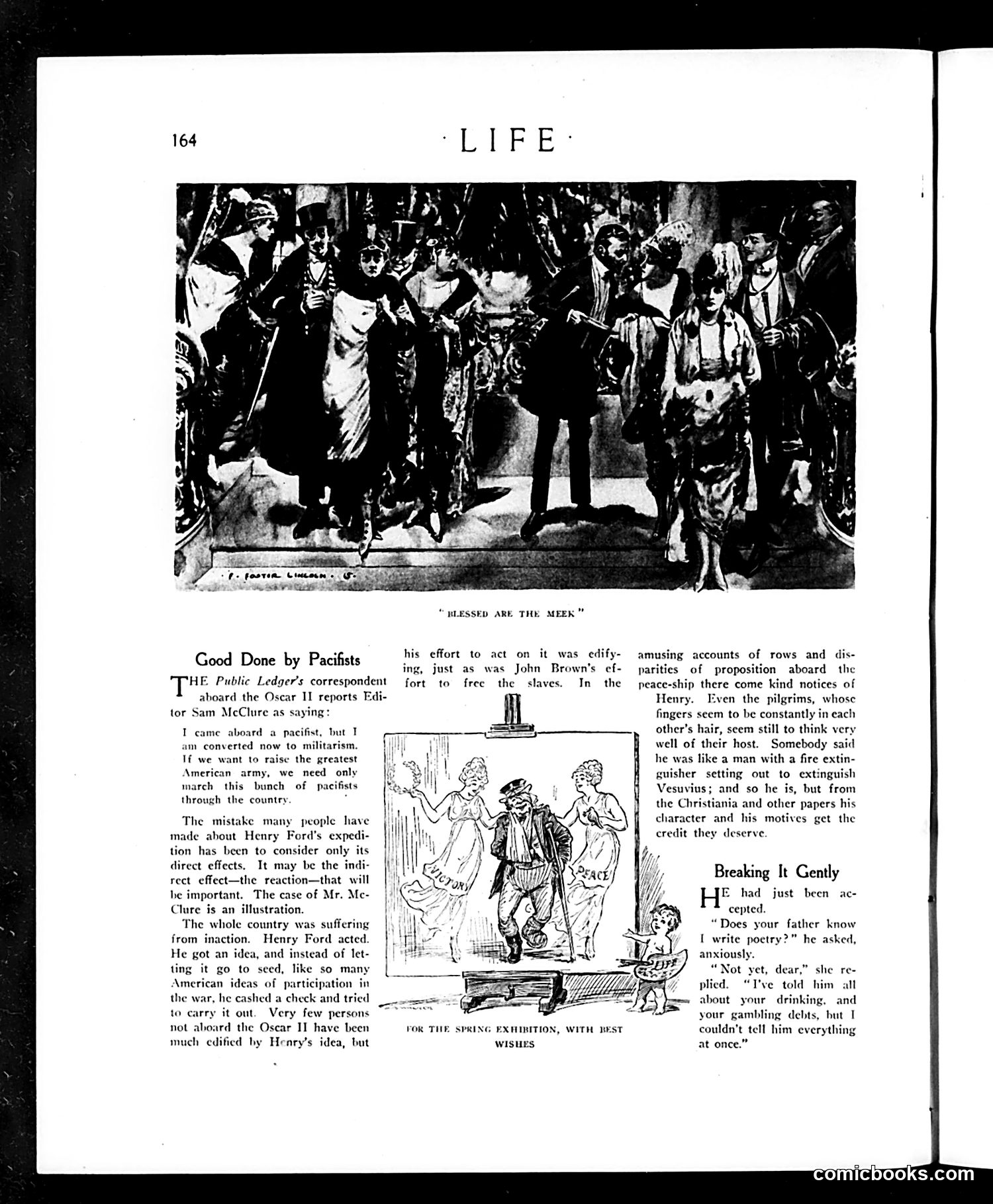
**Main Article: "Good Done by Pacifists"** This piece satirizes Henry Ford's 1915 "Peace Ship" (Oscar II), where Ford sent pacifists to Europe attempting to stop World War I. The article mocks the expedition's ineffectiveness while grudgingly acknowledging Ford's sincere effort. Editor Sam McClure's ironic claim that seeing pacifists convinced him of militarism's necessity is the central joke—the pacifists' very presence backfired, accidentally arguing *for* military preparedness. The comparison to John Brown (anti-slavery radical) suggests the pacifists are equally misguided zealots. **Cartoon: "For the Spring Exhibition, With Best Wishes"** This untitled cartoon appears to depict three allegorical female figures—likely representing Wisdom, Peace, and Justice or similar virtues—presenting or blessing a male figure (unclear if specific person). The artistic style is typical of 1910s editorial cartooning with classical allegorical conventions. **Overall Context:** The page reflects pre-WWI American debate about pacifism versus military intervention, with Life magazine taking a skeptical stance toward pacifist activism.
📄 Transcribed text from this page (OCR, searchable)
Machine-transcribed from the original scan — historical spelling and the odd misread are preserved.
+ 0+ fasten Cimcoem « hy SAAS Good Done by Pacifists THE Public Ledger's correspondent aboard the Oscar II reports Edi- tor Sam McClure as saying: T came aboard a pacifist, but T am converted now to militarism. If we want to raise the greatest American army, we need only march this bunch of pacifists through the country The mistake many people have made about Henry Ford’s expedi- tion has been to consider only its effects. It may be the indi- rect effect—the reaction—that will he important. The case of Mr. Me- Clure is an illustration. The whole country was suffering from inaction. Henry Ford acted. He got an idea, and instead of let- ting it go to seed, like American ideas of participation in the war, he cashed a check and tried to carry it out. Very few persons not aboard the Oscar II have been much cdified hy Henry’s idea, but his effort to act on it ing, just as was John was edify- Brown's cf- slaves. In the fort to free the FOR THE SPRING EXHIBITION, WITH REST WISHES amusing accounts of rows and dis- parities of proposition aboard the peace-ship there come kind notices of Henry. Even the pilgrims, whose fingers seem to be constantly in each other’s hair, seem still to think very well of their host. Somebody said he was like a man with a fire extin- guisher setting out to extinguish Vesuvius; and so he is, but from the Christiania and other papers his character and his motives get the credit they deserve. Breaking It Gently E had cepted. “Does your father know I write poetry?” he asked, anxiously. “Not yet, dear,” she re- just been ac- plied. “I've told him all about your drinking, and your gambling debts, but I couldn't tell him everything at once.”