
Life, 1916-01-27 · page 20 of 44
Life — January 27, 1916 — page 20: what you’re looking at
What you’re looking at
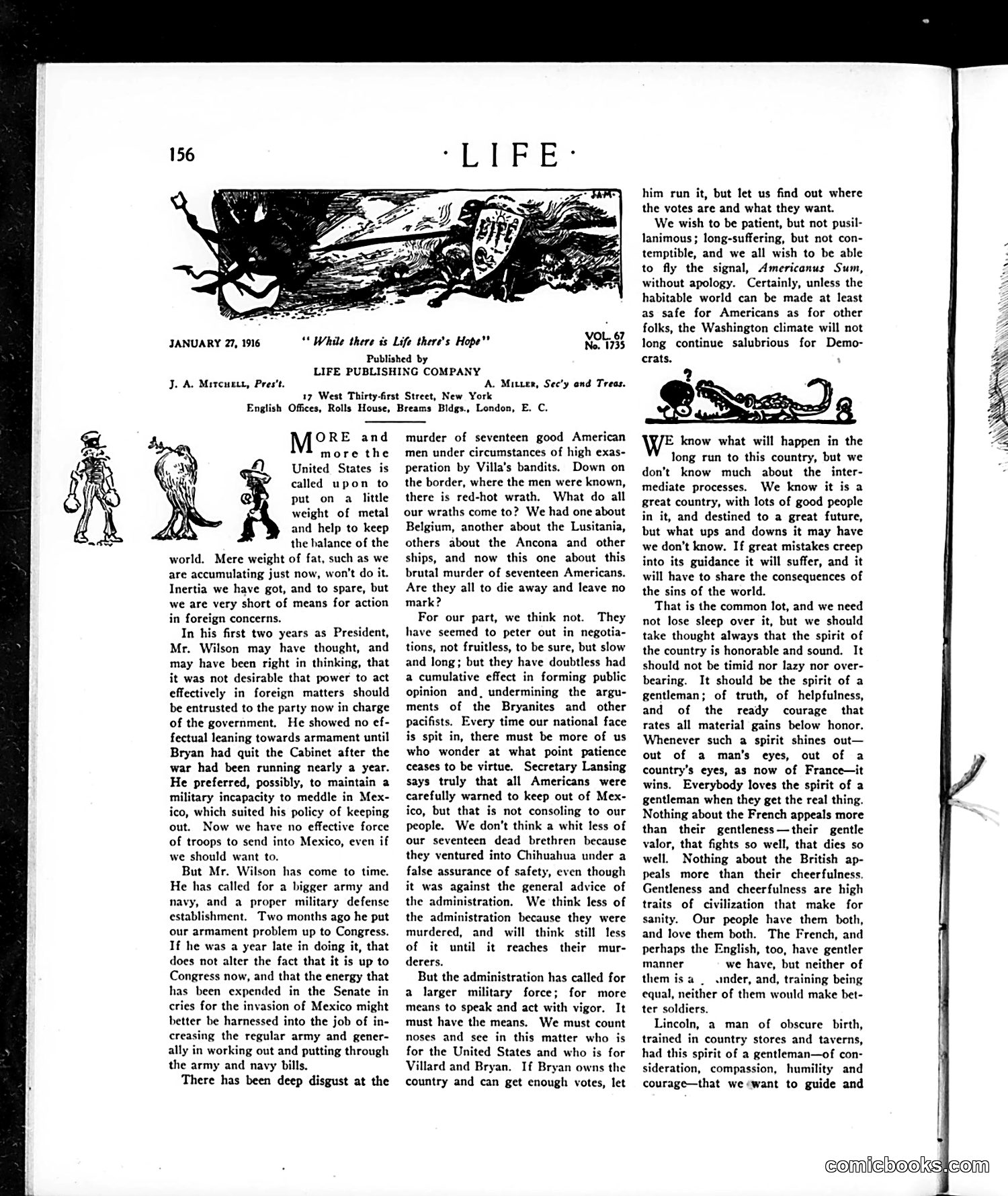
This page addresses America's military preparedness amid foreign crises. The editorial criticizes President Wilson for initially resisting armament while foreign incidents—the sinking of the *Lusitania*, the *Ancona*, and now the murder of seventeen Americans in Chihuahua by Pancho Villa's forces—tested American patience. The author praises Wilson's recent call for expanded military forces but argues Congress must act decisively. The piece attacks pacifists, particularly William Jennings Bryan (Wilson's former Secretary of State who resigned over the *Lusitania* response) and Oswald Garrison Villard, for counseling restraint. The core argument: America must maintain moral authority and national dignity ("Americanus Sum"—"I am American") by responding forcefully to these outrages, not through endless negotiation but through military capability and willingness to use it. The editorial frames military strength as necessary for preserving both honor and effective foreign policy.
📄 Transcribed text from this page (OCR, searchable)
Machine-transcribed from the original scan — historical spelling and the odd misread are preserved.
JANUARY 27, 1916 “« While there is Life there's Hope” Published by LIFE PUBLISHING COMPANY J. A. Mircette, Pres't. English Offices, ORE and more the United States is called upon to put on a little weight of metal and help to keep the balance of the world. Mere weight of fat, such as we are accumulating just now, won't do it. Inertia we have got, and to spare, but we are very short of means for action in foreign concerns. In his first two years as President, Mr. Wilson may have thought, and may have been right in thinking, that it was not desirable that power to act effectively in foreign matters should be entrusted to the party now in charge of the government. He showed no ef- fectual leaning towards armament until Bryan had quit the Cabinet after the war had been running nearly a year. He preferred, possibly, to maintain a military incapacity to meddle in Mex- ico, which suited his policy of keeping out. Now we have no effective force of troops to send into Mexico, even if we should want to. But Mr. Wilson has come to time. He has called for a bigger army and navy, and a proper military defense establishment. Two months ago he put our armament problem up to Congress. If he was a year late in doing it, that does not alter the fact that it is up to Congress now, and that the energy that has been expended in the Senate in cries for the invasion of Mexico might better be harnessed into the job of in- creasing the regular army and gener- ally in working out and putting through the army and navy bills. There has been deep disgust at the A. Minter, Sec'y and Treas. 17 West Thirty-first Street, New York Rolls House, Breams Bldgs., London, E. C. murder of seventeen good American men under circumstances of high exas- peration by Villa’s bandits. Down on the border, where the men were known, there is red-hot wrath. What do all our wraths come to? We had one about Belgium, another about the Lusitania, others about the Ancona and other ships, and now this one about this brutal murder of seventeen Americans. Are they all to die away and leave no mark? For our part, we think not. They have seemed to peter out in negotia- tions, not fruitless, to be sure, but slow and long; but they have doubtless had a cumulative effect in forming public opinion and, undermining the argu- ments of the Bryanites and other pacifists. Every time our national face is spit in, there must be more of us who wonder at what point patience ceases to be virtue. Secretary Lansing says truly that all Americans were carefully warned to keep out of Mex- ico, but that is not consoling to our people. We don’t think a whit less of our seventeen dead brethren because they ventured into Chihuahua under a false assurance of safety, even though it was against the general advice of the administration. We think less of the administration because they were murdered, and will think still less of it until it reaches their mur- derers. But the administration has called for a larger military force; for more means to speak and act with vigor. It must have the means. We must count noses and see in this matter who is for the United States and who is for Villard and Bryan. If Bryan owns the country and can get enough votes, let him run it, but let us find out where the votes are and what they want. We wish to be patient, but not pusil- lanimous ; long-suffering, but not con- temptible, and we all wish to be able to fly the signal, Americanus Sum, without apology. Certainly, unless the habitable world can be made at least as safe for Americans as for other folks, the Washington climate will not long continue salubrious for Demo- crats. E know what will happen in the long run to this country, but we don’t know much about the inter- mediate processes. We know it is a great country, with lots of good people in it, and destined to a great future, but what ups and downs it may have we don’t know. If great mistakes creep into its guidance it will suffer, and it will have to share the consequences of the sins of the world. That is the common lot, and we need not lose sleep over it, but we should take thought always that the spirit of the country is honorable and sound. It should not be timid nor lazy nor over- bearing. It should be the spirit of a gentleman; of truth, of helpfulness, and of the ready courage that rates all material gains below honor. Whenever such a spirit shines out— out of a man’s eyes, out of a country’s eyes, as now of France—it wins, Everybody loves the spirit of a gentleman when they get the real thing. Nothing about the French appeals more than their gentleness—their gentle valor, that fights so well, that dies so well. Nothing about the British ap- peals more than their cheerfulness. Gentleness and cheerfulness are high traits of civilization that make for sanity. Our people have them both, and love them both. The French, and perhaps the English, too, have gentler manner we have, but neither of them is a | inder, and, training being equal, neither of them would make bet- ter soldiers. Lincoln, a man of obscure birth, trained in country stores and taverns, had this spirit of a gentleman—of con- sideration, compassion, humility and courage—that we «want to guide and