
Life, 1916-01-27 · page 24 of 44
Life — January 27, 1916 — page 24: what you’re looking at
What you’re looking at
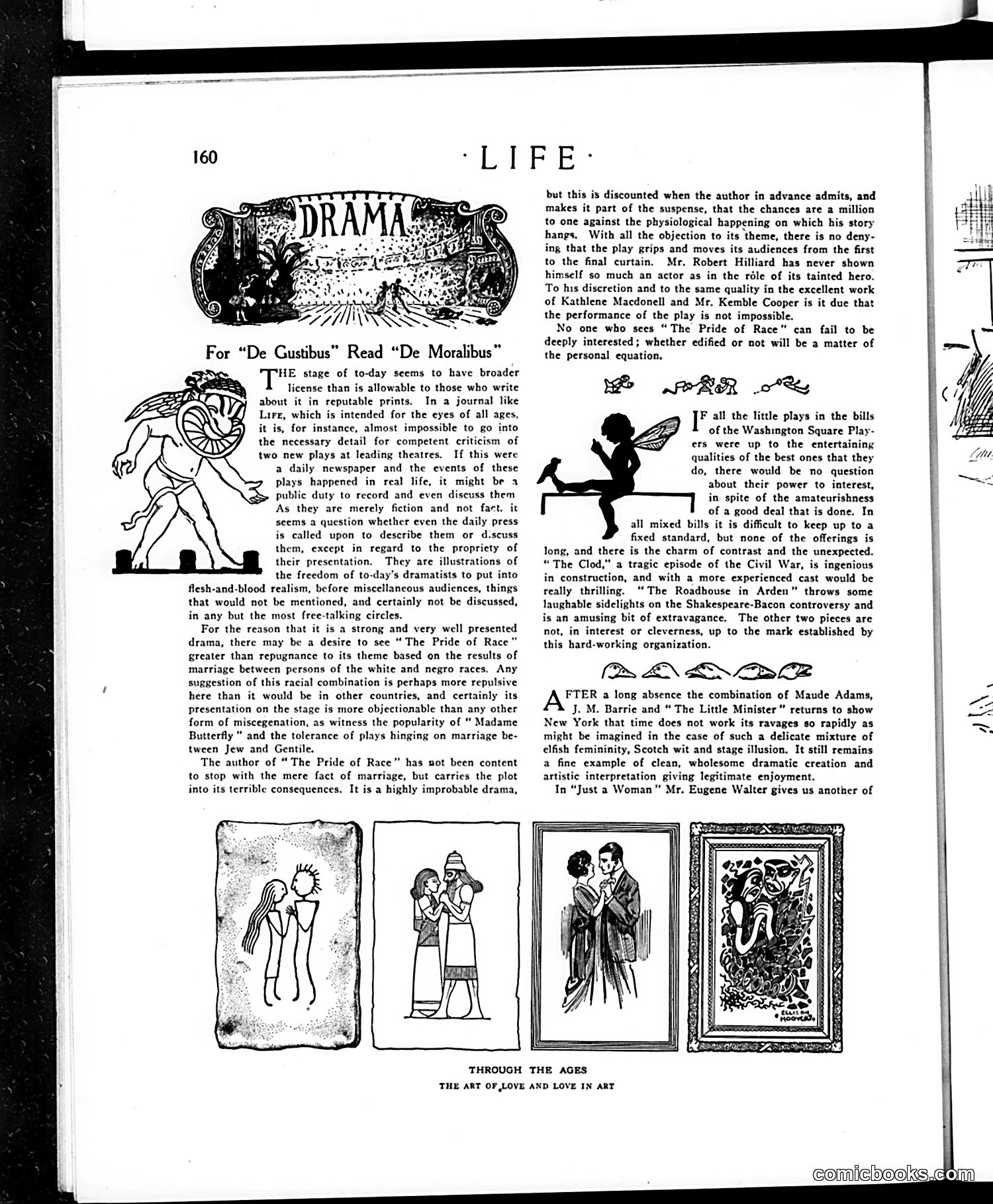
This page critiques contemporary Broadway plays, notably "The Pride of Race." The central satire concerns theatrical censorship and morality standards of the early 1900s. **Key Points:** The author argues that stage presentations face stricter moral scrutiny than newspaper reporting of identical events in real life. "The Pride of Race" depicts miscegenation (interracial marriage between white and Black characters)—a taboo subject that provokes particular American revulsion compared to other nations. **The Satire's Point:** Life's critic highlights the hypocrisy: audiences accept "Madame Butterfly" (white-Asian romance) and Jewish-Gentile marriages, yet viscerally reject Black-white relationships on stage. The title "De Gustibus/De Moralibus" (Latin: "About Taste/About Morals") suggests taste arguments mask actual racial prejudice. Despite objections to its "terrible consequences" plot, the critic acknowledges the play powerfully grips audiences—evidence the dramatic quality transcends its controversial subject matter. The accompanying illustrations appear to satirize romantic/artistic depictions through history, reinforcing the critique of selective moral standards.
📄 Transcribed text from this page (OCR, searchable)
Machine-transcribed from the original scan — historical spelling and the odd misread are preserved.
“LIFE: For “De Gustibus” Read “De Moralibus” HE stage of to-day seems to have broader license than is allowable to those who write about it in reputable prints. In a journal like Lire, which is intended for the eyes of all ages, it is, for instance, almost impossible to go into the necessary detail for competent criticism of two new plays at leading theatres. If this were a daily newspaper and the events of these plays happened in real life, it might be a public duty to record and even discuss them As they are merely fiction and not fact. it seems a question whether even the daily press is called upon to describe them or d.scuss them, except in regard to the propriety of their presentation. They are illustrations of the freedom of to-day’s dramatists to put into flesh-and-blood realism, before miscellaneous audiences, things that would not be mentioned, and certainly not be discussed, in any but the most free-talking circles. For the reason that it is a strong and very well presented drama, there may be a desire to see “ The Pride of Race” Greater than repugnance to its theme based on the results of marriage between persons of the white and negro races. Any suggestion of this racial combination is perhaps more repulsive here than it would be in other countries, and certainly its presentation on the stage is more objectionable than any other form of miscegenation, as witness the popularity of “ Madame Butterfly” and the tolerance of plays hinging on marriage be- tween Jew and Gentile. The author of “ The Pride of Race” has not been content to stop with the mere fact of marriage, but carries the plot into its terrible consequences. It is a highly improbable drama, but this is discounted when the author in advance admits, and makes it part of the suspense, that the chances are a million to one against the physiological happening on which his story hangs. With all the objection to its theme, there is no deny- ing that the play grips and moves its audiences from the first to the final curtain. Mr. Robert Hilliard has never shown himself so much an actor as in the réle of its tainted hero. To his discretion and to the same quality in the excellent work of Kathlene Macdonell and Mr. Kemble Cooper is it due that the performance of the play is not impossible. No one who sees “The Pride of Race” can fail to be deeply interested; whether edified or not will be a matter of the personal equation. we PBR or &% F all the little plays in the bills of the Washington Square Play: ers were up to the entertaining qualities of the best ones that they do, there would be no question about their power to interest, in. spite of the amateurishness of a good deal that is done. In all mixed bills it is difficult to keep up to a fixed standard, but none of the offerings is long, and there is the charm of contrast and the unexpected. “The Clod,” a tragic episode of the Civil War, is ingenious in construction, and with a more experienced cast would be really thrilling. ‘The Roadhouse in Arden” throws some laughable sidelights on the Shakespeare-Bacon controversy and is an amusing bit of extravagance. The other two pieces are not, in interest or cleverness, up to the mark established by this hard-working organization. (2 2X &> BLE FTER a long absence the combination of Maude Adams, J. M. Barrie and “ The Little Minister” returns to show ‘w York that time does not work its ravages so rapidly as might be imagined in the case of such a delicate mixture of clfish femininity, Scotch wit and stage illusion. It still remains a fine example of clean, wholesome dramatic creation and artistic interpretation giving legitimate enjoyment. In “Just a Woman” Mr. Eugene Walter gives us another of THROUGH THE AGES THE ART OF LOVE AND LOVE IN ART comichooks,