
Life, 1916-01-27 · page 8 of 44
Life — January 27, 1916 — page 8: what you’re looking at
What you’re looking at
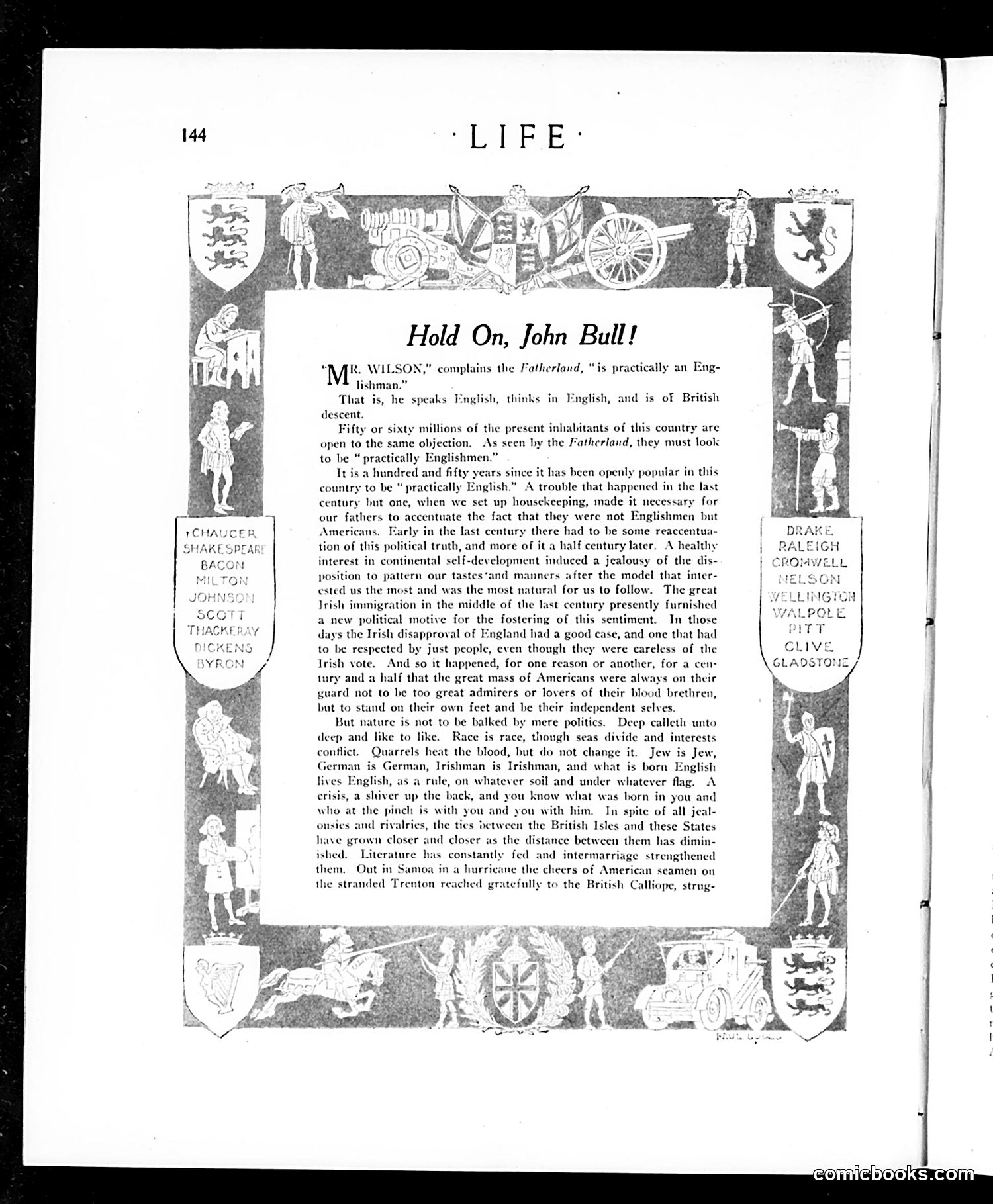
This satirical piece addresses Irish-American identity and Anglo-American relations. Mr. Wilson (the U.S. President, circa 1910s) claims the "Fatherland" produces "practically an Englishman"—someone English-speaking of British descent. The text argues that millions of Americans, though of British descent, should not be considered English but rather independent Americans. It critiques both British expectations of cultural loyalty and American anxiety about divided allegiances. The decorative border features heraldic shields and historical figures (names visible include Chaucer, Shakespeare, Bacon, Johnson, Scott, Dickens, Byron, Drake, and others)—representing English cultural heritage the piece ironically invokes while asserting American independence from it. The "John Bull" reference (British national symbol) emphasizes the central tension: Britain should "hold on" and accept American autonomy.
📄 Transcribed text from this page (OCR, searchable)
Machine-transcribed from the original scan — historical spelling and the odd misread are preserved.
Hold On, John Bull! “NAR. WILSON,” complains the Fatherland, “is practically an Eng- lishman.” That is, he speaks English, thinks in English, and is of British descent. Fifty or sixty millions of the present inhabitants of this country are open to the same objection. As seen by the Fatherland, they must look to be “ practically Englishmen. It is a hundred and fifty years since it has been openly popular in this country to be “practically English.” A trouble that happened in the last century but one, when we set up housekeeping, made it necessary for athers to accentuate the fact that they were not Englishmen but Early in the last century there had to be some reaccentua- tion of this political truth, and more of it a half century later. A healthy interest in continental self-development induced a jealousy of the dis- position to pattern our tastes‘and manners after the model that inter- ested us the most and was the most natural for us to follow. The great Irish immigration in the middle of the last century presently furnished a new political motive for the fostering of this sentiment. In those days the Irish disapproval of England had a good case, and one that had to be respected by just people, even though they were careless of the Irish vote. And so it happened, for one reason or another, for a cen- tury and a half that the great mass of Americans were always on their guard not to be too great admirers or lovers of their blood brethren, but to stand on their own feet and be their independent selves. But nature is not to be balked by mere politics. Deep calleth unto deep and like to like. Race is race, though seas divide and interests conflict. Quarrels heat the blood, but do not change it. Jew is Jew, rman is German, Irishman is Irishman, and what is born English lives English, as a rule, on whatever soil and under whatever flag. A crisis, a shiver up the back, and you know what was born in you and who at the pinch is with you and you with him. In spite of all jeal- ousies and rivalries, the ties between the British Isles and these States have grown closer and closer as the distance between them has dimin- ished. Literature has constantly fed and intermarriage strengthened them, Out in Samoa in a hurricane the cheers of American seamen on the stranded Trenton reached gratefully to the British Calliope, strug-