
Life, 1916-01-27 · page 17 of 44
Life — January 27, 1916 — page 17: what you’re looking at
What you’re looking at
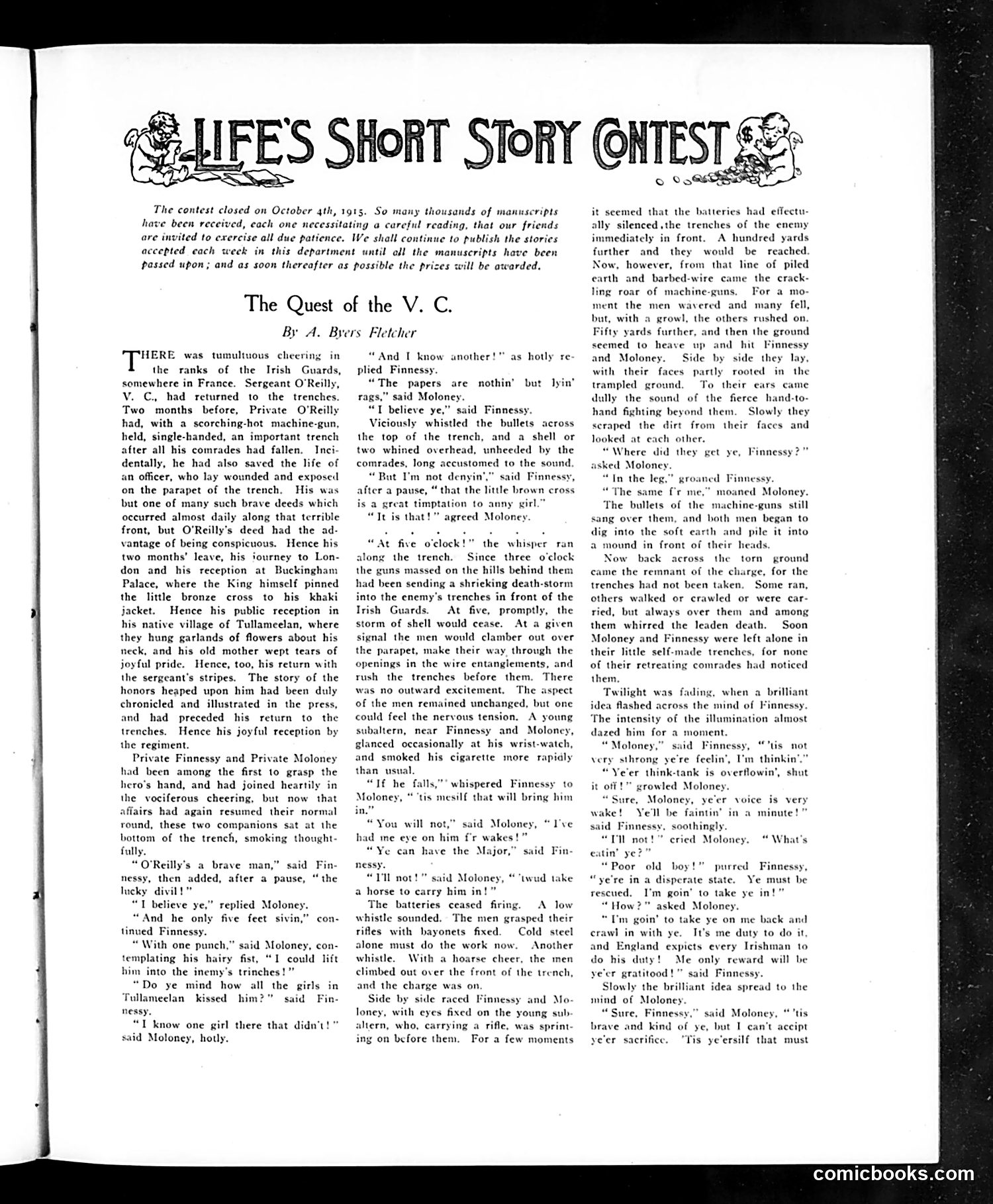
This page presents a WWI short story contest entry set in the trenches of France. The narrative depicts Irish Guards soldiers, including the decorated hero Sergeant O'Reilly (recently awarded the Victoria Cross), preparing for a trench raid. The story's irony lies in contrasting O'Reilly's celebrated heroism with the sardonic realism of fellow soldiers Finnessy and Moloney. While the press romanticizes O'Reilly's valor and the public celebrates him at Buckingham Palace and in his village, his comrades cynically discuss how medals attract girls and joke about carrying him into enemy trenches despite his small stature. The climactic moment arrives at "five o'clock"—the signal for an assault following a artillery barrage. As soldiers prepare to go "over the top," Finnessy and Moloney argue over who will rescue O'Reilly if he falls, revealing the grim reality beneath wartime heroics: daily casualty-producing trench raids. The story exemplifies how Life magazine presented WWI—acknowledging genuine bravery while depicting soldiers' dark humor as coping mechanism for industrial slaughter.
📄 Transcribed text from this page (OCR, searchable)
Machine-transcribed from the original scan — historical spelling and the odd misread are preserved.
The contest closed on October 4th, 1915. So many thousands of manuscripts have been received, each one necessitating a careful reading, that our friends are invited to exercise all due patience. We shall continue to publish the stories accepted cach week in this department until oll the manuscripts have been passed upon; and as soon thereafter as possible the prizes will be awarded. The Quest of the V. C. By A. By HERE was tumultuous cheering in the ranks of the Irish Guards, somewhere in France. Sergeant O'Reilly, V. C, had returned to the trenches. Two months before, Private O'Reilly had, with a scorching-hot_ machine-gun, held, single-handed, an important trench after all his comrades had fallen. Inci dentally, he had also saved the life of an officer, who lay wounded and exposed on the parapet of the trench. His but one of many such brave deeds which occurred almost daily along that terrible front, but O'Reilly's deed had the ad- vantage of being conspicuous. Hence his two months’ leave, his iourney to Lon- don and his reception at Buckingham Palace, where the King himself pinned the little bronze cross to his khak jacket. Hence his public reception in his native village of Tullameelan, where they hung garlands of flowers about his neck, and his old mother wept tears of joyful pride. Hence, too, his return with the sergeant’s stripes. The story of the honors heaped upon him had been duly chronicled and illustrated in the press, and had preceded his return to the trenches. Hence his joyful reception by the regiment. Private Finnessy and Private Moloney had been among the first to grasp the hero’s hand, and had joined heartily in the vociferous cheering, but now that affairs had again resumed their normal round, these two companions sat at the bottom of the trench, smoking thought- fully. “O'Reilly's a brave man,” said nessy, then added, after a pause, lucky divil!” “T believe ye,” replied Moloney. “And he only five feet sivin,” co tinued Finness “With one punch,” said Moloney, con- templating his hairy fist, “I could lift him into the inemy’s trinches!”” “Do ye mind how all the girls in Tullameelan kissed said F nessy. “I know one girl there that didn’t! said Moloney, houy. was him?” rs Fletcher And [ know plied Finnessy. another!" as hotly re “The papers are nothin’ bi lyin’ ." said Moloney. “T believe ye,” said Finnessy, Viciously whistled the bullets across the top of the trench, and a shell or two whined overhead, unheeded by the comrades, long accustomed to the sound, “But I'm not denyin’,” after a pause, “ that the little brown cross a great timptation to anny girl.” “Te is that!” said Finnessy, greed Moloney “At five o'clock!" the whisper ran ng the trench. Since three o'clock the guns massed on the hills behind them had been sending a shrieking death-storm into the enemy's trenches in front of the Irish Guards. At five, promptly, the storm of shell would cease. At a given jgnal the men would clamber out over the parapet, make their way through the openings in the wire entanglements, and rush the trenches before them. There was no outward excitement. The aspect of the men remained unchanged, but one could feel the nervous tension. A young subaltern, near Finnessy and Moloney, glanced occasionally at his wrist-watch, and smoked his cigarette more rapidly than usual. “TE he fall Moloney, in, whispered Finnessy to ‘tis mesilf that will bring him “You will not,” said Moloney, “I've had me eye on him f'r wakes!” “Ye can have the Major, nessy. “TI not!” said Moloney, “ “wud take a horse to carry him in!” The batteries ceased firing. A low whistle sounded. The men grasped their rifles with bayonets fixed. Cold steel alone must do the work now. Another whistle. With a hoarse cheer, the men climbed out over the front of the trench, and the charge was on. Side by side raced Finnessy and Mo- loney, with eyes fixed on the young sub altern, who, carrying a rifle, was sprint- ing on before them. For a few moments said Fin it seemed that the batteries had effectu- ally silenced the trenches of the enemy immediately in front. A hundred yards further and they would be reached Now, however, from that line of piled earth and barbed-wire came the crack- ling roar of machine-guns. ment the men wavered and many fell, but, with a growl, the others rushed on, Fifty yards further, and then the ground seemed to heave up and hit For a mo- innessy and Moloney. le by side they lay, with their faces partly rooted in the trampled ground. To their ears came dully the sound of the fierce hand-to- hand fighting beyond them. Slowly they scraped the dirt from their faces and looked at each other. Where did they get ye, Finnessy?” asked Moloney. “In the leg,” groaned Finnessy. “The same f'r me,” moaned Moloney. The bullets of the machine-guns. still sang over them, and both men began to dig into the soft earth and pile it into a mound in front of their he back the ground came the remnant of the charge, for the trenches had not been taken. Some ran, others walked or crawled or were car- ried, but always over them and among them whirred the leaden death. Soon Moloney and Finnessy were left alone in their little self-made trenches, for none of their retreating comrades had noticed them, Twill idea flashed across the mind of Finnessy. ‘The intensity of the illumination almost dazed him for a moment. “Moloney,” said F not very sthrong ye're feelin’, I'm thinkin’.” Ye'er think-tank is overflowin’, shut it off Now across torn ht was fading, when a bril nnessy, “tis rowled Moloney “Sure, Moloney, ye'er voice is very wake! Yell be faintin’ in a minute!” said Finnessy, soothingly. “TW not!” cried Moloney. “ What's eatin’ ye? “Poor old boy!” purred Finnessy, “ye're in a disperate state. Ye must be rescued. I'm goin’ to take ye in!” “ How?" asked Moloney. “Pm goin’ to take ye on me back and crawl in with ye. It's me duty to do it, and England expicts every Irishman do his duty! Me only reward will be ye'er gratitood!” said Finnessy. Slowly the brilliant id mind of Moloney. “Sure, Finnessy,” said Moloney, “tis brave and kind of ye, but I can't accipt ye'er sacrifice. "Tis ye'ersilf that must to to the sprea comicbooks.com