
A complete issue · 44 pages · 1915
Life — November 25, 1915
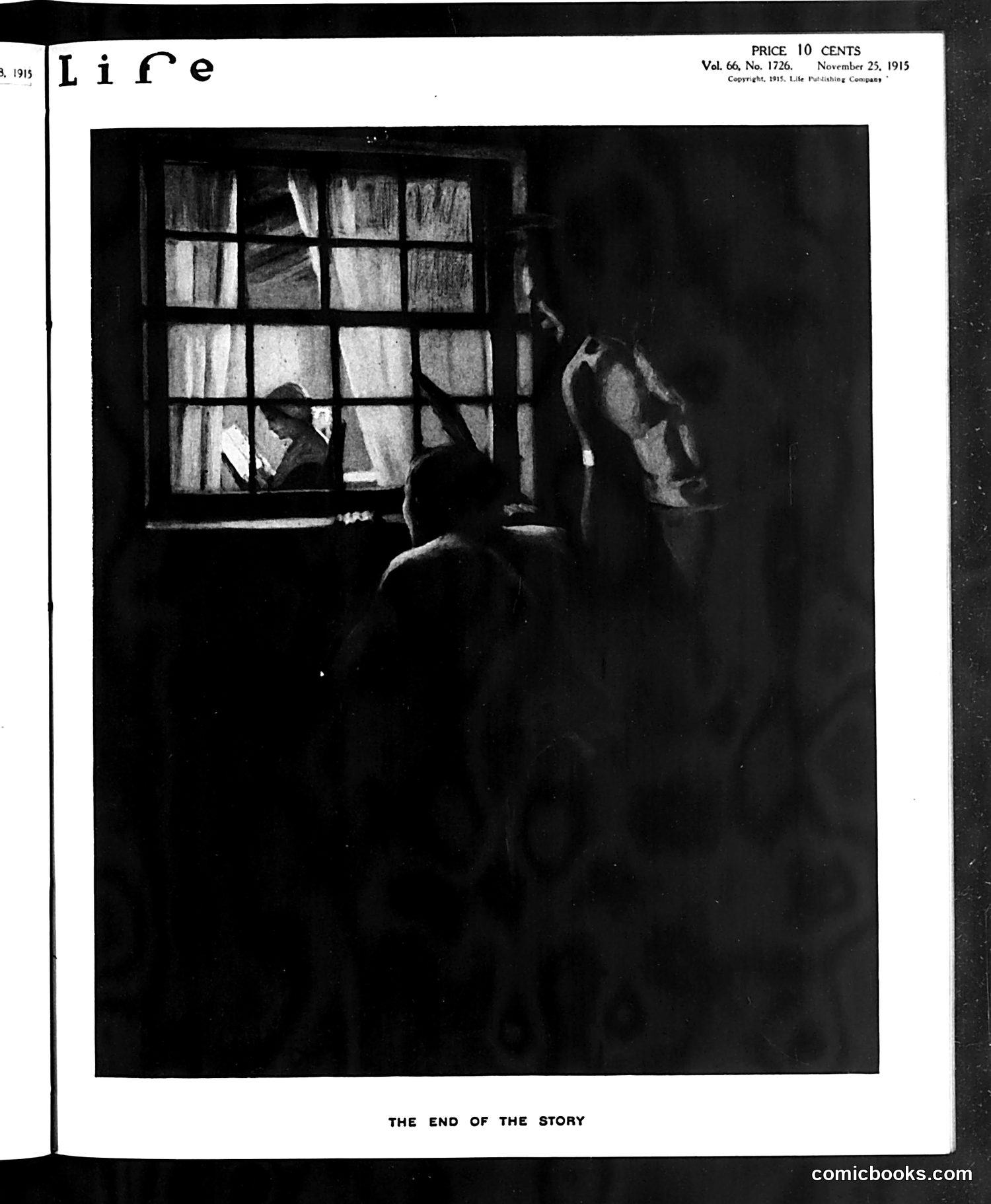
This appears to be a dramatic illustration rather than political satire. The image shows figures peering through a window into a lit interior space, creating a voyeuristic scene. The caption "The End of the Story" suggests this is likely an illustration accompanying a serialized story or short story published in *Life* magazine. Without additional context from the article text, the specific narrative remains unclear. However, the composition—with observers outside looking in—emphasizes voyeurism or revelation of a story's conclusion. The dramatic lighting and silhouettes create tension typical of *Life*'s literary illustrations from this era. The image appears to be narrative illustration rather than political commentary.
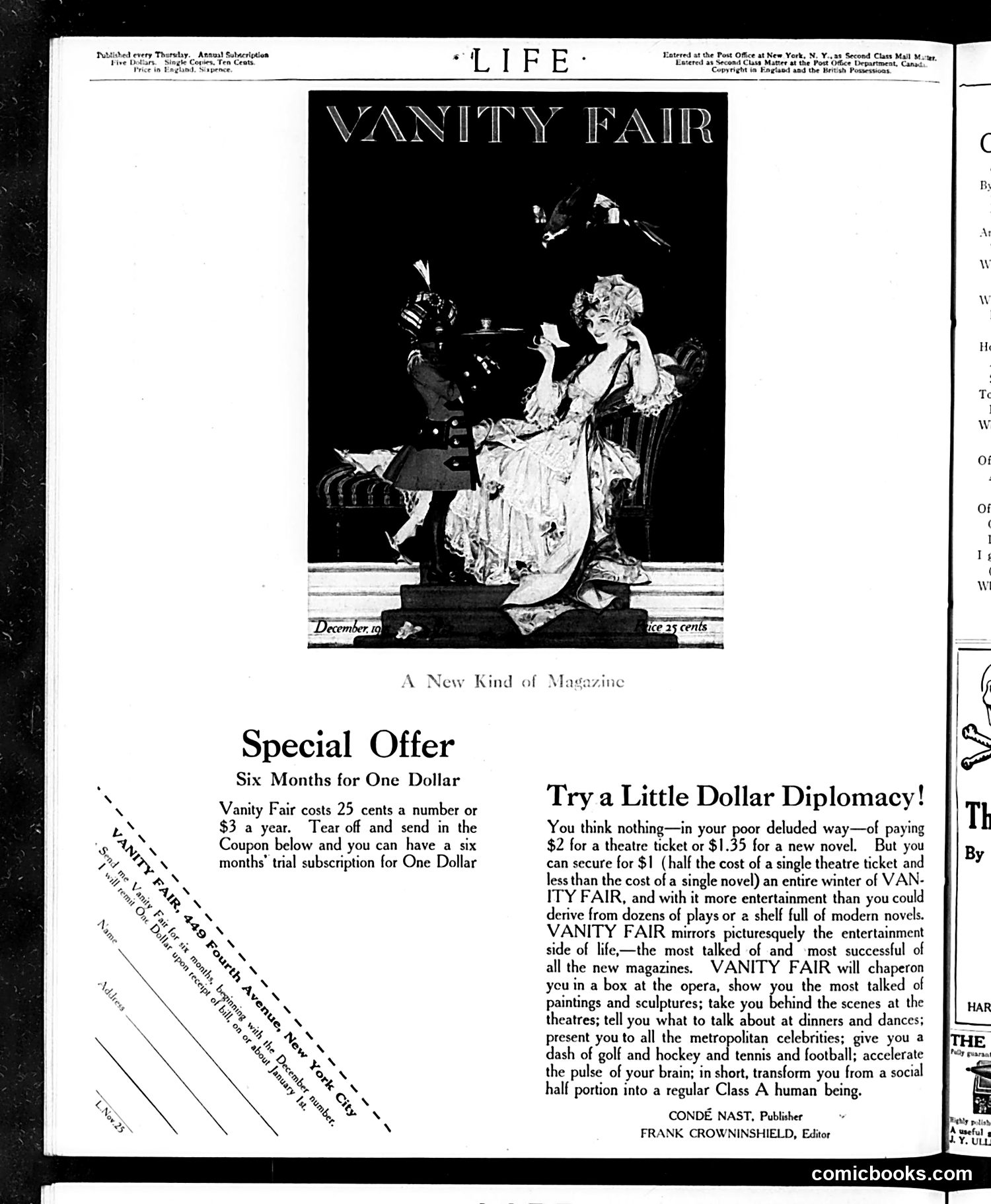
This page is primarily **advertising for Vanity Fair magazine**, not political satire. The central image shows a Vanity Fair cover from December featuring an elegantly dressed woman and a military officer in formal attire—likely depicting high society entertainment and romance. The ads promote two offers: a six-month subscription for one dollar and a pitch emphasizing "Dollar Diplomacy"—using affordable entertainment (theater tickets, novels) as social advancement. The copy promises Vanity Fair will transform readers "from a social half portion into a regular Class A human being" by providing gossip about opera, paintings, metropolitan celebrities, and sports. This reflects **1910s-era aspirational marketing**, targeting middle-class readers seeking entry into upper-class social circles through magazine consumption.
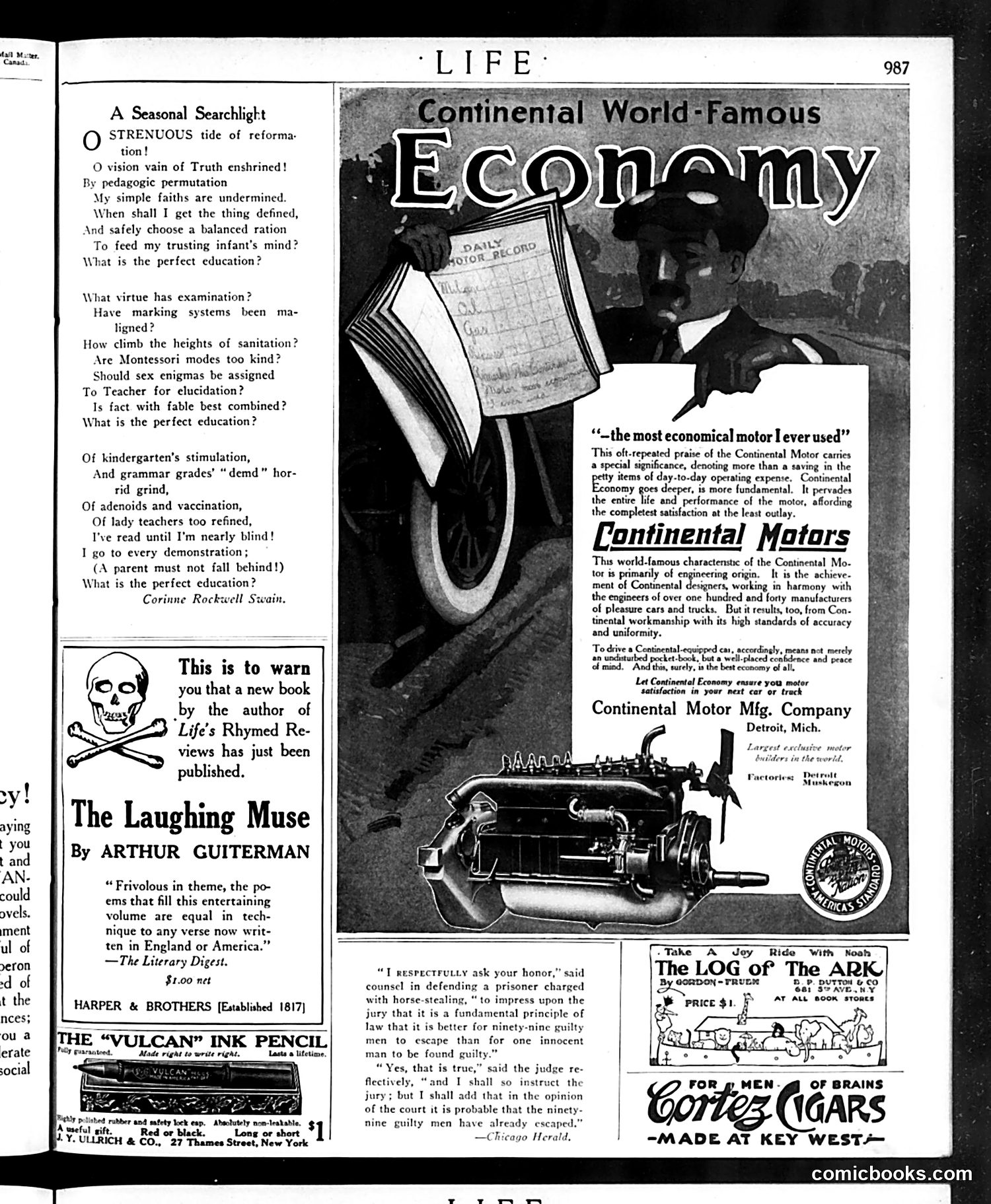
This page is primarily **advertising and literary content** rather than political satire. The main advertisement promotes Continental Motors, featuring a man holding a Daily Motor Record sheet and a large automobile wheel. The copy emphasizes economy and reliability, claiming Continental Motors are "the most economical motor I ever used." Below is an advertisement for "The Laughing Muse" poetry book by Arthur Guiterman, and ads for Vulcan Ink Pencils and Cortez Cigars. The page opens with "A Seasonal Searchlight," a poem by Corinne Rockwell Swain questioning educational philosophy and methods—discussing Montessori schools, examination systems, and vaccination. This appears to be earnest social commentary rather than satire, reflecting early 20th-century educational debates.
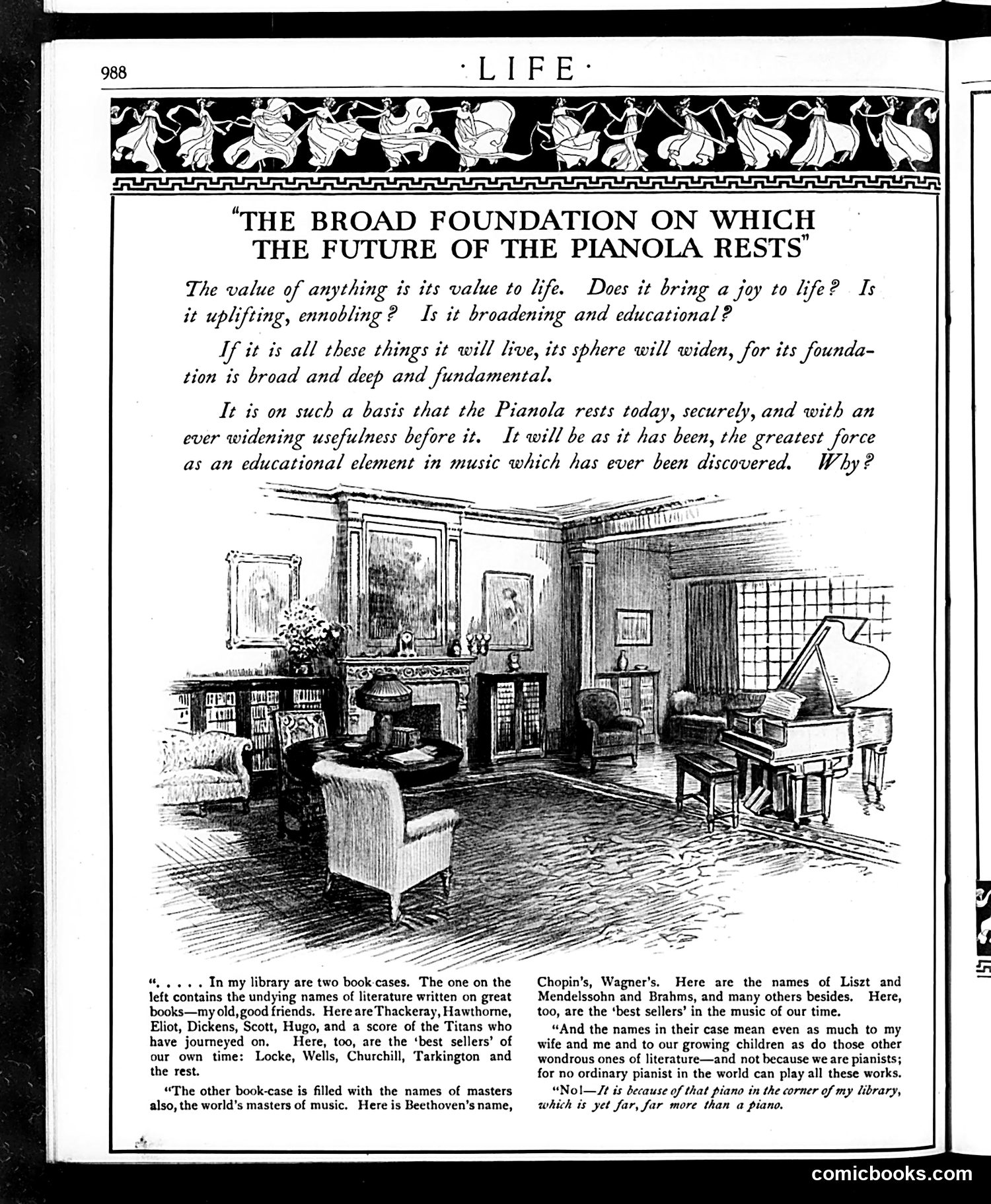
This page is **not a political cartoon** but rather an **advertisement for the Pianola** (an early player piano). The decorative border and interior illustration show an elegant drawing room centered on the instrument. The text argues the Pianola's value rests on being educational and uplifting—bringing joy to life. It claims the device is "the greatest force as an educational element in music which has ever been discovered." The lower section quotes a homeowner praising how the Pianola lets non-musicians access works by great composers (Beethoven, Chopin, Wagner, Liszt, Mendelssohn) without requiring personal skill. The owner compares owning a Pianola to owning a library of the world's greatest literature—presenting it as democratizing access to high culture for ordinary families. This is marketing, not satire.
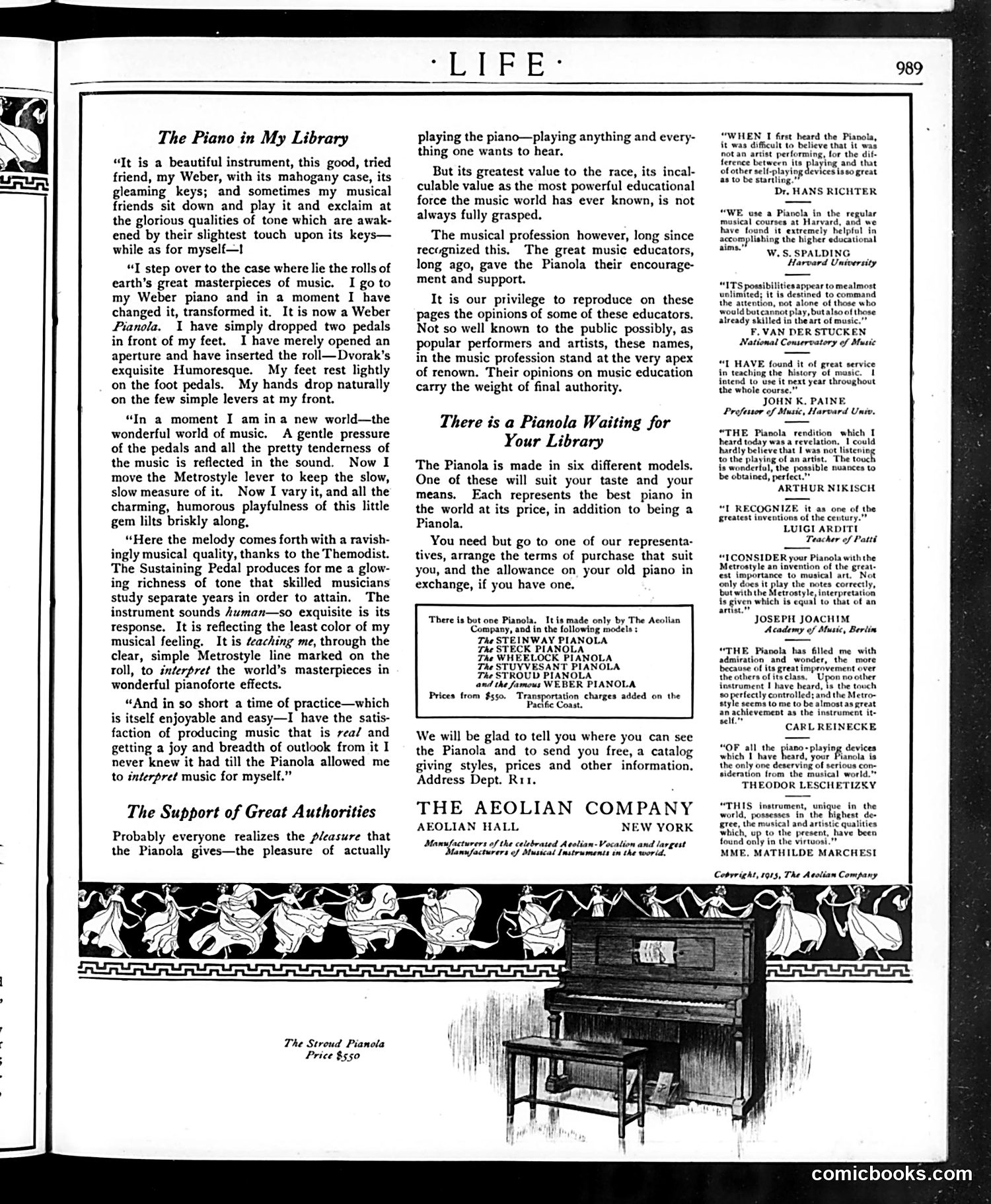
This page is primarily **advertising content**, not satire or political commentary. It's a 1923 advertisement for the Aeolian Company's Pianola—a player piano that mechanically reproduces recorded music performances. The text features testimonials from music educators and famous musicians praising the Pianola as an educational tool. A personal essay describes the writer's experience with their Weber piano, emphasizing how the Pianola democratizes access to "earth's great masterpieces of music." The decorative border shows classical Greek/Roman figures, reinforcing the instrument's cultural prestige. An illustration at bottom shows the Stroud Pianola model. This represents early 20th-century marketing that positioned new music technology as culturally elevating for middle-class households—a common sales strategy before radio and recorded music became widespread.
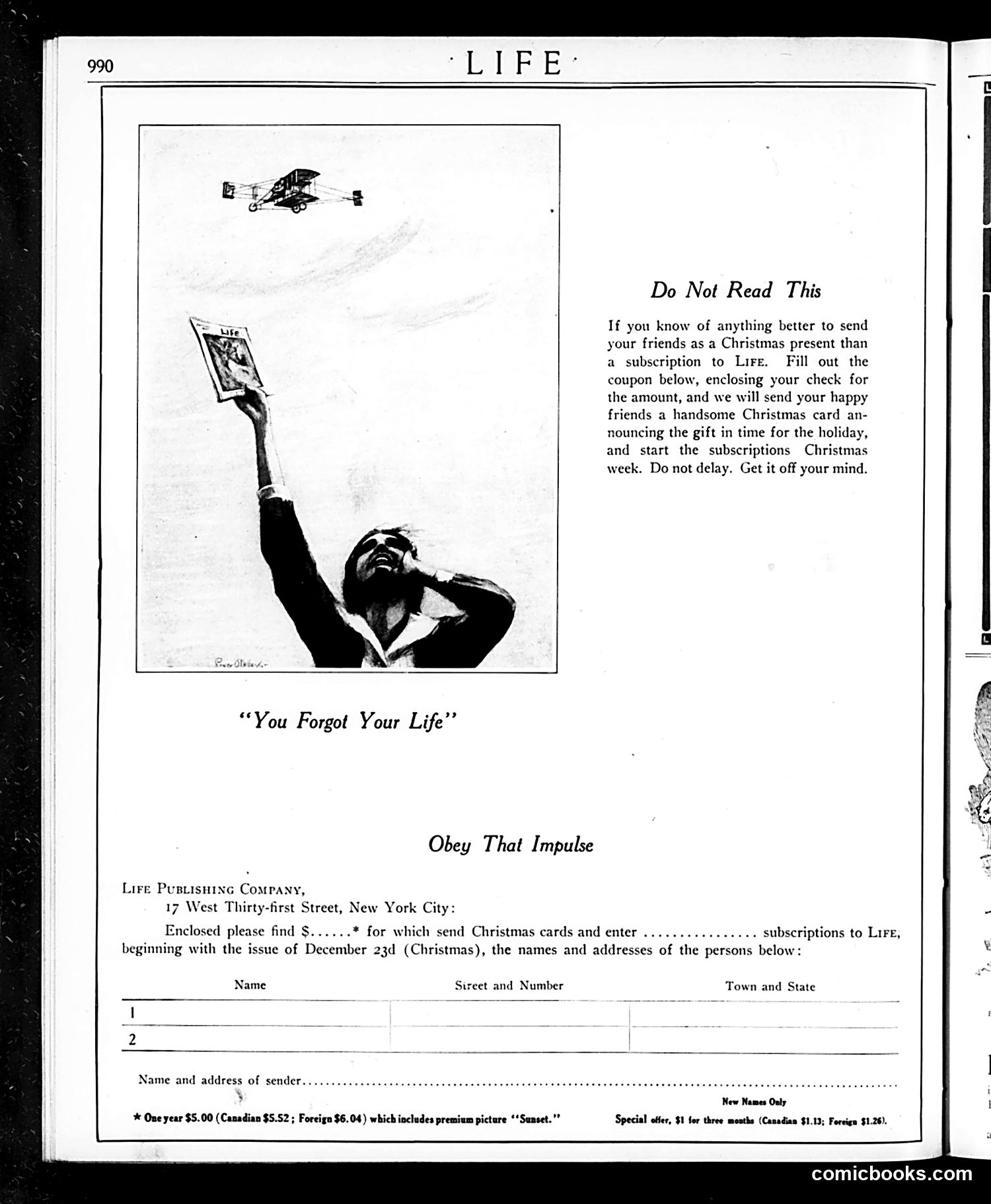
This page is primarily a **Christmas gift advertisement** for LIFE magazine subscriptions, not political satire. The cartoon titled "You Forgot Your Life" shows a man gazing upward at an early airplane, holding up a LIFE magazine. The image suggests that readers become so absorbed in following current events through LIFE that they neglect their own lives—a self-aware, humorous critique of the magazine's own power to captivate attention. The advertisement encourages readers to give LIFE subscriptions as Christmas gifts, with the tagline "Obey That Impulse." The messaging plays on the cartoon's joke: give the gift of staying informed and engaged with the world. The early airplane suggests this is from the 1910s-1920s era, when aviation was novel and symbolized modernity and progress—matching LIFE's positioning as the magazine for contemporary readers.
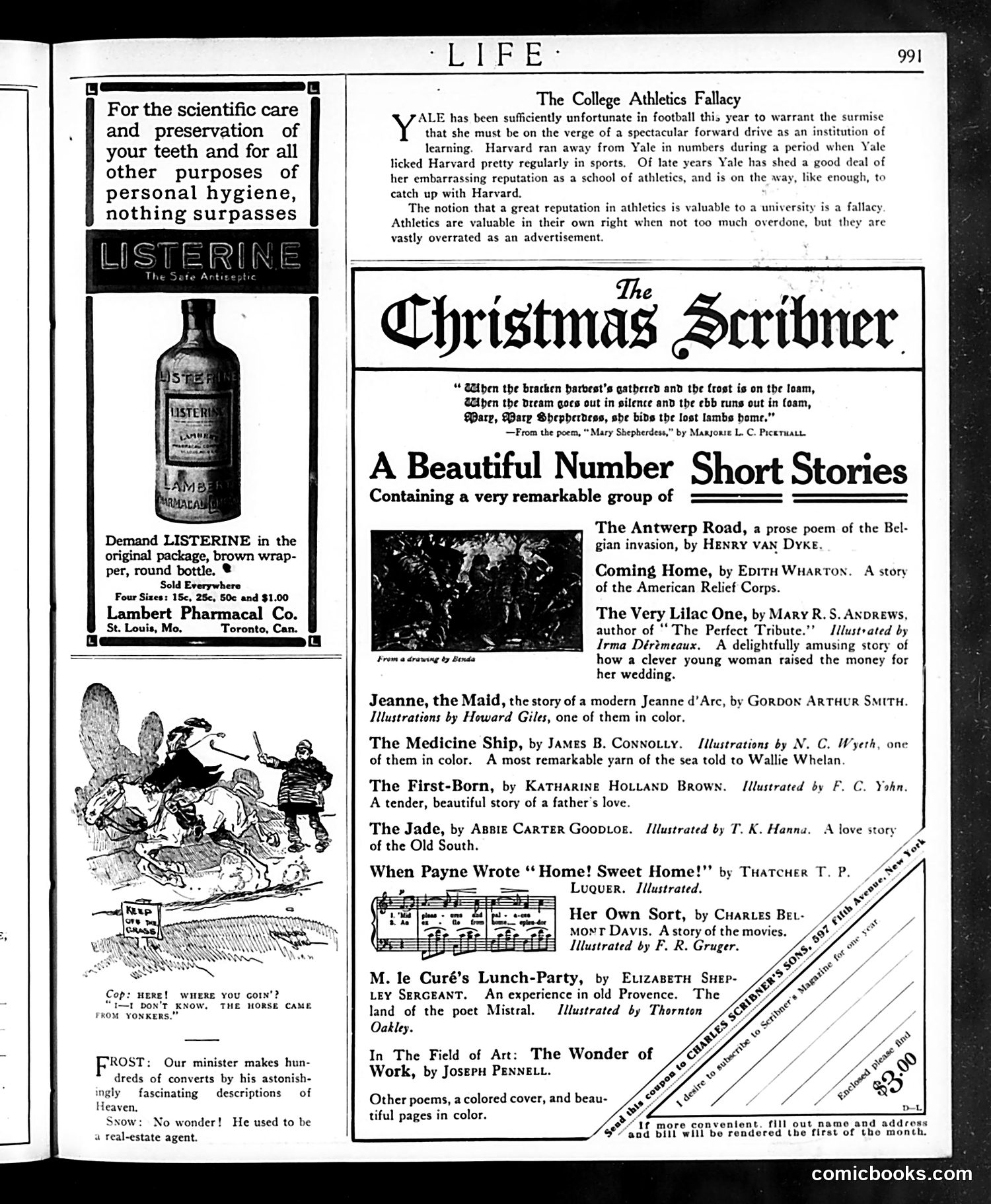
This page is primarily **advertising and literary content** rather than political commentary. The **Listerine advertisement** (left) promotes mouthwash for personal hygiene, a common early 20th-century pitch. The **main feature** is "The Christmas Scribner"—a book advertisement listing short stories. The small cartoon below the Listerine ad shows a soldier asking "Cop: Here! Where you goin'?" with the response "Home—I know, the horse came from Yonkers," apparently a humorous reference to a horse's unexpected journey. The **"Frost" conversation** (bottom left) is a brief joke about a minister describing heaven. **Overall**: This is a typical Life magazine page mixing light humor, advertising, and literary promotions—reflecting early 1900s popular entertainment rather than serious political satire.
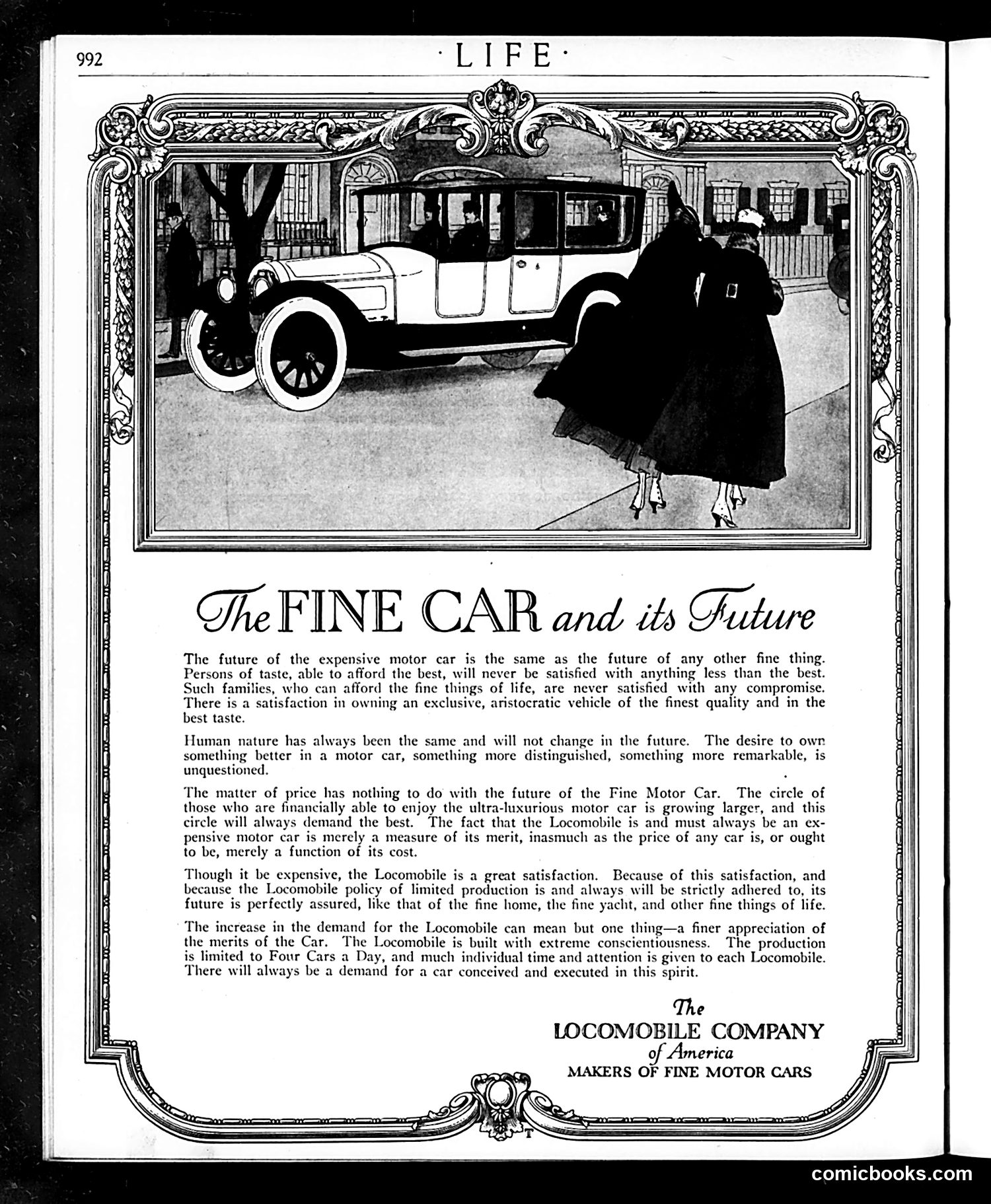
This page is primarily a **luxury automobile advertisement** for the Locomobile Company, not a political cartoon. The image shows a well-dressed woman in elegant dark clothing viewing an expensive motorcar parked on a city street, with pedestrians and buildings in the background. The accompanying text argues that wealthy people will always desire the finest automobiles regardless of price, comparing luxury cars to other exclusive goods like fine homes and yachts. It emphasizes that the Locomobile maintains prestige through limited production ("Four Cars a Day") and meticulous craftsmanship. The satire here is subtle—it's gently mocking the pretensions of the wealthy elite who justify expensive purchases through appeals to taste and exclusivity rather than practical necessity. The well-dressed woman serves as a symbol of this affluent market segment.
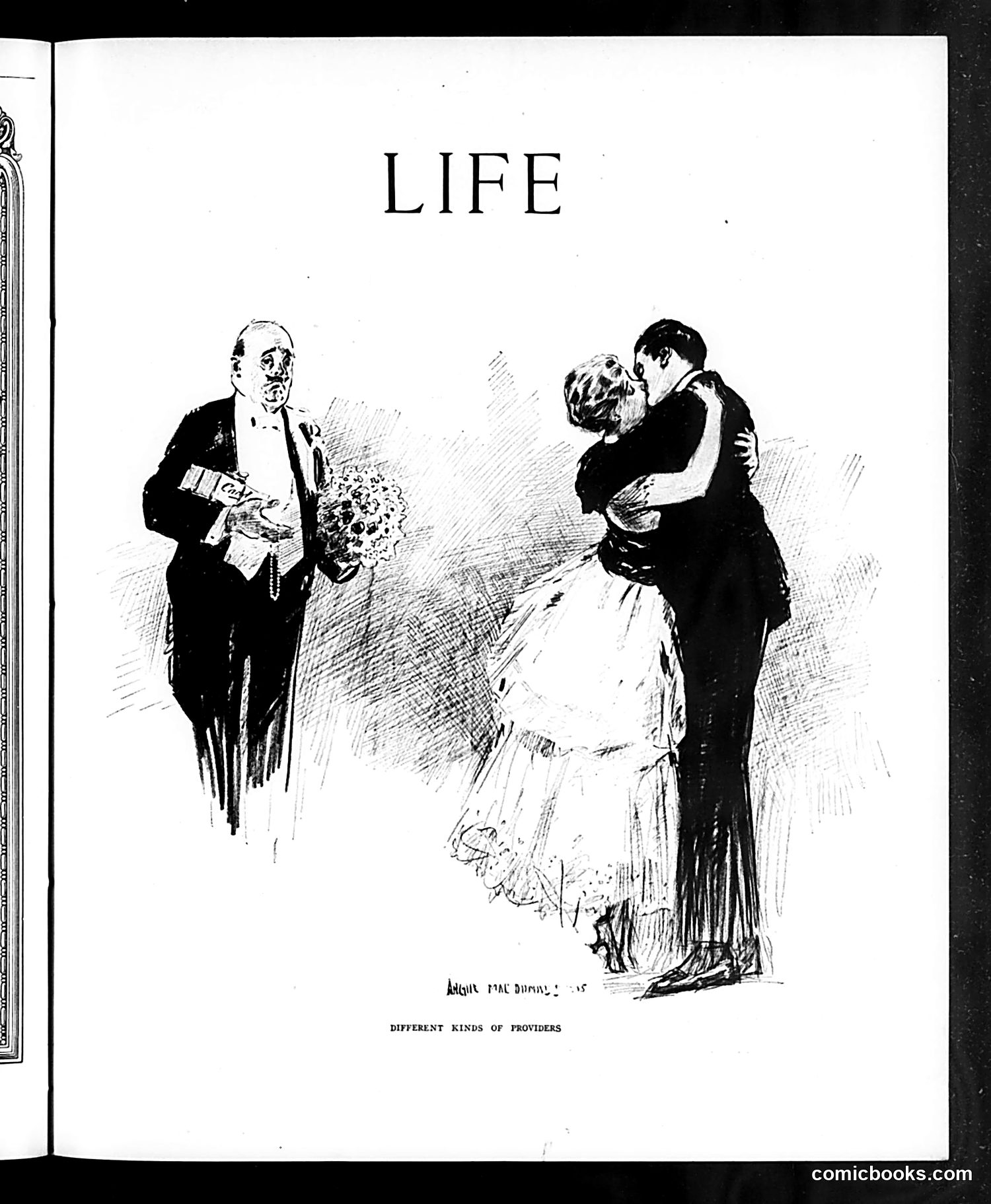
This satirical cartoon depicts two contrasting male figures and their approaches to providing for women. On the left stands a well-dressed older man holding flowers and what appears to be money or gifts—representing traditional courtship or financial provision. On the right, a younger man embraces a woman affectionately, suggesting emotional connection or romantic love as his form of "provision." The satire appears to critique different masculine approaches to relationships: the materialistic suitor relying on wealth and gifts versus the romantically engaged partner offering emotional intimacy. The caption "Different Kinds of Providers" suggests Life magazine is commenting on evolving courtship values and what women actually valued in a partner—a relevant social commentary for early 20th-century American culture.
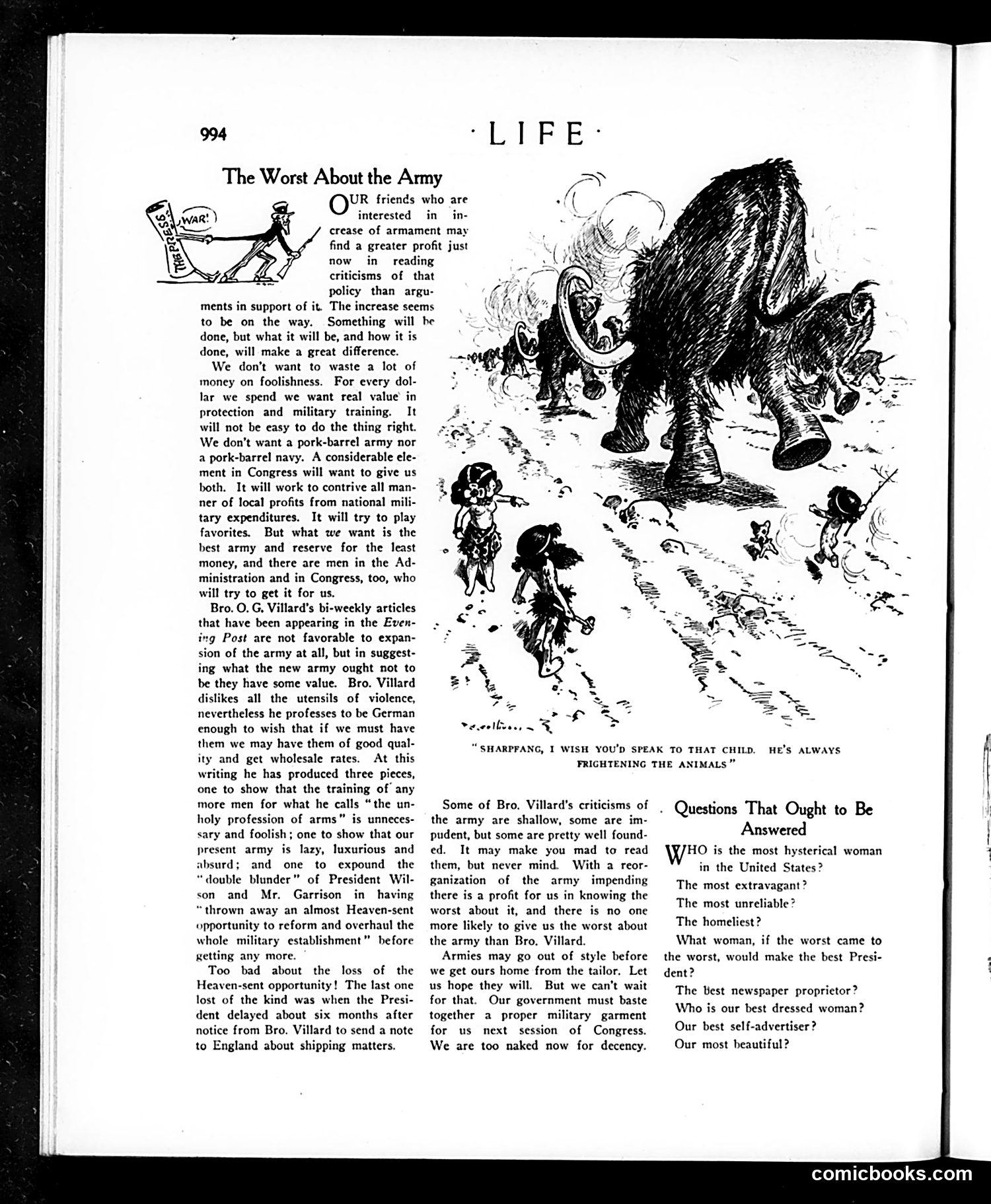
This page critiques pacifist criticism of military spending. The main cartoon depicts an elephant (representing the U.S. Army) being chased by small figures—likely representing pacifist or anti-war advocates like Bro. O.G. Villard (mentioned in the text). The satire argues that while some criticisms of military expenditure are valid, pacifists like Villard offer shallow objections without constructive solutions. The text defends maintaining a strong military, dismissing pacifists as naive while acknowledging legitimate concerns about waste and efficiency. The caption "Sharpang, I wish you'd speak to that child. He's always frightening the animals" sarcastically suggests pacifists are childishly bothering national defense. This reflects early-20th-century American debates between interventionists and isolationist/pacifist movements regarding military preparedness.
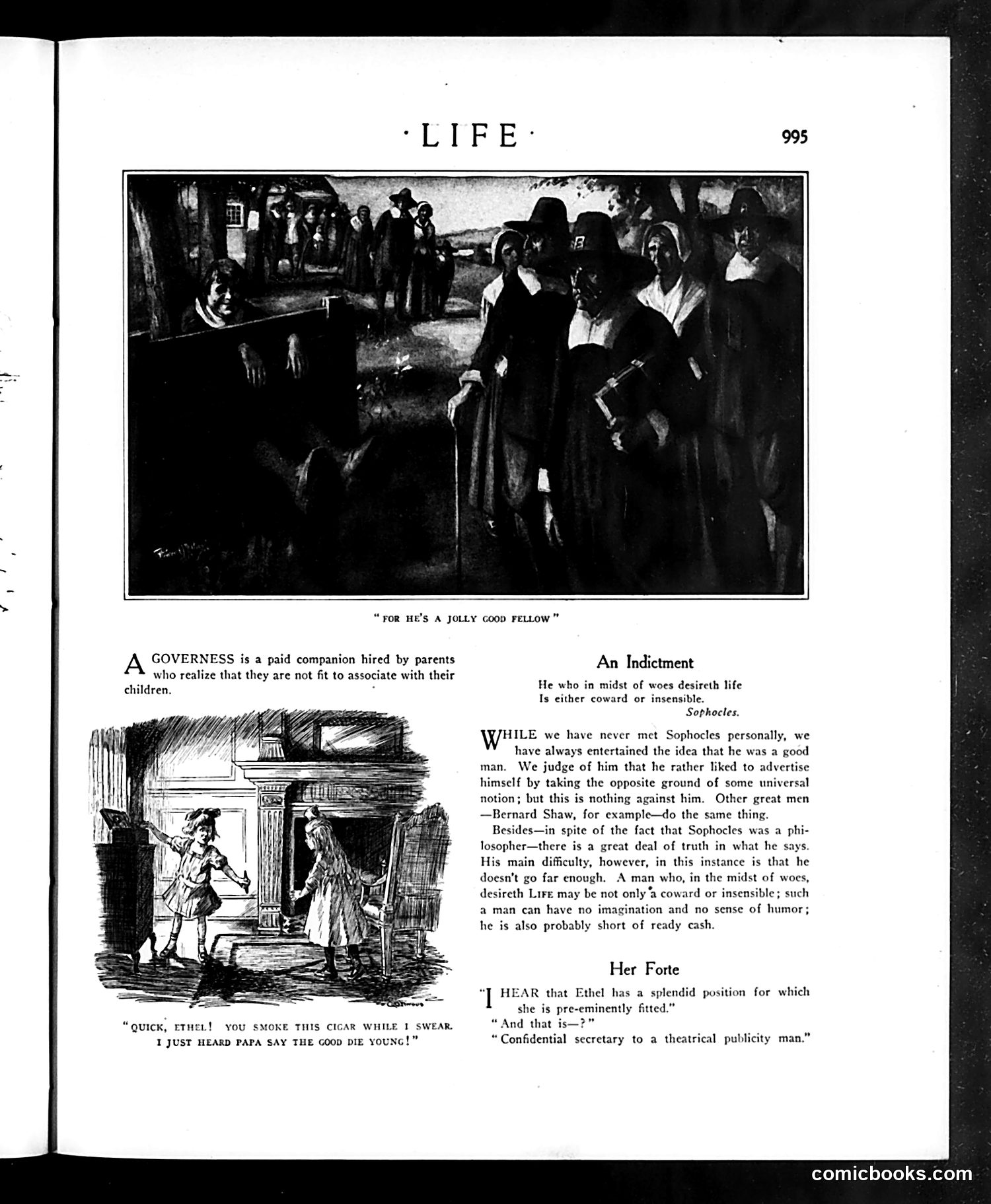
This page contains social commentary and humor typical of early 20th-century Life magazine satire. **Top Image ("For He's a Jolly Good Fellow"):** Shows what appears to be a funeral or memorial gathering, likely satirizing excessive mourning or the social performance of grief among the upper classes. **"An Indictment" Section:** References Sophocles' quote about cowardice and insensibility. The text critiques someone (possibly a public figure) for being contradictory—claiming progressive ideals while acting conservatively. The passage suggests this person lacks imagination, humor, or financial resources to act on stated beliefs. **Lower Cartoon & "Her Forte":** A domestic scene showing a governess hired by parents to manage children. The humor involves class distinctions and social pretension—the joke about the "good die young" satirizes parental attitudes toward caregivers and children's behavior.
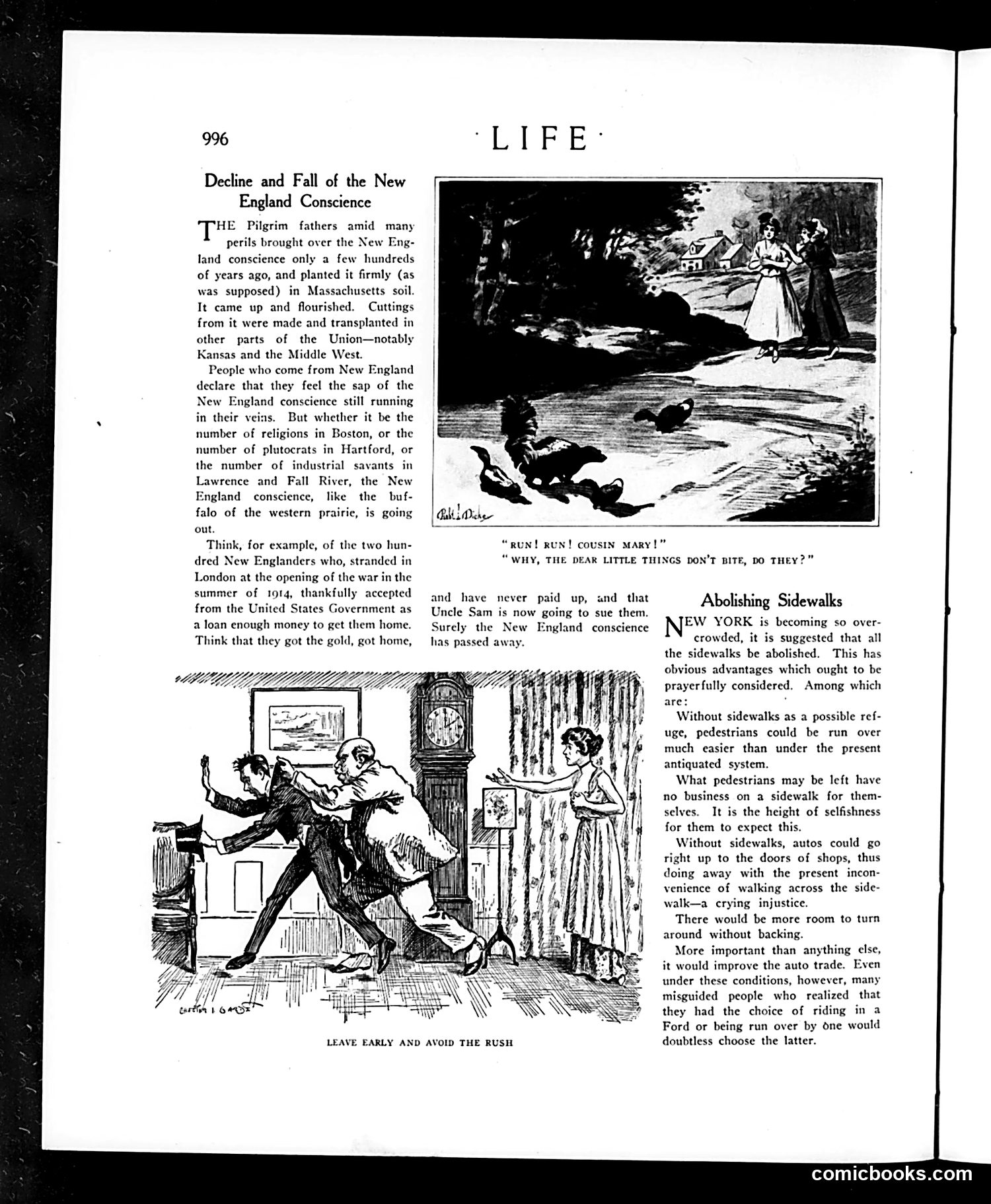
**Top Article: "Decline and Fall of the New England Conscience"** This satirizes the fading moral authority of New England Puritanism. The text argues that the New England conscience—once a powerful cultural force—is dying out, diluted by westward migration and the rise of "plutocrats" and "industrial savants" in cities like Boston and Hartford. A specific anecdote mocks this decline: two stranded New Englanders in 1914 accepted government loans to return home rather than borrowing privately—suggesting moral principles have been abandoned for practical necessity. **Bottom Cartoon: "Leave Early and Avoid the Rush"** Depicts a chaotic domestic scene where a man violently exits through a door while a woman holds curtains. The humor satirizes the popular solution to urban crowding: fleeing the city. It suggests people are so desperate to escape congestion that they're literally running away—even from their own homes.
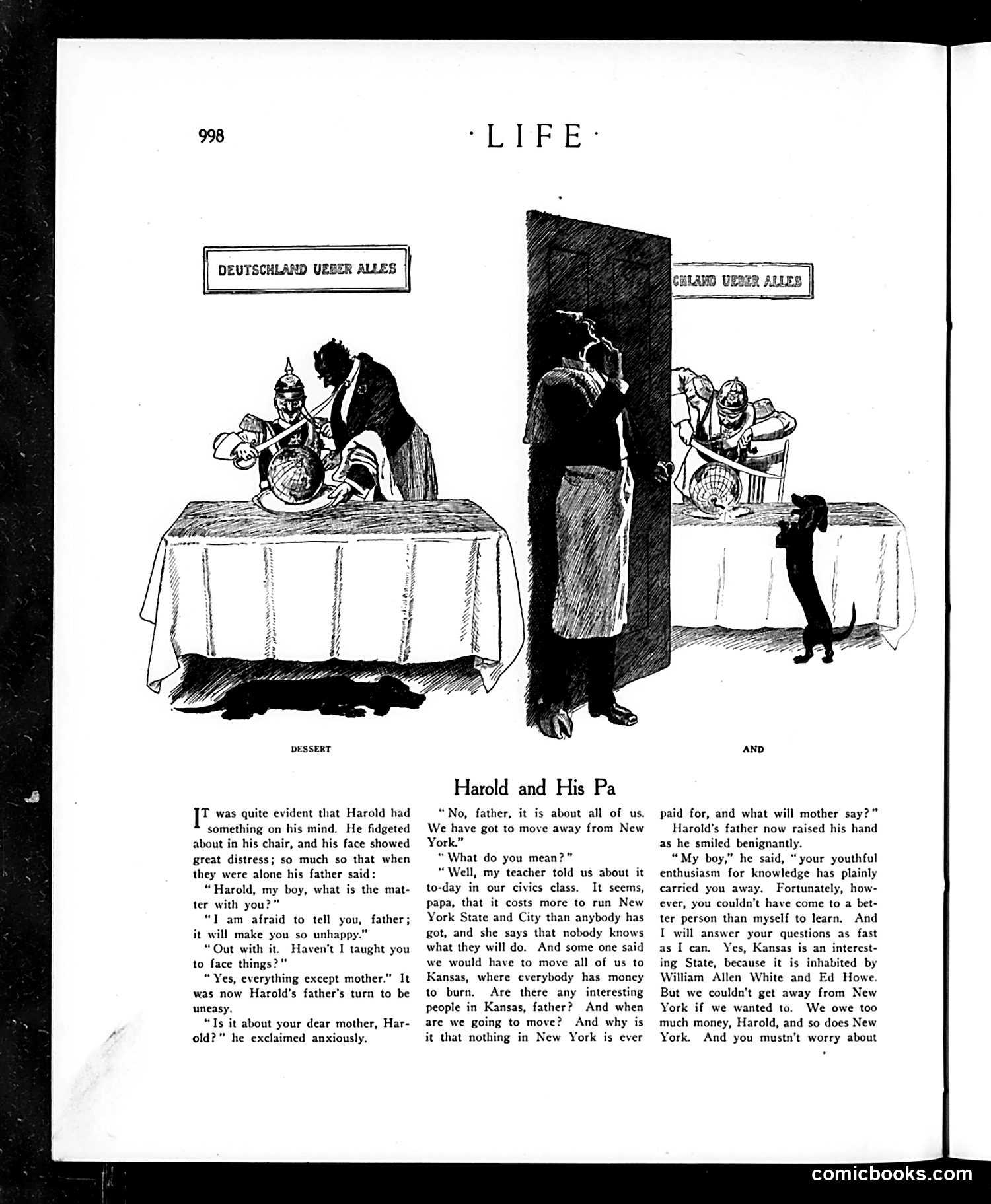
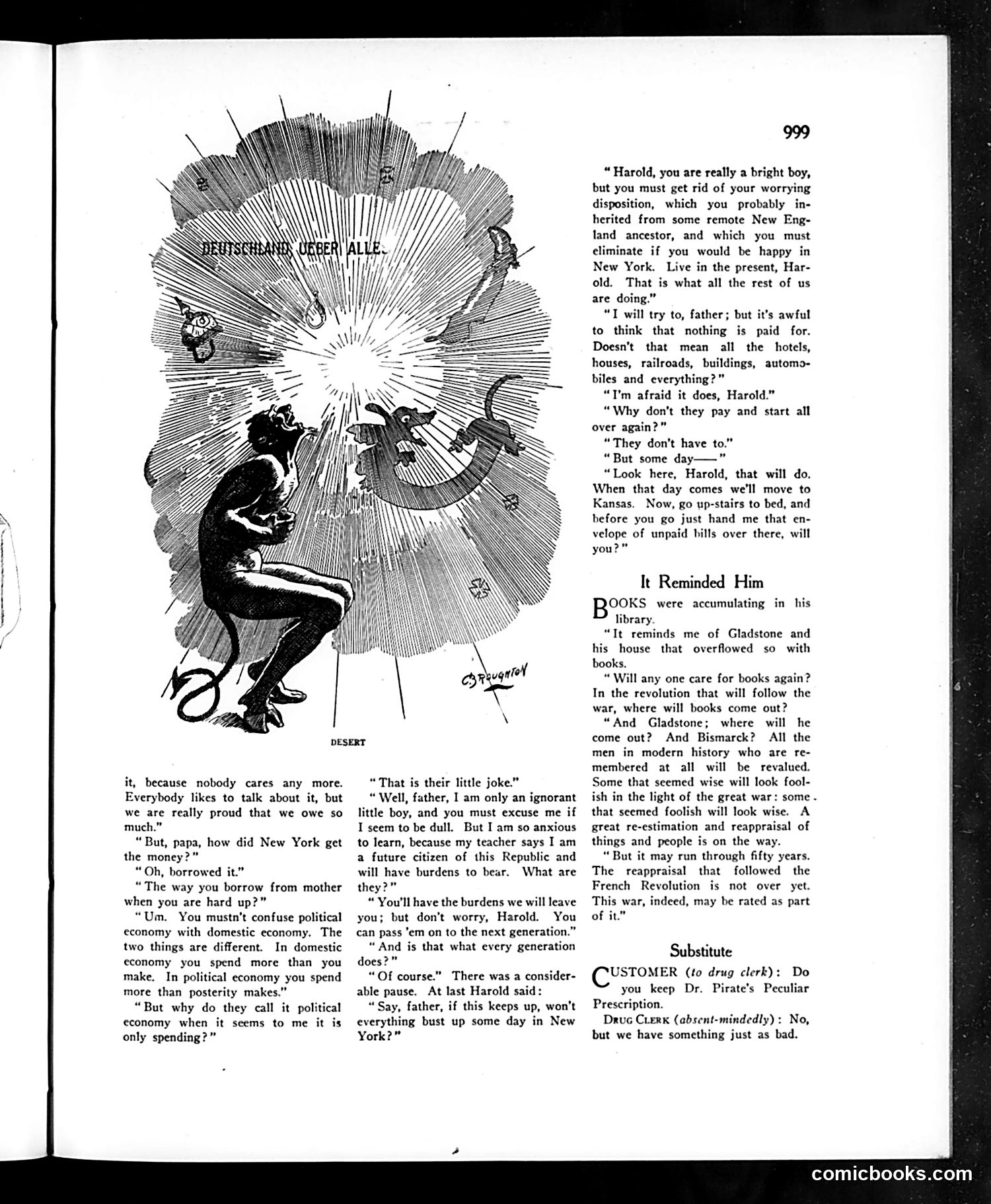
The main illustration depicts a figure emerging from a large head labeled "DEUTSCHLAND ÜBER ALLES" (Germany Above All), showing German militarism/imperialism personified. The radiating lines suggest an explosion or revelation of the ideology's contents. The accompanying text is a dialogue between a father and son named Harold about economics and citizenship. The father explains the difference between "domestic economy" (personal spending) and "political economy" (national spending), using this to teach Harold about fiscal responsibility and generational burdens—likely referencing post-WWI debt and reparations. The secondary section titled "It Reminded Him" discusses books and the French Revolution's aftermath, comparing historical upheaval to contemporary concerns. A brief "Substitute" dialogue appears at the bottom about a drug prescription. The overall page satirizes economic anxiety and historical parallels during what appears to be the interwar period.
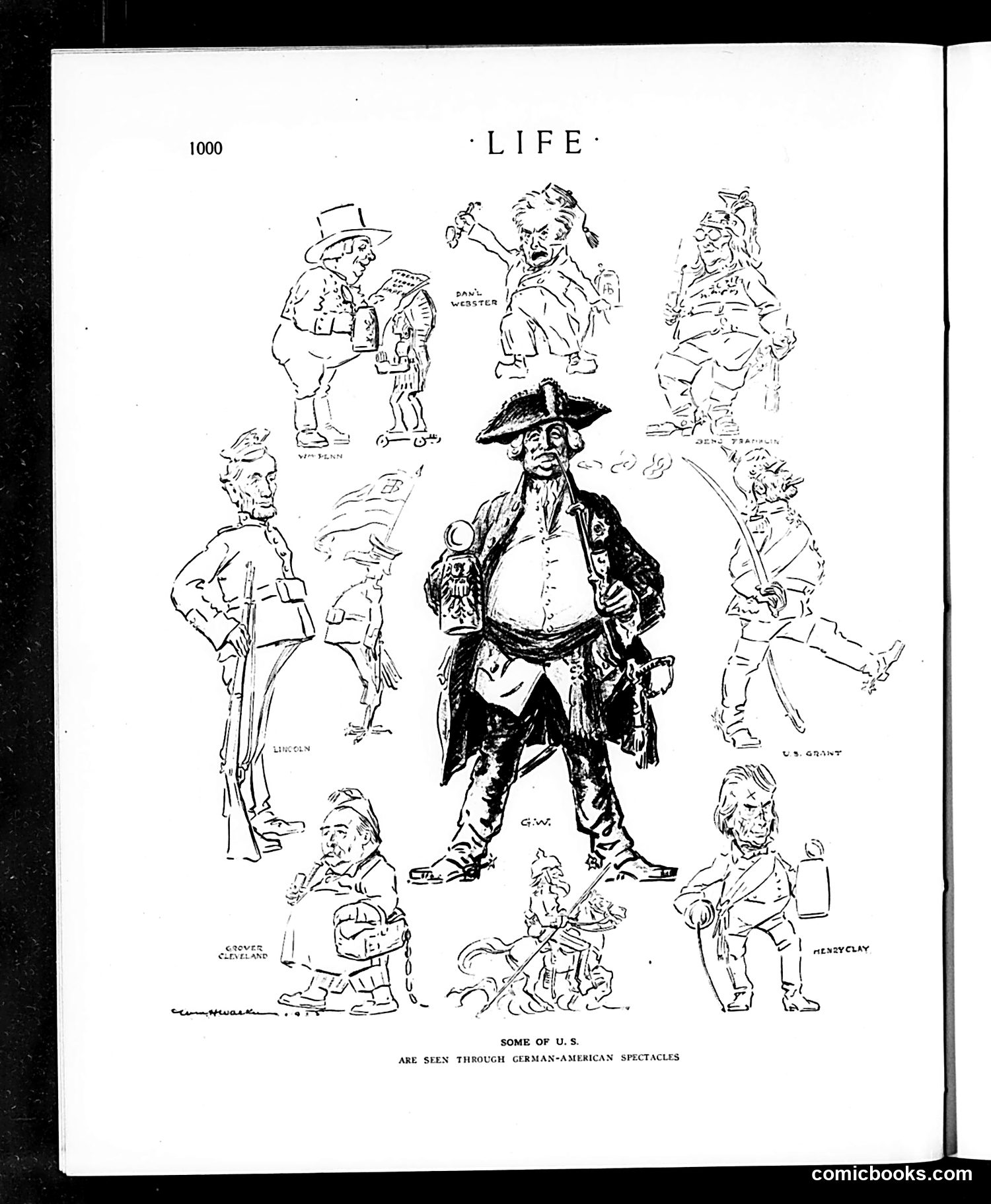
This Life magazine page satirizes American political figures as perceived through a "German-American" lens—likely referencing German-American sympathy during a period of U.S.-German tension (probably WWI era, given the context). The central figure appears to be a caricatured German observer examining various American leaders and military figures arranged around him. The caption explains these are "U.S. spectacles"—meaning how German-Americans viewed American politics and institutions. The cartoon mocks both American figures (identifiable labels suggest Lincoln, Grant, and others) and German-American perspectives, using exaggerated physical caricatures typical of early 20th-century satire. The satire targets perceived German-American bias or sympathy during a period of American-German diplomatic tension, presenting American leaders as objects of foreign scrutiny.
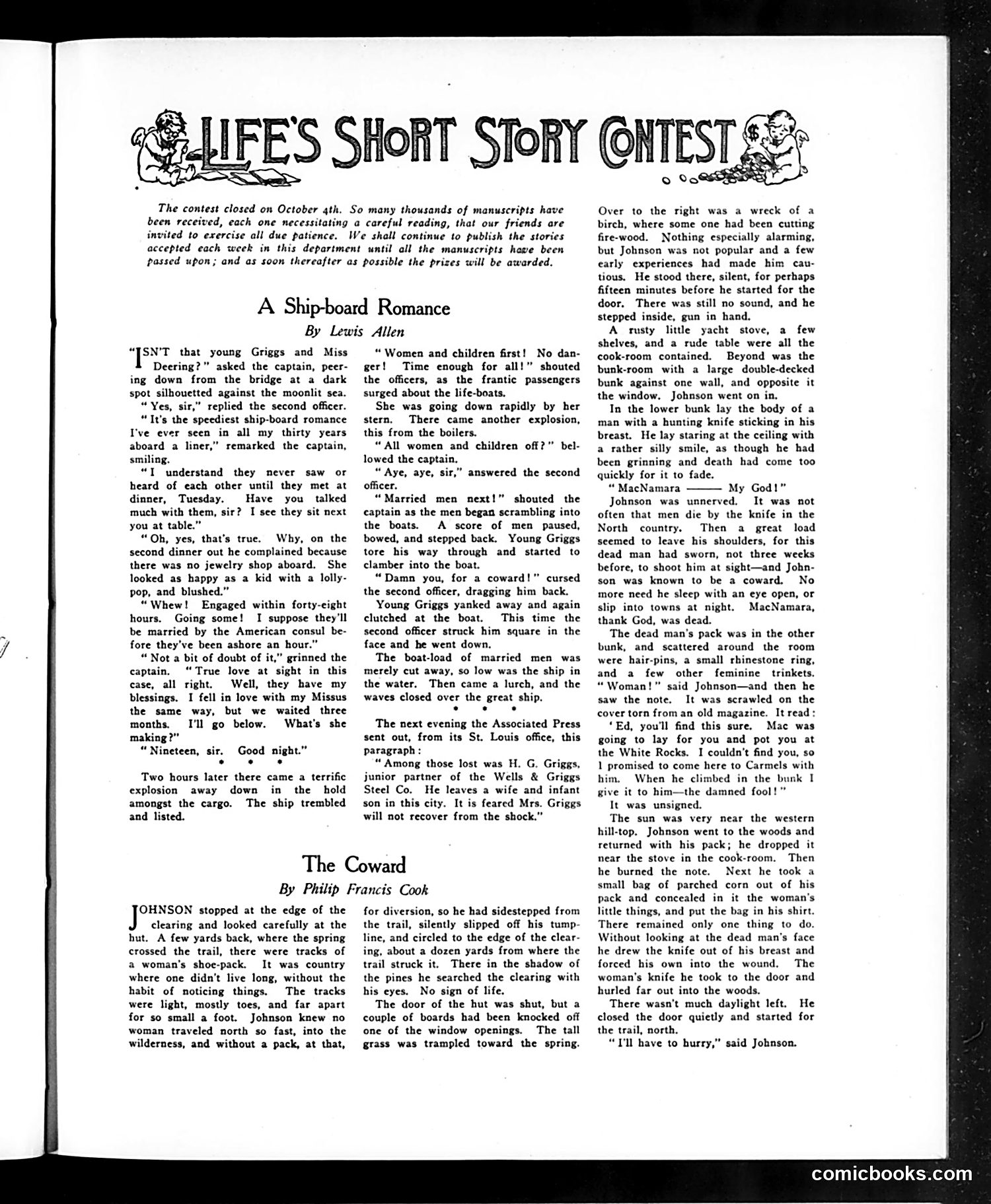
This page presents **two fictional short stories** from Life's contest, not political cartoons or satire. **"A Ship-board Romance"** depicts a sentimental tragedy: Young passengers Griggs and Miss Deering fall in love rapidly aboard ship. When disaster strikes (explosions in cargo and boilers), the captain calls "women and children first," then "married men next." Griggs, unmarried, attempts to board anyway but is beaten back by an officer as a "coward." He perishes when the ship sinks. The story's irony: Griggs dies trying to survive, yet society honors the sacrifice of married men prioritized by the maritime code. **"The Coward"** (incomplete here) appears to be a wilderness survival narrative, following a man named Johnson tracking a woman's footprints into remote northern territory—seemingly a different genre altogether. The page header announces the contest closed October 4th, with winners to be announced after all manuscripts are reviewed. These are reader-submitted stories, not editorial content or satire.
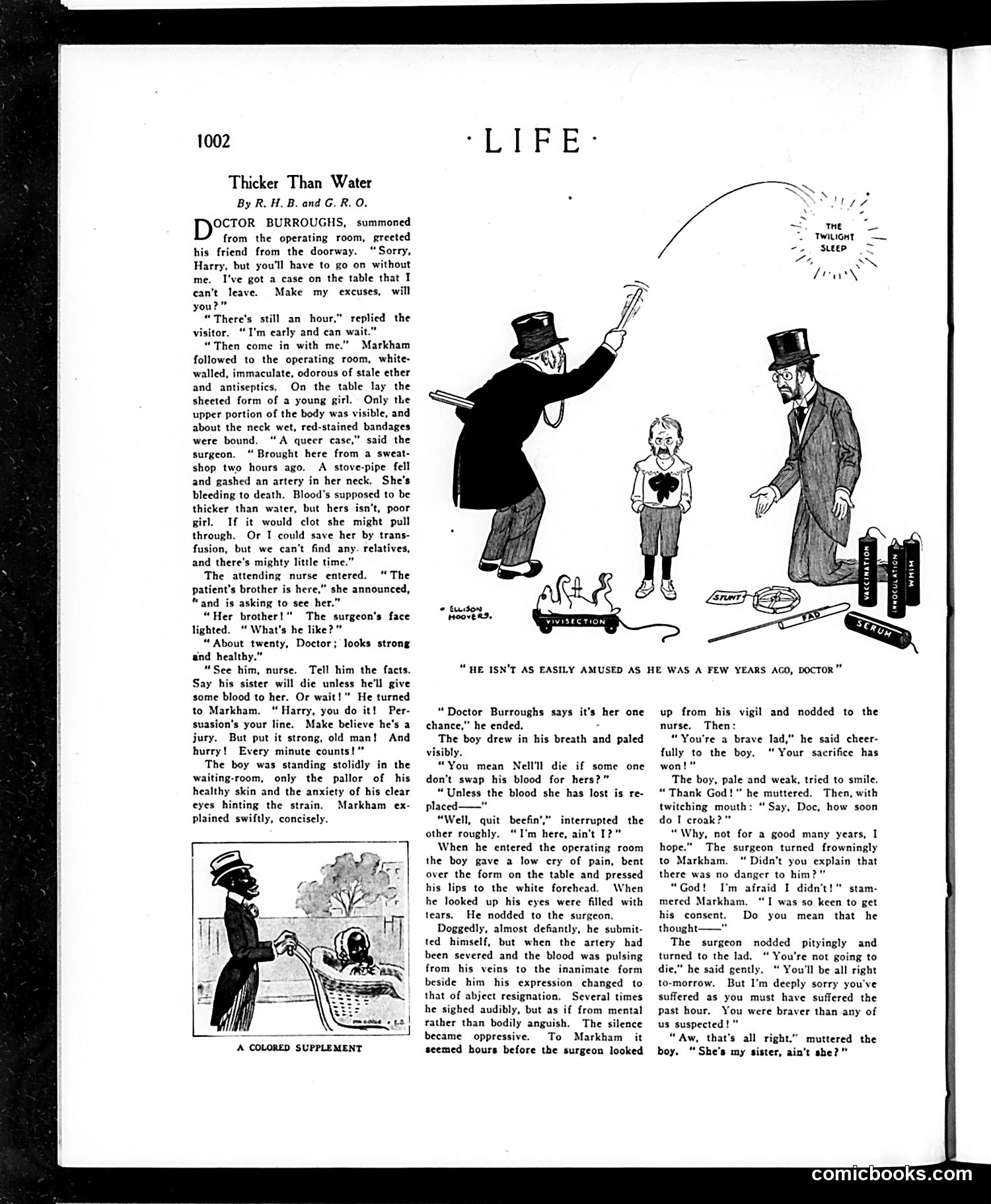
This is a sentimental short story (not political satire) about blood transfusion and family loyalty. The narrative centers on a young working-class girl injured in an industrial accident at a sweatshop, dying from blood loss. The "point" involves the brother's self-sacrifice: he donates blood to save her life, believing (due to miscommunication) that the procedure will kill him. He agrees anyway because "blood is thicker than water"—family bonds matter more than self-preservation. The story's title references the proverb about familial loyalty. The accompanying illustrations show the boy's distress and the doctor's medical intervention. The final irony—that the boy suffered unnecessary emotional anguish thinking he was dying—emphasizes his bravery and the depth of family obligation. This reflects early 20th-century *Life* magazine's mix of humor and earnest moral storytelling, celebrating working-class virtue and medical heroism.
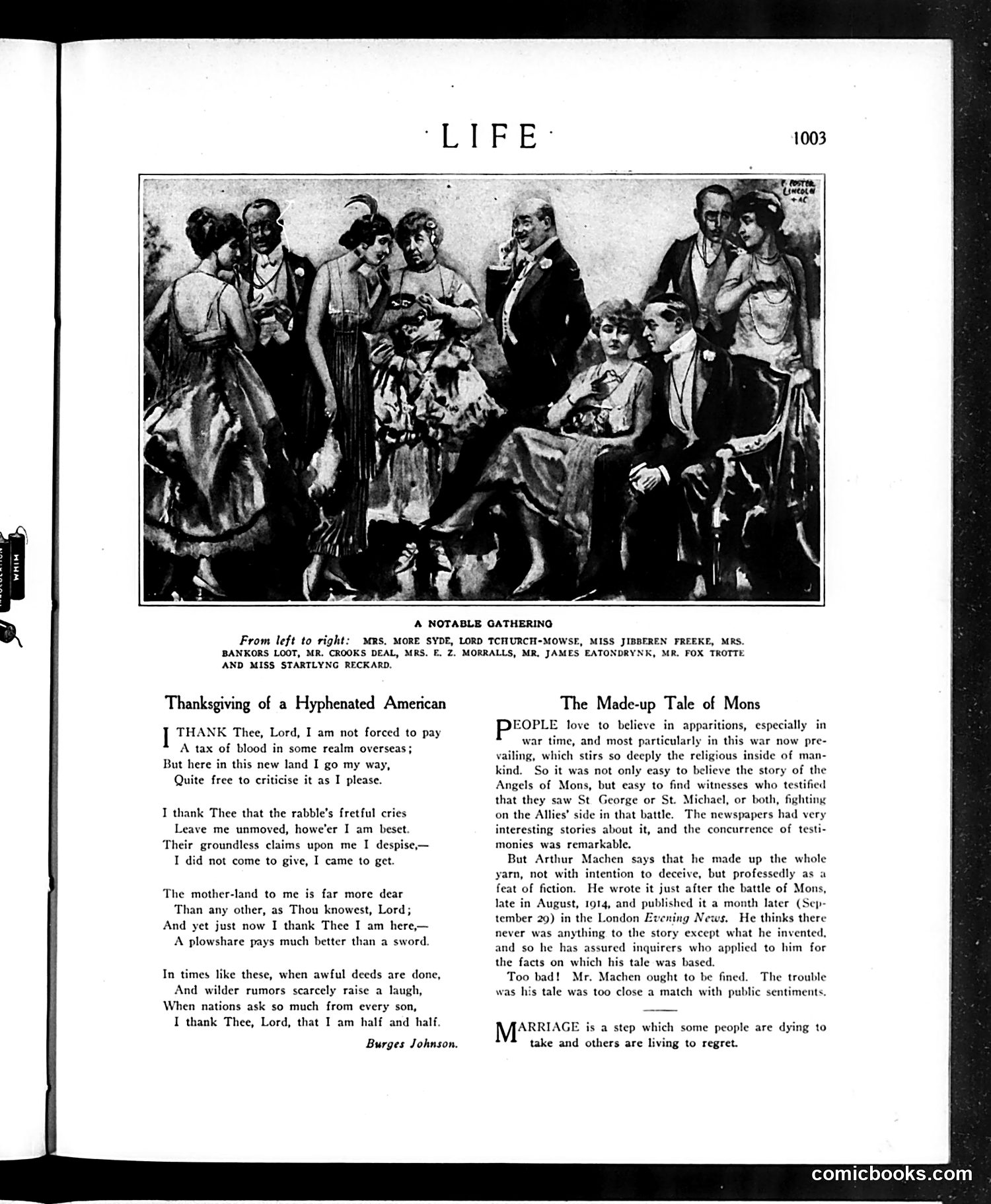
This page satirizes two distinct topics: **"Thanksgiving of a Hyphenated American"** mocks wealthy immigrants or first-generation Americans who retain loyalty to their native countries while exploiting America for profit. The poem, attributed to Burgess Johnson, presents a speaker claiming to thank God for American freedom while simultaneously admitting indifference to national sacrifice ("I am half and half"), disdain for common citizens' concerns, and prioritizing personal gain over civic duty. The sarcastic tone exposes the hypocrisy of those claiming American identity while maintaining divided loyalties—a timely concern during World War I when many Americans questioned the patriotism of hyphenated ethnic identities. **"The Made-up Tale of Mons"** debunks the famous "Angels of Mons" legend—a WWI myth where witnesses claimed supernatural beings aided British forces. The piece reveals that writer Arthur Machen invented the story as fiction, yet it spread as fact because it matched public sentiment and religious desire for divine intervention. This satirizes both media credulity and humanity's willingness to believe comforting falsehoods during wartime.
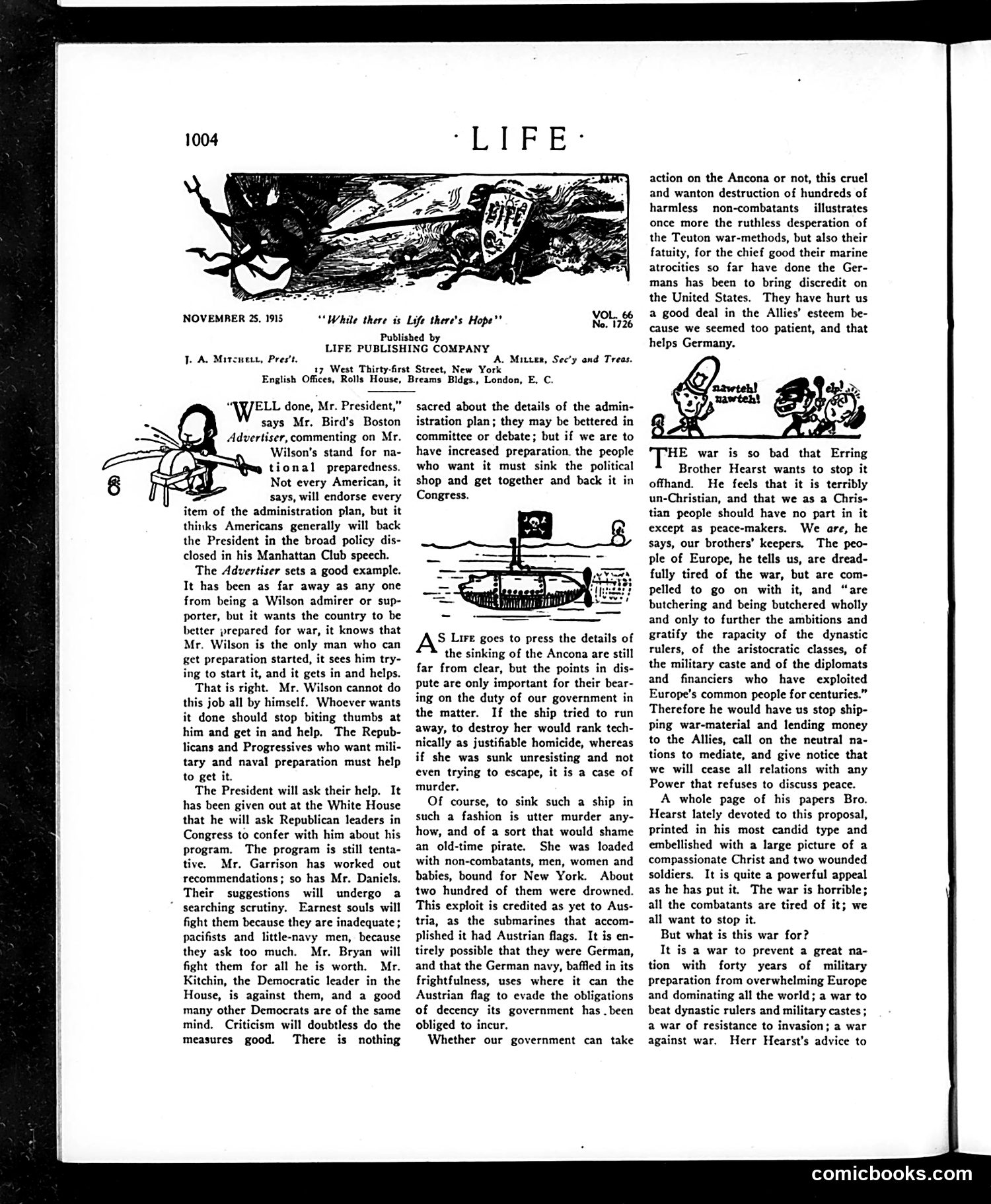
This page addresses American military preparedness and the sinking of the RMS Ancona, a passenger ship torpedoed by Austrian (possibly German) submarines. **Main Editorial Points:** The lead article praises President Wilson's call for national defense preparation, urging Republicans and Democrats to support military expansion despite political disagreements. It notably credits the Boston Advertiser—previously a Wilson critic—for setting an example by backing the President's defense policy. **The Ancona Incident:** Life condemns the submarine sinking of the Ancona, which killed approximately 200 non-combatants (women, children, civilians). The editorial distinguishes between sinking a fleeing ship (potentially justifiable) versus destroying an unresisting vessel (murder). Life suggests Germany may have used Austrian flags to evade responsibility. **Political Context:** The page references Secretary of War Garrison, Secretary of Navy Daniels, and Democratic congressman Kitchin, who opposed preparedness measures. William Jennings Bryan (mentioned as opposing increased military spending) represents the pacifist faction. The cartoons (though small and unclear) appear to mock political opposition to preparedness, typical of Life's satirical approach.
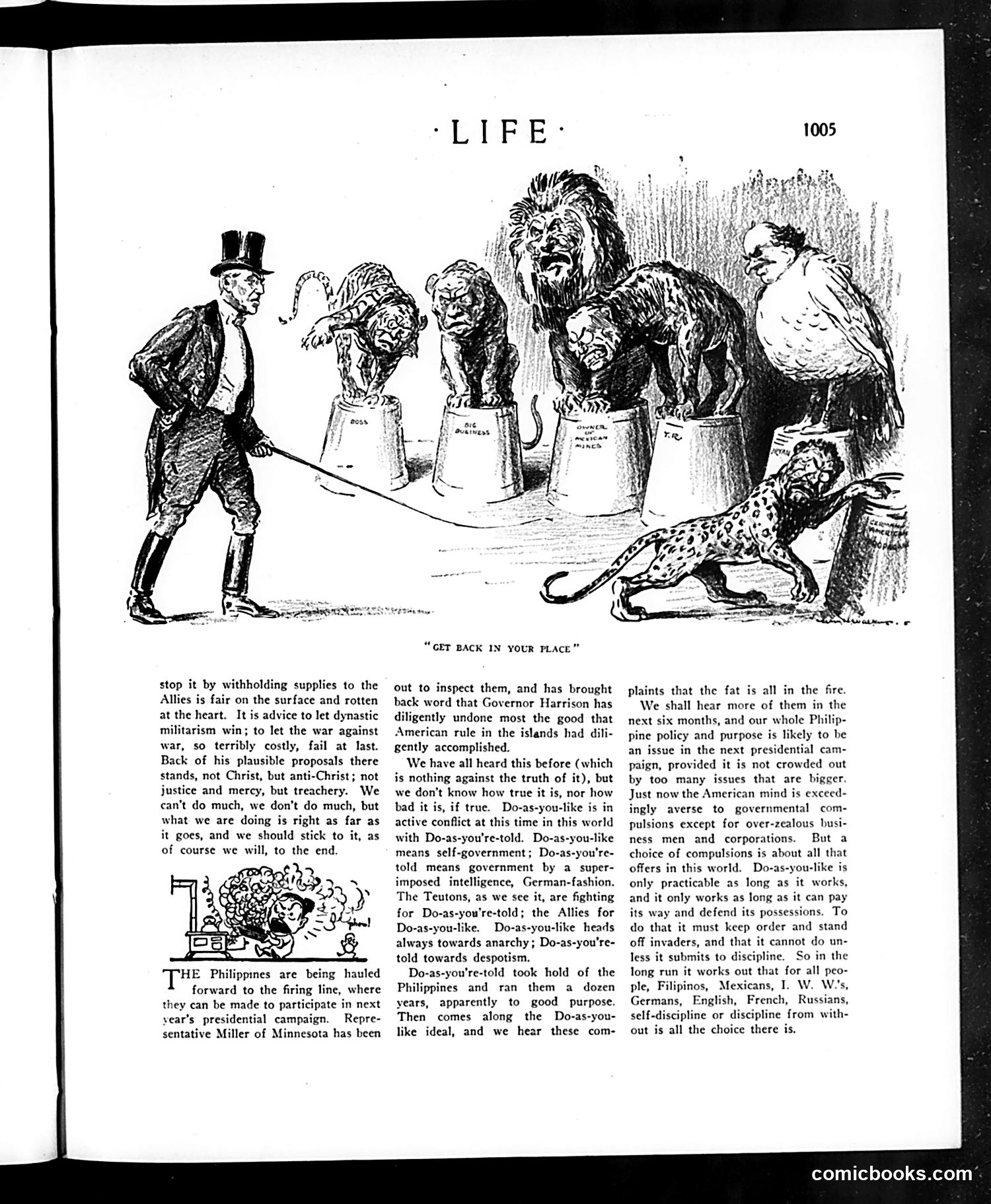
This political cartoon satirizes American imperialism in the Philippines during World War I era. The illustration shows a well-dressed man with a whip (representing American authority/colonialism) commanding various figures trapped in buckets—caricatured representations of Filipinos and other colonized peoples—back into submission. A leopard at right appears to symbolize disorder or wildness. The accompanying text debates Philippine governance: Representative Miller recently visited and reported that Governor Harrison has reversed American colonial progress. The article frames this as a conflict between "Do-as-you-like" (self-government/anarchy) versus "Do-as-you're-told" (imposed order). The satire critiques American hypocrisy—claiming to fight for democratic ideals in WWI while maintaining authoritarian colonial control. The cartoon's title mocks the contradiction: America demands obedience from colonized peoples while publicly championing freedom.
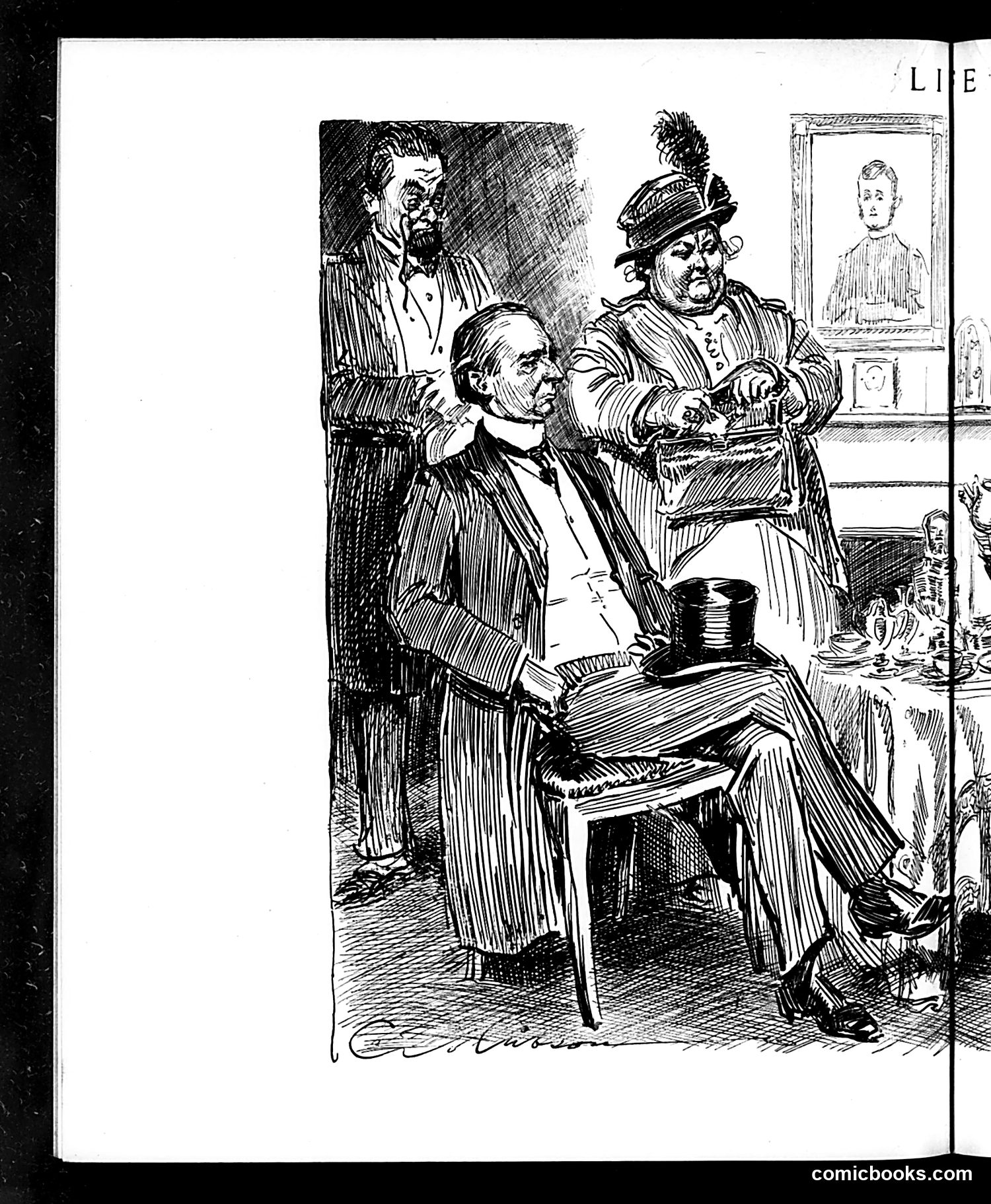
This is a satirical cartoon from *Life* magazine depicting what appears to be a formal social or political gathering. The central figure, seated and wearing formal attire with a top hat nearby, is being addressed by two standing men—one portly and animated, another thin and serious in the background. The satire likely comments on social pretension or political posturing in upper-class settings. The exaggerated facial features and body language suggest mockery of affected manners or insincere rhetoric common in such circles. However, without visible text identifying the specific figures or the cartoon's caption, I cannot definitively state which historical figures or events are being satirized. The style and clothing suggest late 19th or early 20th-century America, but the precise political or social commentary remains unclear from the image alone.
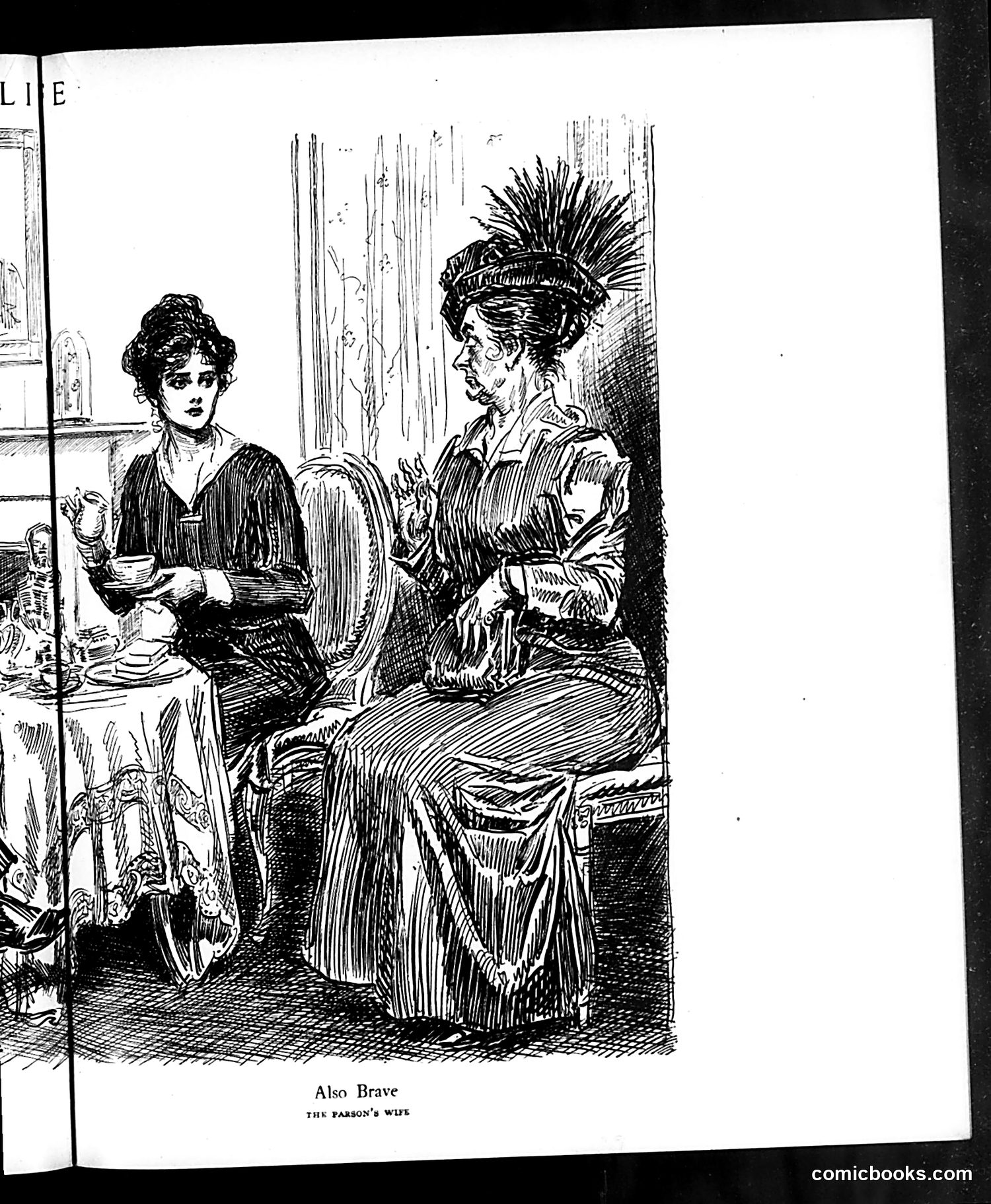
This illustration depicts two women in an interior setting, likely from the early 20th century based on the artistic style. The title suggests social commentary about a clergyman's wife. The cartoon appears to satirize expectations of clergy spouses—presenting the woman on the right as notably courageous or bold ("also brave"), implying her husband the parson possesses such qualities but that his wife matches or exceeds them. The domestic interior setting and the women's engaged postures suggest a commentary on female independence or strength within traditionally constrained social roles. However, without additional context from Life magazine's editorial position or the surrounding content, the precise satirical target remains unclear. It may critique gender roles, clerical authority, or expectations of ministerial households.
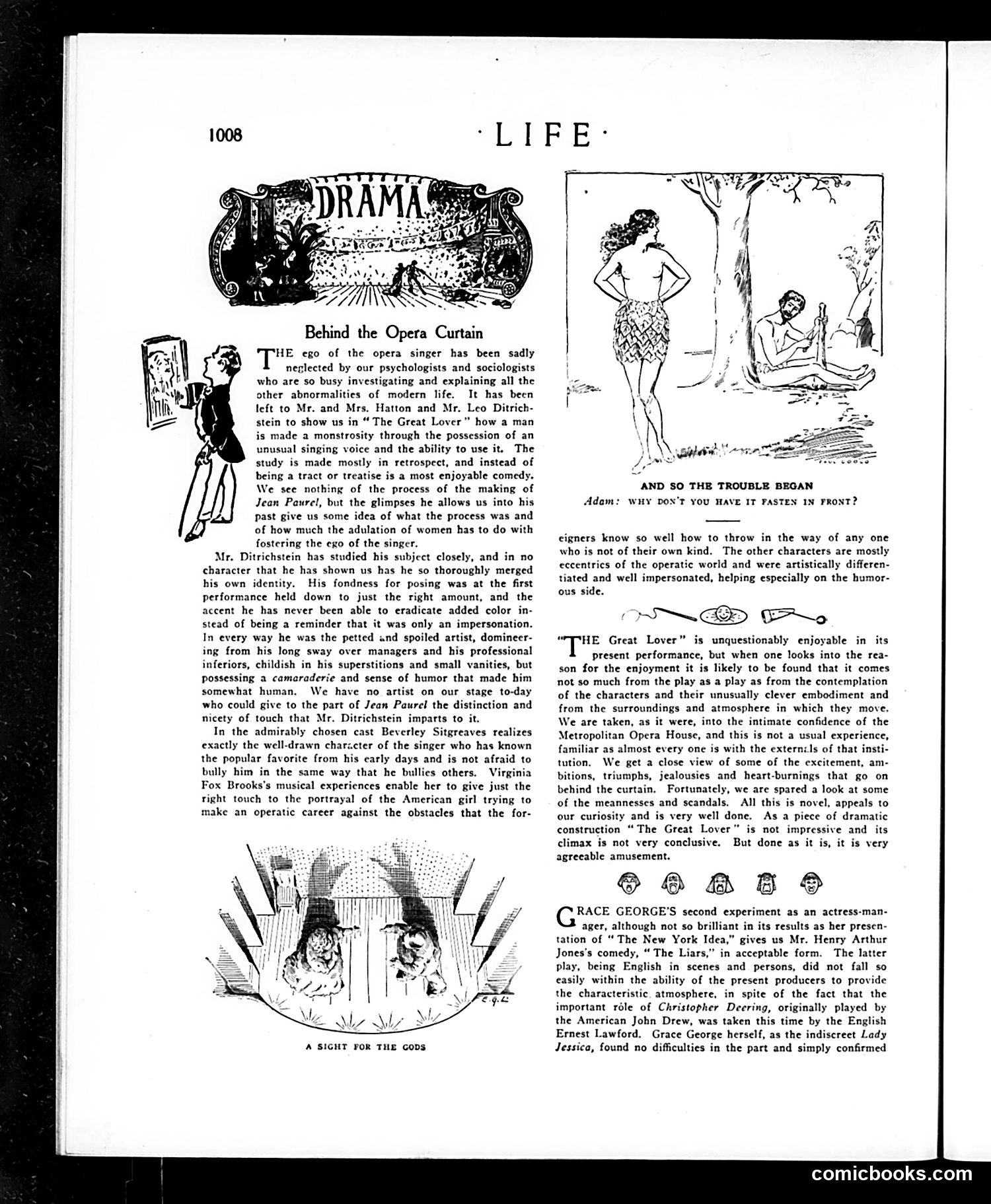
This page reviews "The Great Lover," a stage play starring Leo Ditrichstein about an opera singer whose ego has been corrupted by fame and female admiration. The text praises Ditrichstein's nuanced performance—he has successfully merged his own identity with the character rather than merely impersonating him, avoiding his usual tendency to pose theatrically. The accompanying cartoons satirize operatic excess and vanity. "A Sight for the Gods" depicts the melodramatic self-importance of opera performers. "And So the Trouble Began" shows a barely-clothed woman questioned by Adam about her garment's closure—likely mocking both biblical prudishness and the absurdity of theatrical costume design debates. The review celebrates the play primarily for its backstage glimpses into Metropolitan Opera House intrigue rather than its dramatic construction, finding the character study and atmosphere more compelling than the plot itself.
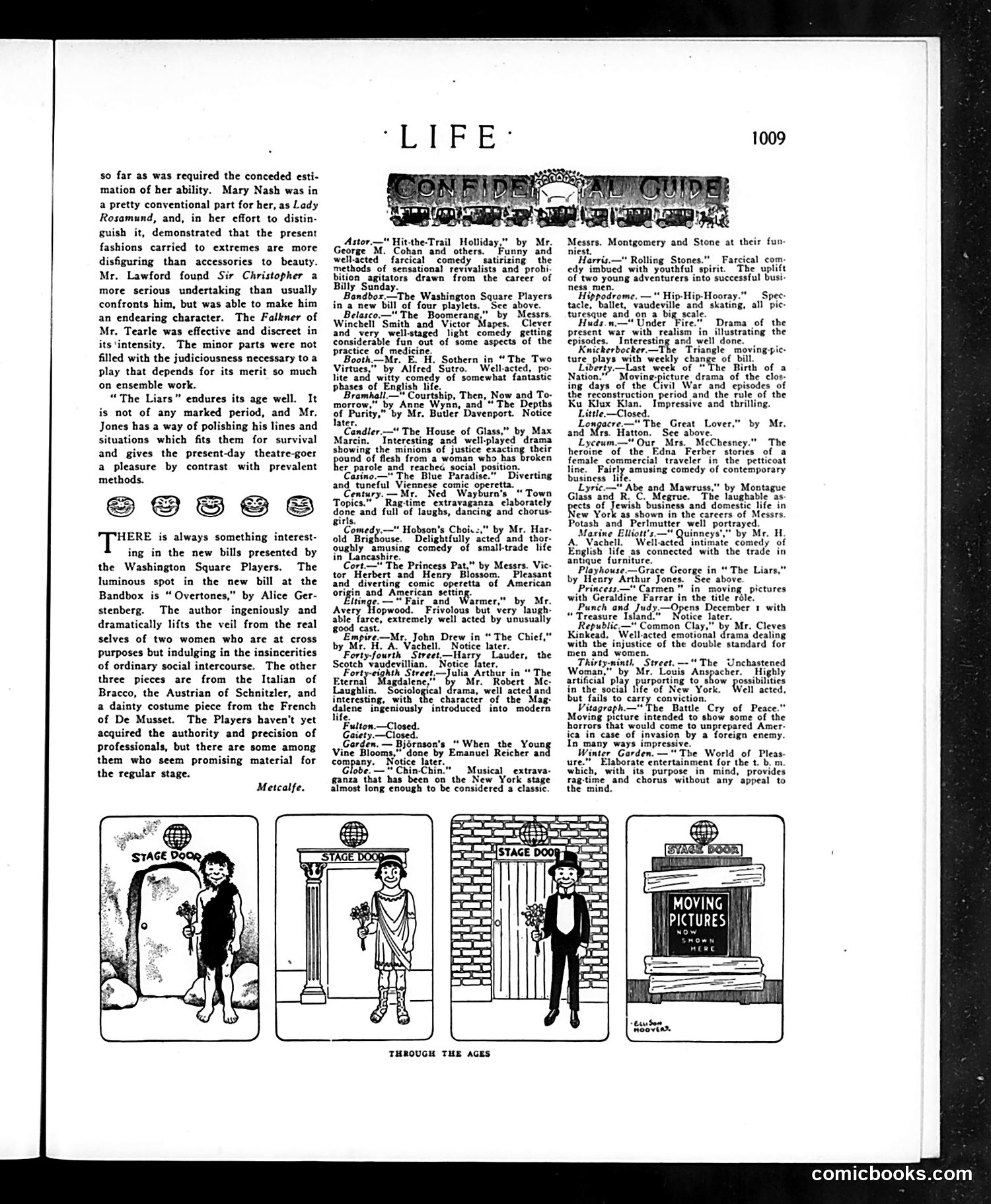
This page is primarily **theater criticism**, not political satire. It reviews current Broadway productions from what appears to be the early 1910s. The four small illustrations at the bottom labeled "THROUGH THE AGES" are decorative vignettes showing theatrical stage doors across different historical periods—not satirical commentary. They humorously depict how theater entrances have evolved from ancient/classical times through to modern "Moving Pictures." The main text discusses plays like "The Liars," "Overtones" (by Alice Gerstenberg), and various comedies and operettas. Notable is a reference to a play satirizing **Billy Sunday**, the famous evangelical revivalist, and **prohibition agitators**—suggesting contemporary social anxieties about religious fervor and temperance reform. The reviews are written by critic **Metcalfe** and focus on theatrical merit: acting quality, script construction, and ensemble work. This is entertainment journalism rather than political cartooning—a straightforward guide for theater-goers about what's playing and whether it's worth seeing.
I can see this is a page from Life magazine containing what appears to be a black and white illustration or engraving, but the image quality and orientation make it difficult to discern specific details with confidence. The OCR text appears corrupted or reversed and doesn't provide clear context. The illustration shows landscape scenery with what might be architectural or urban elements, rendered in a detailed line-drawing style typical of early-to-mid 20th century satirical publications. However, without being able to clearly identify specific figures, caricatures, or read legible text labels, I cannot reliably explain what political or social commentary this particular cartoon conveys to a modern reader. The page's caption appears along the right margin but is not legible enough for accurate transcription.
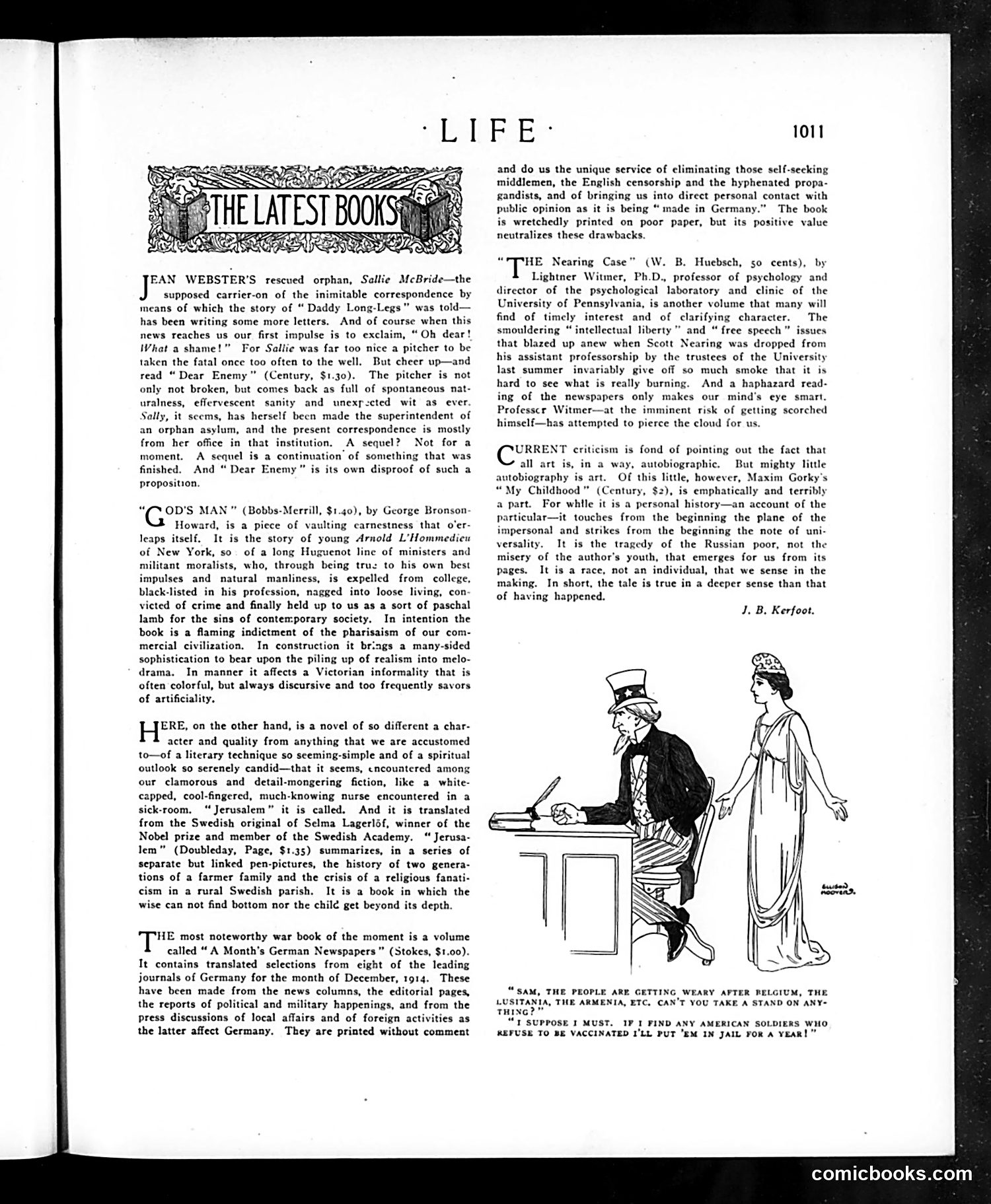
This page reviews contemporary books and includes a cartoon illustrating a wartime disagreement. The cartoon depicts a man (in military/official dress) at a desk speaking with a woman in classical dress, likely representing "America" or a female allegorical figure. The man's dialogue expresses frustration with pacifism and religious objections to military service, declaring he'd imprison American soldiers who refuse vaccination—a reference to conscientious objectors during World War I (America entered in 1917). The joke satirizes the tension between American neutrality/pacifism and pro-war sentiment. The woman's composed demeanor contrasts with the man's heated ultimatum, suggesting the disconnect between idealistic American values and wartime militarism. The book reviews above discuss contemporary novels, including "A Month's German Newspapers," which presents unfiltered German journalism from December 1914—material typically censored by British authorities.
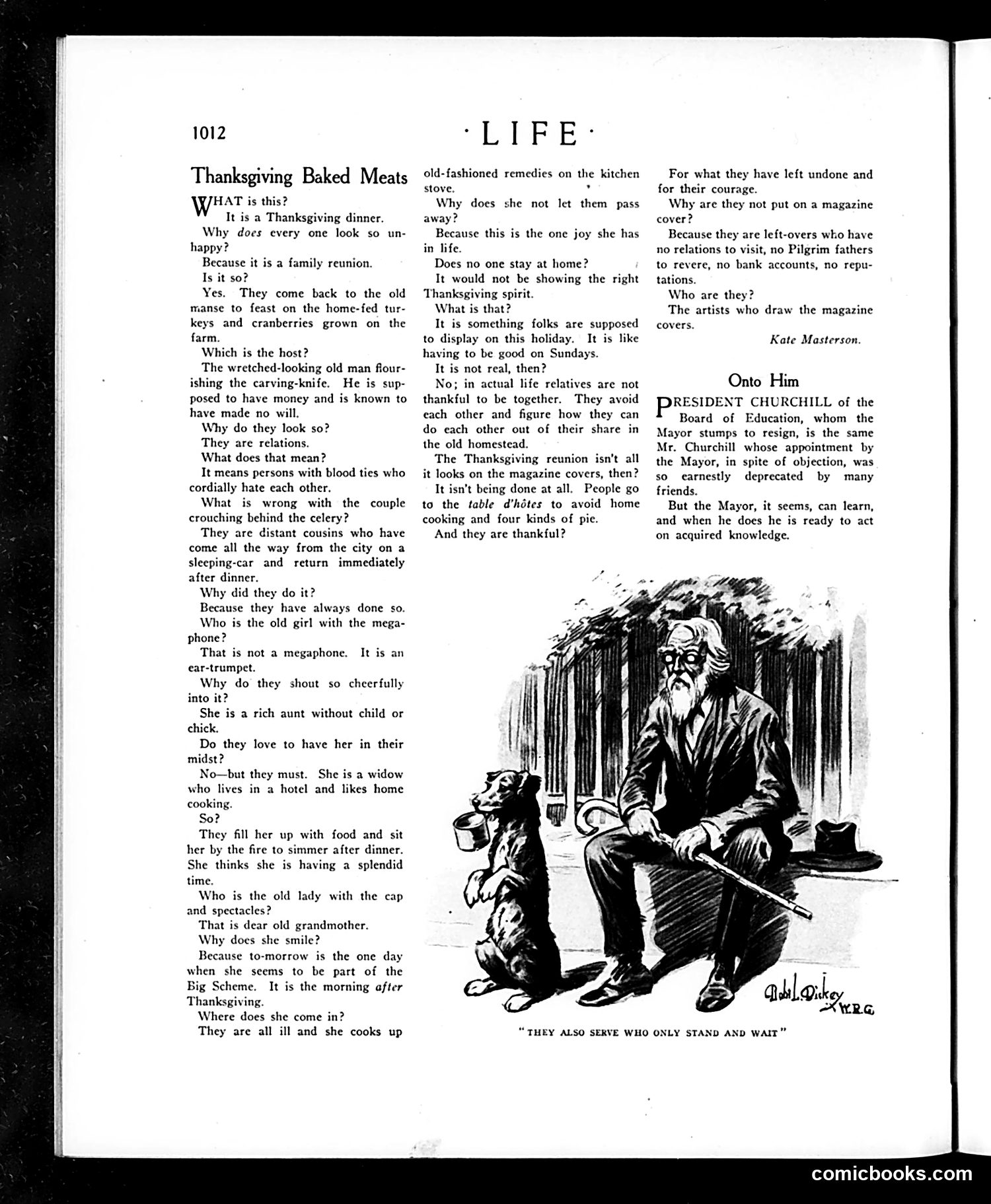
This page presents a cynical Q&A about Thanksgiving dinner that mocks the holiday's sentimental mythology. The accompanying illustration shows an elderly man carving turkey while a dog waits—depicting the supposed "joy" of family reunion. The satire targets the forced sentimentality of Thanksgiving: families pretend affection while actually disliking each other, distant relatives attend out of obligation, a wealthy aunt is tolerated only for her money, and relatives scheme to inherit the homestead. The grandmother alone finds genuine satisfaction—her chance to play nurse the morning after when everyone is ill. The final jab critiques magazine covers depicting idealized Thanksgiving scenes. These images feature artists and models playing roles, not authentic families. Real people without money or "proper" relatives can't appear in such propaganda. The piece exposes the gap between Thanksgiving's marketed image and actual family dynamics—hypocrisy dressed as tradition.
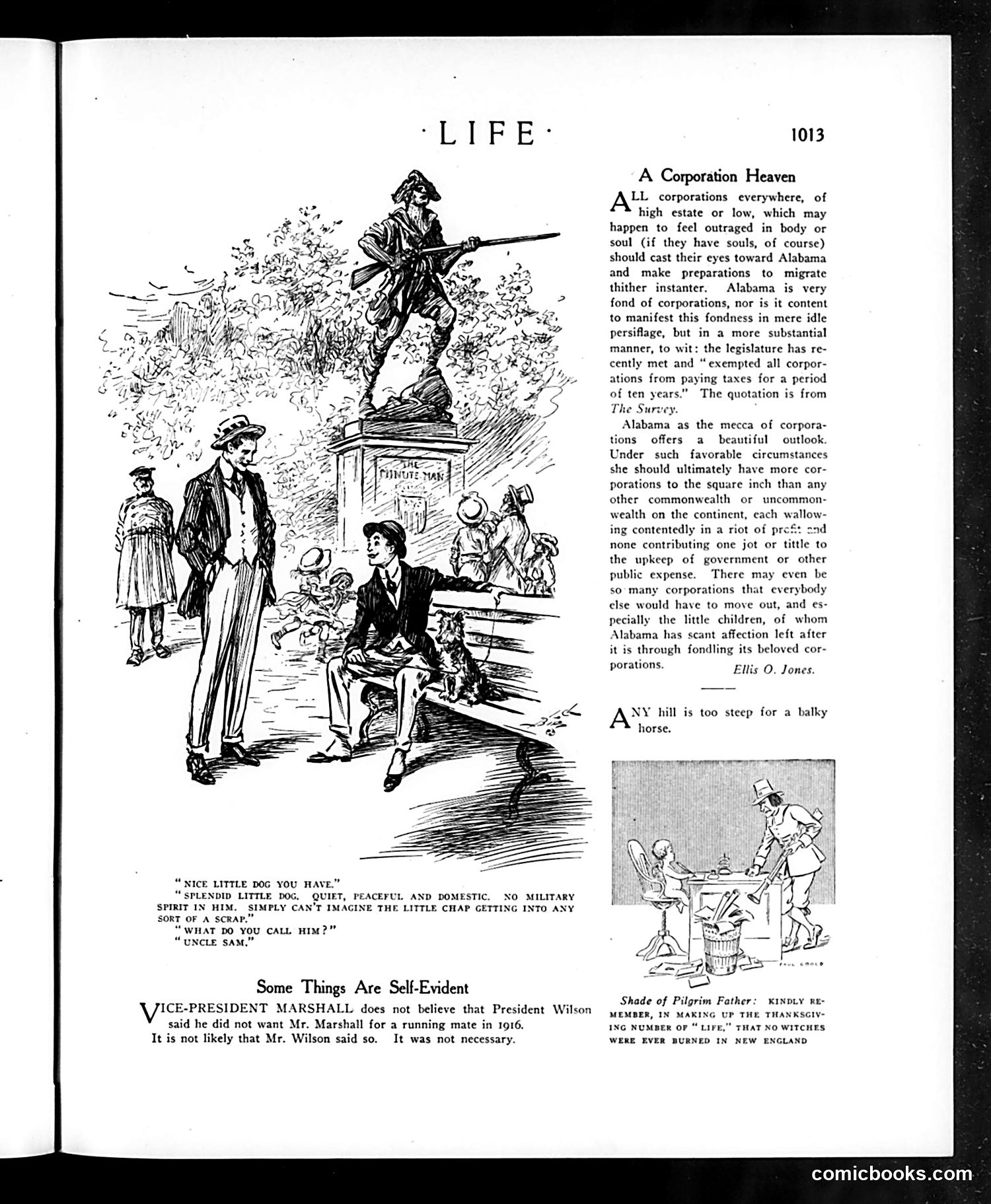
**Main Article: "A Corporation Heaven"** This editorial mocks Alabama's legislature for exempting corporations from taxes for ten years. The satire argues this creates a perverse "heaven" where corporations grow wealthy while contributing nothing to public services—forcing ordinary citizens and children to leave the state. The author (Ellis O. Jones) uses absurdist exaggeration to criticize what he sees as corporate favoritism at citizens' expense. **Secondary Item: "Some Things Are Self-Evident"** This brief political jab questions Vice-President Marshall's credibility. It suggests Marshall's denial that President Wilson didn't want him as running mate in 1916 is transparently false—the comment implies Wilson obviously didn't want Marshall, making Marshall's denial laughably unconvincing. The phrase "self-evident" means the truth needs no proof. **Small Cartoon: "Any hill is too steep for a balky horse"** Appears to be a generic humorous vignette about stubborn animals, unrelated to the political content.
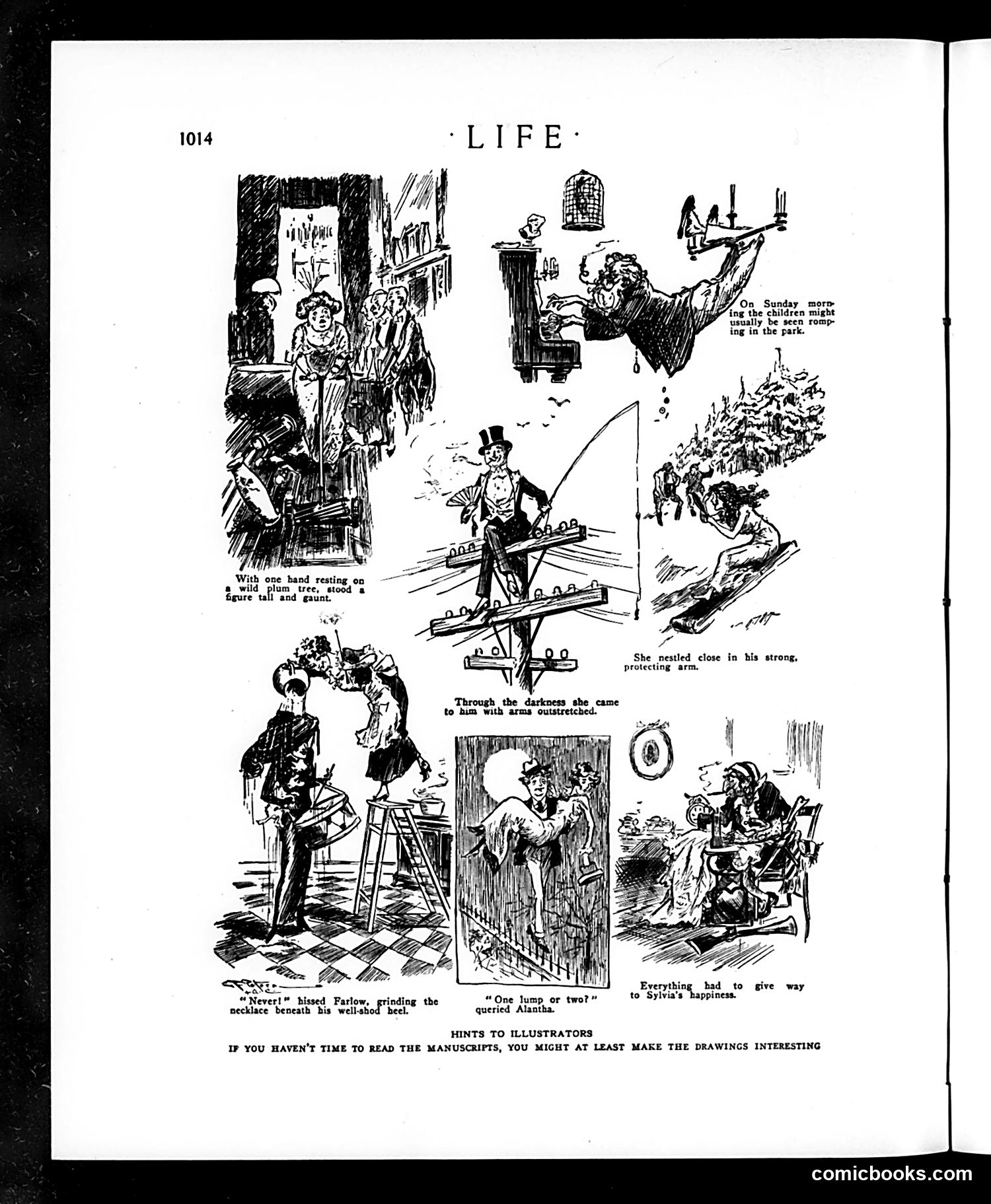
This appears to be an **illustration page accompanying a serialized story** rather than political satire. The drawings depict romantic and dramatic scenes: a tall, gaunt man with a woman nestling against him; winter skiing scenes; domestic interior moments; and what seems to be tension between characters named Farlow, Sylvia, and Alantha. The caption "One lump or two?" suggests a tea service scene. The overall narrative arc—from outdoor romance to domestic conflict—appears to trace a romantic plot. The footer note to illustrators ("IF YOU HAVEN'T TIME TO READ THE MANUSCRIPTS, YOU MIGHT AT LEAST MAKE THE DRAWINGS INTERESTING") is **satirical commentary on magazine illustration practices**, mocking illustrators who prioritize visual appeal over narrative accuracy when working on tight deadlines. This is **not political satire** but rather literary illustration with meta-commentary about publishing practices.
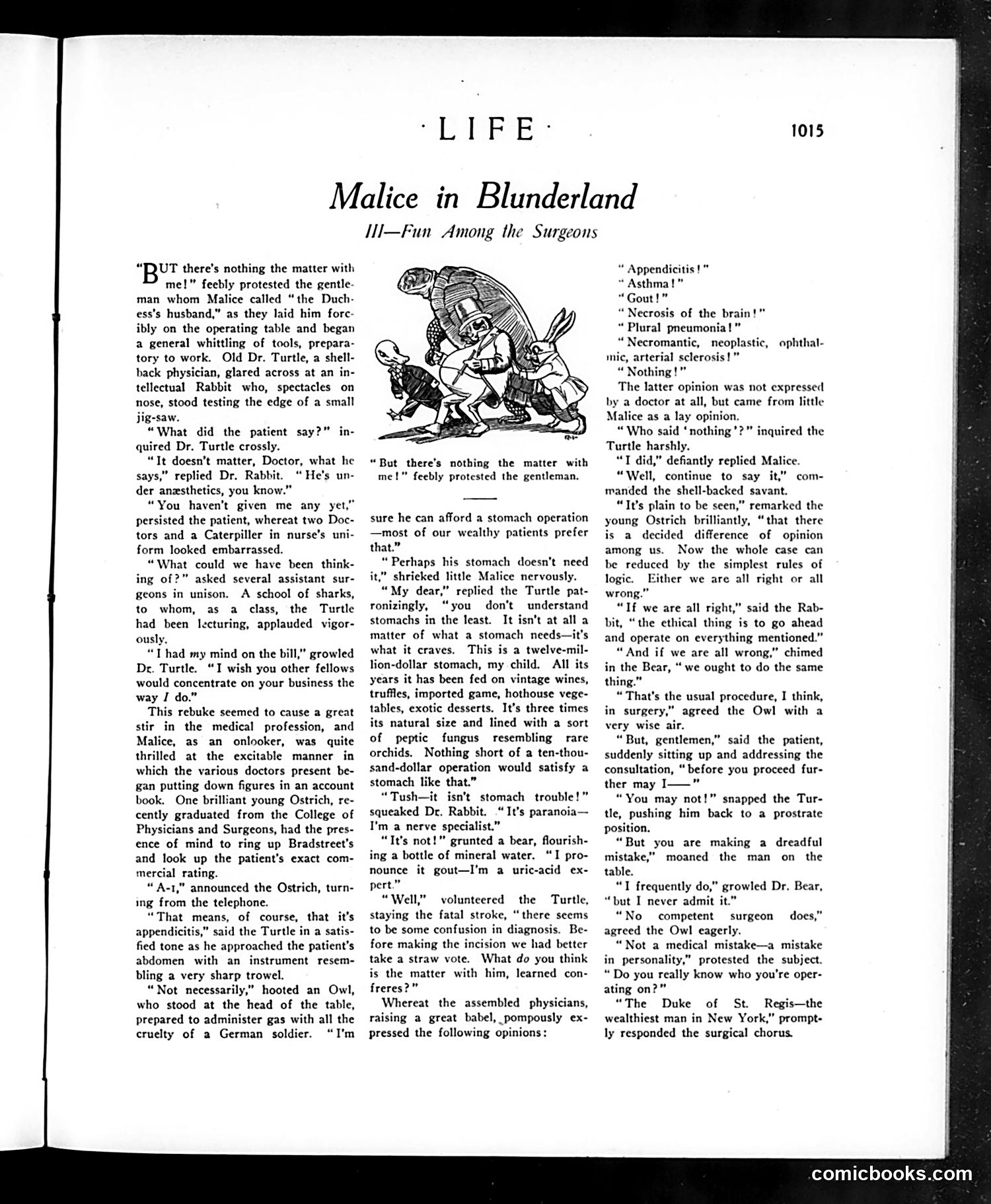
This satirical piece mocks the medical profession's incompetence and profit-driven practices. A patient insists he's healthy, but a group of animal doctors (Turtle, Rabbit, Owl, Bear, Ostrich) ignore him and prepare surgery anyway. The satire targets several abuses: doctors operating on wealthy patients unnecessarily for profit; diagnostic disagreement (they call a straw vote to decide what's actually wrong); anesthesia being "forgotten"; and mercenary behavior (checking the patient's commercial rating before diagnosis). The child character Malice represents common sense—the only one correctly identifying that nothing is wrong. The animal doctors represent various medical specialties squabbling while pursuing financial gain. The reference to the Ostrich checking "Bradstreet's" (a credit-rating agency) suggests doctors prioritized patients' ability to pay over actual medical need. This reflects early 20th-century concerns about surgeon overreach and unnecessary procedures.
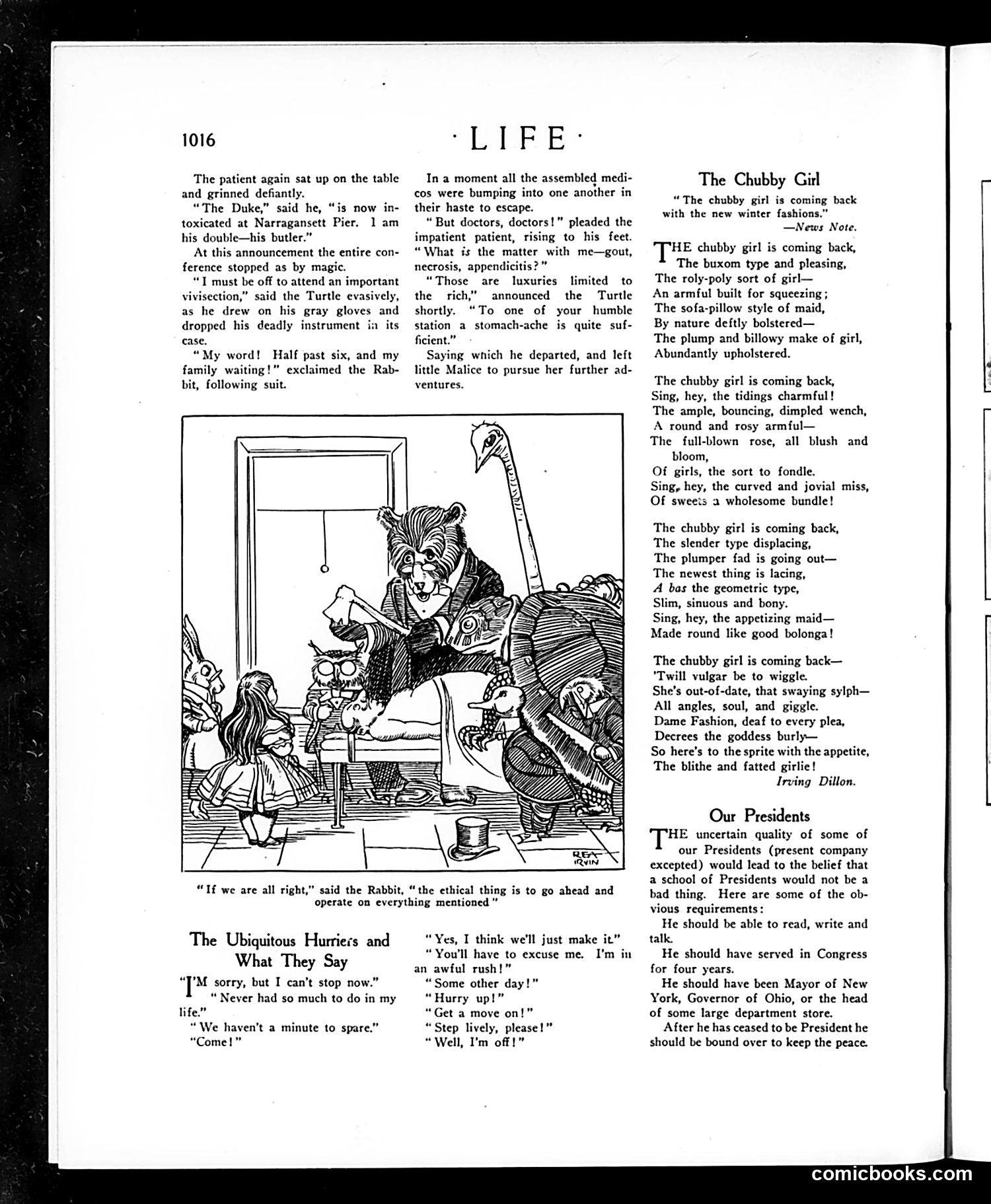
## Main Cartoon: "The Ubiquitous Hurriers" This satirizes the frenetic pace of modern American life. The cartoon depicts doctors fleeing a patient, with dialogue emphasizing constant rushing ("I can't stop now," "never had so much to do"). The joke: even medical professionals abandon their duties because they're too busy—a critique of society's obsession with staying occupied. ## Secondary Content: "The Chubby Girl" Poem A light satirical poem by Irving Dillon celebrating the return of fuller-figured women to fashion, mocking the previous trend toward "geometric" slimness. It's social commentary on changing beauty standards. ## "Our Presidents" Section This humorously proposes requirements for U.S. Presidents, including absurd qualifications (ability to "read, write and talk") and the final requirement that ex-presidents "be bound over to keep the peace"—likely a jab at a specific recent president's behavior or character, though the target isn't clearly identified here. The page captures Life's satirical tone targeting American excess, fashion follies, and political figures.
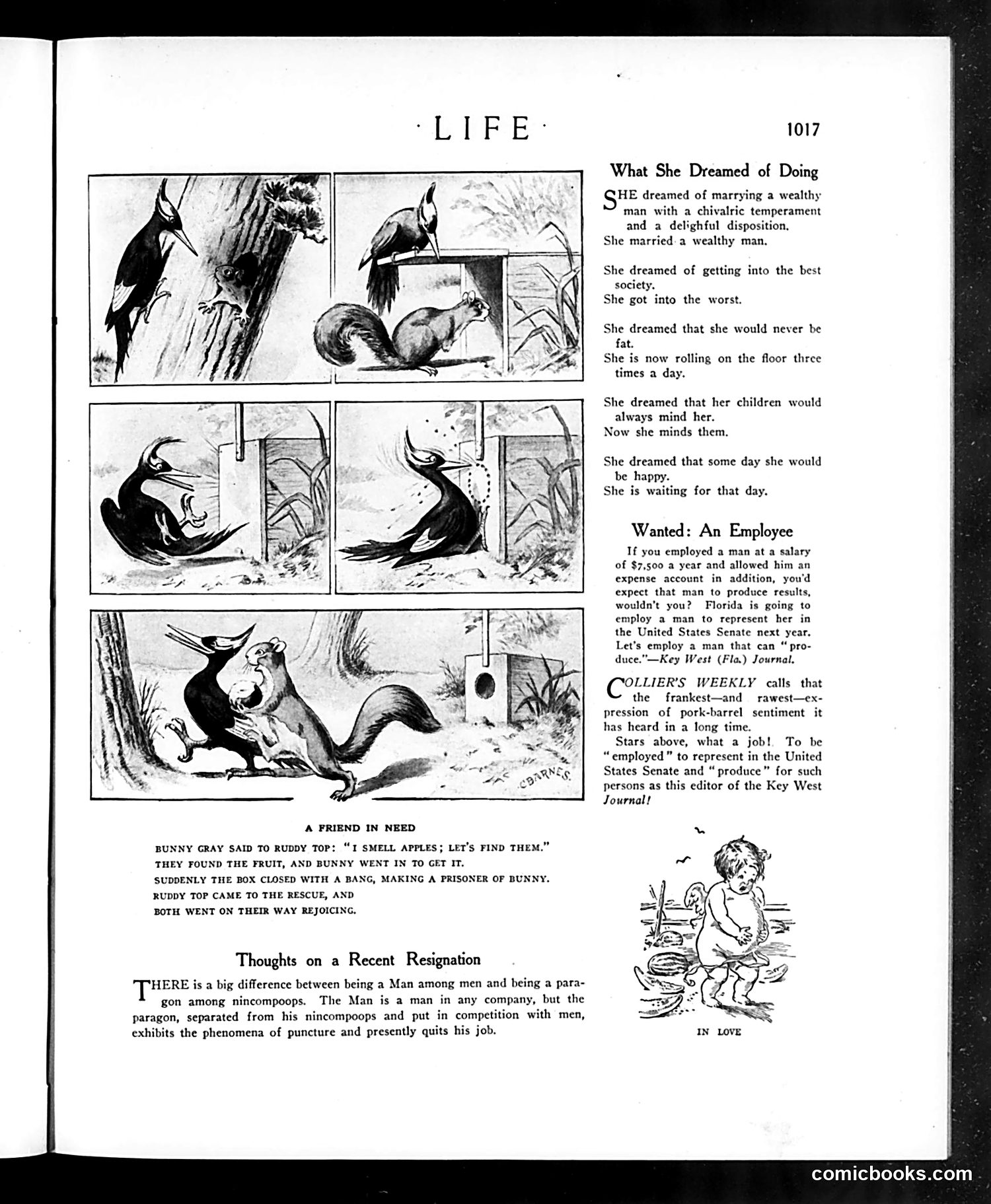
**"What She Dreamed of Doing"** is satirical verse mocking the gap between women's romantic expectations and married reality. It presents a woman who dreamed of marrying a chivalrous wealthy man but got material comfort without emotional fulfillment; aspired to high society but found herself in "the worst"; expected to stay slim but now exercises desperately; imagined obedient children but now serves them; and waits perpetually for happiness that never arrives. The satire critiques both unrealistic feminine expectations and the disillusionment of marriage. **"Wanted: An Employee"** satirizes political corruption. It mocks Florida's plan to hire a Senate representative as a paid operative to "produce results" for his employer (the Key West Journal editor), rather than serve constituents. The piece exposes how politicians function as employees producing favors for those who fund them—brazenly comparing a Senate seat to a commercial employment contract. **"A Friend in Need"** is a simple animal fable about loyalty: when bunny gets trapped, his friend rescues him. The bottom piece criticizes someone's recent resignation, suggesting he succeeded among inferior peers but collapsed under actual competition—a "puncture" revealing his mediocrity.
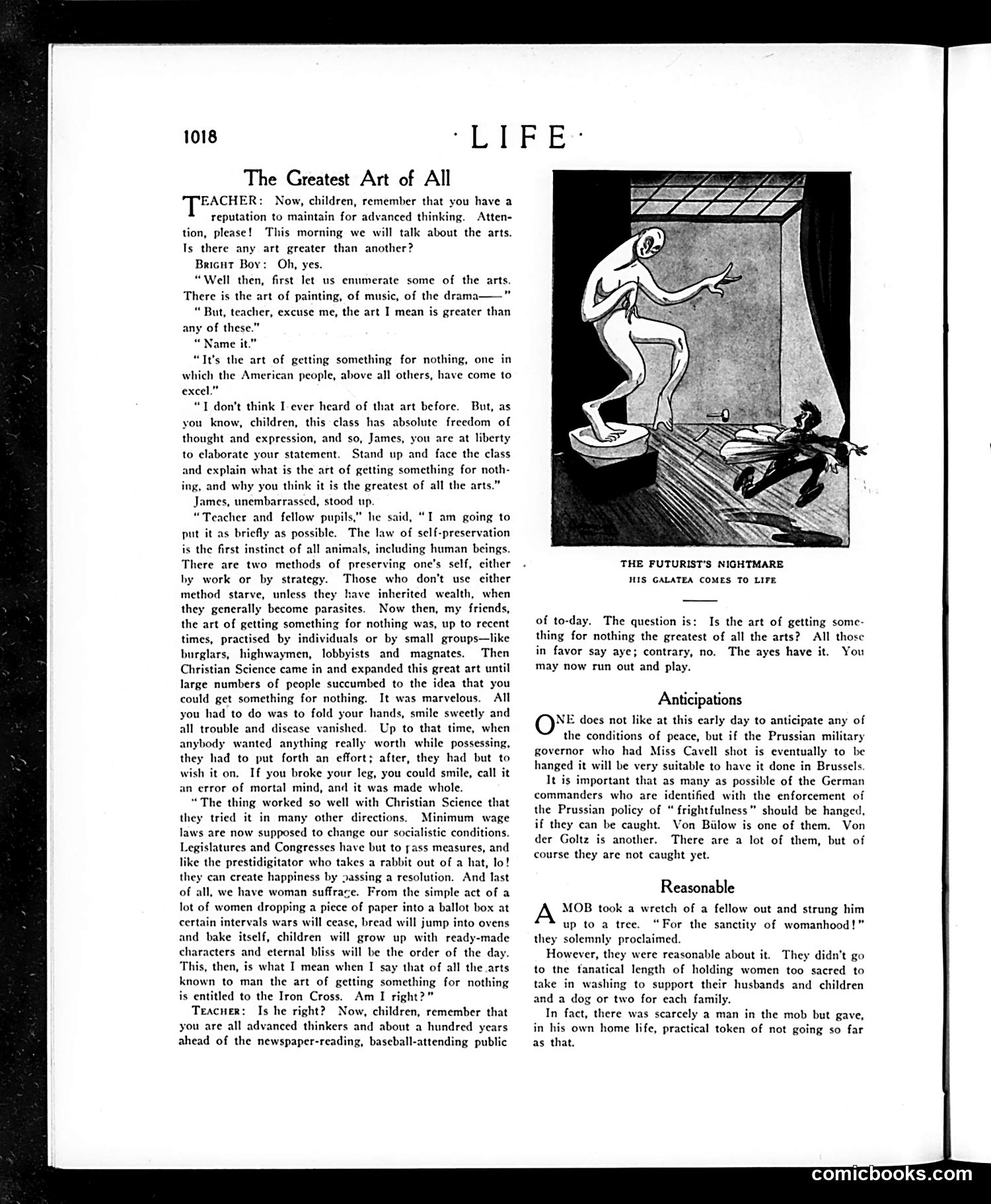
**Main Content: Satirical Dialogue "The Greatest Art of All"** This is a teacher-student exchange mocking Progressive Era idealism. A clever boy argues that "getting something for nothing" is America's supreme art form, practiced historically by criminals but recently legitimized through Christian Science (which promised healing through mind over matter) and political reforms like minimum wage laws and women's suffrage. The satire targets reformers' naive belief that legislation and positive thinking can solve material problems without genuine effort. The teacher's concluding approval—despite the cynical argument—underscores the magazine's skepticism toward Progressive solutions. **Secondary Content: "The Futurist's Nightmare"** An abstract illustration of a nude male figure confronting his own sculptural likeness—likely referencing Futurism's celebration of modernity and dynamism, treated here as absurd or menacing. The page reflects pre-1920s American conservatism critiquing both utopian reformism and avant-garde art movements as dangerous fantasies.
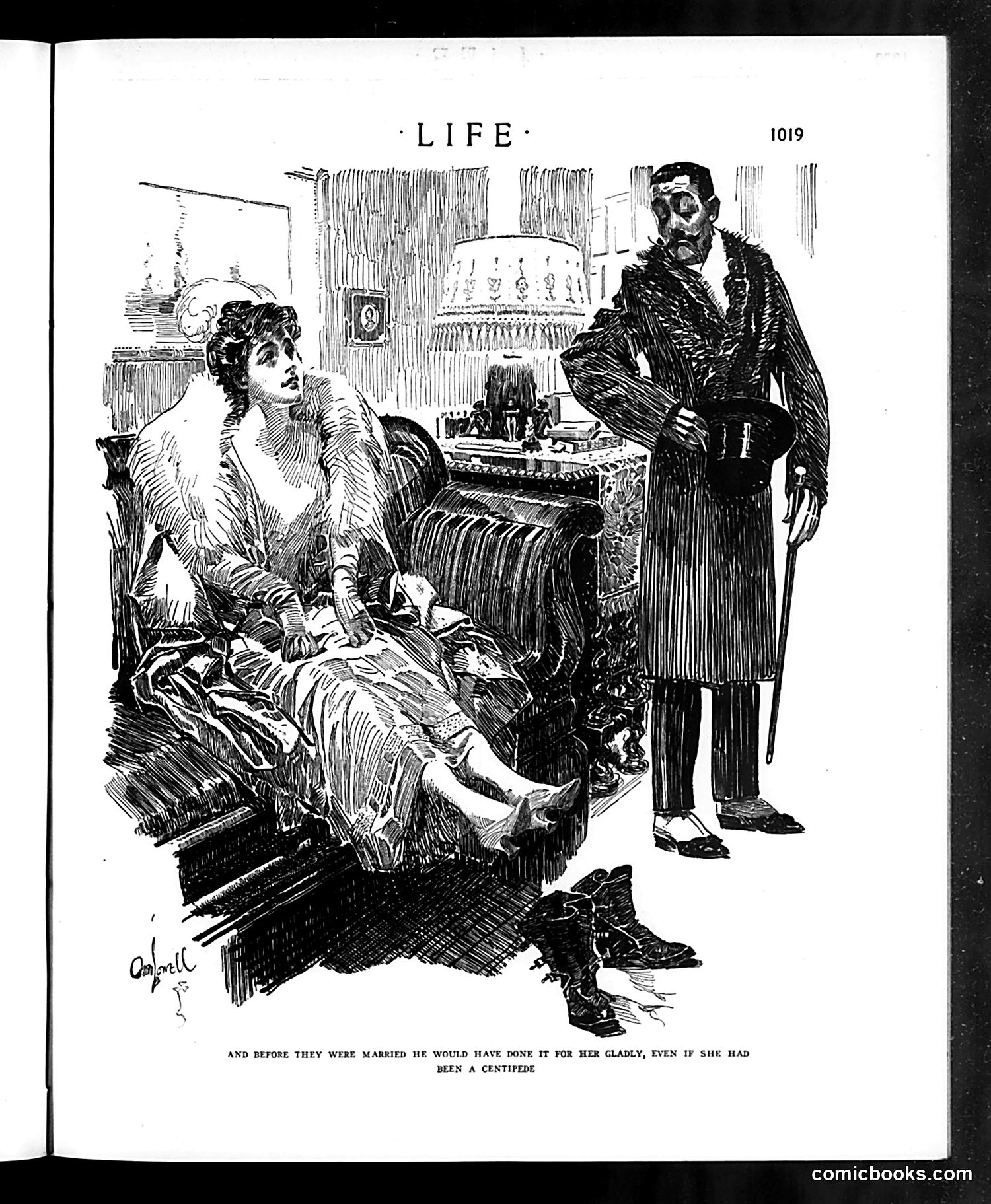
This 1919 *Life* magazine illustration satirizes marriage and male devotion. The scene shows a wealthy woman reclining while a formally dressed man stands attentively nearby—likely her husband or suitor in an interior setting. The caption's joke contrasts pre-marital and post-marital attitudes: before marriage, a man would eagerly perform any task for his beloved, even if she were "a centipede" (an absurd, undesirable creature). The implication is that after marriage, his willingness to help has sharply diminished—she's no longer deserving of such devoted service. This reflects early 20th-century satirical commentary on how romantic ardor cools after the wedding, and how men's gallantry toward women supposedly evaporates once they've married them. The exaggeration of the centipede comparison emphasizes the comedy of waning post-marital affection.
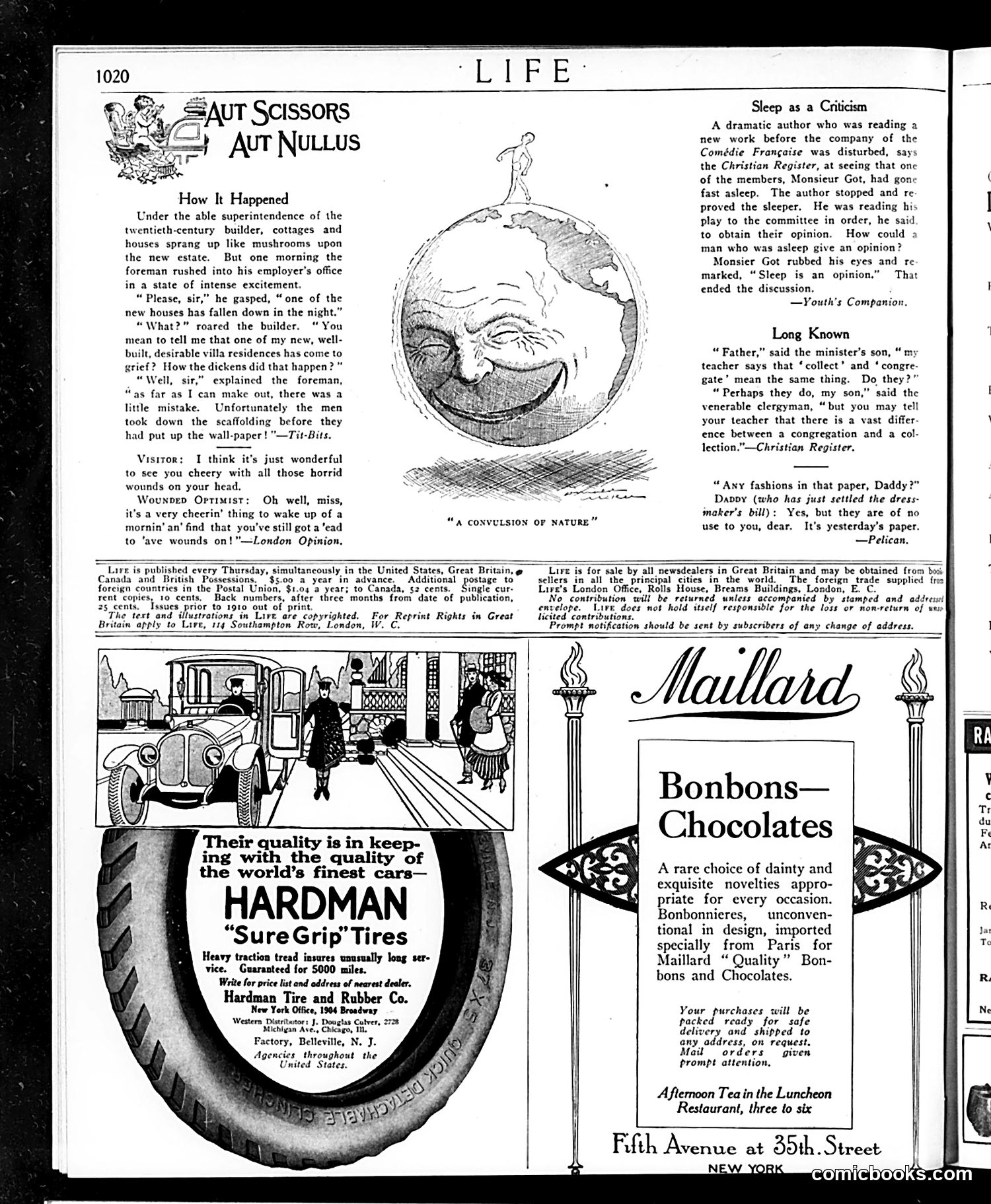
This page contains **short humorous anecdotes** rather than political cartoons. The central cartoon ("A Convulsion of Nature") depicts an oversized stomach, satirizing digestive complaints—a common comedic subject of the era. The text pieces are brief jokes: - **"Aut Scissors Aut Nullus"**: A builder's house collapses because workers removed scaffolding before installing wallpaper—physical comedy about construction mishaps. - **"Sleep as a Criticism"**: A French theater member falls asleep during a playwright's reading; when confronted, he quips "Sleep is an opinion"—mocking pretentious theater culture. - Other brief items joke about clergy, fashion, and wounded soldiers' optimism. The **advertisements** for Hardman tires and Maillard chocolates occupy significant space, reflecting Life's business model. For modern readers: this represents Life's format as a **humor magazine mixing jokes, cartoons, and ads**—more akin to today's *The Onion* than serious satire. The humor is genteel and domestic rather than politically pointed.
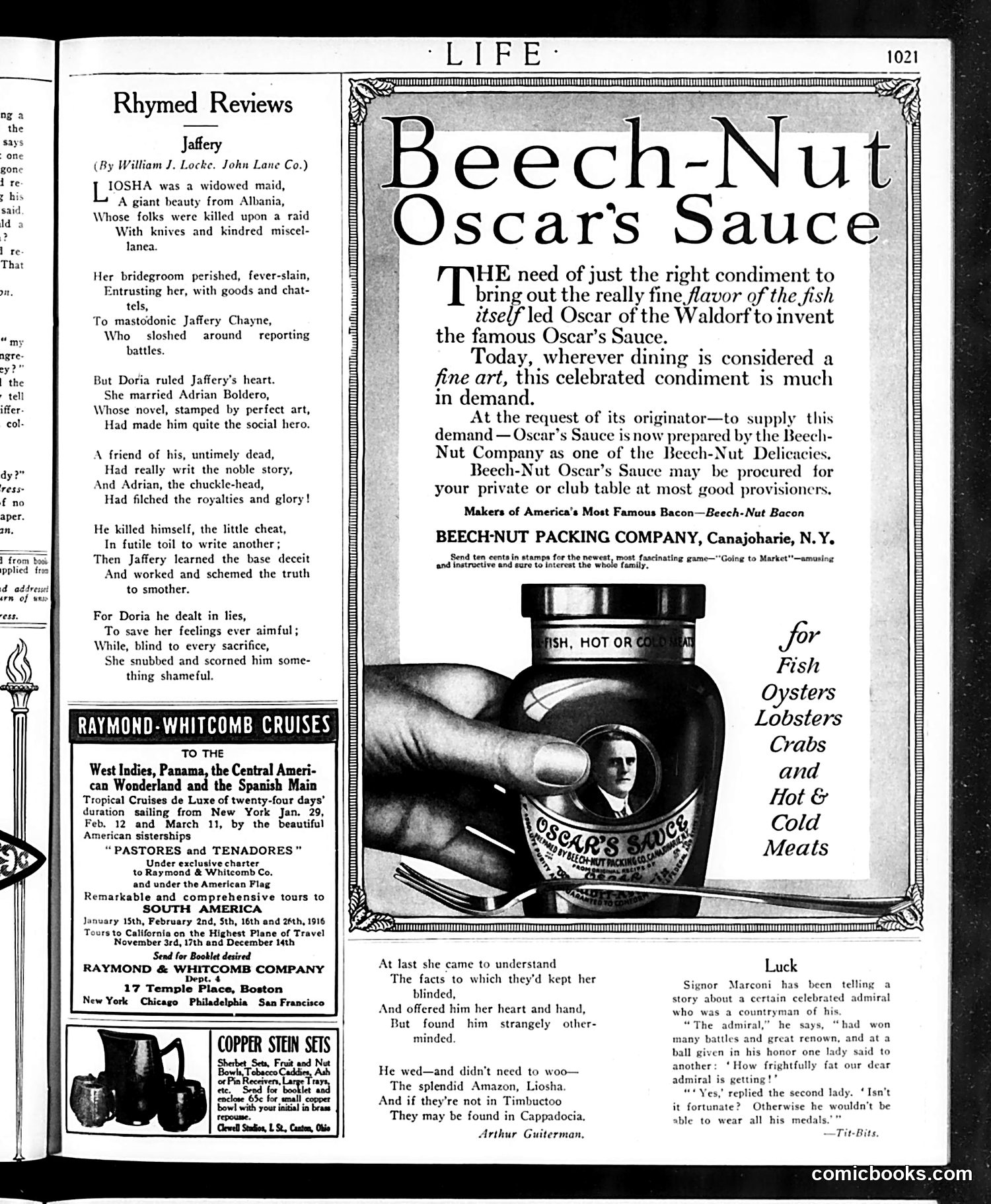
This page contains a **book review in verse** (not a political cartoon) alongside period advertisements. The review critiques William J. Locke's novel *Jaffery*—a melodramatic tale of unrequited love set in Albania. The protagonist, Jaffery, sacrifices himself for a woman named Doria who loves another man (Adrian Boldero). The satirical punch: Adrian is a fraud who stole his literary success, yet Doria remains indifferent to Jaffery's devotion. When she finally understands his selfless deeds, he's already married someone else—a twist the reviewer finds darkly comic. The ads feature **Beech-Nut Oscar's Sauce** (a condiment marketed as refined dining), **Raymond & Whitcomb Cruises** (luxury travel), and a brief anecdote about an admiral so overweight from medals he can barely move—a joke about vanity and physical decline. The satire mocks both romantic melodrama and the gap between noble sacrifice and actual human gratitude.
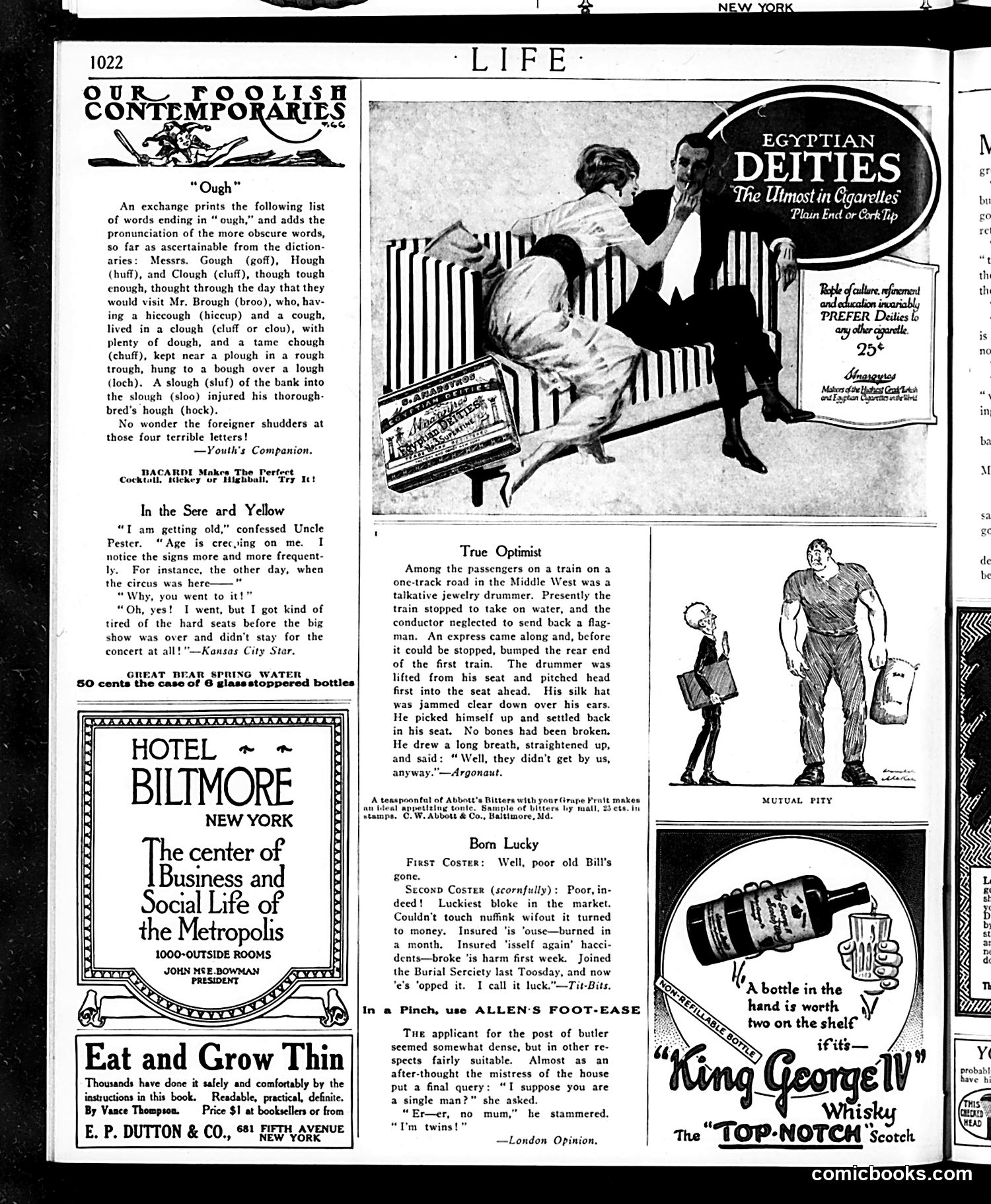
This page is primarily **advertising and humor content** rather than political cartooning. The main visual humor appears in the illustrated anecdotes: 1. **"True Optimist"** depicts a jewelry drummer in a train accident who remains cheerful despite being violently thrown forward—the joke is his absurd optimism ("they didn't get by us") after nearly being killed. 2. **"Mutual Pity"** shows two figures in an unspecified but apparently awkward social situation (unclear without fuller context). 3. The page's opening section lambastes English pronunciation inconsistencies—the word "ough" appears in multiple words (tough, through, cough, dough, etc.) with wildly different pronunciations, making English bewildering to foreigners. The remaining content consists of period advertisements (Hotel Biltmore, Egyptian Deities cigarettes, King George IV whisky, Bacardi, etc.) and brief humorous anecdotes about age, luck, and class differences. **For modern readers:** This represents early 20th-century Life magazine's mix of genteel humor and advertising—relatively mild, class-conscious jokes aimed at educated audiences.
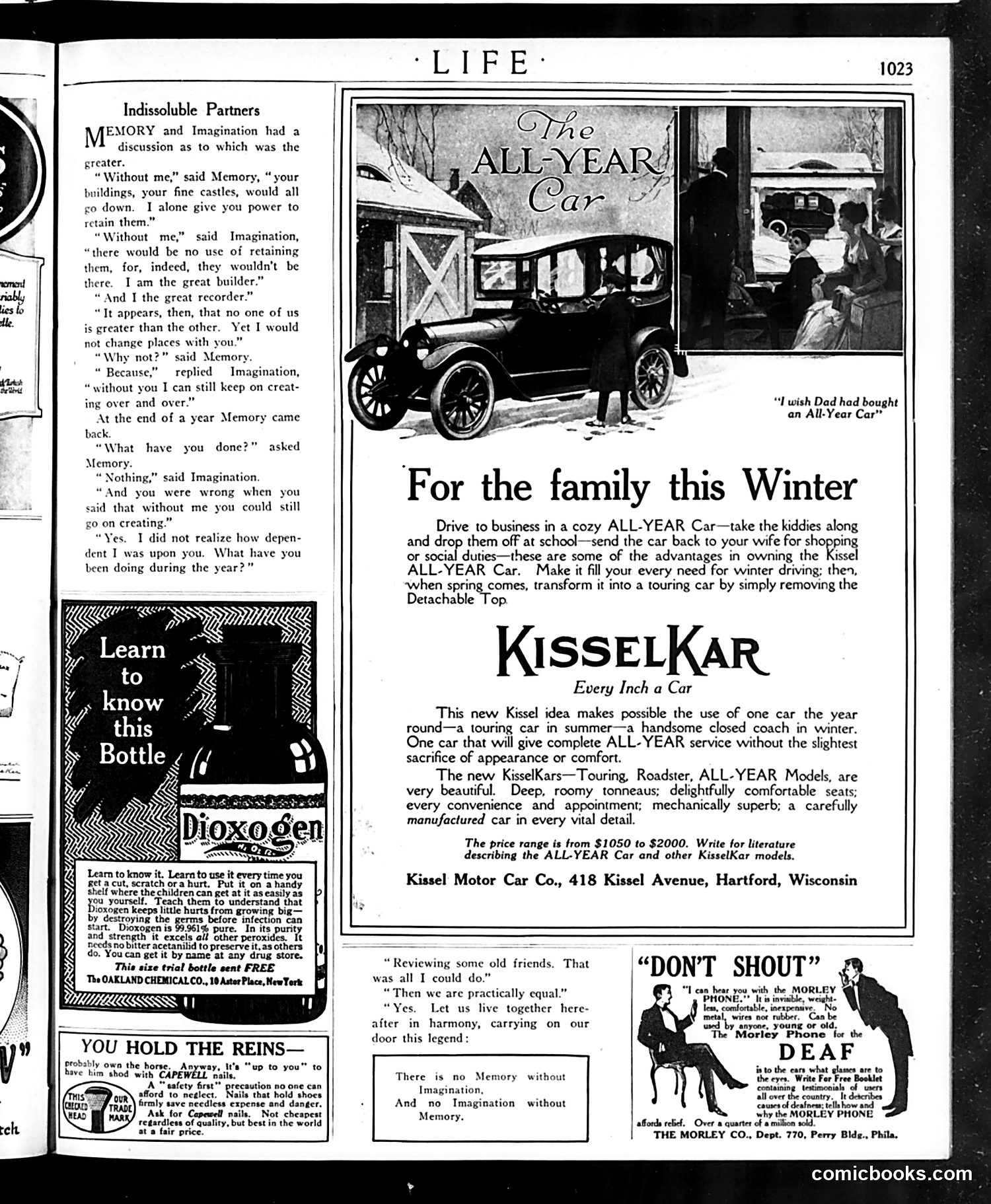
This page contains primarily **advertisements** integrated with a short allegorical story. The lead piece, "Indissoluble Partners," is a philosophical fable depicting Memory and Imagination debating their relative importance. Memory claims to preserve accomplishments; Imagination claims to create them. The moral concludes they're mutually dependent—neither can function alone. The main advertisement is for the **Kissel All-Year Car**, promoting a vehicle with a detachable top convertible between winter sedan and summer touring car. The ad's accompanying illustration shows a child wishing "Dad had bought an All-Year Car," emphasizing family versatility. Secondary ads include **Dioxogen** (a hydrogen peroxide disinfectant), **Capewell** horseshoe nails, the **Morley Phone for the Deaf**, and brief items about horse care and an unidentified product. The page reflects early 1920s automotive marketing (the price range $1050-$2000 suggests this era) and period concerns like infection prevention and assistive devices for disabled users. The allegorical story essentially argues that memory and imagination together equal usefulness—mirroring the advertisement's message that one versatile car serves multiple purposes.
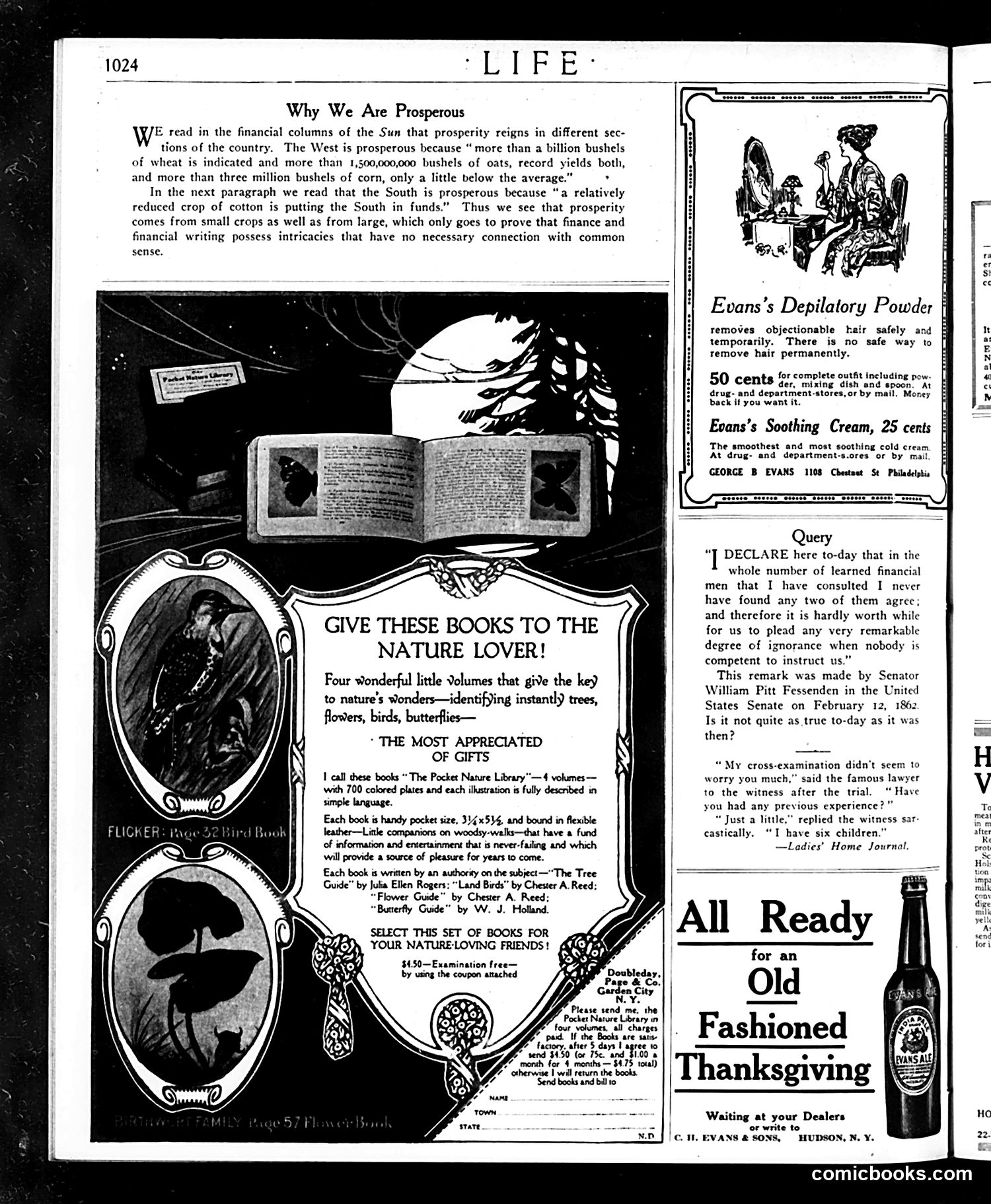
**Main Editorial Satire ("Why We Are Prosperous"):** This piece satirizes contradictory financial reporting. The text mocks newspapers claiming the West prospers from *large* crops (billion bushels of wheat/oats) while simultaneously reporting the South prospers from *reduced* cotton crops. The satire's point: financial writers employ circular logic disconnected from common sense—prosperity apparently springs from both abundance AND scarcity, revealing that financial journalism is inherently nonsensical. The accompanying Senator Fessenden quote (1862) drives home the satire: even learned financial experts never agree, so ordinary people shouldn't feel ignorant when "nobody is competent to instruct us." **Advertisements:** The page is largely ads (nature books, depilatory powder, soothing cream, Thanksgiving beverages)—typical for Life magazine, which balanced editorial content with commercial revenue.
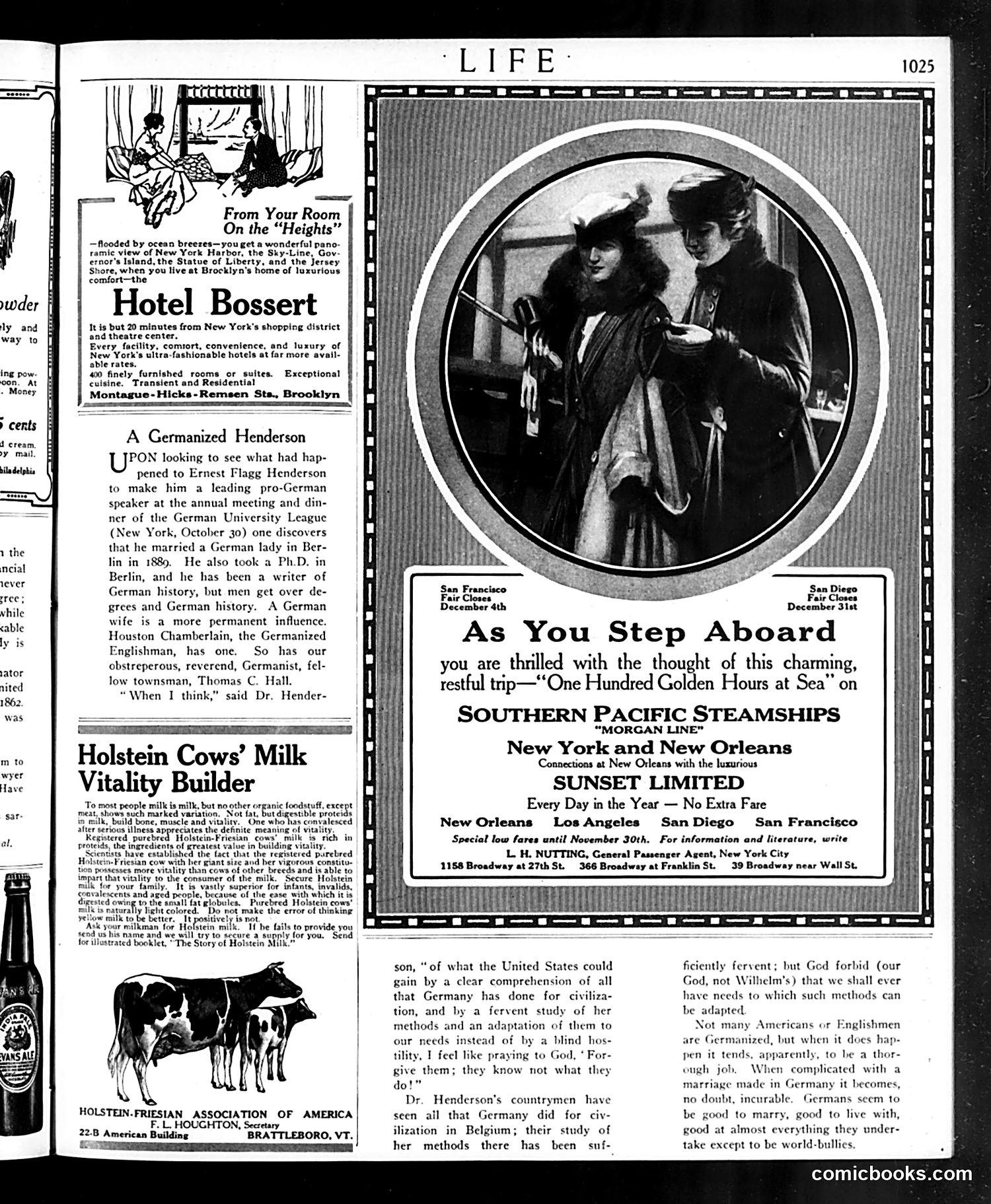
This article satirizes Ernest Flagg Henderson, a pro-German speaker at a 1920s German University League event in New York. The piece argues that Henderson's pro-German sympathies stem from his 1889 marriage to a German woman and his German education—suggesting foreign influence corrupts American judgment. The satire is pointed: Henderson is quoted praising Germany's "civilization" and advocating American adoption of German methods. The author's rebuttal is cutting—referencing Germany's conduct in Belgium (WWI atrocities), they argue Americans need never adopt such "methods." The broader context: This reflects post-WWI American suspicion of "Germanization" and immigrant loyalty. The piece suggests that marrying a German woman and studying in Germany makes one permanently pro-German, implying that such foreign ties render Americans unreliable patriots. This reflects 1920s anxiety about divided loyalties among hyphenated Americans.
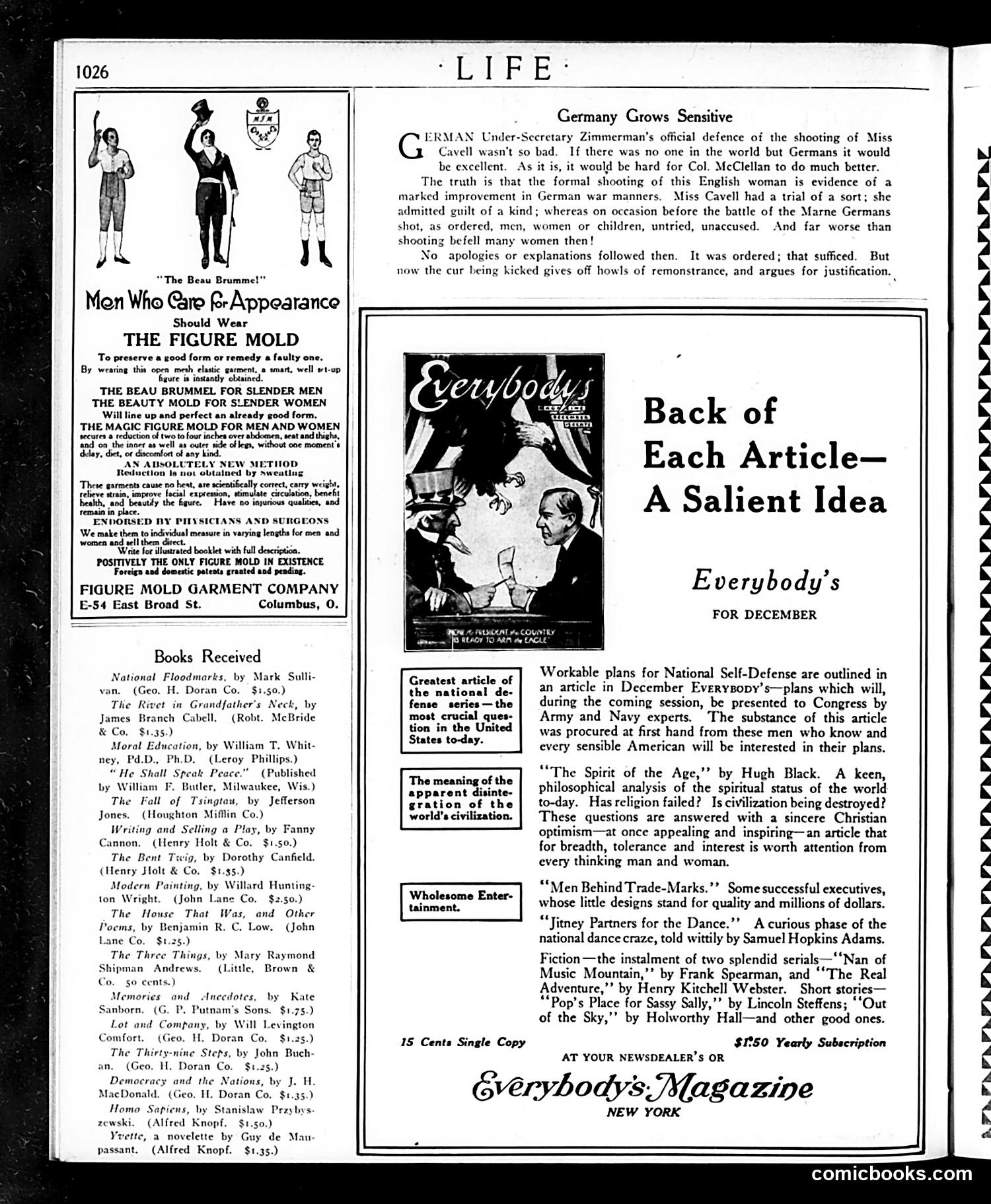
This page contains editorial commentary on Germany's conduct during World War I. The main article, "Germany Grows Sensitive," criticizes Germany's defensive response to international outcry over the execution of Edith Cavell, a British nurse shot by German forces. The satirical point: Life argues that Germany's *apology* for Cavell's shooting actually represents "marked improvement" in German war manners—implying German conduct had been far worse previously. The article sarcastically notes that before the Battle of the Marne, Germans killed civilians without trial or explanation. Now Germany offers justifications, which Life mocks as hypocritical—comparing Germany to "the cur being kicked" that "gives off howls of remonstrance." The left side advertises "Figure Mold" corsets for appearance-conscious men, and lists recently published books.

This is **not a political cartoon or satire**, but rather a **straightforward advertisement** for Willard Storage Batteries, disguised as editorial content in Life magazine. The image shows two men in a service station examining a car battery—likely a salesman or technician (seated) and a customer (standing). The "joke" in the headline—"How Long Should a Storage Battery Last? That's up to you!"—is a rhetorical selling point, not satire. The ad argues that battery longevity depends on proper maintenance and quality construction. It emphasizes that Willard batteries are used by "over 140 car builders" and maintains a nationwide service network to support customers. The text reassures readers that regular inspection at Willard service stations will prolong battery life. This represents early 20th-century **advertorial** practices—commercial messaging presented in the style of magazine editorial content to appear more credible and less promotional.
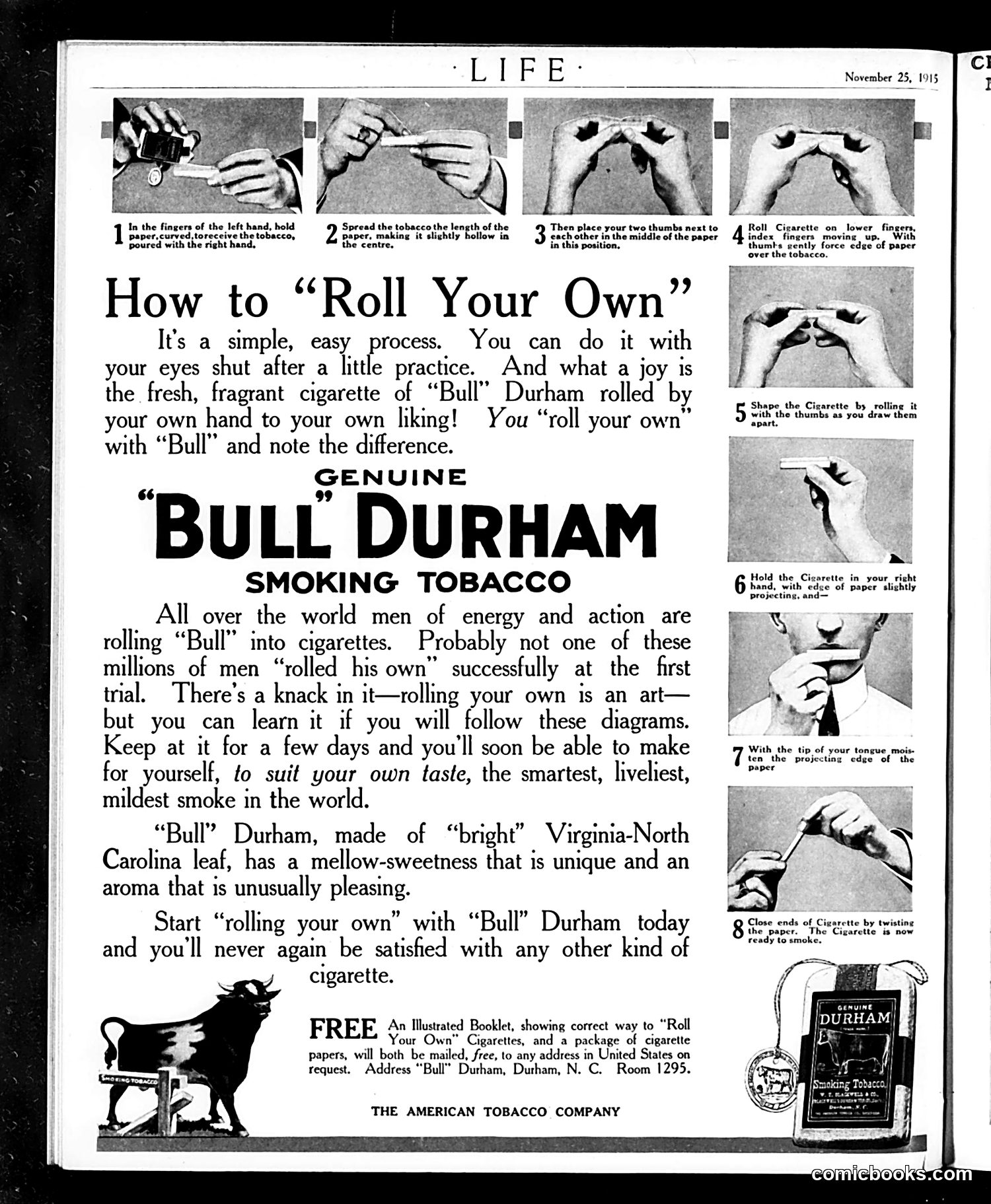
This is a **straightforward advertisement, not satire**—a 1915 Bull Durham tobacco ad teaching readers how to roll hand-made cigarettes. The page contains eight instructional photographs demonstrating rolling technique, alongside marketing text claiming that "rolling your own" cigarettes is an art requiring practice but yields superior flavor. The ad targets "men of energy and action," appealing to self-sufficiency and taste customization. By modern standards, the content is remarkable for its **candid health indifference**—enthusiastically promoting cigarette consumption without any health warnings (which wouldn't be required until decades later). The "Bull" bull logo appears as the company's mascot. The offer of free instructional booklets and rolling papers was typical early-20th-century direct marketing. This represents pre-regulation tobacco advertising, when manufacturers openly encouraged consumption as a desirable lifestyle choice.