
Life, 1915-11-25 · page 25 of 44
Life — November 25, 1915 — page 25: what you’re looking at
What you’re looking at
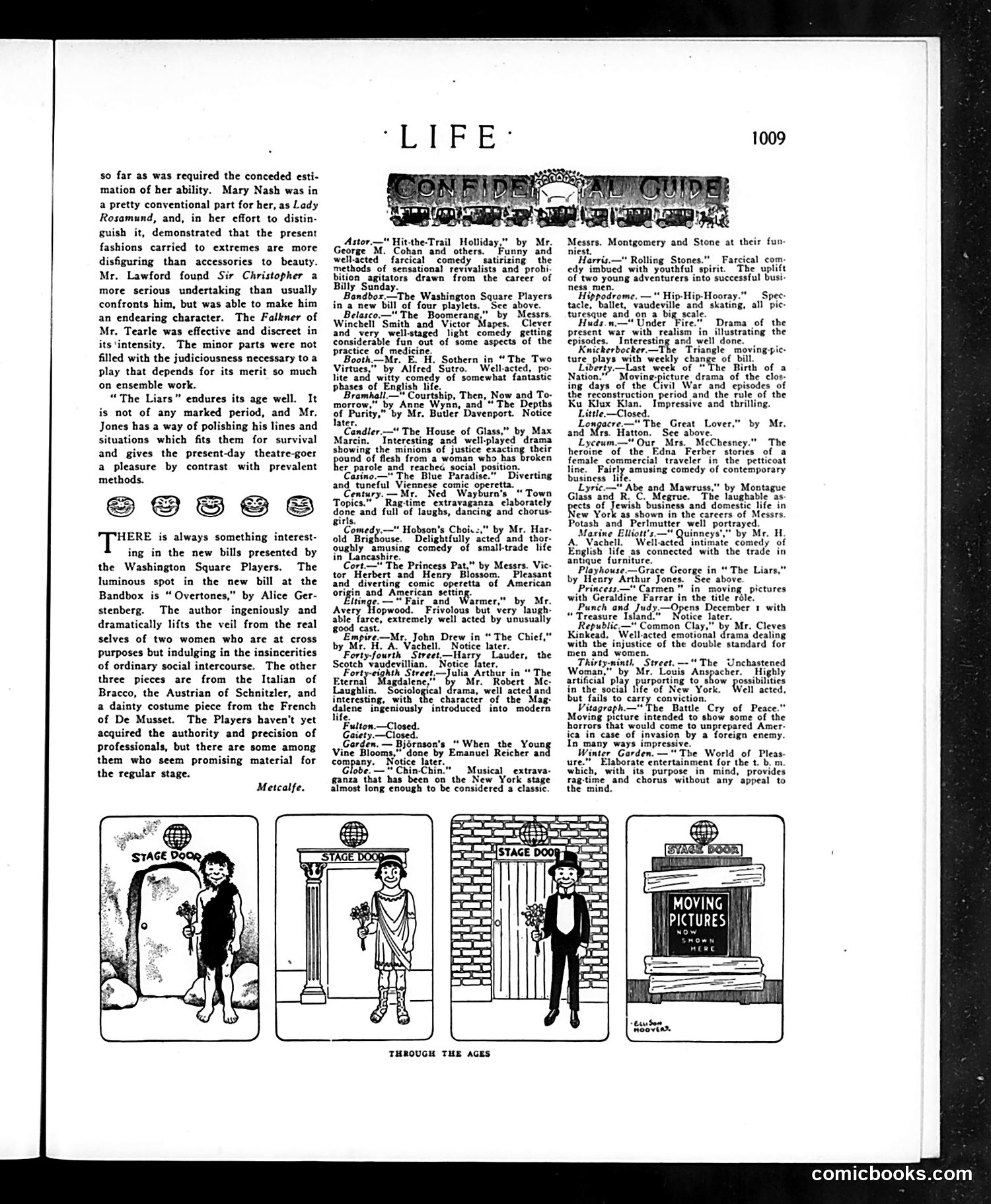
This page is primarily **theater criticism**, not political satire. It reviews current Broadway productions from what appears to be the early 1910s. The four small illustrations at the bottom labeled "THROUGH THE AGES" are decorative vignettes showing theatrical stage doors across different historical periods—not satirical commentary. They humorously depict how theater entrances have evolved from ancient/classical times through to modern "Moving Pictures." The main text discusses plays like "The Liars," "Overtones" (by Alice Gerstenberg), and various comedies and operettas. Notable is a reference to a play satirizing **Billy Sunday**, the famous evangelical revivalist, and **prohibition agitators**—suggesting contemporary social anxieties about religious fervor and temperance reform. The reviews are written by critic **Metcalfe** and focus on theatrical merit: acting quality, script construction, and ensemble work. This is entertainment journalism rather than political cartooning—a straightforward guide for theater-goers about what's playing and whether it's worth seeing.
📄 Transcribed text from this page (OCR, searchable)
Machine-transcribed from the original scan — historical spelling and the odd misread are preserved.
so far as was required the conceded esti- mation of her ability. Mary Nash was in a pretty conventional part for her, as Lady Rosamund, and, in her effort to distin- guish it, demonstrated that the present fashions carried to extremes are more disfiguring than accessories to beauty. Mr. Lawford found Sir Christopher a more serious undertaking than usually confronts him, but was able to make him an endearing character. The Falkner of Mr. Tearle was effective and discreet in its ‘intensity. The minor parts were not filled with the judiciousness necessary to a play that depends for its merit so much ‘on ensemble work. “The Liars” endures its age well. It is not of any marked period, and Mr. Jones has a way of polishing his lines and situations which fits them for survival and gives the present-day theatre-goer a pleasure by contrast with prevalent methods. SSeS8esd HERE is always something interest- ing in the new bills presented by the Washington Square Players. The luminous spot in the new bill at the Bandbox is “ Overtones,” by Alice Ger- stenberg. The author ingeniously and dramatically lifts the veil from the real selves of two women who are at cross purposes but indulging in the insincerities of ordinary social intercourse. The other three pieces are from the Italian of Bracco, the Austrian of Schnitzler, and a dainty costume piece from the French of De Musset. The Players haven't yet acquired the authority and precision of professionals, but there are some among them who seem promising material for the regular stage. Metcalfe. Astor. Holliday,” by Mr. George ‘M. Cohan and others. Funny and well-acted ' farcical comedy satirizing the methods of sensational revivalists and probi. bition agitators drawn from the career of Billy Sunday. Bandbor.—The Washington Square Players new bill of four playlets. See above. Belasco.—""The Boomerang.” by Messrs. Winchell Smith and Victor Mapes. Clever and very well-staged light comedy getting considerable fun out of some aspects of the practice of medicine. . Booth.—Mr. Sothern in “The Two Virtues,” by ‘Alfred’ Sutro. Well-acted, po: lite and witty comedy of somewhat fantastic phases of English life, Bramhall.—" Courtship, Then, Now and To- morrow,” by Anne Wynn, and’ The Depths of Purity,” by Mr. Butler Davenport. Notice ater. dier—" The House of Glass," by Max Marcin, Interesting and well-played drama showing the minions of justice exacting their ound of flesh from a woman who has broken 1er_parole and reachea social position. Casino.—" The Blue Paradise.” Diverting and tuneful Viennese comic operetta. Century.— Mr. Ned Wayburn’s “Town Topics.” Rag-time extravaganza elaborately done and full of laughs, dancing and chorus- girls. Comedy.—" Hobson's Choiv:,"" by Mr. Har- old Brighouse. Delightfully acted and’ thor- oughly amusing comedy of small-trade life in Lancashire. , Cort.—" The Princess Pat,” by Messrs. Vic- tor Herbert and Henry Blossom. Pleasant and diverting comic operetta of American origin and American settin, tiny “Fair and mer,” by Mr. Avery fopwood. Frivolous but very Tau: y able farce, extremely well acted by unusual good cast. Empire—Mr, John Drew in “The Chief,” by Mr. H. A. Vachell. Notice later. Forty-fourth Street,—Harry Lauder, the Scotch vaudevillian, Notice fater. Forty-eighth Street.—Julia Arthur in “ The Eternal Magdalene, Mr. Robert Mc- Sociological drama, well acted and ing, with the character of the Mag- dalene. ingeniously ‘introduced inte modern life, Fulton —Closed. Gaiety.—Closed. jérnson’s “ When the Noung done by Emanuel Reicher an be ‘in-Chin.’ Musical extrava- ganza that has been on the New York stage almost long enough to be considered a classic. Messrs. Montgomery and Stone at their fun: niest. Harris.—" Rolling Stones.” Farcical com: edy imbued with youthful spirit. The uplift of two young adventurers into successful busi- ness men. Hippodrome. —*' Hip-Hip-Hooray.” _ Spec- tacle, ballet, vaudeville and skating, all pic- turesque and on a big scale. Huds.n.—" Under Fire.” Drama of the present war with realism in illustrating the episodes. Interesting and well done. Knickerbocker.—The Triangle moving-pic- ture plays with weekly change of bill. Liberty.—Last week of “The Birth of a Nation.” Movine-picture drama of the clos- ing days of the Civil War and episodes of the reconstruction period and the rule of the Ku Klux Klan, Impressive and thrilling. Little —Closed. Longacre.—" The Great Lover,” by Mr. and Mrs. Hatton. See above. Lyceum.—" Our Mrs. McChesney.” The heroine of the Edna Ferber stories of a female commercial traveler in the petticoat line. Fairly amusing comedy of contemporary business life. Lyric.—" Abe and Mawruss,” by Montague Glass and R. C. Megrue. The laughable as. cts of Jewish business and domestic life in New York as shown in the carcers of Messrs. Potash and Perlmutter well portrayed. Marine Ellign's —" Quinneys'." by Mr. I A. Vachell. Weli-acted intimate comedy of English life as connected with the trade in antique furniture, Playhouse.—Grace George in “ The Liars,” by Henry Arthur Jones, See above. Princess.—" Carmen" in moving pictures with Geraldine Farrar in the title role. Punch and Judy—Opens December 1 with “Treasure Island.” Notice later. epublic—" Common Clay,” by Mr. Cleves Kinkead. Well-acted emotional drama dealing with the injustice of the double standard for men and women. irty-ninth Street. —-" The Unchastened * by Mr. Louis Anspacher. Highly artificial play purporting to show possibilities in the social Ife of New York. Well acted, but fails to carry conviction, Vitagraph—" The Battle Cry of Peace.” Moving picture intended to show some of the horrors that would come to unprepared Amer- ica in case of invasion by a foreign enemy. In many ways impressive. Winter Garden. —" The World of Pleas- ure.” Elaborate entertainment for the t. b. mt which, with its purpose in mind, provides ragtime and chorus without any ‘appeal to the mind. “Cauben Roovew. THROUGH THE AGES comicbooks.com