
Life, 1915-11-25 · page 27 of 44
Life — November 25, 1915 — page 27: what you’re looking at
What you’re looking at
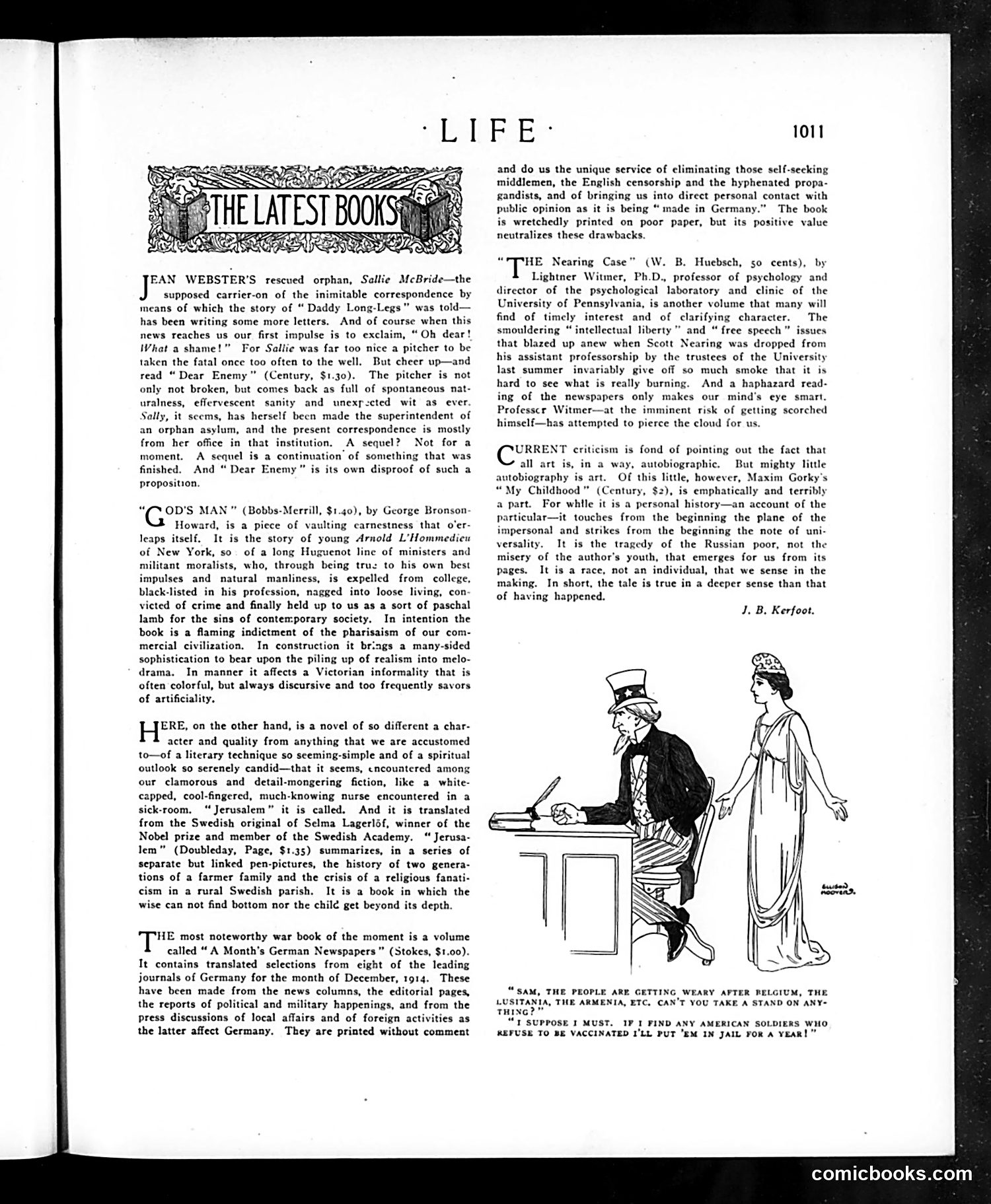
This page reviews contemporary books and includes a cartoon illustrating a wartime disagreement. The cartoon depicts a man (in military/official dress) at a desk speaking with a woman in classical dress, likely representing "America" or a female allegorical figure. The man's dialogue expresses frustration with pacifism and religious objections to military service, declaring he'd imprison American soldiers who refuse vaccination—a reference to conscientious objectors during World War I (America entered in 1917). The joke satirizes the tension between American neutrality/pacifism and pro-war sentiment. The woman's composed demeanor contrasts with the man's heated ultimatum, suggesting the disconnect between idealistic American values and wartime militarism. The book reviews above discuss contemporary novels, including "A Month's German Newspapers," which presents unfiltered German journalism from December 1914—material typically censored by British authorities.
📄 Transcribed text from this page (OCR, searchable)
Machine-transcribed from the original scan — historical spelling and the odd misread are preserved.
“ELE E- EAN WEBSTER'S rescued orphan, Sallie McBride—the J supposed carrier-on of the inimitable correspondence by means of which the story of “ Daddy Long-Legs” was told has been writing some more letters. And of course when this news reaches us our first impulse is to exclaim, “Oh dear! What a shame!” For Sallie was far too nice a pitcher to be taken the fatal once too often to the well. But cheer up—and read “Dear Enemy” (Century, $1.30). The pitcher is not only not broken, but comes back as full of spontaneous nat- uralness, effervescent sanity and unexp-cted wit as ever. Sally, it scems, has herself becn made the superintendent of an orphan asylum, and the present correspondence is mostly from her office in that institution. A sequel? Not for a moment. A sequel is a continuation’ of something that was finished. And ‘ Dear Enemy” is its own disproof of such a proposition. “(XOD'S MAN” (Bobbs-Merrill, $1.40), by George Bronson Howard, is a piece of vaulting carnestness that o’er- leaps itself. It is the story of young Arnold L’Hommedieu of New York, so. of a long Huguenot line of ministers and militant moralists, who, through being trus to his own best impulses and natural manliness, is expelled from college, black-listed in his profession, nagged into loose living, con victed of crime and finally held up to us as a sort of paschal lamb for the sins of contemporary society, In intention the book is a flaming indictment of the pharisaism of our com- mercial civilization. In construction it brings a many-sided sophistication to bear upon the piling up of realism into melo- drama. In manner it affects a Victorian informality that is often colorful, but always discursive and too frequently savors of artificiality. ERE, on the other hand, is a novel of so different a char- acter and quality from anything that we are accustomed to—of a literary technique so seeming-simple and of a spiritual outlook so serenely candid—that it scems, encountered among our clamorous and detail-mongering fiction, like a white- capped, cool-fingered, much-knowing nurse encountered in a sick-room. “ Jerusalem” it is called. And it is translated from the Swedish original of Selma Lagerléf, winner of the Nobel prize and member of the Swedish Academy. “ Jerusa- lem” (Doubleday, Page, $1.35) summarizes, in a series of separate but linked pen-pictures, the history of two genera- tions of a farmer family and the crisis of a religious fanati- cism in a rural Swedish parish. It is a book in which the wise can not find bottom nor the chile get beyond its depth. HE most noteworthy war book of the moment is a volume called “ A Month's German Newspapers ” (Stokes, $1.00). It contains translated selections from eight of the leading journals of Germany for the month of December, 1914. These have been made from the news columns, the editorial pages, the reports of political and military happenings, and from the press discussions of local affairs and of foreign activities as the latter affect Germany. They are printed without comment 1011 and do us the unique service of eliminating those self-secking middlemen, the English censorship and the hyphenated propa- gandists, and of bringing us into direct personal contact with public opinion as it is being “ made in Germany.” The book is wretchedly printed on poor paper, but its positive value neutralizes these drawbacks. i HE Nearing Case” (W. B. Huebsch, so cents), by Lightner Witmer, Ph.D. professor of psychology and director of the psychological laboratory and clinic of the University of Pennsylvania, is another volume that many will find of timely interest and of clarifying character, The smouldering “ intellectual liberty” and “free speech” issues that blazed up anew when Scott Nearing was dropped from his assistant professorship by the trustees of the University last summer invariably give off so much smoke that it is hard to see what is really burning. And a haphazard read- ing of the newspapers only makes our mind’s eye smart. Professcr Witmer—at the imminent risk of getting scorched himself—has attempted to pierce the cloud for us. URRENT criticism is fond of pointing out the fact that all art is, in a way, autobiographic. But mighty little autobiography is art. Of this little, however, Maxim Gorky’s “My Childhood” (Century, $2), is emphatically and terribly a part. For while it is a personal history—an account of the particular—it touches from the beginning the plane of the impersonal and strikes from the beginning the note of uni- versal It is the tragedy of the Russian poor, not the misery of the author's youth, that emerges for us from its pages. It is a race, not an individual, that we sense in the making. In short, the tale is true in a deeper sense than that of having happened. J.B, Kerfoot. “SAM, THE PEOPLE ARE GETTING WEARY APTER RELGIUM, THE LUSITANIA, THE ARMENIA, ETC. CAN'T YOU TAKE A STAND ON ANY- THING?” “1 SUPPOSE I MUST. IF I FIND ANY AMERICAN SOLDIERS WHO REFUSE TO BE VACCINATED I'LL PUT 'EM IN JAIL YOR A YEAR!” comicbooks.com