
Life, 1915-11-25 · page 24 of 44
Life — November 25, 1915 — page 24: what you’re looking at
What you’re looking at
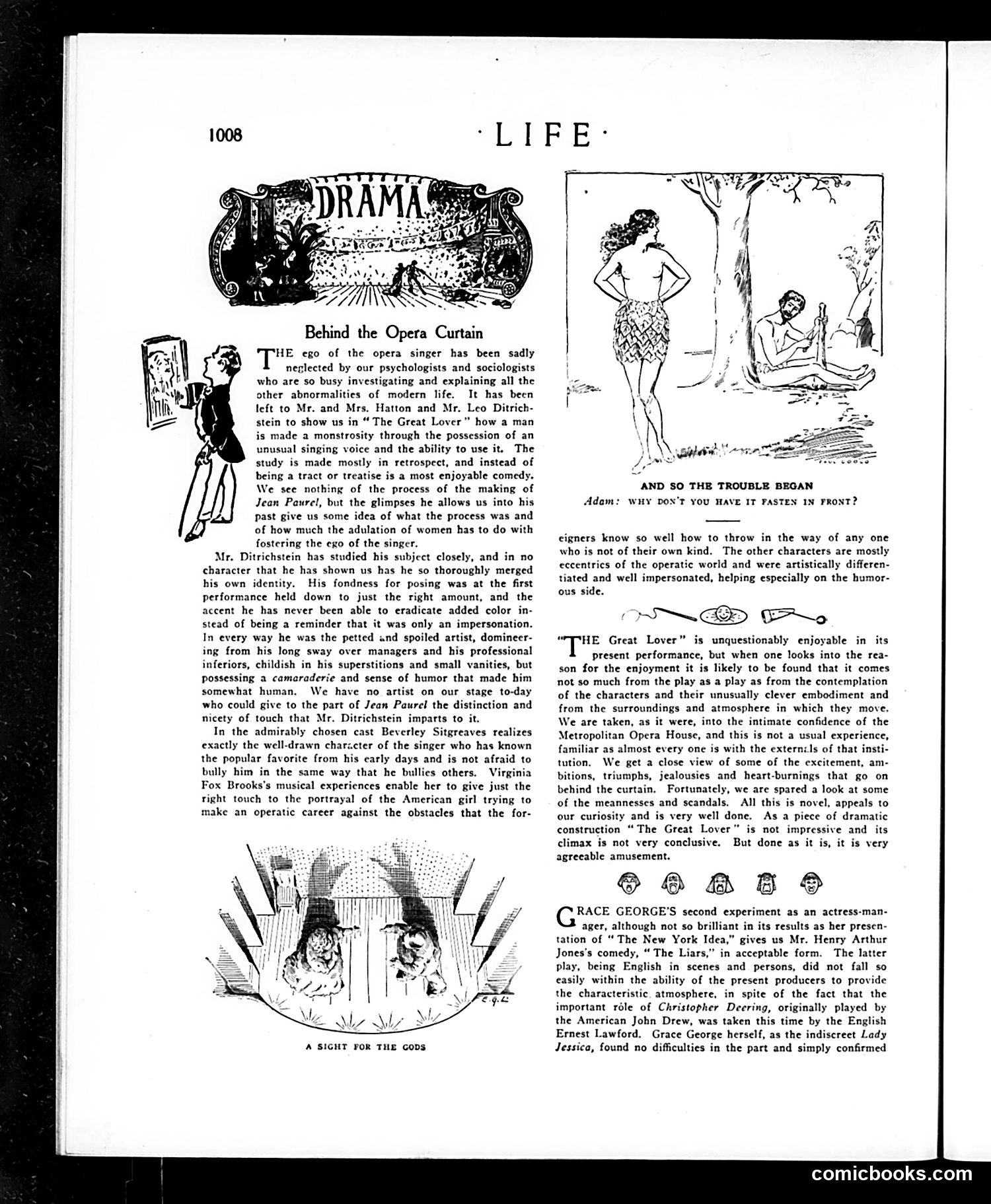
This page reviews "The Great Lover," a stage play starring Leo Ditrichstein about an opera singer whose ego has been corrupted by fame and female admiration. The text praises Ditrichstein's nuanced performance—he has successfully merged his own identity with the character rather than merely impersonating him, avoiding his usual tendency to pose theatrically. The accompanying cartoons satirize operatic excess and vanity. "A Sight for the Gods" depicts the melodramatic self-importance of opera performers. "And So the Trouble Began" shows a barely-clothed woman questioned by Adam about her garment's closure—likely mocking both biblical prudishness and the absurdity of theatrical costume design debates. The review celebrates the play primarily for its backstage glimpses into Metropolitan Opera House intrigue rather than its dramatic construction, finding the character study and atmosphere more compelling than the plot itself.
📄 Transcribed text from this page (OCR, searchable)
Machine-transcribed from the original scan — historical spelling and the odd misread are preserved.
Behind the Opera Curtain HE ego of the opera singer has been sadly neglected by our psychologists and sociologists who are so busy investigating and explaining all the other abnormalities of modern life. It has been left to Mr. and Mrs. Hatton and Mr. Leo Ditrich- stein to show us in “ The Great Lover” how a man is made a monstrosity through the possession of an unusual singing voice and the ability to use it. The study is made mostly in retrospect, and instead of being a tract or treatise is a most enjoyable comedy. We see nothing of the process of the making of Jean Paurel, but the glimpses he allows us into his past give us some idea of what the process was and of how much the adulation of women has to do with fostering the ego of the singer. Mr. Ditrichstein has studied his subject closely, and in no character that he has shown us has he so thoroughly merged his own identity. His fondness for posing was at the first performance held down to just the right amount, and the accent he has never been able to eradicate added color in- stead of being a reminder that it was only an impersonation. In every way he was the petted and spoiled artist, domineer- ing from his long sway over managers and his professional inferiors, childish in his superstitions and small vanities, but possessing a camaraderie and sense of humor that made him somewhat human. We have no artist on our stage to-day who could give to the part of Jean Paurel the distinction and nicety of touch that Mr. Ditrichstein imparts to it. In the admirably chosen cast Beverley Sitgreaves realizes exactly the well-drawn character of the singer who has known the popular favorite from his early days and is not afraid to bully him in the same way that he bullies others. Virginia Fox Brooks's musical experiences enable her to give just the right touch to the portrayal of the American girl trying to make an operatic career against the obstacles that the for- A SIGHT FOR THE cops AND SO THE TROUBLE BEGAN Adam: WHY DON’T YOU HAVE IT FASTEN IN FRONT? cigners know so well how to throw in the way of any one who is not of their own kind. The other characters are mostly eccentrics of the operatic world and were artistically differen- tiated and well impersonated, helping especially on the humor- ous side. OS™ ED F~o “TTHE Great Lover” is unquestionably enjoyable in its present performance, but when one looks into the rea- son for the enjoyment it is likely to be found that it comes not so much from the play as a play as from the contemplation of the characters and their unusually clever embodiment and from the surroundings and atmosphere in which they move. We are taken, as it were, into the intimate confidence of the Metropolitan Opera House, and this is not a usual experience, familiar as almost every one is with the externils of that insti- tution. We get a close view of some of the excitement, am- bitions, triumphs, jealousies and heart-burnings that go on behind the curtain, Fortunately, we are spared a look at some of the meannesses and scandals. All this is novel, appeals to our curiosity and is very well done. As a piece of dramatic construction “The Great Lover” is not impressive and its climax is not very conclusive. But done as it is, it is very agreeable amusement. oo @2 B > RACE GEORGE'S second experiment as an actress-man- ager, although not so brilliant in its results as her presen- tation of “The New York Idea,” gives us Mr. Henry Arthur Jones's comedy, “ The Liars,” in acceptable form. The latter play, being English in scenes and persons, did not fall so easily within the ability of the present producers to provide the characteristic. atmosphere, in spite of the fact that the important réle of Christopher Deering, originally played by the American John Drew, was taken this time by the English Ernest Lawford. Grace George herself, as the indiscreet Lady Jessica, found no difficulties in the part and simply confirmed comicbooks.com