
Life, 1915-11-25 · page 4 of 44
Life — November 25, 1915 — page 4: what you’re looking at
What you’re looking at
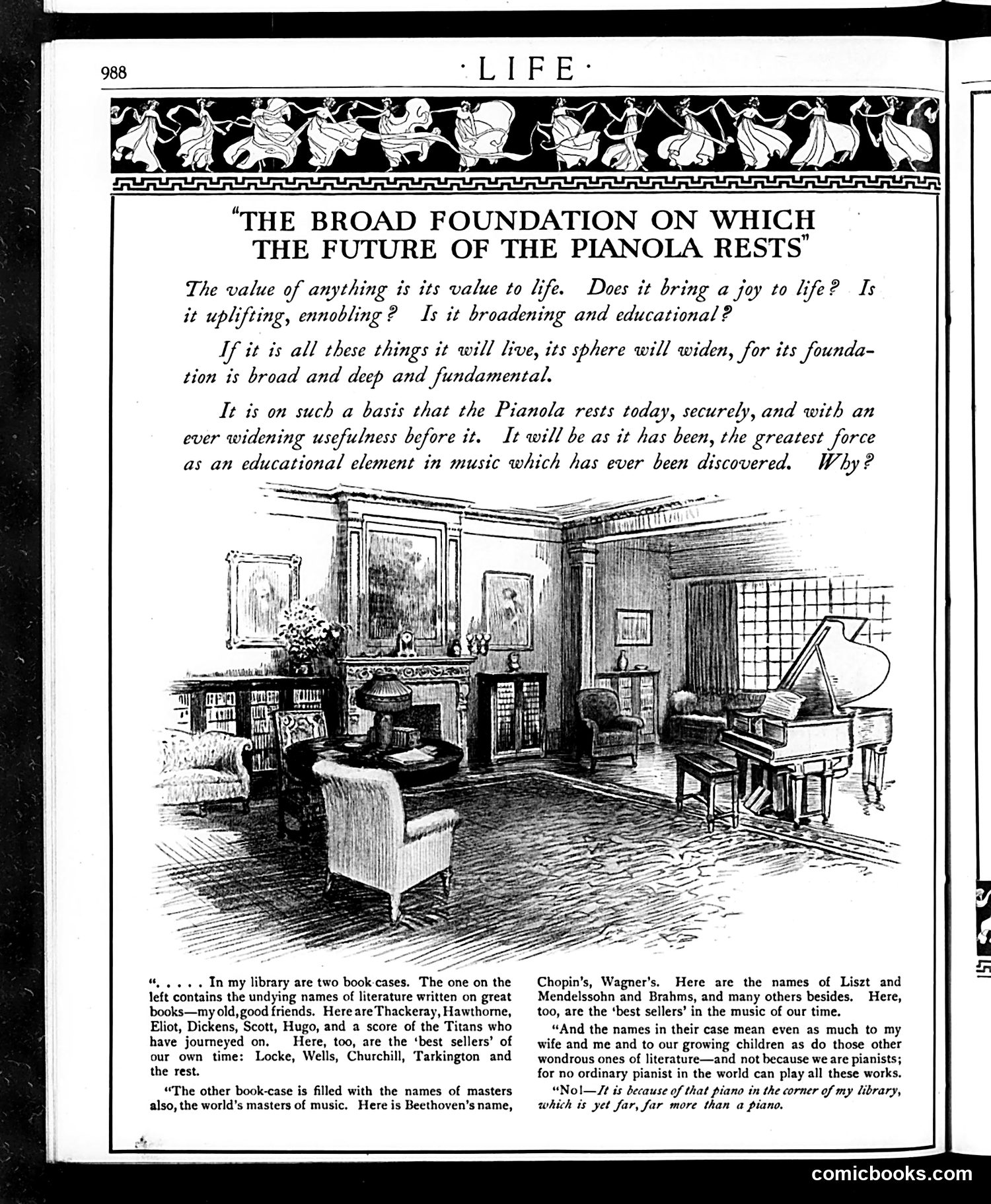
This page is **not a political cartoon** but rather an **advertisement for the Pianola** (an early player piano). The decorative border and interior illustration show an elegant drawing room centered on the instrument. The text argues the Pianola's value rests on being educational and uplifting—bringing joy to life. It claims the device is "the greatest force as an educational element in music which has ever been discovered." The lower section quotes a homeowner praising how the Pianola lets non-musicians access works by great composers (Beethoven, Chopin, Wagner, Liszt, Mendelssohn) without requiring personal skill. The owner compares owning a Pianola to owning a library of the world's greatest literature—presenting it as democratizing access to high culture for ordinary families. This is marketing, not satire.
📄 Transcribed text from this page (OCR, searchable)
Machine-transcribed from the original scan — historical spelling and the odd misread are preserved.
“THE BROAD FOUNDATION ON WHICH THE FUTURE OF THE PIANOLA RESTS’ The value of anything is its value to life. Does it bring a joy to life? Is it uplifting, ennobling ? Is it broadening and educational? Uf it is all these things it will live, its sphere will widen, for its founda- tion is broad and deep and fundamental. It is on such a basis that the Pianola rests today, securely, and with an ever widening usefulness before it. It will be as it has been, the greatest force as an educational element in music which has ever been discovered. Why? “, , .. . In my library are two book-cases. The one on the left contains the undying names of literature written on great books—my old, good friends. Here are Thackeray, Hawthorne, Eliot, Dickens, Scott, Hugo, and a score of the Titans who have journeyed on. Here, too, are the ‘best sellers’ of our own time: Locke, Wells, Churchill, Tarkington and the rest. “The other book-case is filled with the names of masters also, the world’s masters of music. Here is Beethoven’s name, Chopin’s, Wagner's. Here are the names of Liszt and Mendelssohn and Brahms, and many others besides. Here, too, are the ‘best sellers’ in the music of our time. “And the names in their case mean even as much to my wife and me and to our growing children as do those other wondrous ones of literature—and not because we are pianists; for no ordinary pianist in the world can play all these works. “Nol—J/t és because of that piano in the corner of my library, which is yet far, far more than a piano. comicbooks.com