
Life, 1915-11-25 · page 17 of 44
Life — November 25, 1915 — page 17: what you’re looking at
What you’re looking at
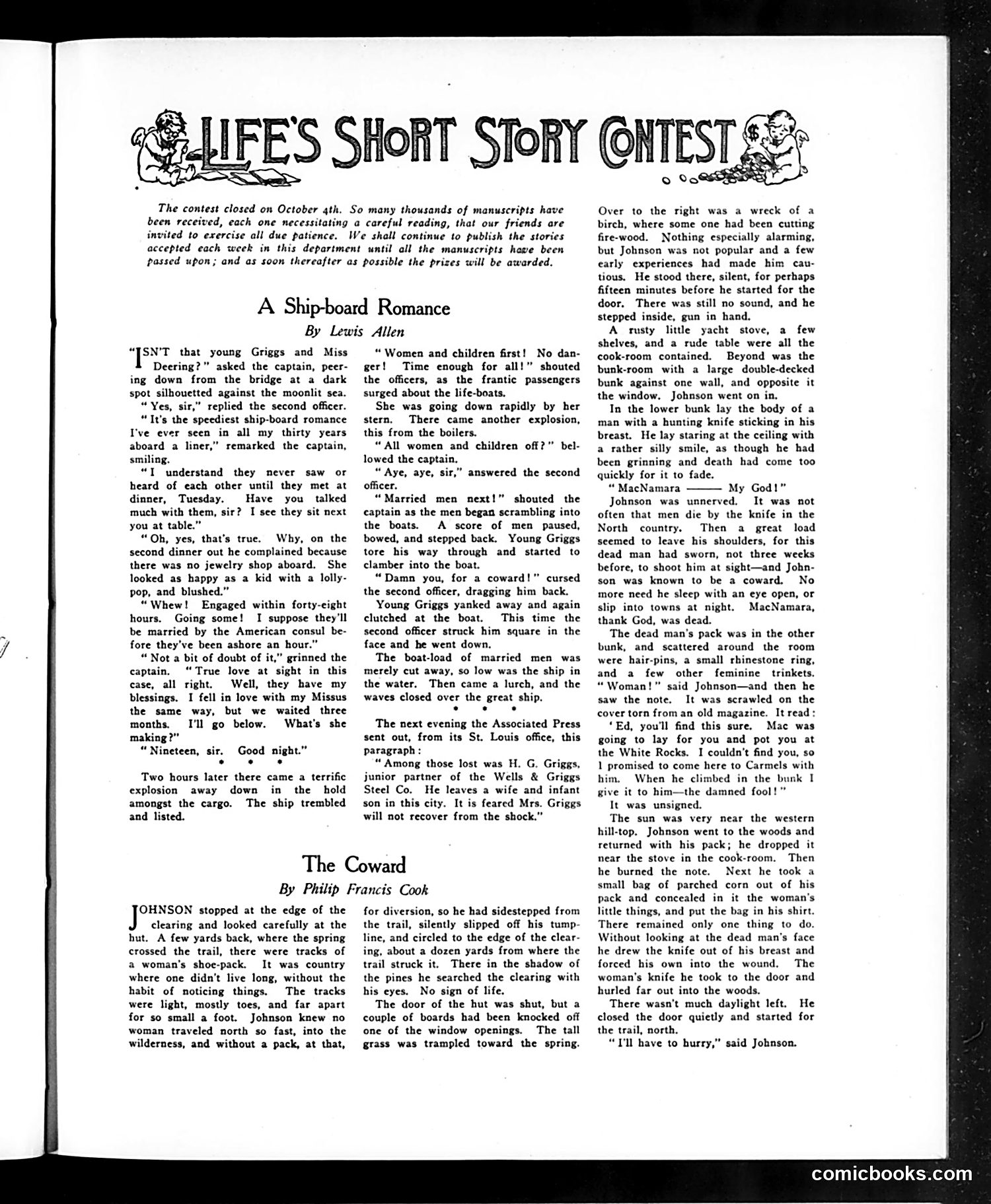
This page presents **two fictional short stories** from Life's contest, not political cartoons or satire. **"A Ship-board Romance"** depicts a sentimental tragedy: Young passengers Griggs and Miss Deering fall in love rapidly aboard ship. When disaster strikes (explosions in cargo and boilers), the captain calls "women and children first," then "married men next." Griggs, unmarried, attempts to board anyway but is beaten back by an officer as a "coward." He perishes when the ship sinks. The story's irony: Griggs dies trying to survive, yet society honors the sacrifice of married men prioritized by the maritime code. **"The Coward"** (incomplete here) appears to be a wilderness survival narrative, following a man named Johnson tracking a woman's footprints into remote northern territory—seemingly a different genre altogether. The page header announces the contest closed October 4th, with winners to be announced after all manuscripts are reviewed. These are reader-submitted stories, not editorial content or satire.
📄 Transcribed text from this page (OCR, searchable)
Machine-transcribed from the original scan — historical spelling and the odd misread are preserved.
The contest closed on October 4th. So many thousands of manuscripts have been received, each one necessitating a careful reading, that our friends are invited to exercise all due patience. We shall continue to publish the stories accepted each week in this department until all the manuscripts hawe been passed upon; and as soon thereafter as possible the prizes will be awarded. A Ship-board Romance By Lewis Allen “ISN'T that young Griggs and Miss Deering?” asked the captain, peer- ing down from the bridge at a dark spot silhouetted against the moonlit sea. “Yes, sir,” replied the second officer. “It's the speediest ship-board romance I've ever seen in all my thirty years aboard a liner,” remarked the captain, smiling. “I understand they never saw or heard of each other until they met at dinner, Tuesday. Have you talked much with them, sir? I see they sit next you at table.” “Oh, yes, that’s true. Why, on the second dinner out he complained because there was no jewelry shop aboard. She looked as happy as a kid with a lolly- pop, and blushed.” “Whew! Engaged within forty-eight hours. Going some! I suppose they'll be married by the American consul be- fore they've been ashore an hour.” “Not a bit of doubt of it,” grinned the captain. ‘True love at sight in this case, all right. Well, they have my blessings. I fell in love with my Missus the same way, but we waited three months. I'll go below. What's she making?” “Nineteen, sir. Good night.” oe Two hours later there came a terrific explosion away down in the hold amongst the cargo. The ship trembled and listed. “Women and children first! No dan- ger! Time enough for all!” shouted the officers, as the frantic passengers surged about the life-boats, She was going down rapidly by her stern, There came another explosion, this from the boilers. “All women and children off?" bel- lowed the capta: “ Aye, aye, 5i officer, “Married men next!” shouted the captain as the men began scrambling into the boats. A score of men paused, bowed, and stepped back. Young Griggs tore his way through and started to clamber into the boat. “Damn you, for a coward!" cursed the second officer, dragging him back. Young Griggs yanked away and again clutched at the boat. This time the second officer struck him square in the face and he went down, The boat-load of married men was merely cut away, so low was the ship in the water. Then came a lurch, and the waves closed over the great ship. oe e answered the second The next evening the Associated Press sent out, from its St. Louis office, this Paragraph: “ Among those lost was H. G. Griggs, junior partner of the Wells & Griggs Steel Co. He leaves a wife and infant son in this city. It is feared Mrs. Griggs will not recover from the shock.” The Coward By Philip Francis Cook OHNSON stopped at the edge of the clearing and looked carefully at the hut. A few yards back, where the spring crossed the trail, there were tracks of a woman's shoe-pack. It was country where one didn't live long, without the habit of noticing things. The tracks were light, mostly toes, and far apart for so small a foot. Johnson knew no woman traveled north so fast, into the wilderness, and without a pack, at that, for diversion, so he had sidestepped from the trail, silently slipped off his tump- line, and circled to the edge of the clear- ing, about a dozen yards from where the trail struck it. There in the shadow of the pines he searched the clearing with his eyes. No sign of life. The door of the hut was shut, but a couple of boards had been knocked off one of the window openings. The tall grass was trampled toward the spring. S Over to the right was a wreck of a birch, where some one had been cutting fire-wood. Nothing especially alarming, but Johnson was not popular and a few early experiences had made him cau- tious. He stood there, silent, for perhaps fifteen minutes before he started for the door. There was still no sound, and he stepped inside, gun in hand. A rusty little yacht stove, a few shelves, and a rude table were all the cook-room contained. Beyond was the bunk-room with a large double-decked bunk against one wall, and opposite it the window. Johnson went on in. In the lower bunk lay the body of a man with a hunting knife sticking in his breast. He lay staring at the ceiling with a rather silly smile, as though he had been grinning and death had come too quickly for it to fade. “ MacNamara My God!” Johnson was unnerved. It was not often that men die by the knife in the North country. Then a great load seemed to leave his shoulders, for this dead man had sworn, not three weeks before, to shoot him at sight—and John- son was known to be a coward. No more need he sleep with an eye open, or slip into towns at night. MacNamara, thank God, was dead. The dead man’s pack was in the other bunk, and scattered around the room were hair-pins, a small rhinestone ring, and a few other feminine trinkets. “Woman!” said Johnson—and then he saw the note. It was scrawled on the cover torn from an old magazine. It read: ‘Ed, you'll find this sure, Mac was going to lay for you and pot you at the White Rocks. I couldn't find you, so 1 promised to come here to Carmels him. When he climbed in the bunk I give it to him—the damned fool!” It was unsigned. The sun was very near the western hill-top. Johnson went to the woods and returned with his pack; he dropped it near the stove in the cook-room. Then he burned the note. Next he took a small bag of parched corn out of his pack and concealed in it the woman's little things, and put the bag in his shirt. There remained only one thing to do. Without looking at the dead man’s face he drew the knife out of his breast and forced his own into the wound. The woman's knife he took to the door and hurled far out into the woods. There wasn't much daylight left. He closed the door quietly and started for the trail, north. “T'll have to hurry,” said Johnson. comicbooks.com