
Life, 1915-11-25 · page 20 of 44
Life — November 25, 1915 — page 20: what you’re looking at
What you’re looking at
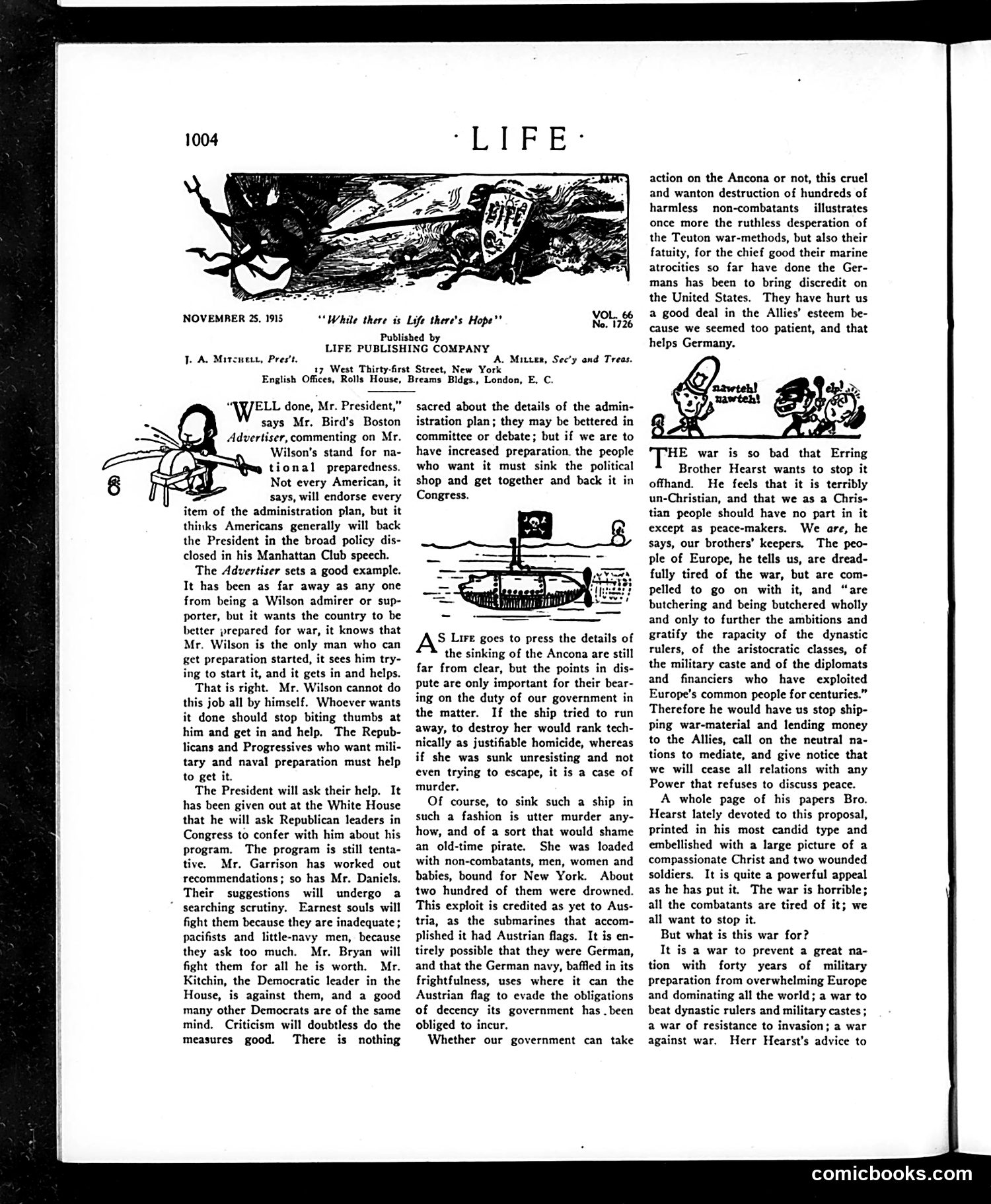
This page addresses American military preparedness and the sinking of the RMS Ancona, a passenger ship torpedoed by Austrian (possibly German) submarines. **Main Editorial Points:** The lead article praises President Wilson's call for national defense preparation, urging Republicans and Democrats to support military expansion despite political disagreements. It notably credits the Boston Advertiser—previously a Wilson critic—for setting an example by backing the President's defense policy. **The Ancona Incident:** Life condemns the submarine sinking of the Ancona, which killed approximately 200 non-combatants (women, children, civilians). The editorial distinguishes between sinking a fleeing ship (potentially justifiable) versus destroying an unresisting vessel (murder). Life suggests Germany may have used Austrian flags to evade responsibility. **Political Context:** The page references Secretary of War Garrison, Secretary of Navy Daniels, and Democratic congressman Kitchin, who opposed preparedness measures. William Jennings Bryan (mentioned as opposing increased military spending) represents the pacifist faction. The cartoons (though small and unclear) appear to mock political opposition to preparedness, typical of Life's satirical approach.
📄 Transcribed text from this page (OCR, searchable)
Machine-transcribed from the original scan — historical spelling and the odd misread are preserved.
NOVEMBER 25. 1915 “While there is Life there's Hope"' Published by LIFE PUBLISHING COMPANY 1. A. Mircnent, Pres’t, A. Mittes, Sec’y and Treas. 7 West Thirty-first Street, New York English Offices, Rolls House, Breams Bldgs., London, E. C. ELL done, Mr. President,” says Mr. Bird’s Boston Advertiser, commenting on Mr. Wilson's stand for na- tional preparedness. Not every American, it says, will endorse every item of the administration plan, but it thinks Americans generally will back the President in the broad policy dis- closed in his Manhattan Club speech. The Advertiser sets a good example. It has been as far away as any one from being a Wilson admirer or sup- porter, but it wants the country to be better prepared for war, it knows that Mr. Wilson is the only man who can get preparation started, it sees him try- ing to start it, and it gets in and helps. That is right. Mr. Wilson cannot do this job all by himself. Whoever wants it done should stop biting thumbs at him and get in and help. The Repub- licans and Progressives who want mili- tary and naval preparation must help to get it. The President will ask their help. It has been given out at the White House that he will ask Republican leaders in Congress to confer with him about his program. The program is still tenta- tive. Mr. Garrison has worked out recommendations; so has Mr. Daniels. Their suggestions will undergo a searching scrutiny. Earnest souls will fight them because they are inadequate ; pacifists and little-navy men, because they ask too much. Mr. Bryan will fight them for all he is worth. Mr. Kitchin, the Democratic leader in the House, is against them, and a good many other Democrats are of the same mind. Criticism will doubtless do the measures good. There is nothing sacred about the details of the admin- istration plan; they may be bettered in committee or debate; but if we are to have increased preparation. the people who want it must sink the political shop and get together and back it in Congress. S Lire goes to press the details of the sinking of the Ancona are still far from clear, but the points in dis- pute are only important for their bear- ing on the duty of our government in the matter. If the ship tried to run away, to destroy her would rank tech- nically as justifiable homicide, whereas if she was sunk unresisting and not even trying to escape, it is a case of murder, Of course, to sink such a ship in such a fashion is utter murder any- how, and of a sort that would shame an old-time pirate. She was loaded with non-combatants, men, women and babies, bound for New York. About two hundred of them were drowned. This exploit is credited as yet to Aus- tria, as the submarines that accom- plished it had Austrian flags. It is en- tirely possible that they were German, and that the German navy, baffled in its frightfulness, uses where it can the Austrian flag to evade the obligations of decency its government has . been obliged to incur. Whether our government can take action on the Ancona or not, this cruel and wanton destruction of hundreds of harmless non-combatants _ illustrates once more the ruthless desperation of the Teuton war-methods, but also their fatuity, for the chief good their marine atrocities so far have done the Ger- mans has been to bring discredit on the United States. They have hurt us a good deal in the Allies’ esteem be- cause we seemed too patient, and that helps Germany. 'HE war is so bad that Erring Brother Hearst wants to stop it offhand. He feels that it is terribly un-Christian, and that we as a Chris- tian people should have no part in it except as peace-makers. We are, he says, our brothers’ keepers, The peo- ple of Europe, he tells us, are dread- fully tired of the war, but are com- pelled to go on with it, and “are butchering and being butchered wholly and only to further the ambitions and gratify the rapacity of the dynastic rulers, of the aristocratic classes, of the military caste and of the diplomats and financiers who have exploited Europe’s common people for centuries.” Therefore he would have us stop ship- ping war-material and lending money to the Allies, call on the neutral na- tions to mediate, and give notice that we will cease all relations with any Power that refuses to discuss peace. A whole page of his papers Bro. Hearst lately devoted to this proposal, printed in his most candid type and embellished with a large picture of a compassionate Christ and two wounded soldiers, It is quite a powerful appeal as he has put it. The war is horrible; all the combatants are tired of it; we all want to stop it. But what is this war for? It is a war to prevent a great na- tion with forty years of military preparation from overwhelming Europe and dominating all the world; a war to beat dynastic rulers and military castes ; a war of resistance to invasion; a war against war. Herr Hearst’s advice to comicbooks.com