
A complete issue · 44 pages · 1915
Life — November 11, 1915
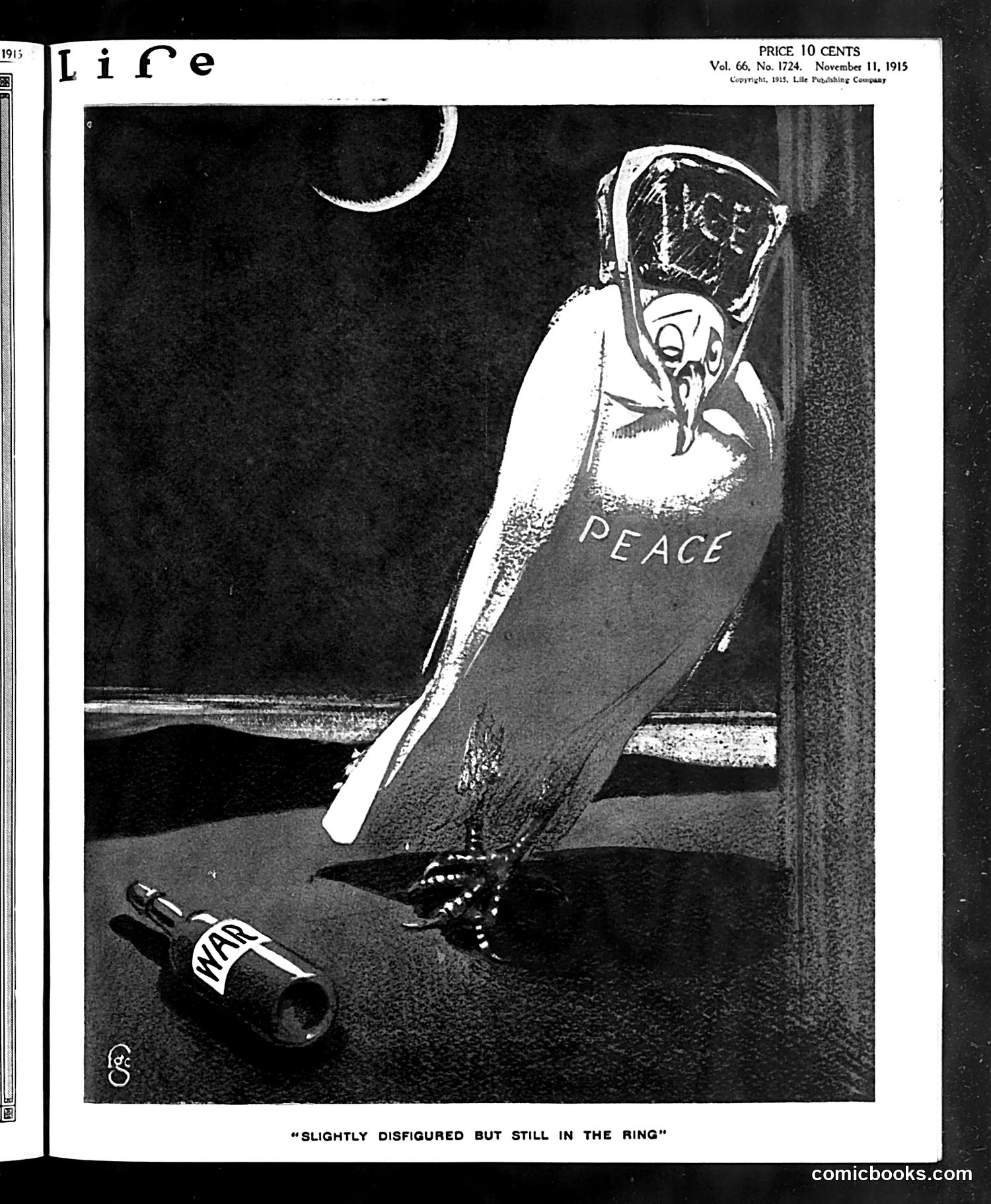
This political cartoon depicts **Peace as a wounded, bandaged figure** sitting in a boxing ring, labeled "PEACE" on its robe. The figure appears bruised and damaged, with a crescent moon visible above—suggesting nighttime or darkness. A champagne bottle labeled "WAR" lies on the ground nearby, suggesting intoxication or recklessness fueling conflict. The caption reads: **"SLIGHTLY DISFIGURED BUT STILL IN THE RING"** **Context:** Published in November 1915, during World War I (which began in 1914), this cartoon satirizes the state of international peace efforts. It suggests that despite the devastating war raging in Europe, peace negotiations continue—though peace itself is badly damaged and compromised by the ongoing violence. The boxing metaphor emphasizes that peace remains "fighting" despite being wounded.
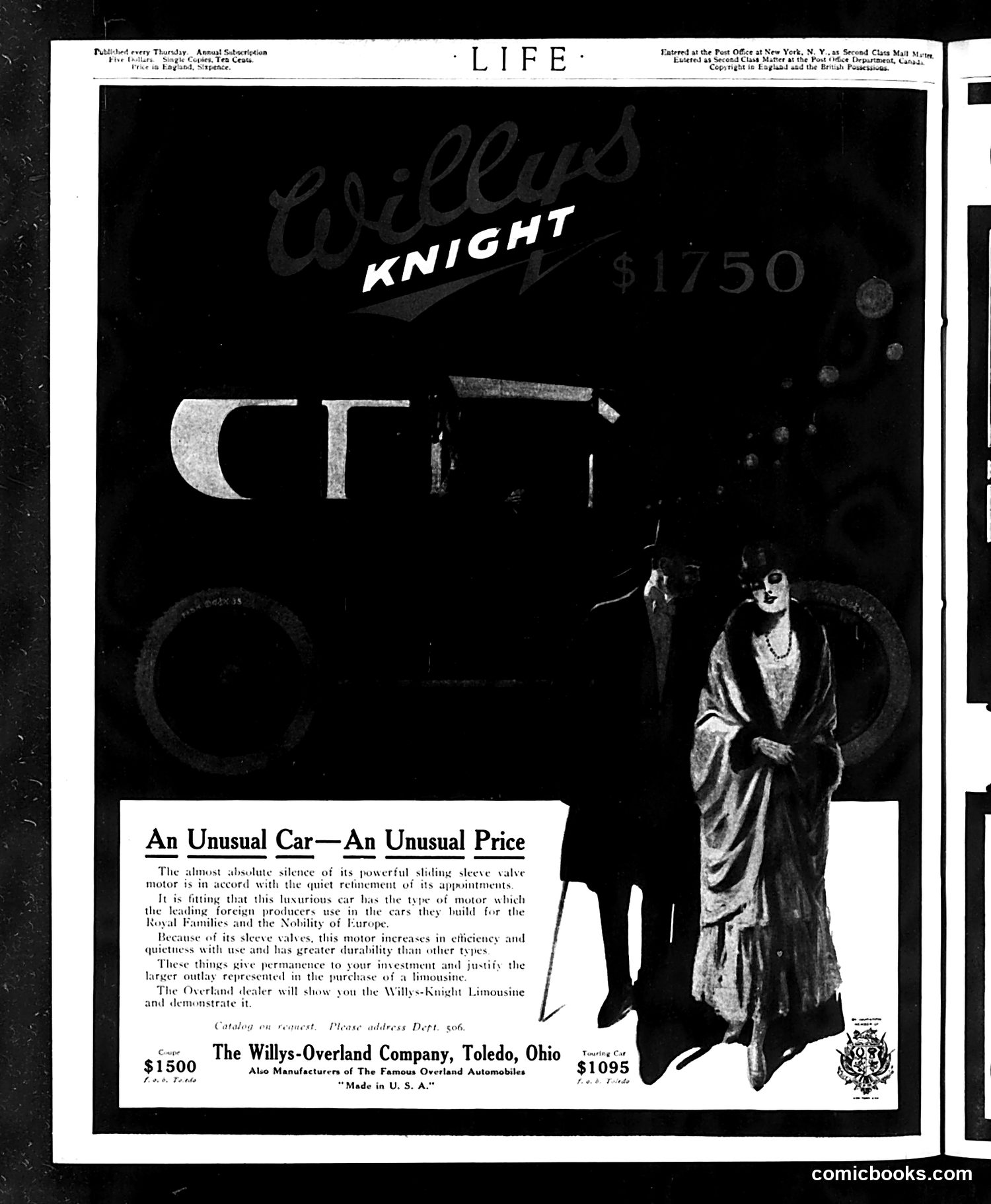
This is primarily an **advertisement**, not political satire. It promotes the Willys-Knight automobile, priced at $1750, marketed as "An Unusual Car—An Unusual Price." The ad emphasizes the car's distinctive sliding sleeve valve motor, claimed to be used by "leading foreign producers" and the "Royal Families and the Nobility of Europe." The illustration shows a wealthy, elegantly dressed woman in fashionable 1920s attire standing beside the vehicle, suggesting luxury and sophistication as selling points. The copy contrasts two prices ($1500 and $1095), likely representing different models. The "Catalog on request" line and manufacturer information (Willys-Overland Company, Toledo, Ohio) confirm this is straightforward commercial marketing rather than political commentary.
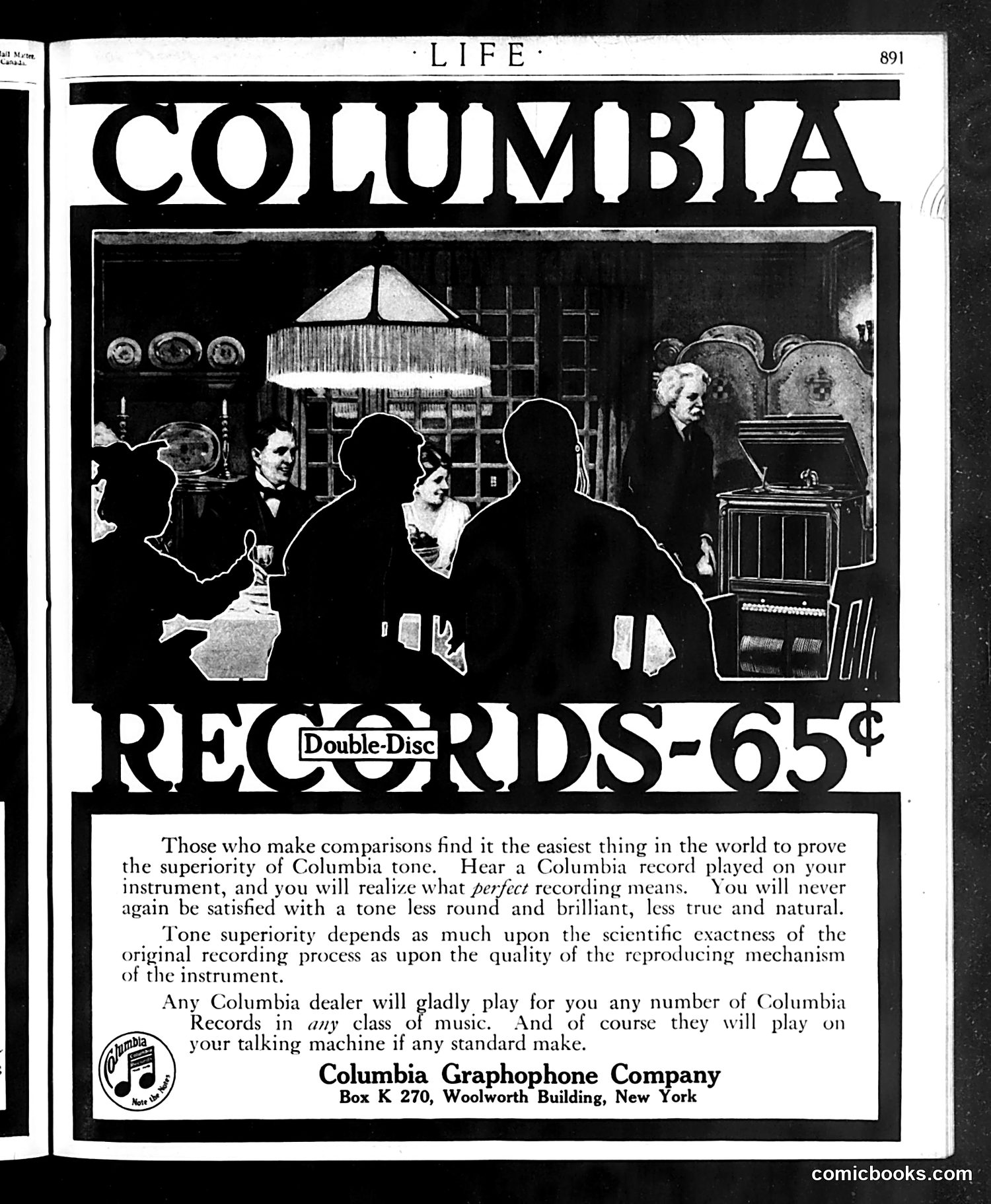
This page is primarily an advertisement for Columbia Records, priced at 65 cents for double-disc sets. The image shows an elegant early 20th-century parlor scene with well-dressed people gathered around a gramophone. The ad's main argument concerns **tone quality**: Columbia claims superiority through scientific precision in both recording and reproduction. The text emphasizes that listeners comparing records will recognize Columbia's "perfect recording means" produces sound that is "round and brilliant, less true and natural" than competitors. The advertisement addresses the competitive market for phonograph records and the emerging consumer preference for high-fidelity sound reproduction. The fashionable setting suggests Columbia targeted affluent, cultured audiences. This reflects the early gramophone era when recorded music was a luxury product and home listening was a status symbol.
This page is a **Christmas gift subscription pitch** for *Life* magazine, not a political cartoon. The "Second Call" headline announces an early holiday campaign to encourage readers to give *Life* subscriptions as presents. The satire is subtle: the text contrasts *Life*'s eagerness to profit from the holiday season against the business department's usual restraint about such promotions. The phrase "Obey That Impulse" humorously frames gift-giving as inevitable impulse-buying rather than thoughtful giving. The decorative border features Christmas imagery (sleigh, snowman, carolers, children playing) typical of period holiday advertising. The subscription cost was $5 yearly ($5.52 Canadian, $6.04 foreign). The satirical point: even a respectable magazine will abandon propriety for Christmas commerce.
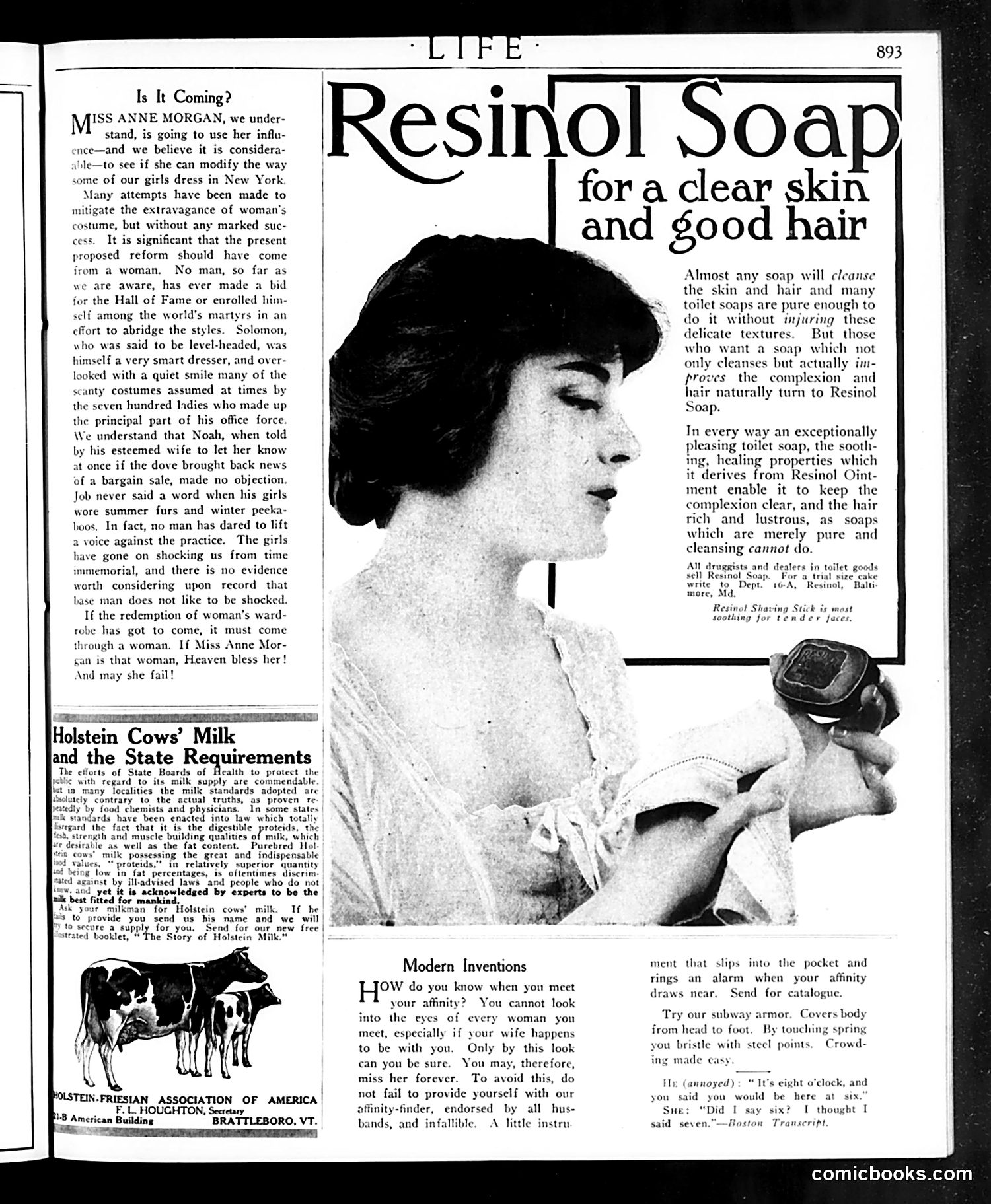
This page is primarily **advertising**, not political satire or comics. The main content features a **Resinol Soap advertisement** (center-right) with a photograph of a woman's face and neck, promoting the product for clear skin and hair. The ad claims Resinol Ointment helps cleanse complexion and hair naturally. The left column contains an editorial piece titled "Is It Coming?" discussing women's fashion reform, advocating that dress code changes should originate from women themselves. Below that is an advertisement for **Holstein Cows' Milk**, emphasizing state health standards. At the bottom, a brief section called "Modern Inventions" presents an "affinity-finder" device—a humorous gadget supposedly helping people identify potential romantic matches. This appears to be light satirical commentary on courtship technology.
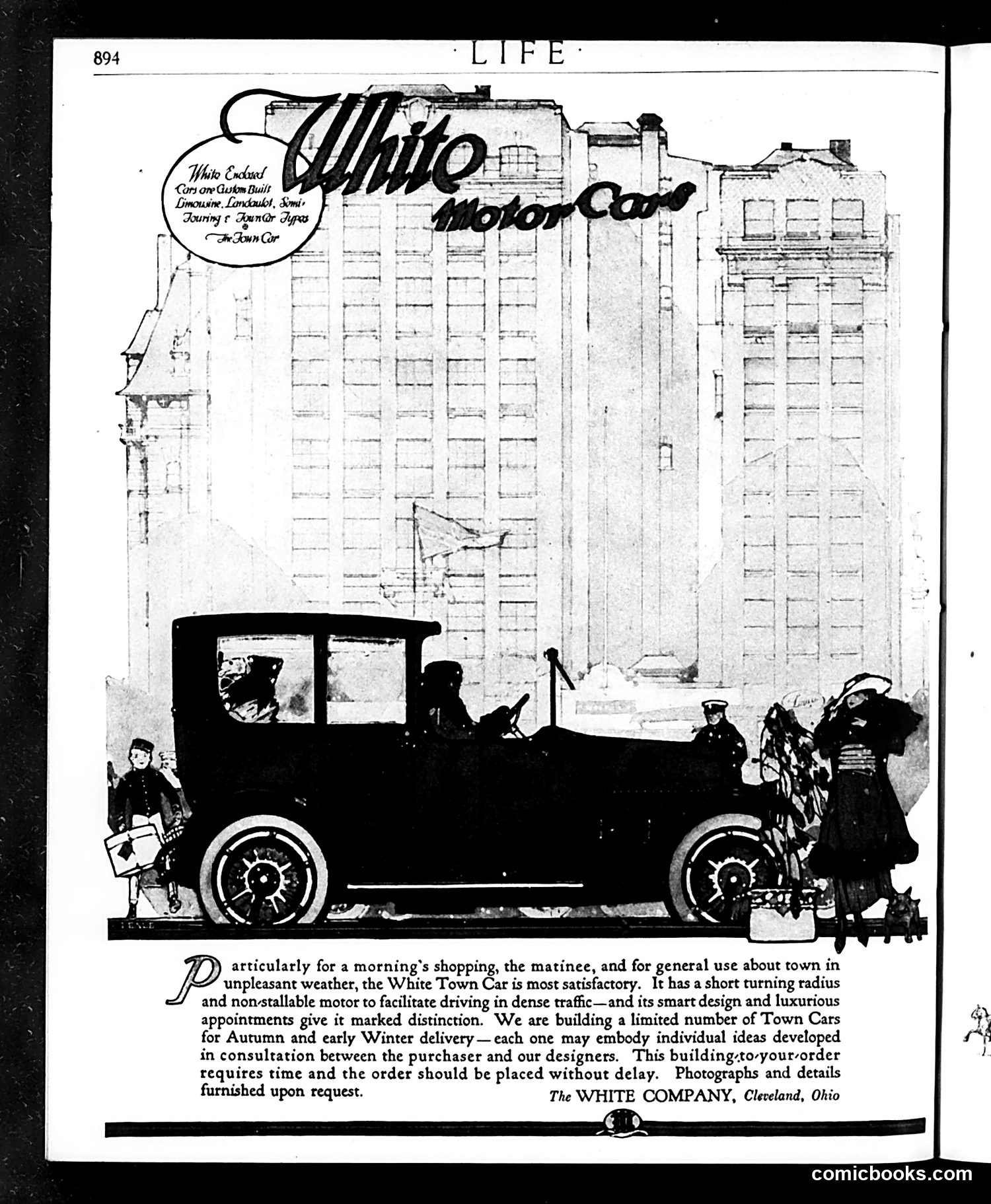
This page is primarily an **automobile advertisement**, not a political cartoon. It advertises the "White Motor Car" manufactured by The White Company of Cleveland, Ohio. The advertisement uses a stylized illustration showing a silhouetted town car (a closed automobile) in front of tall urban buildings. Figures in period dress surround the vehicle, suggesting various uses: shopping, theater attendance, and general urban transportation. The text emphasizes the car's practicality for city use—short turning radius, reliable motor, "smart design and luxurious appointments," and suitability for "unplesant weather." The company notes they're building "a limited number of Town Cars for Autumn and early Winter delivery" and invite custom orders. This is commercial marketing, not satire.
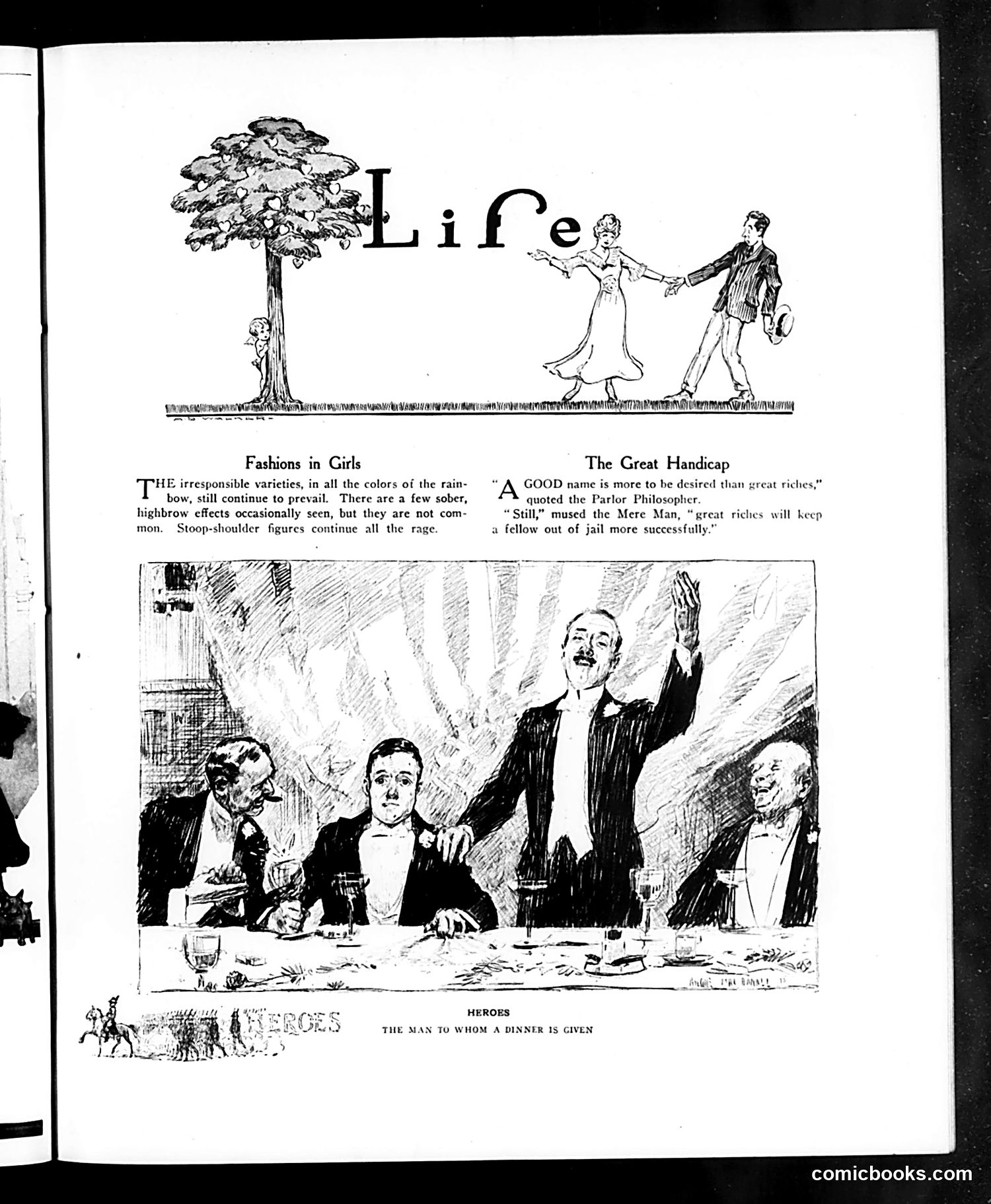
This page from *Life* magazine contains social commentary on early 20th-century gender and class conventions. **"Fashions in Girls"** critiques women's fashion trends, noting that irresponsible color varieties persist despite occasional somber fashions, and that "stoop-shouldered figures continue the rage"—mocking poor posture as a fashionable affectation. **"The Great Handicap"** presents a philosophical dialogue questioning wealth's value. The Parlor Philosopher argues a good name matters more than riches, while the "Mere Man" counters that wealth actually prevents imprisonment—a cynical joke about the justice system's bias toward the wealthy. **"Heroes"** (bottom) depicts men at a formal dinner, captioned "The Man to Whom a Dinner is Given," satirizing how society honors individuals through ceremonial meals rather than substantive recognition.
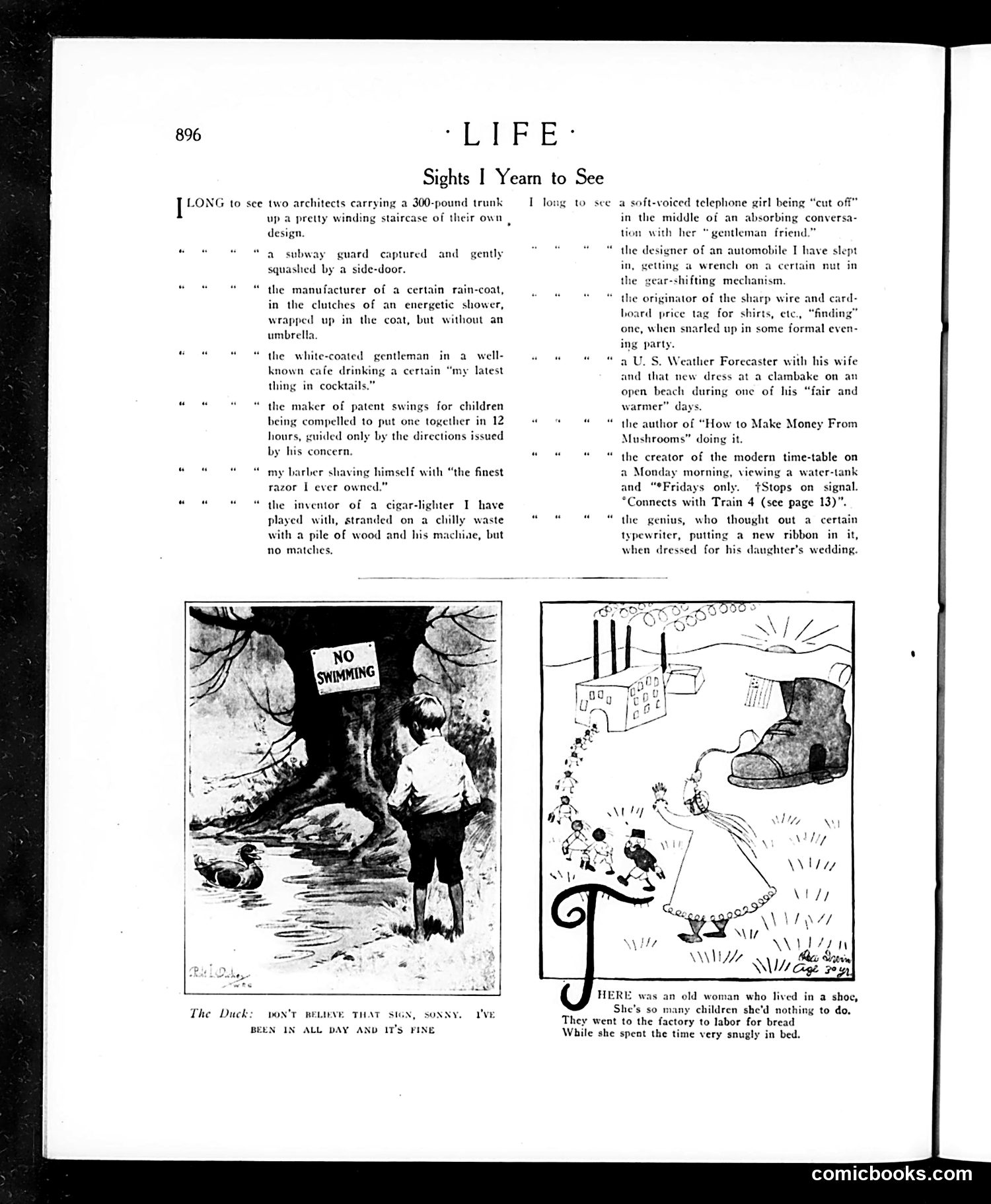
This page presents a satirical wishlist of everyday observations the author desires. The left cartoon shows a child ignoring a "NO SWIMMING" sign at a pond, with the caption "The Duck: 'ISN'T BELIEVE THAT SIGN, SONNY. I'VE BEEN IN ALL DAY AND IT'S FINE.'" This mocks children's tendency to disregard safety warnings and animals' apparent indifference to rules. The right illustration depicts "The Old Woman Who Lived in a Shoe"—a nursery rhyme character with so many children she sends them to factory labor while she stays in bed. This satirizes both the nursery rhyme's dark implications and perhaps contemporary child labor practices or family management struggles. The upper text lists humorous desires: witnessing architects carrying trunks, subway guards being gentle, rain-coat manufacturers testing products—ordinary life moments presented as remarkable or worthy of witnessing.
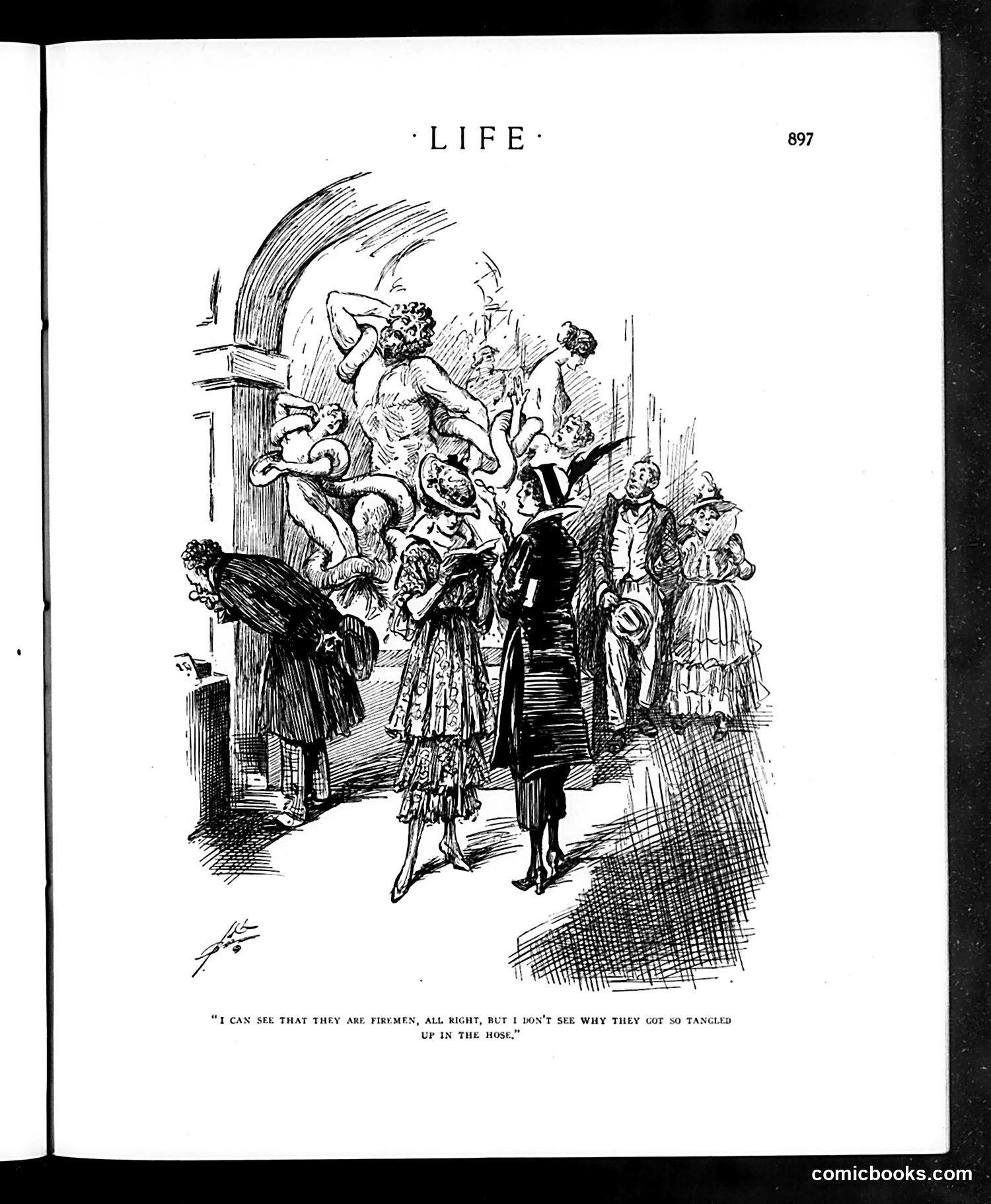
This cartoon satirizes firefighters responding to an emergency. A well-dressed woman observes firefighters with their equipment and makes the comment: "I can see that they are firemen, all right, but I don't see why they got so tangled up in the hose." The humor relies on the contrast between the woman's literal observation of the tangled hose equipment and her apparent lack of understanding about why such tangles occur during emergency response work. She seems to blame the firefighters for poor organization rather than recognizing that hose management during active fire response is inherently chaotic and difficult. The satire targets oblivious or unrealistic civilian criticism of professional workers dealing with genuinely complicated situations.
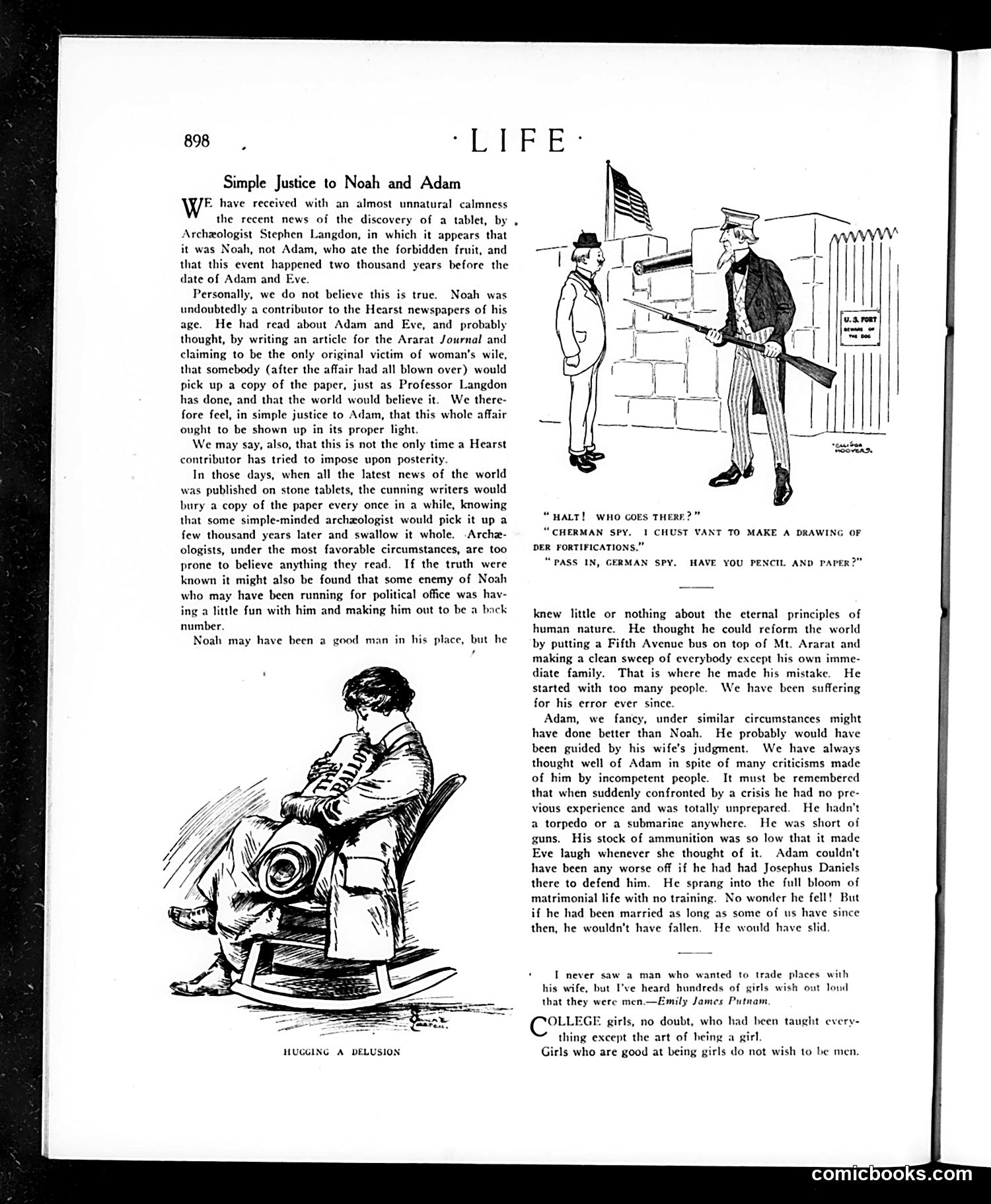
This satirical article defends Noah against archaeologist Stephen Langdon's claim that Adam (not Noah) ate the forbidden fruit. The piece argues Noah was unfairly maligned by Hearst newspapers, which published sensational stories about him. The cartoon "Halt! Who Goes There?" depicts a German spy attempting to sketch U.S. fortifications, suggesting wartime espionage concerns (likely WWI-era, given the German references). Below, "Hugging a Delusion" shows a woman in a rocking chair—likely satirizing those clinging to false beliefs or outdated ideas, possibly referencing women's roles or education. The page uses humor to defend Noah's reputation while addressing contemporary security and social concerns through visual and textual satire.
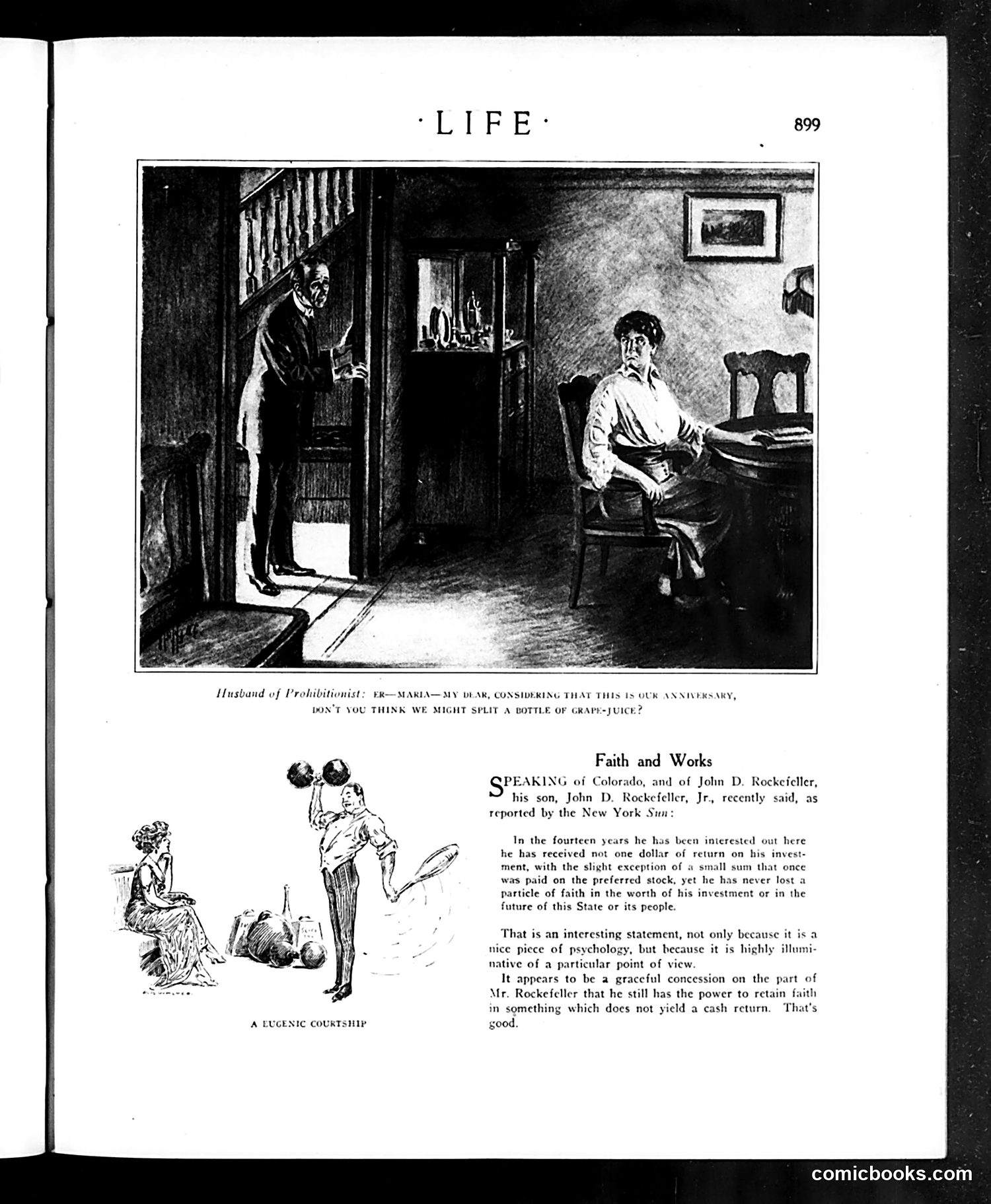
The top cartoon satirizes Prohibition-era hypocrisy. A husband (labeled "Husband of Prohibitionist") suggests splitting "a bottle of grape-juice" on their anniversary—a transparent euphemism, since grape juice was commonly fermented into illegal alcohol during Prohibition. The joke mocks prohibitionists who publicly supported alcohol bans while privately breaking the law. Below, "Faith and Works" discusses John D. Rockefeller Jr.'s Colorado investments. The article notes he's received no financial return despite fourteen years of investment, yet maintains "faith" in something yielding no "cash return." The accompanying sketch titled "A Eugenic Courtship" (depicting couples) appears to illustrate his philanthropic rather than profit-driven interests—contrasting his altruism against typical wealthy industrialists' purely financial motivations.
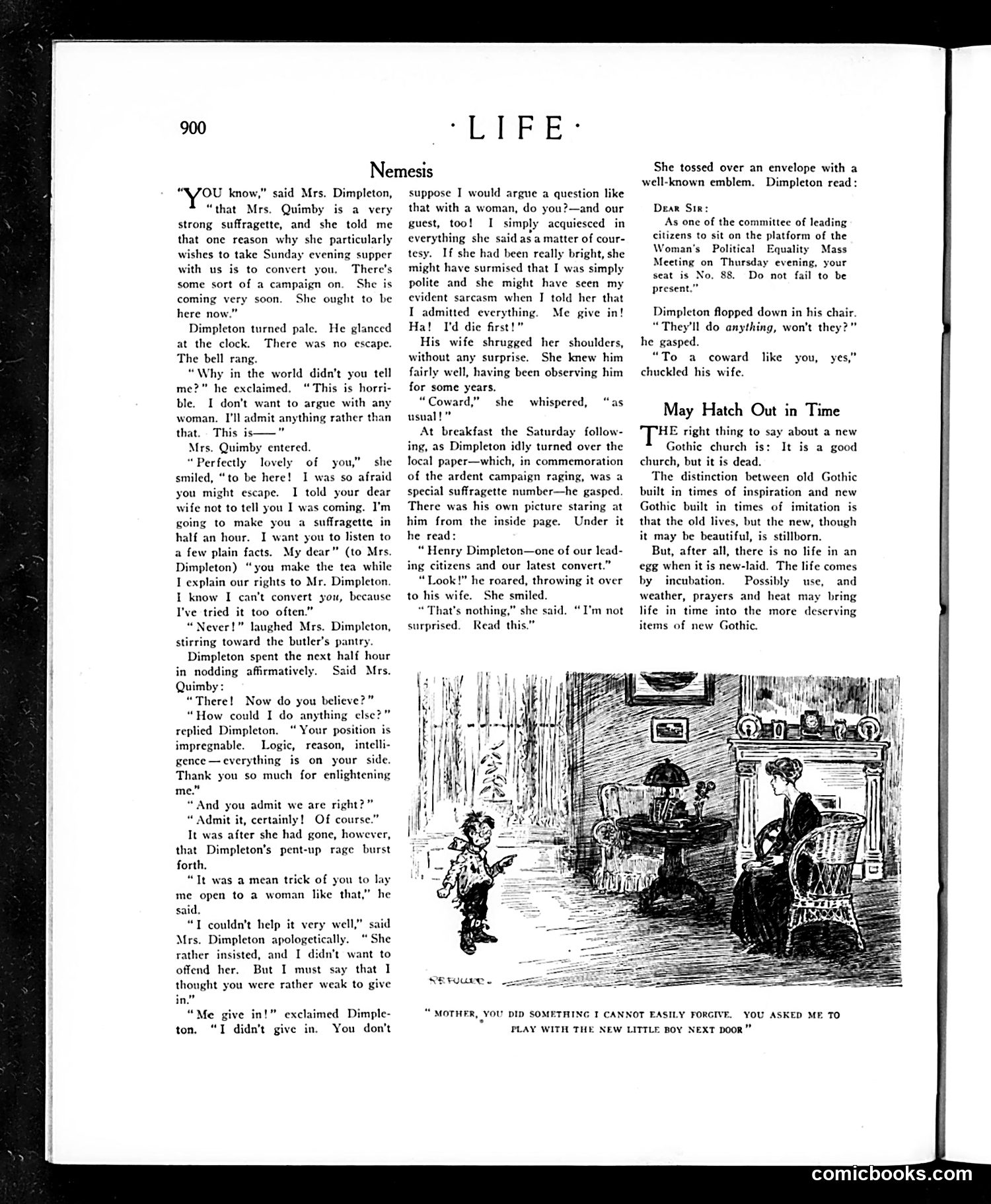
This page contains two distinct pieces: a short story titled "Nemesis" about a domestic disagreement between Mr. and Mrs. Dimpleton, and an essay titled "May Hatch Out in Time" discussing Gothic church architecture. The accompanying illustration depicts a domestic scene where a mother scolds a child, with the caption: "Mother, you did something I cannot easily forgive. You asked me to play with the new little boy next door." The satire targets parental hypocrisy and social pretense. The mother wants her son to befriend the neighbor's child for propriety's sake, yet punishes him when he actually does so. The humor derives from exposing the contradiction between adults' stated values and their actual behavior—a common Life magazine theme mocking middle-class social conventions of the era.
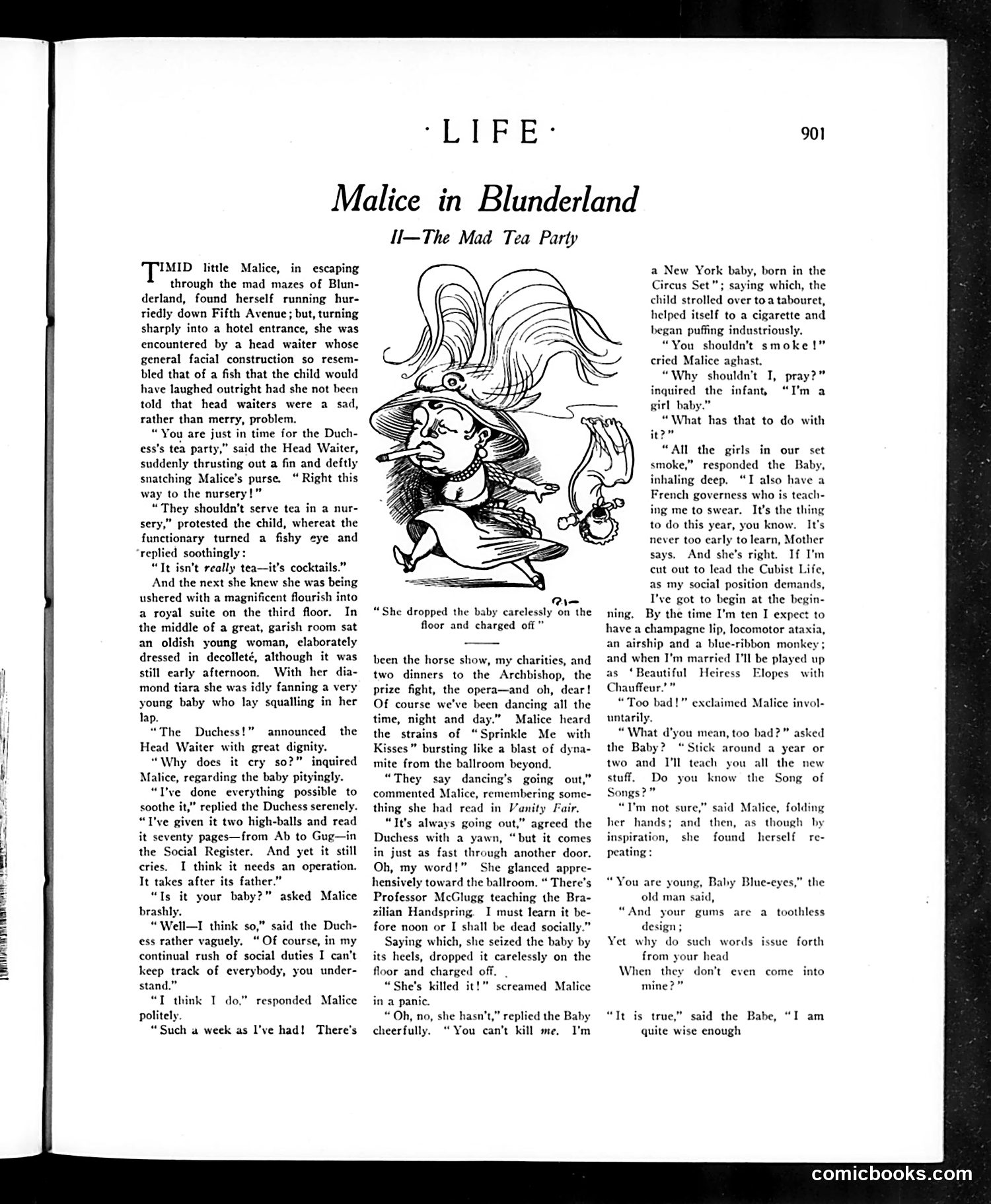
This is a literary parody illustrated by a caricature of the Mad Hatter from Lewis Carroll's *Alice in Wonderland*. The story satirizes high society's social contradictions during the Jazz Age. The narrative mocks wealthy women's hypocritical morality: they criticize a baby for smoking while themselves engaging in heavy drinking ("cocktails"), attending constant social events, and discussing plans for their children to pursue wealth and status through advantageous marriages. The "Baby Blue-eyes" character represents the cynical, sophisticated younger generation responding to adult hypocrisy with frank materialism—she openly declares her plan to marry rich and live as a "Beautiful Heiress." The satire critiques both parental pretense and youth's brazen rejection of conventional morality.
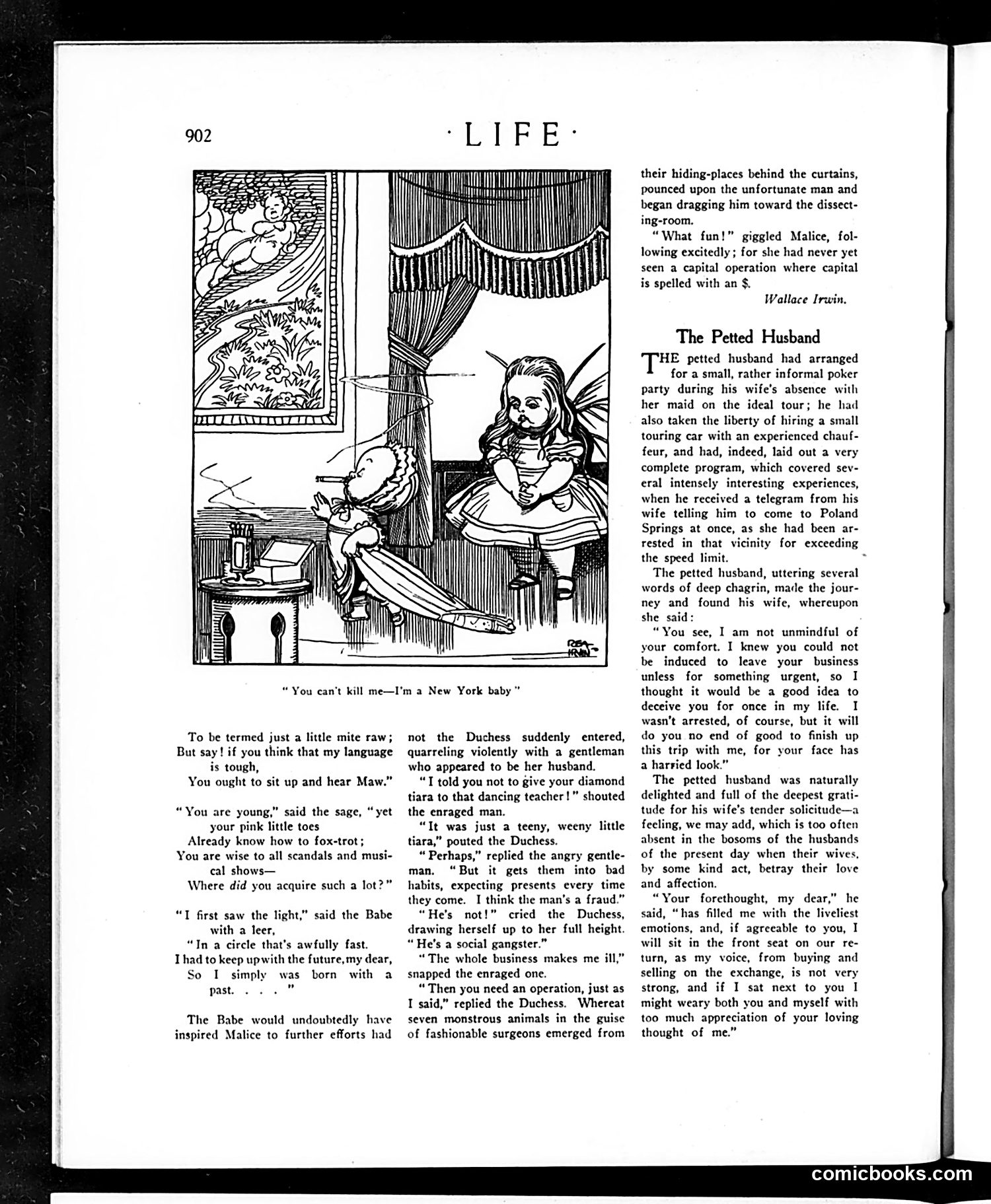
This satirical piece mocks the "petted husband"—a wealthy man indulged by his wife during her absence. The cartoon illustrates a domestic scene where the husband lounges comfortably while his wife travels to Poland Springs (a fashionable resort). The satire critiques **class anxiety and marital dynamics of the era**: the husband arranges poker parties and hires a chauffeur for joy rides, behaving like a neglected child rather than a responsible adult. His wife's sarcastic letter exposes the hypocrisy—she indulges his comfort while he squanders resources and risks arrest for speeding. The joke targets both spouses: wealthy husbands portrayed as emotionally dependent and wives as complicit enablers of male irresponsibility. It reflects early 20th-century anxieties about masculine identity and upper-class leisure culture.
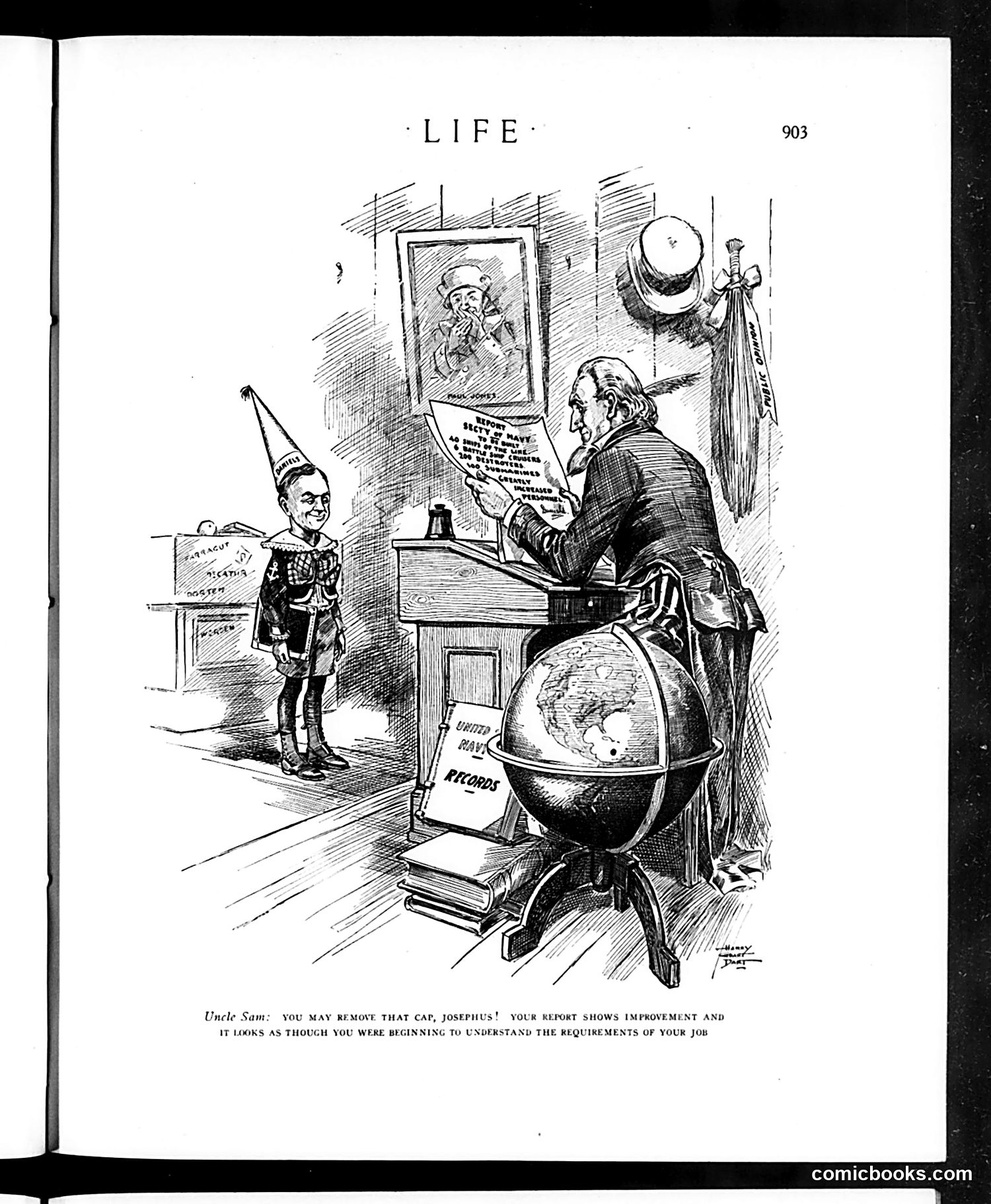
This cartoon depicts Uncle Sam (the tall figure in formal dress) addressing a small military officer wearing a tall pointed hat. Uncle Sam commends the officer for removing his cap and showing "improvement," noting that his report suggests he's "beginning to understand the requirements of your job." The setting includes a globe labeled "United States" and what appears to be official records or documents, indicating a government office. The small officer's exaggerated proportions and formal military attire suggest he represents a specific political or military figure—likely a contemporary military leader or administrator whom Life's editors felt was finally grasping his duties. The satire implies this person was previously incompetent or resistant to understanding his position, and this cartoon celebrates modest progress.
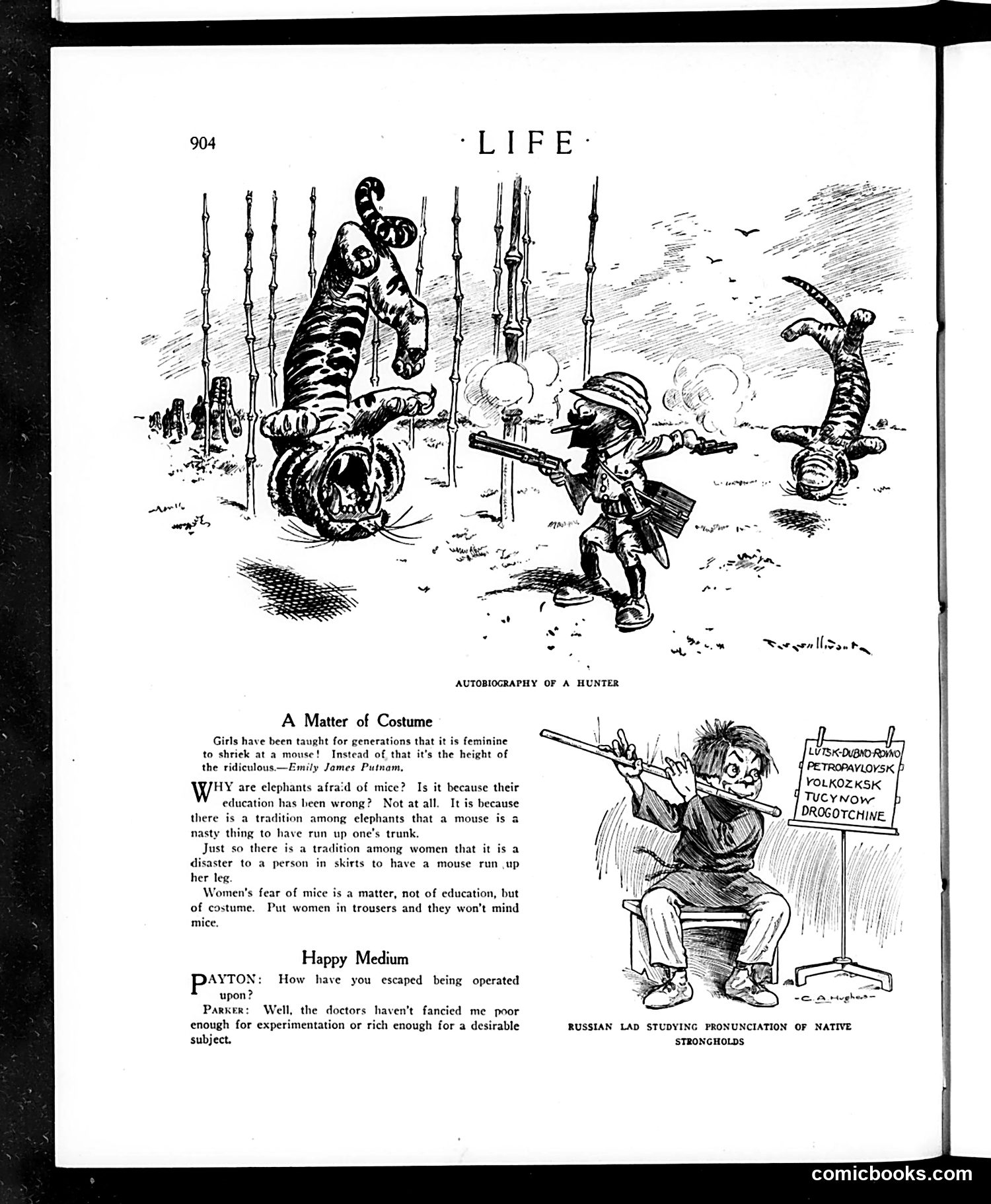
**"A Matter of Costume"** satirizes gender norms around 1910s-1920s femininity. The top cartoon depicts a hunter encountering an elephant and mouse, illustrating the essay's argument: women's fear of mice isn't innate but rather a product of wearing skirts. The piece argues that if women wore trousers (then considered scandalous), they'd lose this "feminine" terror. The satire targets arbitrary social conventions—the claim that costume determines courage—mocking the era's rigid ideas about what women should fear or do. **"Happy Medium"** is a brief joke: Payton has avoided surgery because doctors only operate on the very poor (for experimentation) or the wealthy (who can pay premium fees). As a middle-class person, he escapes their interest entirely—satirizing how medical practice was stratified by class. **"Russian Lad Studying"** appears to mock Russian pronunciation difficulty through a cartoon of someone struggling with transliteration of Russian place names.
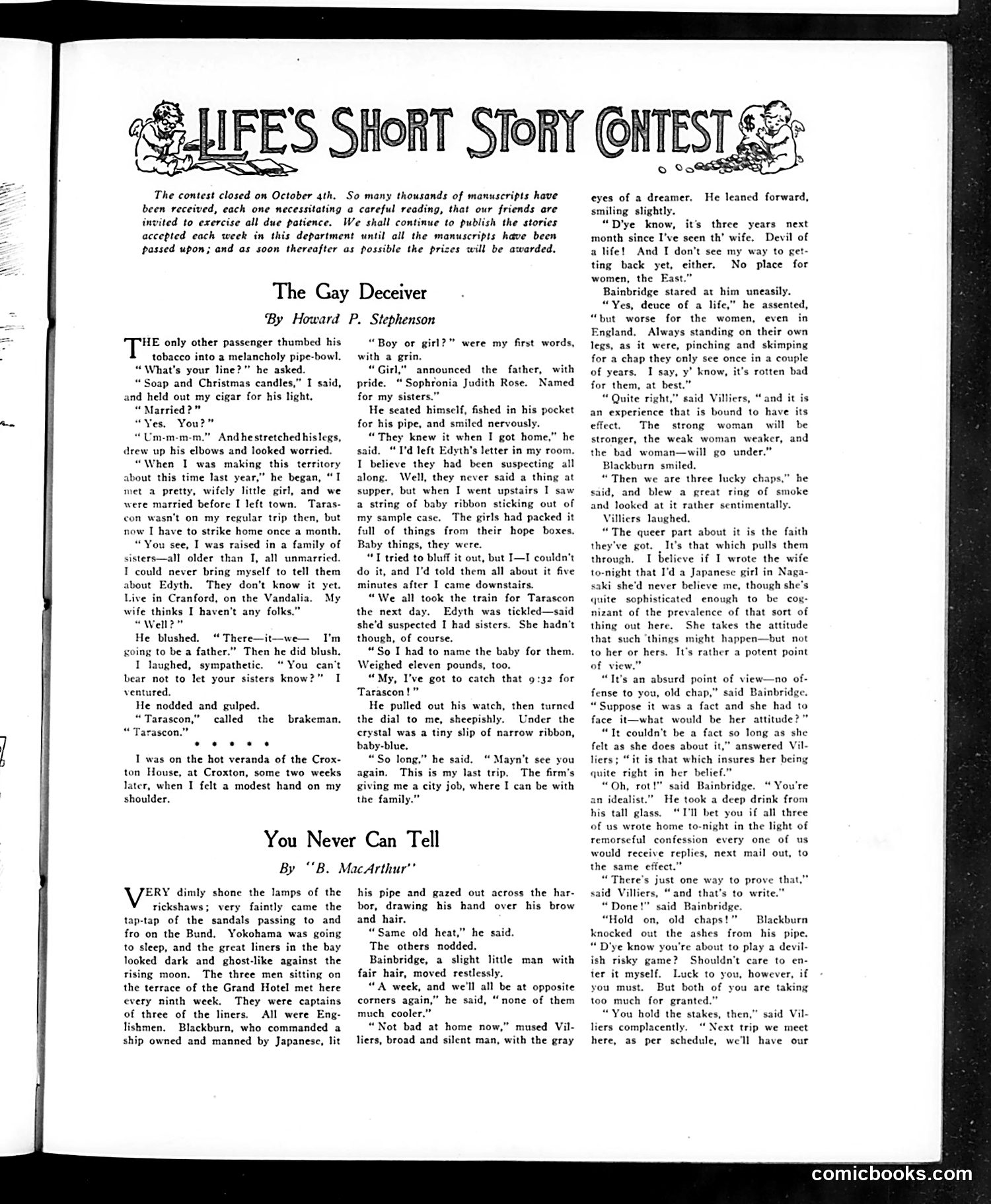
This page presents two short stories from Life's fiction contest (closed October 4th). **"The Gay Deceiver"** by Howard P. Stephenson tells of a traveling salesman who secretly married and fathered a child while hiding his wife from his unmarried older sisters. The humor derives from the social awkwardness of his deception and the eventual discovery—his sisters learn the truth, accept it warmly, and help name the baby. The protagonist abandons his duplicitous traveling life for a steady city job. **"You Never Can Tell"** by "B. MacArthur" appears to be the beginning of a story set in Yokohama, featuring three English ship captains meeting regularly at the Grand Hotel. The narrative establishes an exotic setting and suggests upcoming plot development, though the page cuts off mid-story. Both stories reflect early 20th-century concerns: family obligation, marital secrecy, and professional ambition. The page itself documents Life's literary contest, inviting reader submissions and promising to publish accepted stories weekly.
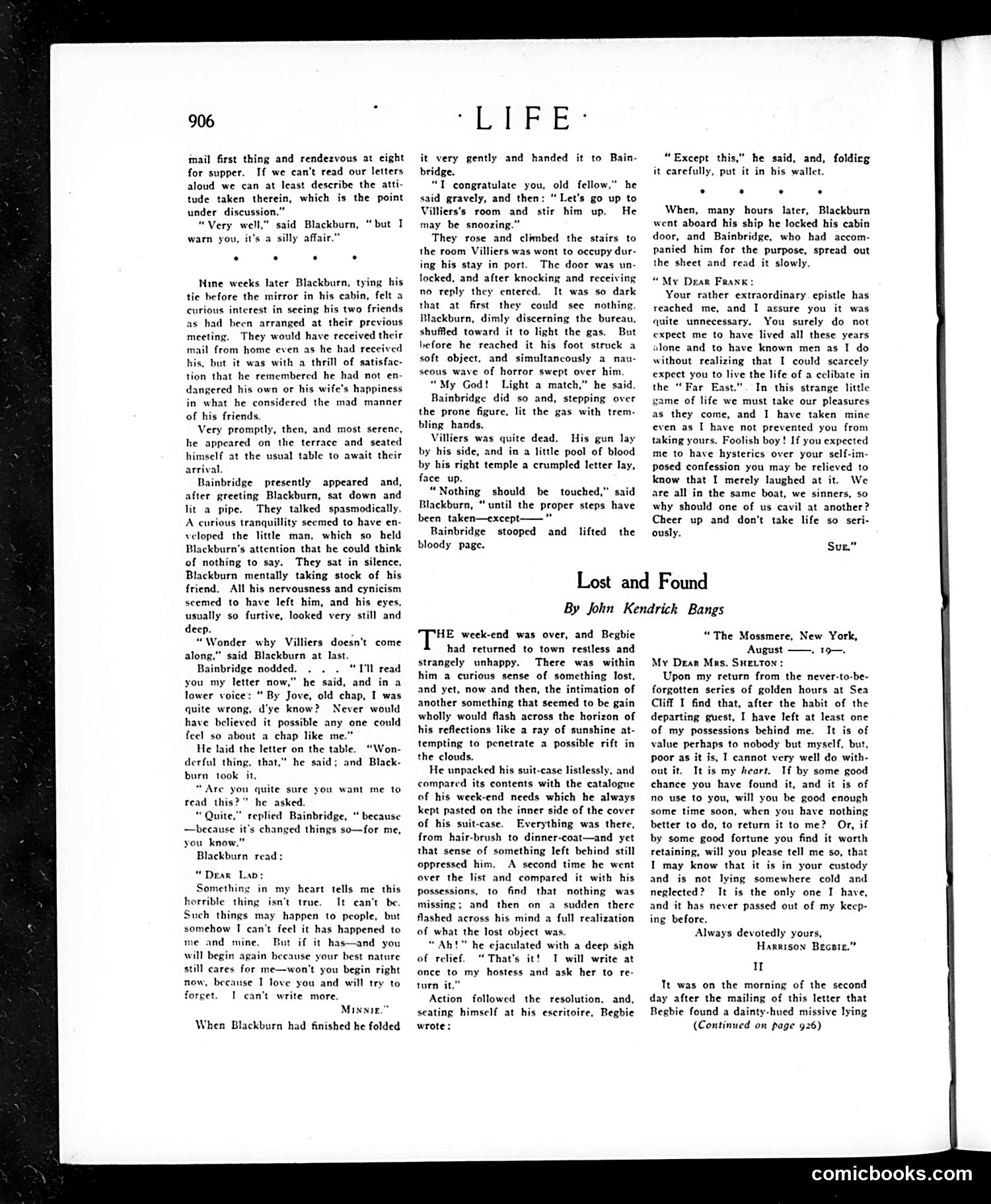
This page contains two literary pieces rather than political cartoons. The main story follows three men—Blackburn, Bainbridge, and Villiers—who agree to share personal letters from home to discuss life's attitudes. The narrative takes a tragic turn: while Blackburn smugly believes himself morally superior for not "endangering" his marriage through some unspecified indiscretion, he discovers Villiers has committed suicide. A crumpled letter lay beside the body. The social satire critiques Victorian-era male self-righteousness and repression. Bainbridge receives a loving letter from his wife forgiving an affair, suggesting emotional honesty strengthens relationships. Meanwhile, Villiers—whose situation remains unclear—chose death over confession. The story suggests that Blackburn's self-congratulatory restraint may be less virtuous than Bainbridge's honest confrontation with his failings. The tragic ending undermines the notion that moral superiority lies in avoiding difficult truths.
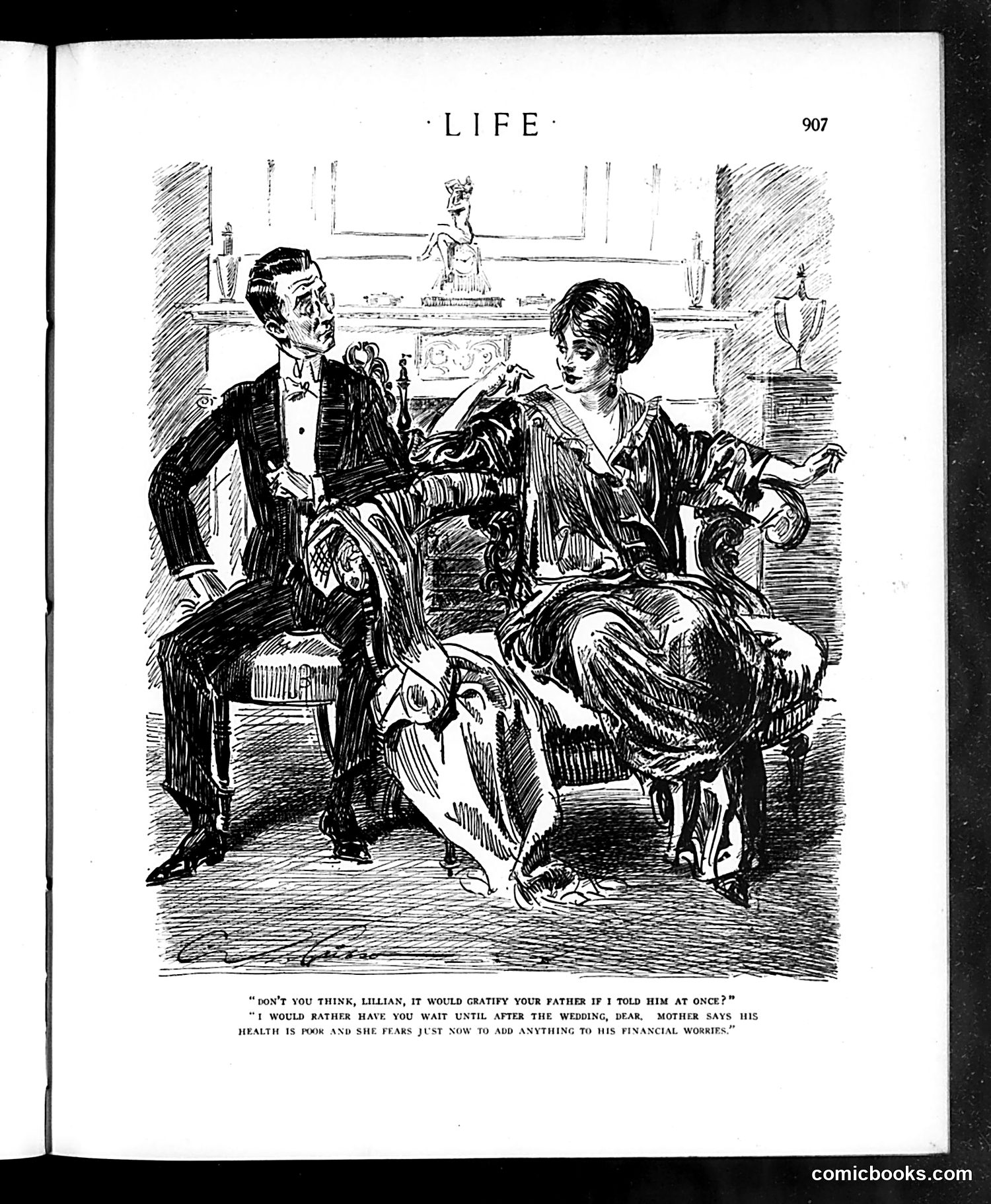
This domestic comedy cartoon depicts an engaged couple discussing when to inform her father of their engagement. The man (standing, in formal attire) wants to tell the father immediately, but the woman (seated) insists on waiting until after the wedding. Her reasoning reveals the satire's target: her mother fears her father's poor health cannot withstand the financial burden of a wedding. The joke satirizes the expense and stress of weddings as a financial crisis for fathers, who traditionally bore these costs. The woman's concern—that wedding expenses might literally endanger her father's health—exaggerates this anxiety into dark comedy. It's a commentary on class anxieties and the economic pressure of maintaining social appearances through expensive ceremonial events in early 20th-century America.
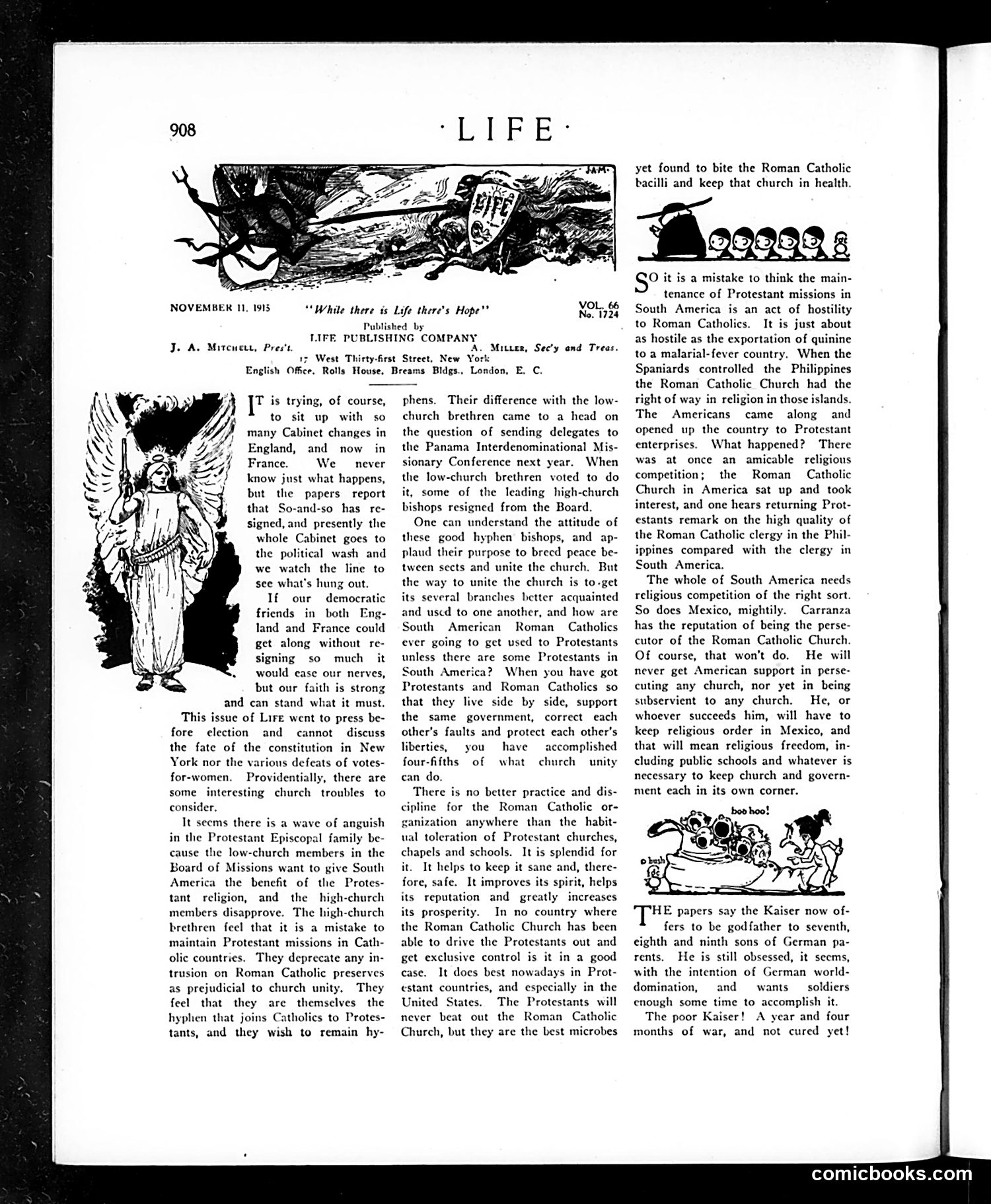
This editorial cartoon and article satirize a dispute within the Protestant Episcopal Church over missionary work in South America. High-church bishops resigned from the Board of Missions, opposing low-church efforts to send Protestant delegates to a Panama missionary conference, fearing it would intrude on Roman Catholic territory and harm "church unity." The author mocks this position, arguing that Protestant-Catholic coexistence actually benefits both faiths. He uses medical metaphors—Protestants as beneficial "microbes" that keep the Catholic Church "healthy" through competition. He cites examples like the Philippines and United States, where religious competition thrives alongside Catholic dominance. The cartoon's angel figure likely represents this idealized interfaith harmony. The piece satirizes the bishops' naïve "hyphen" theology while advocating pragmatic religious pluralism—a modern argument wrapped in 1915's wartime context.
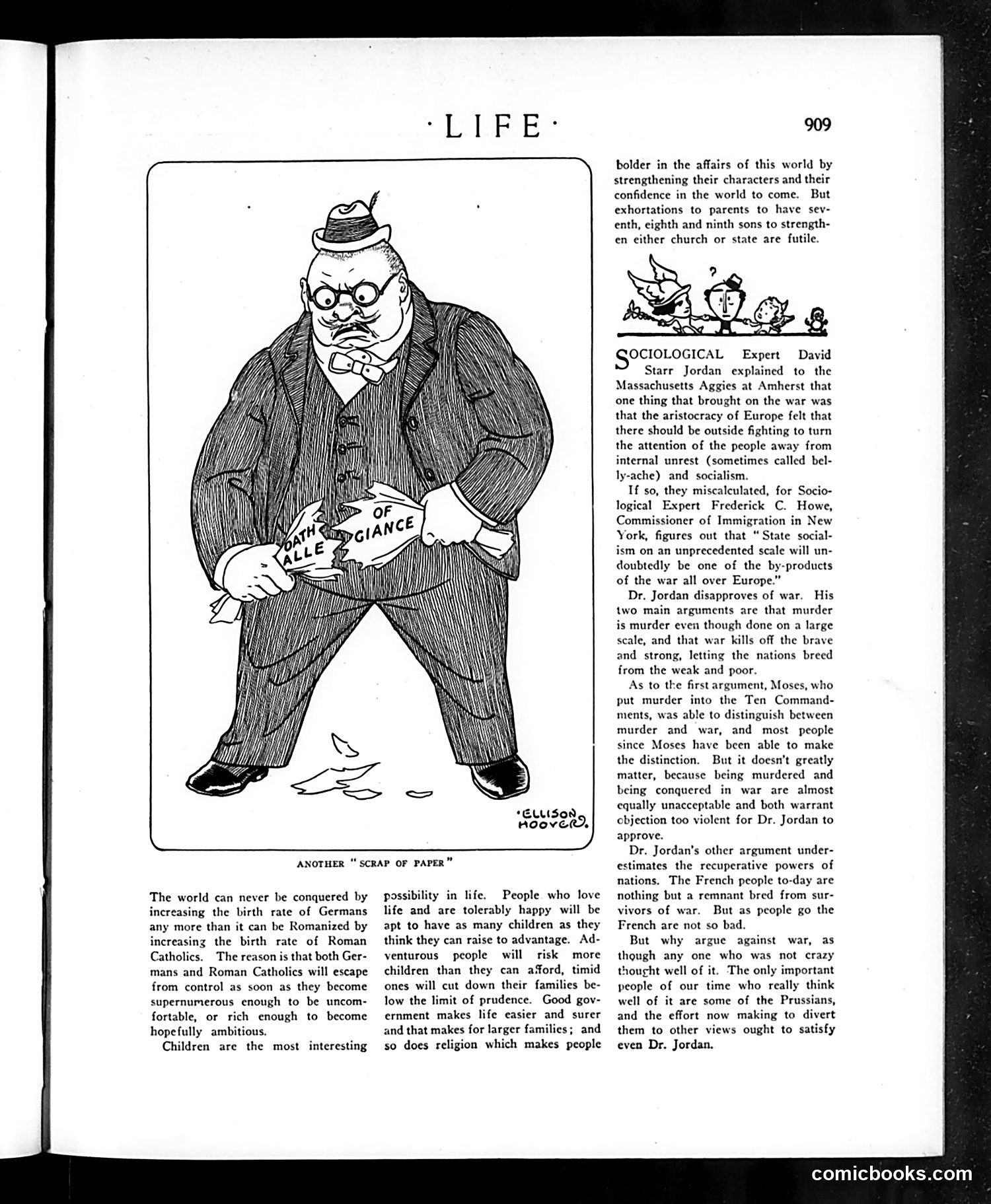
This *Life* magazine page satirizes arguments against war and large families, specifically targeting sociologist David Starr Jordan's pacifist views. **The Cartoon:** The caricatured figure holds a document labeled "Path of Science," depicted as a pompous academic or expert promoting eugenic/population control ideas. The "scrap of paper" reference echoes the phrase used to dismiss Belgium's neutrality treaty before WWI. **The Satire:** The text mocks Jordan's two antiwar arguments: (1) that war kills the brave and strong, weakening nations, and (2) that aristocrats started WWI to distract from socialism. The author dismisses both points as naive and pedantic—arguing that France survived despite war casualties, and that "only" Prussians actually support war, making Jordan's pacifism pointless preaching. **Context:** This reflects early-20th-century debates over Darwinism, eugenics, and American neutrality before U.S. entry into WWI. The piece defends war as inevitable and criticizes intellectual pacifism as ineffectual.
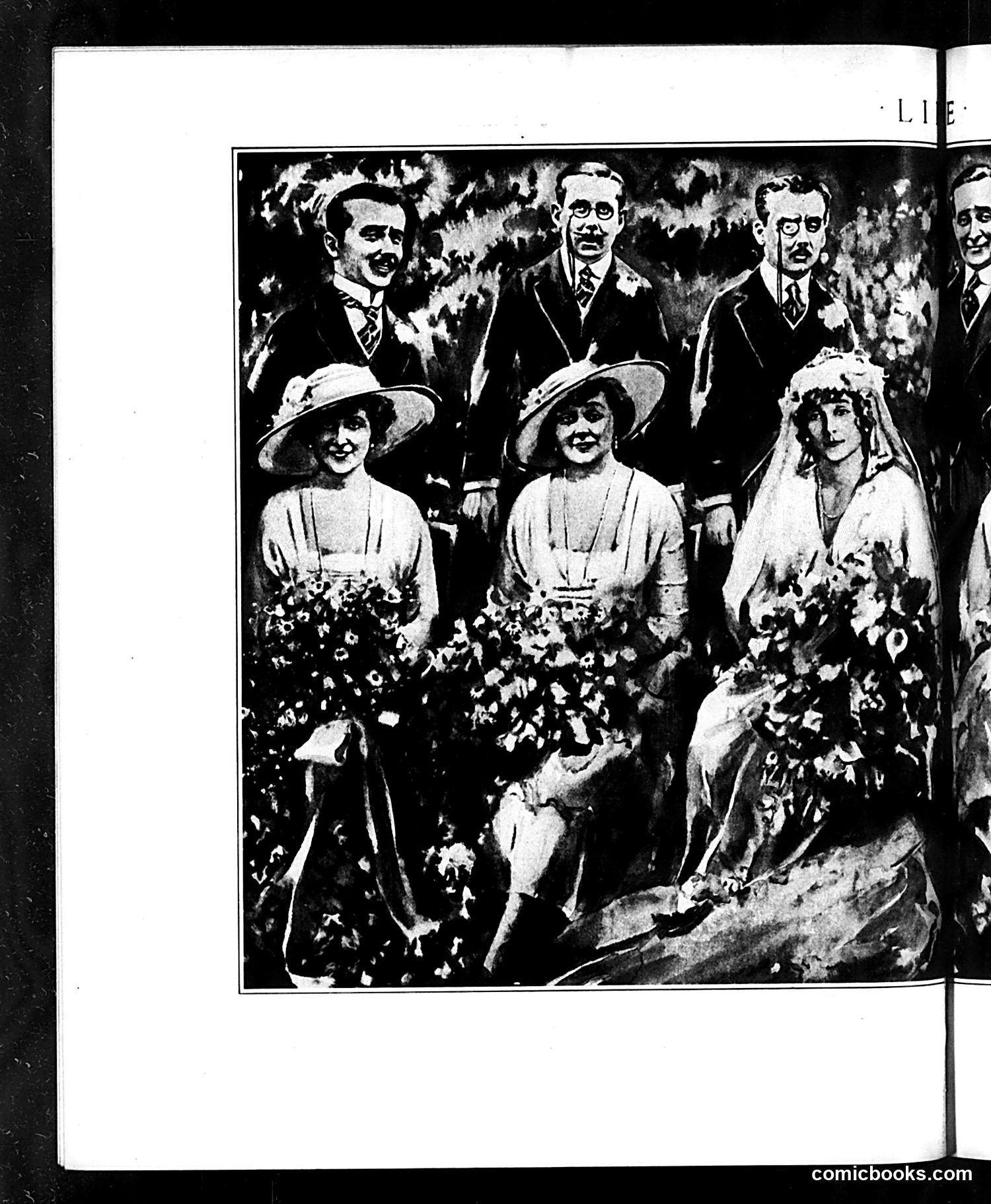
This black-and-white photograph shows a formal group portrait of what appears to be a wedding party or formal occasion from the early 20th century. Three women in the foreground wear elaborate floral bouquets, white hats, and formal dress typical of that era. Four men in dark suits stand behind them. Without additional caption text or context visible on this page, I cannot definitively identify who these specific individuals are or what political or social satire, if any, is intended. The page header reads "LIE" (possibly "LIFE" with partial text cut off), suggesting this is from Life magazine. However, without clear identifying information, captions, or surrounding editorial content, the specific satirical point remains unclear from the image alone.
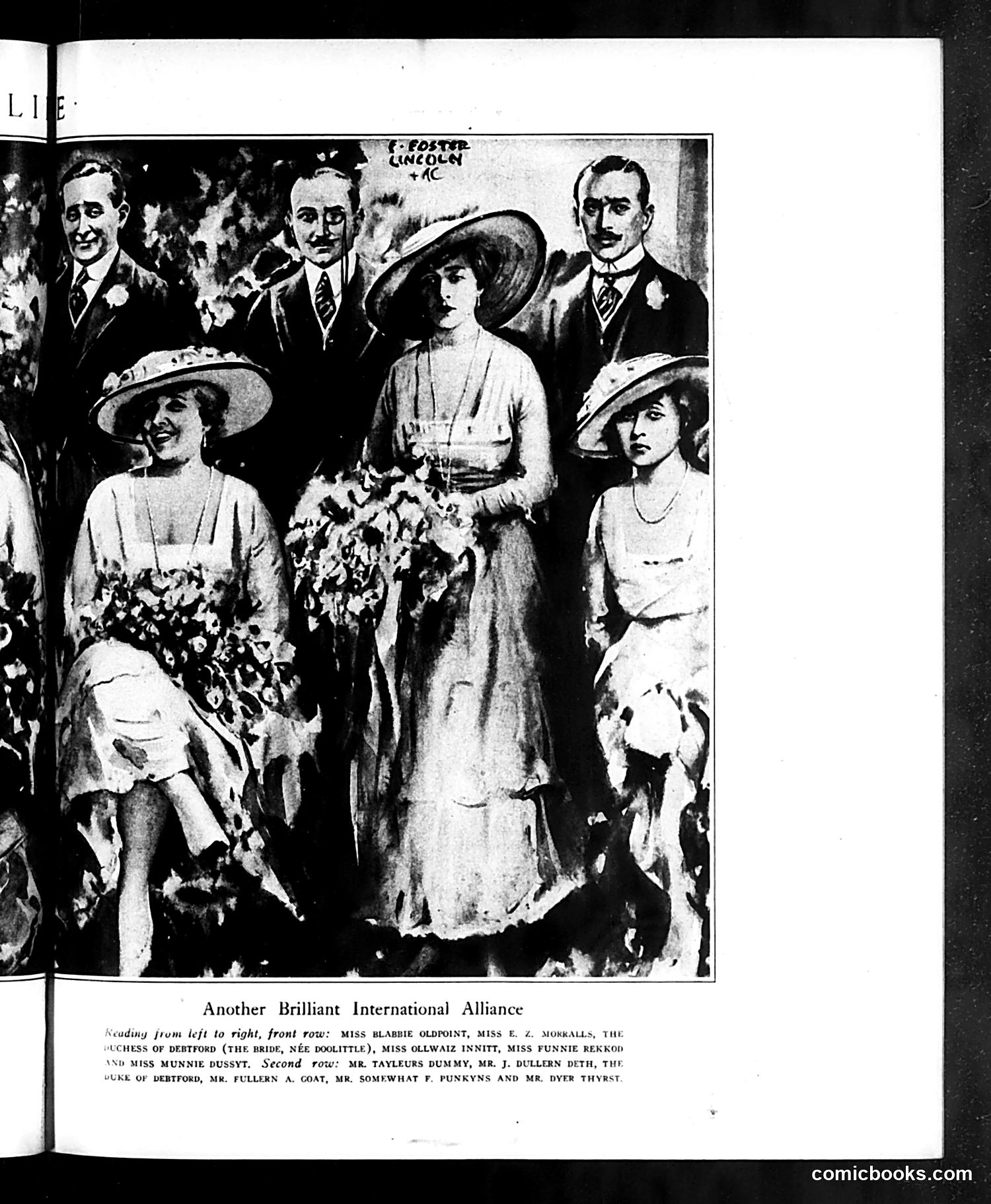
This satirical illustration depicts an international wedding party, but the humor lies entirely in the characters' punning names—visible wordplay rather than visual caricature. The "bride" is the Duchess of Debtford (née Doolittle), surrounded by guests with names like "Miss E.Z. Morals," "Miss Blabbie Oldpoint," and "Mr. Dullern Deth." These transparent puns mock what the caption implies: a purely mercenary international marriage alliance between nations or wealthy families. The satire suggests such "alliances" are hollow affairs conducted by shallow, interchangeable figures—people defined by their vices (debt, boredom, dullness) rather than genuine diplomacy or virtue. The elaborate formal dress and flower arrangements contrast with the absurdity of the participants' names, emphasizing the superficiality of the proceedings. This likely reflects early 20th-century satirical anxiety about international marriages as cynical political/financial arrangements.
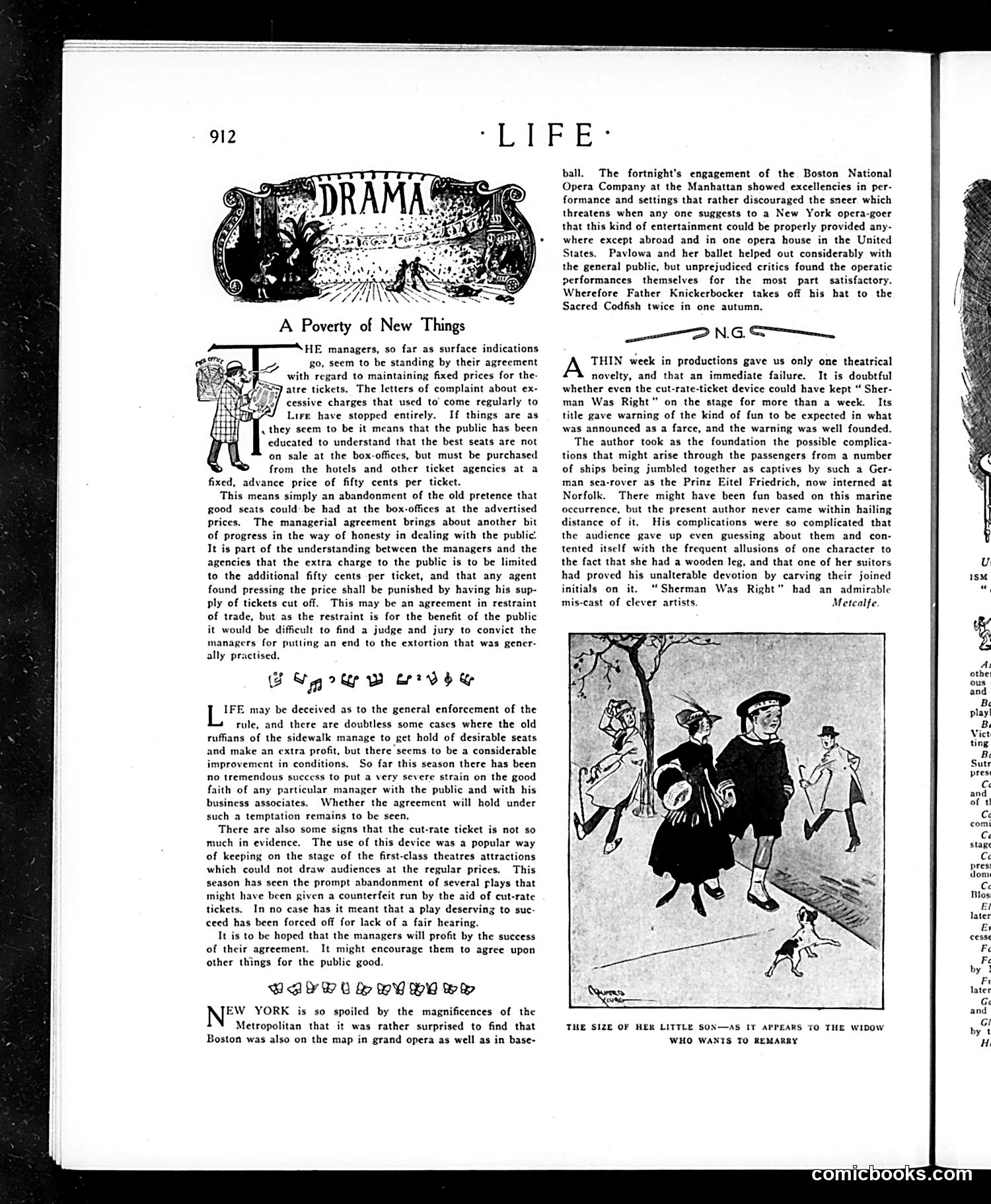
This page critiques Broadway theater management practices and celebrates Boston opera. The main article discusses theater ticket pricing: managers have agreed to maintain fixed prices and limit scalpers' markups to fifty cents per ticket—an honest acknowledgment that premium seats aren't sold at box offices but through hotels and ticket agencies. Life praises this as progress in "honesty in dealing with the public," though it acknowledges enforcement challenges. The accompanying illustration shows three well-dressed figures (likely theater patrons or managers) observing a small boy—a visual joke about theatrical proportions or the diminished quality of current productions (the caption reads "THE SIZE OF HER LITTLE SON"). The page also notes Boston's opera company performed creditably at Manhattan, surprising New York's snobbish assumption that quality entertainment exists only in New York or abroad. A brief theatrical review dismisses a new play called "Sherman Was Right" as an immediate failure.
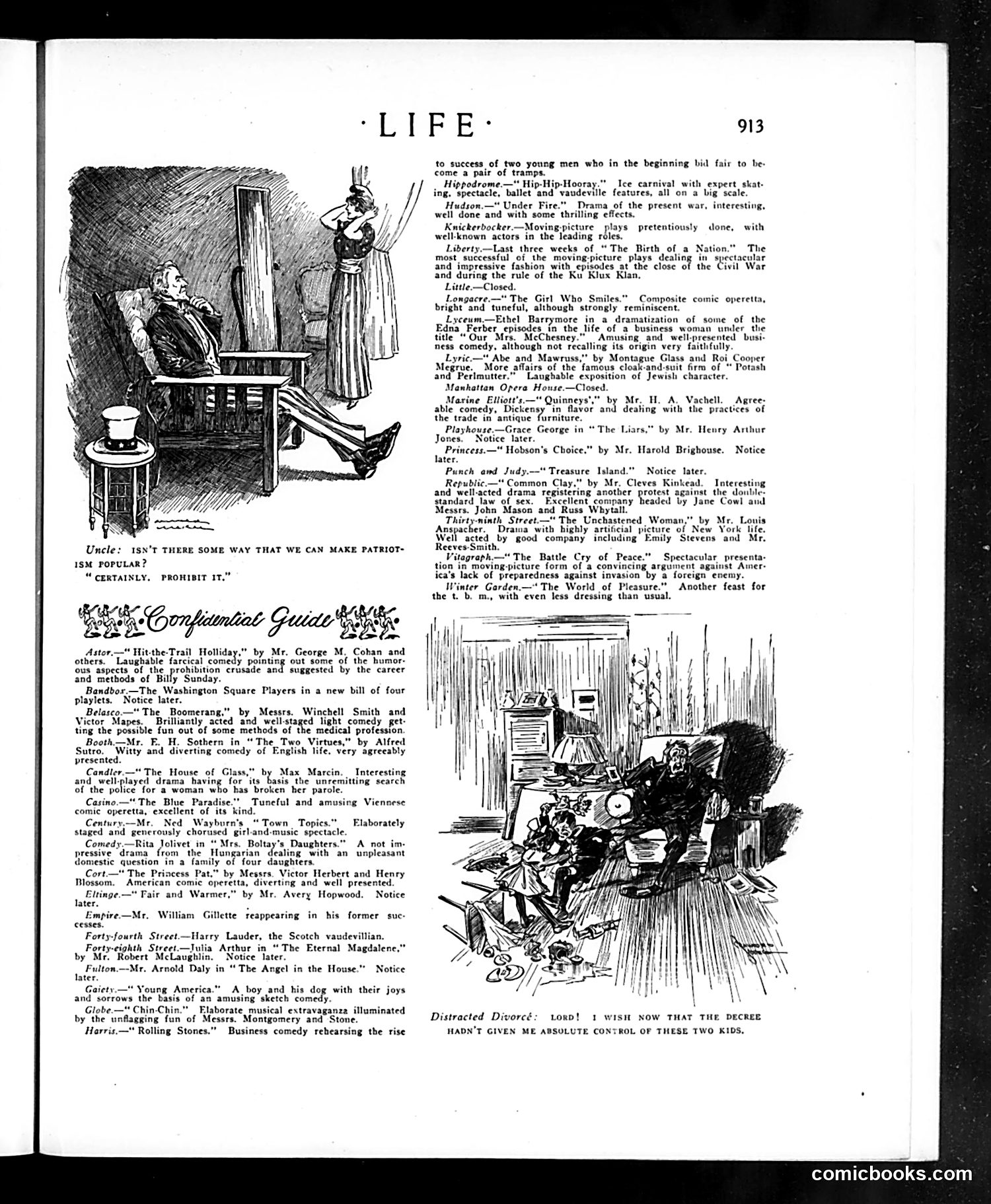
The main cartoon satirizes the prohibition movement. An "Uncle" figure asks how to make patriotism popular, and receives the blunt answer: "Certainly, prohibit it." The joke mocks prohibition advocates—particularly referencing Billy Sunday, the famous evangelical preacher leading temperance crusades—by suggesting that forbidding something makes Americans embrace it as patriotic duty rather than genuine conviction. The accompanying text is a theatrical review listing Broadway productions. Notably, it mentions "The Birth of a Nation," describing it as "the most successful of the moving-picture plays"—this silent film, though now recognized for its racist KKK propaganda, was celebrated at the time. The review also references "Hit-the-Trail Holliday," a comedy mocking the prohibition movement itself, indicating contemporary debate over alcohol regulation. The satire critiques how moral causes become political tools rather than genuine reform movements.
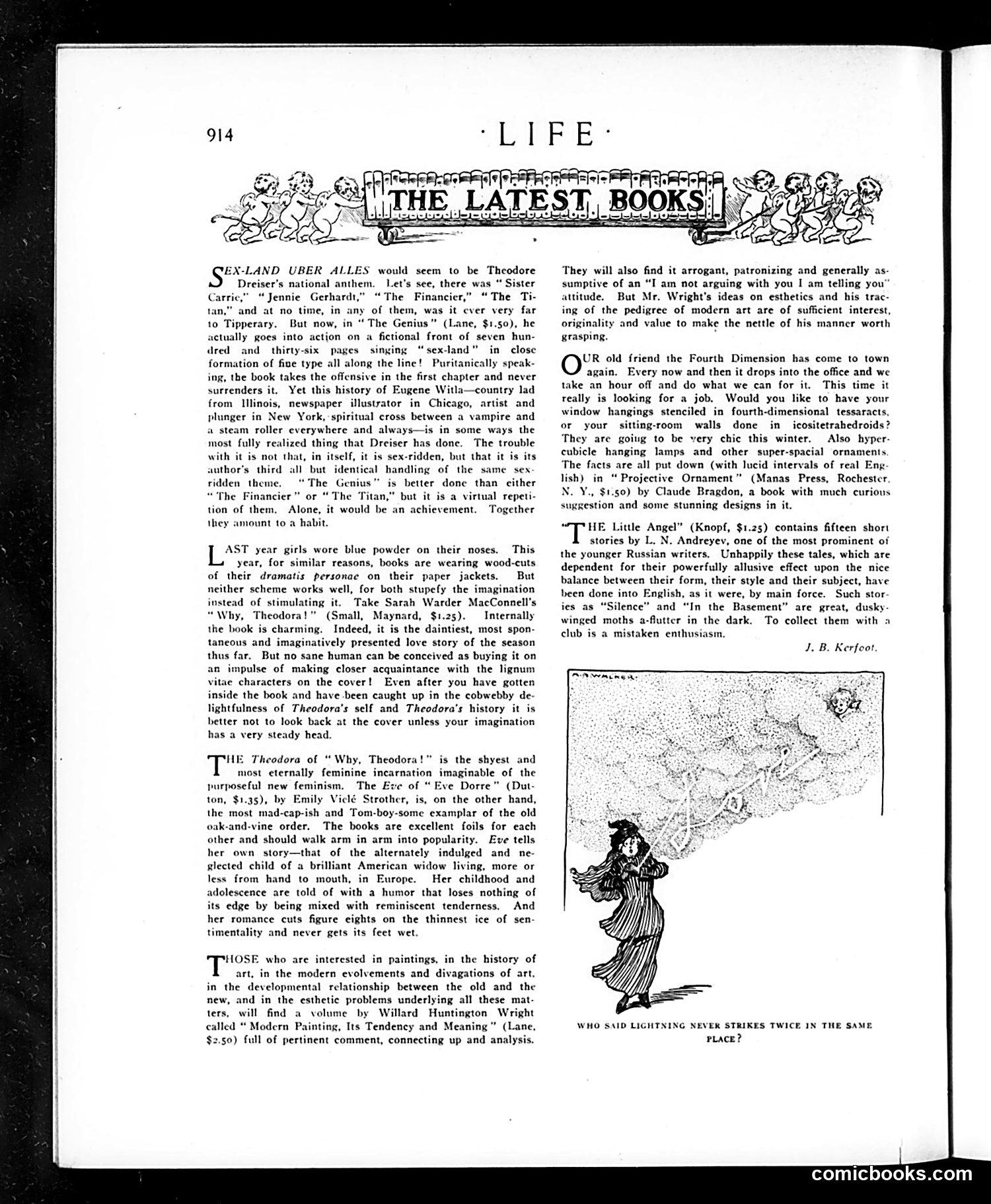
This book review page satirizes Theodore Dreiser's novel *The Genius* through the section header "SEX-LAND UBER ALLES"—a parody of the German nationalist phrase "Deutschland Über Alles," suggesting Dreiser's obsessive focus on sexual themes. The critic notes this is Dreiser's third repetition of essentially identical sex-driven narratives (*The Financier*, *The Titan*, *The Genius*), calling it a "habit" rather than artistic achievement. The cartoon at bottom right, captioned "WHO SAID LIGHTNING NEVER STRIKES TWICE IN THE SAME PLACE?" depicts a figure being struck by lightning—a visual punchline mocking Dreiser's repetitive formula. The page also reviews other books, critiquing poor book jacket design and discussing feminism through contrasting female characters in *Why, Theodora!* and *Eve Dorre*. The satire targets both Dreiser's formulaic approach and broader publishing trends of the era.
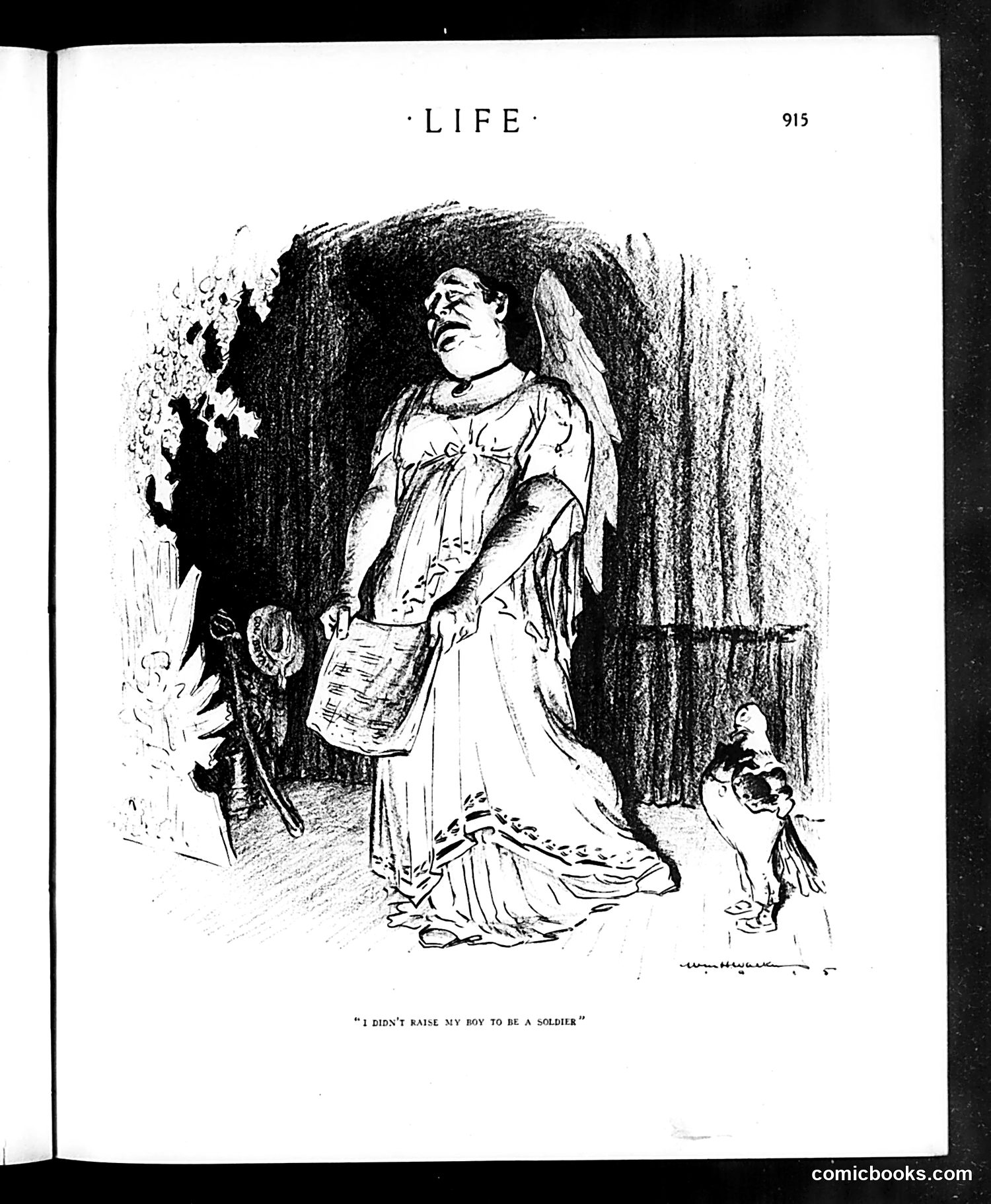
This cartoon references the famous anti-war song of that title, likely from the World War I era. The illustration shows a woman (presumably a mother) gesturing in distress or protestation, with a small child visible. The emotional appeal of the caption suggests the cartoon satirizes mothers who opposed military service for their sons. The joke likely critiques either pacifist sentiment during wartime or, conversely, mothers' reluctance to sacrifice their children for military purposes. Without clearer context about Life magazine's political stance in the specific year of publication, the exact target of satire remains somewhat ambiguous—whether the cartoon mocks anti-war mothers or sympathizes with their position.
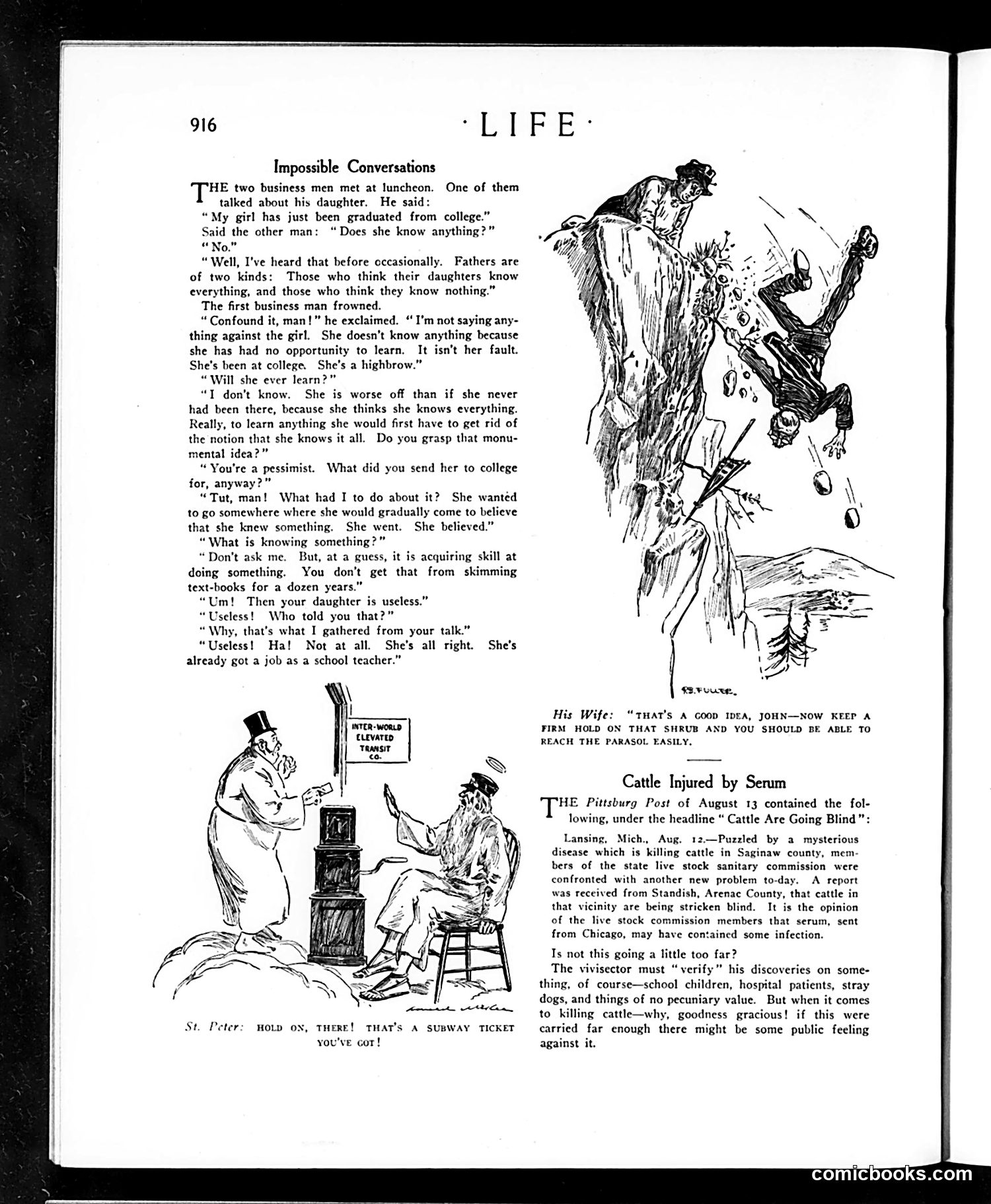
**"Impossible Conversations"** satirizes the contradictions in higher education. A businessman boasts his daughter graduated college, but admits she knows nothing. The satire reveals the era's skepticism about women's college education: it allegedly fills graduates with false confidence in their knowledge while teaching them nothing practical. The irony culminates when the cynic notes she's "useless"—only to learn she's employed as a schoolteacher, suggesting either that teaching requires no real knowledge, or that his entire critique was baseless. This reflects early 20th-century debates about whether women's education was frivolous or genuinely useful. **The bottom cartoon** appears to be an unrelated quip about mistaking a subway ticket for something else, likely a visual pun. **"Cattle Injured by Serum"** criticizes medical vivisection: the author notes it's acceptable when experimenting on "school children, hospital patients, stray dogs"—but suddenly becomes controversial when cattle are harmed. The sarcasm highlights society's selective outrage over animal welfare versus human experimentation.
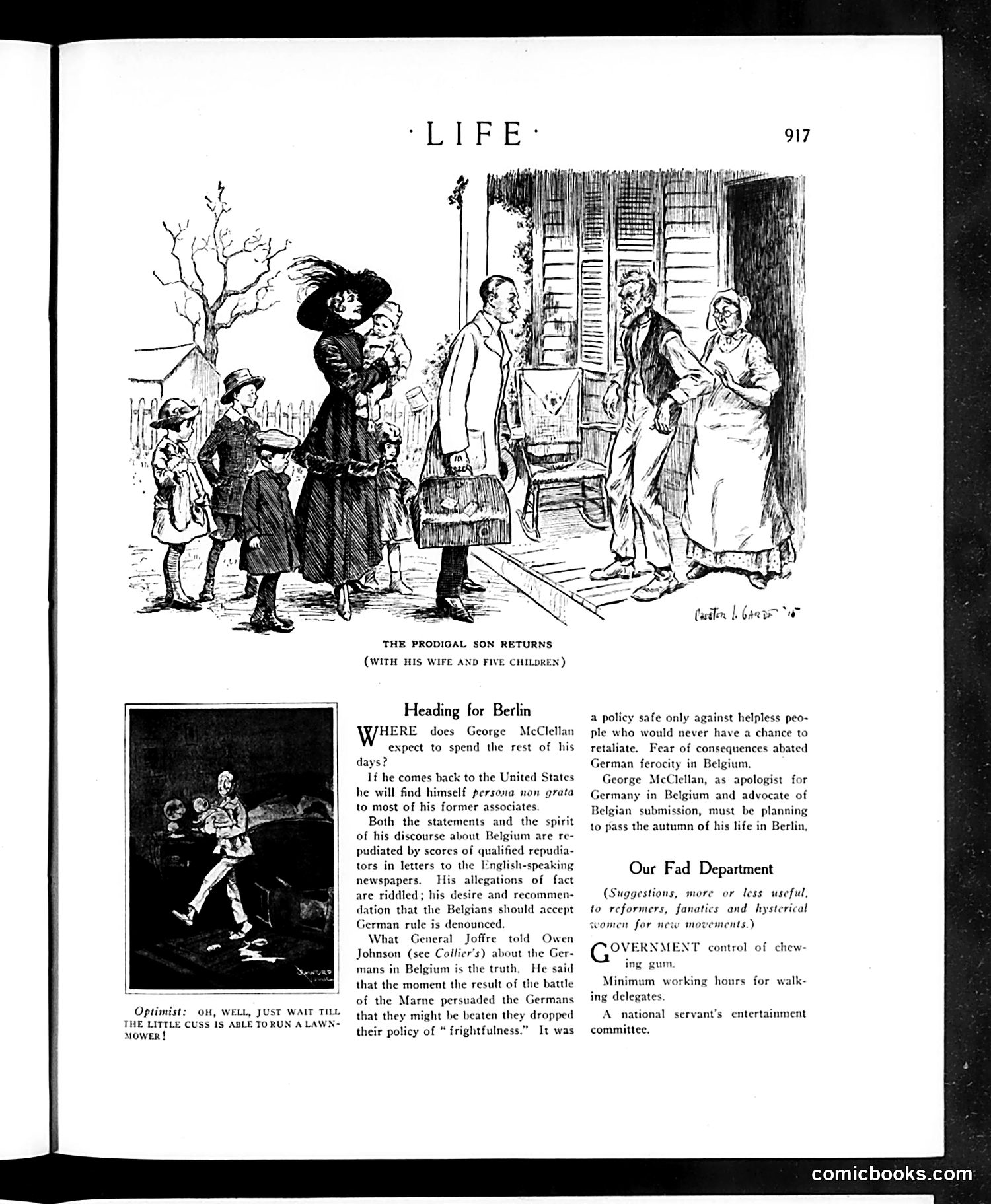
**Top Cartoon ("The Prodigal Son Returns"):** A satirical domestic scene depicting a man returning home with his wife and five children. The caption's joke—"just wait till the little cuss is able to run a lawnmower"—suggests optimism about a troublemaking child's eventual usefulness, likely commentary on a contemporary social or political figure's redemption prospects. **"Heading for Berlin" Section:** This article attacks George McClellan (appears to be a public figure of the era) for defending German conduct in Belgium and advocating Belgian acceptance of German rule. The text indicates his statements about Belgium were widely repudiated in newspapers. The satire suggests McClellan should relocate to Berlin since his pro-German stance makes him unwelcome in America. This references WWI-era tensions and German "frightfulness" (atrocities) in Belgium. **"Our Fad Department":** Brief satirical suggestions for reform movements, including gum regulation and servant entertainment—likely mocking trendy social reform proposals of the period.
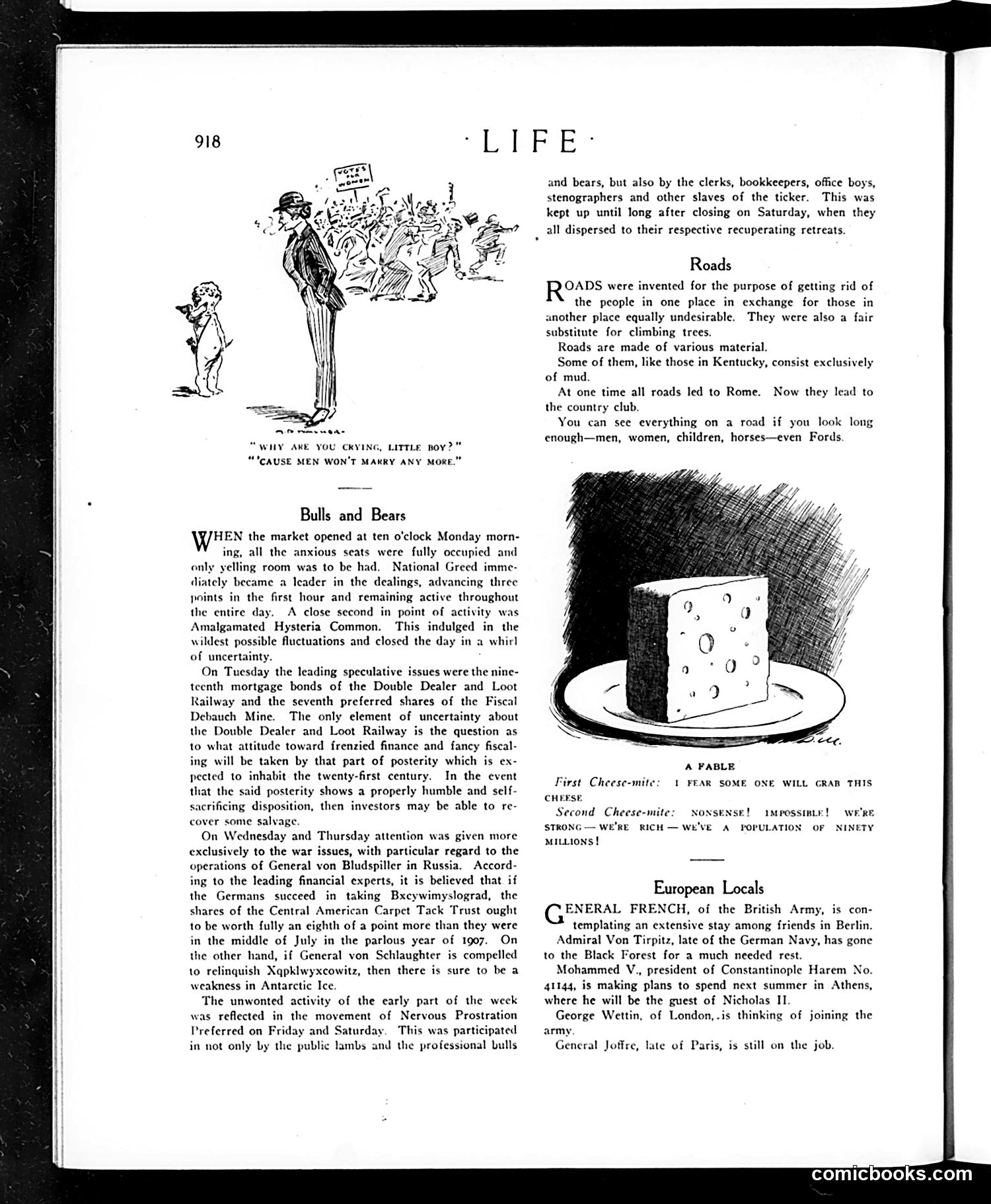
## Main Cartoon The top cartoon shows a man towering over a small boy, asking why he's crying. The boy responds: "Because men won't marry anymore." This satirizes post-WWI anxieties about marriage decline, likely reflecting concerns about casualties, economic disruption, or changing social values after the war. ## "Bulls and Bears" Section This satirizes stock market speculation with deliberately absurd company names ("National Greed," "Amalgamated Hysteria Common," "Double Dealer and Loot Railway"). The mock financial commentary mocks both reckless investment behavior and the future generations who'll inherit these debts—a sharp critique of wartime profiteering and fiscal irresponsibility. ## "European Locals" This section appears satirical, listing prominent WWI military figures (General French, Admiral von Tirpitz, General Joffre) in casual social scenarios—implying they should be relaxing rather than directing warfare. The final line about Joffre "still on the job" suggests ongoing military engagement while others supposedly rest. The overall tone mocks wartime chaos, financial excess, and the absurdity of continued conflict.
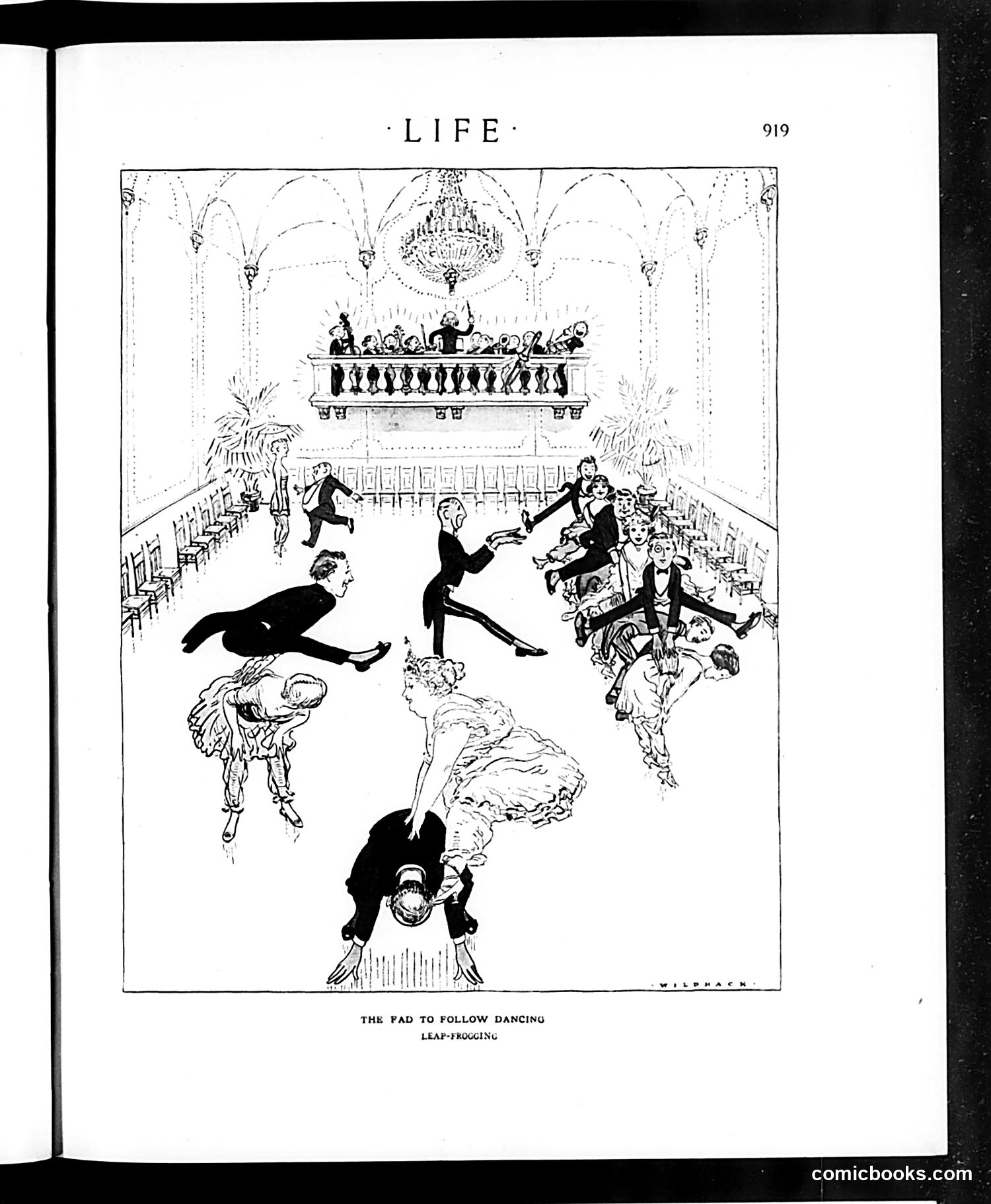
This satirical cartoon depicts a ballroom scene where couples are literally leap-frogging over each other instead of dancing normally. The illustration mocks a contemporary dance fad by exaggerating it to absurdity—showing well-dressed figures in a elegant venue (complete with chandelier and orchestra balcony) engaging in childish, undignified behavior. The satire targets either a specific modern dance craze or broader criticism of Jazz Age social trends. By presenting leap-frogging as the logical extreme of "following dancing" fashions, the cartoonist suggests that contemporary dance styles are increasingly ridiculous and have abandoned traditional grace. The formal setting contrasts sharply with the chaotic, childish activity, amplifying the joke about how far modern entertainment has deviated from decorum.
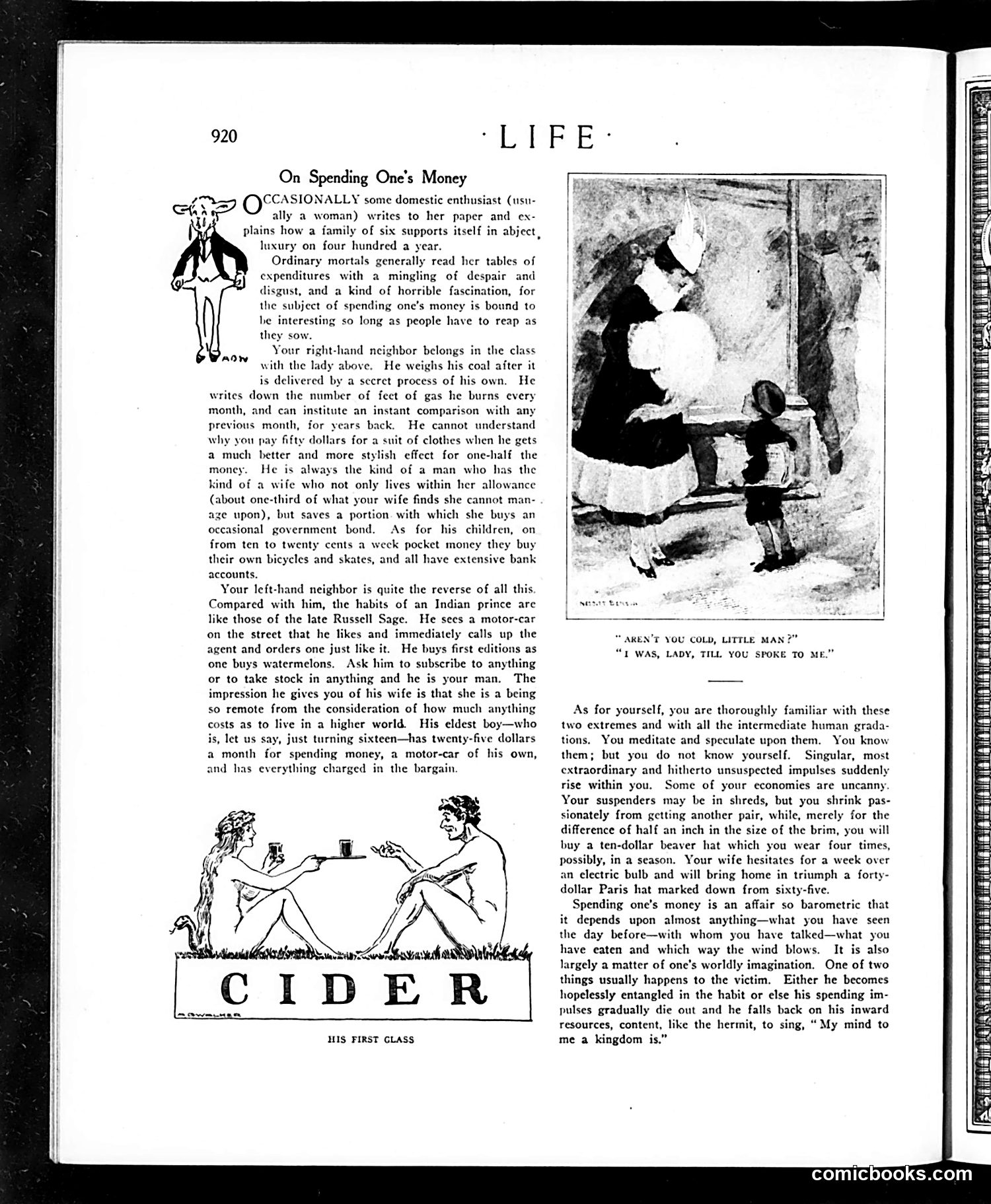
This page satirizes middle-class attitudes toward personal finances through character types. The article contrasts two neighbors: **The Right-Hand Neighbor**: A penny-pincher who meticulously tracks utilities, buys cheap clothes, and raises children on pittances—yet his wife somehow saves money for government bonds. He represents joyless frugality. **The Left-Hand Neighbor**: A spendthrift who impulsively buys luxury cars, rare books, and gives his teenage son a motorcar and $25 monthly allowance. His wife is so detached from costs she lives in "a higher world." The satire's point: spending habits are irrational and contradictory. The author notes that people themselves don't understand their own financial impulses—we obsess over suspenders but splurge on fancy hats; wives agonize over light bulbs then buy $40 Paris hats. The small cartoon "His First Class" and accompanying dialogue appear unrelated advertising or filler. The overall message mocks American middle-class anxiety about money and the gap between aspirations and actual behavior.
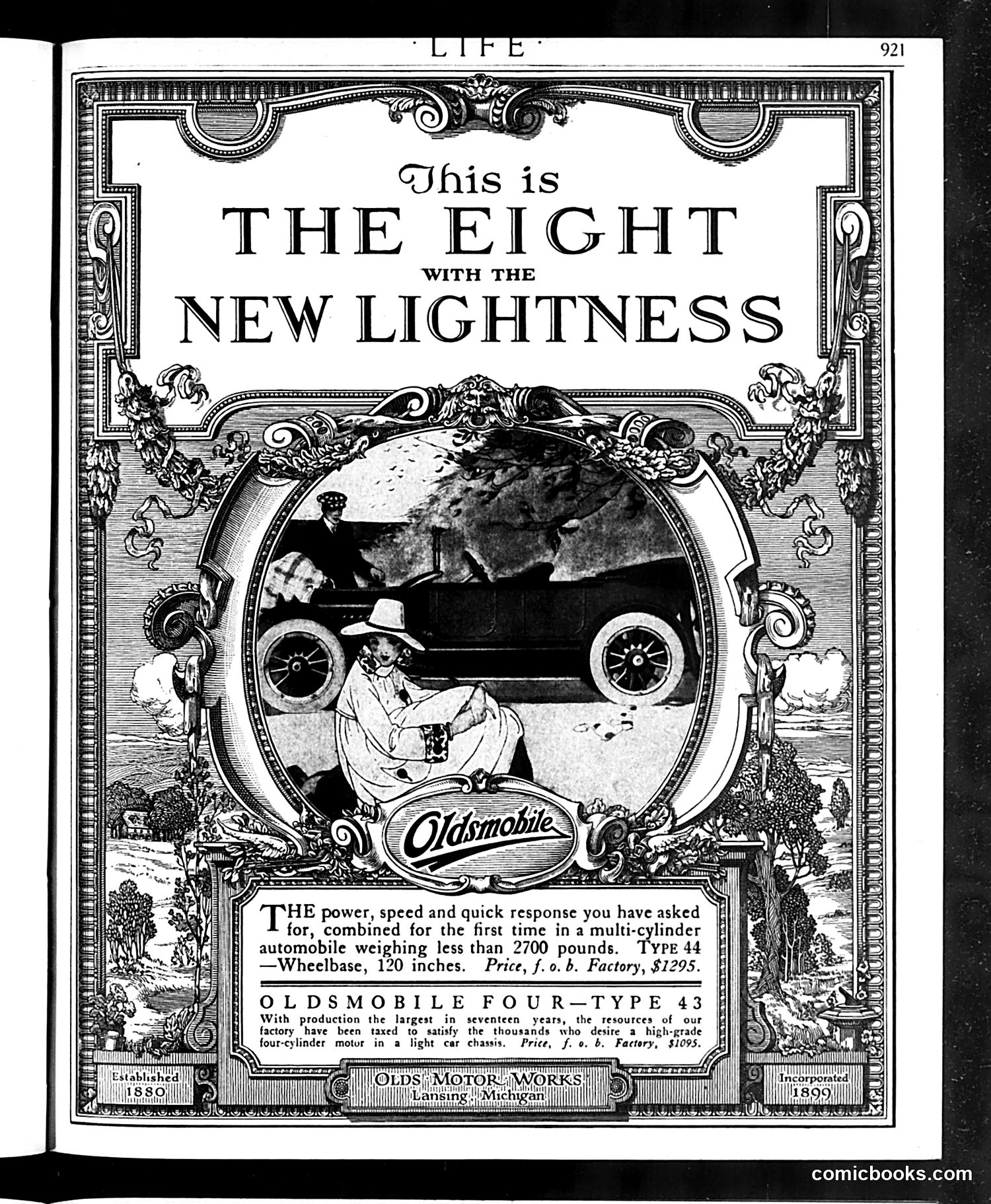
This is **not a cartoon or satire page**—it's a **straightforward automobile advertisement** for Oldsmobile, appearing in *Life* magazine (likely early 1900s, given the "Established 1880" notation). The page advertises two models: 1. **Type 44** ("The Eight"): A multi-cylinder automobile under 2,700 pounds, priced at $1,295 2. **Type 43** ("Oldsmobile Four"): A four-cylinder model priced at $1,095 The ornate decorative border and period illustrations of well-dressed drivers are typical of early automotive advertising design. The text emphasizes the vehicles' power, speed, and response—selling points for early motorists. The reference to "production the largest in seventeen years" suggests strong market demand. There is no political satire or social commentary present. This is commercial advertising using *Life*'s decorative design conventions to appeal to middle-to-upper-class readers who could afford automobiles.
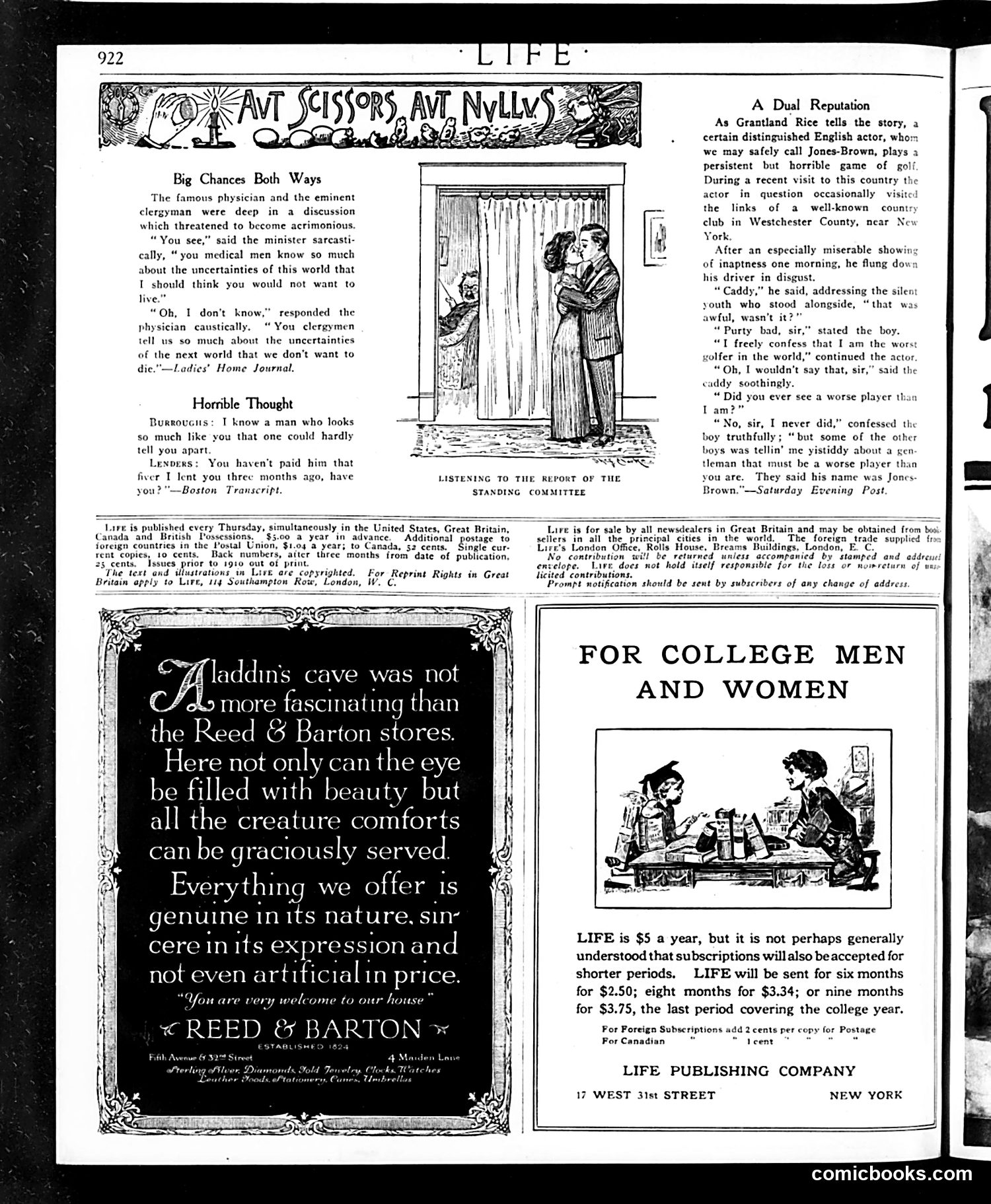
This page contains three separate humorous anecdotes satirizing professional pretension: **"Big Chances Both Ways"** mocks the mutual skepticism between doctors and clergy. A physician and minister argue about life's uncertainties—the doctor dismisses the minister's warnings about the afterlife, while the minister counters that medical men's gloomy pronouncements make life seem hardly worth living. The joke: both professions undermine confidence in their own domains. **"Horrible Thought"** is a brief quip about an unpaid debt and mistaken identity. **"A Dual Reputation"** (the main cartoon, showing a caddy at a golf club door) satirizes an English actor's terrible golf skills. After playing miserably, he admits to being "the worst golfer in the world." The caddy soothingly disagrees—but then reveals another golfer is worse: "Jones-Brown." The joke: the actor's reputation for bad golfing is so widespread that even his caddy doesn't recognize him, knowing him only by his golfing infamy. The page also contains period advertisements for Reed & Barton stores and Life magazine subscriptions.
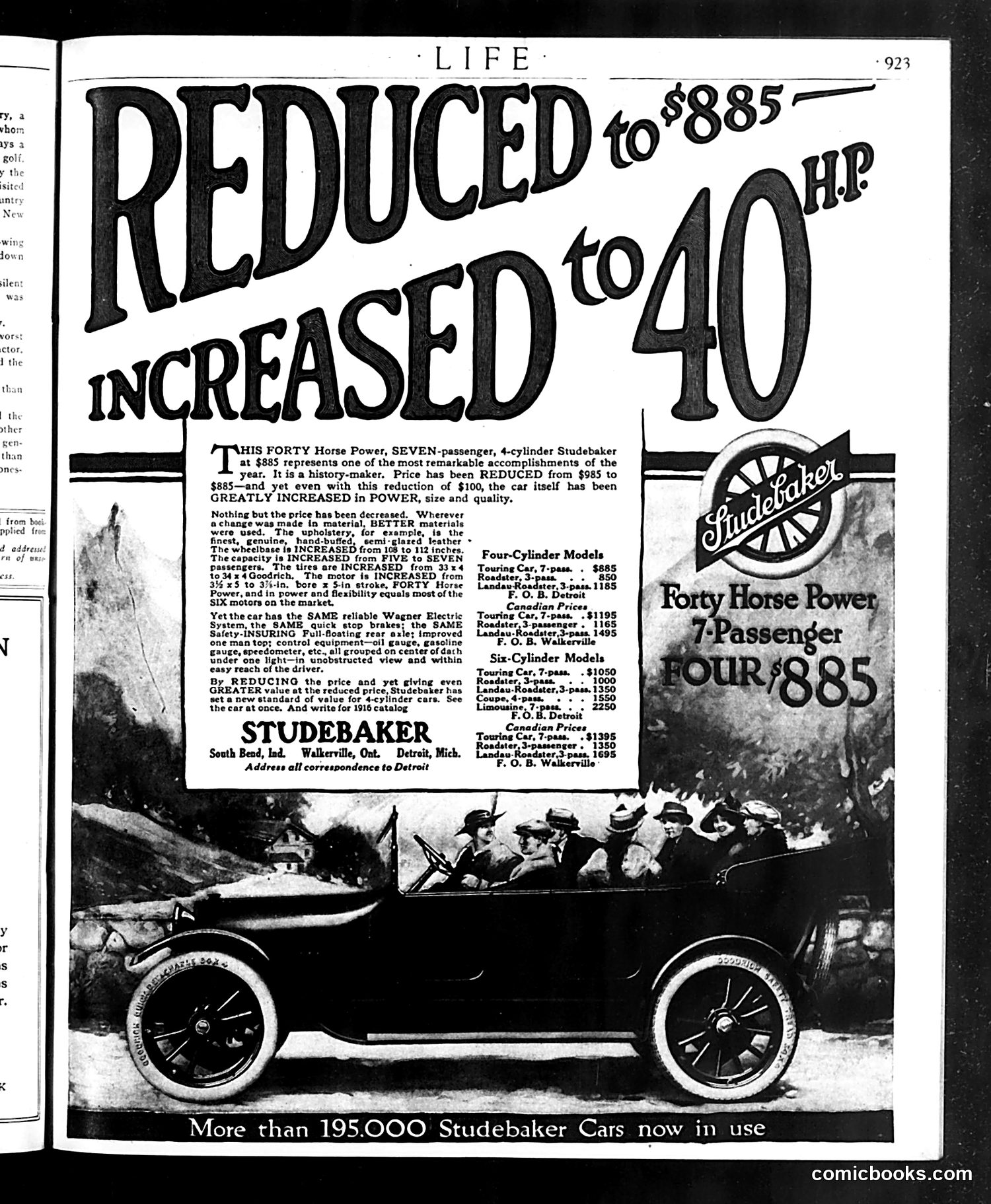
This is **not a cartoon or satire page**, but rather a **straightforward automobile advertisement** from Life magazine (1916). The Studebaker company advertises their 40-horsepower, seven-passenger touring car, emphasizing a dramatic price reduction from $985 to $885—a $100 cut—while claiming the vehicle itself has been *improved* in nearly every way: better materials, larger wheelbase (108 to 112 inches), increased tire size, upgraded motor, and expanded seating capacity. The ad's rhetorical strategy—"nothing but the price has been decreased"—attempts to convince buyers that this represents unprecedented value: you're paying *less* while getting *more*. The photograph shows well-dressed passengers in an open-air touring car, and the tagline "More than 195,000 Studebaker Cars now in use" serves as social proof. There is **no political satire or social commentary** visible. This is a period automobile advertisement targeting middle-class American consumers by leveraging the appeal of both affordability and quality.
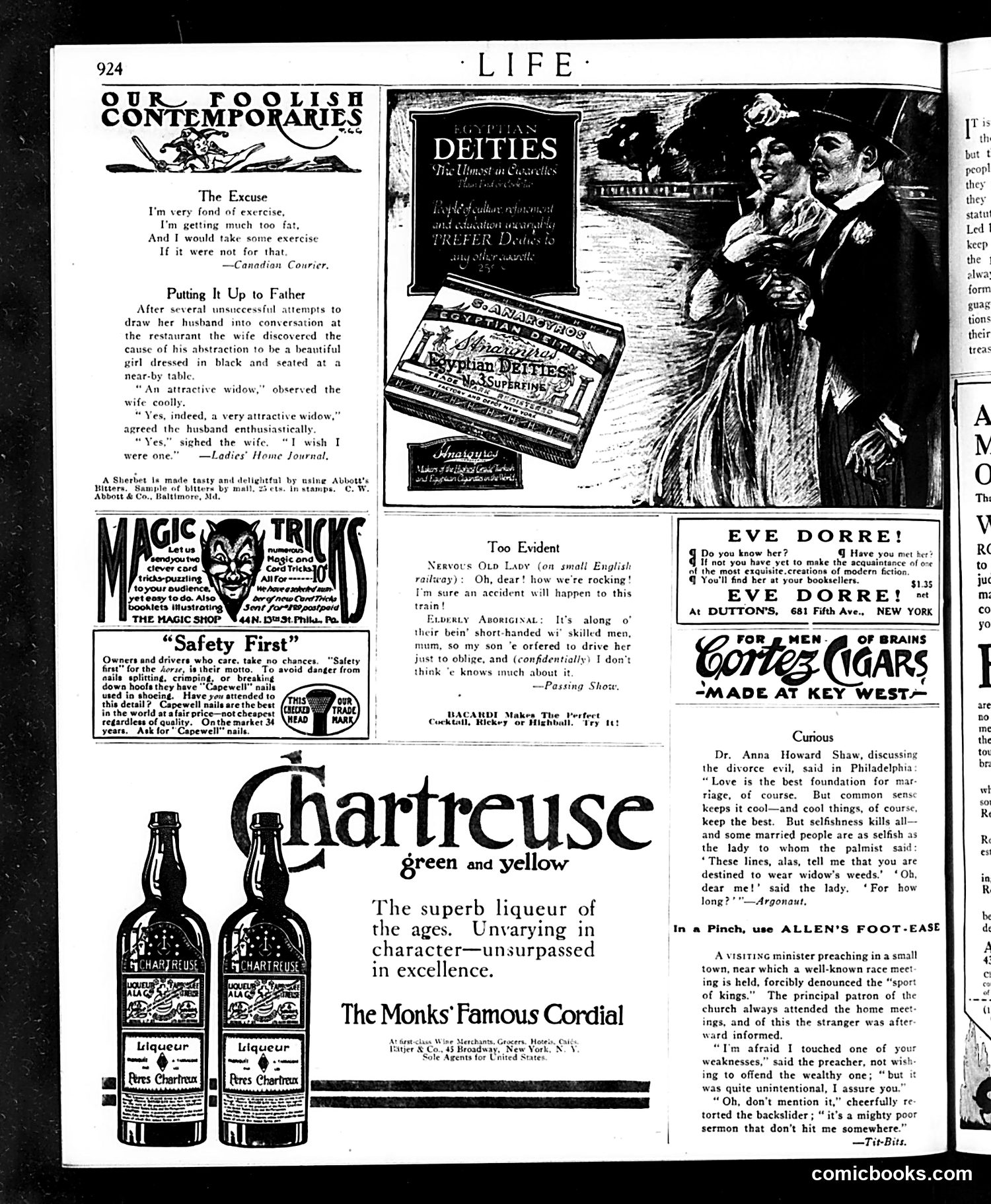
This page is primarily **advertising with satirical humor columns**, typical of Life's format during the 1920s. The main satirical content includes: **"Our Foolish Contemporaries"** — Short jokes mocking common human behaviors: a man avoiding exercise, a husband distracted by an attractive widow, and nervousness about train accidents. **"Too Evident"** — A joke about an elderly woman and her son offering to drive her, with the implication his inexperience makes accidents obvious. **"Safety First"** — A humorous anecdote about a man whose son drives dangerously, subverting workplace safety rhetoric. The page is dominated by **period advertisements** for Chartruse liqueur, Bacardi rum, Cortes cigars, Eve Dorree novels, and other products — standard for Life magazine's revenue model. A final humor piece discusses Dr. Anna Howard Shaw on divorce, and jokes about a minister's sermon inadvertently criticizing a wealthy parishioner's hobby (horse racing). The satire reflects 1920s concerns: marital discord, new automobile dangers, and social class tensions.
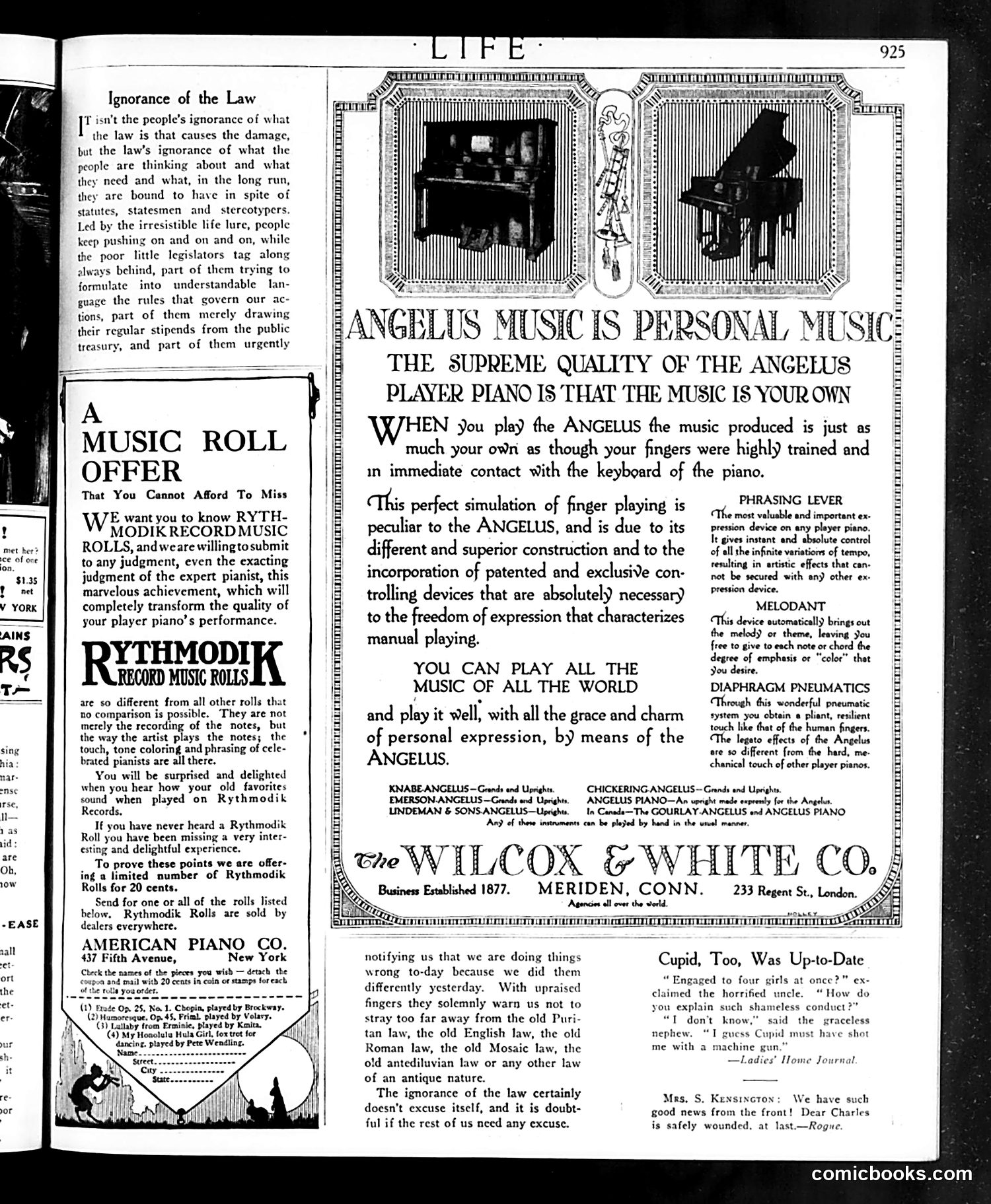
This page combines editorial commentary with period advertisements. The main essay "Ignorance of the Law" argues that legislation fails because lawmakers lag behind public needs and desires—that people's natural progress outpaces legal frameworks, rendering statutes obsolete before implementation. The advertisements promote player pianos (the Angelus and Rythmodik brands), technology that allows non-musicians to reproduce professional pianists' performances. These ads are notably placed beneath an essay about laws failing to keep pace with modern life—an ironic juxtaposition suggesting technological advancement (automatic music playing) represents genuine progress, unlike stagnant legal systems. The page reflects early 20th-century tensions between rapid technological/social change and conservative institutional lag. Player pianos themselves exemplified modernization that disrupted traditional piano manufacturing and music instruction industries.
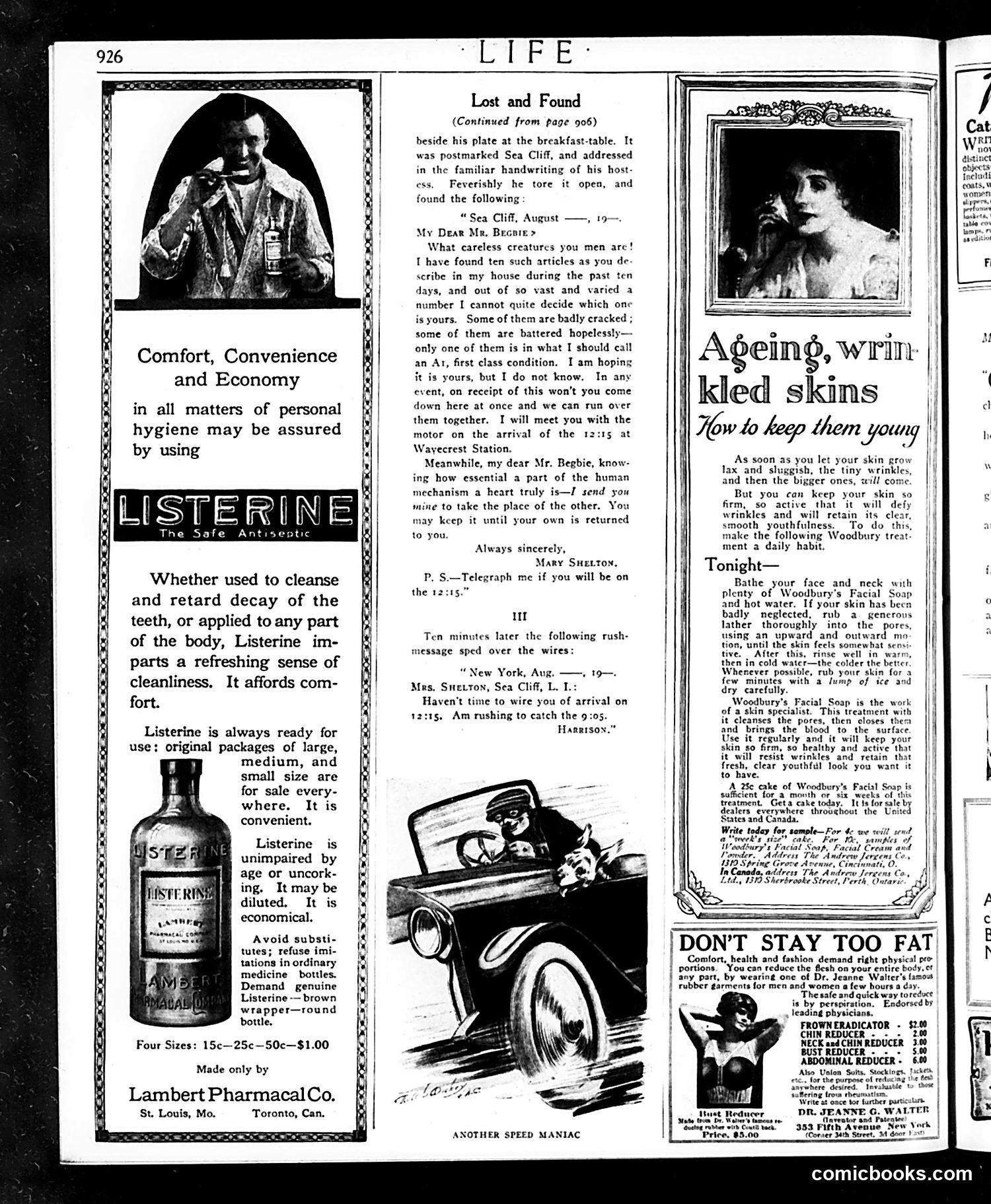
This page contains a serialized romantic comedy story rather than political satire. The narrative involves a man named Mr. Begbie who has left personal items at a woman's house (implied to be romantic trinkets or intimate objects). The hostess, Mary Shelton, writes him a playfully teasing letter saying she's found ten such items and cannot determine which is his—some "badly cracked" or "battered hopelessly." The joke relies on double entendre: she offers to return his "heart" to him, implying romantic interest. A rival suitor, Harrison, rushes to intercept him via telegram, creating comedic romantic rivalry. The surrounding advertisements (Listerine, Woodbury's Facial Soap, weight-reduction garments) are typical period marketing, not part of the satire. This appears to be entertainment fiction for Life's readers rather than political commentary.
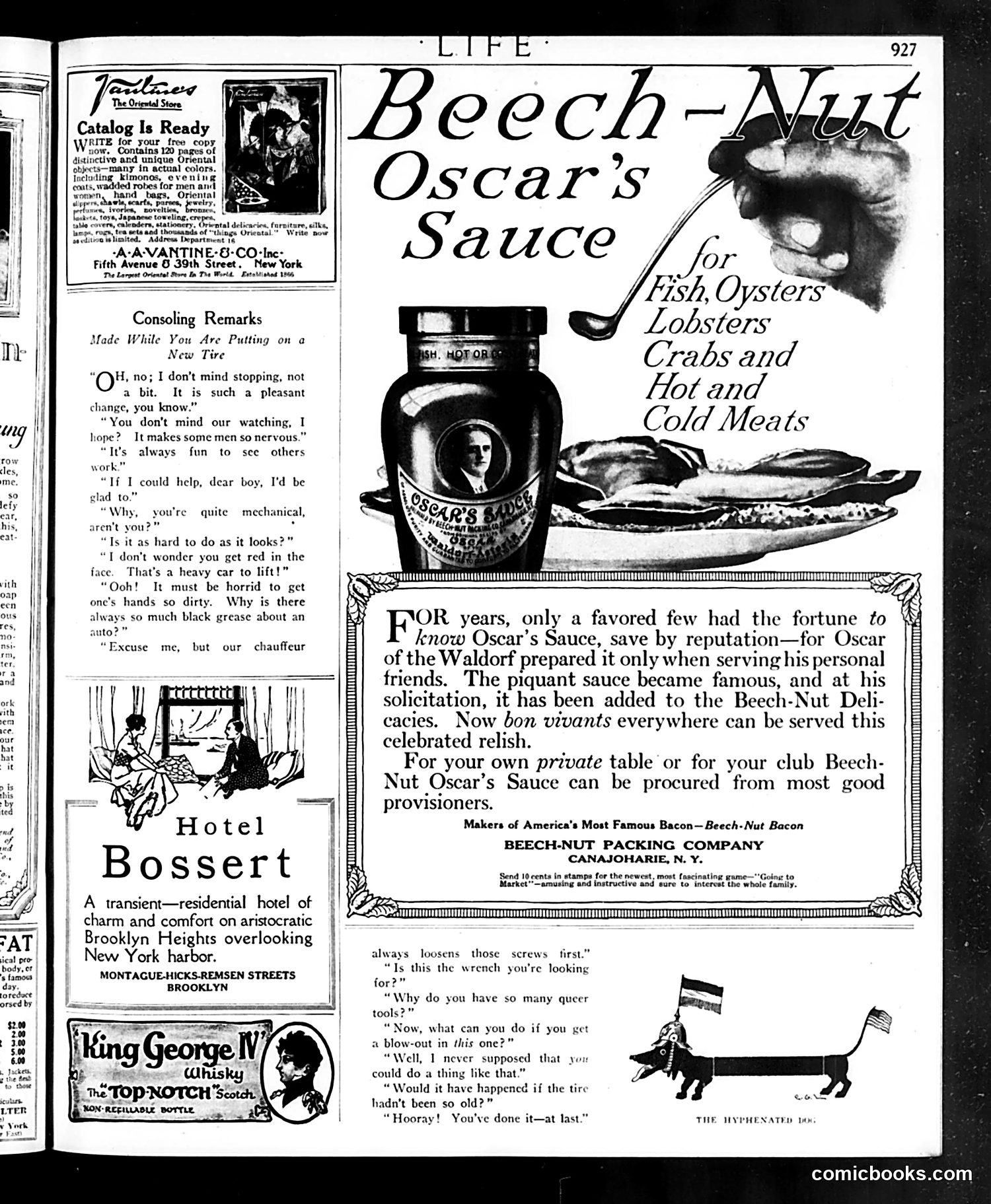
This page contains several distinct advertisements and a satirical piece, typical of *Life* magazine's early 20th-century format. **"Consoling Remarks"** (left column) is a humorous sketch satirizing the annoying behavior of backseat observers while someone changes a car tire. The "consoling remarks" are actually patronizing, intrusive comments that mock both the observer's fake helpfulness and the driver's frustration. The joke targets the social awkwardness of well-meaning bystanders who make manual labor worse through constant commentary. **Main advertisement** (right) promotes Beech-Nut Oscar's Sauce, claiming it was originally made exclusively by "Oscar of the Waldorf" for elite diners and is now commercially available. This appeals to aspirational consumers wanting to serve upscale cuisine at home. **Other ads** include the A-A-Vantine catalog (Oriental goods), Hotel Bossert (Brooklyn Heights lodging), and King George IV whiskey. The page demonstrates *Life*'s mix of satirical social commentary alongside luxury product advertising targeting affluent readers.
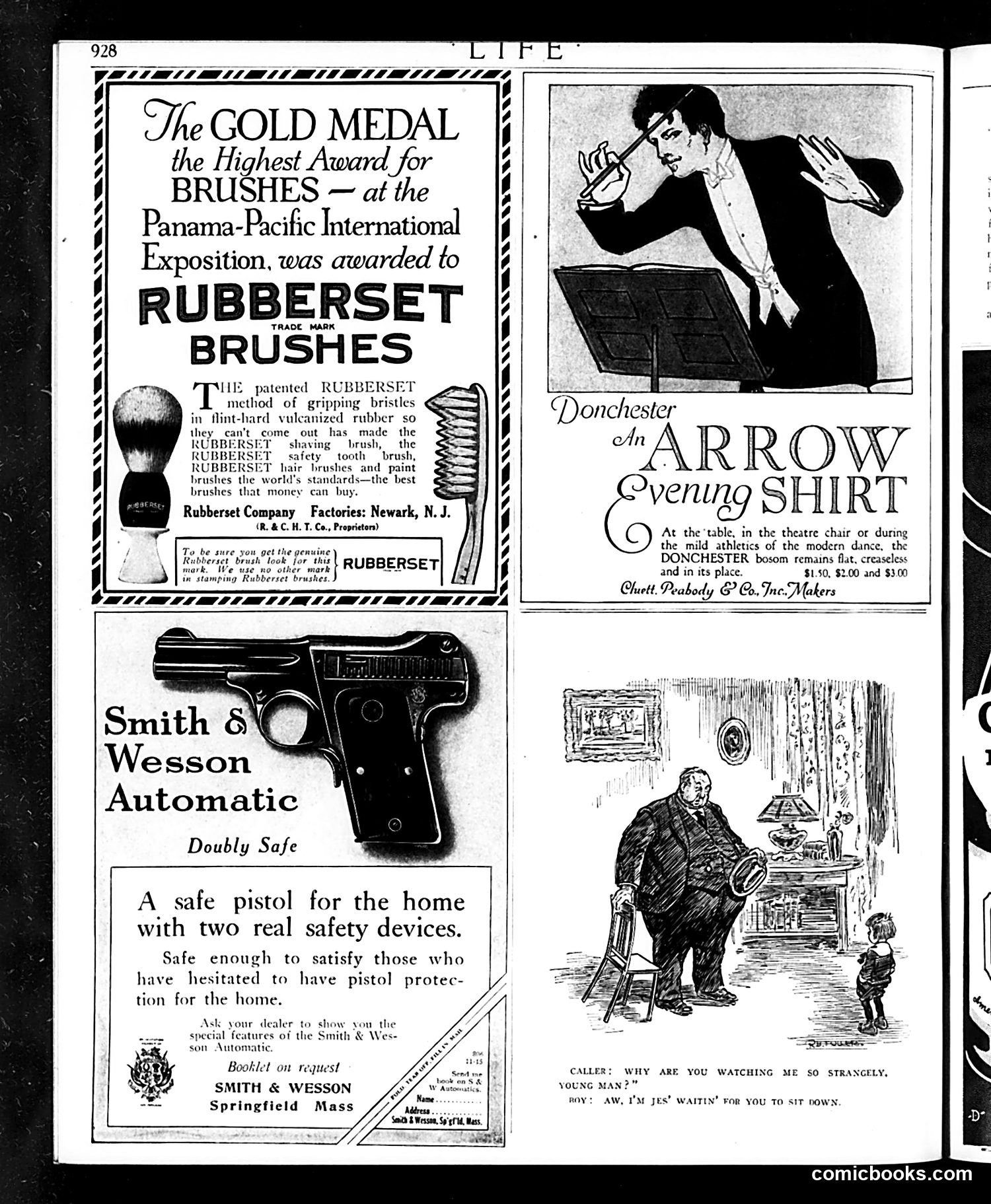
This page consists primarily of **period advertisements** (circa 1915, based on the Panama-Pacific International Exposition reference) with one small **racial humor cartoon** at bottom right. The ads promote consumer goods: Rubberset brushes (winning a gold medal), Donchester Arrow dress shirts (marketed for formal occasions), and Smith & Wesson pistols (pitched as "safe" home protection). The cartoon depicts an elderly white man and a young Black boy. The caption's dialect-heavy dialogue—"JES' WAITIN' FoR YOU TO SIT DOWN"—plays on a racist stereotype about Black people and watermelons, implying the boy is waiting to steal the man's seat to access food. This represents the **casual, normalized racial mockery** typical of early 20th-century American humor magazines, reflecting deeply embedded segregation-era attitudes. The "joke" relies entirely on dehumanizing stereotypes for its effect.
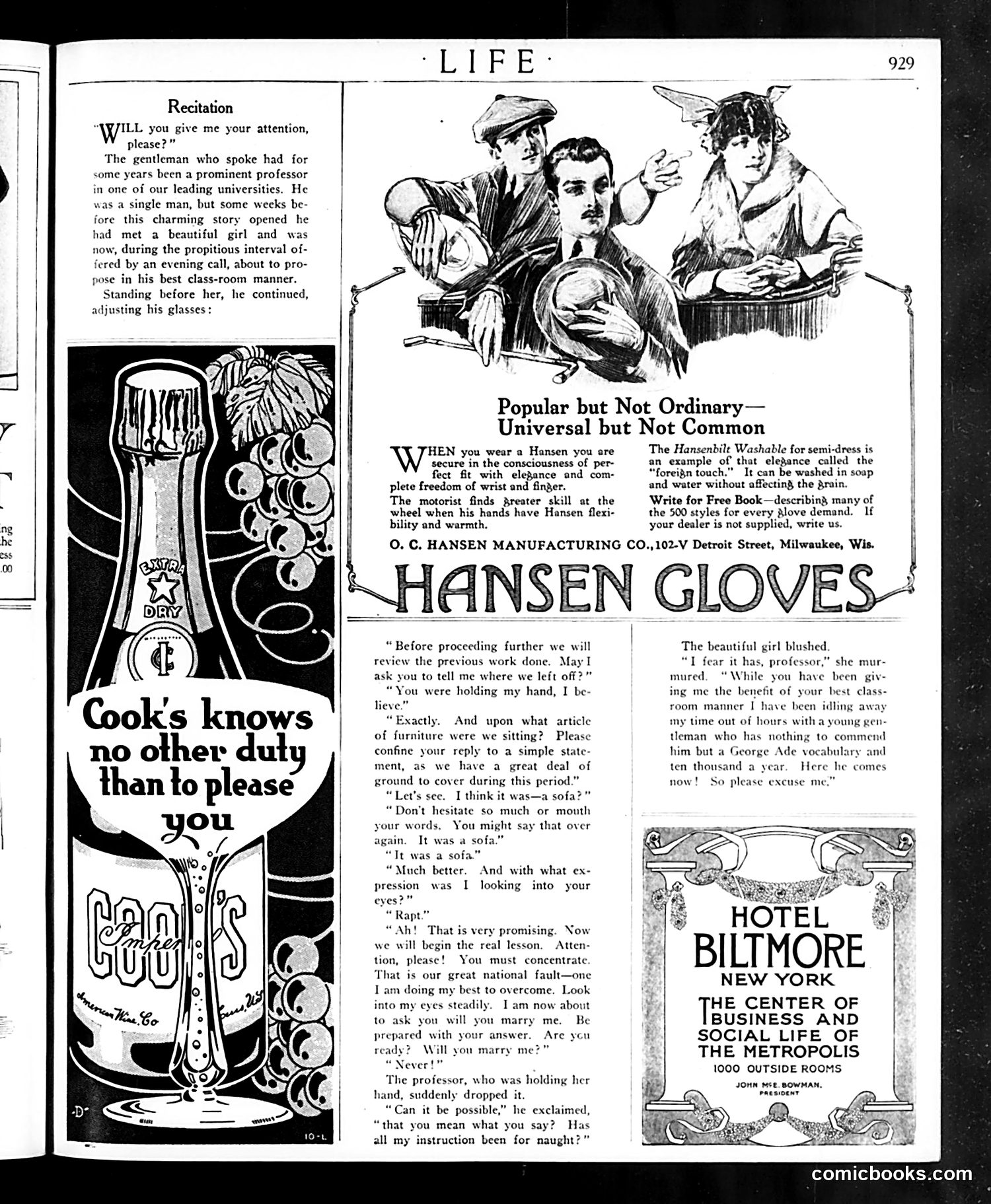
This page contains a humorous short story satirizing academic pomposity and romantic pretense. A university professor attempts to propose to a young woman using the same methodical, pedantic teaching style he employs in the classroom—treating her response like a recitation exercise, complete with corrections and review questions. The joke targets the professor's absurd formality: he quizzes her on their previous interactions ("where did we leave off?") and coaches her on proper expression, demonstrating that his professorial manner is so ingrained he cannot shift into genuine human emotion for romance. The punchline subverts expectations: despite his careful "instruction," the girl rejects him because she's already involved with a wealthy young man (referenced as having "a George Ade vocabulary"—likely meaning unsophisticated speech). The professor's obsession with precision and classroom decorum has left him completely oblivious to actual courtship. The page also includes period advertisements for Hansen Gloves and Cook's Extracts, typical of Life's commercial content.
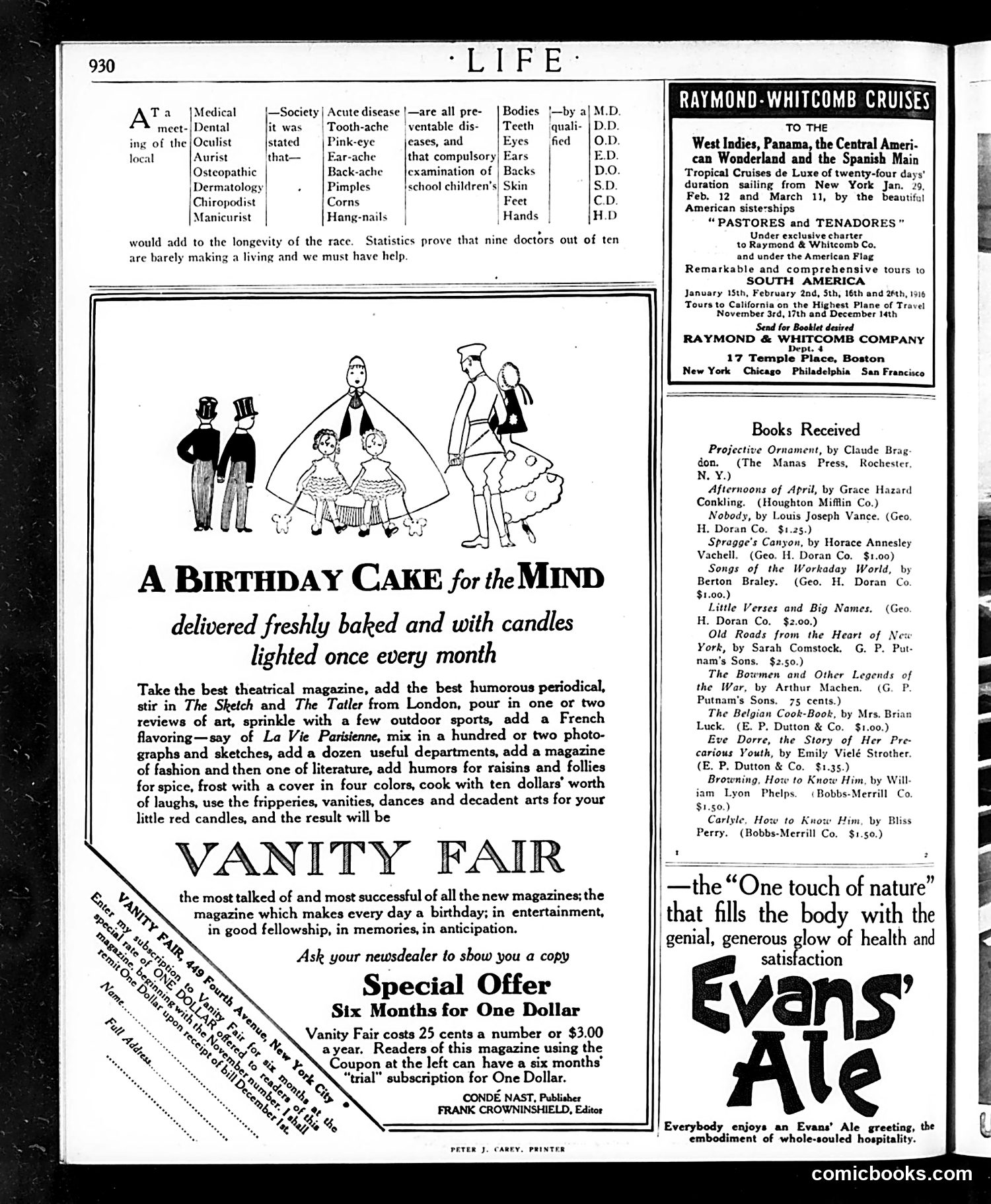
This page is primarily **advertising and book listings**, not satirical editorial content. The top section contains a medical satire diagram showing various doctors (dentist, oculist, osteopath, chiropodist, dermatologist, manicurist) treating different ailments, with text arguing that nine of ten doctors barely earn a living and need support—likely advocating for professionalization or public health measures. The main content features advertisements for: - **Vanity Fair magazine** ("A Birthday Cake for the Mind"), pitched as the premier entertainment publication mixing theatrical, humorous, and fashion content - **Raymond & Whitcomb cruise lines** offering Caribbean and South American luxury voyages - **Evans' Ale** as a health-promoting beverage A "Books Received" section lists contemporary publications (1916-era literature and reference works). The satire is mild—the magazine's self-promotion uses playful metaphor ("birthday cake for the mind") but isn't pointed political commentary. This appears to be a standard magazine page mixing editorial content with period advertising.
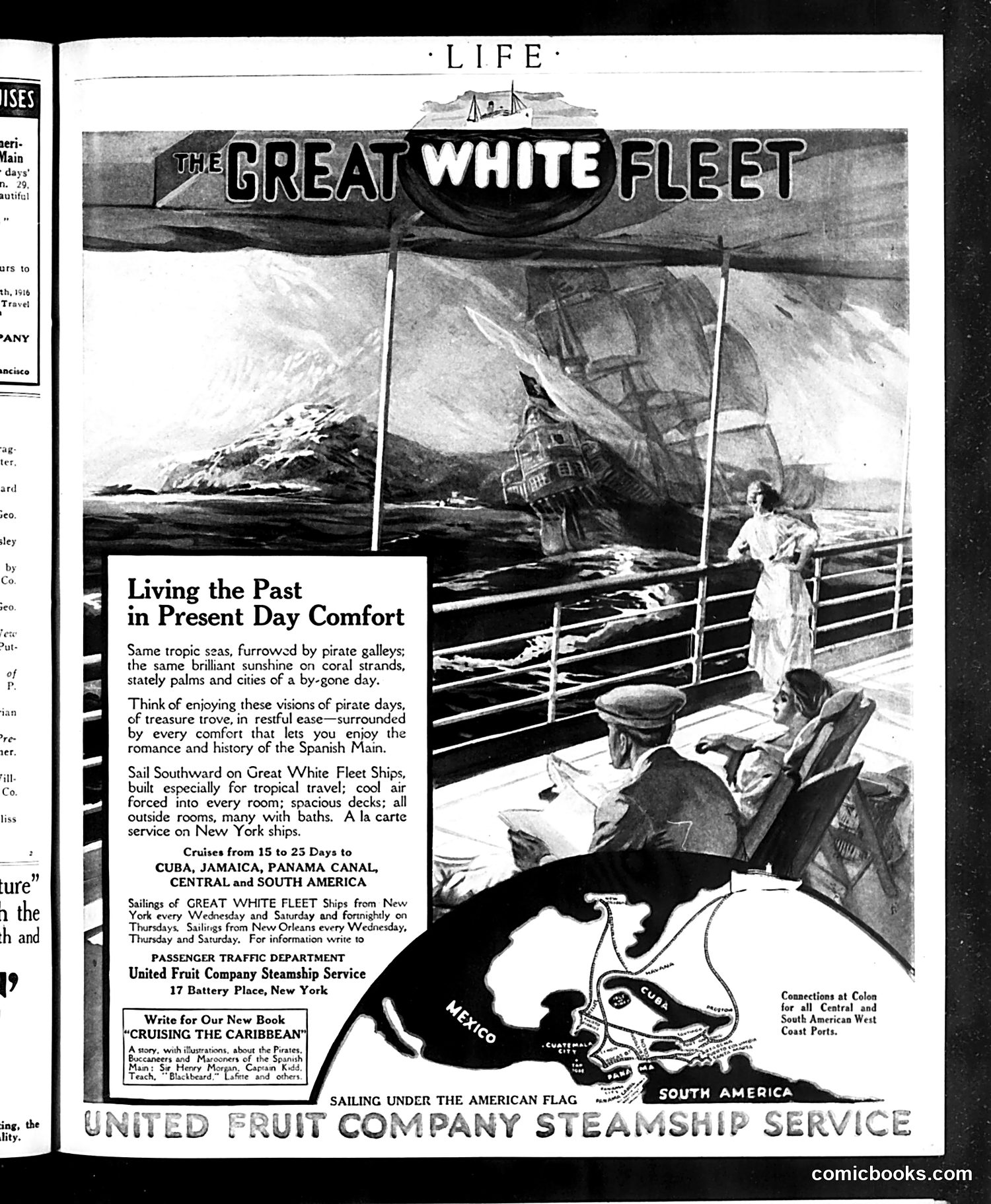
This is primarily a **cruise line advertisement**, not political satire. The United Fruit Company's "Great White Fleet" promotes tropical Caribbean voyages to customers seeking romantic adventure. The appeal is explicitly nostalgic: passengers can experience "pirate days" and "treasure trove" amid "the romance and history of the Spanish Main"—reimagining colonial-era Caribbean piracy as exotic entertainment. The advertisement juxtaposes historical imagery (a wrecked ship, period map of South America) with modern comfort (air conditioning, private baths, à la carte dining). For a modern reader: this reflects early 20th-century tourism marketing that exoticized and romanticized a region's violent colonial past as leisure fantasy. The "living the past in present day comfort" tagline captures the core pitch—historical romance stripped of moral weight, consumed by affluent Americans. There is no evident satire; *Life* magazine is simply running a commercial advertisement.
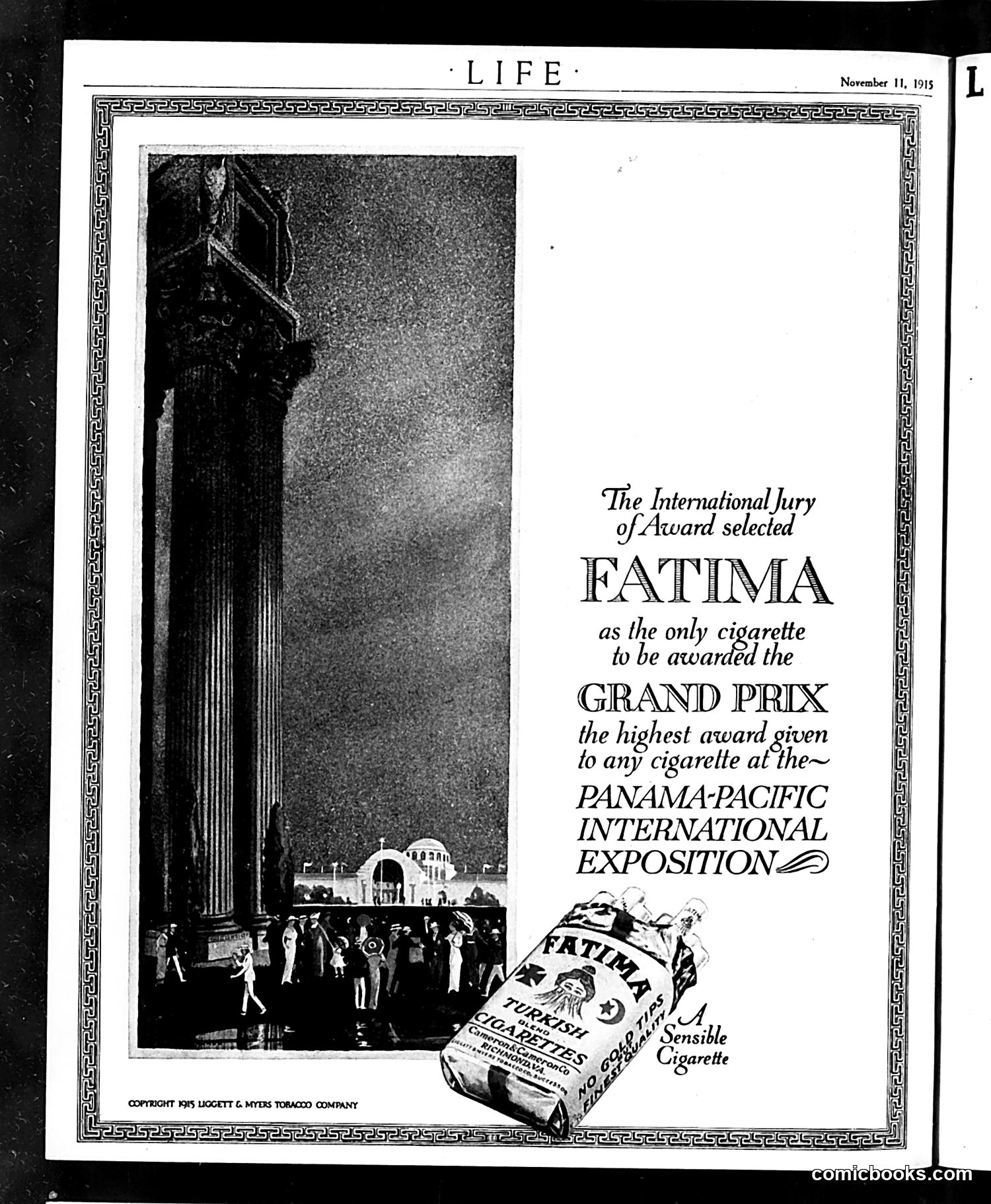
This is an advertisement for Fatima cigarettes from November 1915. It claims that Fatima won the Grand Prix—the highest award for cigarettes—at the Panama-Pacific International Exposition (a real 1915 fair in San Francisco). The page features a classical architectural monument with crowds gathered below, suggesting prestige and international recognition. The cigarette pack is displayed prominently as "A Sensible Cigarette." This is straightforward advertising rather than satire. It leverages the credibility of an international exposition award to market the product as superior. The classical imagery and formal language aim to position Fatima as a quality, refined choice. There is no political commentary or cartoon humor present—it's a commercial endorsement using a real historical event (the exposition) to boost consumer confidence.