
Life, 1915-11-11 · page 20 of 44
Life — November 11, 1915 — page 20: what you’re looking at
What you’re looking at
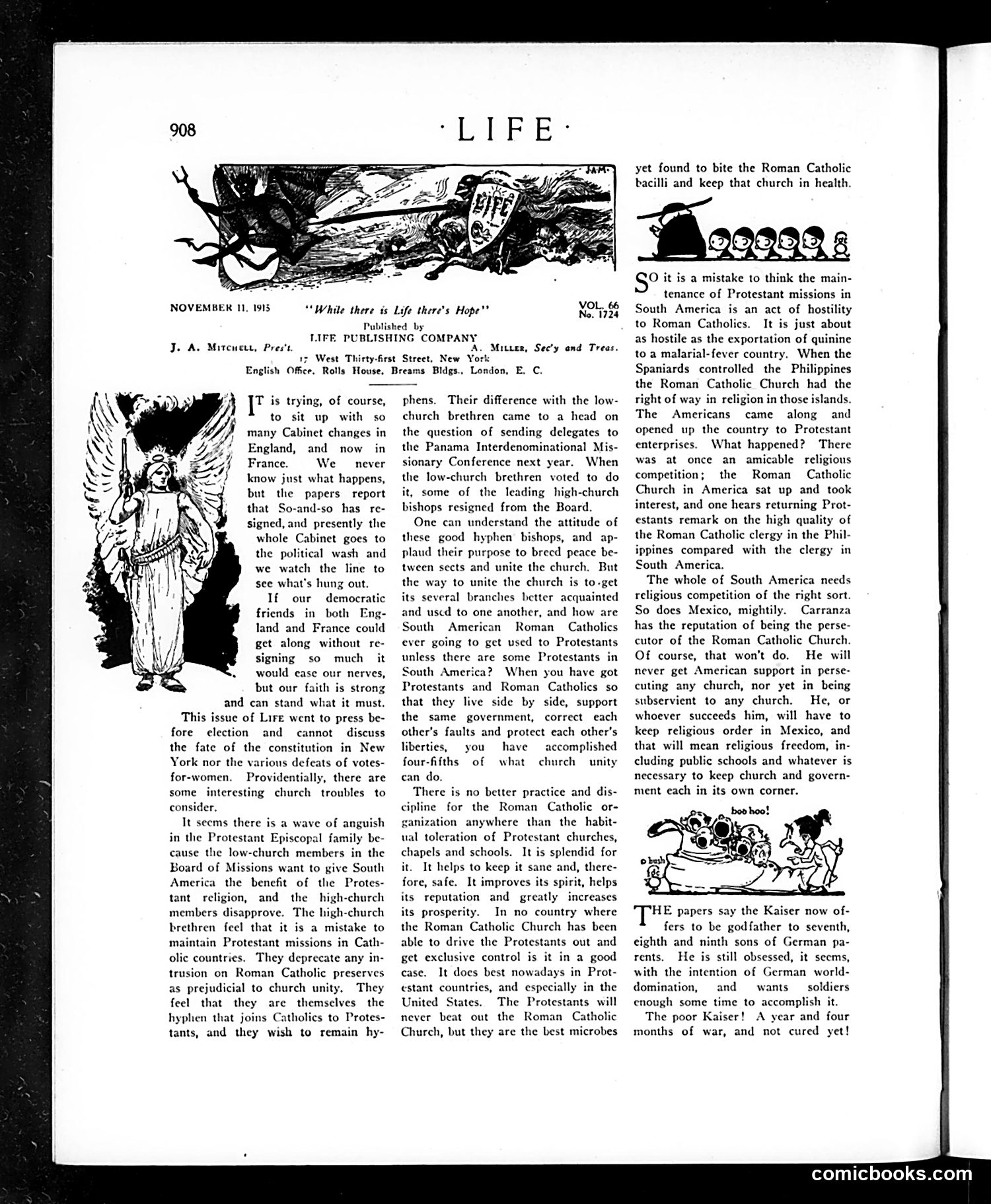
This editorial cartoon and article satirize a dispute within the Protestant Episcopal Church over missionary work in South America. High-church bishops resigned from the Board of Missions, opposing low-church efforts to send Protestant delegates to a Panama missionary conference, fearing it would intrude on Roman Catholic territory and harm "church unity." The author mocks this position, arguing that Protestant-Catholic coexistence actually benefits both faiths. He uses medical metaphors—Protestants as beneficial "microbes" that keep the Catholic Church "healthy" through competition. He cites examples like the Philippines and United States, where religious competition thrives alongside Catholic dominance. The cartoon's angel figure likely represents this idealized interfaith harmony. The piece satirizes the bishops' naïve "hyphen" theology while advocating pragmatic religious pluralism—a modern argument wrapped in 1915's wartime context.
📄 Transcribed text from this page (OCR, searchable)
Machine-transcribed from the original scan — historical spelling and the odd misread are preserved.
NOVEMBER 11, 1915 “While there is Life there's Hope’ Published by LIFE PUBLISHING COMPANY J. A. Mitcnent, Pres't - Mituer, Sec’y and Treas. 17 West Thirty-first Street, New Y English Office, Rolls House, Breams Bldgs., London, E. C. T is trying, of course, to sit up with so many Cabinet changes in England, and now in France. We — never know just what happens, but the papers report that So-and-so has re- signed, and presently the whole Cabinet goes to the political wash and we watch the line to see what's hung out. If our democratic friends in both Eng- land and France could get along without re- signing so much it would case our nerves, but our faith is strong and can stand what it must. This issue of Lire went to press be- fore election and cannot discuss the fate of the constitution in New York nor the various defeats of votes- for-women. Providentially, there are some interesting church troubles to consider, It seems there is a wave of anguish in the Protestant Episcopal family be- cause the low-church members in the Board of Missions want to give South America the benefit of the Protes- tant religion, and the high-church members disapprove. The high-church brethren feel that it is a mistake to maintain Protestant missions in Cath- olic countries. They deprecate any in- trusion on Roman Catholic preserves as prejudicial to church unity. They feel that they are themselves the hyphen that joins Catholics to Protes- tants, and they wish to remain hy- phens. Their difference with the low- church brethren came to a head on the question of sending delegates to the Panama Interdenominational Mis- sionary Conference next year. When the low-church brethren voted to do it, some of the leading high-church bishops resigned from the Board. One can understand the attitude of these good hyphen bishops, and ap- plaud their purpose to breed peace be- tween sects and unite the church. But the way to unite the church is to-get its several branches better acquainted and uscd to one another, and how are South Ameri Roman Catholics ever going to get used to Protestants unless there are some Protestants in South America? When you have got Protestants and Roman Catholics so that they live side by side, support the same government, correct each other’s faults and protect each other's liberties, you have accomplished four-fifths of what church unity can do. There is no better practice and dis- cipline for the Roman Catholic or- ganization anywhere than the habit- ual toleration of Protestant churches, chapels and schools. It is splendid for it. It helps to keep it sane and, there- fore, safe. It improves its spirit, helps its reputation and greatly increases its prosperity. In no country where the Roman Catholic Church has been able to drive the Protestants out and get exclusive control is it in a good case. It docs best nowadays in Prot- ¢stant countries, and especially in the United States. The Protestants will never beat out the Roman Catholic Church, but they are the best microbes yet found to bite the Roman Catholic bacilli and keep that church in health, O it is a mistake to think the main- tenance of Protestant missions in South America is an act of hostility to Roman Catholics. It is just about as hostile as the exportation of quinine to a malarial-fever country. When the Spaniards controlled the Philippines the Roman Catholic Church had the right of way in religion in those islands. The Americans came along and opened up the country to Protestant enterprises. What happened? There was at once an amicable religious competition; the Roman Catholic Church in America sat up and took interest, and one hears returning Prot- estants remark on the high quality of the Roman Catholic clergy in the Phil- ippines compared with the clergy in South America. The whole of South America needs religious competition of the right sort. So does Mexico, mightily. Carranza has the reputation of being the perse- cutor of the Roman Catholic Church. Of course, that won't do. He will never get American support in perse- cuting any church, nor yet in being subservient to any church. He, or whoever succeeds him, will have to keep religious order in Mexico, and that will mean religious freedom, in- cluding public schools and whatever is necessary to keep church and govern- ment each in its own corner. 'HE papers say the Kaiser now of- fers to be godfather to seventh, eighth and ninth sons of German pa- rents. He is still obsessed, it seems, with the intention of German world- domination, and wants _ soldiers cnough some time to accomplish it. The poor Kaiser! A year and four months of war, and not cured yet! comicbooks.com