
Life, 1915-11-11 · page 26 of 44
Life — November 11, 1915 — page 26: what you’re looking at
What you’re looking at
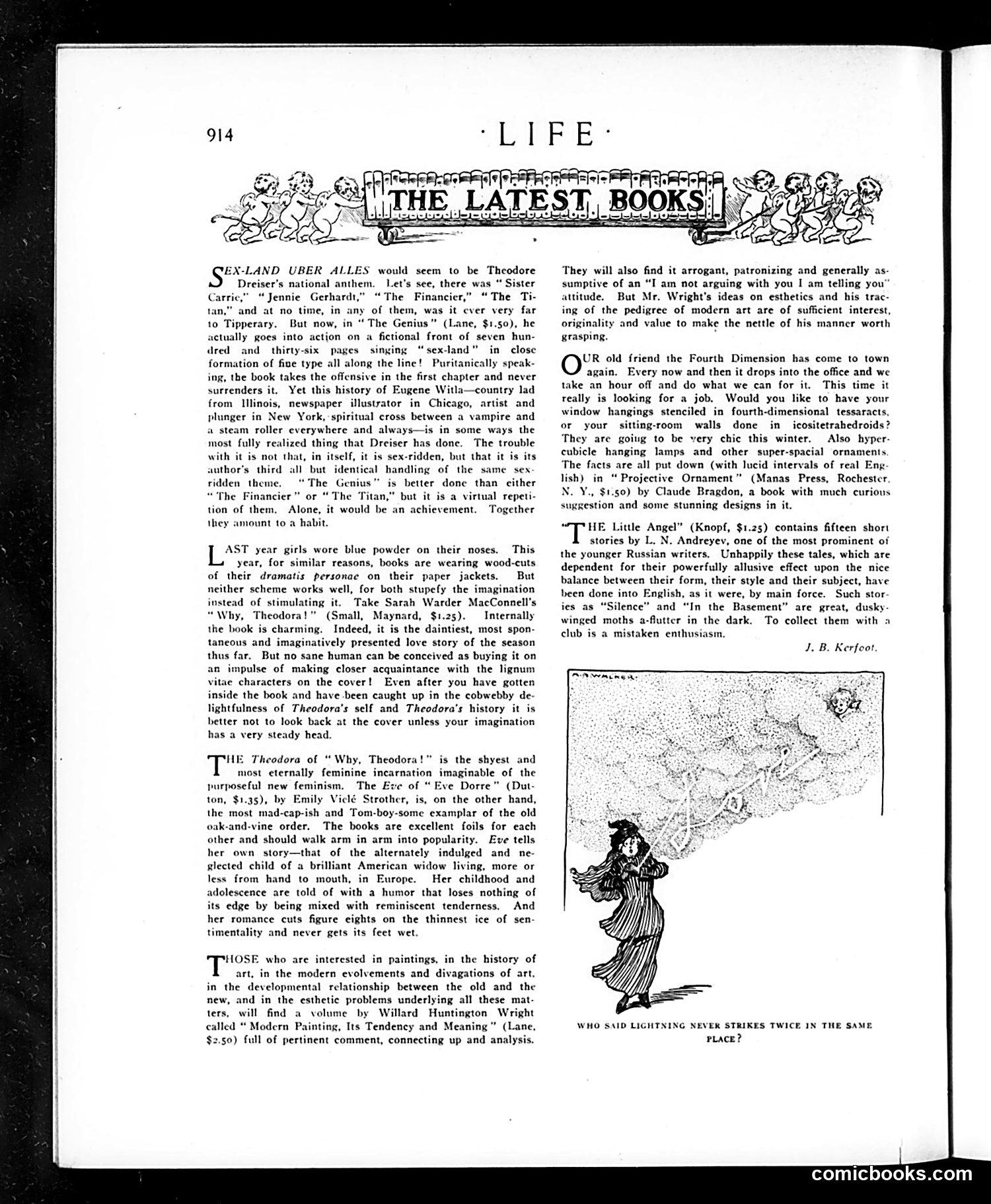
This book review page satirizes Theodore Dreiser's novel *The Genius* through the section header "SEX-LAND UBER ALLES"—a parody of the German nationalist phrase "Deutschland Über Alles," suggesting Dreiser's obsessive focus on sexual themes. The critic notes this is Dreiser's third repetition of essentially identical sex-driven narratives (*The Financier*, *The Titan*, *The Genius*), calling it a "habit" rather than artistic achievement. The cartoon at bottom right, captioned "WHO SAID LIGHTNING NEVER STRIKES TWICE IN THE SAME PLACE?" depicts a figure being struck by lightning—a visual punchline mocking Dreiser's repetitive formula. The page also reviews other books, critiquing poor book jacket design and discussing feminism through contrasting female characters in *Why, Theodora!* and *Eve Dorre*. The satire targets both Dreiser's formulaic approach and broader publishing trends of the era.
📄 Transcribed text from this page (OCR, searchable)
Machine-transcribed from the original scan — historical spelling and the odd misread are preserved.
would seem to be Theodore r’s national anthem. Let's see, there was “ Sister “Jennie Gerhardt,” “The Financier,” “The Ti- and at no time, in any of them, was it ever very far to Tipperary. But now, in “The Genius” (Lane, $1.50), he actually goes into action on a fictional front of seven hun- dred and thirty-six pages singing “sex-land” in close formation of five type all along the line! Puritanically speak- ing, the book takes the offensive in the first chapter and never surrenders it. Yet this history of Eugene Witla—country lad from Illinois, newspaper illustrator in Chicago, artist and plunger in New York, spiritual cross between a vampire and a steam roller everywhere and always—is in some ways the most fully realized thing that Dreiser has done. The trouble with it is not that, in itself, it is sex-ridden, but that it is its author's third all but identical handling of the same sex ridden theme, “The Genius" is better done than cither “The Financier” or “The Titan,” but it is a virtual repeti- tion of them, Alone, it would be an achievement. Together they amount to a habit. X-LAND UBER ALLE. AST year girls wore blue powder on their noses. This year, for similar reasons, books are wearing wood-cuts of their dramatis personae on their paper jackets. But neither scheme works well, for both stupefy the imagination nstead of stimulating it. Take Sarah Warder MacConnell's “Why, Theodora!” (Small, Maynard, $1.25). Internally the book is charming. Indeed, it is the daintiest, most spon- taneous and imaginatively presented love story of the season thus far, But no sane human can be conceived as buying it on an impulse of making closer acquaintance with the lignum vitae characters on the cover! Even after you have gotten inside the book and have been caught up in the cobwebby de- lightfulness of Theodora's self and Theodora’s history it is better not to look back at the cover unless your imagination has a very steady head. HIE Theodora of “ Why, Theodora!” is the shyest and most eternally feminine incarnation imaginable of the purposeful new feminism, The Eve of “ Eve Dorre” (Dut- ton, $1.35), by Emily Viclé Strother, is, on the other hand, the most mad-cap-ish and Tom-boy-some examplar of the old oak-and-vine order, The books are excellent foils for each other and should walk arm in arm into popularity. Eve tells her own story—that of the alternately indulged and ne- glected child of a brilliant American widow living, more or less from hand to mouth, in Europe. Her childhood and adolescence are told of with a humor that loses nothing of its edge by being mixed with reminiscent tenderness. And her romance cuts figure eights on the thinnest ice of sen- timentality and never gets its feet wet. HOSE who are interested in paintings, in the history of art, in the modern evolvements and divagations of art. in the developmental relationship between the old and the new, and in the esthetic problems underlying all these mat- ters, will find a volume by Willard Huntington Wright called “ Modern Painting, Its Tendency and Meaning” (Lane, $2.50) full of pertinent comment, connecting up and analysis. They will also find it arrogant, patronizing and generally as- sumptive of an “I am not arguing with you I am telling you” attitude, But Mr. Wright's ideas on esthetics and his trac- ing of the pedigree of modern art are of sufficient interest, originality and value to make the nettle of his manner worth grasping. . UR old friend the Fourth Dimension has come to town again. Every now and then it drops into the office and we take an hour off and do what we can for it. This time it really is looking for a job. Would you like to have your window hangings stenciled in fourth-dimensional tessaracts, or your sitting-room walls done in icositetrahedroids? They are goiug to be very chic this winter. Also hyper- cubicle hanging lamps and other super-spacial ornaments. The facts are all put down (with lucid intervals of real E lish) in “ Projective Ornament” (Manas Press, Rochester N. Y., $1.50) by Claude Bragdon, a book with much curious suggestion and some stunning designs in it. “THE Little Angel” (Knopf, $1.25) contains fifteen short stories by L. N. Andreyev, one of the most prominent of the younger Russian writers. Unhappily these tales, which are dependent for their powerfully allusive effect upon the nice balance between their form, their style and their subject, have been done into English, as it were, by main force. Such stor ies as “Silence” and “In the Basement” are great, dusky- winged moths a-utter in the dark. To collect them with a club is a mistaken enthusiasm. J. B. Kerfoot. WHO SAID LIGHTNING NEVER STRIKES TWICE IN THE SAME PLACE? comicbooks.com