
Life, 1915-11-11 · page 24 of 44
Life — November 11, 1915 — page 24: what you’re looking at
What you’re looking at
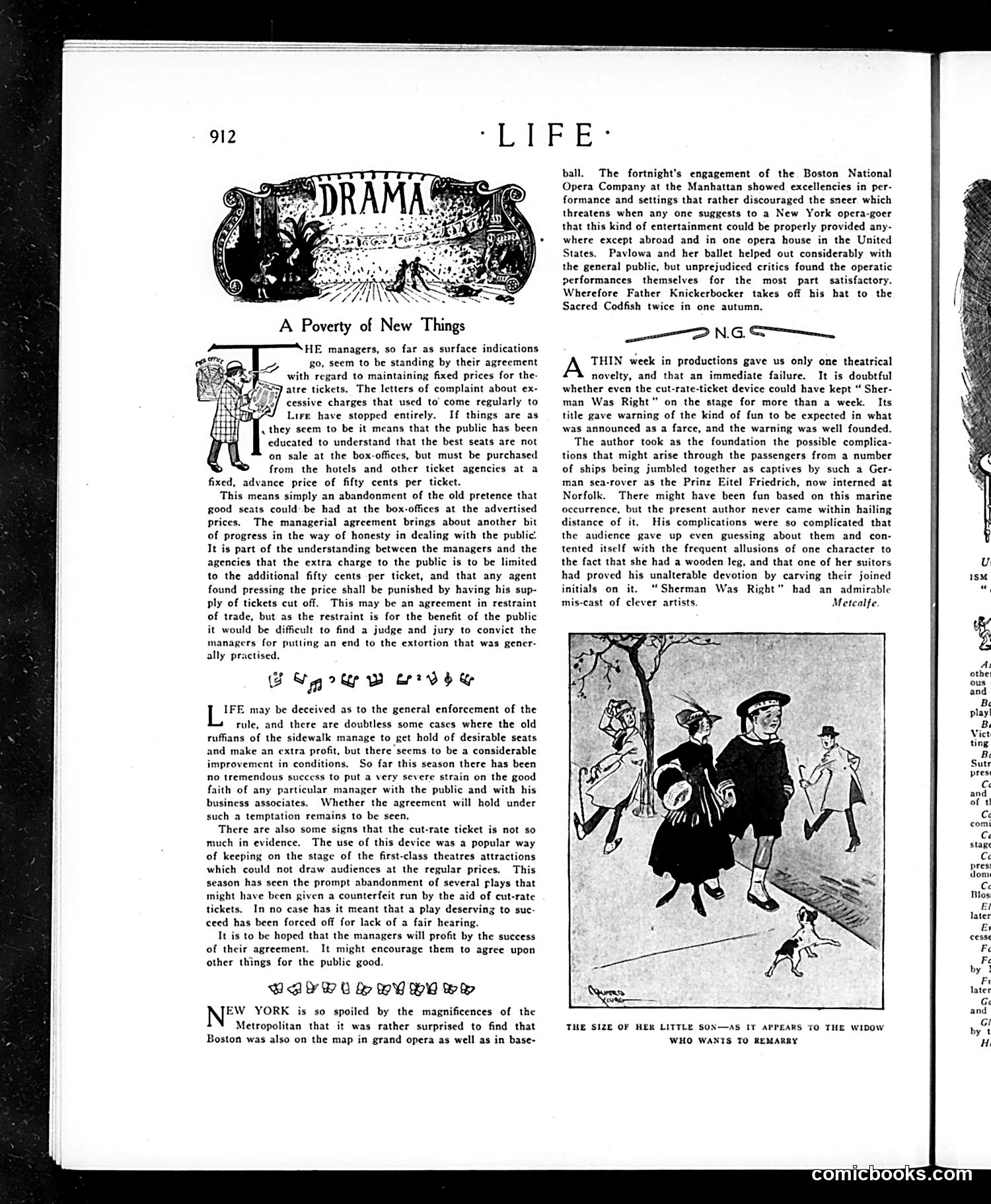
This page critiques Broadway theater management practices and celebrates Boston opera. The main article discusses theater ticket pricing: managers have agreed to maintain fixed prices and limit scalpers' markups to fifty cents per ticket—an honest acknowledgment that premium seats aren't sold at box offices but through hotels and ticket agencies. Life praises this as progress in "honesty in dealing with the public," though it acknowledges enforcement challenges. The accompanying illustration shows three well-dressed figures (likely theater patrons or managers) observing a small boy—a visual joke about theatrical proportions or the diminished quality of current productions (the caption reads "THE SIZE OF HER LITTLE SON"). The page also notes Boston's opera company performed creditably at Manhattan, surprising New York's snobbish assumption that quality entertainment exists only in New York or abroad. A brief theatrical review dismisses a new play called "Sherman Was Right" as an immediate failure.
📄 Transcribed text from this page (OCR, searchable)
Machine-transcribed from the original scan — historical spelling and the odd misread are preserved.
HE managers, so far as surface indications g0, seem to be standing by their agreement with regard to maintaining fixed prices for the cessive charges that used to’ come regularly to Lire have stopped entirely. If things are as «they seem to be it means that the public has been educated to understand that the best seats are not on sale at the box-offices, but must be purchased from the hotels and other ticket agencies at a fixed, advance price of fifty cents per ticket. This means simply an abandonment of the old pretence that good seats could be had at the box-offices at the advertised prices, The managerial agreement brings about another bit of progress in the way of honesty in dealing with the public. It is part of the understanding between the managers and the agencies that the extra charge to the public is to be limited to the additional fifty cents per ticket, and that any agent found pressing the price shall be punished by having his sup- ply of tickets cut off. This may be an agreement in restraint of trade, but as the restraint is for the benefit of the public it would be difficult to find a judge and jury to convict the managers for putting an end to the extortion that was gener- ally practised. BMgrerw vee IFE may be deceived as to the general enforcement of the rule, and there are doubtless some cases where the old ruffians of the sidewalk manage to get hold of desirable seats and make an extra profit, but there seems to be a considerable improvement in conditions, So far this season there has been no tremendous success to put a very severe strain on the good faith of any particular manager with the public and with his business associates. Whether the agreement will hold under such a temptation remains to be seen. There are also some signs that the cut-rate ticket is not so much in evidence. The use of this device was a popular way of keeping on the stage of the first-class theatres attractions which could not draw audiences at the regular prices. This season has seen the prompt abandonment of several plays that might have been given a counterfeit run by the aid of cut-rate tickets, In no case has it meant that a play deserving to suc- ceed has been forced off for lack of a fair hearing. It is to be hoped that the managers will profit by the success of their agreement. It might encourage them to agree upon other things for the public good. BWAYH OH BY BO Swe EW YORK is so spoiled by the magnificences of the Metropolitan that it was rather surprised to find that Boston was also on the map in grand opera as well as in base- ball. The fortnight's engagement of the Boston National Opera Company at the Manhattan showed excellencies in per- formance and settings that rather discouraged the sneer which threatens when any one suggests to a New York opera-goer that this kind of entertainment could be properly provided any- where except abroad and in one opera house in the United States. Pavlowa and her ballet helped out considerably with the general public, but unprejudiced critics found the operatic performances themselves for the most part satisfactory. Wherefore Father Knickerbocker takes off his hat to the Sacred Codfish twice in one autumn. NGS THIN week in productions gave us only one theatrical novelty, and that an immediate failure. It is doubtful whether even the cut-rate-ticket device could have kept “ Sher- man Was Right” on the stage for more than a week. Its title gave warning of the kind of fun to be expected in what was announced as a farce, and the warning was well founded. The author took as the foundation the possible complica- tions that might arise through the passengers from a number of ships being jumbled together as captives by such a Ger- man sea-rover as the Prinz Eitel Friedrich, now interned at Norfolk. There might have been fun based on this marine occurrence, but the present author never came within hailing distance of it. His complications were so complicated that the audience gave up even guessing about them and con- tented itself with the frequent allusions of one character to the fact that she had a wooden leg, and that one of her suitors had proved his unalterable devotion by carving their joined initials on it. “Sherman Was Right” had an admirable mis-cast of clever artists. Metcalfe. THE SIZE OF HER LITTLE SON—AS IT APPEARS TO THE WIDOW WHO WANTS TO REMARRY pres: dom Ccomicbooks.com