
Life, 1915-11-11 · page 18 of 44
Life — November 11, 1915 — page 18: what you’re looking at
What you’re looking at
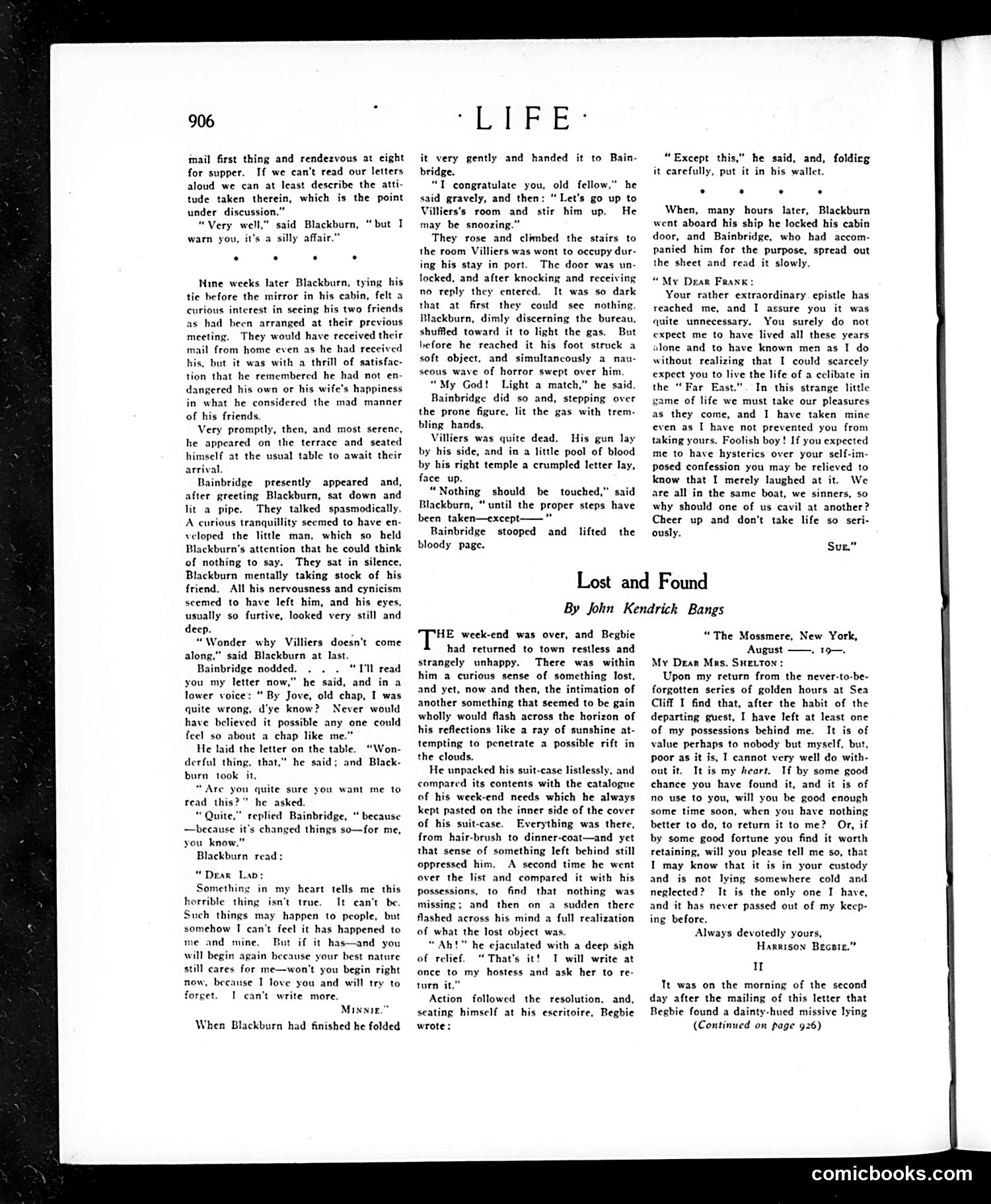
This page contains two literary pieces rather than political cartoons. The main story follows three men—Blackburn, Bainbridge, and Villiers—who agree to share personal letters from home to discuss life's attitudes. The narrative takes a tragic turn: while Blackburn smugly believes himself morally superior for not "endangering" his marriage through some unspecified indiscretion, he discovers Villiers has committed suicide. A crumpled letter lay beside the body. The social satire critiques Victorian-era male self-righteousness and repression. Bainbridge receives a loving letter from his wife forgiving an affair, suggesting emotional honesty strengthens relationships. Meanwhile, Villiers—whose situation remains unclear—chose death over confession. The story suggests that Blackburn's self-congratulatory restraint may be less virtuous than Bainbridge's honest confrontation with his failings. The tragic ending undermines the notion that moral superiority lies in avoiding difficult truths.
📄 Transcribed text from this page (OCR, searchable)
Machine-transcribed from the original scan — historical spelling and the odd misread are preserved.
906 mail first thing and rendezvous at cight for supper. If we can't read our letters aloud we can at least describe the atti- tude taken therein, which is the point under discussion. “Very well,” said Blackburn, “but I warn you, it's a silly affair.” . . . . Nine weeks later Blackburn, tying his tie hefore the mirror in his cabin, felt a curious interest in seeing his two friends as had been arranged at their previous meeting. They would have received their mail from home even as he had received his, but it was with a thrill of satisfac- tion that he remembered he had not en- dangered his own or his wife’s happiness in what he considered the mad manner of his friends. Very promptly, then, and most serene, he appeared on the terrace and seated himself at the usual table to await their arriva Bainbridge presently appeared and, after greeting Blackburn, sat down and lit a pipe. They talked spasmodically, A curious tranquillity seemed to have en- veloped the little man, which so held Blackburn's attention that he could think of nothing to say. They sat in silence, Blackburn mentally taking stock of his friend. All his nervousness and cynicism scemed to have left him, and his eyes, usually so furtive, looked very still and deep. “Wonder why Villiers doesn’t come along.” said Blackburn at last Bainbridge nodded. . . . “I'll read you my letter now,” he said, and in a lower voice: “ By Jove, old chap, I was quite wrong, d'ye know? Never would have believed it possible any one could feel so about a chap like me. He laid the letter on the table. “Won- derful thing, that,” he said; and Black- burn took it. “Are you quite sure you want me to read this?” he asked. “Quite,” replied Bainbridge, “ because —because it’s changed things so—for me, you know. Blackburn read: “Dear Lap: Somethins in my heart tells me this horrible thing isn’t true. It can't be Such things may happen to people, but somehow I can't feel it has happened to me and But if it has—and you will begin again because your best nature still cares for me—won't you begin right now, because I love you and will try to forget. I can't write more. Mixwie.” When Blackburn had finished he folded mine. “DRE it very gently and handed it to Bain- bridge. “T congratulate you, old fellow,” he said gravely, and then: “Let's go up to Villiers’s room and stir him up. He may be snoozing.” They rose and climbed the stairs to the room Villiers was wont to occupy dur- ing his stay in port. The door was un- locked, and after knocking and receiving no reply they entered. It was so dark that at first they could see nothing. Blackburn, dimly discerning the bureau, shuffled toward it to light the gas. But lefore he reached it his foot struck a soft object, and simultancously a nau- seous wave of horror swept over him “My God! Light a match,” he said. Bainbridge did so and, stepping over the prone figure, lit the gas with trem- bling hands. Villiers was quite dead. His gun lay by his side, and in a little pool of blood by his right temple a crumpled letter lay, face up. “Nothing should be touched,” said Blackburn, “ until the proper steps have been taken—except——" Bainbridge stooped and bloody page. lifted the “Except this,” he said, and, foldicg it carefully, put it in his wallet. . . . . When, many hours later, Blackburn went aboard his ship he locked his cabin door, and Bainbridge, who had accom- panied him for the purpose, spread out the sheet and read it slowly. My Dear Frank: Your rather extraordinary. epistle has reached me, and I assure you it was quite unnecessary, You surely do not expect me to have lived all these years alone and to have known men as I do without realizing that I could scarcely expect you to live the life of a celibate in the “Far East.”. In this strange little me of life we must take our pleasures as they come, and I have taken mine even as I have not prevented you from taking yours. Foolish boy! If you expected me to have hysterics over your self-im- posed confession you may be relieved to know that I merely laughed at it. We are all in the same boat, we sinners, so why should one of us cavil at another? Cheer up and don’t take life so seri- ously, Suz.” Lost and Found By John Kendrick Bangs HE week-end was over, and Begbie had returned to town restless and strangely unhappy. There was within him a curious sense of something lost, and yet, now and then, the intimation of another something that seemed to be gain wholly would flash across the horizon of his reflections like a ray of sunshine at- tempting to penetrate a possible rift in the clouds. He unpacked his suit-case listlessly, and compared its contents with the catalogue of his week-end needs which he always kept pasted on the inner side of the cover of his suit-case. Everything was there, from hair-brush to dinner-coat—and yet that sense of something left behind still oppressed him. A second time he went over the list and compared it with his possessions, to find that nothing was missing; and then on a sudden there flashed across his mind a full realization of what the lost object was. “Ah!” he ejaculated with a deep sigh of relief. “That's it! T will write at once to my hostess and ask her to re- turn it. Action followed the resolution, and, seating himself at his escritoire, Begbie wrote: “The Mossmere, New York, August ——. 19—. My Dear Mrs. Suexton : Upon my return from the never-to-be- forgotten series of golden hours at Sea Cliff I find that, after the habit of the departing guest, I have left at least one of my possessions behind me. It is of value perhaps to nobody but myself, but, poor as it is, I cannot very well do with- out it. It is my heart. If by some good chance you have found it, and it is of no use to you, will you be good enough some time soon, when you have nothing better to do, to return it to me? Or, if by some good fortune you find it worth retaining, will you please tell me so, that I may know that it is in your custody and is not lying somewhere cold and neglected? It is the only one I have, and it has never passed out of my kecp- ing before. Always devotedly yours, Harrison Becote.” Ir Tt was on the morning of the second day after the mailing of this letter that Regbie found a dainty-hued missive lying (Continued on page 926) comicbooks.com