
Life, 1915-11-11 · page 17 of 44
Life — November 11, 1915 — page 17: what you’re looking at
What you’re looking at
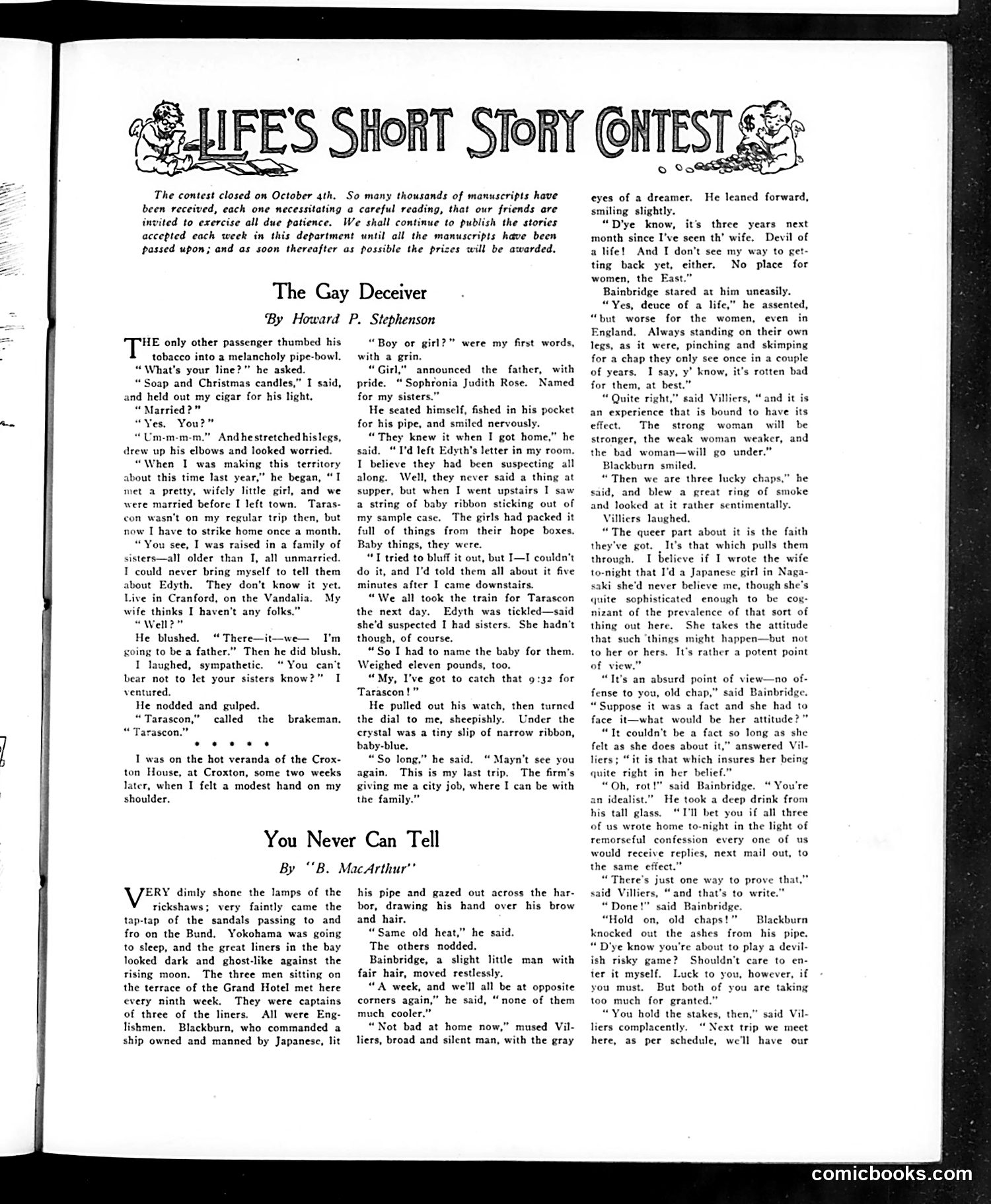
This page presents two short stories from Life's fiction contest (closed October 4th). **"The Gay Deceiver"** by Howard P. Stephenson tells of a traveling salesman who secretly married and fathered a child while hiding his wife from his unmarried older sisters. The humor derives from the social awkwardness of his deception and the eventual discovery—his sisters learn the truth, accept it warmly, and help name the baby. The protagonist abandons his duplicitous traveling life for a steady city job. **"You Never Can Tell"** by "B. MacArthur" appears to be the beginning of a story set in Yokohama, featuring three English ship captains meeting regularly at the Grand Hotel. The narrative establishes an exotic setting and suggests upcoming plot development, though the page cuts off mid-story. Both stories reflect early 20th-century concerns: family obligation, marital secrecy, and professional ambition. The page itself documents Life's literary contest, inviting reader submissions and promising to publish accepted stories weekly.
📄 Transcribed text from this page (OCR, searchable)
Machine-transcribed from the original scan — historical spelling and the odd misread are preserved.
«SAIEES S The contest closed on October 4th. So many thousands of manuscripts have been received, each one necessitating a careful reading, that our friends are invited to exercise all due patience. We shall continue to publish the stories accepted each week in this department until all the manuscripts have been passed upon; and as soon thereafter as possible the prizes will be awarded. The Gay Deceiver By Howard HE only other passenger thumbed his tobacco into a melancholy pipe-bowl. “What's your line?” he asked. “ Soap and Christmas candles,” I said, and held out my cigar for his light. “ Married?” “Yes. You?” “Um-m-m-m.” Andhestretchedhislegs, drew up his elbows and looked worried. “When I was making this territory about this time last year,” he began, “T met a pretty, wifely little girl, and we were married before I left town. Taras- con wasn't on my regular trip then, but now I have to strike home once a month, “You see, I was raised in a family of sisters—all older than I, all unmarried. I could never bring myself to tell them about Edyth, ‘They don't know it yet. Live in Cranford, on the Vandalia. My wife thinks I haven’t any folks.” “Well?” He blushed. “There—it—we— I'm going to be a father.” Then he did blush, I laughed, sympathetic. “You can't bear not to let your sisters know?” I ventured. He nodded and gulped. “Tarascon,” called the “ Tarascon.” brakeman, ee eee T was on the hot veranda of the Crox- ton House, at Croxton, some two weeks later, when I felt a modest hand on my shoulder. P. Stephenson “Boy or girl?” were my first words, with a grin. “Girl,” announced pride. “Sophronia Judith Rose. for my sisters.” He seated himself, fished in his pocket for his pipe, and smiled nervously. “They knew it when I got home,” he said. “I'd left Edyth’s letter in my room. I believe they had been suspecting all along. Well, they never said a thing at supper, but when I went upstairs I saw a string of baby ribbon sticking out of my sample case, The girls had packed it full of things from their hope boxes. Baby things, they were. “T tried to bluff it out, but IAT couldn't do it, and I'd told them all about it five minutes after I came downstairs. “We all took the train for Tarascon the next day. Edyth was tickled—said she'd suspected I had sisters. She hadn't though, of course. “So I had to name the baby for them. Weighed eleven pounds, too. “My, I've got to catch that 9:32 for Tarascon!” He pulled out his watch, then turned the dial to me, sheepishly. Under the crystal was a tiny slip of narrow ribbon, baby-blue. “So long,” he said. “ Mayn’t see you again. This is my last trip. The firm’s giving me a city job, where I can be with the family.” the father, with Named You Never Can Tell By “B. MacArthur’’ ERY dimly shone the lamps of the rickshaws; very faintly came the tap-tap of the sandals passing to and fro on the Bund. Yokohama was going to sleep, and the great liners in the bay looked dark and ghost-like against the rising moon. The three men sitting on the terrace of the Grand Hotel met here every ninth week. They were captains of three of the liners. All were Eng- men. Blackburn, who commanded a ship owned and manned by Japanese, lit his pipe and gazed out across the har- bor, drawing his hand over his brow and hair. “Same old heat,” he said. The others nodded. Bainbridge, a slight little man with fair hair, moved restlessly. “A week, and we'll all be at opposite corners again,” he said, “none of them much cooler.” “Not bad at home now,” mused Vi liers, broad and silent man, with the gray HORT STORY @NTES eyes of a dreamer. He leaned forward, smiling slightly. “D'ye know, it’s three years next month since I've seen th’ wife, Devil of a life!’ And I don’t see my way to get- ting back yet, either. No place for women, the East.” Bainbridge stared at him uneasily. “Yes, deuce of a life,” he assented, “but worse for the women, even in England, Always standing on their own legs, as it were, pinching and skimping for a chap they only see once in a couple of years, I say, y' know, it’s rotten bad for them, at best. “ Quite right,” said Villiers, “and it is an experience that is bound to have its effect. The strong woman will be stronger, the weak woman weaker, and ¢ bad woman—will go unde Blackburn smiled. “Then we are three lucky chaps,” he said, and blew a great ring of smoke and looked at it rather sentimentally. Villiers laughed. “The queer part about it is the faith they've got. It’s that which pulls them through. I believe if I wrote the wife to-night that I'd a Japanese girl in N: saki she'd never believe me, though she's quite sophisticated enough to be cox- nizant of the prevalence of that sort of thing out here. She takes the attitude that such ‘things might happen—but not to her or hers. It's rather a potent point of view.” “It's an absurd point of view—no of- fense to you, old chap,” said Bainbridge. “Suppose it was a fact and she had to face it—what would be her attitude?” “Tt couldn't be a fact so long as she felt as she does about it,” answered Vil- liers; “it is that which insures her being quite right in her belief. “Oh, rot!" said Bainbridge. “ You're an idealist.” He took a deep drink from his tall glass. “I'll bet you if all three of us wrote home to-night in the light of remorseful confession every one of us would receive replies, next mail out, to the same ” “There's just one way to prove that,” said Villiers, “and that’s to write. “Done!” said Bainbridge. “Hold on, old chaps Blackburn knocked out the ashes from his pipe. “ D'ye know you're about to play a devil- ish risky game? Shouldn't care to en- ter it myself. Luck to you, however, if you must. But both of you are taking too much for granted.” “You hold the stakes, then,” said Vil- liers complacently. “ Next trip we meet here, as per schedule, we'll have our fect. comicbooks.com