
Life, 1915-11-11 · page 32 of 44
Life — November 11, 1915 — page 32: what you’re looking at
What you’re looking at
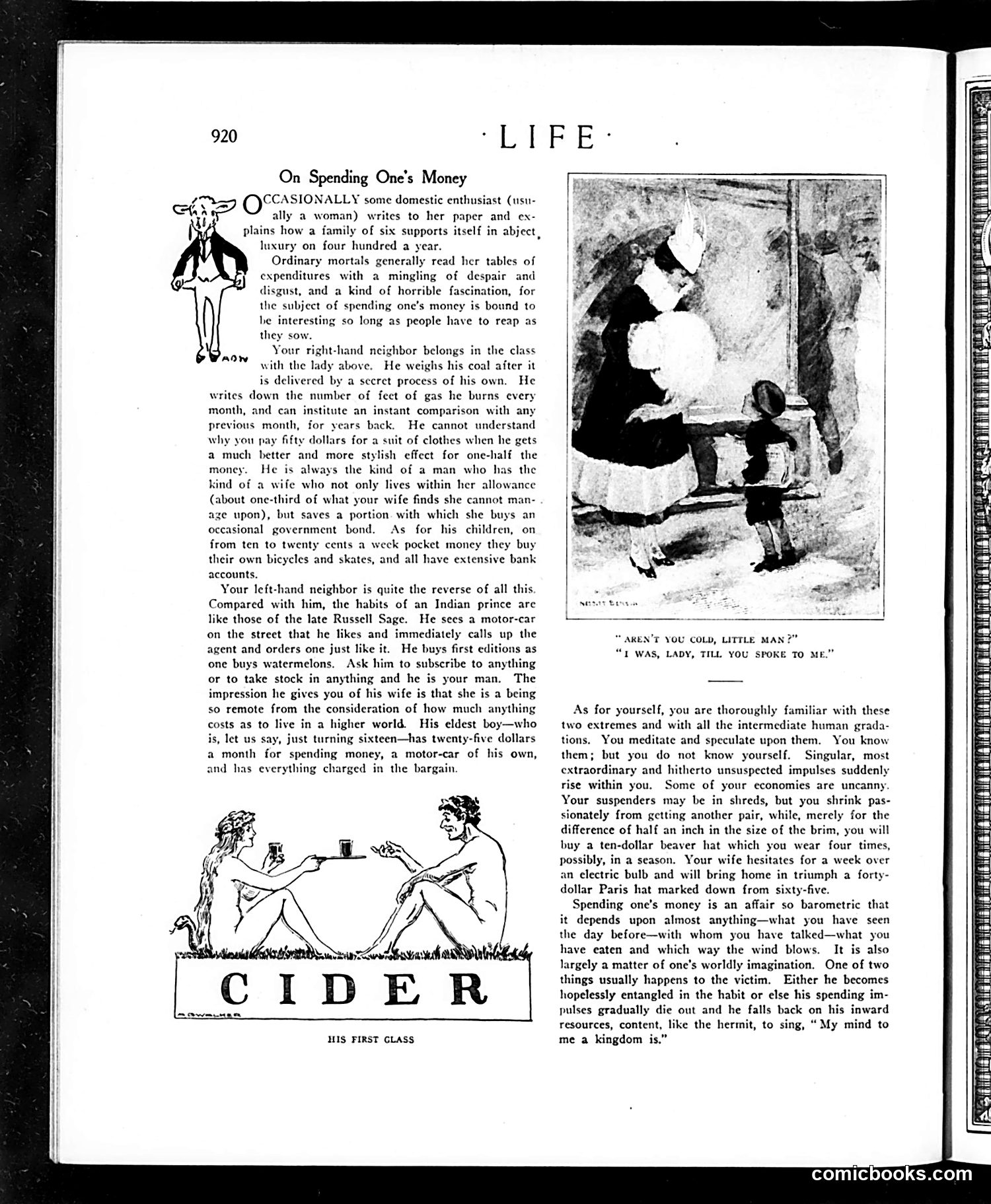
This page satirizes middle-class attitudes toward personal finances through character types. The article contrasts two neighbors: **The Right-Hand Neighbor**: A penny-pincher who meticulously tracks utilities, buys cheap clothes, and raises children on pittances—yet his wife somehow saves money for government bonds. He represents joyless frugality. **The Left-Hand Neighbor**: A spendthrift who impulsively buys luxury cars, rare books, and gives his teenage son a motorcar and $25 monthly allowance. His wife is so detached from costs she lives in "a higher world." The satire's point: spending habits are irrational and contradictory. The author notes that people themselves don't understand their own financial impulses—we obsess over suspenders but splurge on fancy hats; wives agonize over light bulbs then buy $40 Paris hats. The small cartoon "His First Class" and accompanying dialogue appear unrelated advertising or filler. The overall message mocks American middle-class anxiety about money and the gap between aspirations and actual behavior.
📄 Transcribed text from this page (OCR, searchable)
Machine-transcribed from the original scan — historical spelling and the odd misread are preserved.
On Spending One’s Money CCASIONALLY some domestic enthusiast (usu- ally a woman) writes to her paper and ex- plains how a family of six supports itself in abject, luxury on four hundred a year. Ordinary mortals generally read her tables of expenditures with a mingling of despair and disgust, and a kind of horrible fascination, for the subject of spending one’s moncy is bound to he interesting so long as people have to reap as they sow. Your right-hand neighbor belongs in the class with the lady above. He weighs his coal after it is delivered by a sceret process of his own. He writes down the number of fect of gas he burns every month, and can institute an instant comparison with an: previous month, for years back. He cannot understand why you pay fifty dollars for a suit of clothes when he gets a much better and more stylish effect for one-half the money. He is always the kind of a man who has the kind of a wife who not only lives within her allowance (about one-third of what your wife finds she cannot man- age upon), but saves a portion with which she buys an occasional government bond. As for his children, on from ten to twenty cents a wi pocket money they buy their own bicycles and skates, and all have extensive bank accounts, Your left-hand neighbor is quite the reverse of all this. Compared with him, the habits of an Indian prince are like those of the late Russell Sage. He secs a motor-car on the street that he likes and immediately calls up the agent and orders one just like it. He buys first editions as one buys watermelons. Ask him to subscribe to anything or to take stock in anything and he is your man. The impression he gives you of his wife is that she is a being so remote from the consideration of how much anything costs as to live in a higher world. His eldest boy—who is, let us say, just turning sixteen—has twenty-five dollars a month for spending money, a motor-car of his own, and has everything charged in the bargain. AoW HIS FIRST GLASS “AREN'T YOU COLD, LITTLE MAN?” “1 WAS, LADY, TILL YOU SPOKE TO ME.” As for yourself, you are thoroughly familiar with these two extremes and with all the intermediate human grada- tions. You meditate and speculate upon them. You know ther but you do not know yourself. Singular, most extraordinary and hitherto unsuspected impulses suddenly rise within you. Some of your economies are uncanny. Your suspenders may be in shreds, but you shrink pas- sionately from getting another pair, while, merely for the difference of half an inch in the size of the brim, you will buy a ten-dollar beaver hat which you wear four times, possibly, in a season. Your wife hesitates for a week over an electric bulb and will bring home in triumph a forty- dollar Paris hat marked down from sixty-five. Spending one’s money is an affair so barometric that it depends upon almost anything—what you have seen the day before—with whom you have talked—what you have eaten and which way the wind blows. It is also largely a matter of one’s worldly imagination. One of two things usually happens to the victim. Either he becomes hopelessly entangled in the habit or else his spending im- pulses gradually die out and he falls back on his inward resources, content, like the hermit, to sing, “My mind to me a kingdom is.’ WA UB UG ue yau: comicbooks.com