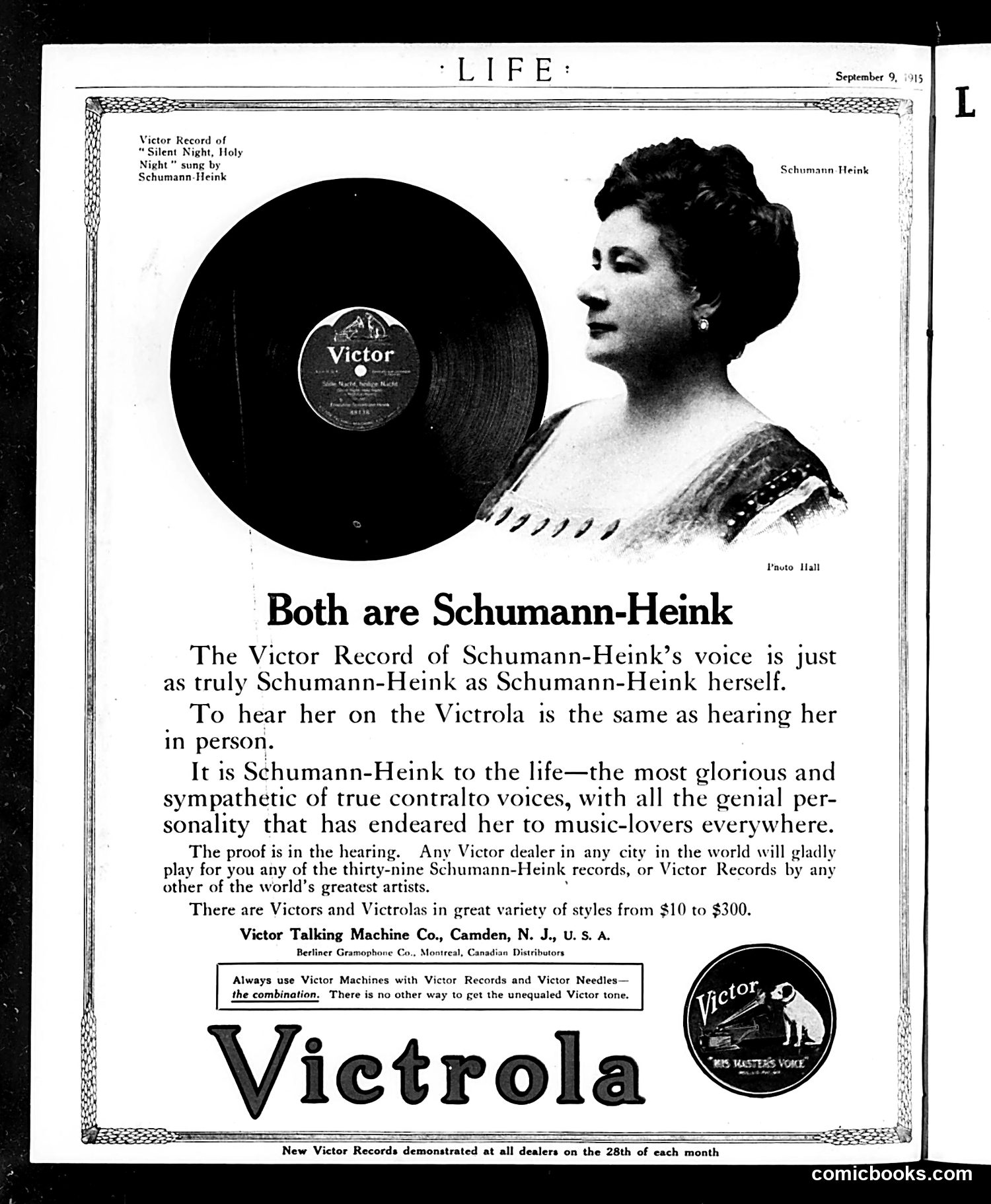
A complete issue · 44 pages · 1915
Life — September 9, 1915
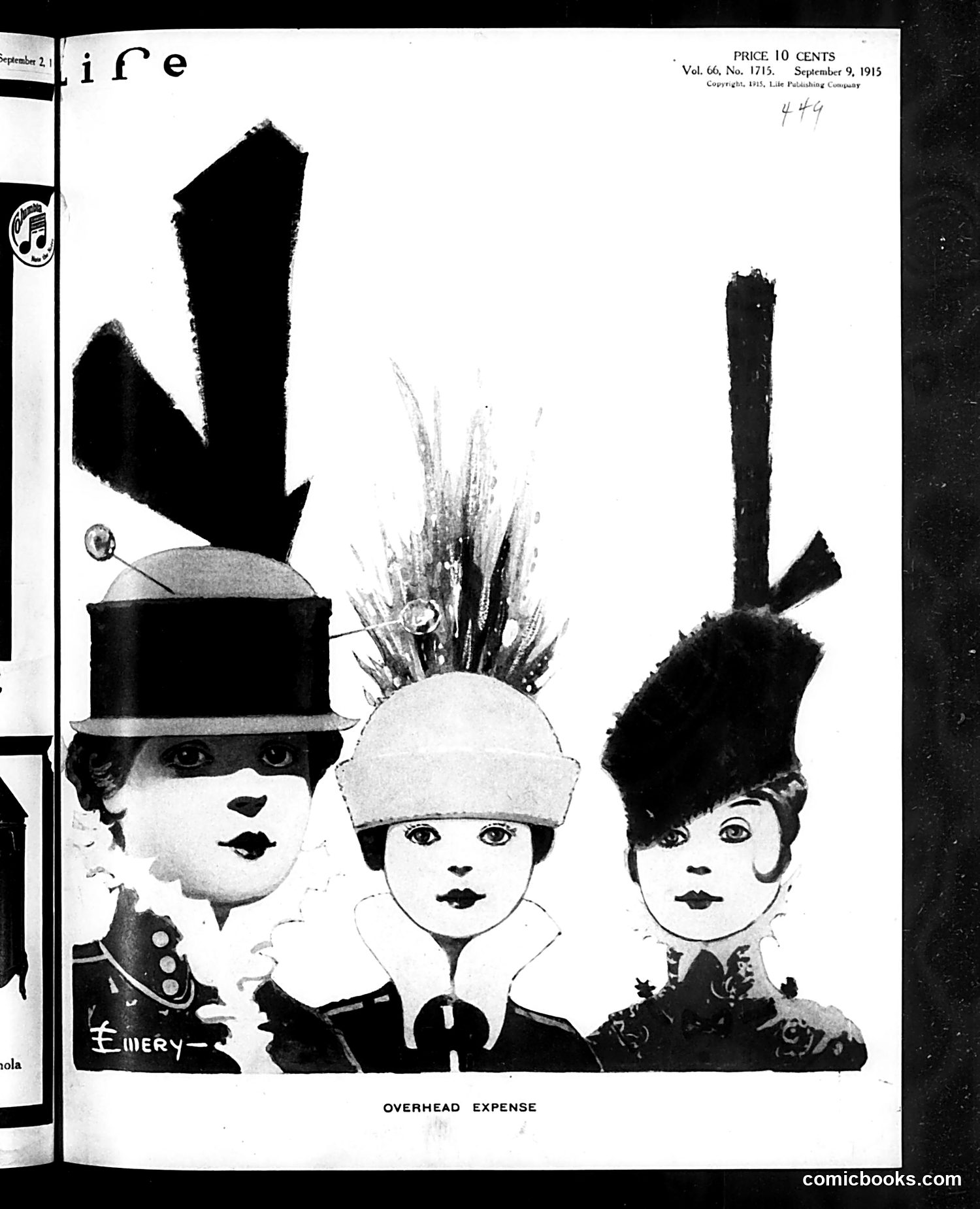
This satirical cartoon depicts three women wearing extravagantly tall, elaborate hats—a visual commentary on the absurdly expensive millinery fashions of the 1910s era. The title "Overhead Expense" is a pun: the hats are literally "overhead" (above the head), while also referencing business costs. The cartoon mocks women's fashion spending during this period, when ornate feathered hats adorned with plumes, birds, and structural elements were status symbols but financially burdensome. The exaggerated height and complexity of these designs emphasize how impractical and costly such fashion statements were—the joke being that maintaining fashionable appearance represented a significant household expense, particularly for those aspiring to social status.
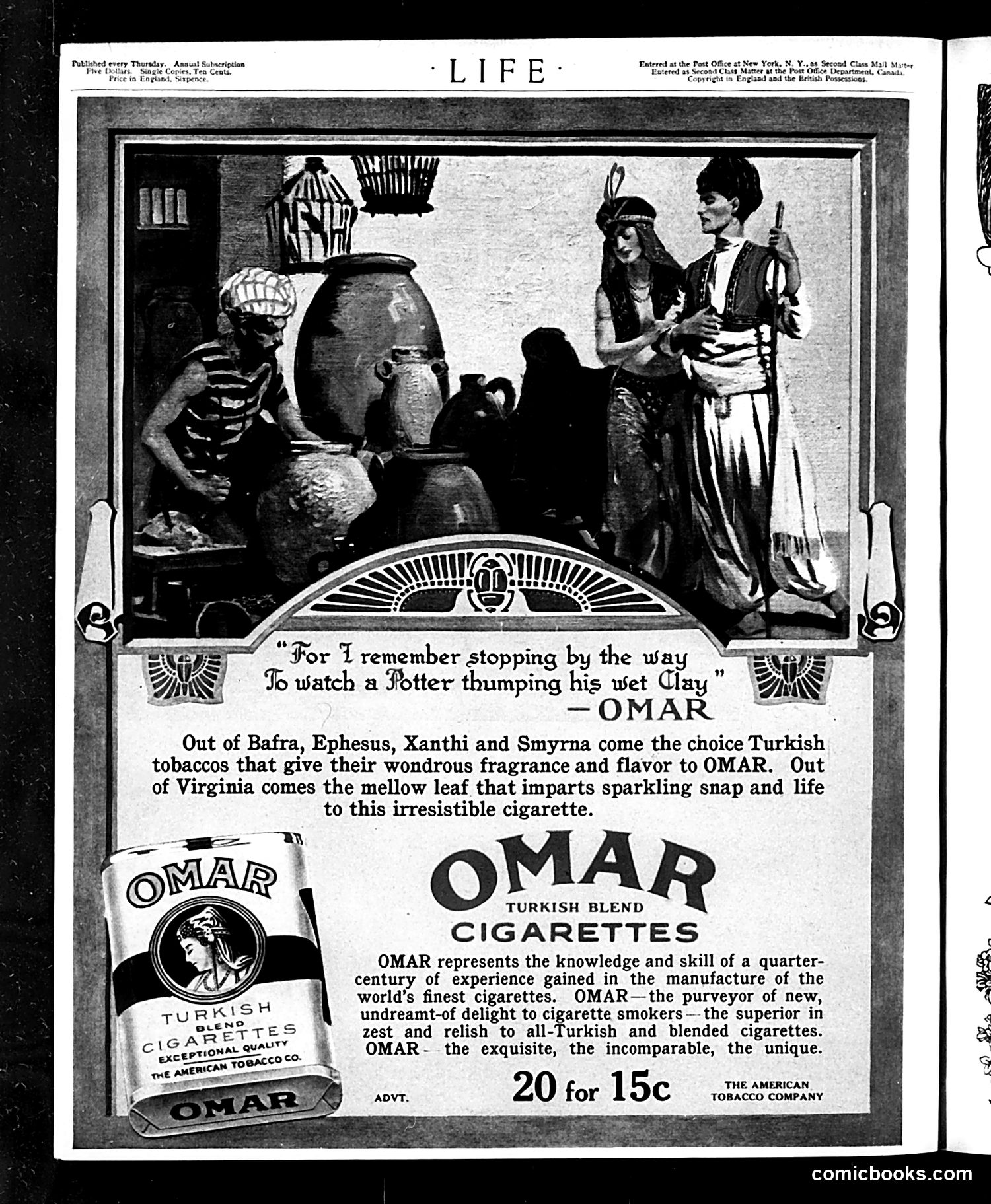
This is primarily a **cigarette advertisement**, not political satire. The page shows an Orientalist scene depicting figures in Turkish/Middle Eastern dress examining pottery vessels in what appears to be a bazaar or workshop setting. The ad quotes Omar Khayyam (the Persian poet), using his name to market "Turkish Blend" cigarettes. It emphasizes exotic origins—tobaccos from Bafra, Ephesus, Xanthi, and Smyrna (Ottoman Empire regions)—combined with Virginia leaf. The imagery trades on early 20th-century Western fascination with "the Orient" as luxurious and mysterious. The price advertised is "20 for 15¢." This represents typical period advertising that used orientalist aesthetics and literary allusions to appeal to consumers seeking sophistication and exotic appeal.

This page is primarily a **product advertisement**, not political satire. It promotes White Rock mineral water from Wauksha, Wisconsin, marketed as "the world's best table water" with "unquestioned superiority now being preferred by the American public." The decorative design features classical architectural elements (columns, urns), eagles, and stars suggesting prestige and patriotism. The central medallion depicts a Native American figure, likely referencing the product's mineral spring origins and evoking authenticity/natural purity—a common advertising trope of the era. The office address (100 Broadway, NYC) indicates this is a national brand seeking upscale consumers. Rather than satire, this reflects early 20th-century luxury marketing emphasizing quality, tradition, and American superiority through classical and patriotic imagery.
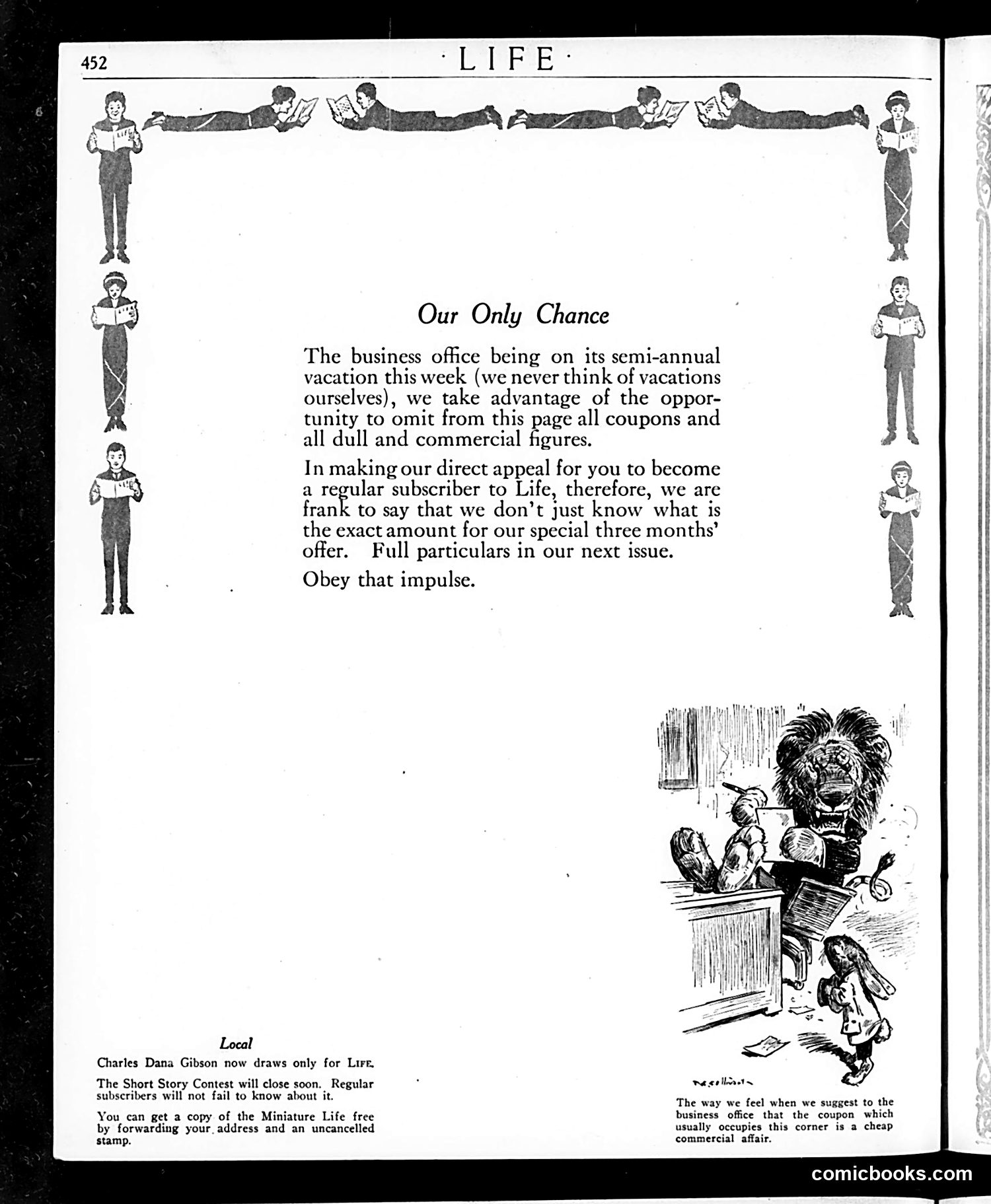
This page contains a subscription appeal titled "Our Only Chance," explaining that Life's business office is on vacation, so they're omitting coupons and commercial content this week. The editors frankly admit they don't know the exact price of their special three-month subscription offer, promising details in the next issue. The decorative border features illustrated figures holding newspapers. The bottom cartoon shows a lion emerging from a box labeled "LIFE," terrorizing children and adults—likely satirizing the magazine's fearsome reputation or bold satirical approach. The caption notes this reflects how the business office views coupons in that corner as a "cheap commercial affair." The page primarily promotes subscriptions rather than delivering satirical political content.
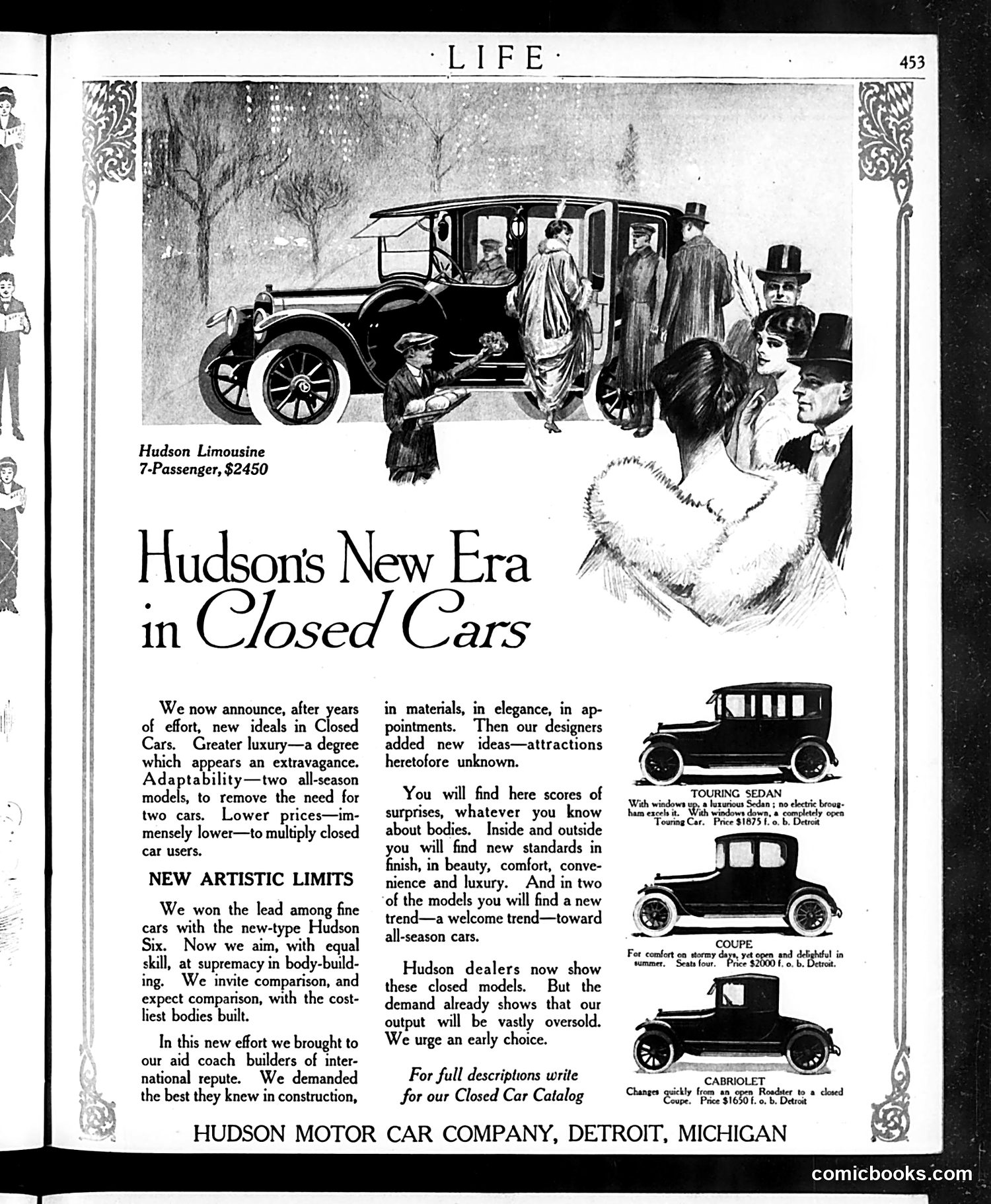
This page is **primarily advertising, not satire or political commentary**. It's a Hudson Motor Car Company advertisement for their new closed-car models from the 1910s-1920s era. The illustration shows well-dressed passengers boarding or exiting a Hudson Limousine, depicting luxury and social status. The accompanying text emphasizes Hudson's innovations: closed cars (as opposed to open vehicles), improved comfort, lower prices, and aesthetic design. The three car models shown (Touring Sedan, Coupe, Cabriolet) represent Hudson's marketing strategy to reach multiple consumer segments. The ad's language—"new era," "new artistic limits," "greatest bodies built"—reflects typical period advertising rhetoric emphasizing technological progress and refinement. There is no discernible political satire or social commentary present on this page.
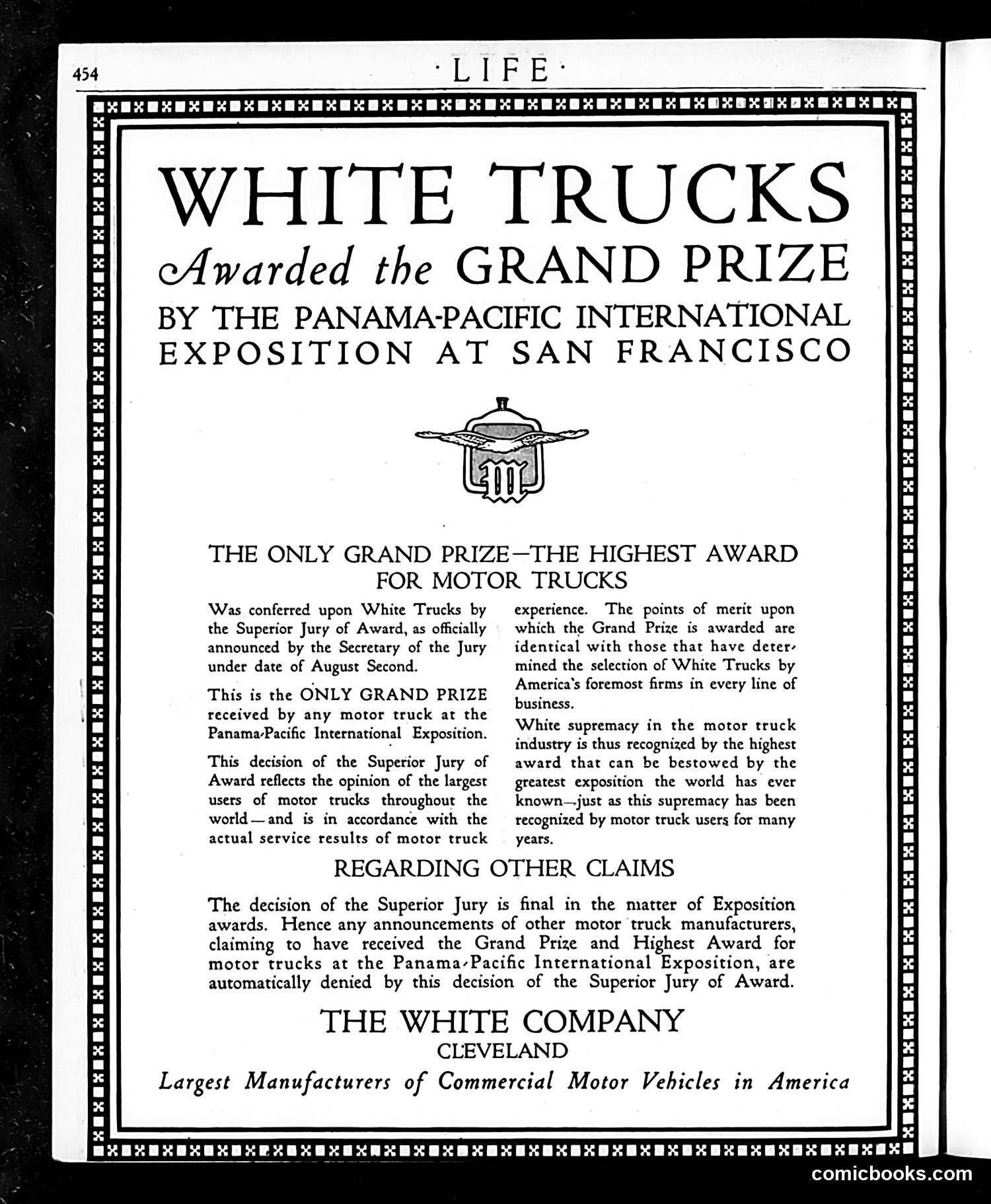
This is **not a cartoon or satirical content** — it's a straightforward advertisement for White Trucks, placed in Life magazine. The page announces that White Trucks received the Grand Prize at the 1915 Panama-Pacific International Exposition in San Francisco. The ad emphasizes this was "the ONLY GRAND PRIZE" awarded to any motor truck manufacturer at the event. The text argues that White's award reflects the "opinion of the largest users of motor trucks throughout the world" and demonstrates the company's superiority in design and performance. A section titled "REGARDING OTHER CLAIMS" dismisses competing manufacturers' assertions about winning similar awards. The White Company, based in Cleveland, describes itself as "Largest Manufacturers of Commercial Motor Vehicles in America." This is commercial promotional material, not satire.
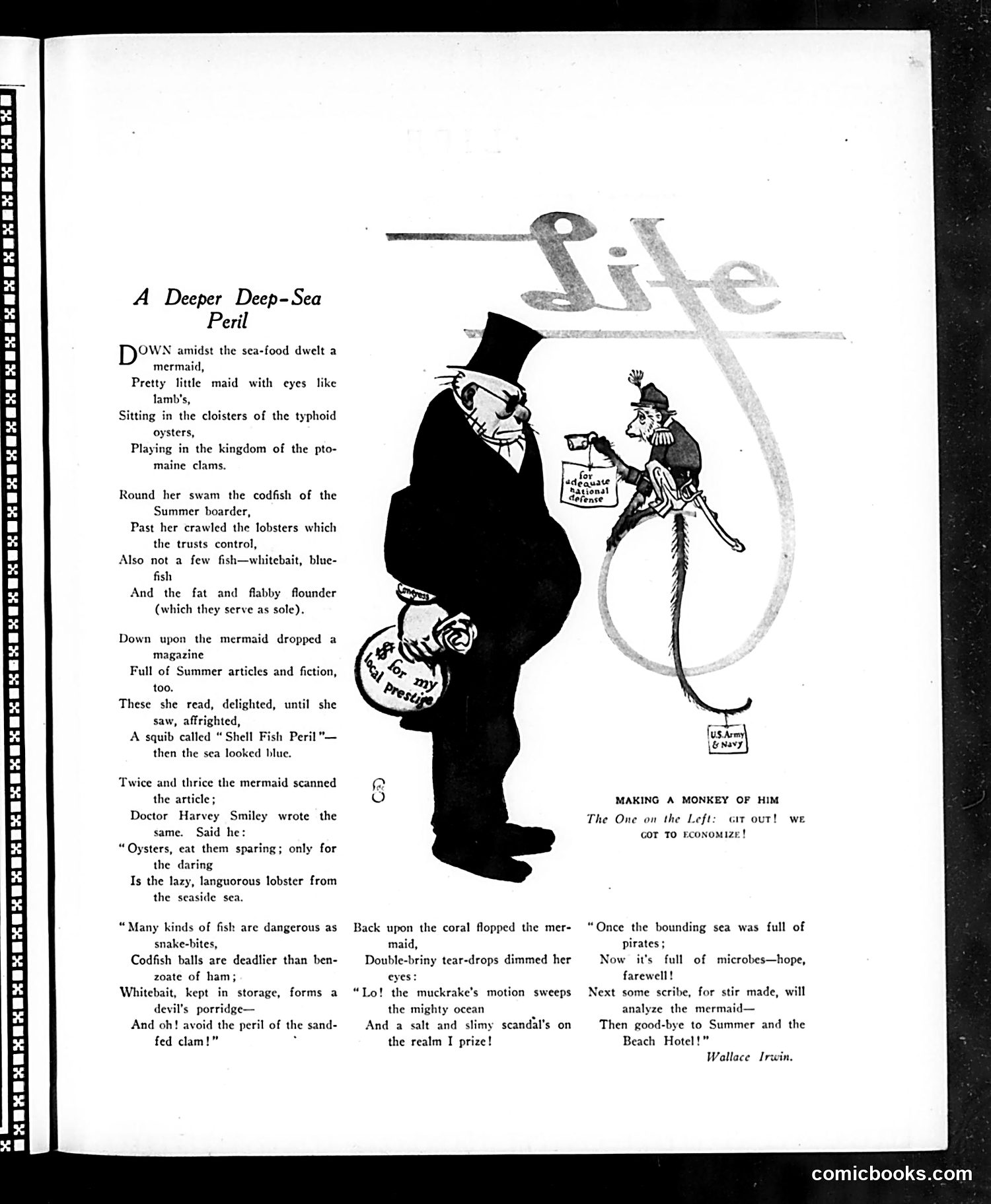
This page satirizes concerns about ocean conservation and seafood safety. The poem warns of dangers in deep-sea creatures—mentioning typhoid oysters, dangerous fish, and problematic lobsters—presented humorously as threats to summer beachgoers. The cartoon mocks bureaucratic overreach: a portly government official (labeled with what appears to be economic/regulatory authority) is made into a "monkey" by a smaller figure representing the public or press. The official holds a magazine ("Collegiate National Digest"), suggesting criticism of how authorities handle information about food safety and ocean resources. The satire likely targets 1920s-era debates over food regulation, government authority, and concerns about commercial fishing practices—depicting bureaucrats as laughable obstacles to public interests rather than protectors.
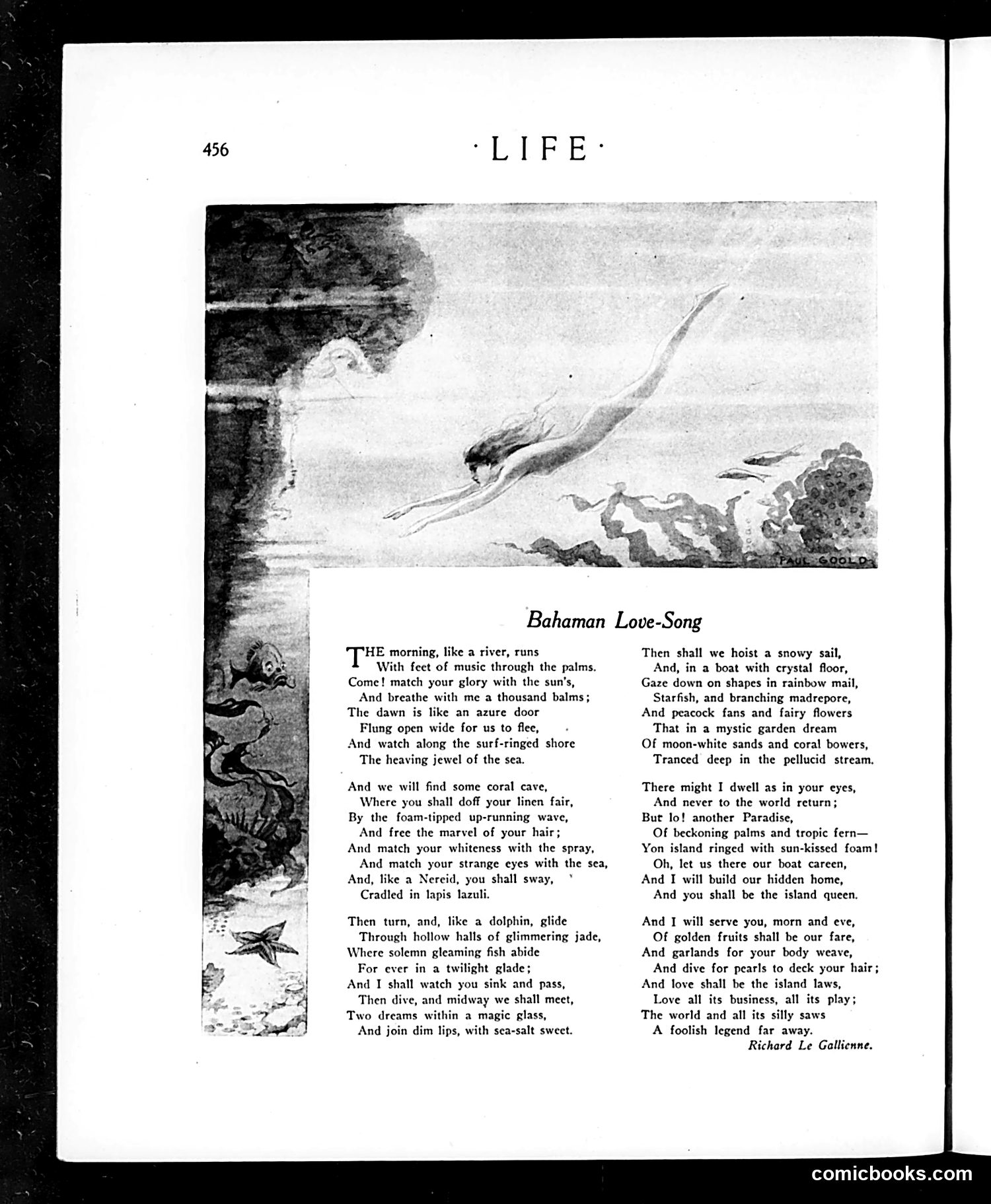
This page from *Life* magazine contains a poem titled "Bahaman Love-Song" by Richard Le Gallienne, accompanied by decorative illustrations rather than political satire or cartooning. The artwork depicts tropical/oceanic scenes: a swimmer diving into water in the upper illustration, and seashells and starfish in the left margin decoration. These are romantic, aesthetic illustrations complementing the poem's theme of tropical island romance and passion. The poem itself is romantic verse celebrating love in a Bahaman paradise setting, with imagery of coral caves, dolphins, and island life. There is no political commentary, satire, or social criticism evident on this page—it is purely literary and decorative content typical of *Life*'s cultural magazine format during this period.
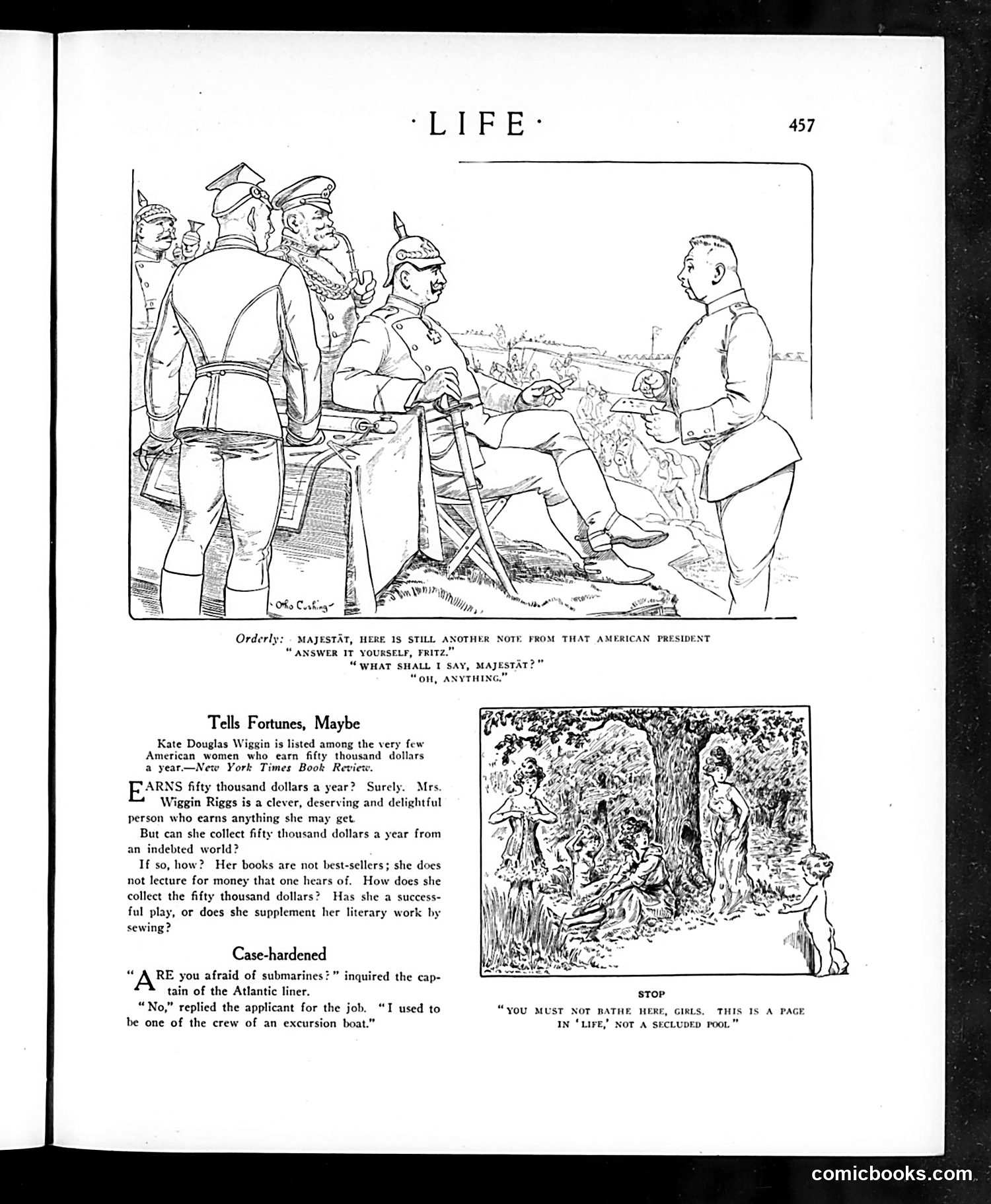
The top cartoon satirizes German military leadership during World War I. German officers (identifiable by their spiked helmets/Pickelhaube) receive another message from "that American president" (Woodrow Wilson), with one officer dismissing it by saying "answer it yourself, Fritz" and "oh, anything"—mocking their contempt for American diplomatic efforts and Wilson's peace initiatives. The page's second section discusses Kate Douglas Wiggin, an American author earning $50,000 annually, questioning how she accumulates wealth from writing. A small cartoon below shows a woman being told not to bathe in "Life" magazine, treating it as a "secluded pool." The cartoons reflect wartime attitudes toward Germany and early 20th-century gender expectations around women's economic success.
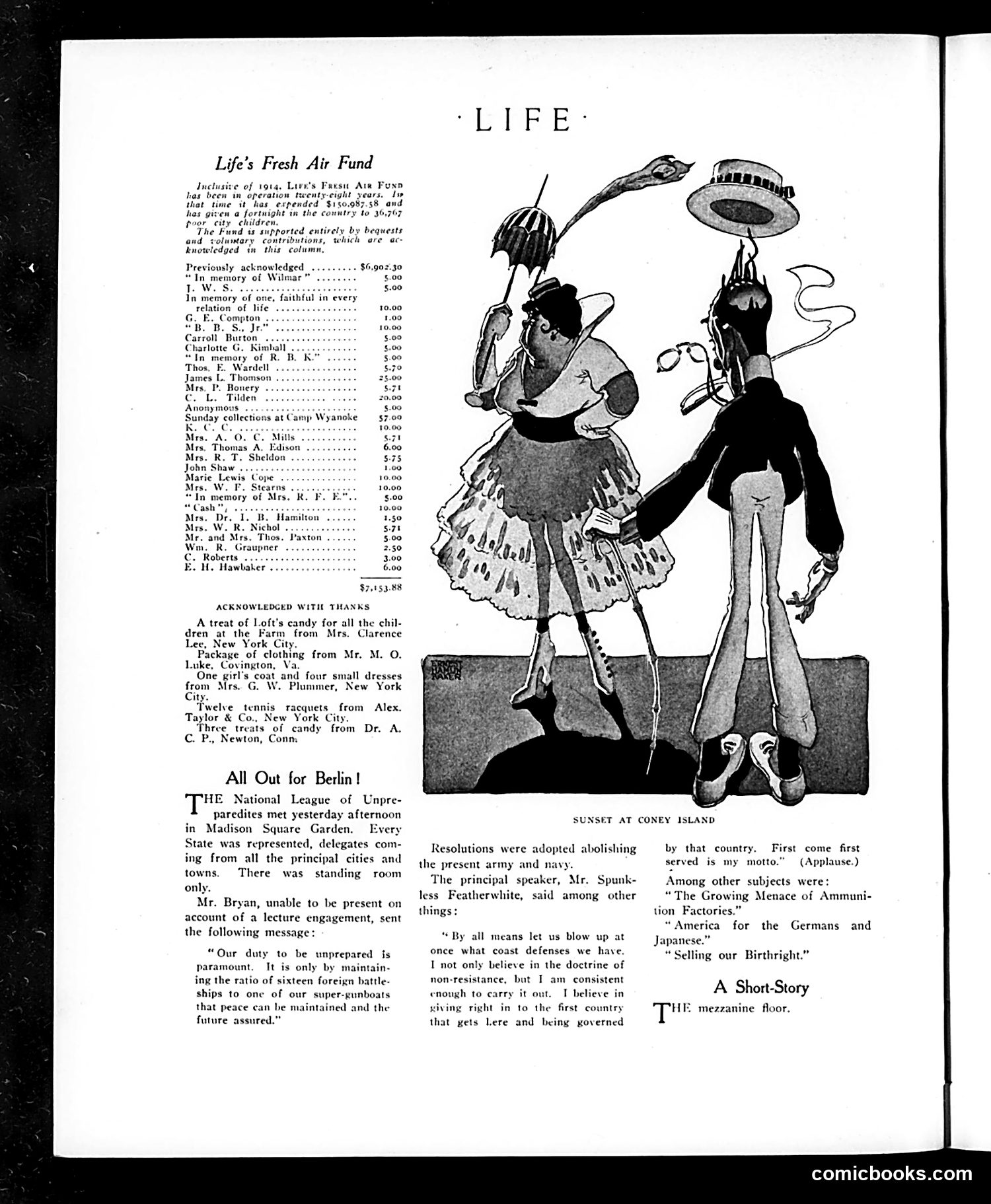
This page contains two distinct sections: **Upper Left**: A fundraising notice for Life's Fresh Air Fund (established 1914), listing donor contributions totaling $2,453.88. The fund provides country retreats for underprivileged urban children. **Main Illustration**: "Sunset at Coney Island" depicts two figures—a woman in a polka-dot dress and a man in formal attire with a UFO-like hat—enjoying seaside recreation with exaggerated, comedic proportions. The satirical point appears to target fashion absurdities or leisure culture pretension of the era, though specifics remain unclear. **Lower Section**: "All Out for Berlin!" reports on a National League of Unprepared-ites meeting opposing military preparedness. A speaker argues against coast defenses and foreign policy aggression—likely 1910s-era isolationist sentiment. The page mixes civic fundraising, fashion satire, and political commentary typical of Life's editorial approach.
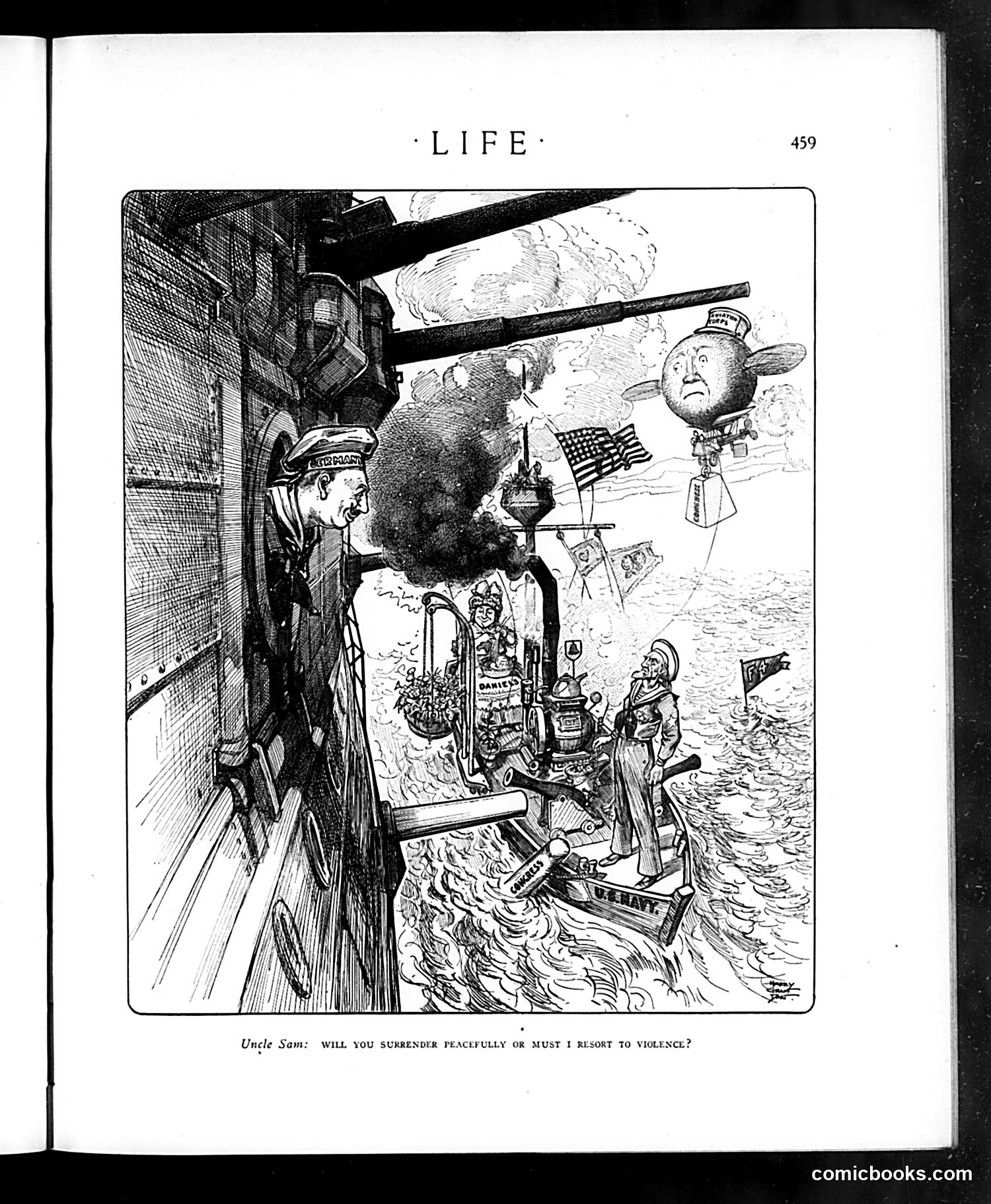
This is a World War I-era political cartoon showing Uncle Sam (the American figure on the left, in the fortified position) confronting what appears to be German forces across No Man's Land. The cartoon depicts a military standoff with trenches, soldiers, flags, and artillery. The caption reads: "WILL YOU SURRENDER PEACEFULLY OR MUST I RESORT TO VIOLENCE?" The satire presents Uncle Sam demanding German surrender while himself surrounded by weapons of war—an ironic contradiction. The cartoon likely comments on American diplomatic or military posturing regarding entry into WWI, suggesting that Uncle Sam's ultimatum is itself backed by violence rather than peaceful means. The image criticizes the contradiction between claiming to seek peaceful resolution while simultaneously preparing for military conflict.
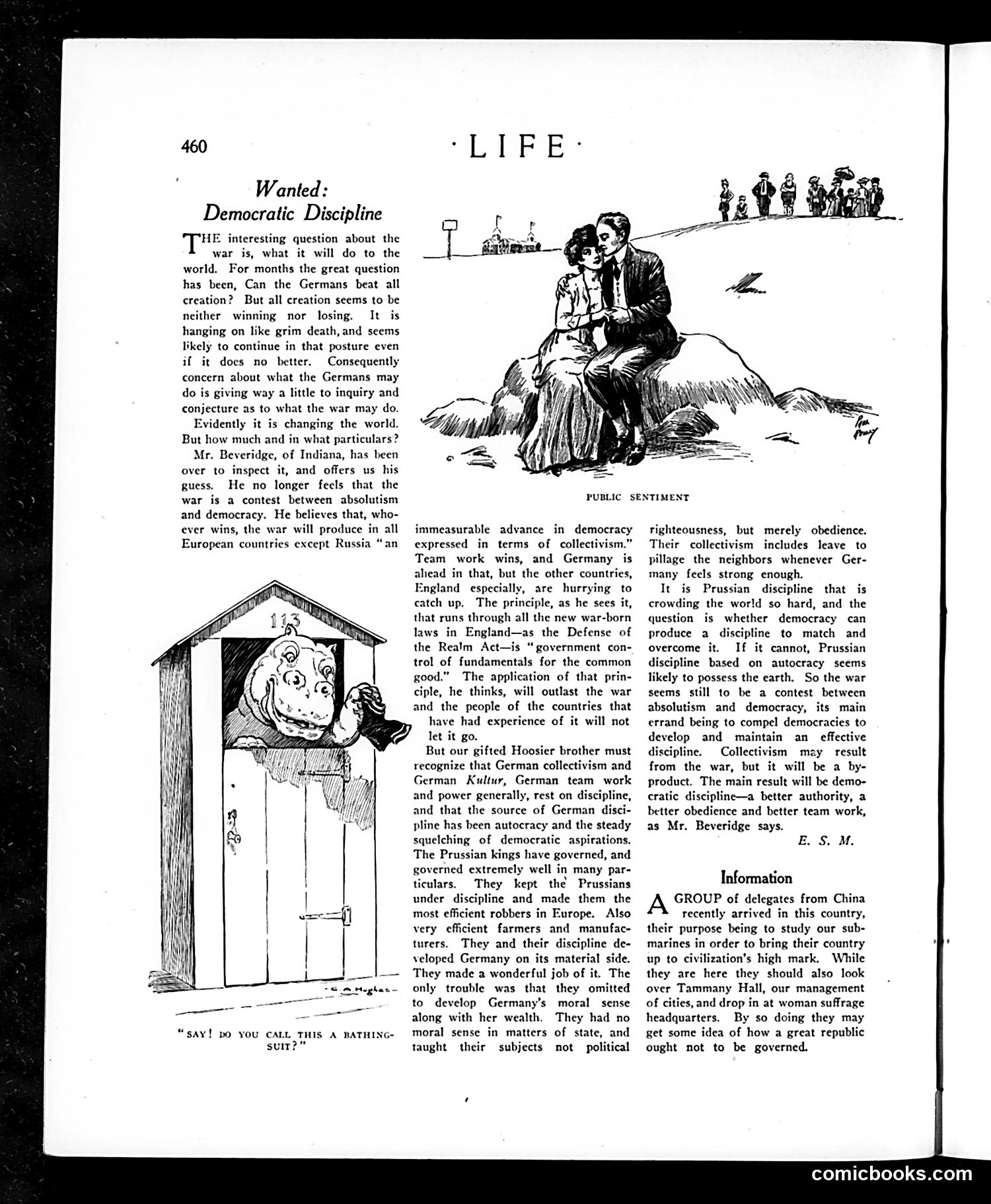
This page from *Life* magazine presents an editorial essay titled "Wanted: Democratic Discipline," attributed to E.S.M. The text critiques whether democracy can produce the military discipline that Germany possesses, arguing this is the central question of WWI. The main cartoon shows a figure labeled "BATHING SUIT" — apparently mocking inadequate or frivolous preparation for serious conflict. The sketch depicts what appears to be a poorly constructed shelter, satirizing unpreparedness. The upper illustration shows a romantic couple on a hillside overlooking soldiers marching away to war, contrasting civilian life with military realities. The essay suggests that while German authoritarianism created effective discipline, democracies like England must develop similar cohesion to compete militarily. The satire questions whether democratic societies can sacrifice individual freedoms sufficiently to win wars.
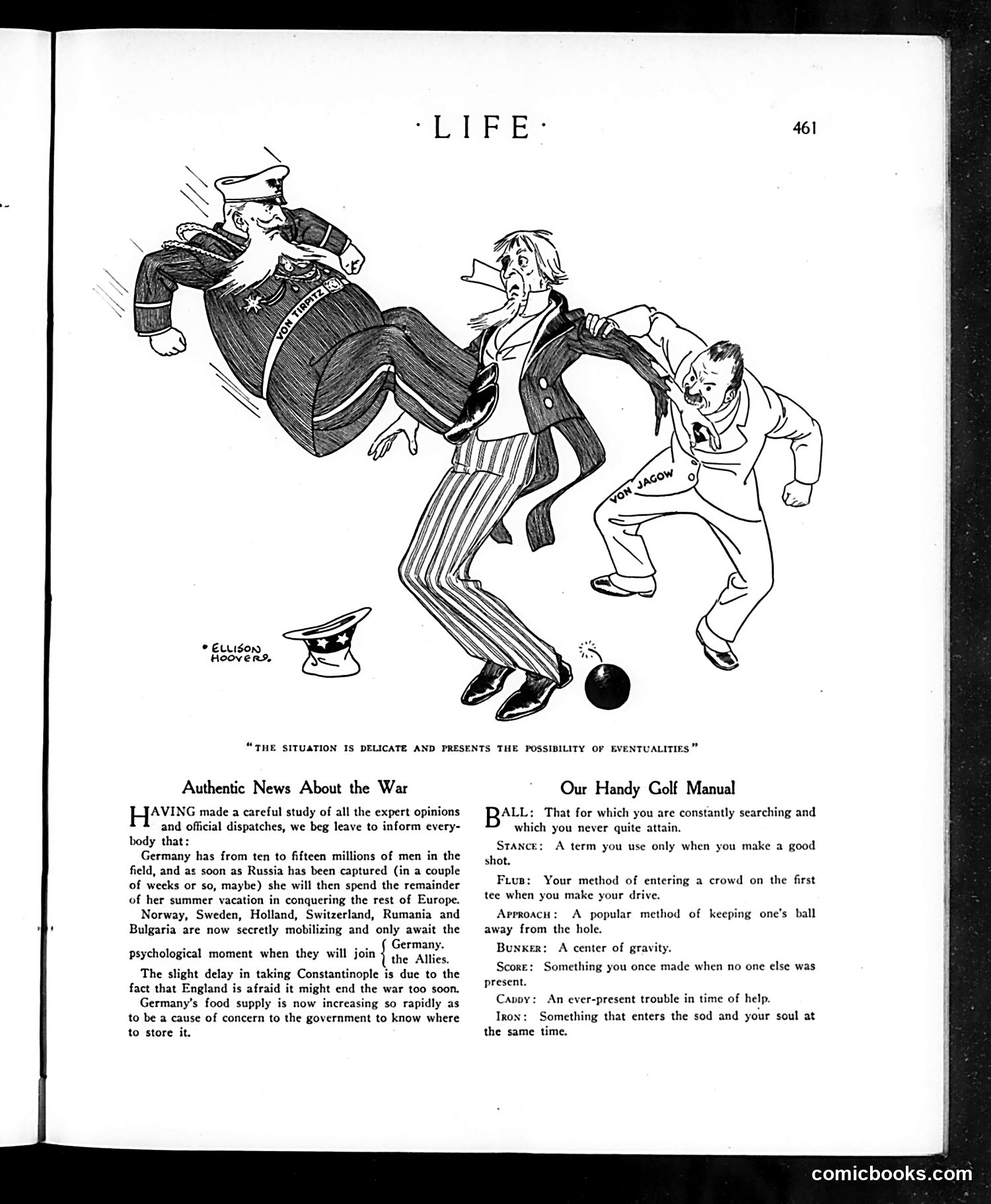
The main cartoon depicts a military figure being tossed in a blanket by two men labeled "Von Jagom" (likely a German name). The caption reads: "The situation is delicate and presents the possibility of eventualities." This appears to be WWI-era political satire about Germany's military situation. The "blanket toss" is a humiliation metaphor—the German officer is being literally thrown around, suggesting Germany's precarious position in the war. The "Authentic News About the War" section below discusses Germany's food supply concerns and Allied strategy, while "Our Handy Golf Manual" provides golf terminology as humorous counterpoint. The satire mocks German military leadership's unstable position while simultaneously satirizing American detachment through juxtaposing serious war analysis with trivial golf instruction.
This page contains three short stories from Life's short story contest, not political cartoons. The visible stories are: 1. "What the Vandals Leave" by Herbert Riley Howe - appears to depict a romantic encounter between a man and woman in an urban setting, with dialogue suggesting mistaken identity and romantic complications. 2. "Food For Thought" by Harriet Lummis Smith - involves characters named Forbes, Chandler, Keith, and Agnes in what seems to be a domestic drama about marriage, jealousy, and questions of paternity regarding a child. These are literary fiction submissions, not satire or political commentary. The page represents Life's role as a general-interest magazine publishing creative content alongside its better-known humorous illustrations and commentary.
This page from *Life* magazine (page 463) contains two distinct pieces of fiction rather than political cartoons: 1. **"Life"** - A concluding section of a romantic story involving characters named Diantha, Forbes, and Agnes, discussing marriage, uncertainty, and emotional conflict. 2. **"Patches"** by Francis E. Norris - A short story about Van Gilder, a wealthy man (worth "an easy million") who becomes interested in rescuing a poor, starving dog he encounters. The narrative explores Van's internal conflict about whether to buy the dog for twenty-five dollars, ultimately revealing his character through this minor moral decision. Neither piece contains political satire or social commentary requiring historical context. They are straightforward fiction pieces typical of *Life*'s literary content from this era.
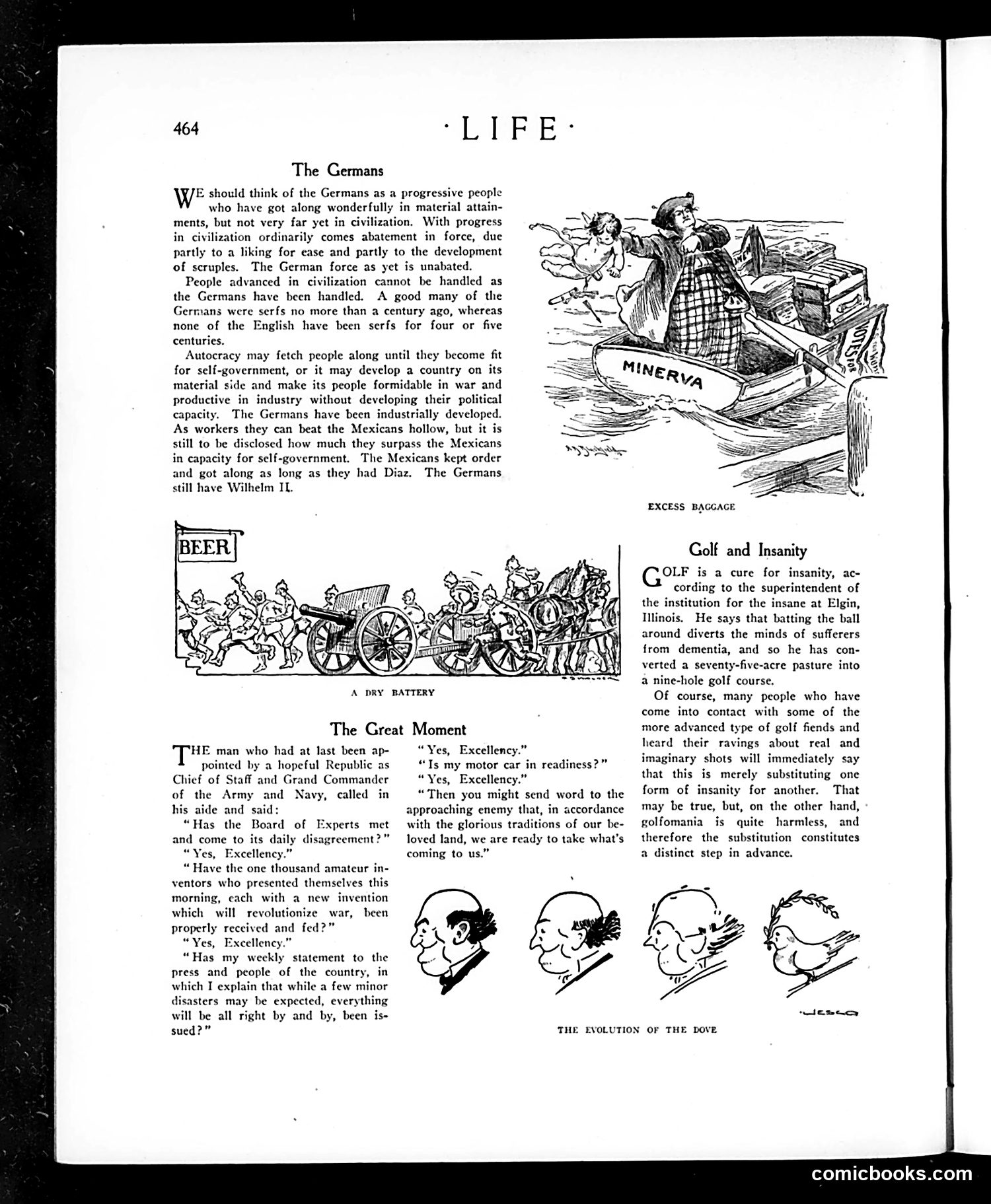
**"The Germans"**: This essay critiques German society under Kaiser Wilhelm II, arguing Germans are industrially advanced but politically backward—comparing them unfavorably to Mexicans under Díaz. The satire suggests autocracy can develop military/industrial capacity without fostering self-governance. The cartoon "Excess Baggage" shows the Goddess Minerva (wisdom) struggling with oversized baggage, likely representing Germany's militarism as cumbersome excess. **"The Great Moment"**: A satirical dialogue mocking military incompetence and bureaucratic absurdity. A newly appointed military commander casually asks his aide whether everything is ready—experts meeting, inventors fed, press statements issued—before cheerfully telling the approaching enemy "we are ready to take what's coming to us." The joke targets military ineffectuality and resignation to defeat. **"Golf and Insanity"**: A humorous piece claiming golf cures insanity, then humorously noting golfers themselves seem insane, creating a self-referential joke about the sport's addictive nature. The page reflects pre-WWI anxieties about German militarism and wartime concerns about military preparedness.
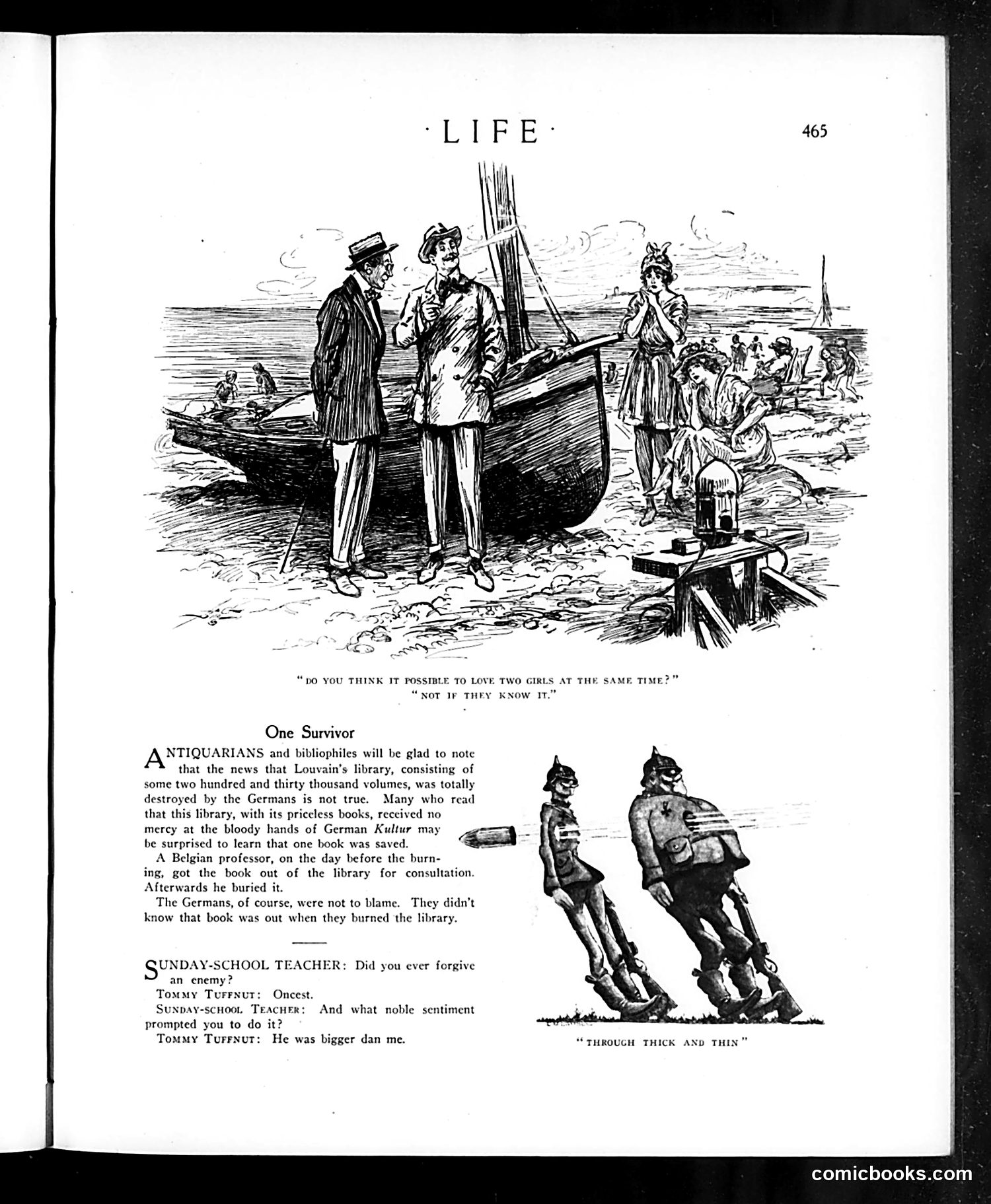
**Top Cartoon:** A seaside flirtation joke. Two men discuss the possibility of loving two women simultaneously. The punchline—"Not if they know it"—is a cynical commentary on infidelity, suggesting women would object if aware of romantic rivals. **"One Survivor" Article:** This sardonically reports that despite Germans destroying Louvain's library during WWI (a real historical atrocity), one book survived because a Belgian professor had removed it beforehand. The piece mocks German "Kultur" (civilization) while absurdly suggesting the Germans bear no blame since they "didn't know" the book was missing. The satire criticizes both German militarism and the hollow excuse-making that followed wartime destruction. **"Sunday-School Teacher" Joke:** Tommy Tuffnut claims he forgave an enemy once—but only because the enemy was larger and could beat him. The humor undercuts the moral lesson about forgiveness, exposing self-interested pragmatism rather than Christian virtue. The page reflects WWI-era American attitudes toward German aggression and cultural destruction.
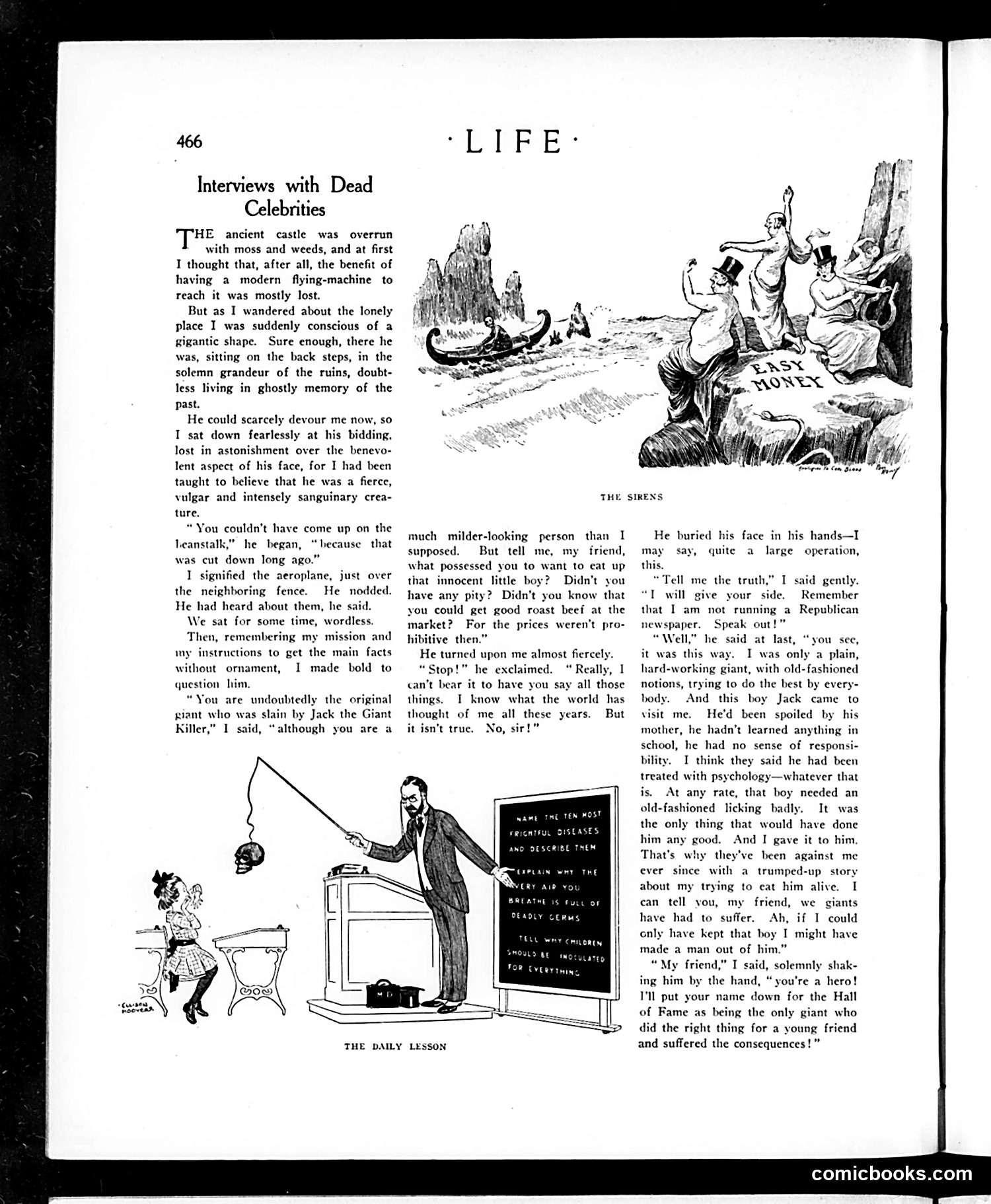
This satirical piece reimagines the fairy tale villain—the giant killed by Jack—as a misunderstood figure. The giant claims he wasn't a monster but a disciplinarian who gave Jack "an old-fashioned licking" for being a spoiled, irresponsible boy. He blames Jack's mother and modern "psychology" for ruining the child. The satire targets early 20th-century anxieties about child-rearing. It mocks progressive parenting methods (psychology, permissiveness) while celebrating traditional corporal punishment. The narrator's conclusion—that the giant deserves fame for administering harsh discipline—presents this view as heroic common sense. The cartoons "The Sirens" and "The Daily Lesson" (about teaching children about diseases) reinforce the theme of moral instruction and parental authority, reflecting contemporary debates about education and discipline versus modern psychological approaches.
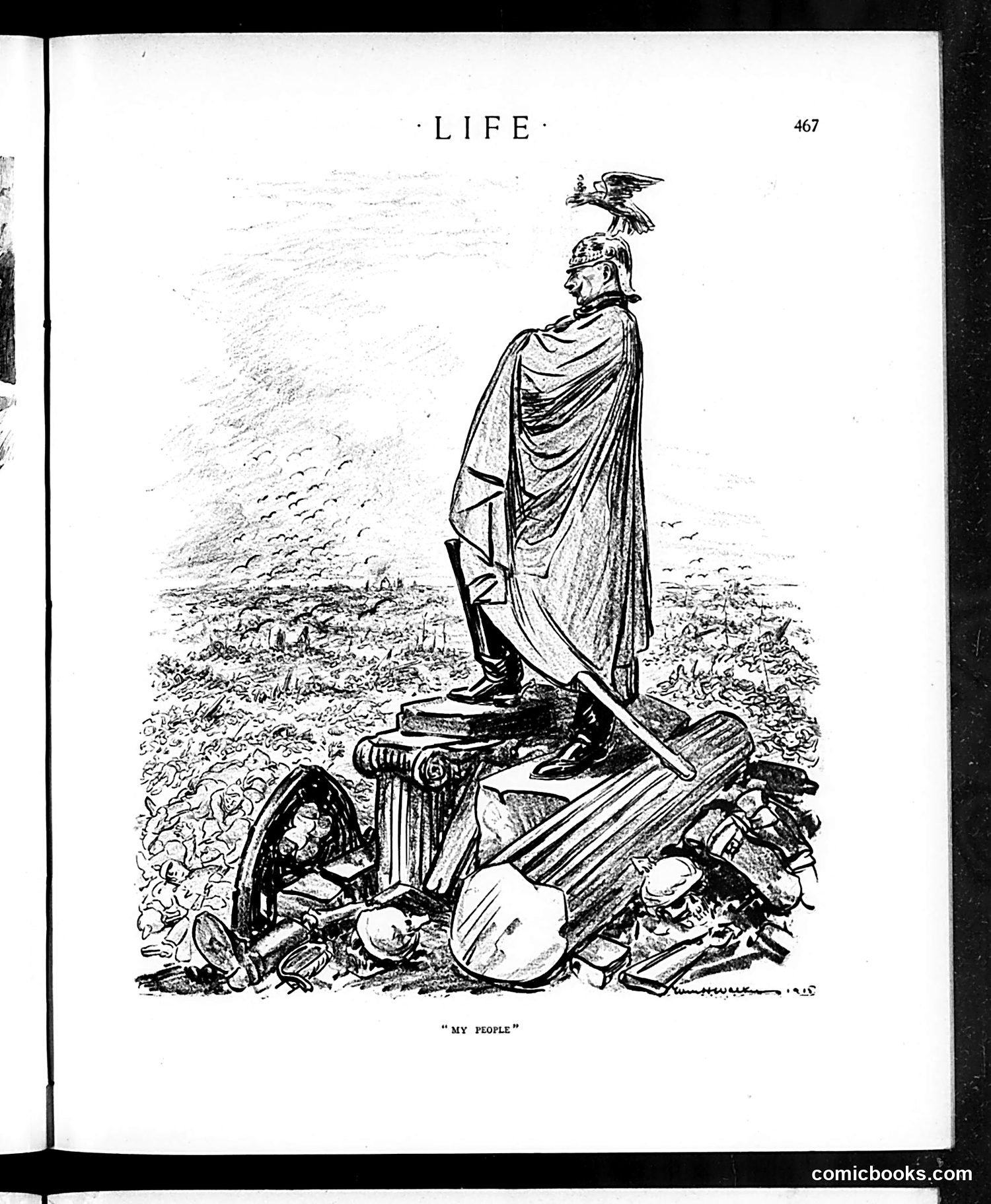
This political cartoon depicts a military or imperial figure standing elevated on a pedestal, wearing a helmet with an eagle (a Roman or Germanic imperial symbol) and a flowing cape. Below him lies a mass of suffering humanity—the poor, wounded, and dead—depicted as his "people." The satire critiques authoritarian leadership and militarism: a leader who claims to represent his people while standing literally above them, indifferent to their suffering and death. The martial regalia and eagle suggest this targets imperialism or militaristic nationalism. The contrast between the commander's dignified pose and the carnage beneath him exposes the hypocrisy of leaders who wage war claiming patriotic duty while their citizens bear the human cost.
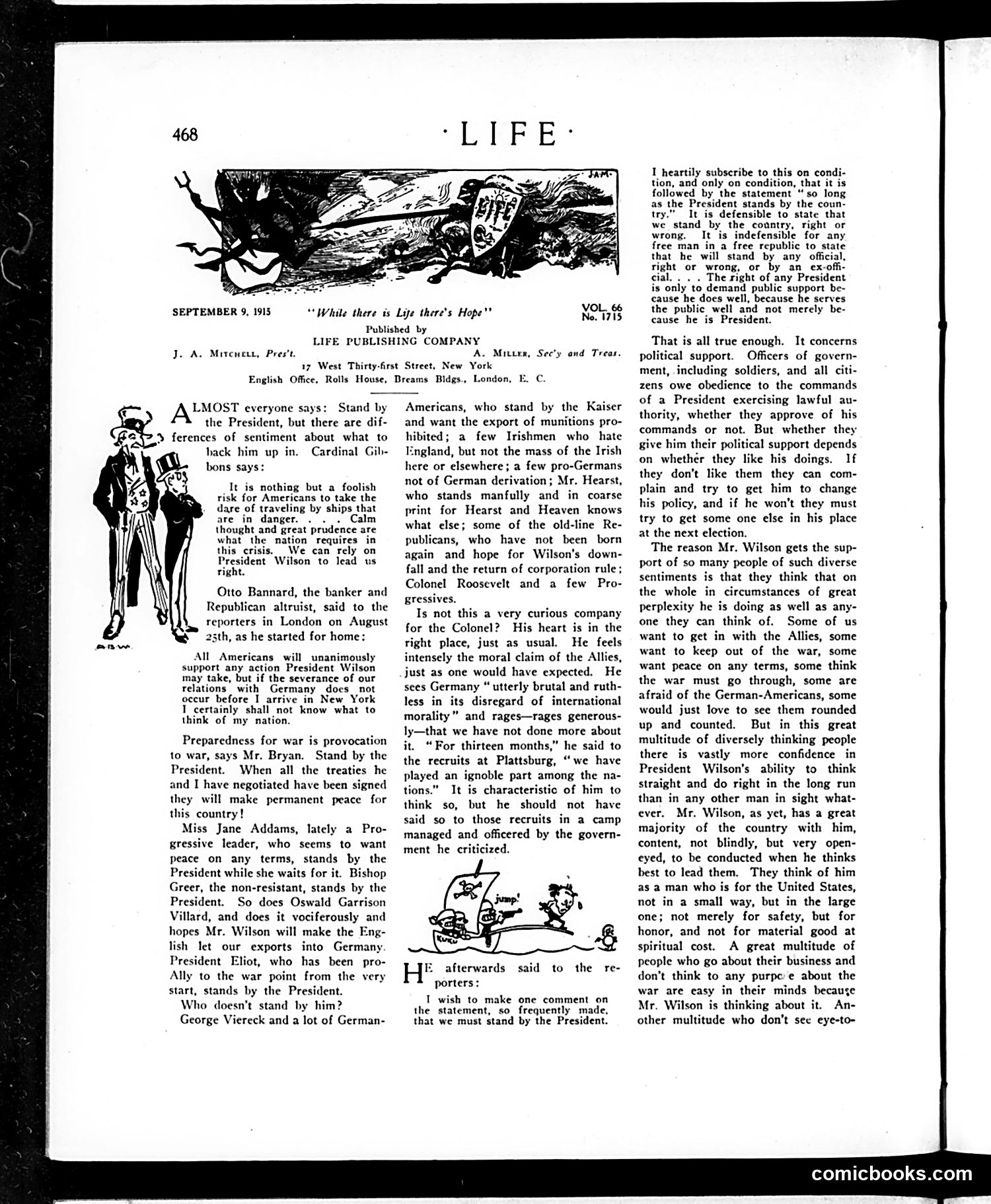
This satirical piece examines support for President Wilson during WWI neutrality debates. The cartoon "While there is Life there's Hope" depicts Uncle Sam in a precarious position—literally balancing on a tightrope—illustrating America's dangerous neutrality posture. The text catalogs various American figures claiming to "stand by the President," revealing the contradiction: they support him for contradictory reasons. Cardinal Gibbons wants caution; banker Otto Bannard demands war with Germany; Bryan opposes preparedness; Jane Addams seeks peace; Theodore Roosevelt criticizes the government while supporting it militarily. The satire's point: claiming unified support for Wilson masks deep disagreement about whether America should enter the war, aid the Allies, or remain neutral. The article notably mentions George Viereck and "pro-Germans" as the only real dissenters—those actually opposing Wilson's direction. The piece questions whether such diverse motivations constitute genuine support or merely political theater masking fundamental policy disputes.
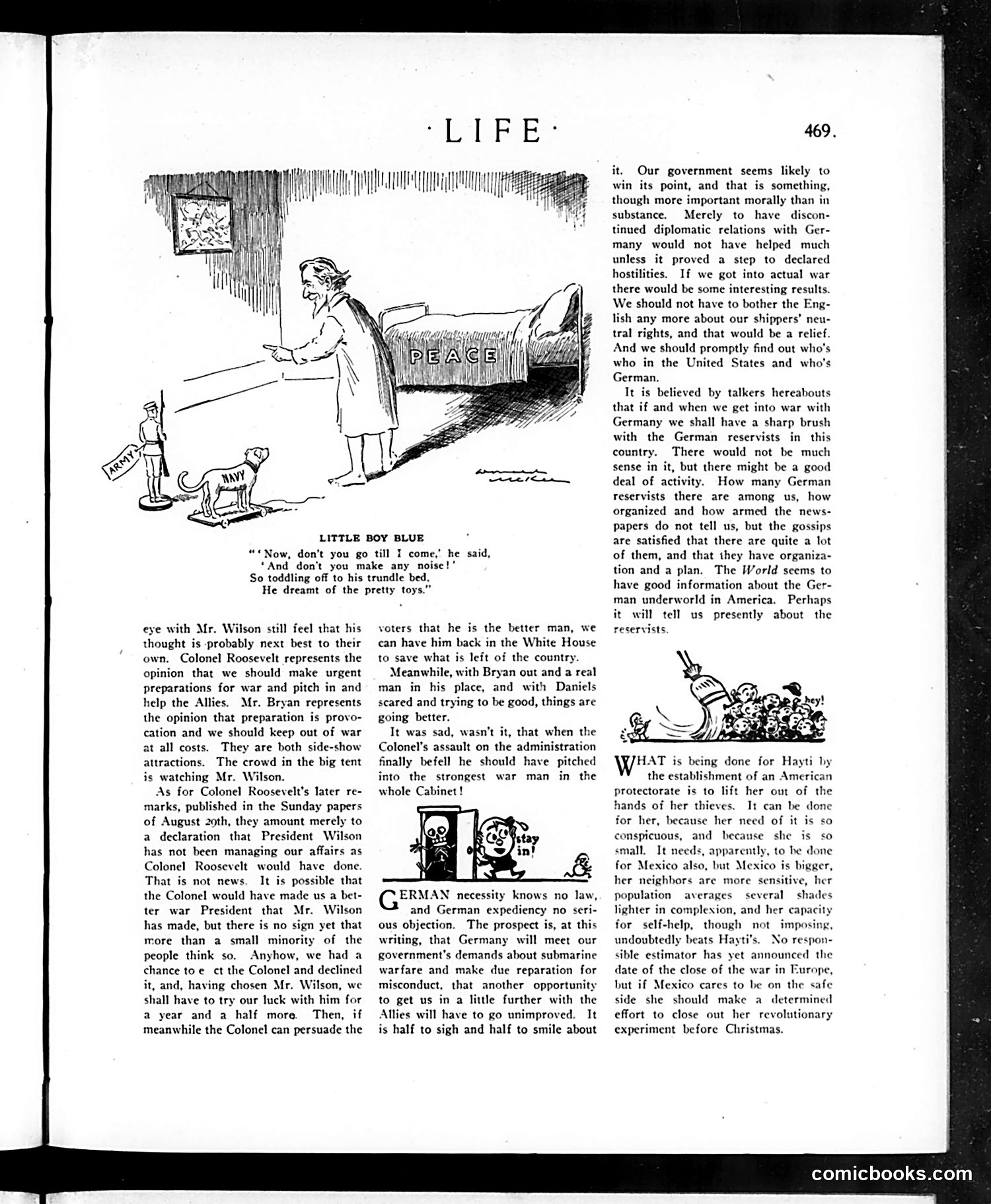
## "Little Boy Blue" Cartoon The illustration depicts a woman (Lady Peace) tucking in a small boy representing America, cautioning him to stay quiet and not make noise. This satirizes America's neutral stance during World War I—the nation is being "put to bed" peacefully while global conflict rages. ## Political Context The text discusses three competing visions for U.S. policy: - **President Wilson**: Cautious neutrality (the "main tent" drawing crowds) - **Colonel Roosevelt**: Aggressive military preparedness and support for the Allies - **William Jennings Bryan**: Isolationism and avoiding war at any cost The author mocks Roosevelt's recent criticism of Wilson's war management as hypocritical, noting Roosevelt attacks the administration's strongest war advocate (Secretary Daniels). ## Additional Topics The piece addresses German submarine warfare negotiations, speculation about German reservists operating within America, and U.S. intervention in Haiti and Mexico—reflecting 1916-era American foreign policy debates and anxieties about hidden enemy agents.
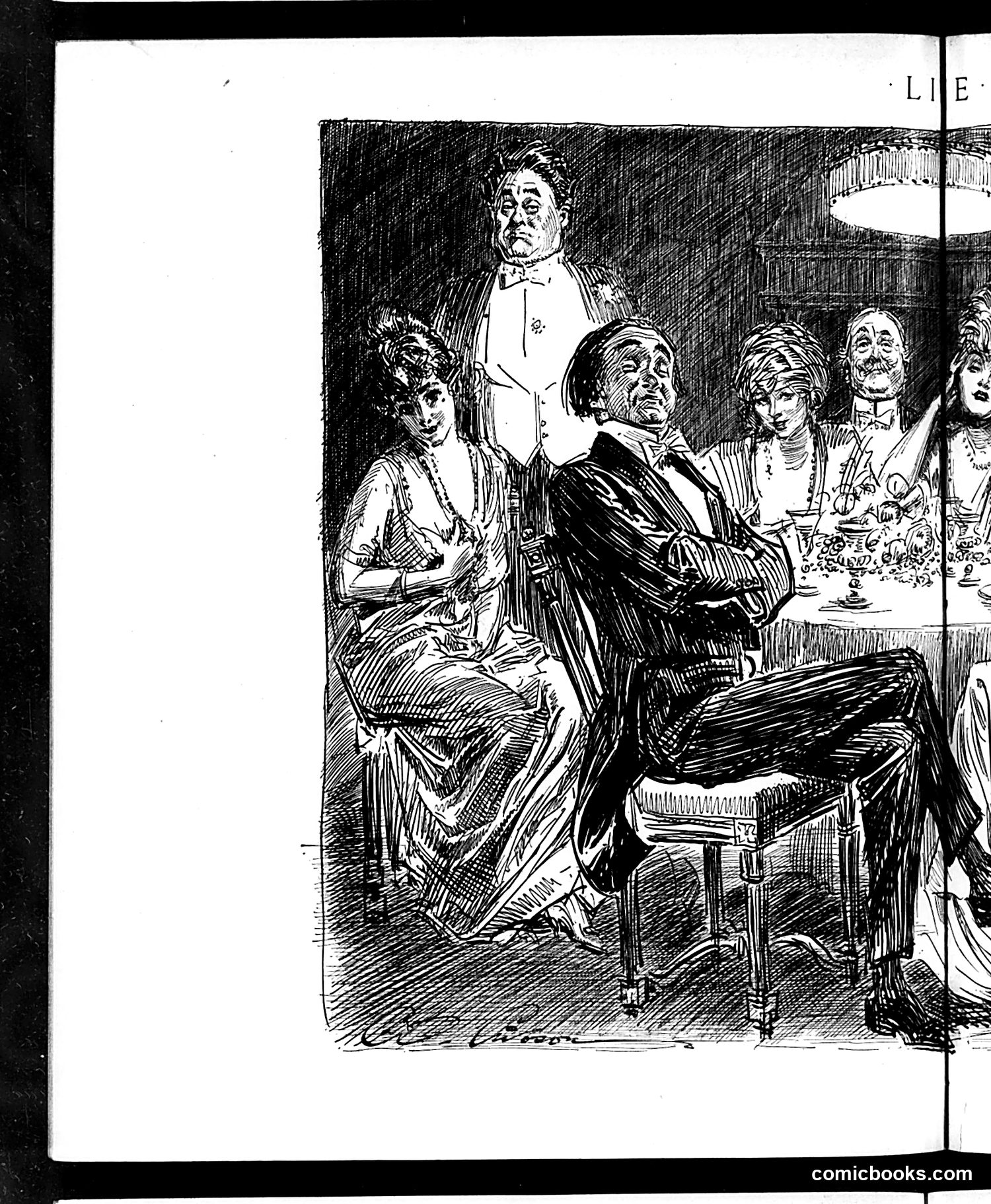
The OCR text is largely unreadable, but the image shows a formal dinner scene in black ink. A well-dressed man in a tuxedo sits prominently in the foreground, gesturing expressively while conversing with a woman in an elegant gown. A tall waiter stands behind them, and other formally-dressed guests are visible in the background at what appears to be an upscale dining establishment. Without legible text or caption, I cannot definitively identify the specific figures or political/social commentary intended. The scene depicts high-society dinner conversation—typical subject matter for *Life* magazine's satirical commentary on upper-class behavior and social pretension. However, **I cannot specify what particular people, events, or social critiques are being targeted** without readable accompanying text or other identifying details visible in the image.
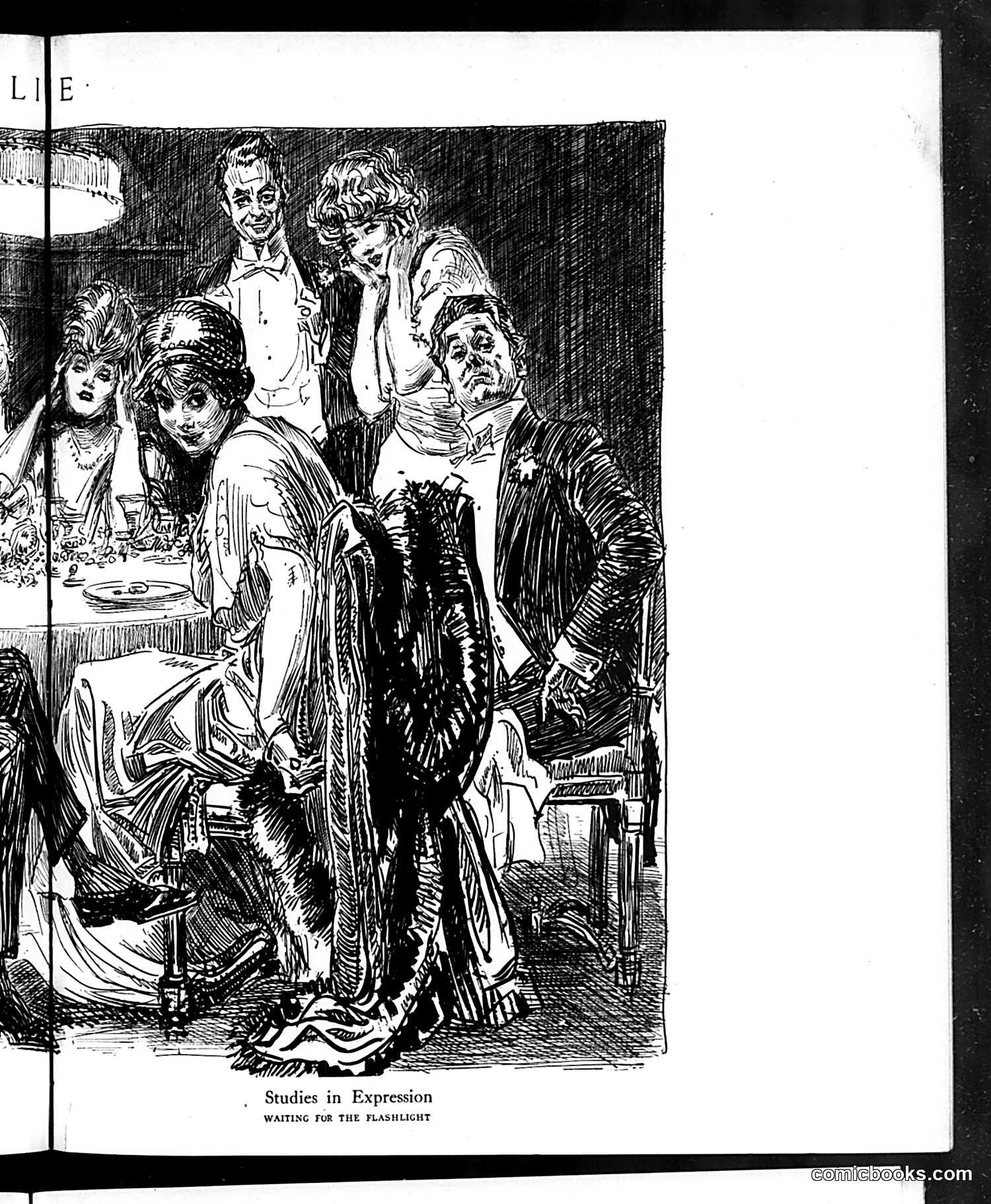
This illustration is titled "Studies in Expression" and depicts a formal social gathering—likely an upper-class dinner party or reception based on the elegant clothing and setting. The sketch shows five figures displaying various emotional states or reactions as they await something called "the flashlight" (presumably a photograph being taken). The humor appears to center on how people artificially compose their expressions when aware they're being observed or photographed. Each figure demonstrates a different pose or emotion—some forced smiles, affected postures, or exaggerated expressions—satirizing the self-conscious behavior people adopt for the camera. This reflects turn-of-the-century anxieties about photography's growing social presence and the performative nature of public appearance.
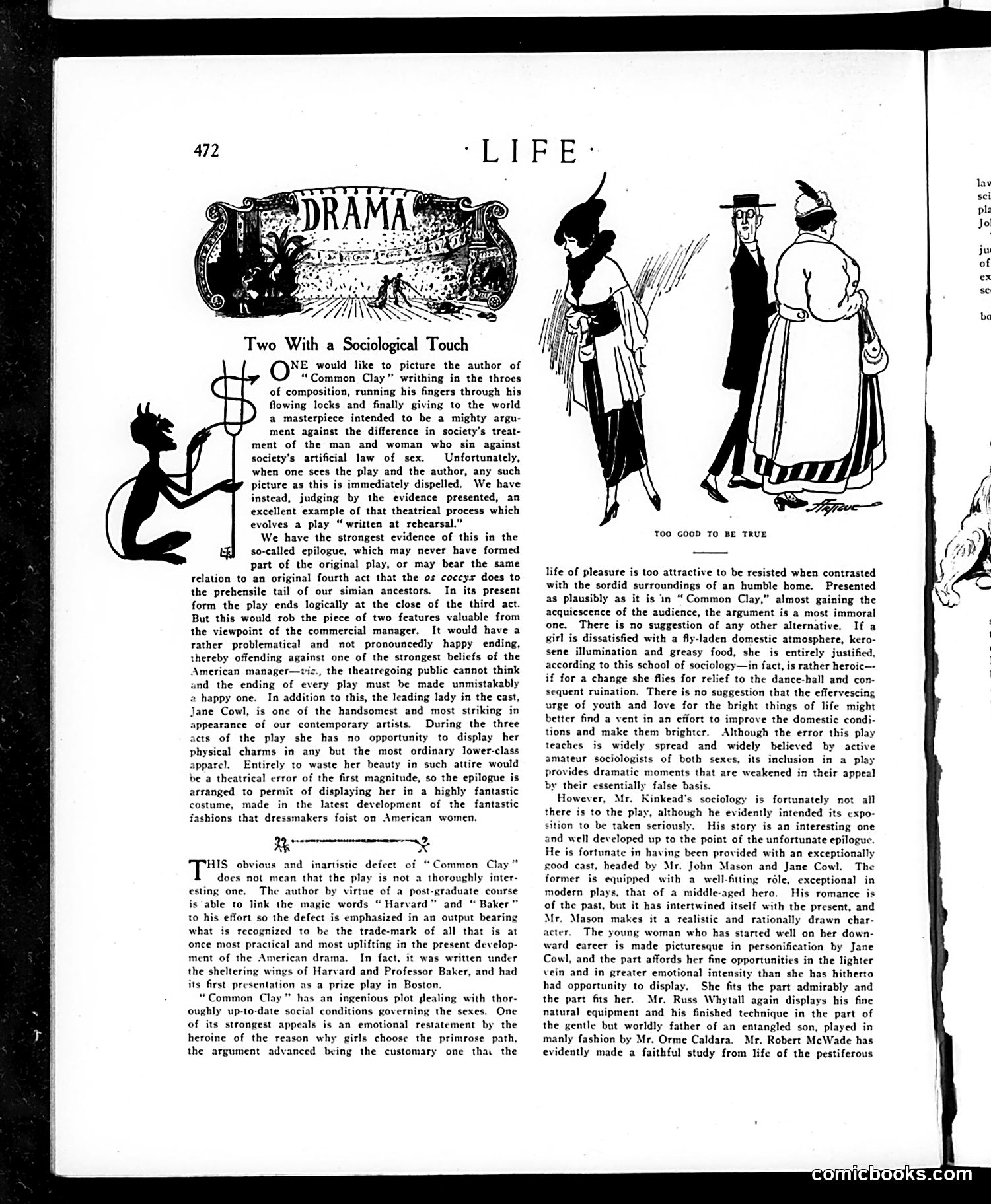
This review critiques the play *"Common Clay,"* likely by Charles H. Kinkead, starring actress Jane Cowl. The critic praises the play's serious treatment of sexual double standards—its central argument that women are driven to "sin" by poverty and dreary domestic conditions—but finds the execution flawed and morally problematic. The satirical point: the play presents seduction as the *only* escape for dissatisfied working-class women, ignoring alternatives like social reform or personal effort to improve circumstances. The critic also mocks the play's construction as "written at rehearsal," adding an implausible epilogue solely to showcase Cowl in fashionable costumes, thus undermining the serious sociological argument with commercial spectacle. The Harvard/Baker reference indicates the play's academic theatrical pedigree, making its moral weakness more embarrassing. The cartoon's caption "Too Good to Be True" reinforces the critique: the play's premise is seductively appealing but fundamentally dishonest sociology.
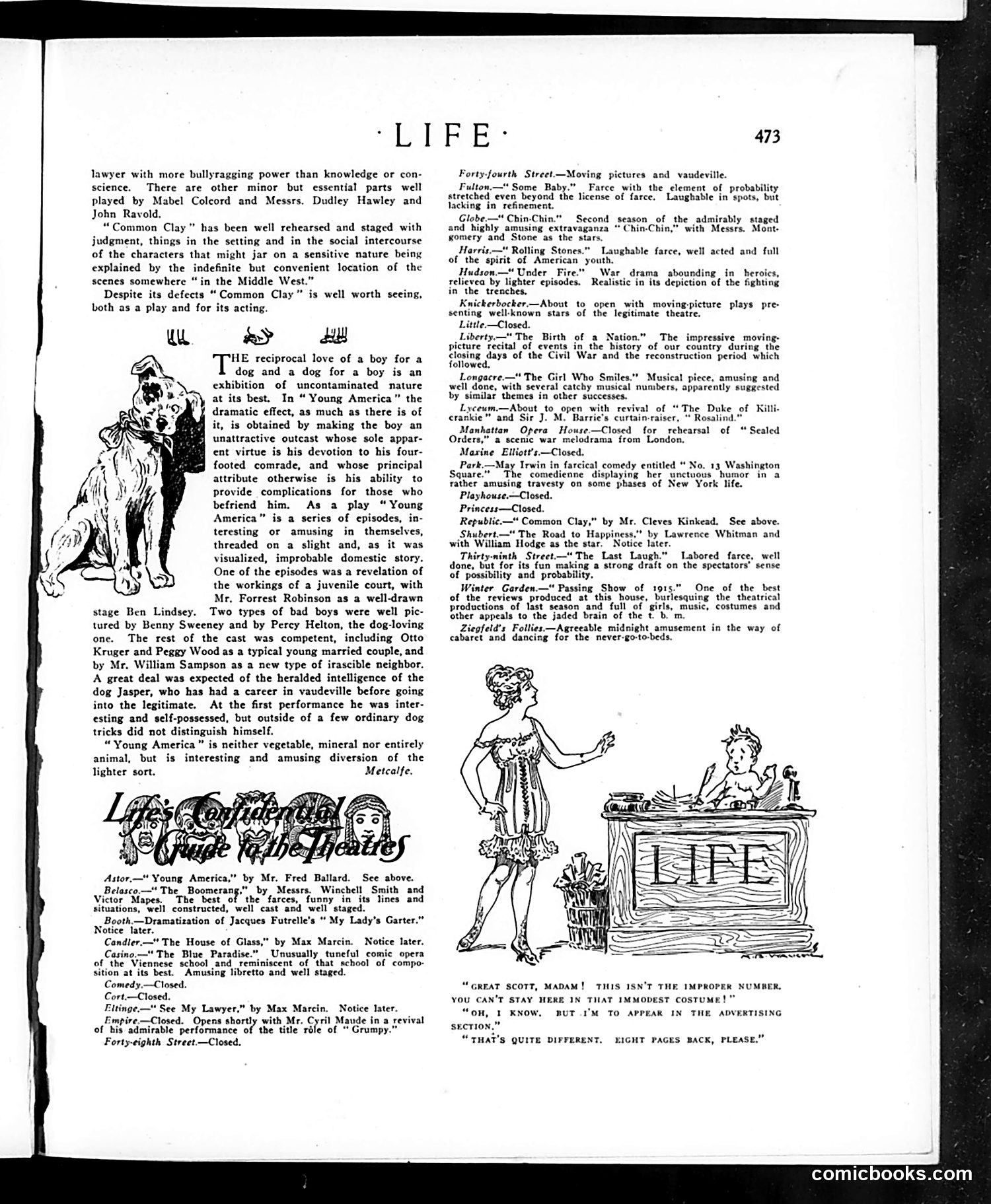
This page primarily reviews Broadway theatrical productions from the early 1910s, featuring a satirical cartoon at bottom right. **The Cartoon:** A woman in fashionable dress speaks to a theater manager/editor at his desk. She protests appearing "eight pages back" in an advertising section rather than in the main editorial content, claiming the location is "improper" for her "immaculate costume." The joke satirizes theatrical vanity and the tension between editorial prestige and advertising revenue—performers and advertisers compete for prominent placement, and appearing in back-matter sections was considered degrading despite being read by the same audience. **Context:** This reflects early 20th-century anxieties about commercialization of culture. Life magazine depended on advertising revenue while maintaining editorial standards; this cartoon mocks how performers obsessed over placement status regardless of actual visibility. The page's theater reviews mention stars like Peggy Wood and reference Ben Lindsey (a real Progressive-era judge famous for juvenile court reform), grounding the satirical commentary in contemporary entertainment culture.
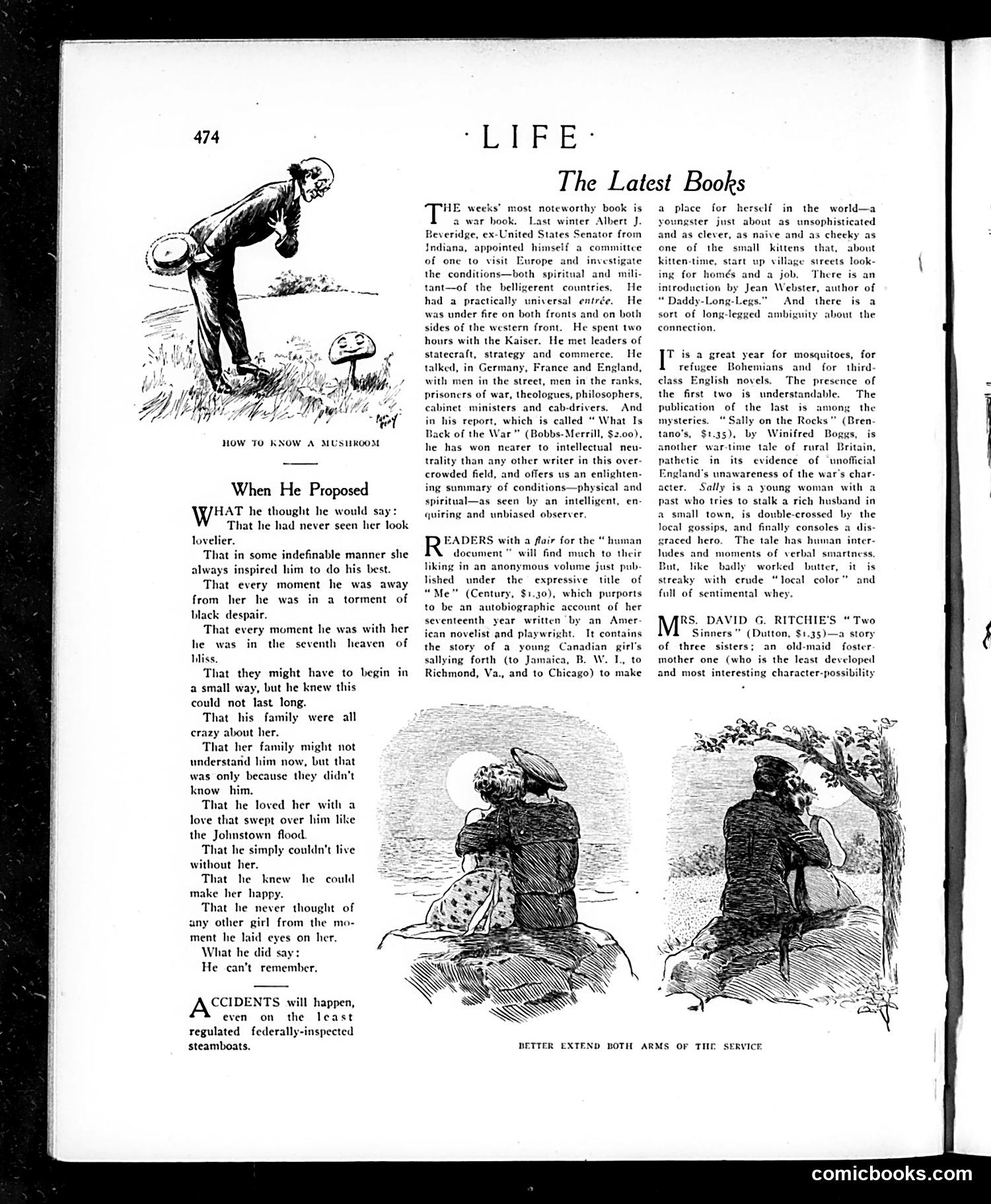
This satirical piece contrasts what a man *intends* to say during a marriage proposal with what he actually says—nothing he remembers. The joke ridicules romantic pretension: the imagined speech is florid and overwrought (comparing his love to the Johnstown flood, claims of constant devotion), while reality is awkward silence. The "mushroom" title suggests the man is fungal-like—pale, underdeveloped, insubstantial. The accompanying cartoon (top left) shows a man bending forward awkwardly, reinforcing the physical awkwardness matching his verbal inadequacy. The page also reviews contemporary war books and novels, reflecting Life magazine's literary criticism section. A separate cartoon labeled "Better Extend Both Arms of the Service" depicts two figures embracing outdoors, likely commentary on wartime romance or morale.
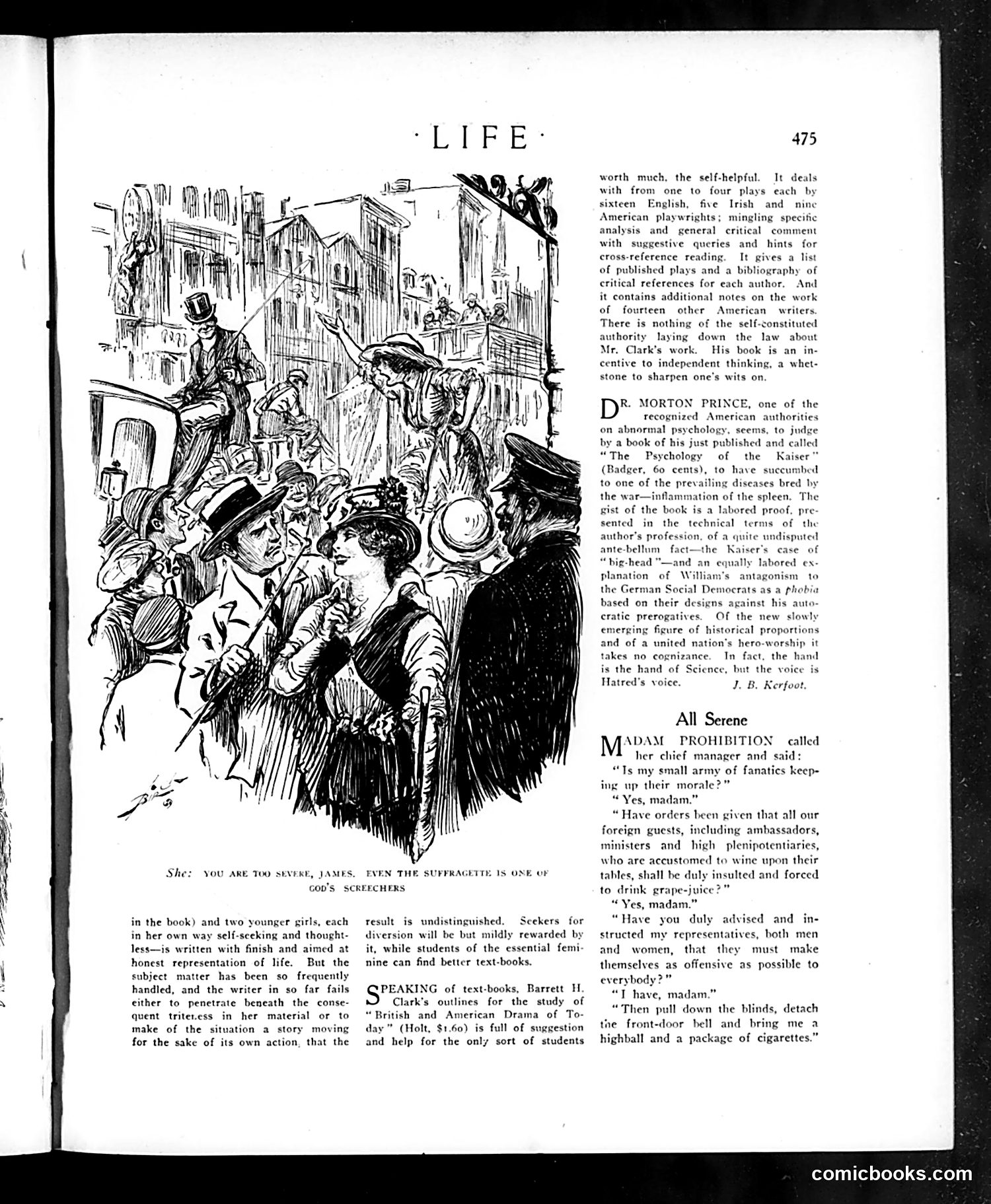
This page contains two distinct satirical pieces: **The Main Cartoon** (upper left) depicts a crowded urban street scene with a woman speaking to a man named James. Her remark—"You are too severe, James. Even the suffragette is one of God's screechers"—mocks both his criticism and the women's suffrage movement. The "screechers" reference was a common derogatory term for suffragettes, portraying them as loud, unpleasant agitators. The cartoon satirizes contemporary dismissal of women's rights advocates. **"All Serene" (lower right)** is a fictional dialogue satirizing Prohibition enforcement. "Madam Prohibition" orders her agents to insult foreign diplomats and force them to drink grape-juice instead of wine, while she secretly enjoys a highball and cigarettes. This mocks the hypocrisy and zealotry of Prohibition supporters who imposed strict rules on others while violating them privately—a common complaint during the Prohibition era (1920-1933). Both pieces use satire to critique social reform movements the magazine viewed as sanctimonious and excessive.
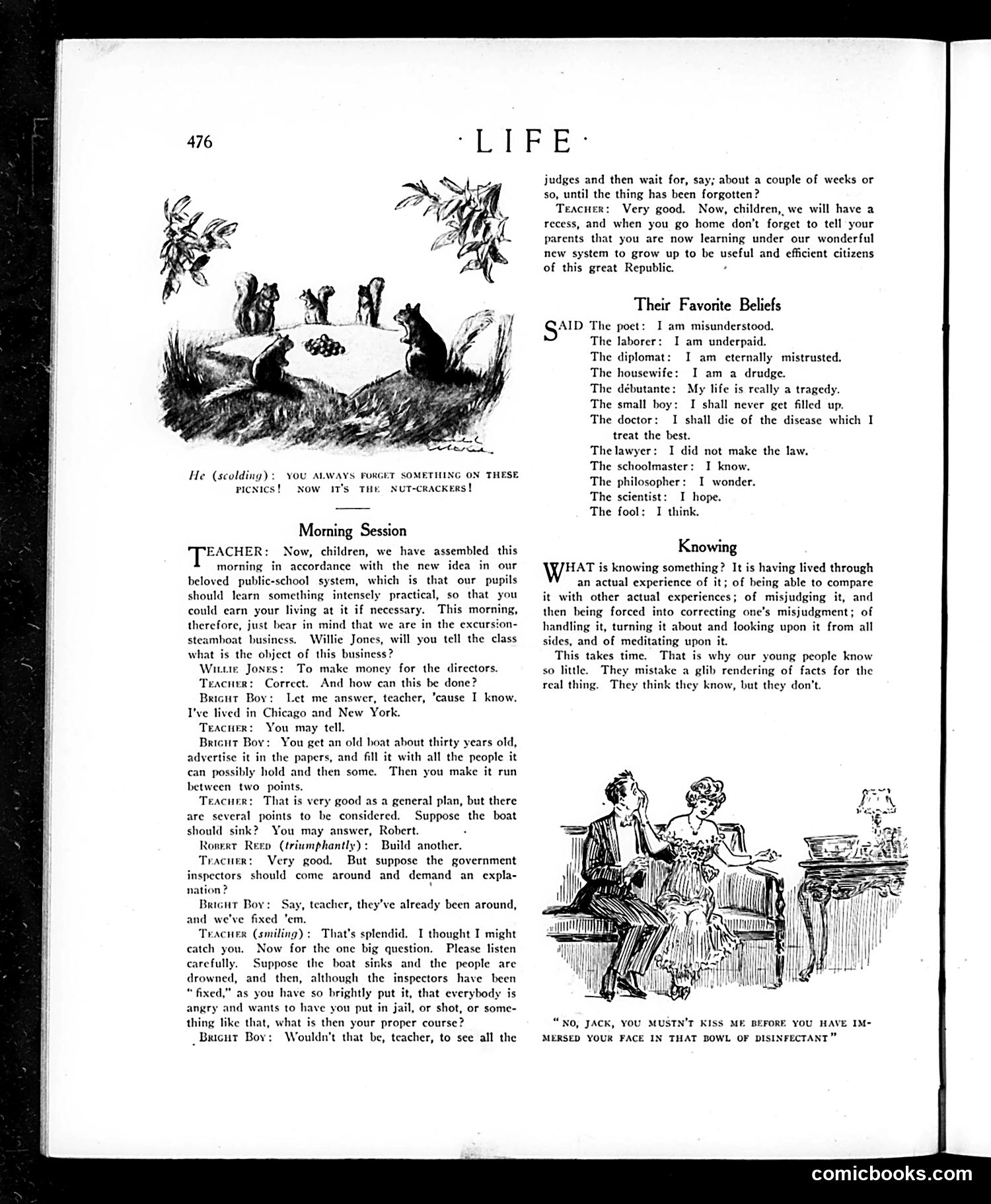
This page satirizes Progressive-era educational reform and corporate corruption. The main cartoon depicts a teacher conducting a mock "practical business lesson" where students learn steamboat operation—but the real curriculum is institutional fraud. The bright boy recites a cynical playbook: overcrowd an old vessel, bribe government inspectors, and when disaster strikes (drowning passengers), wait for public memory to fade before facing consequences. The satire targets both naive educational reformers promoting "practical" learning and the actual corruption plaguing Gilded Age industries. Steamboat disasters were real and frequent; inspectors genuinely could be "fixed." The teacher's cheerful conclusion—that students are learning to be "useful and efficient citizens"—is deeply ironic. The lower section's list of "Favorite Beliefs" mocks self-deception across professions, reinforcing the page's theme: people rationalize wrongdoing through convenient falsehoods.
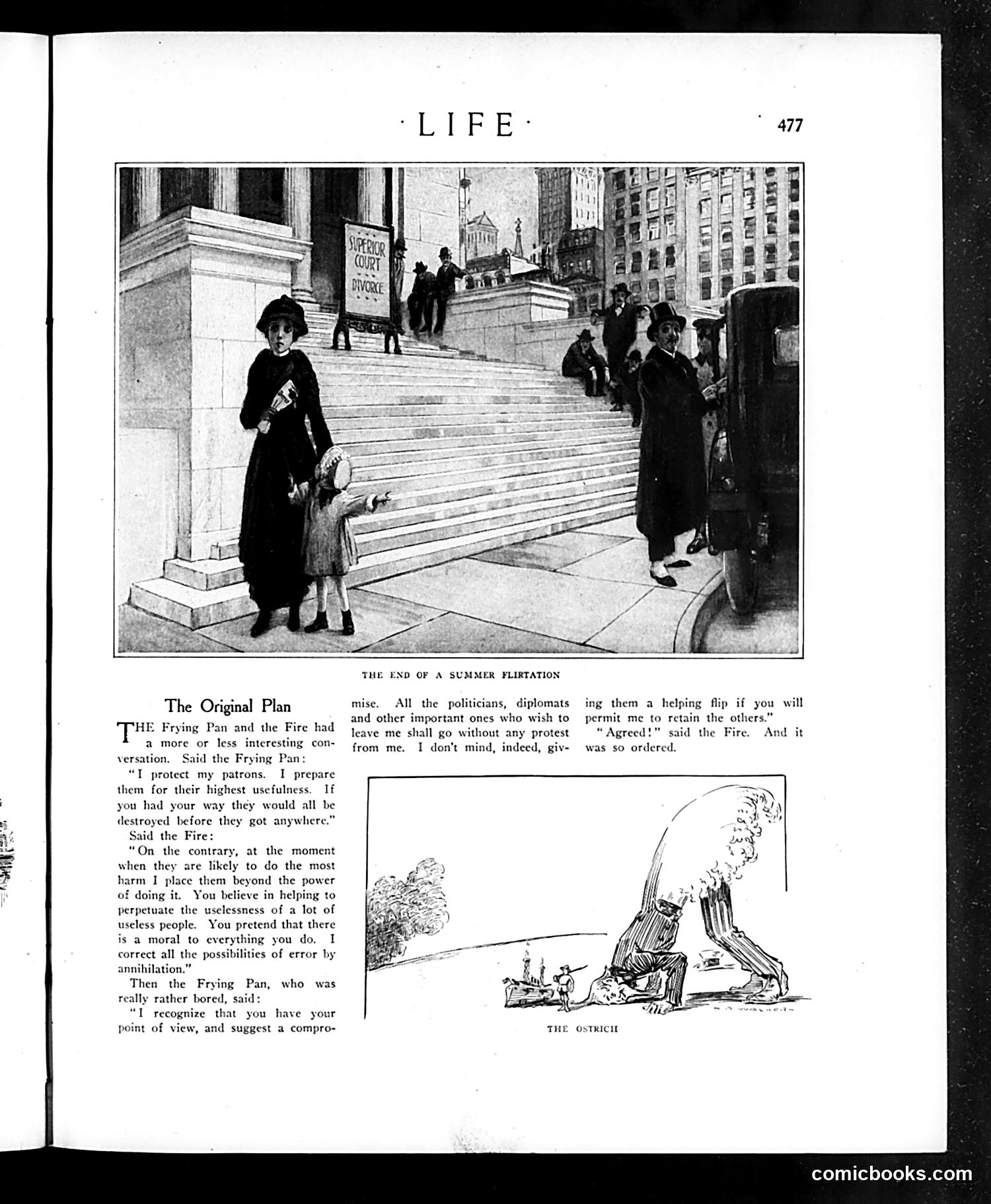
This page contains two distinct satirical pieces from Life magazine: **Top Image: "The End of a Summer Flirtation"** A photograph showing well-dressed people on the steps of what appears to be a courthouse or government building, depicting a social scene in an urban setting. **Bottom Fable: "The Original Plan"** An allegorical dialogue between the Frying Pan and Fire—personified abstract concepts debating philosophy. The Frying Pan represents protective paternalism ("I protect my patrons"), while Fire represents destructive elimination ("I correct all possibilities of error by annihilation"). The satire targets moral hypocrisy: both claim noble purposes, but the Frying Pan admits to merely perpetuating uselessness while wearing a moral mask. Their proposed "compromise"—allowing important politicians and diplomats to escape while retaining ordinary people—mocks how those in power exempt themselves from consequences. The accompanying illustration shows an ostrich (symbol of willful ignorance) and likely reinforces the theme of self-deception and averted vision from uncomfortable truths about social hierarchy and selective justice.
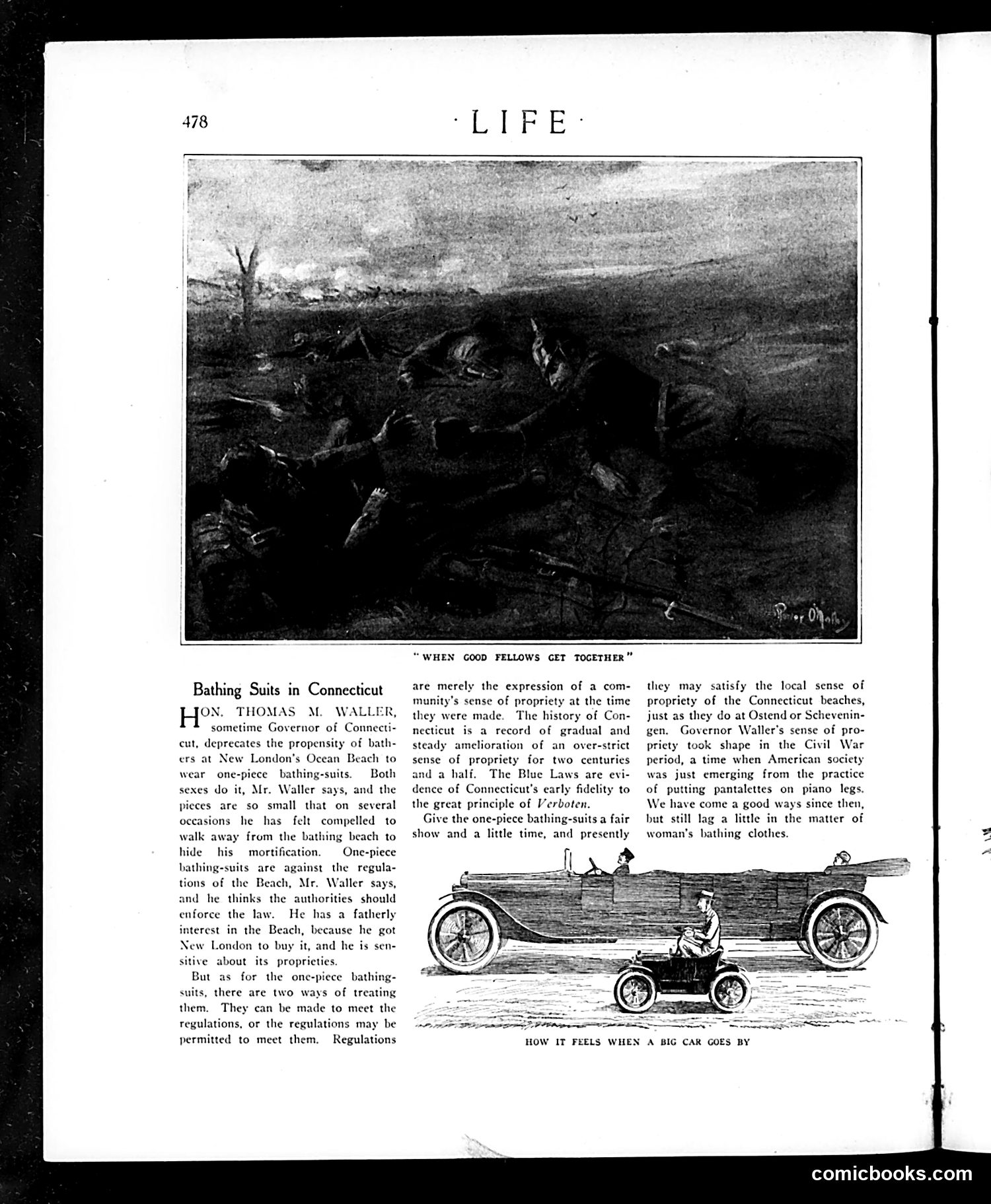
This page satirizes former Connecticut Governor Thomas M. Waller's objection to one-piece bathing suits at New London's Ocean Beach. The article argues that Waller's prudishness reflects outdated Victorian morality—comparing his sensitivity to the absurd practice of putting "pantalettes on piano legs" to hide their shape during the Civil War era. The satire's point: Connecticut's strict "Blue Laws" represent an overly rigid historical sense of propriety that gradually evolves. One-piece suits, already accepted at European beaches like Ostend, will eventually become normal in Connecticut too. Waller's mortification reveals how relative and time-bound moral standards are. The two cartoons below—"When Good Fellows Get Together" (soldiers in a trench) and "How It Feels When a Big Car Goes By" (a small car dwarfed by a larger one)—appear to be unrelated humorous illustrations typical of Life's format, not directly connected to the bathing suit debate.
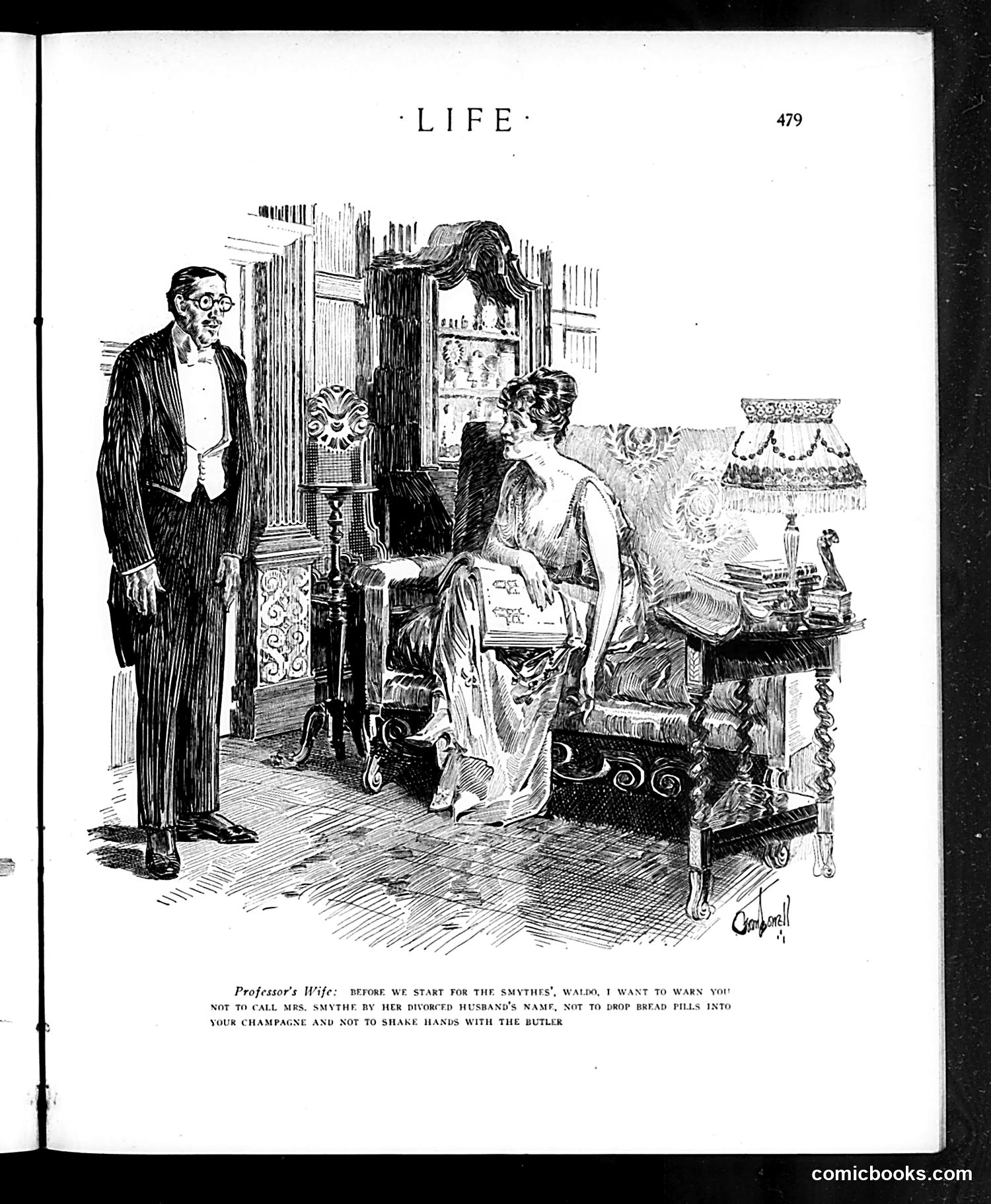
This Life magazine cartoon satirizes upper-class etiquette and social anxiety. A woman (the "Professor's Wife") gives her husband detailed warnings before attending a social gathering at the Smythes' home. The humor targets several concerns: - The awkwardness around Mrs. Smythe's divorce (using her ex-husband's name would be a gaffe) - Absurd dining behavior (dropping bread pills into champagne) - Class confusion about proper servant interaction (shaking hands with the butler) The satire mocks both the rigid social conventions of genteel society and the Professor's apparent cluelessness about basic etiquette. The cartoon suggests anxiety about maintaining appearances and the elaborate rules governing "proper" behavior among the educated elite.
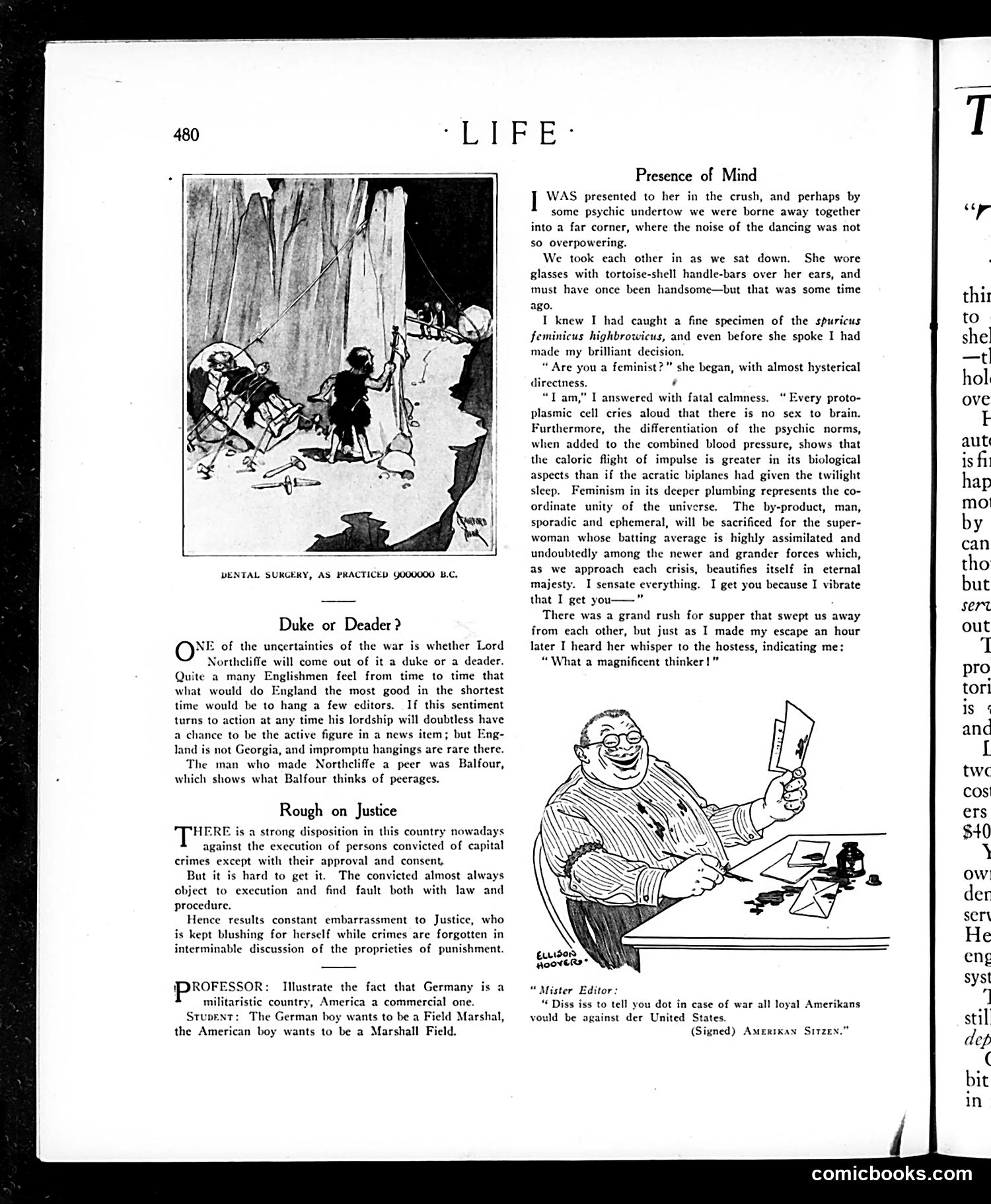
**"Duke or Deader?"** satirizes Lord Northcliffe, a powerful British newspaper editor and peer. The piece suggests some Englishmen jokingly wish editors would be hanged for their influence. The joke notes that while lynchings occur in Georgia (America), England's more civilized restraint means Northcliffe will likely survive the war—becoming either a duke or simply dying naturally ("deader"). It's a backhanded insult to his power and unpopularity. **"Rough on Justice"** mocks the judicial system's embarrassment when convicted criminals object to their own executions and legal procedures—suggesting the system worries more about procedural propriety than actual justice. **The professor/student joke** contrasts German and American militarism: German boys aspire to be Field Marshals (military rank); American boys want to be Marshall Field (the famous Chicago department store owner/businessman). It stereotypes America as commercially rather than militaristically driven. The other pieces satirize feminism and contain a mock-patriotic letter using German-accented English, likely mocking hyphenated-American loyalty concerns during WWI.
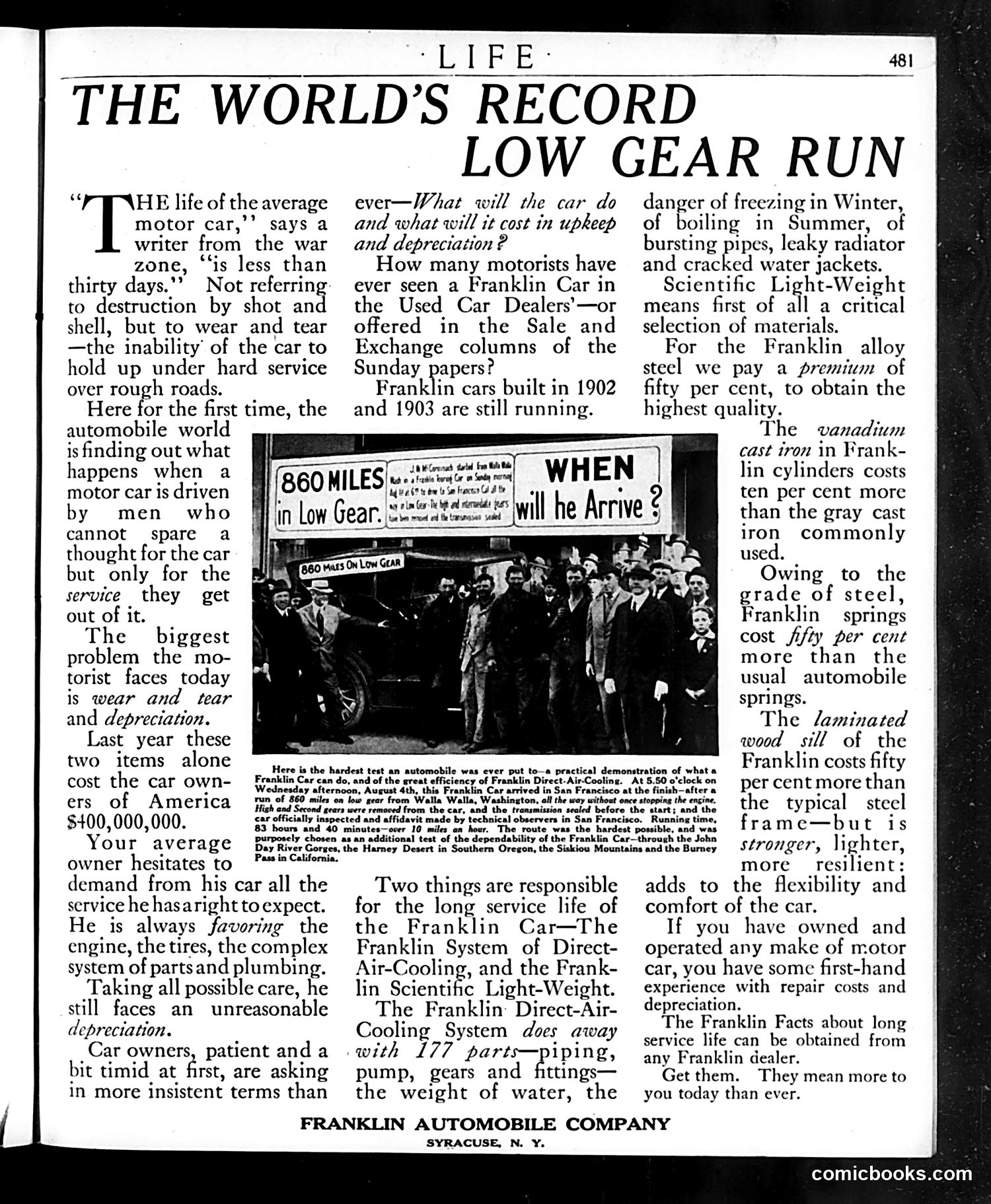
This is primarily a **Franklin Automobile Company advertisement**, not satire. The page presents a dramatic endurance test: a Franklin car completed an 860-mile journey from Walla Walla, Washington to San Francisco running *only in low gear* with the transmission sealed, to demonstrate durability and reliability. The accompanying article argues that car depreciation and wear-and-tear are major consumer concerns—costing American car owners $400 million annually. Franklin emphasizes its superiority through two engineering features: a direct-air-cooling system (eliminating water-cooling complications) and scientific light-weight construction using premium materials (vanadium cast iron, alloy steel, laminated wood). The implicit claim: Franklin cars from 1902-1903 still run, while competitors deteriorate rapidly. This addresses early automotive buyers' anxiety about whether their expensive purchase will hold value and withstand rough roads—especially relevant given WWI's demonstrated harsh vehicle conditions mentioned in the opening.
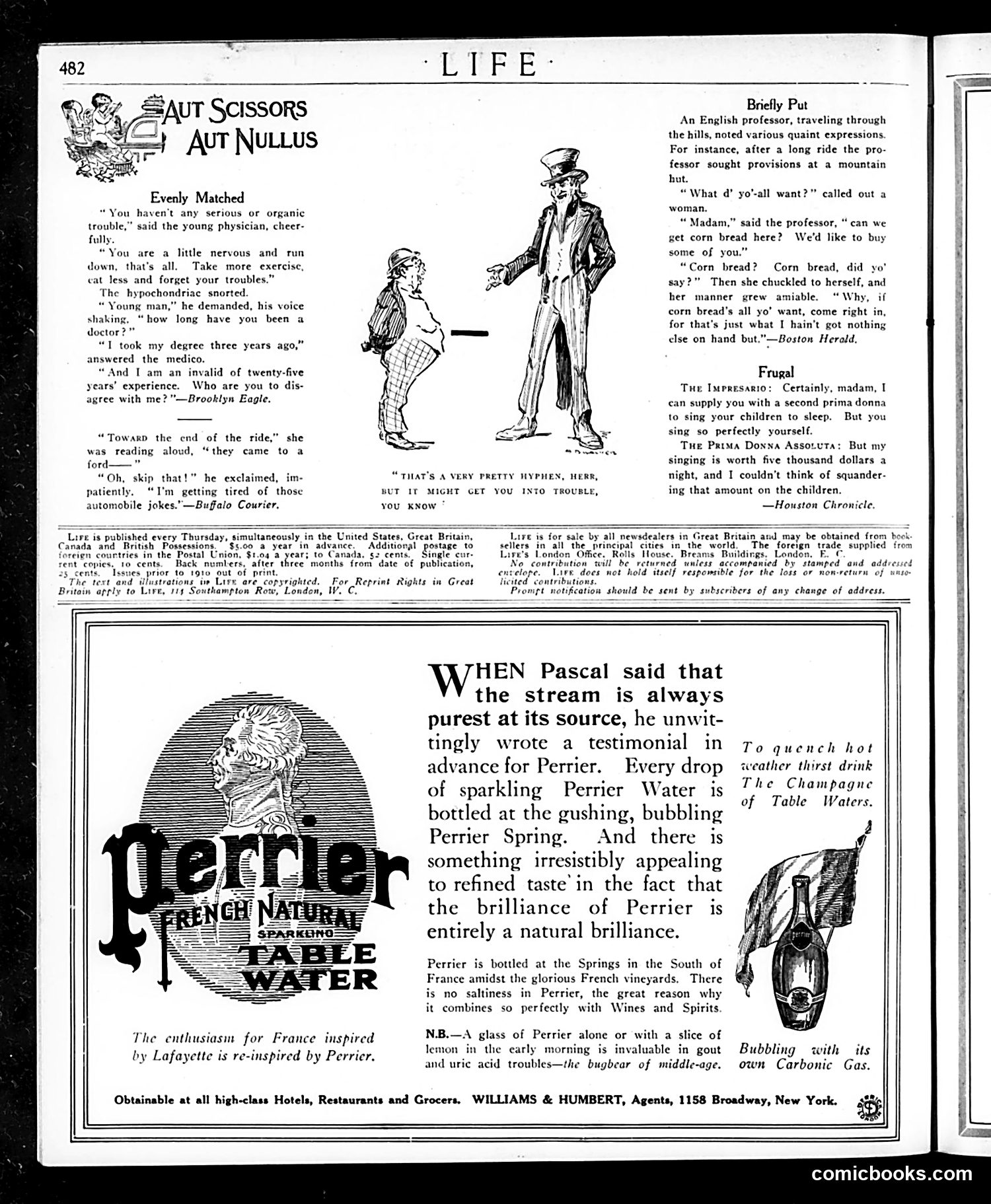
This page contains four unrelated humor pieces and a Perrier water advertisement: **The cartoons/jokes** satirize everyday social situations: 1. A physician and chronic hypochondriac debate medical expertise—the invalid, with 25 years of experience being sick, dismisses the young doctor's three-year degree. 2. A man interrupts a woman's reading, tired of "automobile jokes" (likely contemporary humor about cars). 3. A British professor misunderstands rural American dialect, asking to "buy some" cornbread from a woman who finds his formal phrasing amusing. 4. An opera impresario notes that a prima donna won't "squander" her five-thousand-dollar-per-night talent on singing her own children to sleep. 5. A German cartoon (with hyphen reference) appears to make a political joke, though context is unclear. The humor relies on class differences, linguistic misunderstandings, and human vanity rather than specific topical references. The **Perrier advertisement** invokes Pascal and French sophistication to market sparkling water as the refined choice.
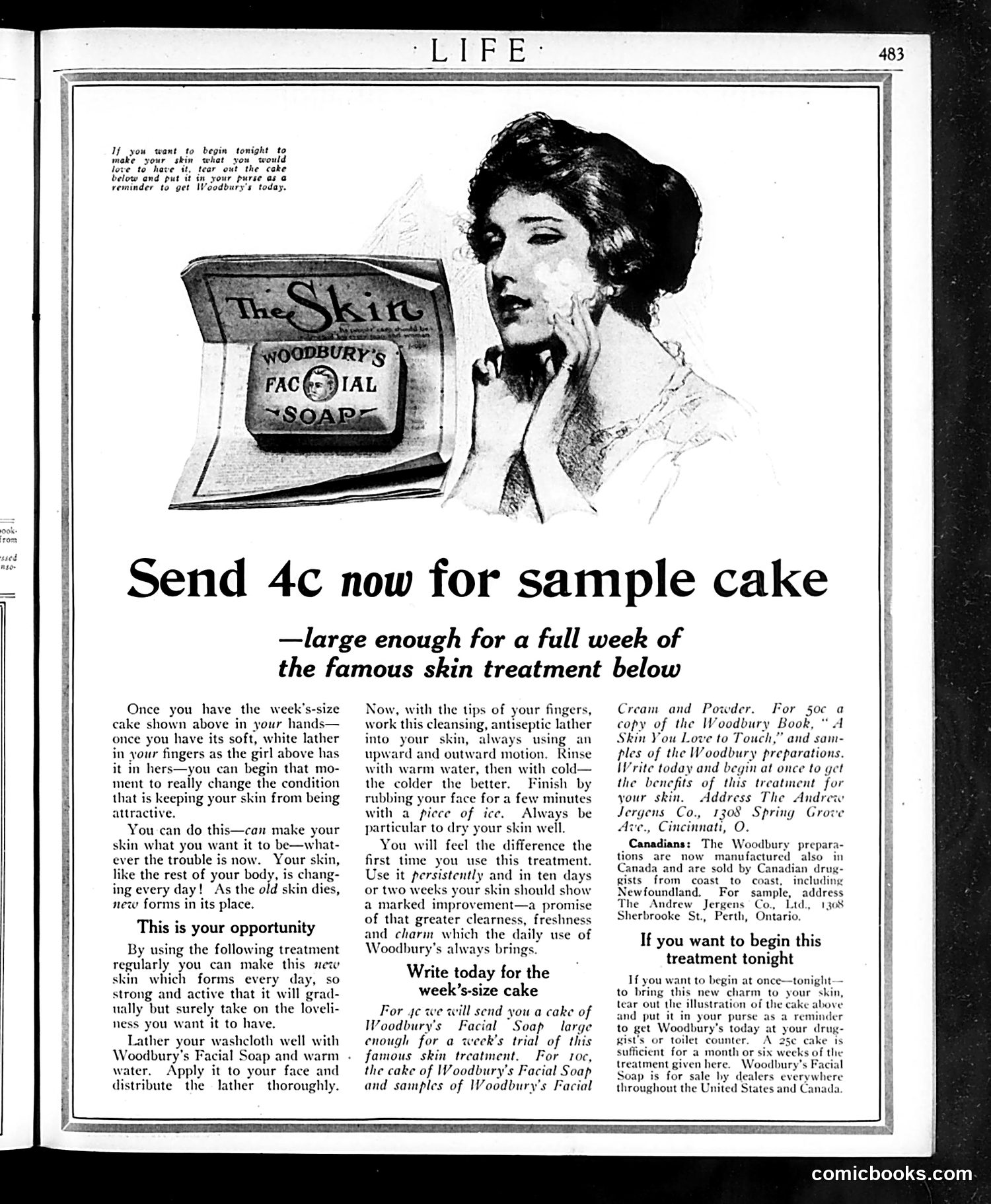
This is primarily a **product advertisement**, not satire or political content. It occupies page 483 of *Life* magazine and promotes Woodbury's Facial Soap. The image shows a woman's face alongside a soap cake package, illustrating the product. The ad employs common early 20th-century beauty marketing tactics: - **The pitch**: For 4 cents, readers could obtain a week-long sample of soap with instructions for a facial treatment regimen - **The promise**: Claims that consistent use would visibly improve skin within "ten days or two weeks" - **The appeal**: Suggests skin naturally regenerates daily, so proper treatment can enhance this natural process - **The mechanism**: Detailed instructions for lathering, massage technique, and finishing with ice water The language emphasizes "charm" and attractiveness as achievable through the product's "famous skin treatment." This represents typical early-20th-century beauty advertising that positioned soap as transformative rather than merely cleansing. There is no apparent satire, cartoon, or political commentary on this page.
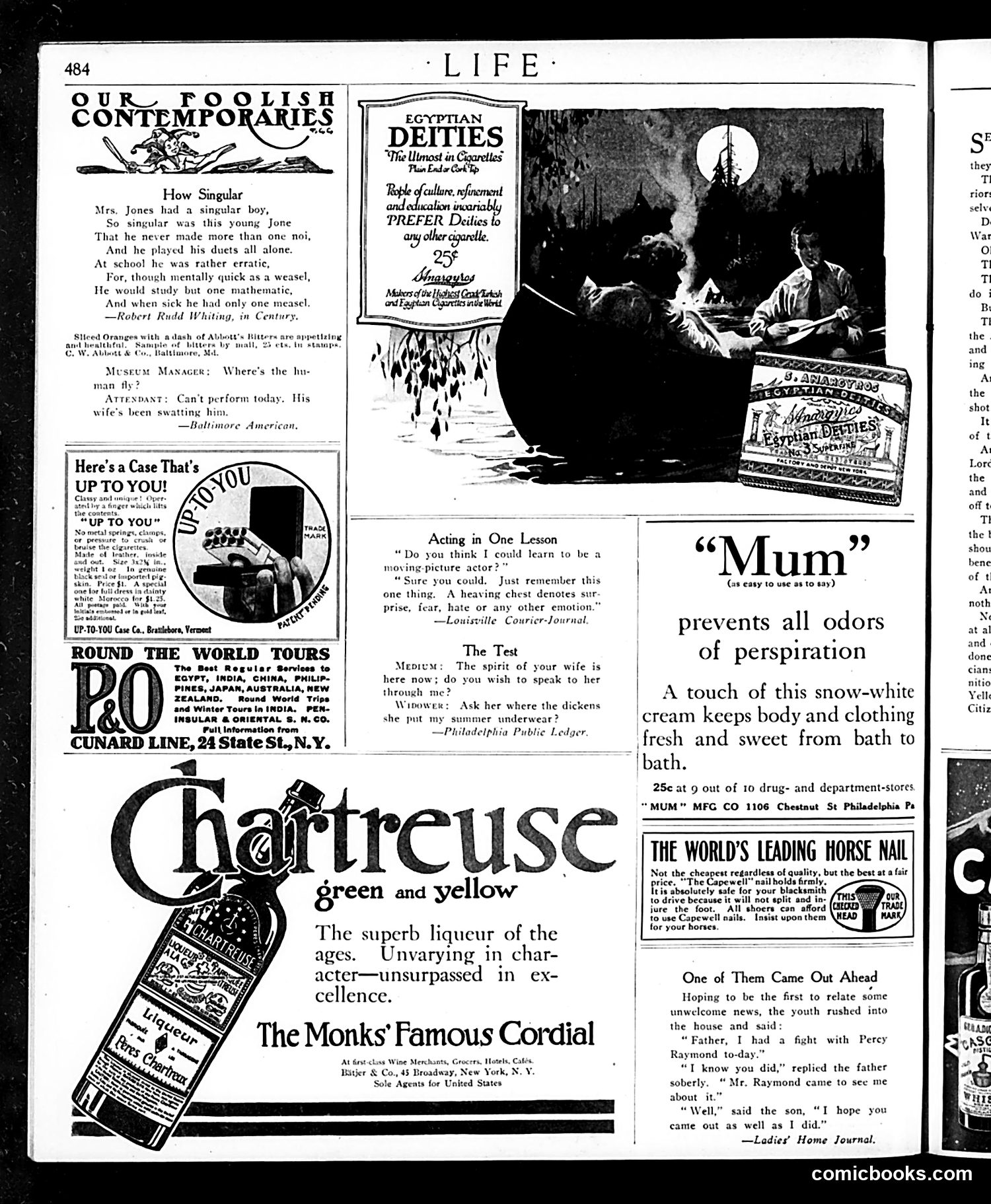
This page from Life magazine (appears to be early 20th century) contains mostly **advertisements and brief humorous anecdotes** rather than political cartoons. The content includes: **Humor pieces**: Short jokes about singular behavior ("Mrs. Jones had a singular boy"), a "human fly" performer unable to work because his wife swatted him, and a spiritualist séance where a widower asks his wife's ghost where she hid his underwear—all playing on domestic absurdities. **Acting lesson joke**: A quip about movie acting requiring only one technique—a "heaving chest" to convey any emotion (satirizing early silent film's melodramatic conventions). **Advertisements**: Including travel tours, Egyptian Deities liqueur, Chartreuse cordial, "Mum" deodorant cream, and Capewell horse nails. **The fighting sons anecdote**: Two boys fight; the father reveals he also fought the other boy's father, with both emerging equally battered—a gentle joke about adult dignity undermined by childish behavior. The page reflects Life's mix of satirical humor and commercial content typical of the era.
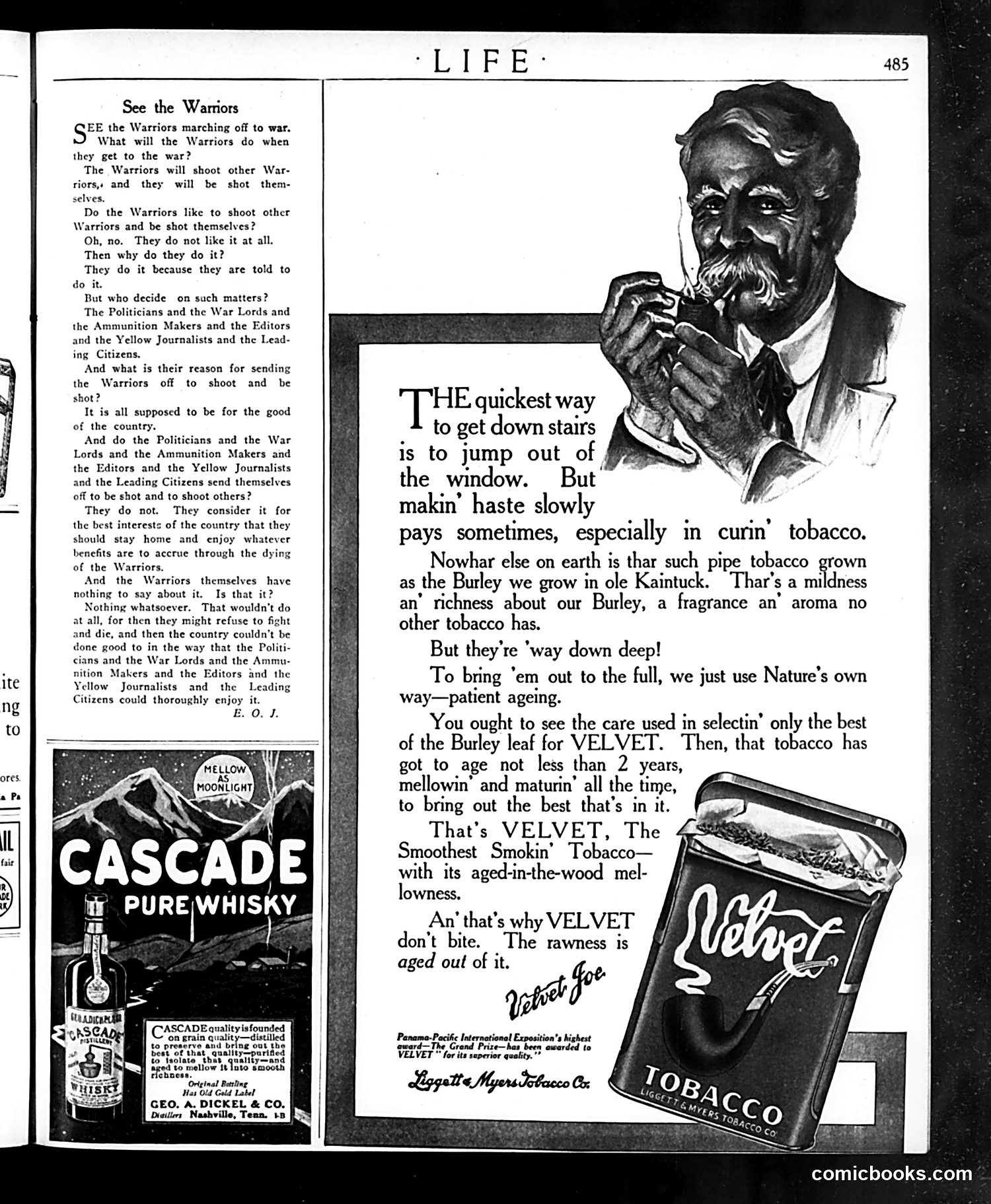
The left column presents an anti-war editorial cartoon titled "See the Warriors." Using a question-and-answer format, it satirizes the disconnect between decision-makers and soldiers: politicians, war profiteers (ammunition makers), and media figures (editors, yellow journalists) send young men to fight and die, yet refuse to fight themselves. The cartoon's point is biting—these leaders claim war serves "the good of the country" while the actual warriors have "nothing to say about it" and would refuse if given choice. It's a sharp critique of how power structures sacrifice ordinary people for profit and glory without personal consequence. The right side is a tobacco advertisement for Velvet brand pipe tobacco, featuring a bearded man and folksy copy about Kentucky Burley leaf and patient aging—completely incongruous with the anti-war message beside it, reflecting early 20th-century magazine advertising practices.
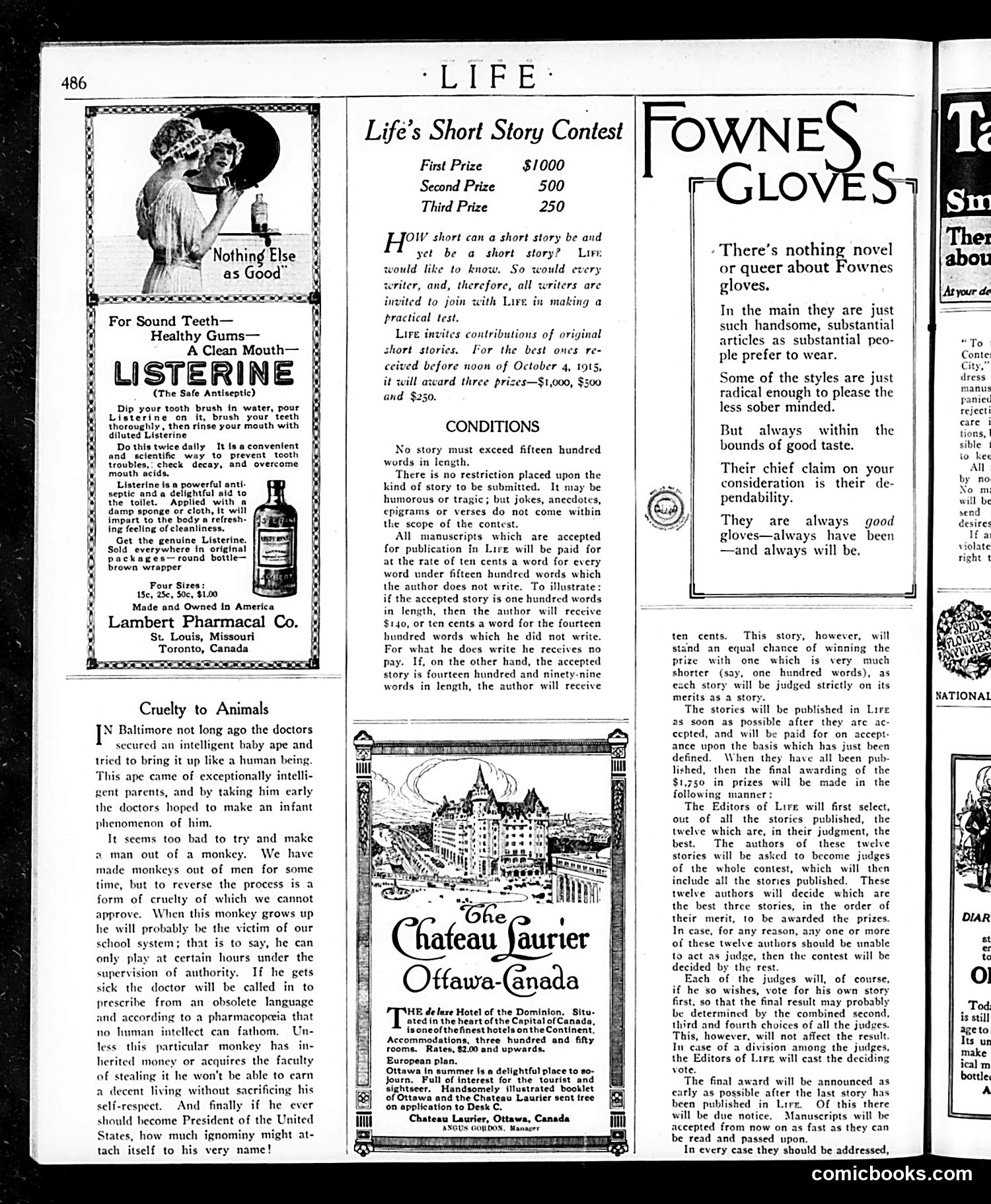
This page contains three distinct elements: **The "Cruelty to Animals" Editorial** (left column) uses dark satire to mock a real Baltimore experiment where doctors attempted to raise a young chimpanzee as a human child. The piece inverts the premise: rather than sympathizing with the ape, it sarcastically warns that teaching the monkey human ways will only subject it to society's miseries—compulsory education, obsolete medical practices, economic exploitation, and worst of all, the possibility of becoming U.S. President. The satire targets American institutions and education rather than the experiment itself. **Life's Short Story Contest** (center) announces a genuine literary competition with unusual rules: writers are paid ten cents per *unwritten* word (up to 1,500 words), not for words they actually write—a clever inversion rewarding brevity. **Advertising** dominates: Listerine mouthwash, Fownes Gloves, and Chateau Laurier Hotel occupy remaining space—typical of period magazines. The page reflects 1915 popular culture: scientific curiosity about animal intelligence, satire of American institutions, and the magazine's role as both entertainment and advertising vehicle.
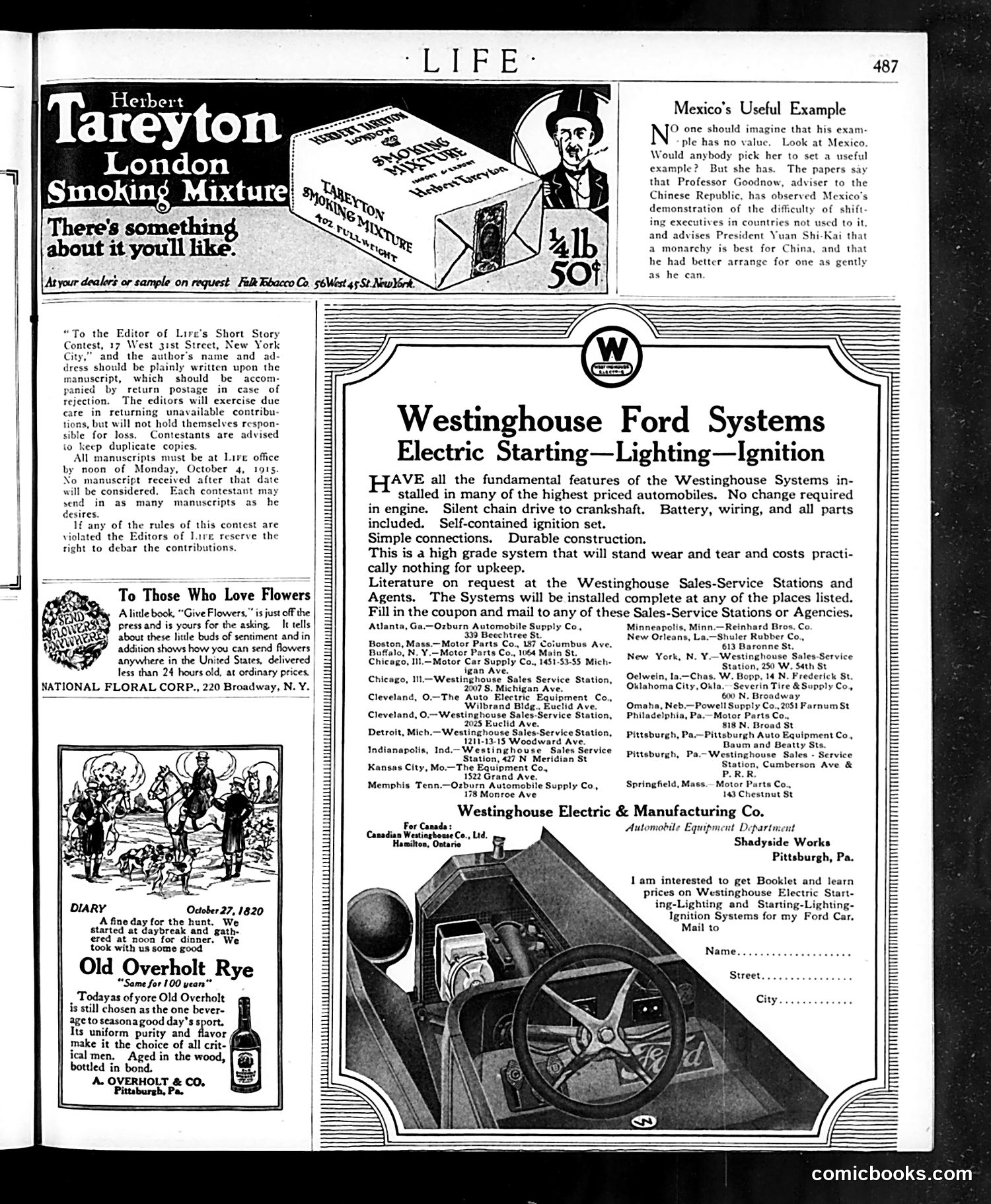
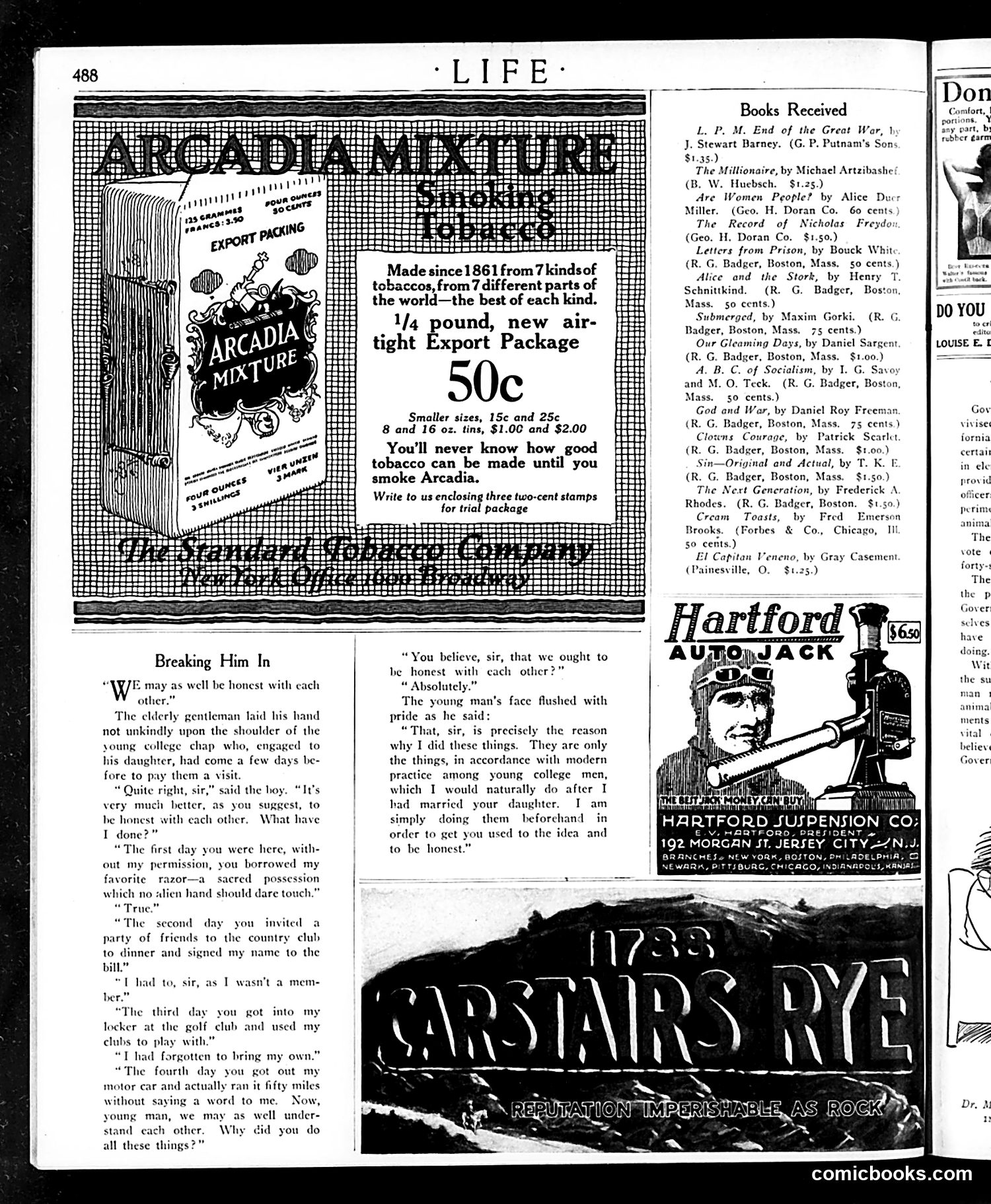
This cartoon mocks the behavior and values of young college men of the era. An elderly father confronts his daughter's fiancé about a series of liberties taken during his visit: borrowing the father's razor, signing his name to a dinner bill, using his golf clubs, and taking his motor car—all without permission. The joke's twist: the young man defends himself by claiming he's practicing dishonesty *beforehand* to prepare the father for what he'll do *after marriage*, framing brazen entitlement as honest preparation. The satire targets both the arrogance of young college men who feel entitled to their elders' possessions and the absurdity of using "honesty" to justify selfish behavior. It's a commentary on generational conflict and the moral shortcuts some young men justified under modern practice.
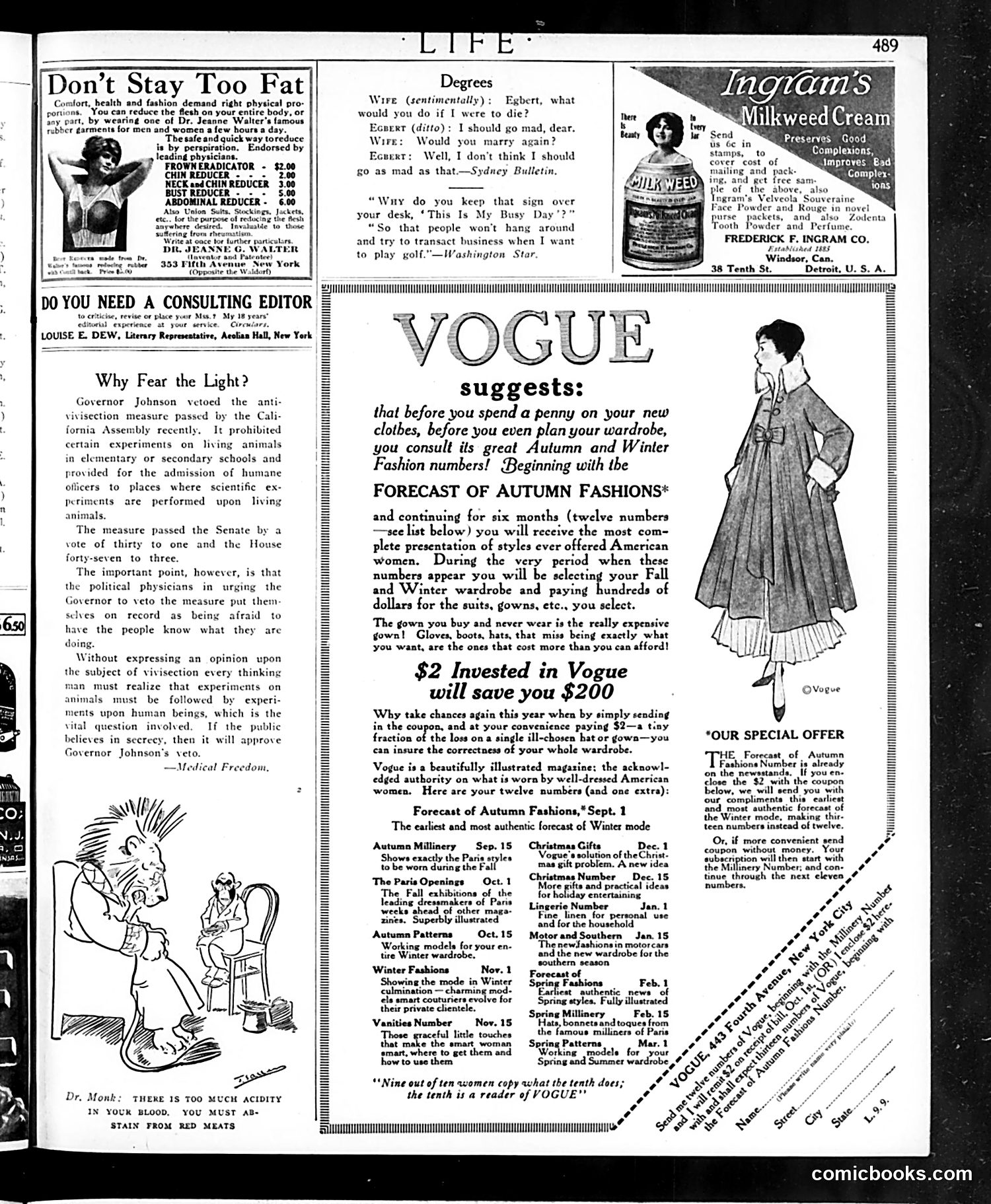
This page contains **satirical commentary and period advertising** rather than political cartoons. **The "Degrees" section** presents a humorous marital dialogue mocking romantic sentimentality. A wife asks her husband what he'd do if she died; when he says he'd "go mad," she responds that remarrying wouldn't drive him "as mad as that"—a joke deflating the notion of undying devotion. **"Why Fear the Light?"** critiques California Governor Johnson's veto of an anti-vivisection bill. The editorial argues that politicians opposing transparency about animal testing experiments reveal they're "afraid" of public knowledge. It suggests such secrecy undermines democratic accountability—the "light" of public scrutiny being essential. **The cartoon at lower left** (unsigned but satirical) appears to mock excess or indulgence, though details are unclear. The remainder is primarily **Vogue magazine advertising**, promoting fashion forecasts for $2—a sales pitch rather than satire. The page reflects 1920s concerns: women's marital expectations, scientific ethics, and consumer fashion culture.
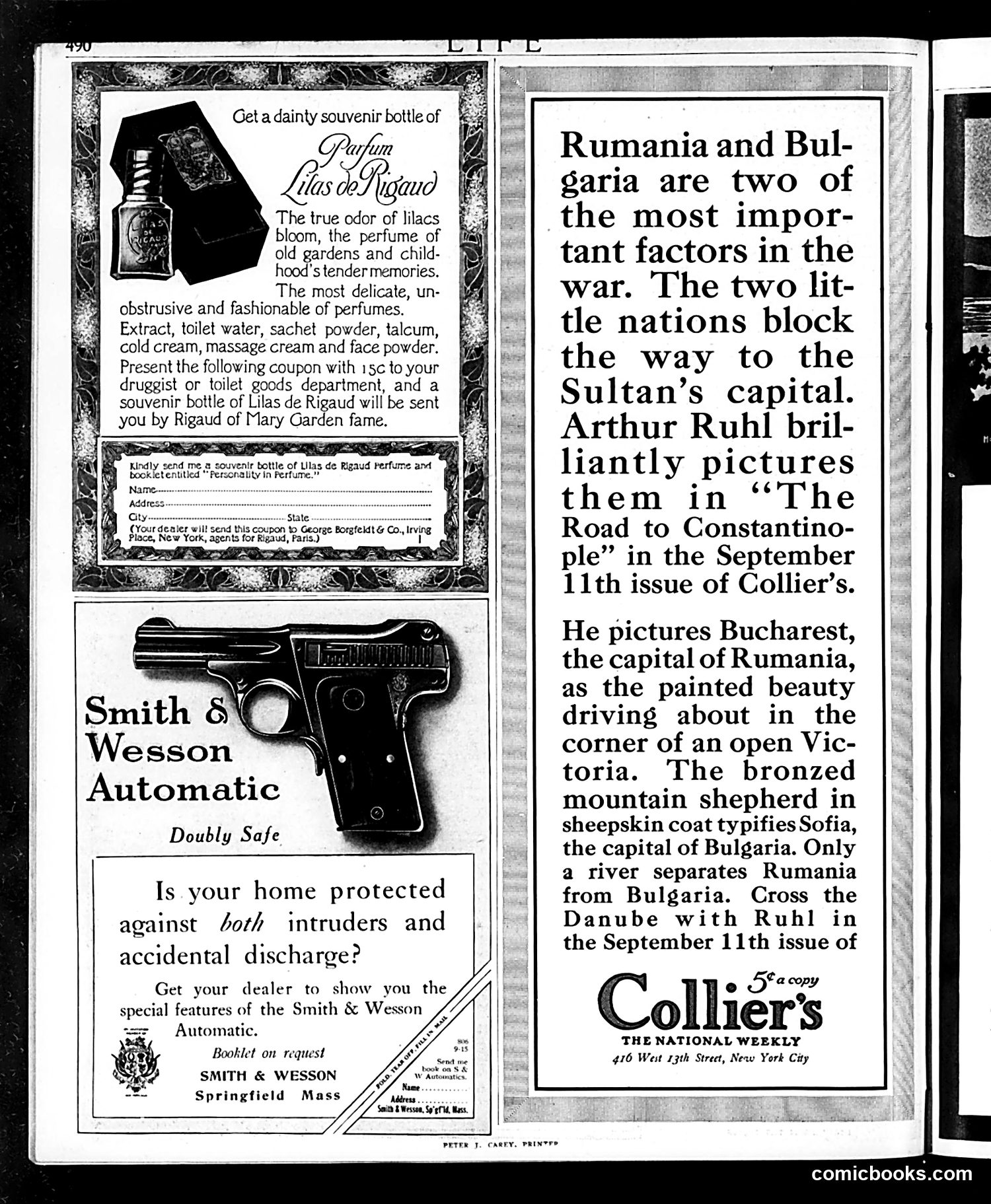
This page contains **advertisements and promotional content**, not political cartoons. The layout shows three ads: 1. **Lilas de Rigaud perfume**: A luxury fragrance marketed as delicate and fashionable, offering a souvenir bottle for 15 cents plus a coupon. 2. **Smith & Wesson Automatic pistol**: Marketed as "Doubly Safe," asking whether homes are "protected against both intruders and accidental discharge"—emphasizing home security during an unspecified period of concern. 3. **Collier's magazine advertisement**: Promoting an article by Arthur Ruhl titled "The Road to Constantinople" in the September 11th issue. The text describes Romania and Bulgaria as strategically important in "the war" (likely WWI), portraying their capitals through romanticized imagery—Bucharest as feminine beauty, Sofia as a mountain shepherd. This references the Balkans' geopolitical importance in blocking access to Ottoman territory. The page reflects early-20th-century consumer culture and wartime concerns.
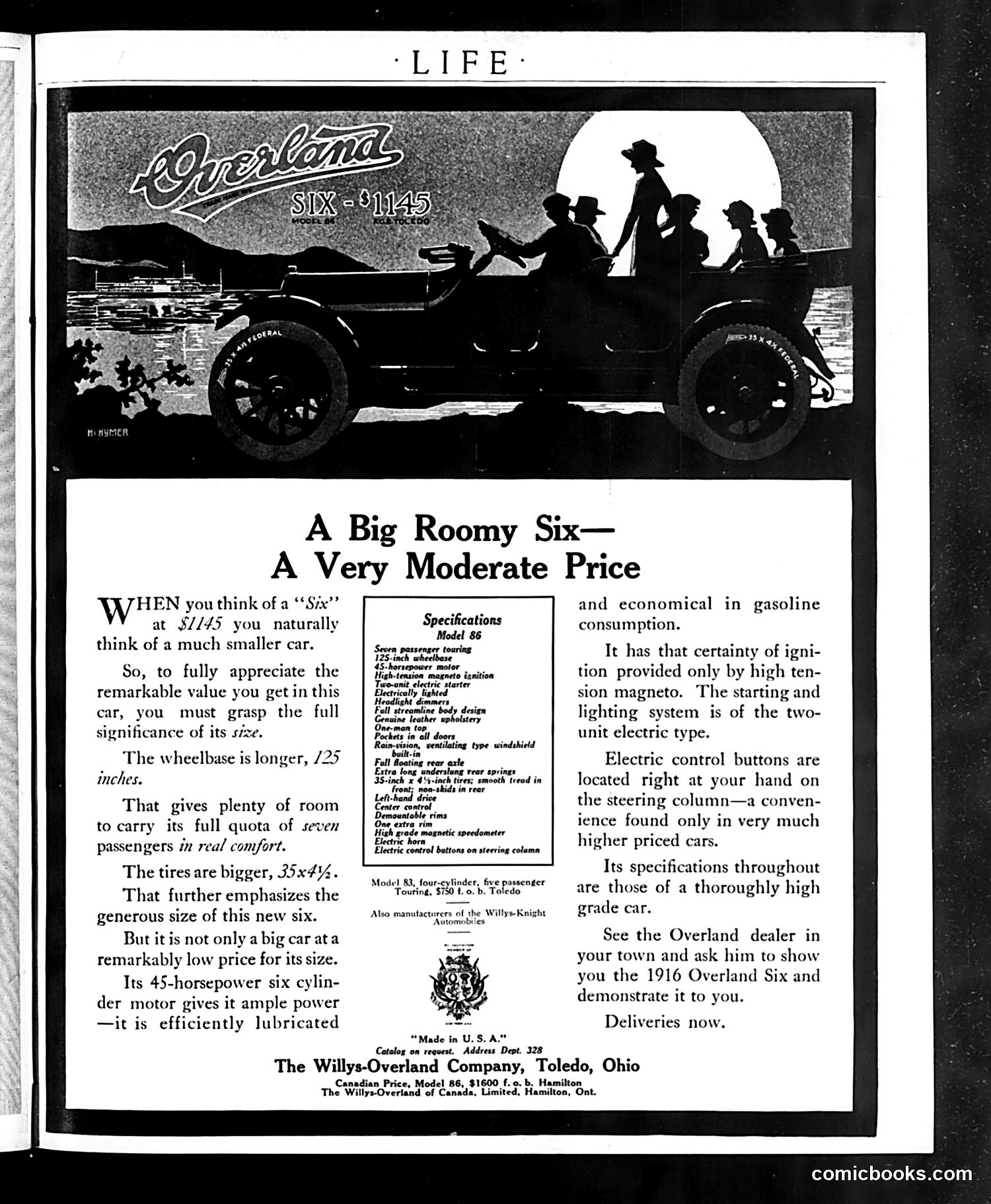
This is **not satirical content** — it's a straightforward automobile advertisement for the 1916 Overland Six automobile, placed in *Life* magazine. The silhouetted illustration shows a well-dressed family (seven passengers as advertised) riding in an open-air touring car against a moonlit landscape, emphasizing the vehicle's spaciousness and appeal to middle-class buyers. The ad's pitch is that buyers shouldn't underestimate the car's size and quality despite its moderate $1,145 price. It emphasizes practical features: a 125-inch wheelbase, seven-passenger capacity, 45-horsepower engine, and modern conveniences like electric starters and magnetic ignition—features typically found in more expensive vehicles. The Willys-Overland Company manufactured this model in Toledo, Ohio. This represents early-1900s automotive marketing, targeting consumers who wanted car ownership without luxury pricing. There is no satire or political commentary here—merely commercial promotion in the style of period magazine advertising.