
Life, 1915-09-09 · page 26 of 44
Life — September 9, 1915 — page 26: what you’re looking at
What you’re looking at
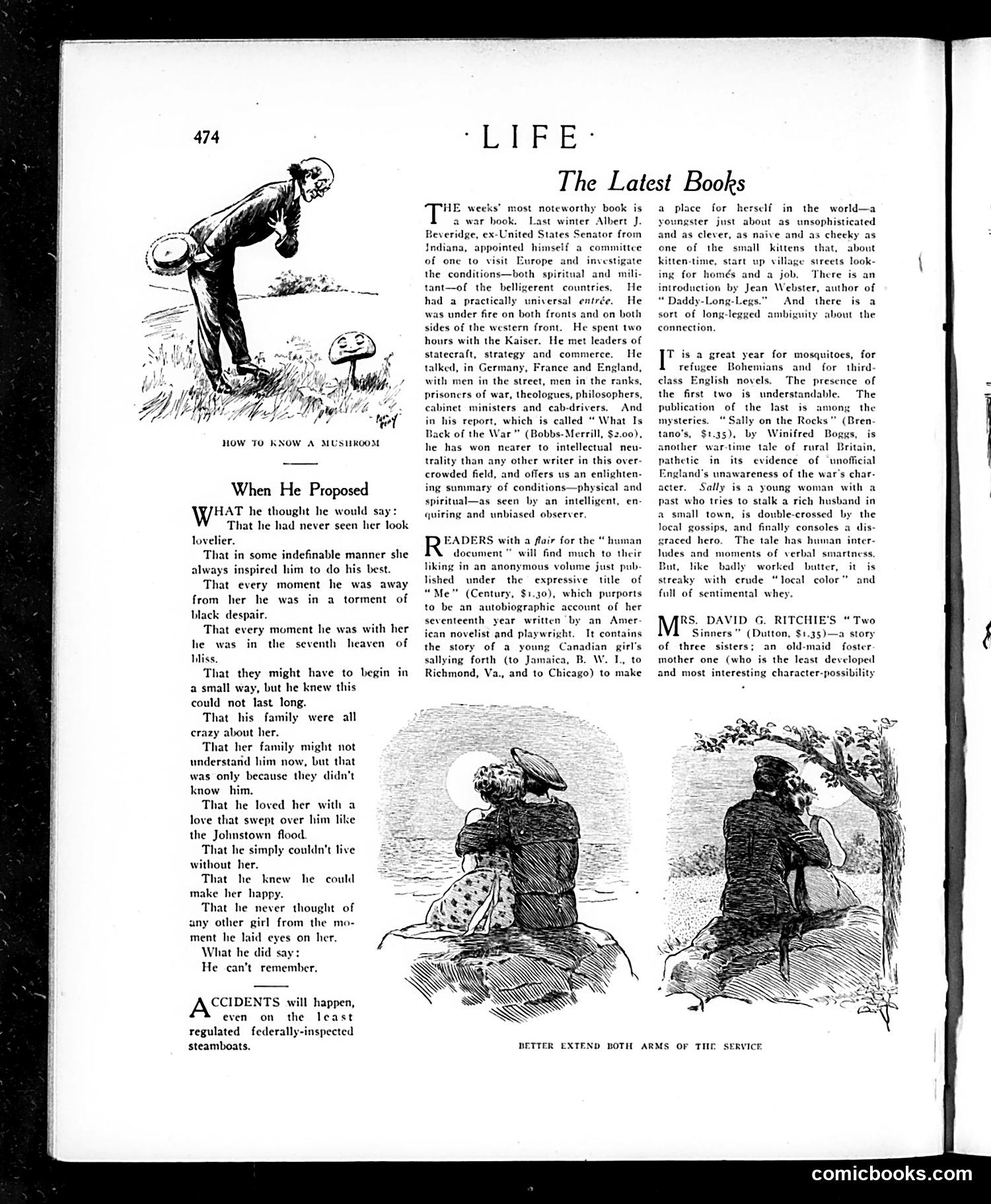
This satirical piece contrasts what a man *intends* to say during a marriage proposal with what he actually says—nothing he remembers. The joke ridicules romantic pretension: the imagined speech is florid and overwrought (comparing his love to the Johnstown flood, claims of constant devotion), while reality is awkward silence. The "mushroom" title suggests the man is fungal-like—pale, underdeveloped, insubstantial. The accompanying cartoon (top left) shows a man bending forward awkwardly, reinforcing the physical awkwardness matching his verbal inadequacy. The page also reviews contemporary war books and novels, reflecting Life magazine's literary criticism section. A separate cartoon labeled "Better Extend Both Arms of the Service" depicts two figures embracing outdoors, likely commentary on wartime romance or morale.
📄 Transcribed text from this page (OCR, searchable)
Machine-transcribed from the original scan — historical spelling and the odd misread are preserved.
HOW TO KNOW A MUSUROOM When He Proposed HAT he thought he would say: That he had never seen her look lovelier. That in some indefinable manner she always inspired him to do his best. That every moment he was away from her he was in a torment of Dlack despair. That every moment he was with her he was in the seventh heaven of Iliss. That they might have to begin in a small way, but he knew this could not last long. That his family were all crazy about her. That her family might not understand him now, but that was only because they didn't know him. That he loved her with a love that swept over him like the Johnstown flood. That he simply couldn't live without her. That he knew he could make her happy. That he never thought of any other girl from the mo- ment he laid son her. What he did say: He can’t remember. CCIDENTS will happen, even on the least regulated federally-inspected steamboats. TIGRE The Latest Books HE weeks’ most noteworthy book is a war book, Last winter Albert J. Beveridge, ex-United States Senator from Indiana, appointed himself a committce of one to visit Europe and investigate the conditions—both spiritual and_ mili- tant—of the belligerent countries. He had a practically universal entrée. He was under fire on both fronts and on both sides of the western front. He spent two hours with the Kaiser. He met leaders of statecraft, strategy and commerce. He talked, in Germany, France and England, with men in the street, men in the ranks, prisoners of war, theologues, philosophers, cabinet ministers and cab-drivers, And in his report, which is called “ What Is Back of the War” (Bobbs-Merrill, $2.00), he has won nearer to intellectual neu- trality than any other writer in this over- crowded field, and offers us an enlighten- ing summary of conditions—phy spiritual—as seen by an intelligent, quiring and unbiased observer. R EADERS with a flair for the document" will find much to their liking in an anonymous volume just pub: lished under the expressive title of “Me” (Century, $1.30), which purports to be an autobiographic account of her seventeenth year written by an Amer ican novelist and playwright. It contains the story of a young Canadian girl's sallying forth (to Jamaica, B. W. I Richmond, Va., and to Chicago) to make a place for herself in the world—a youngster just about as unsophisticated and as clever, as naive and as cheeky as one of the small kittens that, about kitten-time, start up village streets look- ing for homés and a job, There is an introduction by Jean Webster, author of “ Daddy-Long. And there is a sort of long-legged ambiguity about the connection, T is a great year for mosquitoes, for refugee Bohemians and for third- class English novels. The presence of the first two is understandable. The publication of the last is among the mysteries.“ Sally on the Rocks” (Bren tano’s, $1.35), by Winifred Boggs, is another war-time tale of rural Britain, pathetic in its evidence of ‘unofficial England's unawareness of the war's char- acter. Sally is a young woman with a past who tries to stalk a rich husband in a small town, is double-crossed by the local gossips, and finally consoles a dis- graced hero, The tale has human inter- ludes and moments of verbal smartness. But, like badly worked butter, it is streaky with erude “local color and full of sentimental whey. RS. DAVID G. RITCHIE'’S “ Two Sinners" (Dutton, $1.35)—a story of three sisters; an old-m, foster. mother one (who is the least developed and most interesting character-possibility BETTER EXTEND BOTH ARMS OF TIIE SERVICE comicbooks.com