
Life, 1915-09-09 · page 20 of 44
Life — September 9, 1915 — page 20: what you’re looking at
What you’re looking at
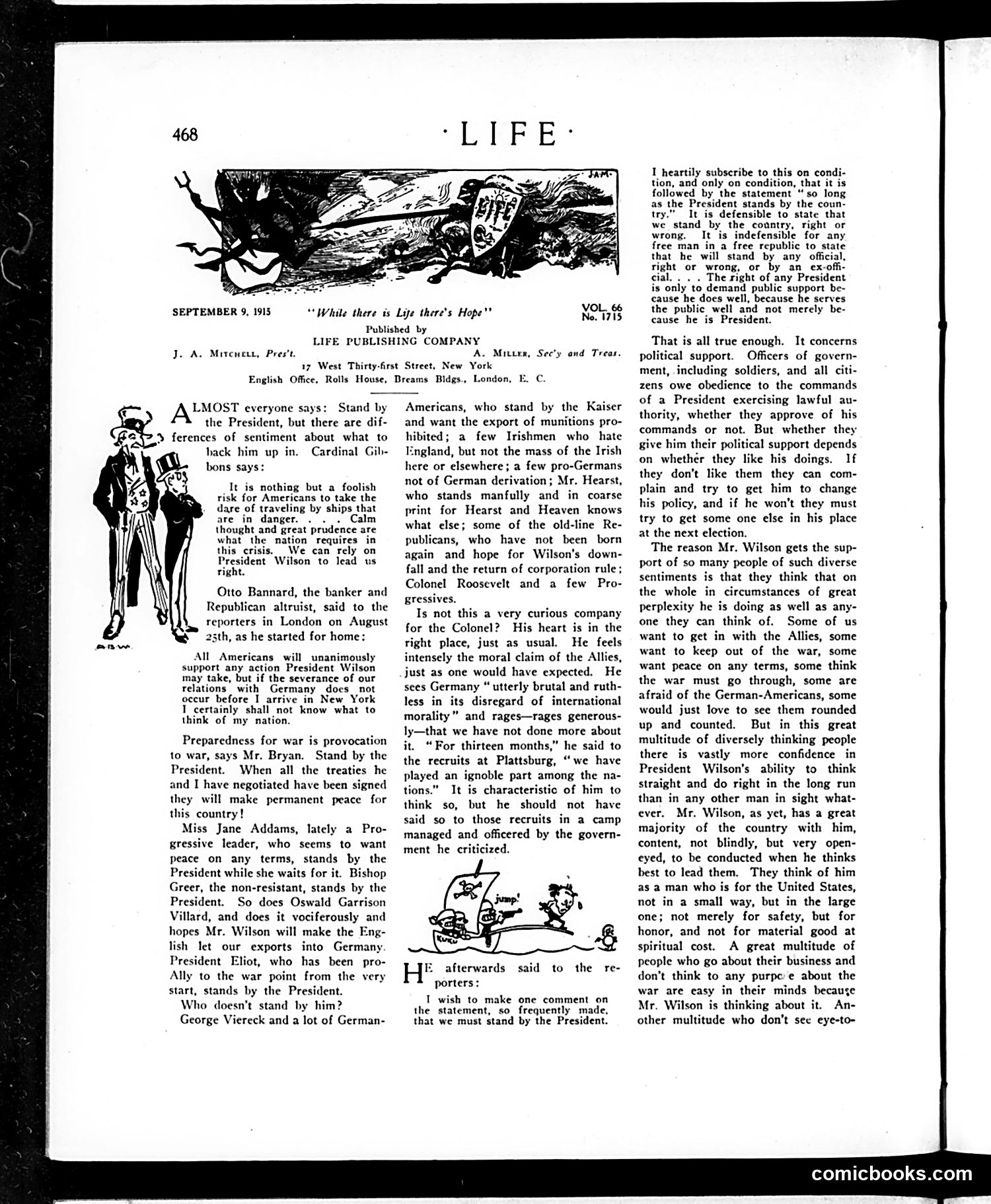
This satirical piece examines support for President Wilson during WWI neutrality debates. The cartoon "While there is Life there's Hope" depicts Uncle Sam in a precarious position—literally balancing on a tightrope—illustrating America's dangerous neutrality posture. The text catalogs various American figures claiming to "stand by the President," revealing the contradiction: they support him for contradictory reasons. Cardinal Gibbons wants caution; banker Otto Bannard demands war with Germany; Bryan opposes preparedness; Jane Addams seeks peace; Theodore Roosevelt criticizes the government while supporting it militarily. The satire's point: claiming unified support for Wilson masks deep disagreement about whether America should enter the war, aid the Allies, or remain neutral. The article notably mentions George Viereck and "pro-Germans" as the only real dissenters—those actually opposing Wilson's direction. The piece questions whether such diverse motivations constitute genuine support or merely political theater masking fundamental policy disputes.
📄 Transcribed text from this page (OCR, searchable)
Machine-transcribed from the original scan — historical spelling and the odd misread are preserved.
SEPTEMBER 9, 1915 J. A. Mitenett, Pres't. AlMost everyone says: Stand by the President, but there are dif- > ferences of sentiment about what to back him up in. Cardinal Gib- bons says: It is nothing but a foolish risk for Americans to take the dare of traveling by ships that are in danger... . Calm thought and great prudence are what the nation requires in this crisis. We can rely on President Wilson to lead us right. Otto Bannard, the banker and Republican altruist, said to the reporters in London on August 23th, as he started for home: = All Americans will unanimously support any action President Wilson may take, but if the severance of our relations’ with Germany does not occur before I arrive in New York I certainly shall not know what to think of my nation. Preparedness for war is provocation to war, says Mr. Bryan. Stand by the President. When all the treaties he and I have negotiated have been signed they will make permanent peace for this country! Miss Jane Addams, lately a Pro- gressive leader, who seems to want peace on any terms, stands by the President while she waits for it. Bishop Greer, the non-resistant, stands by the President. So does Oswald Garrison Villard, and does it vociferously and hopes Mr. Wilson will make the Eng- lish let our exports into Germany. President Eliot, who has been pro- Ally to the war point from the very start, stands by the President. Who doesn’t stand by him? George Viereck and a lot of German- “While there is Lie there's Hope" NOt, Published by LIFE PUBLISHING COMPANY A. Miturx, Sec’y and Treas. 17 West Thirty-first Street, New York English Office, Rolls House, Breams Bldgs, London, 66 ib Americans, who stand by the Kaiser and want the export of munitions pro- hibited; a few Irishmen who hate England, but not the mass of the Irish here or elsewhere; a few pro-Germans not of German derivation; Mr. Hearst, who stands manfully and in coarse print for Hearst and Heaven knows what else; some of the old-line Re- publicans, who have not been born again and hope for Wilson's down- fall and the return of corporation rule ; Colonel Roosevelt and a few Pro- gressives. Is not this a very curious company for the Colonel? His heart is in the right place, just as usual. He feels intensely the moral claim of the Allies, just as one would have expected. He sees Germany “ utterly brutal and ruth- less in its disregard of international morality” and rages—rages generous- ly—that we have not done more about it. “For thirteen months,” he said to the recruits at Plattsburg, “we have played an ignoble part among the na- tions.” It is characteristic of him to think so, but he should not have said so to those recruits in a camp managed and officered by the govern- ment he criticized. afterwards said to the re- porters : I wish to make one comment on the statement, so frequently made, that we must stand by the President. I heartily subscribe to this on condi- tion, and only on condition, that it is followed by the statement “so long as the President stands by the coun- try.” It is defensible to state that we stand by the country, right or wrong. It is indefensible for any free man in a free republic to state that he will stand by any official, right or wrong, or by an ex-offi- cial. . . . The right of any President is only to demand public support be- cause he does well, because he serves the public well and not merely be- cause he is President. That is all true enough. It concerns political support. Officers of govern- ment, including soldiers, and all citi- zens owe obedience to the commands of a President exercising lawful au- thority, whether they approve of his commands or not. But whether they give him their political support depends on whether they like his doings. If they don’t like them they can com- plain and try to get him to change his policy, and if he won't they must try to get some one else in his place at the next election. The reason Mr. Wilson gets the sup- port of so many people of such diverse sentiments is that they think that on the whole in circumstances of great perplexity he is doing as well as any- one they can think of. Some of us want to get in with the Allies, some want to keep out of the war, some want peace on any terms, some think the war must go through, some are afraid of the German-Americans, some would just love to see them rounded up and counted. But in this great multitude of diversely thinking people there is vastly more confidence in President Wilson's ability to think straight and do right in the long run than in any other man in sight what- ever. Mr. Wilson, as yet, has a great majority of the country with him, content, not blindly, but very open- eyed, to be conducted when he thinks best to lead them. They think of him as a man who is for the United States, not in a small way, but in the large one; not merely for safety, but for honor, and not for material good at spiritual cost. A great multitude of people who go about their business and don’t think to any purpe e about the war are easy in their minds because Mr. Wilson is thinking about it. An- other multitude who don’t see eye-to- comicbooks.com