
Life, 1915-09-09 · page 15 of 44
Life — September 9, 1915 — page 15: what you’re looking at
What you’re looking at
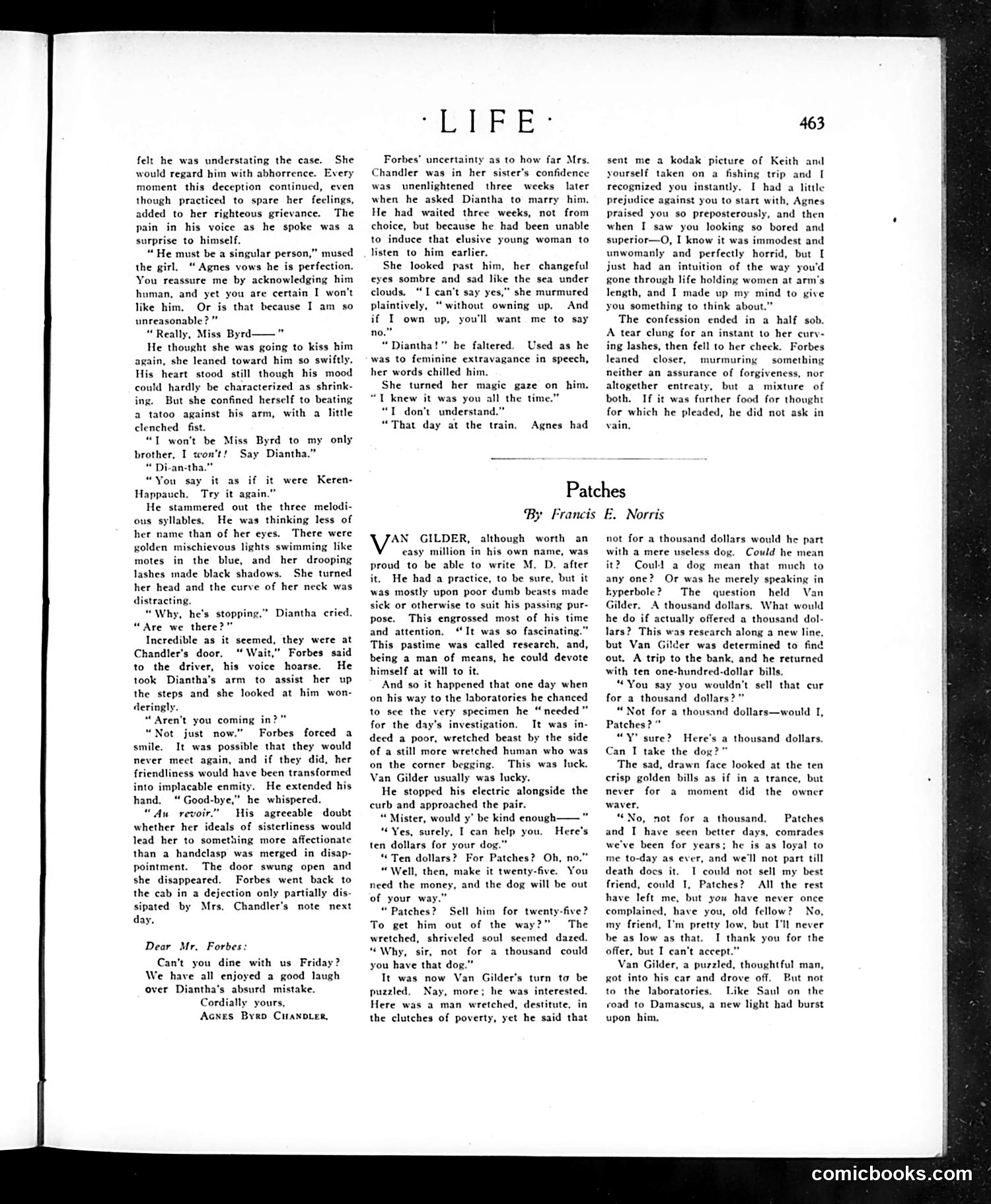
This page from *Life* magazine (page 463) contains two distinct pieces of fiction rather than political cartoons: 1. **"Life"** - A concluding section of a romantic story involving characters named Diantha, Forbes, and Agnes, discussing marriage, uncertainty, and emotional conflict. 2. **"Patches"** by Francis E. Norris - A short story about Van Gilder, a wealthy man (worth "an easy million") who becomes interested in rescuing a poor, starving dog he encounters. The narrative explores Van's internal conflict about whether to buy the dog for twenty-five dollars, ultimately revealing his character through this minor moral decision. Neither piece contains political satire or social commentary requiring historical context. They are straightforward fiction pieces typical of *Life*'s literary content from this era.
📄 Transcribed text from this page (OCR, searchable)
Machine-transcribed from the original scan — historical spelling and the odd misread are preserved.
felt he was understating the case. She would regard him with abhorrence. Every moment this deception continued, even though practiced to spare her feclings, added to her righteous grievance. The pain in his voice as he spoke was a surprise to himself. “He must be a singular person,” mused the girl. “Agnes vows he is perfection. You reassure me by acknowledging him human, and yet you are certain I won't like him. Or is that because I am so unreasonable?” “ Really, Miss Byrd ——” He thought she was going to kiss him in, she leaned toward him so swiftly. His heart stood still though his mood could hardly be characterized as shrink- ing. But she confined herself to beating a tatoo against his arm, with a little clenched fist. “T won't be Miss Byrd to my only brother, I won't! Say Diantha. “ Di-an-tha.” “You say it as if it Happauch. Try it again.” He stammered out the three melodi- ous syllables. He was thinking less of her name than of her eyes. There were golden mischievous lights swimming like motes in the blue, and her drooping lashes made black shadows. She turned her head and the curve of her neck was distracting. Why, he’s stopping,” “Are we there?” Incredible as it seemed, they were at Chandler's door, “Wait,” Forbes said to the driver, his voice hoarse. He took Diantha’s arm to assist her up the steps and she looked at him won- deringly Aren't you coming in?” “Not just now.” Forbes forced a smile. It was possible that they would never mect again, and if they did, her friendliness would have been transformed into implacable enmity. He extended his hand. “Good-bye,” he whispered. “Au revoir.” His agreeable doubt whether her ideals of sisterliness would lead her to something more affectionate than a handclasp was merged in disap- pointment. The door swung open and she disappeared. Forbes went back to the cab in a dejection only partially dis- sipated by Mrs. Chandler's note next day, were Keren- Diantha cried. Mr. Can't you dine with us Friday? We have all enjoyed a good laugh over Diantha’s absurd mistake. Cordially yours, Aones Byeo Cuanpier, Dear Forbes: “DIRE Forbes’ uncertainty as to how far Mrs. Chandler was in her sister's confidence was unenlightened three weeks later when he asked Diantha to marry him. He had waited three weeks, not from choice, but because he had been unable to induce that elusive young woman to listen to him earlier. She looked past him, her changeful eyes sombre and sad like the sea under clouds. “I can’t say yes,” she murmured plaintively, “without owning up. And if I own up, you'll want me to say no. Diantha!” he faltered. Used as he was to feminine extravagance in speech, her words chilled him. She turned her magic gaze on him. “T knew it was you all the time.” “T don't understand.” “That day at the train, Agnes had 463 sent me a kodak picture of Keith and yourself taken on a fishing trip and I recognized you instantly. [ had a little prejudice against you to start with, Agnes praised you so preposterously, and then when I saw you looking so bored and superior—O, I know it was immodest and unwomanly and perfectly horrid, but I just had an intuition of the way you'd gone through life holding women at arm's length, and I made up my mind to give you something to think about.” The confession ended in a half sob. A tear clung for an instant to her curv- ing lashes, then fell to her check. Forbes leaned closer, murmuring something neither an assurance of forgiveness, nor altogether entreaty, but a mixture of both. If it was further food for thought for which he pleaded, he did not ask in vain, Patches ‘By ‘AN GILDER, although worth an easy million in his own name, was proud to be able to write M. D. after it. He had a practice, to be sure, but it was mostly upon poor dumb beasts made sick or otherwise to suit his passing pur- pose. This engrossed most of his time and attention. “It was so fascinating.” This pastime was called research, and, being a man of means, he could devote himself at will to it. And so it happened that one day when on his way to the laboratories he chanced to see the very specimen he “needed ” for the day's investigation. It was in- deed a poor, wretched beast by the side of a still more wretched human who was on the corner begging. This was luck. Van Gilder usually was lucky. He stopped his electric alongside the curb and approached the pair. “ Mister, would y’ be kind enough—— “Yes, surely, I can help you. Here's ten dollars for your dog.” “Ten dollars? For Patches? Oh, no, Well, then, make it twenty-five. You need the money, and the dog will be out of your way. “Patches? Sell him for twenty-five? To get him out of the way The wretched, shriveled soul seemed dazed. “Why, sir, not for a thousand could you have that dog.” It was now Van Gilder's turn to be puzzled. Nay, more; he was interested. Here was a man wretched, destitute, in the clutches of poverty, yet he said that ancis E. Norris not for a thousand dollars would he part with a mere useless dog. Could he mean it? Coull a dog mean that much to any one? Or was he merely speaking in kyperbole? The question held Van Gilder. A thousand dollars, What would he do if actually offered a thousand dol- lars? This was rescarch along a new line, but Van Gilder was determined to find out. A trip to the bank, and he returned with ten one-hundred-dollar bills. “You say you wouldn't sell that cur for a thousand dollars?” “Not for a thousand dollars—would I, Patches?” “Y" sure? Here’s a thousand dollars. Can T take the dog?” The sad, drawn face looked at the ten crisp golden bills as if in a trance, but never for a moment did the owner waver. “No, not for a thousand. Patches and T have seen better days, comrades we've been for years; he is as loyal to me to-day as ever, and we'll not part till death docs it. I could not sell my best friend, could I, Patches? All the rest have left me, but you have never once complained, have you, old fellow? No, my friend, I'm pretty low, but I'll never be as low as that. T thank you for the offer, but I can't accept.” Van Gilder, a puzzled, thoughtful man, got into his car and drove off. Put not to the laboratories. Like Saul on the road to Damascus, a new light had burst upon him, comicbooks.com