
Life, 1915-09-09 · page 14 of 44
Life — September 9, 1915 — page 14: what you’re looking at
What you’re looking at
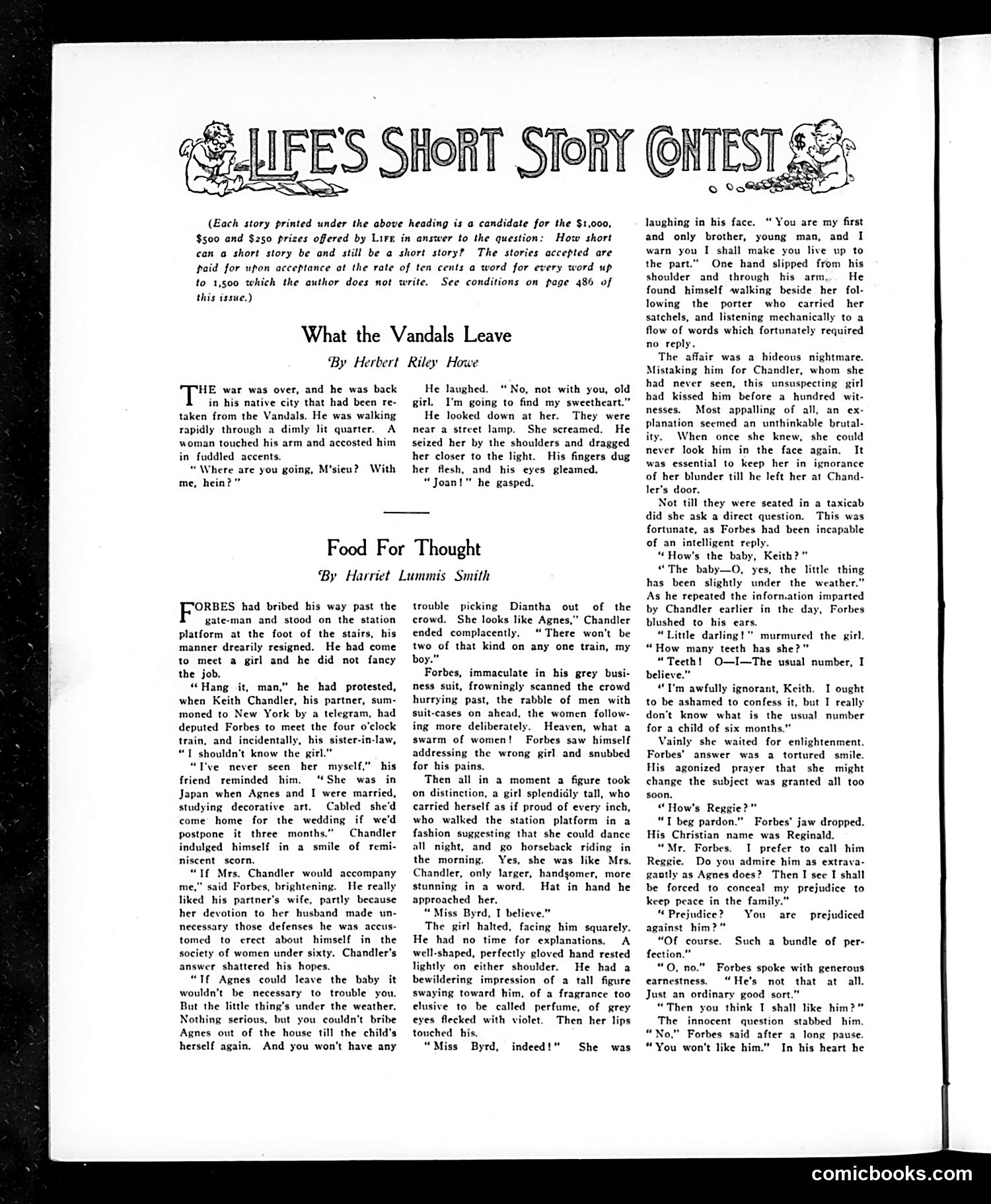
This page contains three short stories from Life's short story contest, not political cartoons. The visible stories are: 1. "What the Vandals Leave" by Herbert Riley Howe - appears to depict a romantic encounter between a man and woman in an urban setting, with dialogue suggesting mistaken identity and romantic complications. 2. "Food For Thought" by Harriet Lummis Smith - involves characters named Forbes, Chandler, Keith, and Agnes in what seems to be a domestic drama about marriage, jealousy, and questions of paternity regarding a child. These are literary fiction submissions, not satire or political commentary. The page represents Life's role as a general-interest magazine publishing creative content alongside its better-known humorous illustrations and commentary.
📄 Transcribed text from this page (OCR, searchable)
Machine-transcribed from the original scan — historical spelling and the odd misread are preserved.
(Each story printed under the above heading is a candidate for the $1,000, $500 and $250 prises offered by Lire in answer to the question: short story? The stories accepted are of ten cents a word for every word up write, can a short story be and still be a paid for upon acceptance at the rate to 1,500 which the author does not this issue.) How short See conditions on page 486 of What the Vandals Leave ‘By Herbert 'HE war was over, and he was back in his native city that had been re- taken from the Vandals. He was walking rapidly through a dimly lit quarter. A woman touched his arm and accosted him in fuddled accents. “ Where are you going, M'sieu? With me, hein?” Riley Howe He laughed. “No, not with you, old girl. I'm going to find my sweetheart.” He looked down at her. They were near a street lamp. She screamed. He seized her by the shoulders and dragged her closer to the light. His fingers dug her flesh, and his eyes gleamed. “Joan!” he gasped. Food For Thought By Harriet Lummis Smith ‘ORBES had bribed his way past the gate-man and stood on the station platform at the foot of the stairs, his manner drearily resigned. He had come to meet a girl and he did not fancy the job. “Hang it, man,” he had protested, when Keith Chandler, his partner, sum- moned to New York by a telegram, had deputed Forbes to meet the four o'clock train, and incidentally, his sister-in-law, “T shouldn't know the girl.” “T've never seen her myself,” his friend reminded him. ‘She was in Japan when Agnes and I were married, studying decorative art. Cabled she'd come home for the wedding if we'd postpone it three months.” Chandler indulged himself in a smile of remi- niscent scorn. “If Mrs. Chandler would accompany me,” said Forbes, brightening. He really liked his partner's wife, partly because her devotion to her husband made un- necessary those defenses he was accus- tomed to erect about himself in the society of women under sixty. Chandler's answer shattered his hopes. “Tf Agnes could leave the baby it wouldn't be necessary to trouble you. But the little thing’s under the weather, Nothing serious, but you couldn't bribe Agnes out of the house till the child's herself again. And you won't have any trouble picking Diantha out of the crowd. She looks like Agnes,” Chandler ended complacently, “There won't be two of that kind on any one train, my boy.” Forbes, immaculate in his grey busi- ness suit, frowningly scanned the crowd hurrying past, the rabble of men with suit-cases on ahead, the women follow- ing more deliberately. Heaven, what a swarm of women! Forbes saw himself addressing the wrong girl and snubbed for his pains. Then all in a moment a figure took on distinction, a girl splendidly tall, who carried herself as if proud of every inch, who walked the station platform in a fashion suggesting that she could dance all night, and go horseback riding in the morning. Yes, she was like Mrs. Chandler, only larger, handgomer, more stunning in a word. Hat in hand he approached her. “Miss Byrd, I believe.” The girl halted, facing him squarely. He had no time for explanations. A well-shaped, perfectly gloved hand rested lightly on either shoulder. He had a bewildering impression of a tall figure swaying toward him, of a fragrance too elusive to be called perfume, of grey eyes flecked with violet. Then her lips touched his. “Miss Byrd, indeed!” She was © S686 laughing in his face. “ You are my first and only brother, young man, and I warn you I shall make you live up to the part.” One hand slipped from his shoulder and through his arm, He found himself walking beside her fol- lowing the porter who carried her satchels, and listening mechanically to a flow of words which fortunately required no reply. The affair was a hideous nightmare. Mistaking him for Chandler, whom she had never seen, this unsuspecting girl had kissed him before a hundred wit- nesses. Most appalling of all, an ex- planation seemed an unthinkable brutal- ity. When once she knew, she could never look him in the face again. It was essential to keep her in ignorance of her blunder till he left her at Chand- ler’s door. Not till they were seated in a taxicab did she ask a direct question. This was fortunate, as Forbes had been incapable of an intelligent reply. “How's the baby, Keith?” “The baby—O, yes, the little thing has been slightly under the weather.” As he repeated the inforn.ation imparted by Chandler earlier in the day, Forbes blushed to his ears. “Little darling!" murmured the girl. “How many teeth has she?” “Teeth! O—I—The usual number, I believe.” “I'm awfully ignorant, Keith. I ought to be ashamed to confess it, but I really don’t know what is the usual number for a child of six months.” Vainly she waited for enlightenment. Forbes’ answer was a tortured smile. His agonized prayer that she might change the subject was granted all too soon. “How's Reggie? “T beg pardon.” Forbes’ jaw dropped. His Christian name was Reginald. “Mr. Forbes. I prefer to call him Regi Do you admire him as extrava- gantly as Agnes does? Then I see I shall be forced to conceal my prejudice to keep peace in the family.” “Prejudice? You are against him?” “Of course. fection.” “0. no.” Forbes spoke with generous earnestness. “He's not that at all. Just an ordinary good sort.” “Then you think T shall like him?” The innocent question stabbed him. “No,” Forbes said after a long pause. “You won't like him.” In his heart he Prejudiced Such a bundle of per- comicbooks.com