
Life, 1915-09-09 · page 25 of 44
Life — September 9, 1915 — page 25: what you’re looking at
What you’re looking at
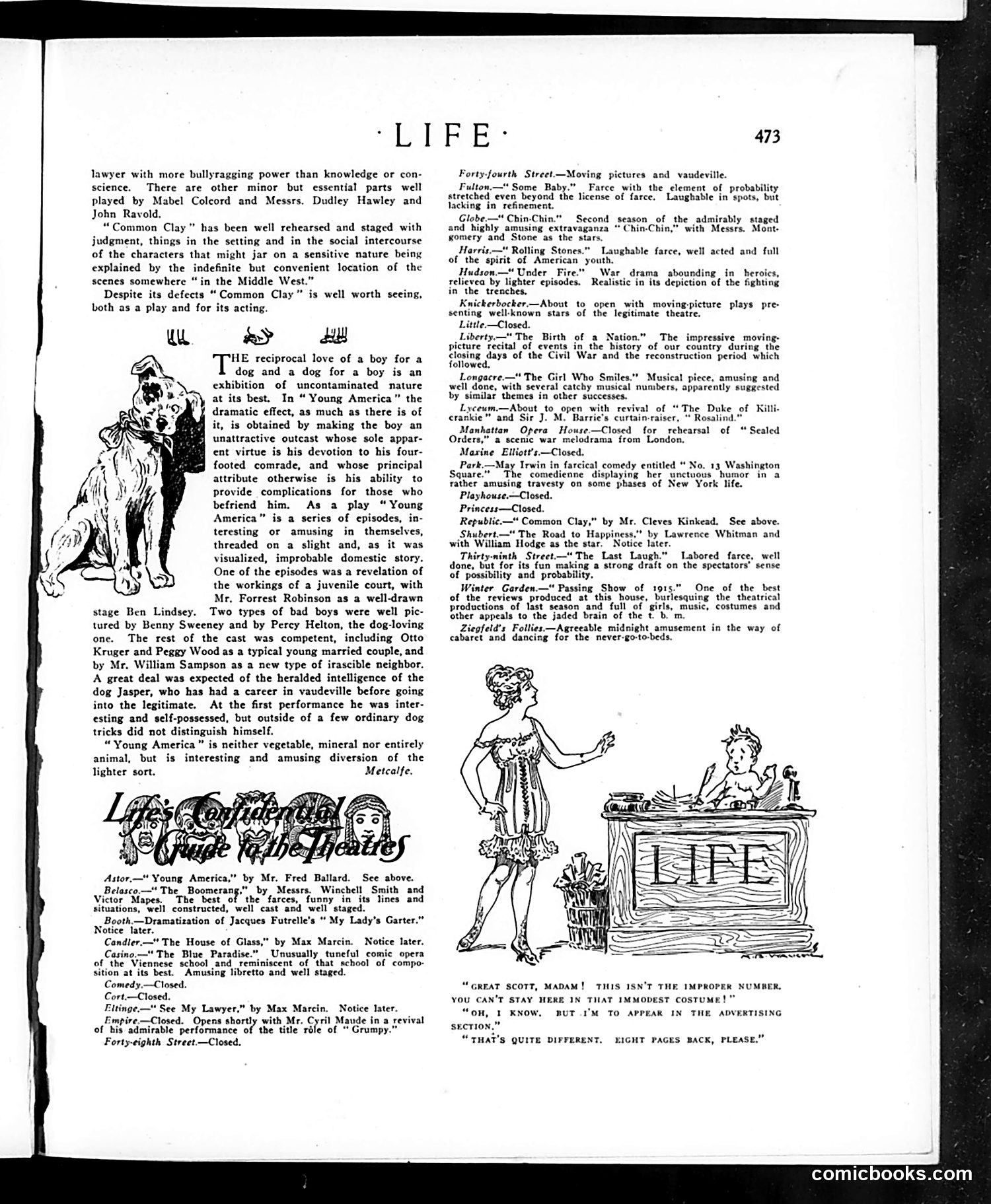
This page primarily reviews Broadway theatrical productions from the early 1910s, featuring a satirical cartoon at bottom right. **The Cartoon:** A woman in fashionable dress speaks to a theater manager/editor at his desk. She protests appearing "eight pages back" in an advertising section rather than in the main editorial content, claiming the location is "improper" for her "immaculate costume." The joke satirizes theatrical vanity and the tension between editorial prestige and advertising revenue—performers and advertisers compete for prominent placement, and appearing in back-matter sections was considered degrading despite being read by the same audience. **Context:** This reflects early 20th-century anxieties about commercialization of culture. Life magazine depended on advertising revenue while maintaining editorial standards; this cartoon mocks how performers obsessed over placement status regardless of actual visibility. The page's theater reviews mention stars like Peggy Wood and reference Ben Lindsey (a real Progressive-era judge famous for juvenile court reform), grounding the satirical commentary in contemporary entertainment culture.
📄 Transcribed text from this page (OCR, searchable)
Machine-transcribed from the original scan — historical spelling and the odd misread are preserved.
“LIFE: 473 lawyer with more bullyragging power than knowledge or con- science. There are other minor but essential parts well played by Mabel Colcord and Messrs. Dudley Hawley and John Ravold. “Common Clay” has been well rehearsed and staged with judgment, things in the setting and in the social intercourse of the characters that might jar on a sensitive nature being explained by the indefinite but convenient location of the scenes somewhere “in the Middle West.” Despite its defects “Common Clay” is well worth seeing, both as a play and for its acting. ey HE reciprocal love of a boy for a dog and a dog for a boy is an exhibition of uncontaminated nature at its best. In “ Young America” the dramatic effect, as much as there is of it, is obtained by making the boy an unattractive outcast whose sole appar- ent virtue is his devotion to his four- footed comrade, and whose principal attribute otherwise is his ability to provide complications for those who befriend him. As a play “ Young America” is a series of episodes, in- teresting or amusing in themselves, threaded on a slight and, as it was visualized, improbable domestic story. One of the episodes was a revelation of the workings of a juvenile court, with Mr, Forrest Robinson as a well-drawn stage Ben Lindsey. Two types of bad boys were well pic- tured by Benny Sweeney and by Percy Helton, the dog-loving one. The rest of the cast was competent, including Otto Kruger and Peggy Wood as a typical young married couple, and by Mr. William Sampson as a new type of irascible neighbor. A great deal was expected of the heralded intelligence of the dog Jasper, who has had a career in vaudeville before going into the legitimate, At the first performance he was inter- esting and self-possessed, but outside of a few ordinary dog tricks did not di ish himself, “Young America” is neither vegetable, mineral nor entirely animal, but is interesting and amusing diversion of the lighter sort. Metcalfe. Astor,—" Young America,” by Mr. Fred Ballard. See above. Belasco.—" The Boomerang,” by Messrs. Winchell Smith and Victor Mapes. The best of the farces, funny in its lines and situations, well constructed, well cast and well staged. Booth.—Dramatization of Jacques Futrelle’s “ My Lady's Garter.” Notice later. Candler._— The House of Glass,” by Max Marcin. Notice later. Casino.—" The Blue Paradise.” Unusually tuneful comic opera of the Viennese school and reminiscent of that school of compo- sition at its best. Amusing libretto and well staged. Comedy.—Closed. Cort—Closed. Eltinge.—" See My Lawyer,” by Max Marcin, Notice later. Empire—Closed. Opens shortly with Mr. Cyril Maude in a revival of his admirable performance of the title réle of Grumpy. Forty-eighth Street—Closed. Forty-fourth Street—Moving pictures. and vaudeville. Fulton.—" Some Baby.” Farce with the clement of probability stretched even beyond the license of farce, Laughable in spots, but lacking in refinement. Globe —“ Chin-Chin.” Second season of the admirably staged and highly amusing extravaganza “Chin-Chin,” with Messrs. Mont- komery and Stone as the stars. Horris—' Rolling Stones.” Laughable farce, well acted and full of the spirit of American youth, Hudson.—" Under Fire." War drama abounding in heroics, relievea by lighter episodes. Realistic in its depiction of the fighting in the trenches, Knickerbocker—About to open with moving-picture plays pre- senting well-known stars of the legitimate theatre. Little. —Closed. Liberty.—" The Birth of a Nation.” The impressive moving- picture recital of events in the history of our country during the closing days of the Civil War and the reconstruction period which followed, Longacre—" The Girl Who Smiles.” Musical piece, amusing and well done, with several catchy musical numbers, apparently suggested by similar themes in other successes. Lyceum.—About to open with revival of “The Duk crankie” and Sir J. M. Barrie's curtain-raiser, “ Rosali Manhattan Opera House—Closed for rehearsal of “ Sealed Orders,” a scenic war melodrama from London, Marine Elliott’s—Closed, Park.—May Irwin in farcical comedy entitled “ No. 13 Washington Square. ¢ comedienne displaying her unctuous humor in a rather amusing travesty on some phases of New York life. Playhouse.—Closed. Princess—Closed. Republic. —" Common Clay,” by Mr. Cleves Kinkead. See above. Shubert—" The Road to Happiness." by Lawrence Whitman and with William Hodge as the star. Notice later. Thirty-ninth Street—" The Last Laugh.” Labored farce, well done, but for its fun making a strong draft on the spectators” sense of possibility and probability. Winter Garden.—" Passing Show of 1915." One of the best of the reviews produced at this house, burlesquing the theatrical productions of last season and full of girls, music, costumes and Other appeals to the jaded brain of the t. b.'m Ziegfeld’s Follies—Agreeable midnight amusement in the way of cabaret and dancing for the never-go-to-beds. “GREAT SCOTT, MADAM! THIS ISN'T THE IMPROPER NUMBER, YOU CAN'T STAY MERE IN THAT IMMODEST CosTUME!" “OH, 1 KNOW, RUT I'M TO APPEAR IN THE ADVERTISING “THAT'S QUITE DIFFER EIGHT PAGES BACK, PLEASE.” comicbooks.com