
Life, 1915-09-09 · page 24 of 44
Life — September 9, 1915 — page 24: what you’re looking at
What you’re looking at
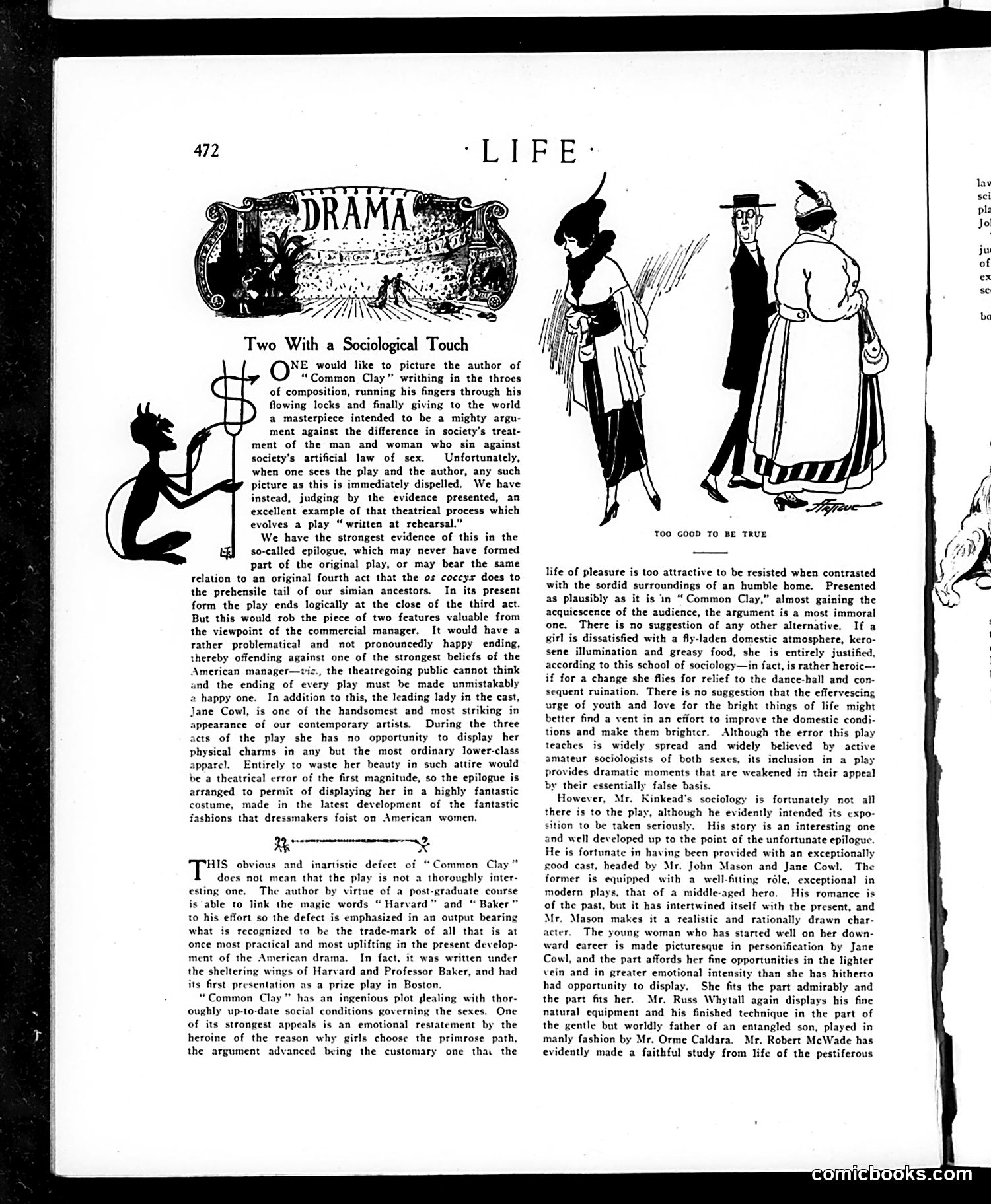
This review critiques the play *"Common Clay,"* likely by Charles H. Kinkead, starring actress Jane Cowl. The critic praises the play's serious treatment of sexual double standards—its central argument that women are driven to "sin" by poverty and dreary domestic conditions—but finds the execution flawed and morally problematic. The satirical point: the play presents seduction as the *only* escape for dissatisfied working-class women, ignoring alternatives like social reform or personal effort to improve circumstances. The critic also mocks the play's construction as "written at rehearsal," adding an implausible epilogue solely to showcase Cowl in fashionable costumes, thus undermining the serious sociological argument with commercial spectacle. The Harvard/Baker reference indicates the play's academic theatrical pedigree, making its moral weakness more embarrassing. The cartoon's caption "Too Good to Be True" reinforces the critique: the play's premise is seductively appealing but fundamentally dishonest sociology.
📄 Transcribed text from this page (OCR, searchable)
Machine-transcribed from the original scan — historical spelling and the odd misread are preserved.
Two With a Sociological Touch NE would like to picture the author of “Common Clay” writhing in the throes of composition, running his fingers through his flowing locks and finally giving to the world a masterpiece intended to be a mighty argu- ment against the difference in society's treat- ment of the man and woman who sin against society’s artificial law of sex. Unfortunately, when one sees the play and the author, any such picture as this is immediately dispelled. We have instead, judging by the evidence presented, an excellent example of that theatrical process which evolves a play “written at rehearsal. We have the strongest evidence of this in the so-called epilogue, which may never have formed part of the original play, or may bear the same relation to an original fourth act that the os coccyxs does to the prehensile tail of our simian ancestors. In its present form the play ends logically at the close of the third act. But this would rob the piece of two features valuable from the viewpoint of the commercial manager. It would have a rather problematical and not pronouncedly happy ending, thereby offending against one of the strongest beliefs of the American manager— the theatregoing public cannot think and the ending of every play must be made unmistakably 2 happy one. In addition to this, the leading lady in the cast, Jane Cowl, is one of the handsomest and most striking in appearance of our contemporary artists. During the three acts of the play she has no opportunity to display her physical charms in any but the most ordinary lower-class apparel. Entirely to waste her beauty in such attire would be a theatrical error of the first magnitude, so the epilogue is arranged to permit of displaying her in a highly fantastic costume, made in the latest development of the fantastic iashions that dressmakers foist on American women. a aes HIS obvious and inartistic defect of “Common Cla does not mean that the play is not a thoroughly inter- esting one. The author by virtue of a post-graduate course is‘able to link the magic words “ Harvard” and “ Baker” to his effort so the defect is emphasized in an output bearing what is recognized to be the trade-mark of all that is at once most practical and most uplifting in the present develop- ment of the American drama. In fact, it was written under the sheltering wings of Harvard and Professor Baker, and had its first presentation as a prize play in Boston. “Common Clay” has an ingenious plot dealing with thor- oughly up-to-date social conditions governing the sexes. One of its strongest appeals is an emotional restatement by the heroine of the reason why girls choose the primrose path, the argument advanced being the customary one thar the TOO GOOD To BE TRUE life of pleasure is too attractive to be resisted when contrasted with the sordid surroundings of an humble home. Presented as plausibly as it is in “Common Clay,” almost gaining the acquiescence of the audience, the argument is a most immoral one. There is no suggestion of any other alternative. If a girl is dissatisfied with a fly-laden domestic atmosphere, kero- sene illumination and greasy food, she is entirely justified, according to this school of sociology—in fact, is rather heroic—- if for a change she flies for relief to the dance-hall and con- sequent ruination. There is no suggestion that the effervescing urge of youth and love for the bright things of life might better find a vent in an effort to improve the domestic condi- tions and make them brightcr. Although the error this play teaches is widely spread and widely believed by active amateur sociologists of both sexes, its inclusion in a play provides dramatic moments that are weakened in their appeal by their essentially false basis. However, Mr. Kinkead’s sociology is fortunately not all there is to the play, although he evidently intended its expo- sition to be taken seriously. His story is an interesting one and well developed up to the point of the unfortunate epiloguc. He is fortunate in having been provided with an exceptionally good cast, headed by Mr. John Mason and Jane Cowl. The former is equipped with a well-fitting réle, exceptional in modern plays, that of a middle-aged hero. His romance is of the past, but it has intertwined itself with the present, and Mr. Mason makes it a realistic and rationally drawn char- acter. The young woman who has started well on her down- ward career is made picturesque in personification by Jane Cowl, and the part affords her fine opportunities in the lighter vein and in greater emotional intensity than she has hitherto had opportunity to display. She fits the part admirably and the part fits her. Mr. Russ Whytall again displays his fine natural equipment and his finished technique in the part of the gentle but worldly father of an entangled son, played in manly fashion by Mr. Orme Caldara. Mr. Robert McWade has evidently made a faithful study from life of the pestiferous