
A complete issue · 40 pages · 1915
Life — August 12, 1915
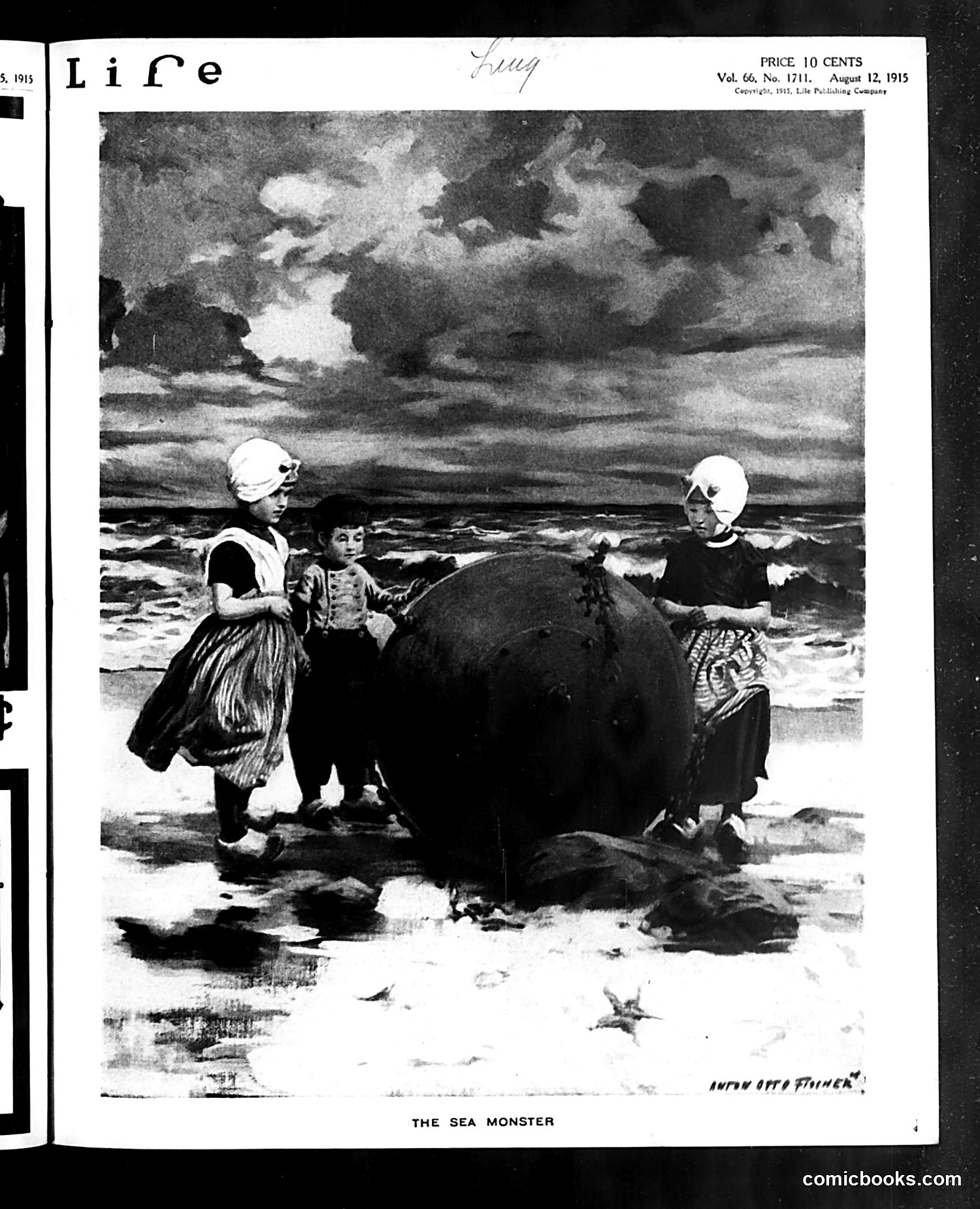
This illustration depicts children at a beach encountering what appears to be a large, dark spherical object in the shallow water. Given the 1915 date and title "The Sea Monster," this likely references the **RMS Lusitania**, the British ocean liner torpedoed and sunk by a German U-boat on May 7, 1915—a major news event that killed nearly 1,200 people, including 128 Americans. The cartoon satirizes public anxiety about German submarines as a tangible threat. By showing innocent children discovering this "monster" at an ordinary beach, Life emphasizes how the war—previously distant—now threatened American civilians and domestic spaces. The image transforms the abstract naval conflict into something physically present and menacing on American shores.
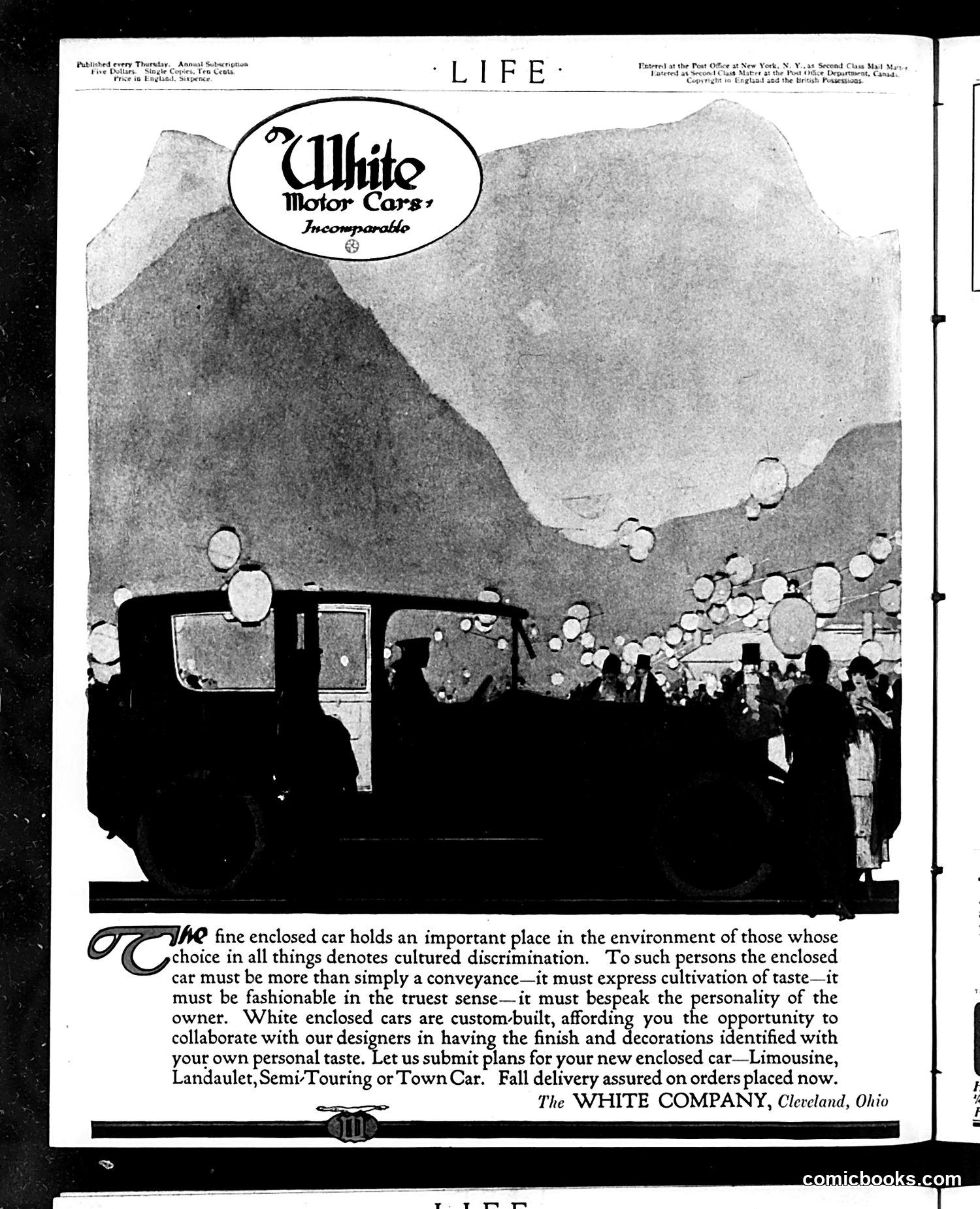
This page is **primarily a commercial advertisement**, not political satire. It promotes White Motor Cars' enclosed vehicles, marketed to affluent buyers with "cultured discrimination" and refined taste. The ad features a silhouetted automobile surrounded by crowds and hot-air balloons against a mountainous backdrop—imagery suggesting leisure, celebration, and social status. The text explicitly targets wealthy consumers who value "cultivation of taste" and "truest sense" of personal distinction. The ad emphasizes custom-built options (Limousine, Semi-Touring, Town Car), positioning enclosed cars as status symbols for the discriminating elite. This reflects early automotive marketing that equated ownership with social class and refined sensibility—a common approach in 1920s advertising to affluent Life magazine readers.
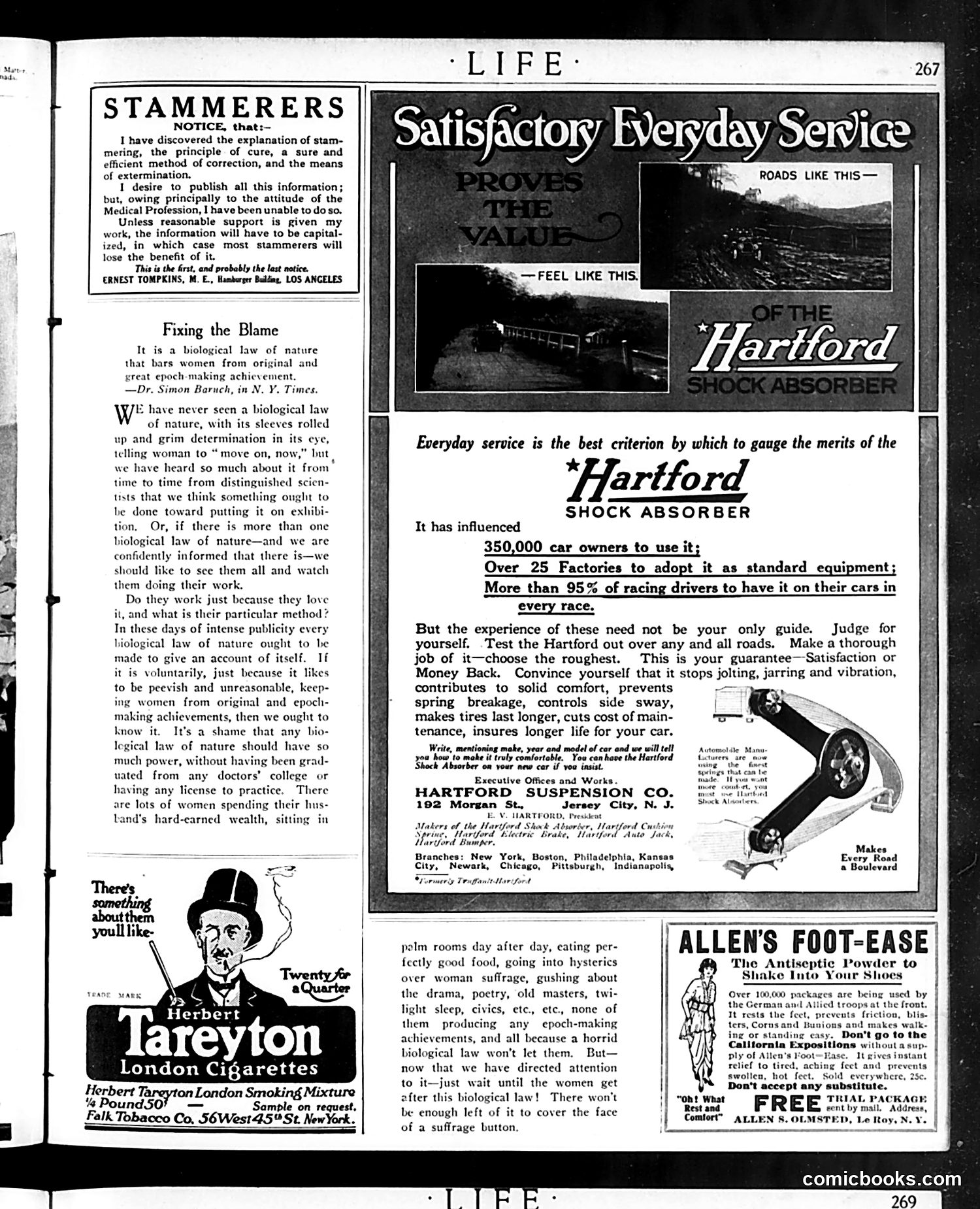
This Life magazine page is primarily **advertising**, not political satire. The main content features a **Hartford Shock Absorber advertisement** highlighting the product's popularity (350,000 car owners, 25 factories, 95% of racing drivers). Below that is a **Herbert Tareyton London Cigarettes ad** with a stylized male figure in formal wear, promoting the product's "London Smoking Mixture." The left column contains an essay titled "Fixing the Blame," discussing a biological law preventing women from making great achievements—a sexist piece typical of the era, attributed to Dr. Simon Baruch. At bottom right is an **Allen's Foot-Ease advertisement** for an antiseptic powder. No political cartoons appear here. The page reflects 1920s advertising conventions and period attitudes toward women and consumer products.
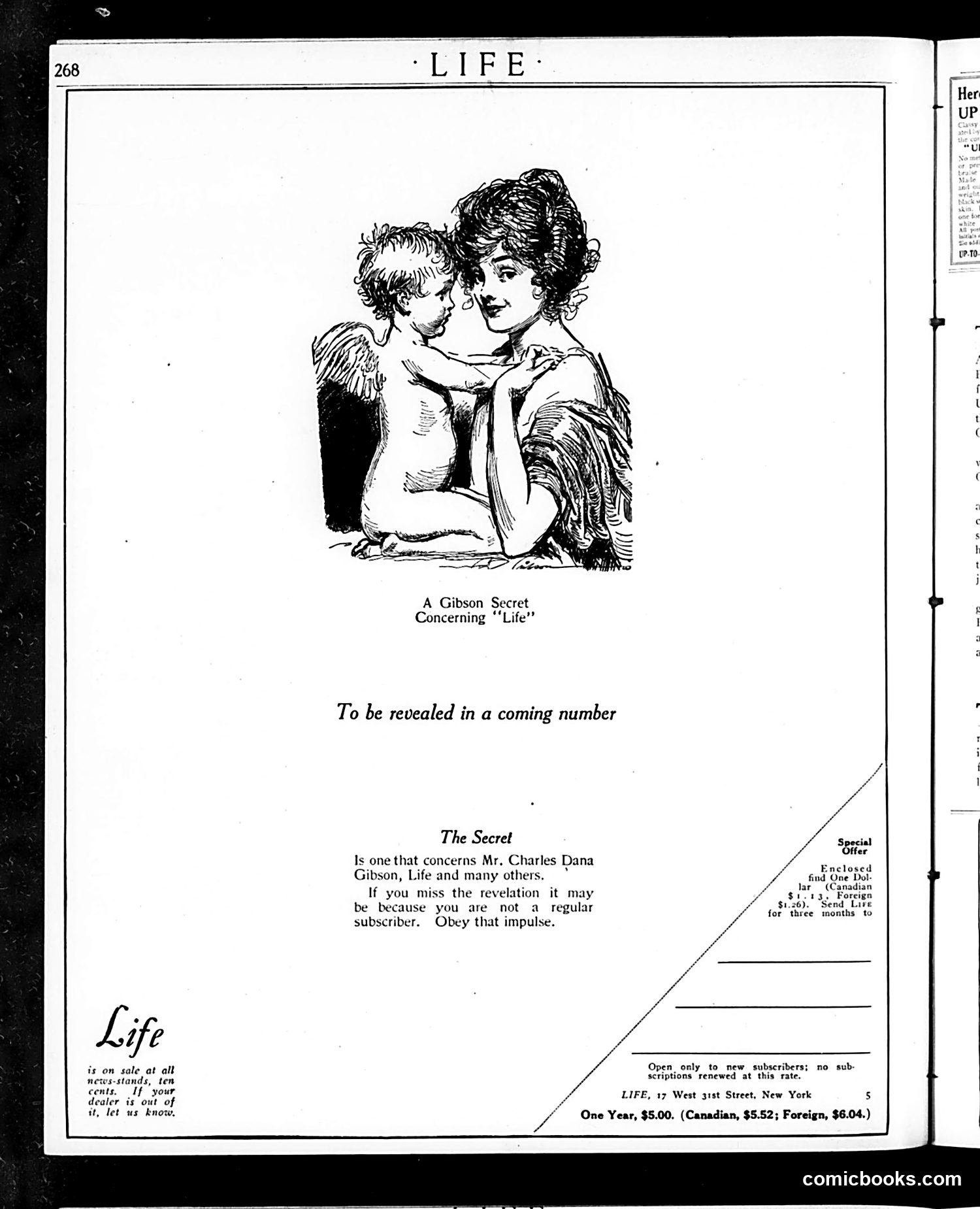
This page is primarily **advertising for Life magazine itself**, not political satire. The central illustration shows an adult (likely a woman) with a young child, rendered in Gibson Girl style—the elegant, idealized feminine aesthetic popularized by illustrator Charles Dana Gibson. The ad teases "A Gibson Secret Concerning 'Life'" to be revealed in a coming issue, using curiosity as a marketing hook. The accompanying text emphasizes that subscribers shouldn't miss the revelation, targeting both regular readers and potential new subscribers. The bottom section includes subscription pricing ($5.00 annually in the US, with Canadian and foreign rates listed) and notes Life's newsstand availability. This represents early 20th-century magazine marketing strategy: leveraging an artist's popular brand (Gibson) and mysterious promises to drive subscriptions.
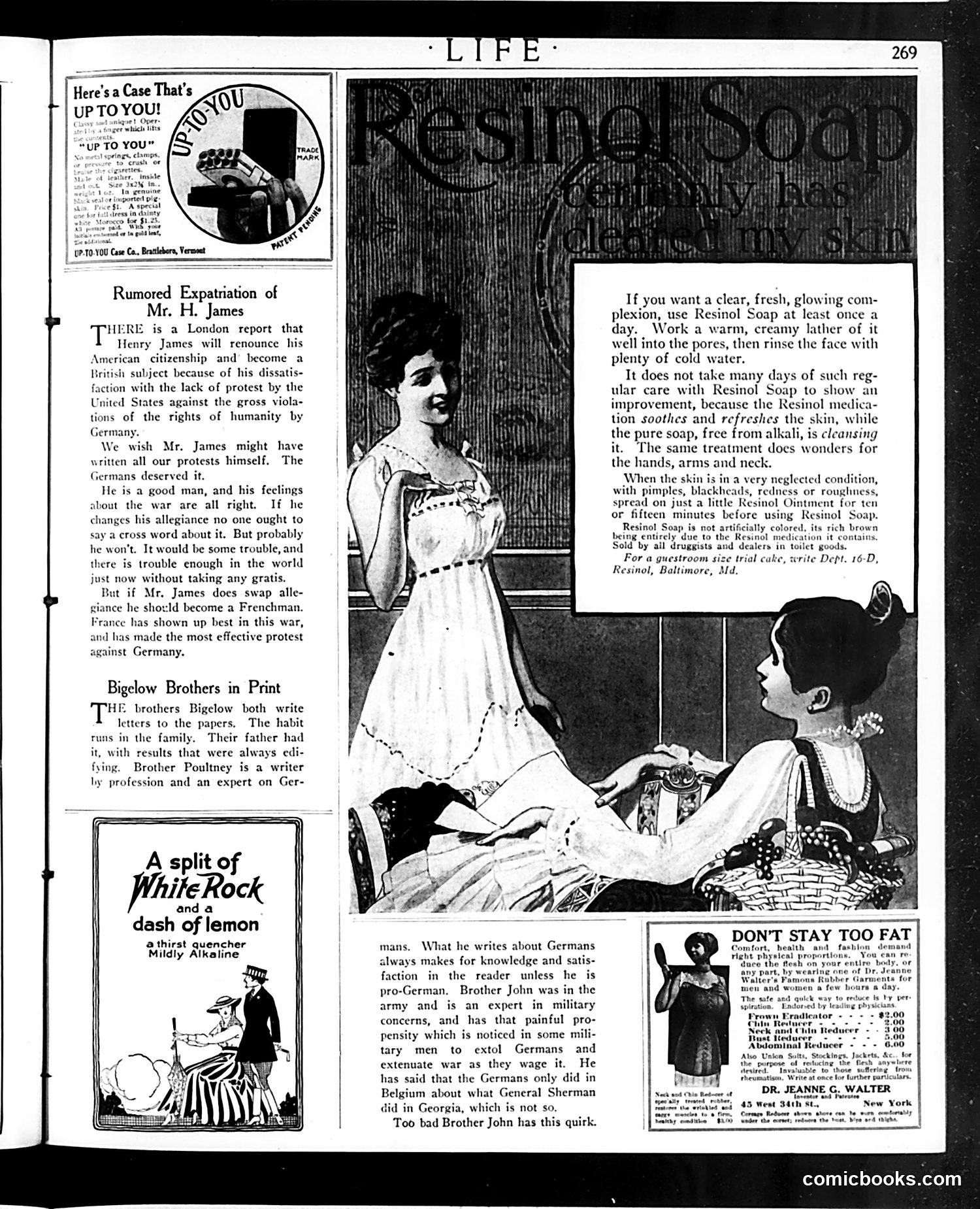
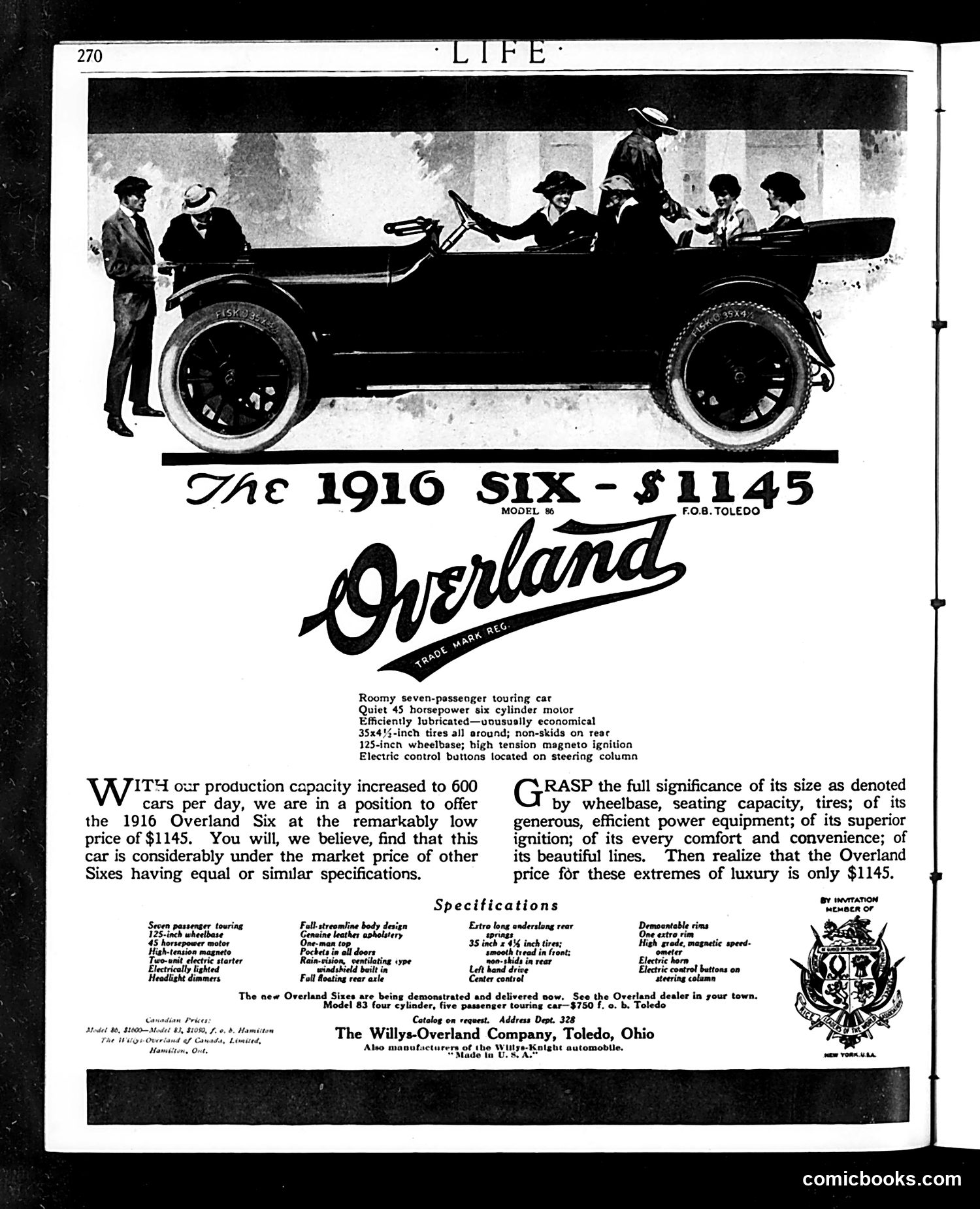
This page is primarily **advertising, not satire or editorial content**. It's a 1916 automobile advertisement for the Overland Six, manufactured by Willys-Overland Company in Toledo, Ohio. The image shows a side-view illustration of an open-air touring car with seven passengers and one attendant. The ad emphasizes the vehicle's spaciousness, affordability ($1,145), and technical specifications (six-cylinder engine, 45 horsepower, electric starter). The marketing pitch targets middle-class buyers by positioning the Overland Six as offering "luxury" features at a competitive price compared to other six-cylinder automobiles of the era. There is no political satire or social commentary present—this is straightforward commercial promotion from Life magazine's advertising pages.
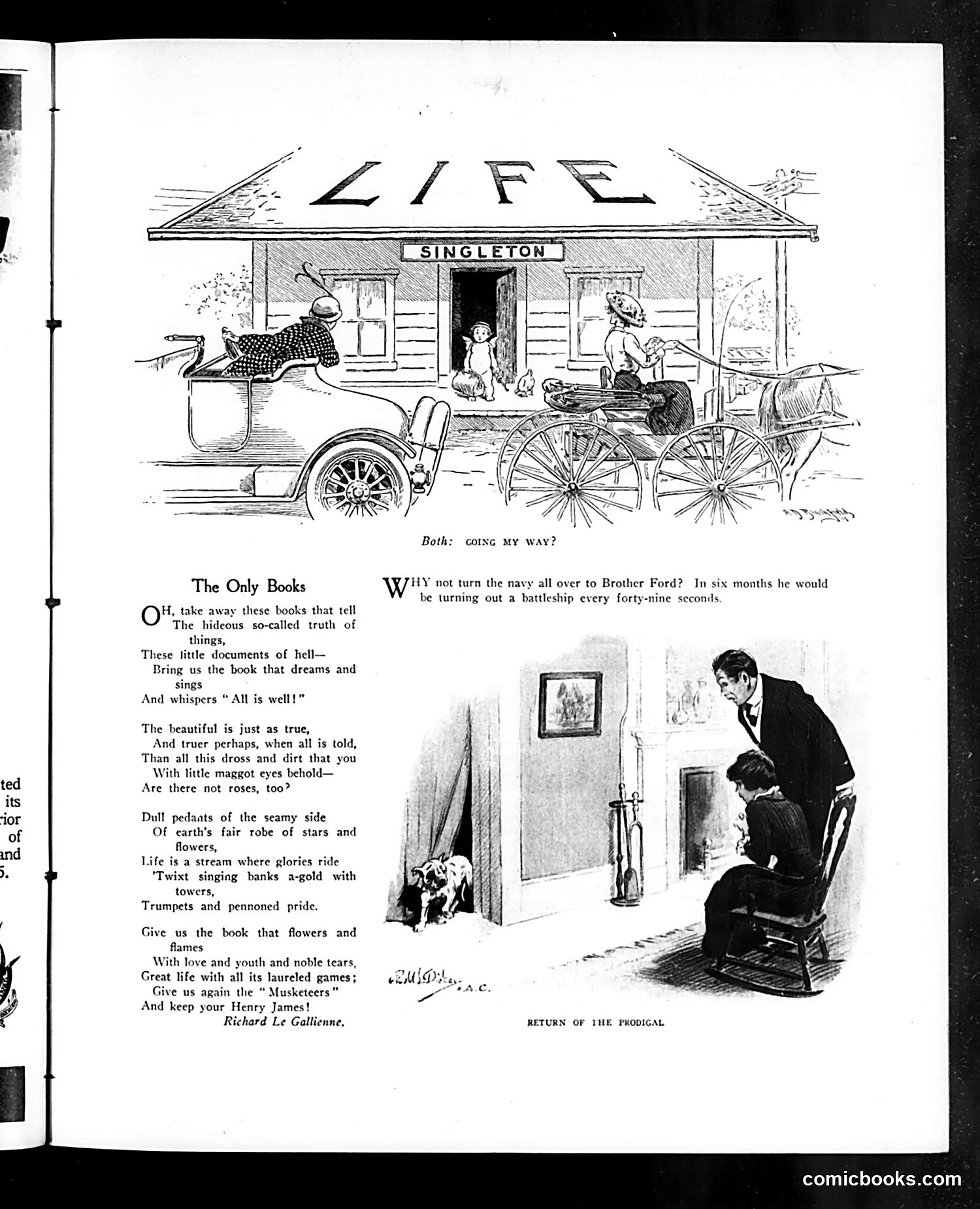
This page contains two distinct pieces: **Top cartoon:** A humorous domestic scene titled "Both: GOING MY WAY?" shows a couple at "Singleton Life" — a boarding house or modest residence — with two figures apparently heading in different directions: one leaving in a car, another on a bicycle. The joke appears to satirize marital discord or incompatible lifestyles in marriage. **Bottom section:** "The Only Books" is a poem by Richard Le Gallienne praising literature's value, contrasting books' beauty and idealism against life's "dross and dirt." An accompanying illustration titled "Return of the Prodigal" shows two figures in what appears to be a domestic reconciliation scene, possibly linking thematically to the marriage theme above. Together, the page seems to explore marriage tensions and reconciliation through both humor and sentimental verse.
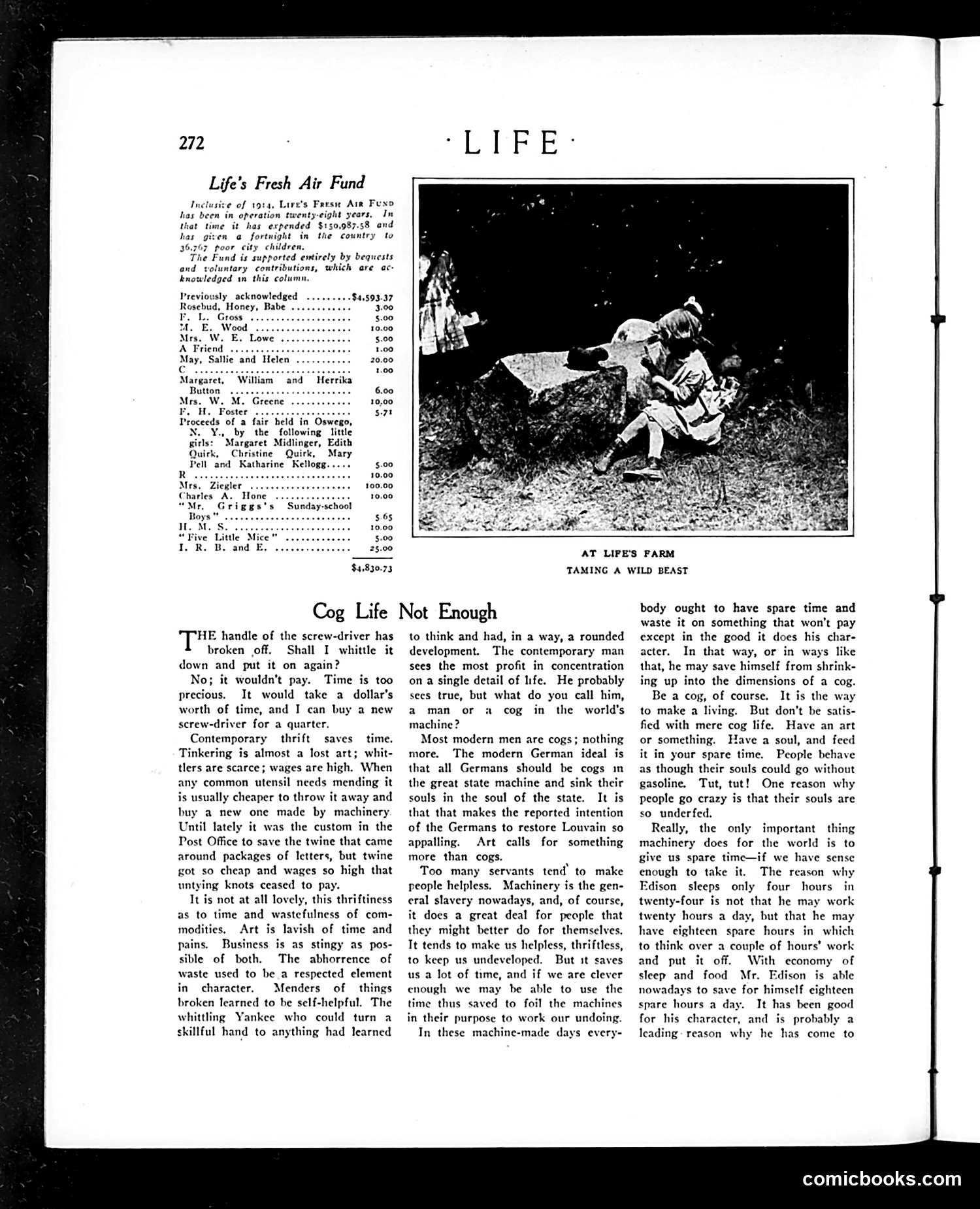
The page contains an article titled "Cog Life Not Enough" alongside a photograph captioned "At Life's Farm: Taming a Wild Beast." The article critiques modern industrial society's dehumanization of workers, arguing that humans reduced to mere "cogs" in machines lack purpose and dignity. It references German philosophy (likely Prussian militarism) that treated citizens as state machinery. The satire advocates for leisure time and personal development—citing Thomas Edison's practice of working only twenty hours daily—as essential to maintaining human character and individuality against mechanization. The photograph shows what appears to be children at a farm, likely illustrating the article's argument that humans need connection to nature and meaningful activity beyond factory work. The page also lists donations to "Life's Fresh Air Fund," supporting outdoor recreation for underprivileged children.
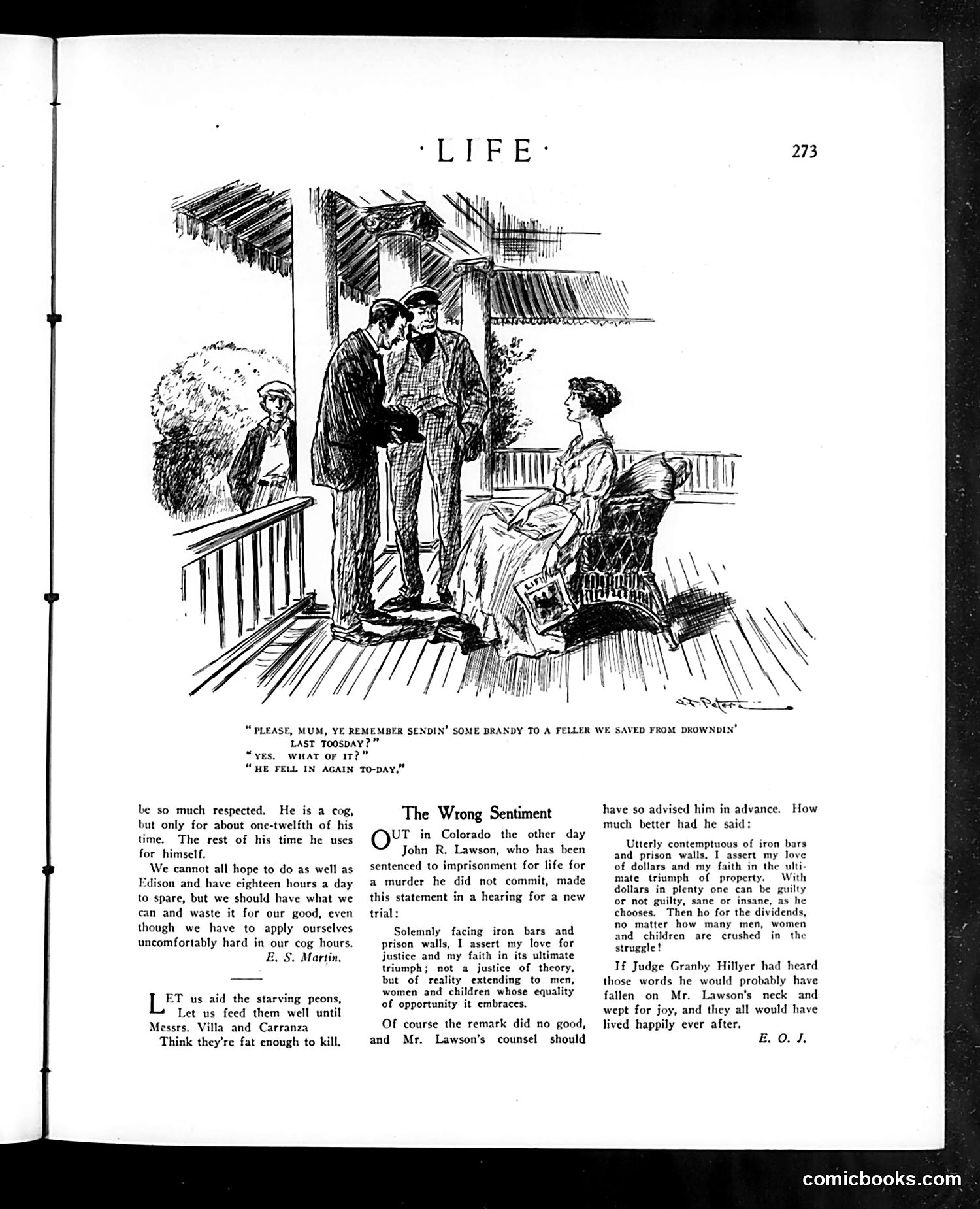
This page contains a cartoon and two opinion pieces. The cartoon depicts a domestic scene on a porch where two men discuss sending brandy to a drowning victim's rescuer, while a woman listens. The humor relies on the absurdity of the gesture. Below, "The Wrong Sentiment" discusses John R. Lawson, imprisoned for life for a murder he claims he didn't commit. The piece argues that sentiment about property matters more than justice for human life. Two letters respond: one sarcastically suggesting Judge Hillyer should have hanged Lawson to please those prioritizing property rights, and another by "E.S. Martin" critiquing society's misplaced values regarding the poor versus the wealthy. The page satirizes class bias in the justice system and public sympathy.
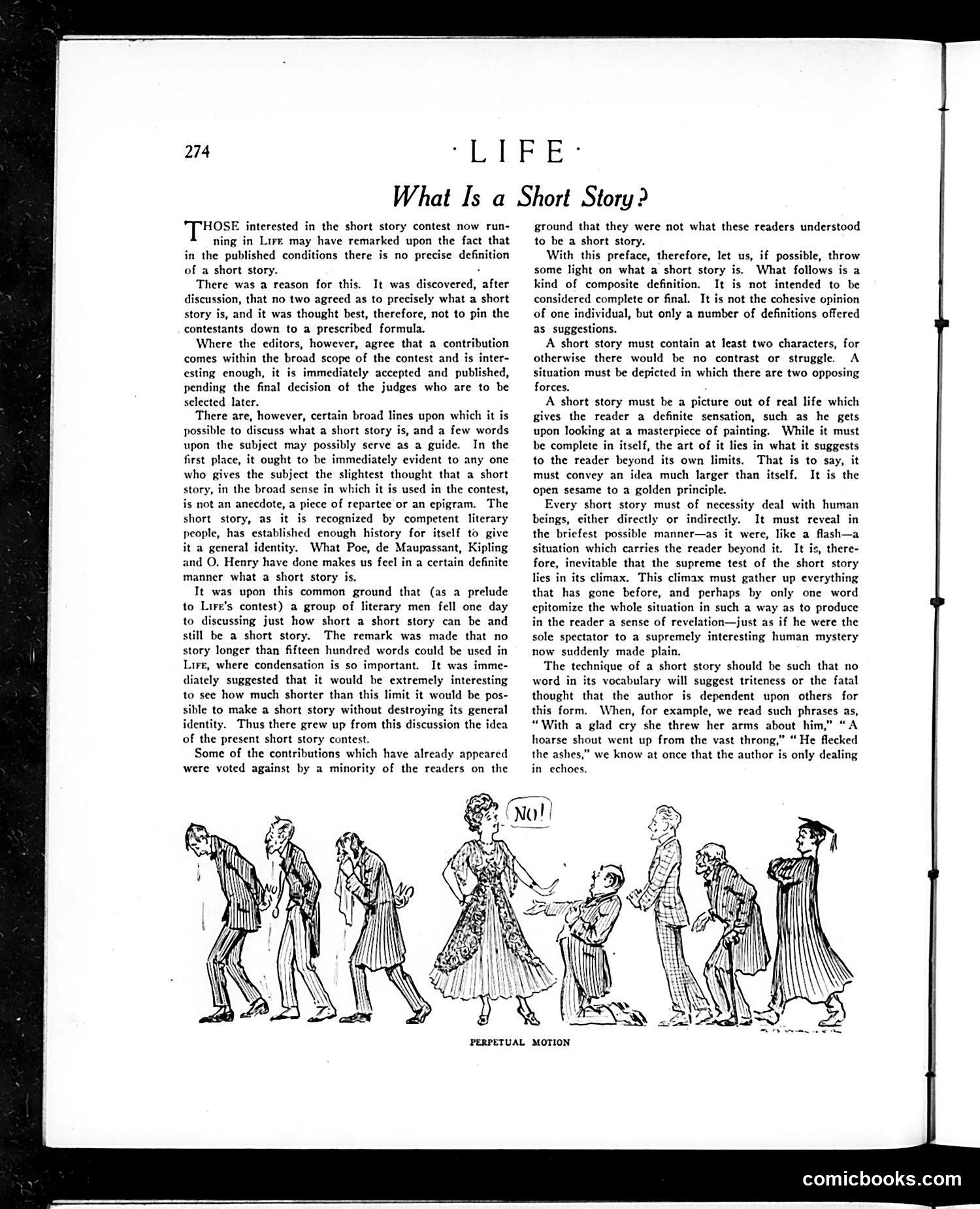
This page is primarily **editorial content**, not satire or political cartoon. It's an instructional essay defining what constitutes a short story for readers interested in Life magazine's short story contest. The sole illustration at the bottom, titled "PERPETUAL MOTION," appears to be a **humorous social commentary** showing a line of figures in various poses of argument or animated discussion, with one figure saying "NO!" The cartoon likely satirizes endless, circular debate or disagreement—possibly commenting on how definitions and standards (like those discussed in the essay above) spark perpetual disagreement among people. The illustration uses caricature and exaggerated body language to convey the absurdity of never-ending conflict.
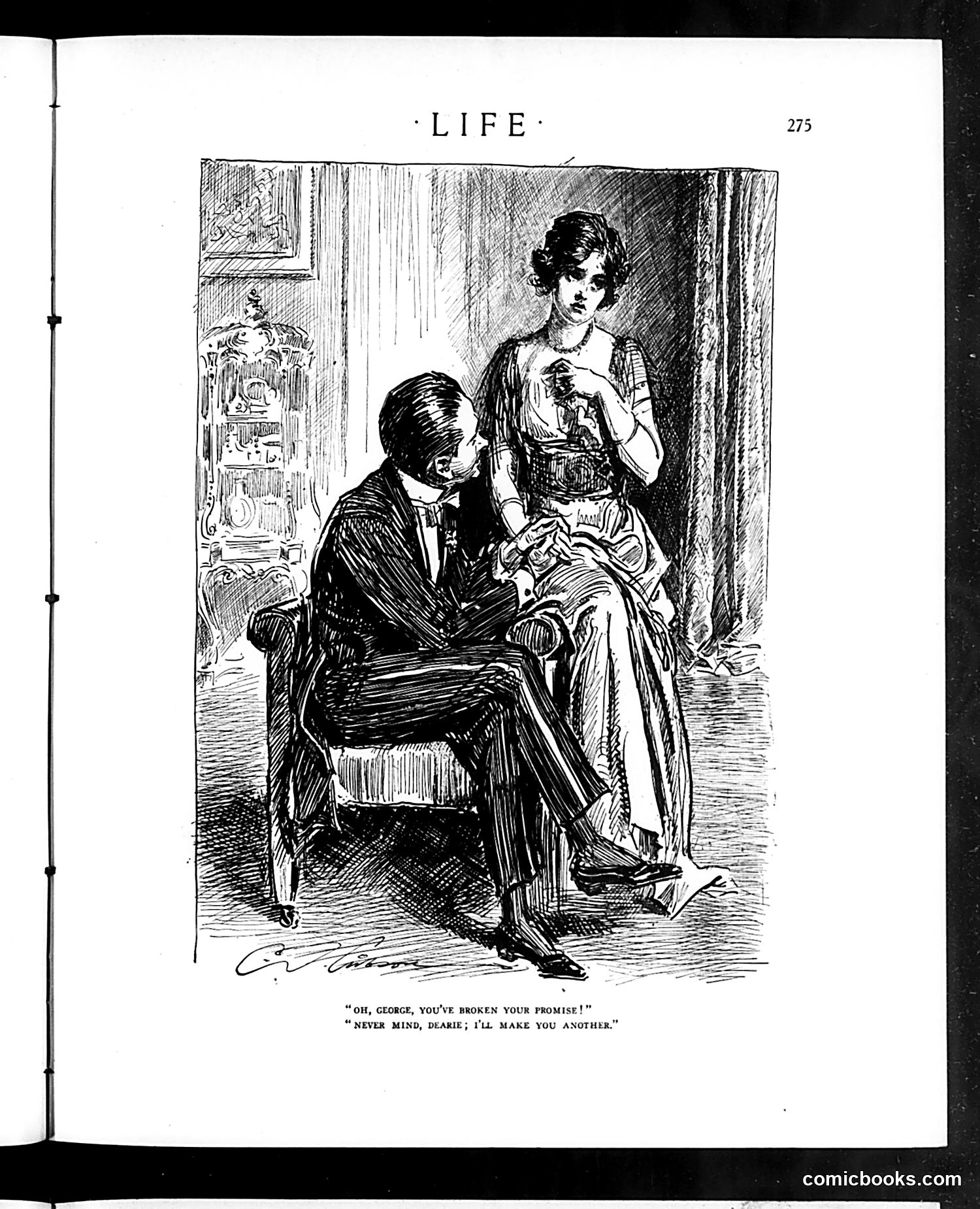
This illustration depicts a domestic scene with satirical dialogue. A man sits in a chair while a woman stands nearby, and he says: "Oh, George, you've broken your promise!" to which she responds: "Never mind, Dearie; I'll make you another." The cartoon appears to satirize marriage dynamics and gender roles of the early 20th century. The woman's response—offering to replace a broken promise with another—suggests she views promises from her husband as easily disposable or interchangeable, implying either that his promises are frequently broken or that she has low expectations of his reliability. The satire likely mocks either male infidelity/untrustworthiness in marriage or the resigned, accommodating attitude wives were expected to adopt toward their husbands' failings.
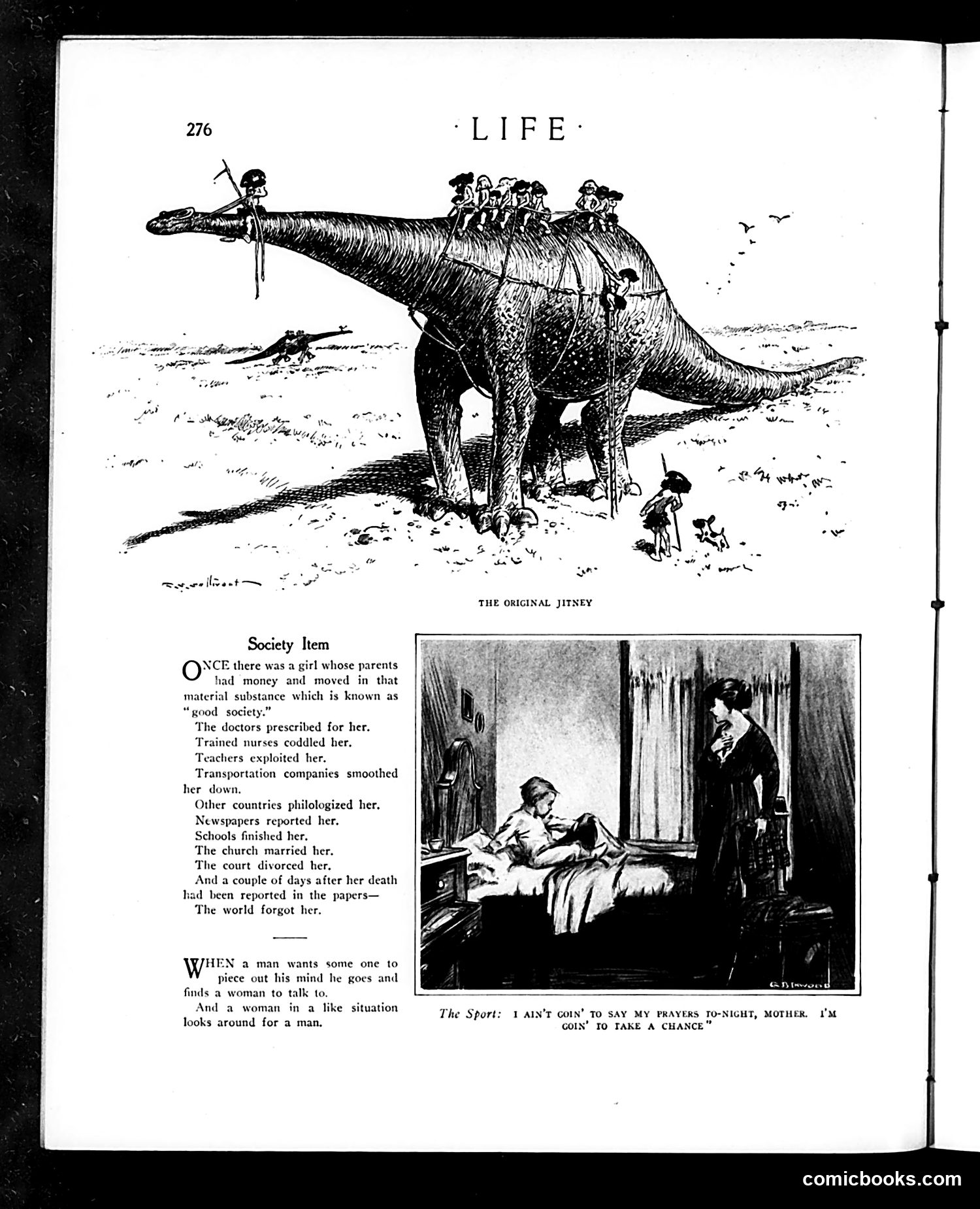
**"The Original Jitney"** cartoon depicts a massive dinosaur carrying multiple tiny human passengers on its back, satirizing the newly popular "jitney" — cheap, informal shared-ride vehicles that were disrupting established transportation monopolies in the early 1900s. **The "Society Item"** text below mocks wealthy women whose lives are consumed by social institutions: doctors, nurses, teachers, transportation companies, newspapers, schools, church, and courts all profit from or regulate her existence. The accompanying bedroom photograph illustrates a woman in bed, captioned with dialogue about taking chances rather than saying prayers—suggesting social satire about idle, privileged women. Both pieces critique early 20th-century American society: commercialized transportation and the frivolous lives of the wealthy elite.
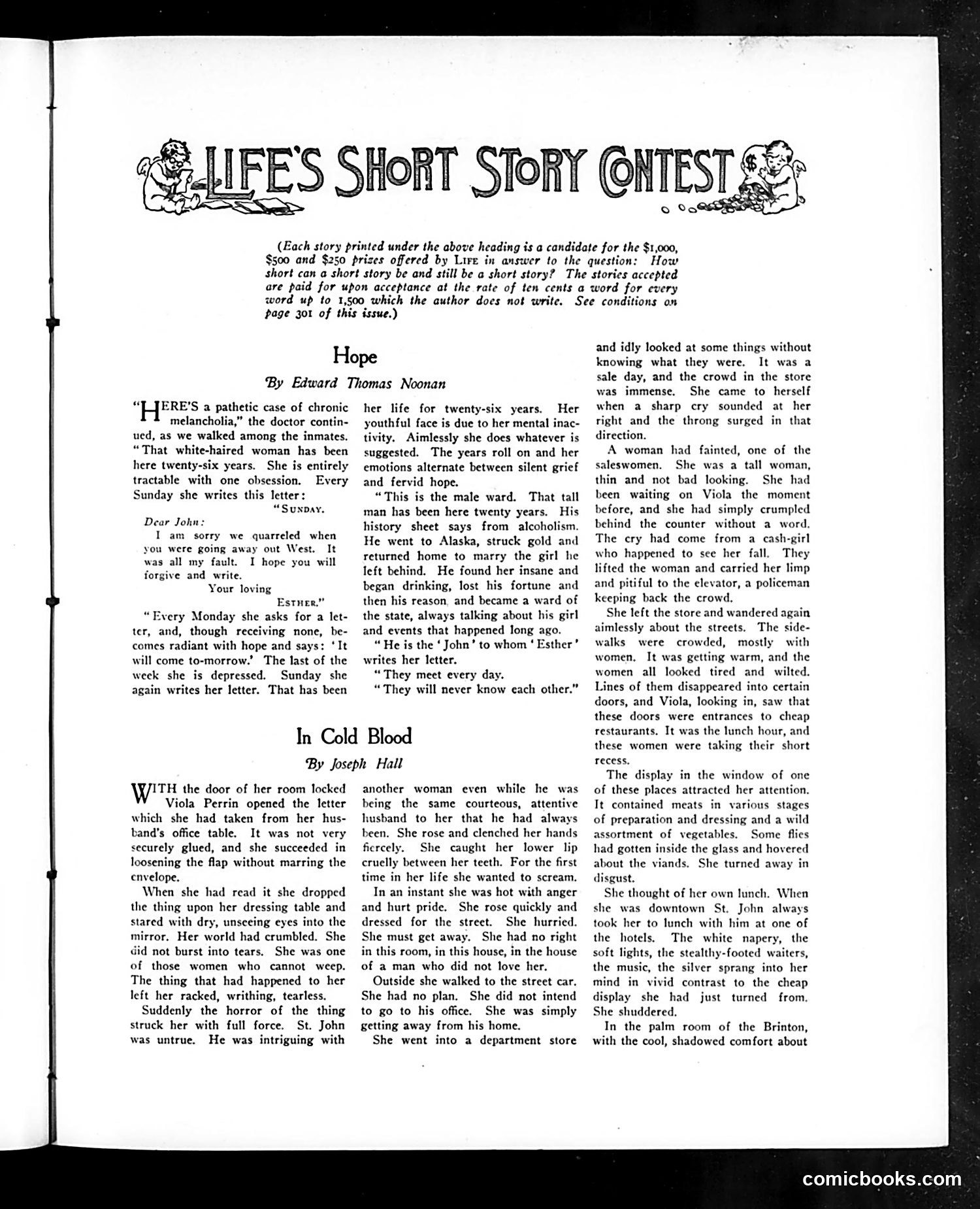
This page contains **no political cartoons**. Instead, it presents **Life's Short Story Contest**, offering monetary prizes ($1,000, $500, $250) for submitted short fiction. The page displays two contest entries: 1. **"Hope"** by Edward Thomas Noonan — about a woman with chronic melancholia in a mental ward, written to a patient named John through letters from his mother "Esther." 2. **"In Cold Blood"** by Joseph Hall — depicting a woman (Wisha Peris) who discovers her husband's infidelity and leaves him, wandering into a department store. Both appear to be serialized fiction entries competing for the contest prize. This is a **literary feature**, not political satire or editorial cartooning.
This page contains a short story titled "The Horse Heaver" by Brander Paterson. The narrative depicts a domestic dispute between Mike Kallsher and his wife over his work-related exhaustion. When his wife complains about his tiredness, Kallsher becomes defensive, insisting he needs rest without explanation. The story involves a neighbor, Mrs. Coogan, who mentions that Kallsher is "a ditch digger on the new Twelfth Street sewer"—apparently a source of embarrassment. When a horse falls into the ditch during work, Kallsher heroically saves it by hauling it back to the street, earning local admiration. The satire contrasts Kallsher's humble, backbreaking labor with his dignified response to being questioned about his work, suggesting themes about working-class pride and the dignity found in manual labor, however unglamorous.
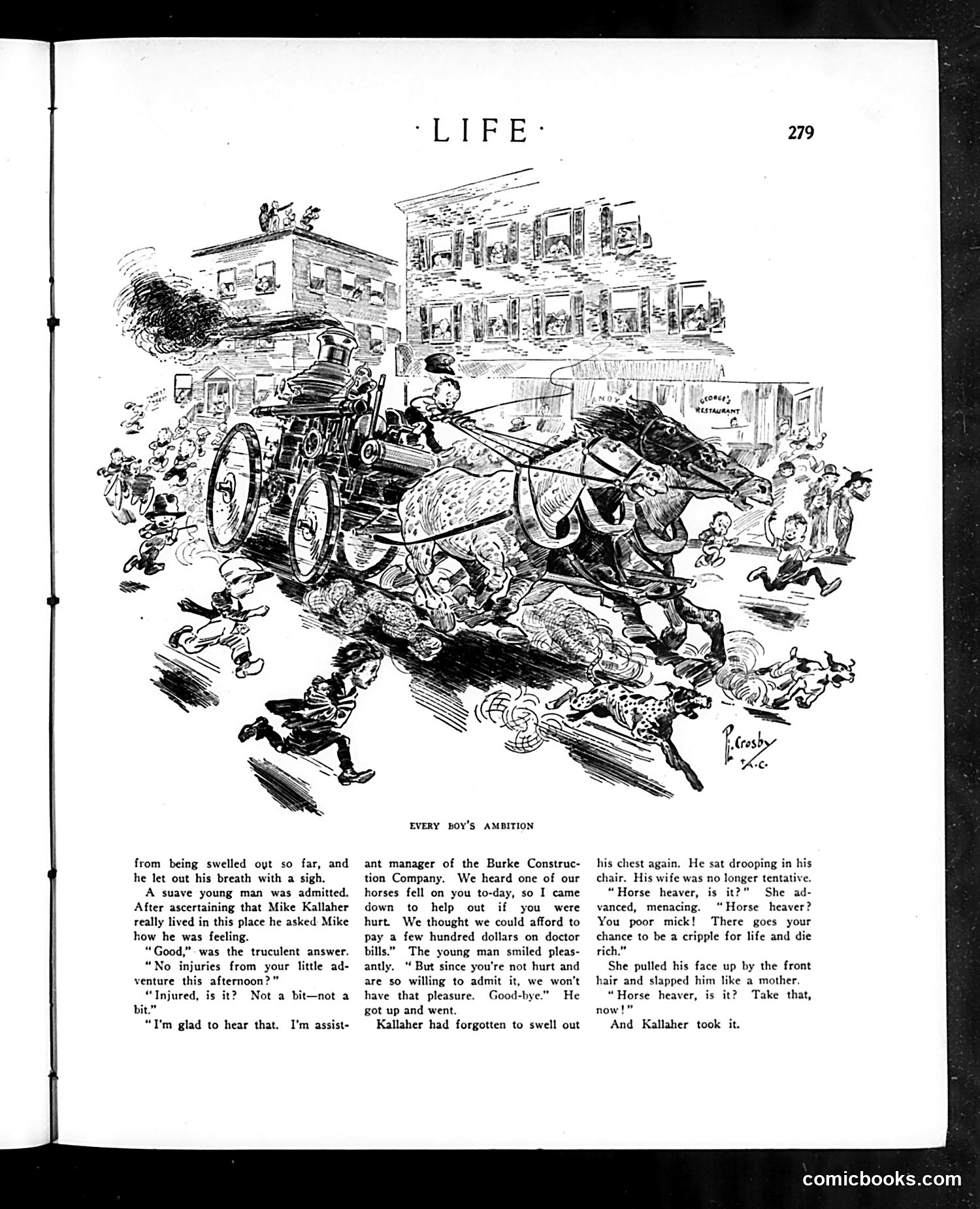
This satirical cartoon depicts a chaotic street scene where a horse-drawn cart laden with goods has overturned, scattering produce and debris everywhere while pedestrians scatter in panic. The illustration satirizes the romanticized notion of working-class aspiration—specifically, the idea that every boy dreams of becoming a teamster or cart driver (a common working-class occupation of the era). The humor lies in the visual contradiction: rather than depicting an orderly, dignified profession, the cartoon shows the reality—chaos, danger, and disaster. The accompanying text discusses injuries from a horse accident, reinforcing that such work was actually hazardous and unglamorous, mocking the notion that this represented genuine ambition or success for young men.
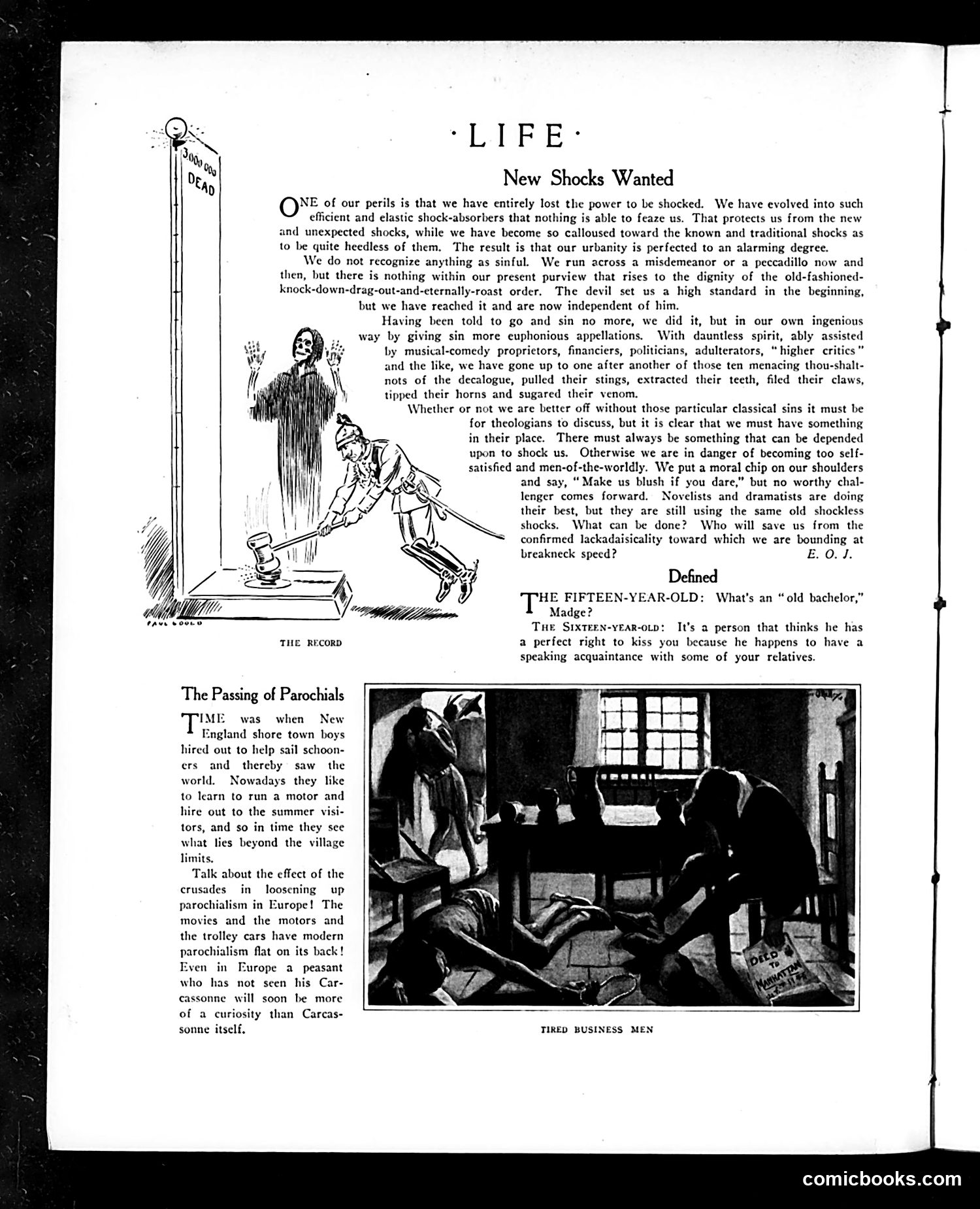
This satirical essay argues that modern society has become morally numb—so desensitized to scandal and vice that nothing shocks us anymore. The author laments that we've euphemistically renamed sins ("higher critics," "adulterators") rather than truly reformed, making transgression socially acceptable. The illustration shows Death looming over a skeletal figure being executed, symbolizing society's self-inflicted moral demise through complacency. The accompanying cartoons mock contemporary social changes: "Tired Business Men" depicts weary urbanites, while "The Passing of Parochials" suggests that modern transportation (motors, trolleys, movies) has eroded small-town insularity—previously, only crusaders traveled abroad; now even peasants explore beyond their villages. The "Defined" section offers wry definitions of old bachelors and young women, exemplifying the witty, tongue-in-cheek humor characteristic of *Life* magazine's social commentary.
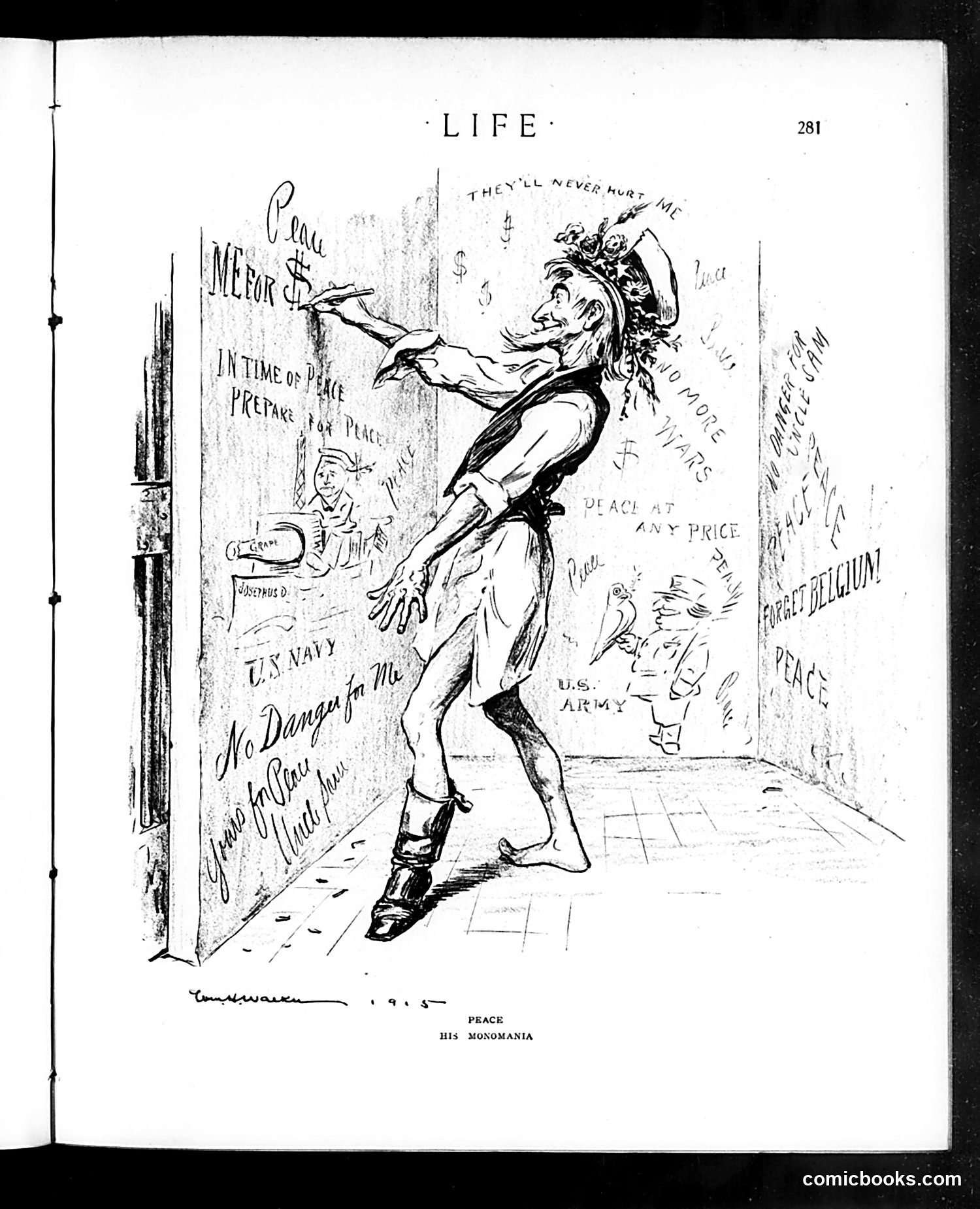
This 1915 satirical cartoon titled "Peace: His Monomania" depicts a caricatured figure obsessed with peace during wartime. The figure is surrounded by handwritten text on walls representing competing demands: "Meteor" (military spending), "U.S. Navy," "U.S. Army," "No Danger to Me," and "Peace at Any Price" — the last phrase appearing most prominently. The cartoon critiques what appears to be President Woodrow Wilson's pacifist stance during World War I. While European conflict raged and American military interests pressed for preparedness, Wilson's administration initially maintained neutrality and pursued peace negotiations. The exaggerated caricature suggests this peace advocacy bordered on obsessive monomania, out of touch with practical military and economic realities clamoring for American attention and resources.
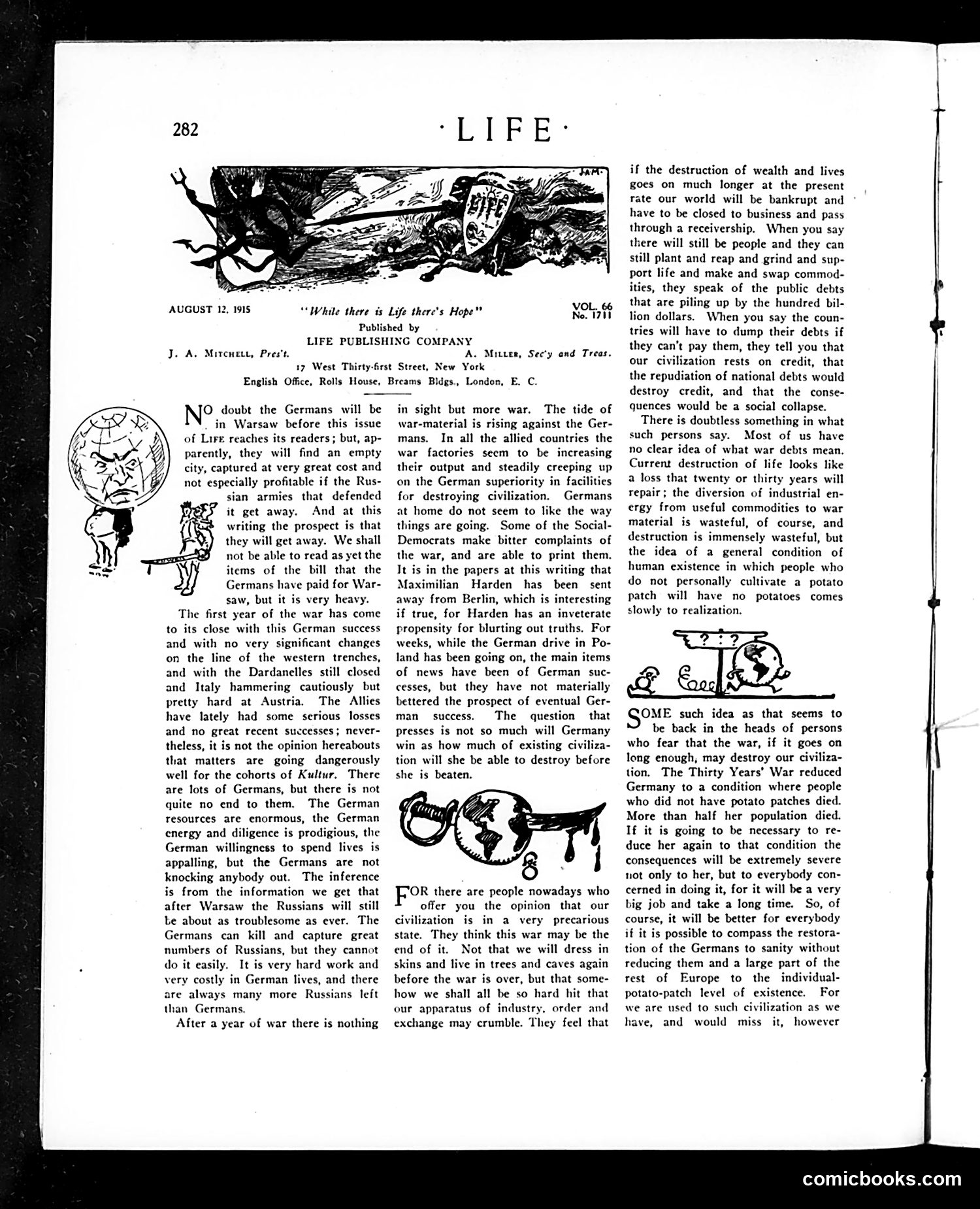
This editorial page discusses the first year of World War I, focusing on Germany's capture of Warsaw. The author argues that despite German military successes, their overall position remains unsustainable: they're inflicting massive casualties but can't decisively defeat Russia, while Allied war production is increasing. The satirical point centers on contemporary anxieties about civilization's collapse. The page mocks pessimists who fear the war will destroy Western civilization entirely—reducing society to subsistence living. The author counters this by distinguishing between potential financial bankruptcy (massive public debt) and actual civilizational collapse. The cartoons (appearing as decorative elements) appear to be generic wartime illustrations rather than specific political caricatures. The editorial's real target is defeatist thinking, arguing that while the war's costs are severe, civilization will survive—though reconstruction will be difficult and take considerable time.
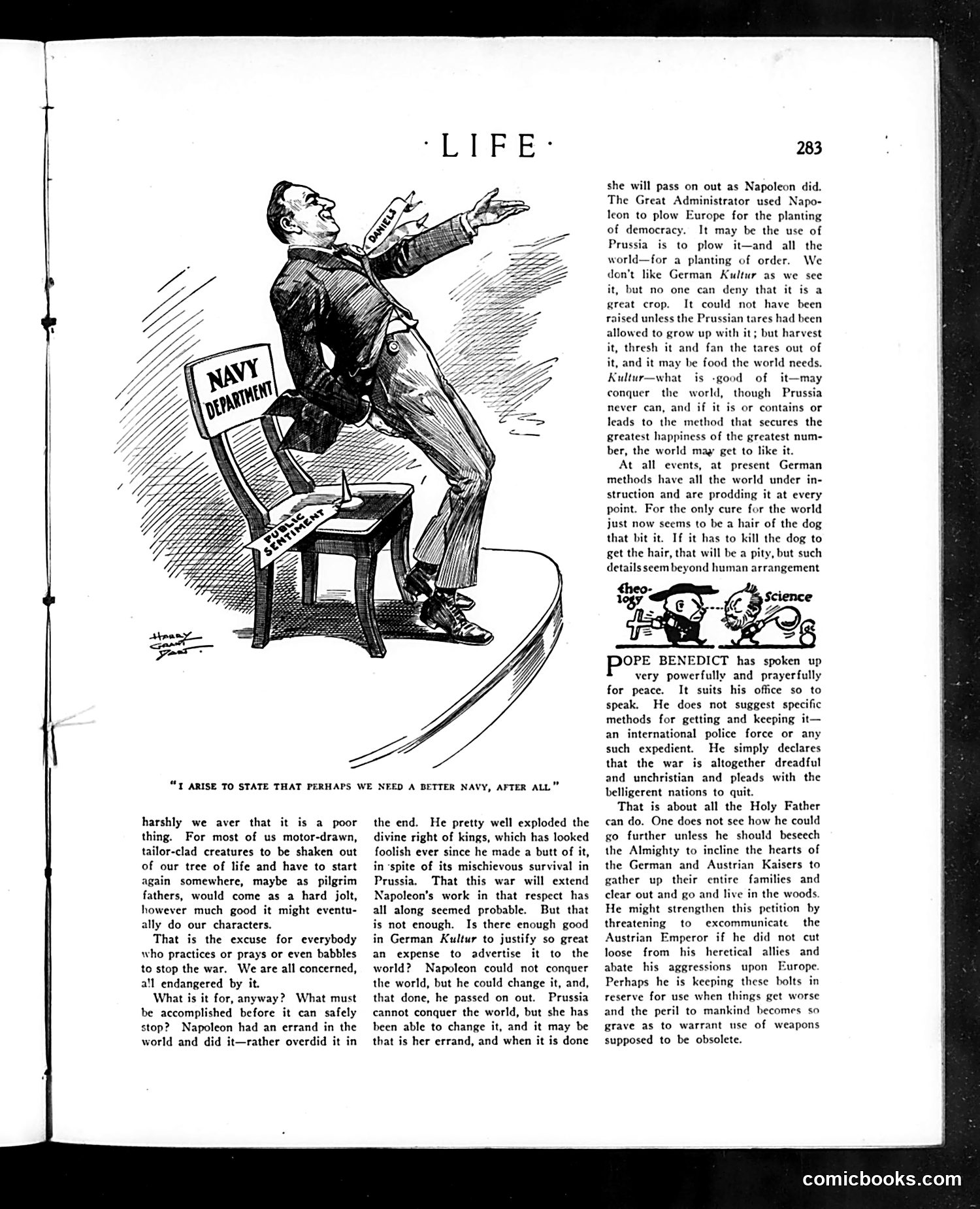
## The Cartoon The illustration depicts a military officer in formal dress, positioned dramatically atop a stool labeled "Navy Department," gesturing expansively. The caption reads: "I ARISE TO STATE THAT PERHAPS WE NEED A BETTER NAVY, AFTER ALL." ## Context & Meaning This appears to be WWI-era satire (based on references to Germany, Prussia, and war). The cartoon mocks an unnamed military or political figure—likely a Navy Department official or politician—making grandiose arguments for increased naval spending. The exaggerated pose and melodramatic caption suggest the satirist views such advocacy as theatrical posturing rather than substantive argument. The accompanying text discusses whether the war serves legitimate purposes, comparing Prussia's role to Napoleon's, and debating whether German "Kultur" (civilization/culture) justifies the conflict's costs. The satire implies that calls for naval expansion may be self-serving rather than genuinely addressing the war's necessities. The cartoon critiques both military establishment advocacy and broader wartime rhetoric through absurdist humor.
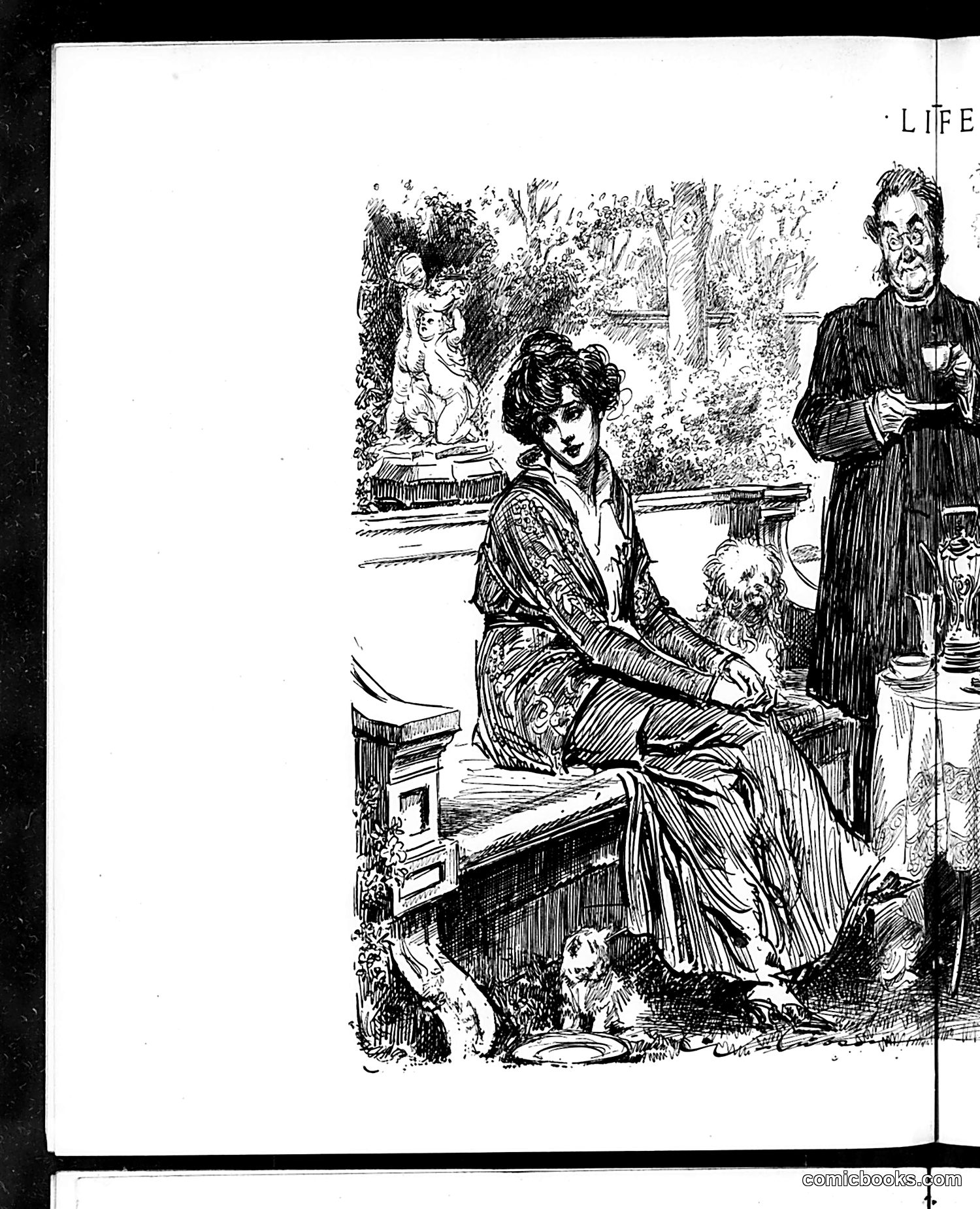
This appears to be a satirical illustration from Life magazine depicting a social scene in what looks like a wealthy household or garden setting. A well-dressed woman sits on a bench with a small child, while a man in formal attire stands nearby observing. In the background, there's a classical statue and elaborate garden or conservatory setting. The satire likely critiques class consciousness, parenting styles, or social pretension among the wealthy during the late 19th or early 20th century. The woman's ornate clothing and the formal setting suggest commentary on aristocratic or upper-class affectation. However, **without visible text identifying specific figures or clearer context, I cannot definitively state what precise social/political target this cartoon addresses**. The tone appears mocking toward the subjects' self-importance or behavior.
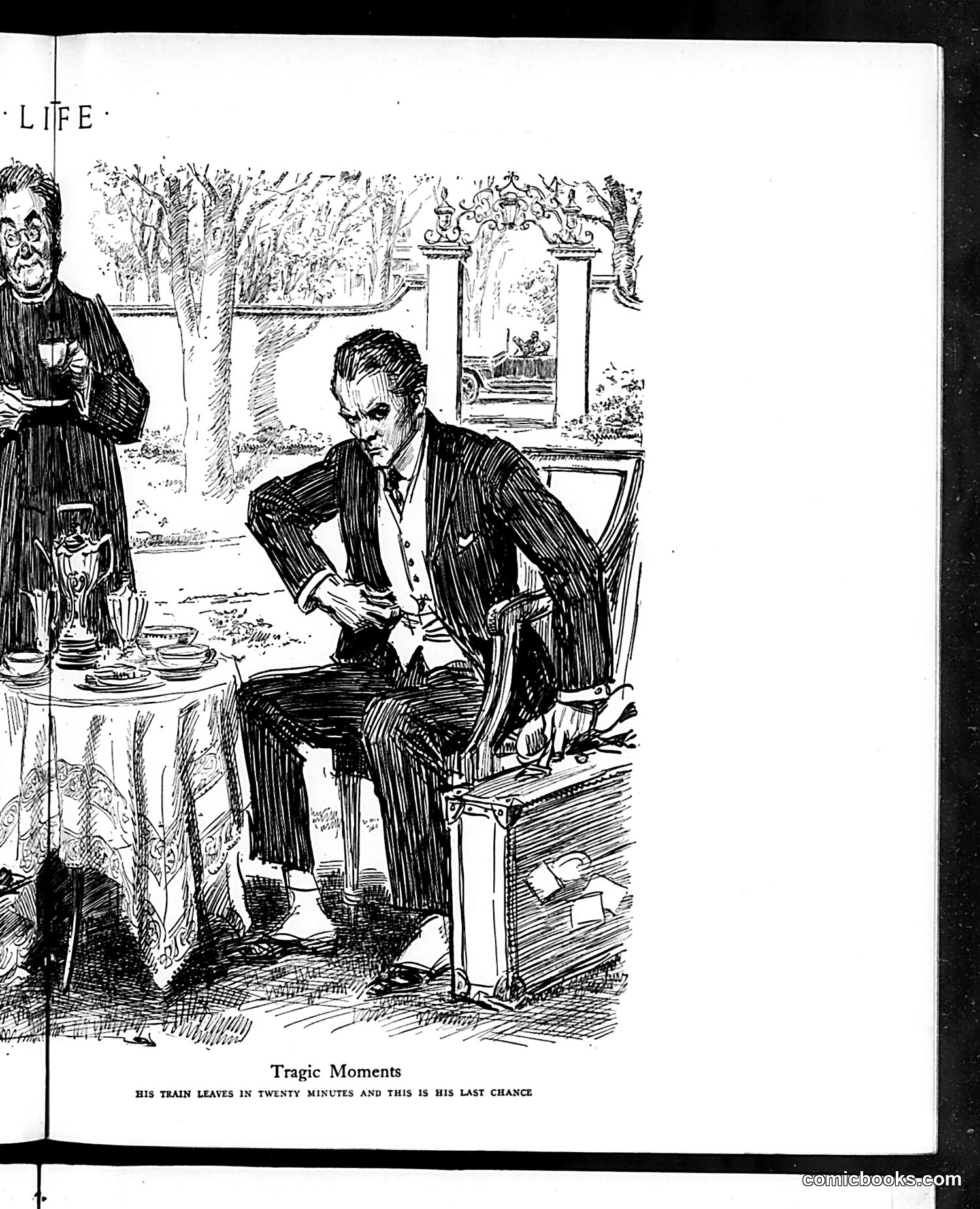
This satirical illustration depicts a domestic crisis in an upper-class setting. A well-dressed man sits anxiously checking his watch while a waiter or servant stands nearby with refreshments. The caption indicates his train departs in twenty minutes, suggesting time pressure for an important departure. The "tragedy" appears to be a romantic or personal dilemma—likely involving the woman whose figure is visible in the background near the garden entrance. The satire mocks melodramatic Victorian/Edwardian social situations where gentlemen faced emotional entanglements requiring difficult last-minute decisions. The detailed interior with formal dining setup and ornamental garden views emphasizes the privileged setting, making the man's predicament seem both urgent and absurdly trivial—the hallmark of Life magazine's humor targeting wealthy social anxieties.
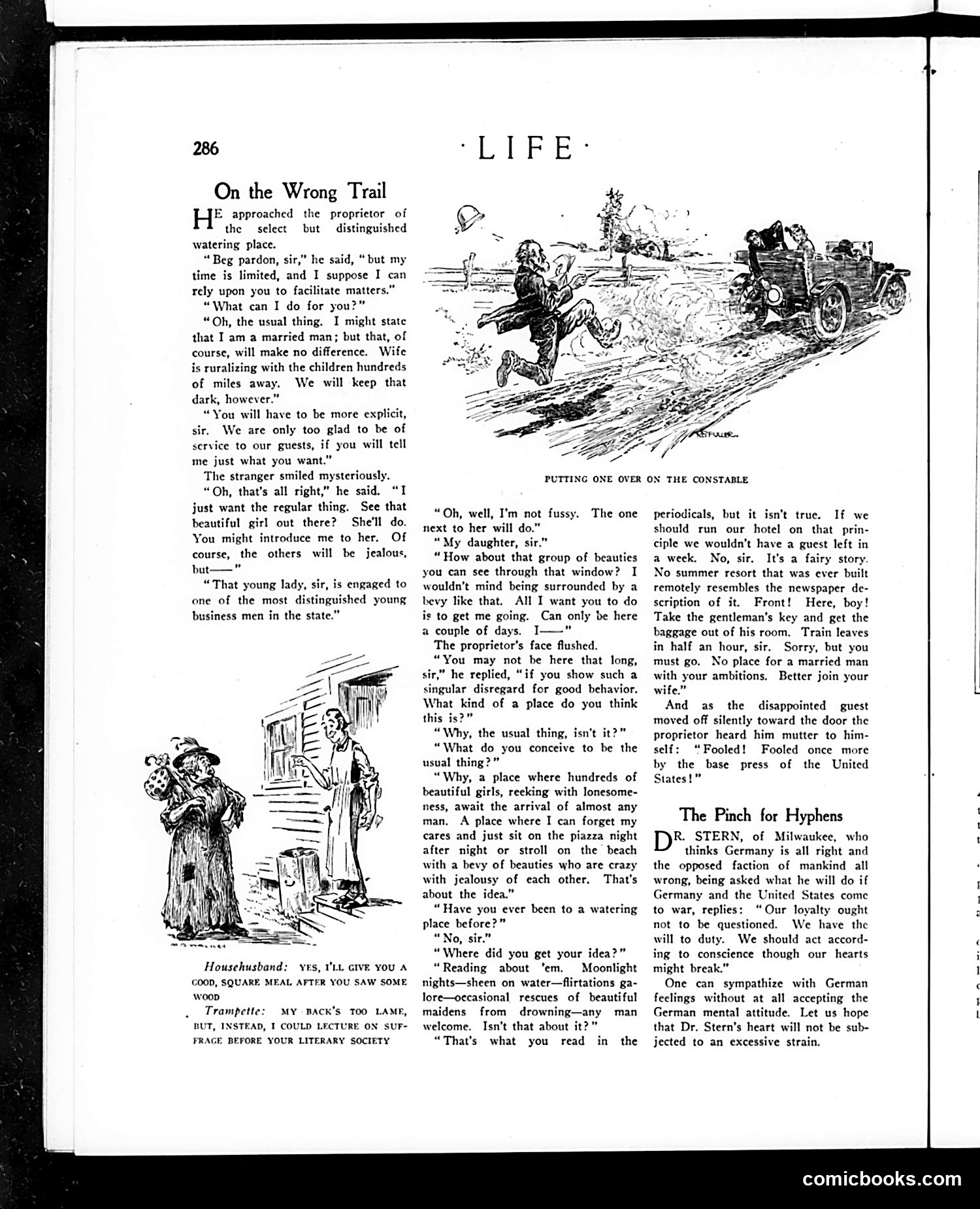
This satirical story mocks popular literary and journalistic depictions of American resort hotels. A married man arrives expecting the classic romance-novel fantasy: beautiful, lonely women waiting to flirt with male guests, moonlit beach scenes, and dramatic rescues. The proprietor deflates these illusions, revealing the gap between sensational newspaper and magazine accounts and reality. Resort hotels, he explains, would lose all guests if they operated as depicted in popular fiction. He ejects the man for his inappropriate behavior. The final joke—the guest blaming "the base press of the United States"—criticizes how periodicals romanticize and misrepresent ordinary places, creating false expectations. The satire targets both gullible readers who believe sensationalized accounts and the publications that publish them, suggesting the press bears responsibility for deceiving the public about reality.
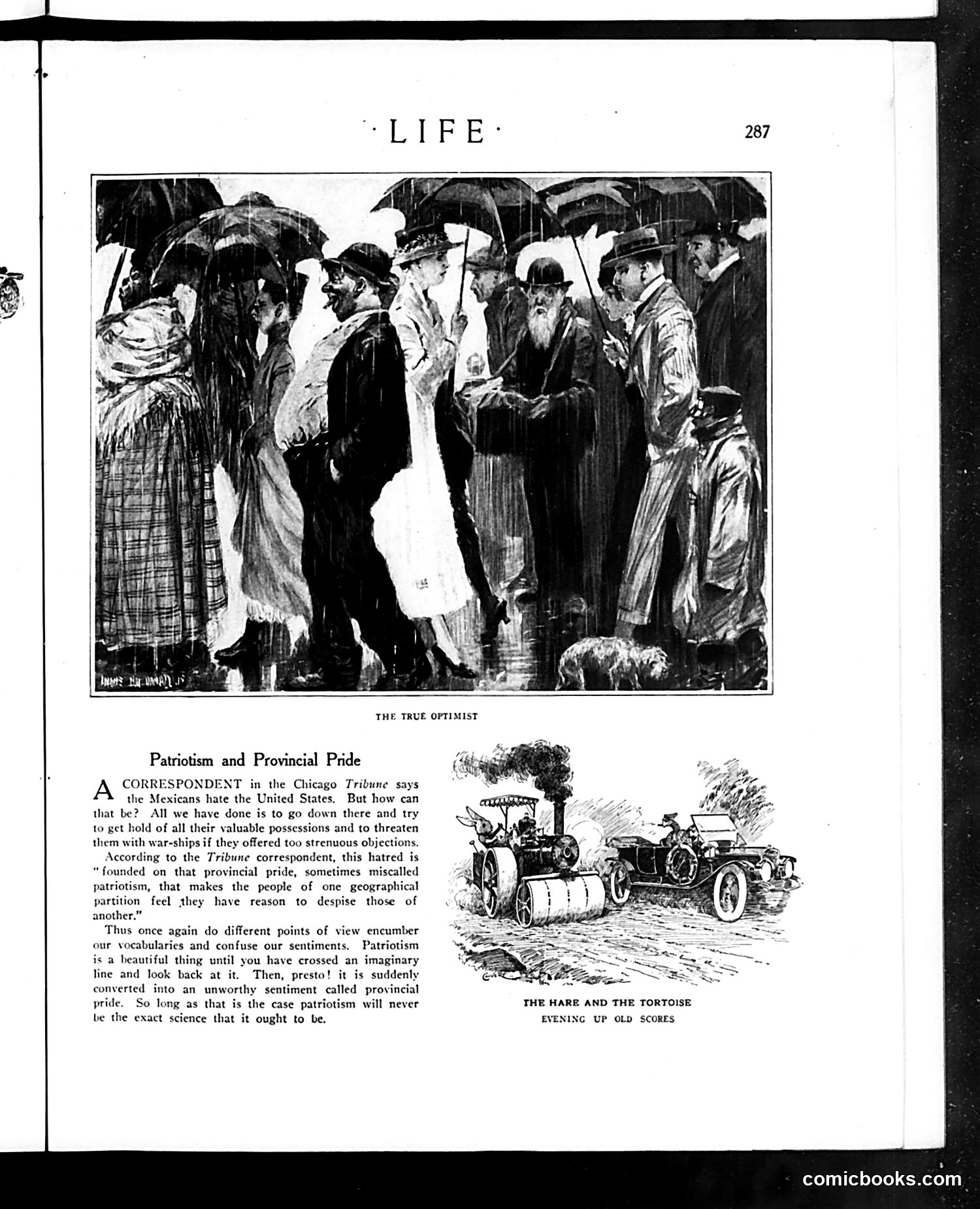
This editorial satirizes American hypocrisy regarding Mexican-American relations. A Chicago Tribune correspondent dismisses Mexican resistance to U.S. intervention as mere "provincial pride," but the writer exposes the double standard: when Americans defend their own interests, it's called patriotism; when Mexicans do the same, it's branded as petty regional sentiment. The top illustration depicts a crowd in rain—likely representing Mexican citizens facing American pressure. The accompanying text mocks the semantic gymnastics that allow Americans to justify territorial ambitions and military threats while dismissing legitimate Mexican nationalism as inferior emotion. The "Hare and Tortoise" illustration below suggests America (the hare) is trying to "even up old scores" through superior force, while Mexico (the tortoise) represents slower, steadier resistance. The satire argues that patriotism cannot be a true principle if it only applies selectively—legitimizing one nation's self-interest while delegitimizing another's identical defense.
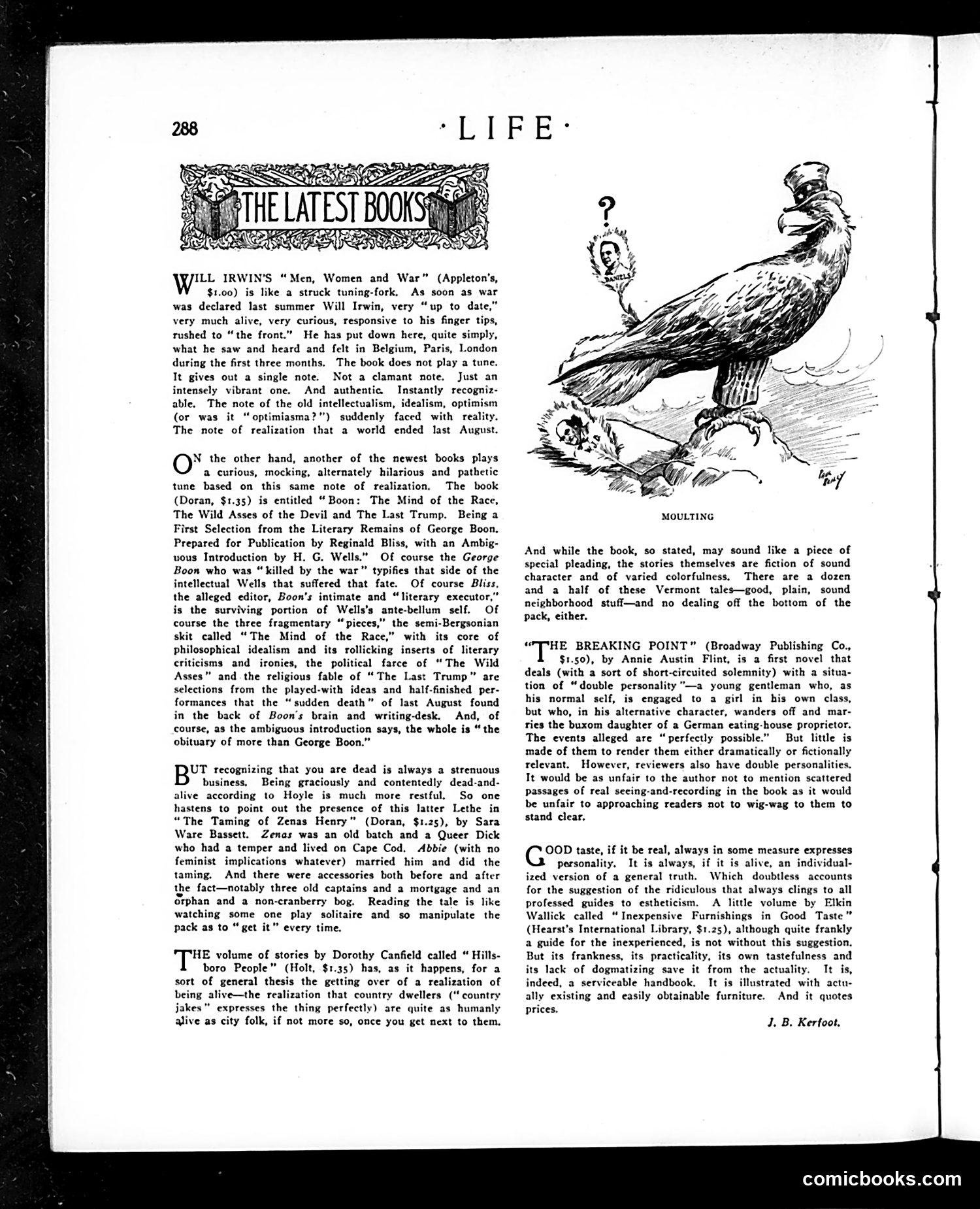
This page from *Life* magazine reviews several contemporary novels, mostly published around 1914-1915 during World War I's early months. The illustration labeled "MOULTING" depicts a bird shedding feathers—a metaphor for the intellectual and cultural transformation occurring as war shattered pre-war idealism. This visual accompanies discussion of Will Irwin's *Men, Women and War*, a firsthand account of the conflict's impact on established philosophical optimism. The reviews emphasize a common theme: the "realization that a world ended last August" (referring to war's declaration in 1914). H.G. Wells's *Boon* is presented as a satirical elegy for pre-war intellectualism—its protagonist "killed by the war" symbolizes ideas rendered obsolete by reality. Other novels reviewed (*The Breaking Point*, *Hillsboro People*) explore psychological transformation and social perception, reflecting the era's broader anxiety about how war fundamentally altered consciousness and certainty. The page's tone suggests cultured anxiety about modernity's disruption of established beliefs and values.
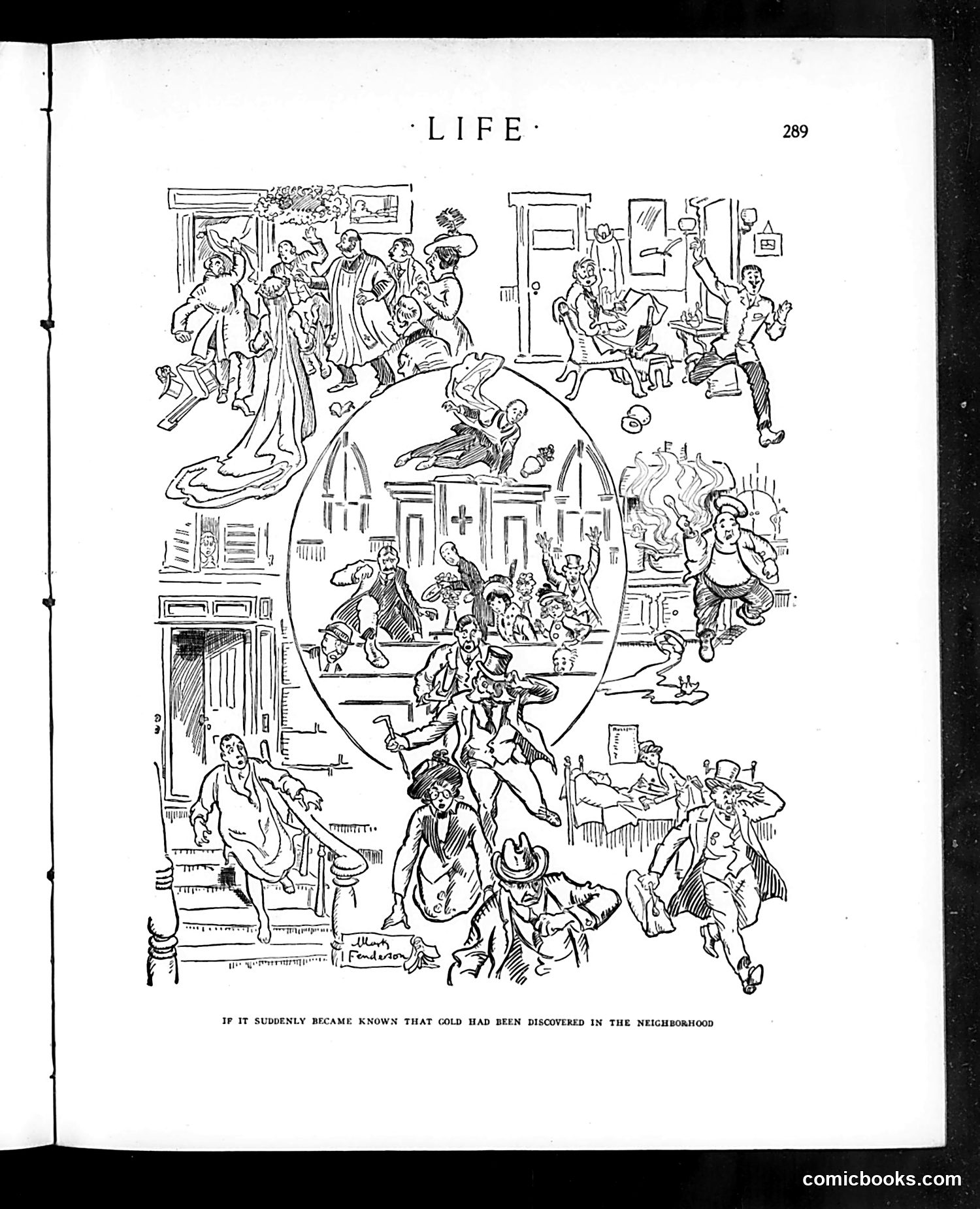
This satirical cartoon depicts the chaos that would erupt if gold were discovered in an ordinary residential area. The illustration shows multiple scenes of everyday life transformed into pandemonium: a church service dissolves into frenzy, domestic scenes become frantic, and orderly neighborhoods turn to bedlam. The satire targets human nature—specifically greed and the abandonment of social order and morality when wealth appears possible. The juxtaposition of civilized settings (church, homes, streets) with wild behavior suggests that even society's most stable institutions cannot withstand the allure of sudden riches. This reflects common anxieties during gold rush periods about how materialism corrupts communities and individuals.
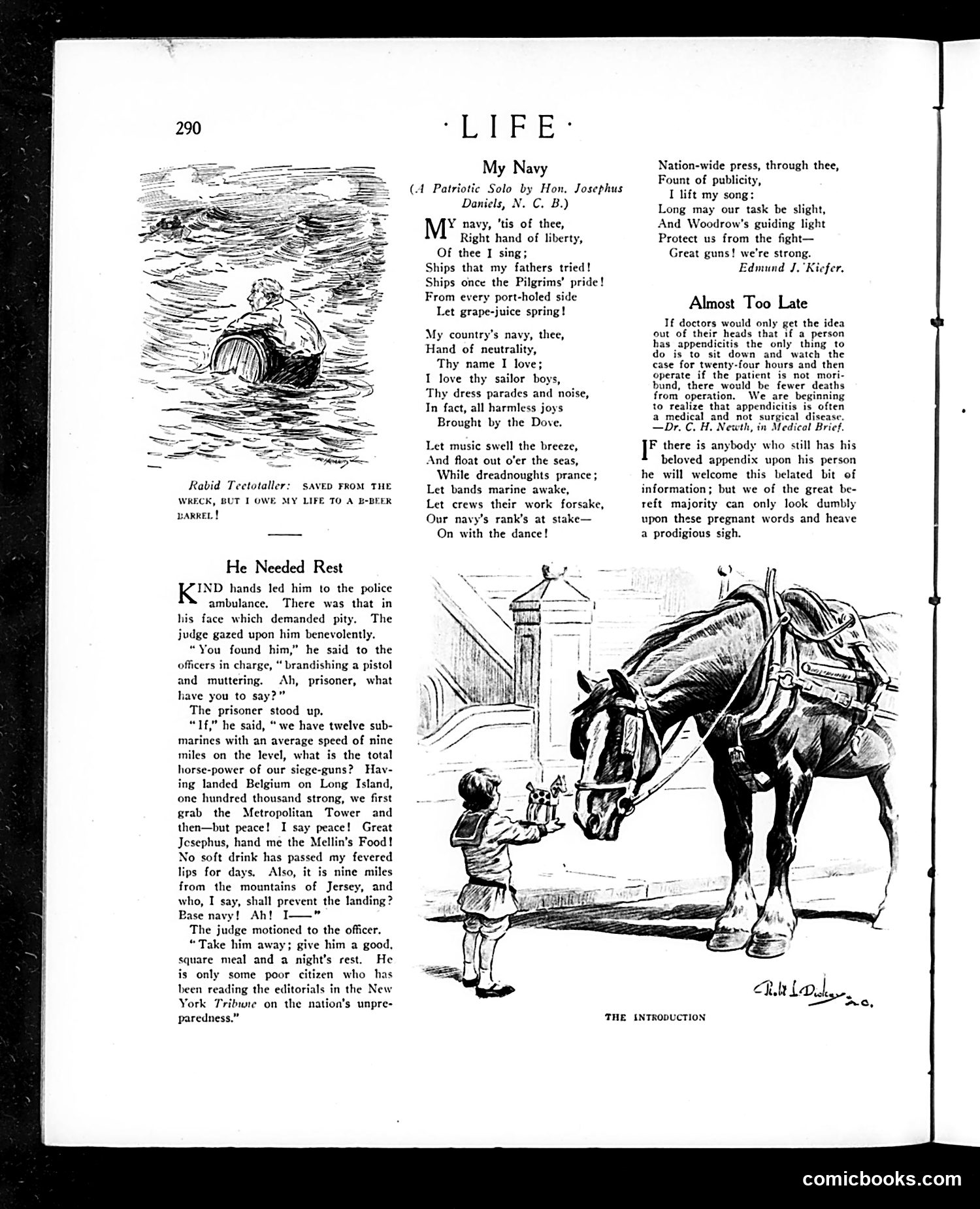
This page contains three pieces of political-social commentary from the World War I period: **"My Navy"** is a patriotic parody attributed to Secretary of the Navy Josephus Daniels, mocking American naval policy. The poem ironically celebrates "neutrality" and "harmless joys" while referencing "grape-juice" (Daniels was a prohibitionist) instead of martial strength. It satirizes the gap between patriotic rhetoric and actual military preparedness. **"He Needed Rest"** depicts a deranged man arrested for ranting incoherently about military strategy, submarines, and invasion scenarios. The judge dismissively attributes his breakdown to reading alarmist editorials in the *New York Tribune* about national unpreparedness—satirizing both war anxiety and sensationalist press coverage. **"Almost Too Late"** is a medical editorial excerpt criticizing delayed appendicitis surgery, followed by the magazine's dry commentary on the now-obsolete concern for those who've already had the procedure. The page satirizes American anxiety about military unpreparedness, naval policy, and media-fueled panic during the neutral period before U.S. entry into WWI.
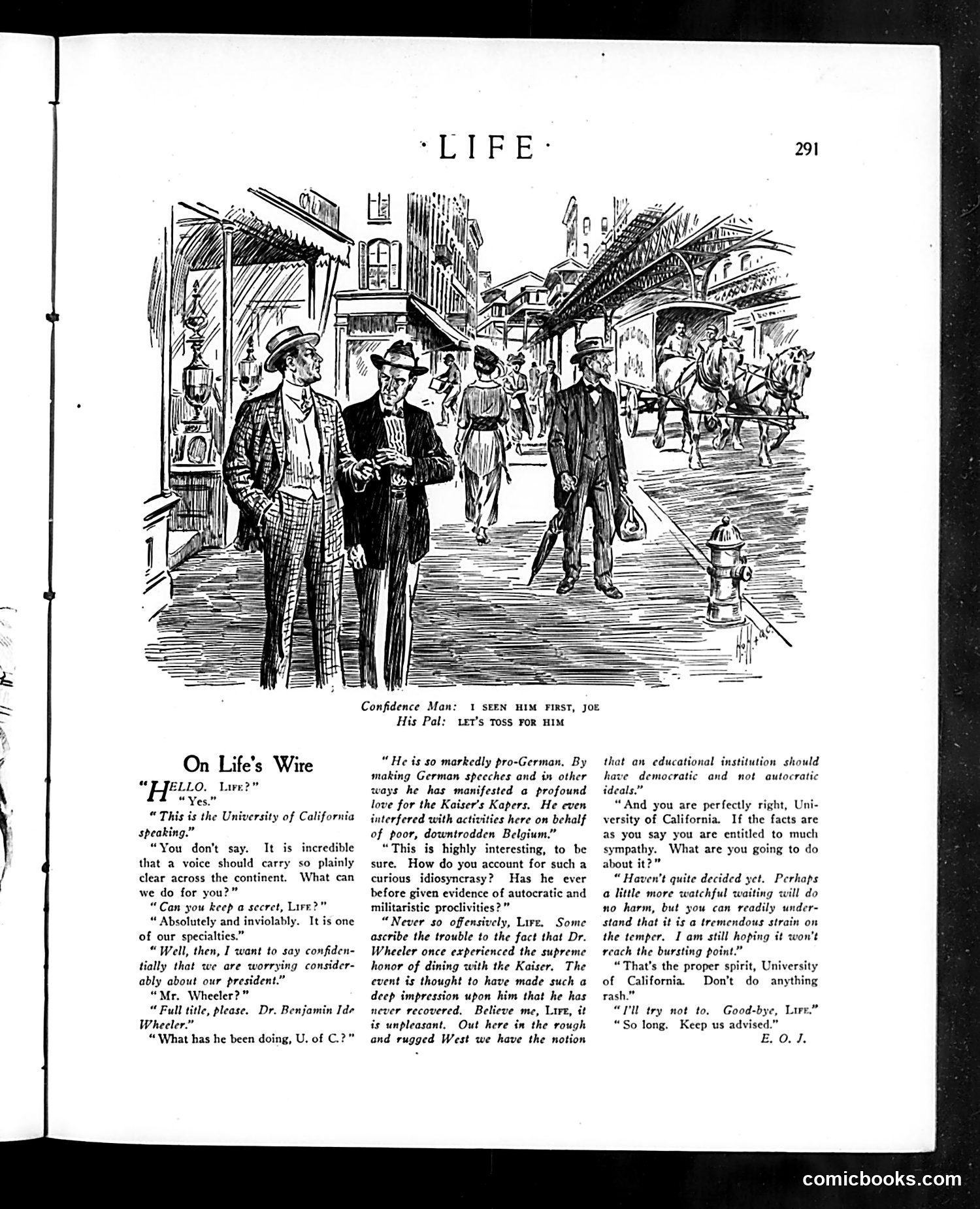
This page satirizes University of California President Benjamin Ide Wheeler's perceived pro-German sympathies, likely during World War I or the period leading to American entry (1914-1917). **The Setup:** The cartoon uses a "confidence man" framing device where "Life" (the magazine, personified) converses with UC as a worried institution. UC confides that President Wheeler is troublingly pro-German—he gives German speeches, supported Belgium's enemies, and allegedly never recovered from dining with the Kaiser. **The Satire:** The piece mocks both Wheeler's apparent German sympathies and UC's passive response ("watchful waiting"). It contrasts Eastern establishment attitudes with Western American ideals, suggesting that a Pacific university should embrace democratic rather than autocratic values. **The Point:** This is political pressure disguised as gossip—shaming an educational leader for insufficient patriotism during a period of intense anti-German sentiment in America.
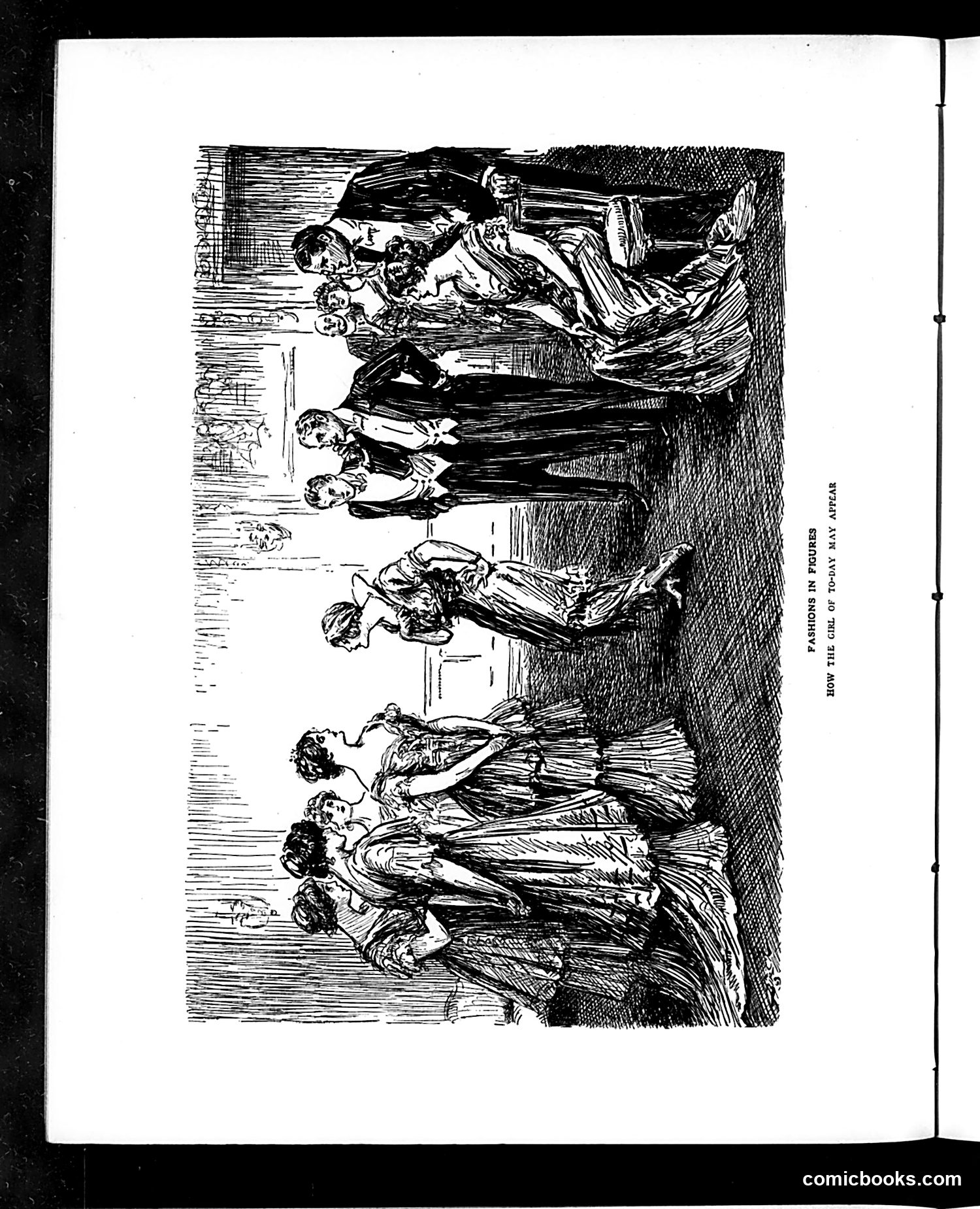
This page contains a single engraving-style illustration rotated 90 degrees, depicting what appears to be a formal social or theatrical scene with multiple figures in period dress (likely 18th or 19th century based on clothing). The composition shows figures arranged in an interior setting with architectural elements visible. The OCR text is largely illegible and appears corrupted, making it impossible to determine the cartoon's specific subject, title, or satirical point with confidence. **Without readable caption text, I cannot reliably identify the figures, explain the political or social references, or describe the intended satire.** The artistic style suggests this is a serious political or social commentary typical of Life magazine's satirical tradition, but the specific context and meaning remain unclear from this image alone.
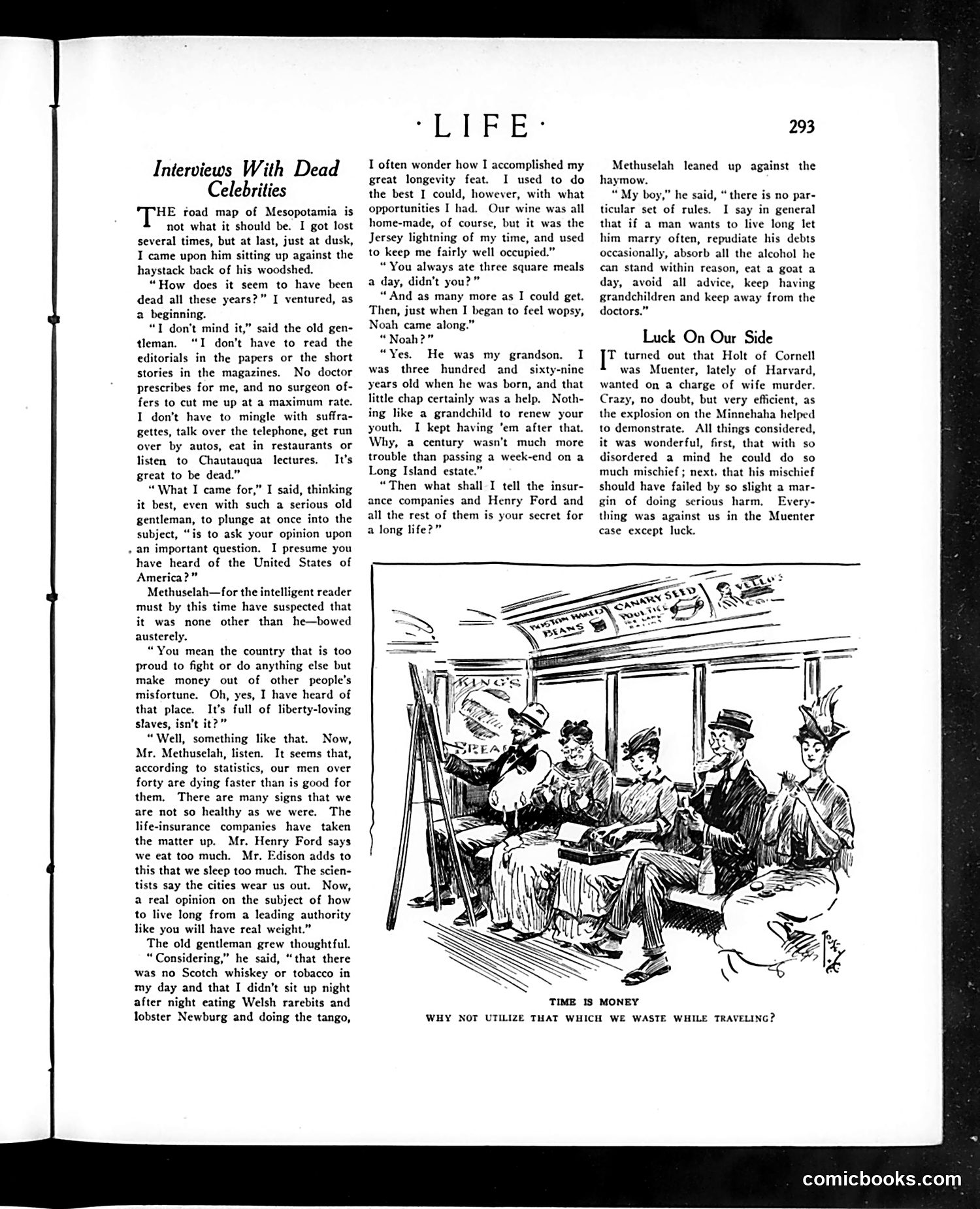
This satirical piece interviews the biblical figure Methuselah about American health and longevity. The humor operates on multiple levels: **The Setup**: Life magazine asks the world's oldest man for advice on why modern American men over 40 are dying faster than previous generations. **The Satire**: Methuselah's advice mocks contemporary health experts (Henry Ford, Thomas Edison) and progressive concerns about modern life—urban stress, overeating, lack of sleep. His actual "secret" to long life is deliberately contradictory and hedonistic: marry often, avoid paying debts, drink heavily, eat excessively, ignore doctors, and have many grandchildren. **The Point**: The joke critiques both modern "scientific" health advice as contradictory nonsense, and American morality as hypocritical. A biblical patriarch's wicked lifestyle supposedly worked better than contemporary experts' prescriptions. The cartoon illustration shows travelers on a train, captioned "TIME IS MONEY—WHY NOT UTILIZE THAT WHICH WE WASTE WHILE TRAVELING?" — advertising productive use of travel time.
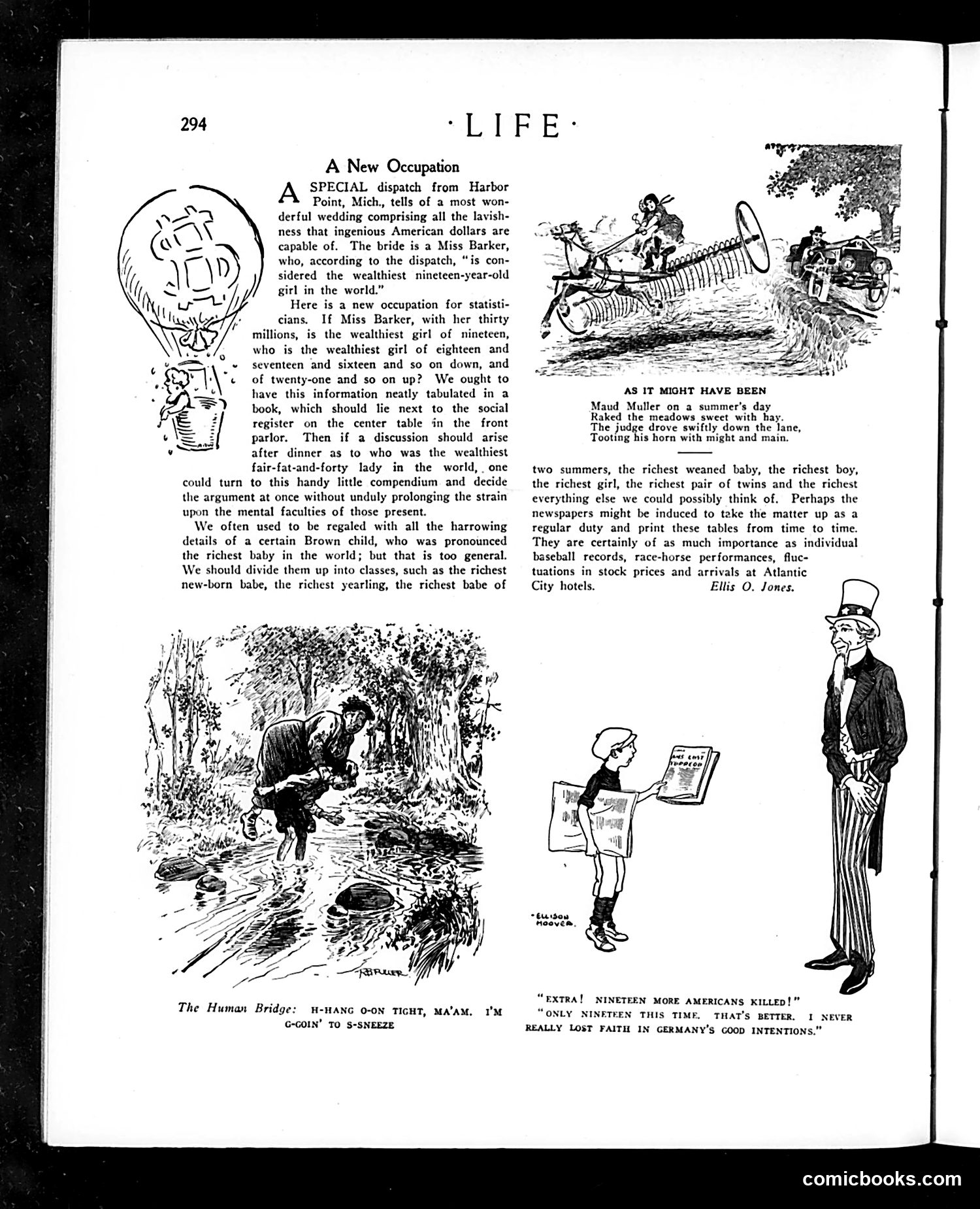
**"A New Occupation"** mocks wealthy American society's obsession with wealth rankings. The article proposes creating a detailed statistical compendium cataloging the richest people by age and gender — treating wealth like baseball statistics or stock prices. The satire suggests this reflects how American society prioritizes money above all else, treating financial status as legitimate news worthy of systematic tracking. **"The Human Bridge"** cartoon depicts a person clinging to another during a sneeze — social commentary on manners and physical indignity in close quarters. **"As It Might Have Been"** references John Greenleaf Whittier's 1856 poem "Maud Muller," reimagined here with a judge arriving by automobile, suggesting modernization of classic American literature. **The right cartoon** appears to reference World War I casualty reporting — the character's cynical comment about Germany killing "only nineteen" Americans this time (rather than more) satirizes either wartime propaganda or desensitization to mounting death tolls.
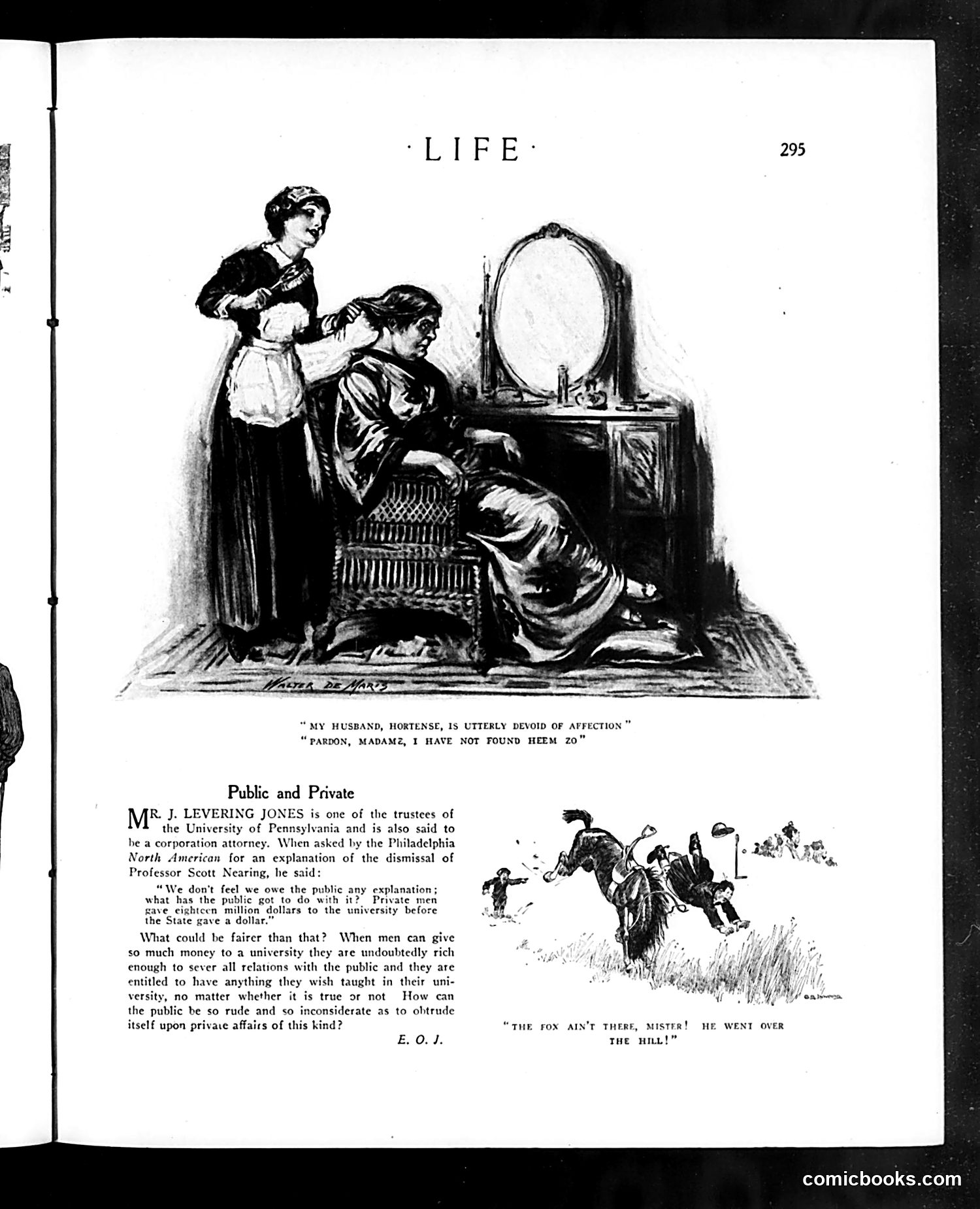
This 1915 *Life* magazine page satirizes wealthy donors' control over universities. The article criticizes J. Levering Jones, a University of Pennsylvania trustee, who dismissed public concerns about professor Scott Nearing's firing, claiming private donors needn't answer to the public. The top cartoon (by Walter de Maris) shows a woman at her mirror telling her friend her husband is emotionally cold, while the friend says she "hasn't found him so"—implying infidelity. This is visual satire: just as the husband appears different in private versus public, Jones claims universities can operate privately while accepting public trust. The bottom cartoon depicts hunters pursuing a fox that has escaped—a visual metaphor suggesting those seeking accountability (the hunters/public) are chasing something that has fled their reach, paralleling how private wealth allows institutional power to evade public oversight. The satire argues: wealthy donors shouldn't be able to hide behind "private affairs" when they control public institutions.
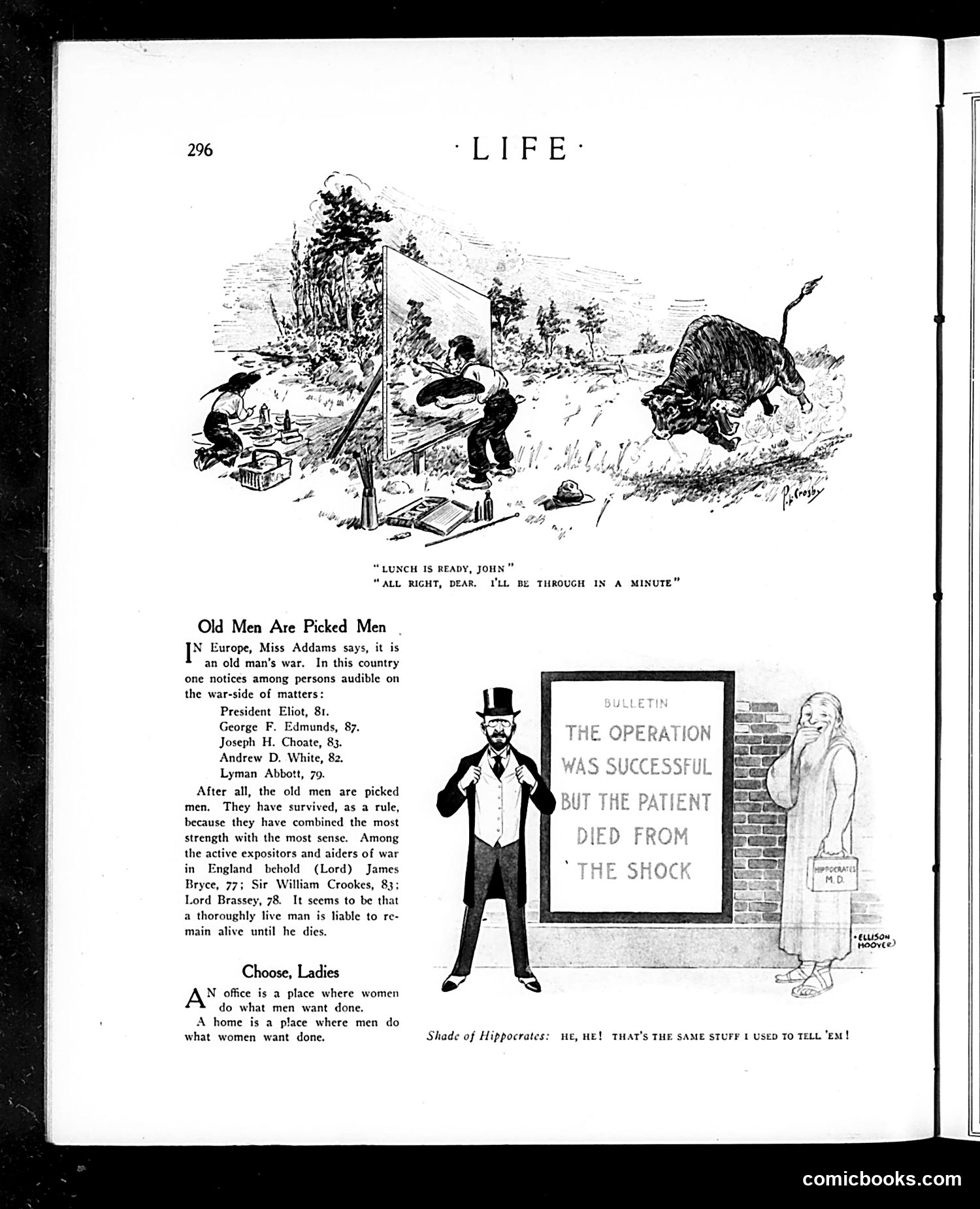
**Top Cartoon:** A domestic scene where a man promises his wife he'll finish fishing "in a minute" while a bear charges toward them—satirizing men's obliviousness to danger and priorities. **"Old Men Are Picked Men":** This article defends elderly war advocates (naming real figures like President Eliot, age 81, and British Lord Bryce, 77) against Jane Addams's critique that WWI is "an old man's war." The piece argues these aged men survived because they possessed strength *and* sense, therefore deserve credibility on war matters. The satire is subtle but present: the author defends the elderly's right to advocate war while younger men fight. **"Choose, Ladies":** A brief joke contrasting offices (where women serve men's wishes) with homes (where men serve women's wishes)—reflecting early 20th-century gender role anxieties. **Medical Cartoon:** Shows a doctor and ghost, with the caption mocking a failed surgery ("operation successful, patient died of shock")—a timeless dark joke about medical incompetence, attributed to Hippocrates ironically.
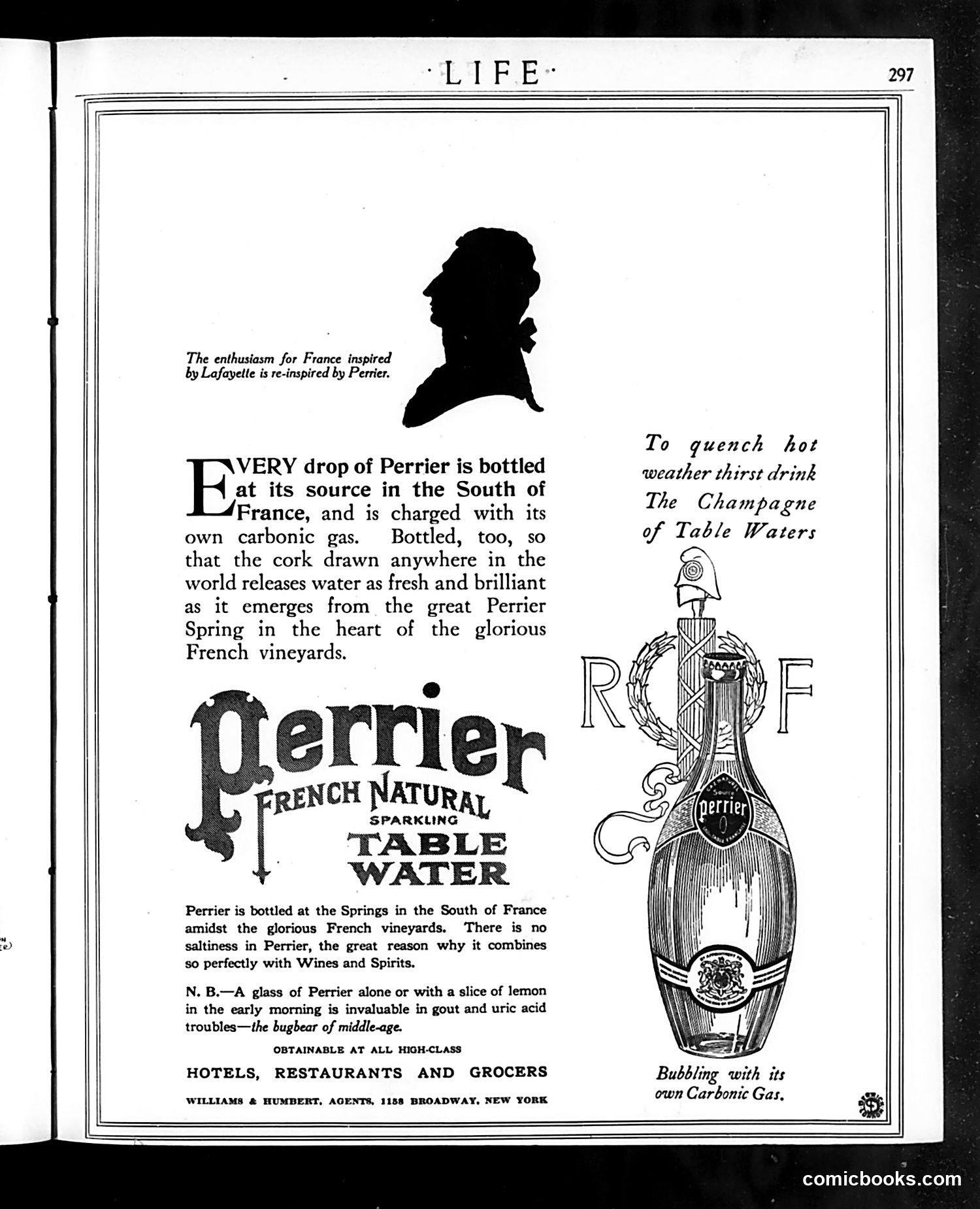
This is a **product advertisement**, not political satire. The page promotes Perrier sparkling water to American readers by invoking patriotic sentiment toward France. The silhouette appears to be **Lafayette**, the French Revolutionary War hero, referenced in the opening line to create positive associations with France. The advertisement cleverly equates enthusiasm for Lafayette with enthusiasm for Perrier—a humorous but straightforward marketing technique. The copy emphasizes Perrier's French origins ("South of France," "glorious French vineyards") and claims health benefits for "gout and uric acid troubles," common wealthy-man complaints of the era. The tagline "Champagne of Table Waters" positions it as premium. This reflects early-20th-century advertising strategies: using nationalism, historical prestige, health claims (however dubious), and class signaling to sell imported luxury goods to affluent American consumers.
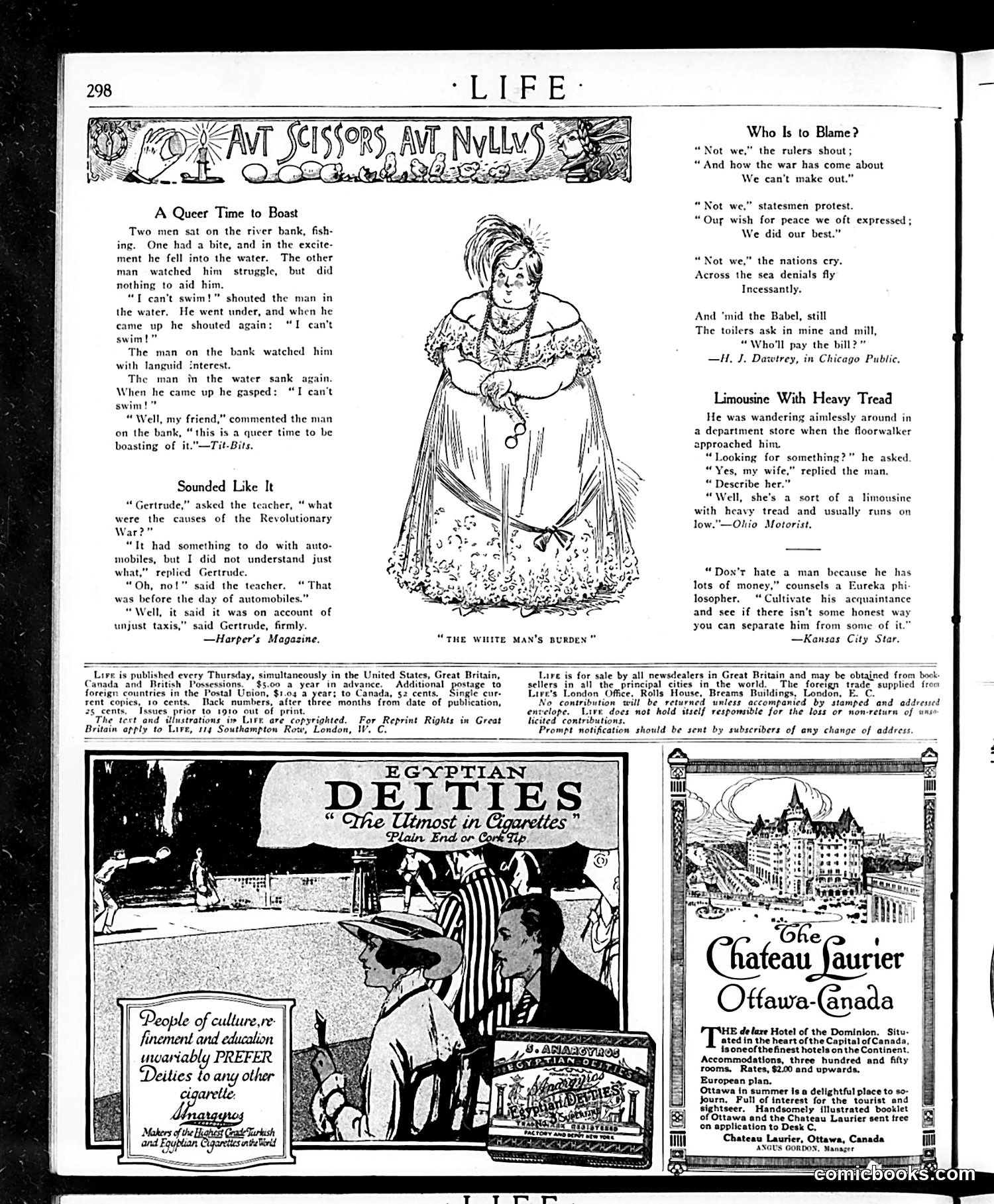
This page contains three distinct humor pieces and advertisements. **"A Queer Time to Boast"** and **"Sounded Like It"** are brief jokes: the first mocks someone announcing inability to swim while drowning; the second plays on a student mishearing "unjust taxes" as "unjust taxis" (automobiles being relatively new). **"Who Is to Blame?"** is post-WWI political satire. It depicts leaders and nations denying responsibility for the war's outbreak—rulers claim ignorance, statesmen claim they wanted peace, nations issue denials. The satirical punchline: common workers in mines and mills ask "Who'll pay the bill?"—highlighting how ordinary people bear financial costs while elites evade accountability. **"Limousine With Heavy Tread"** is automotive humor: a wife is humorously compared to a large, low-riding vehicle. The remaining content consists of magazine masthead information and advertisements for Egyptian Deities cigarettes and the Chateau Laurier hotel in Ottawa.
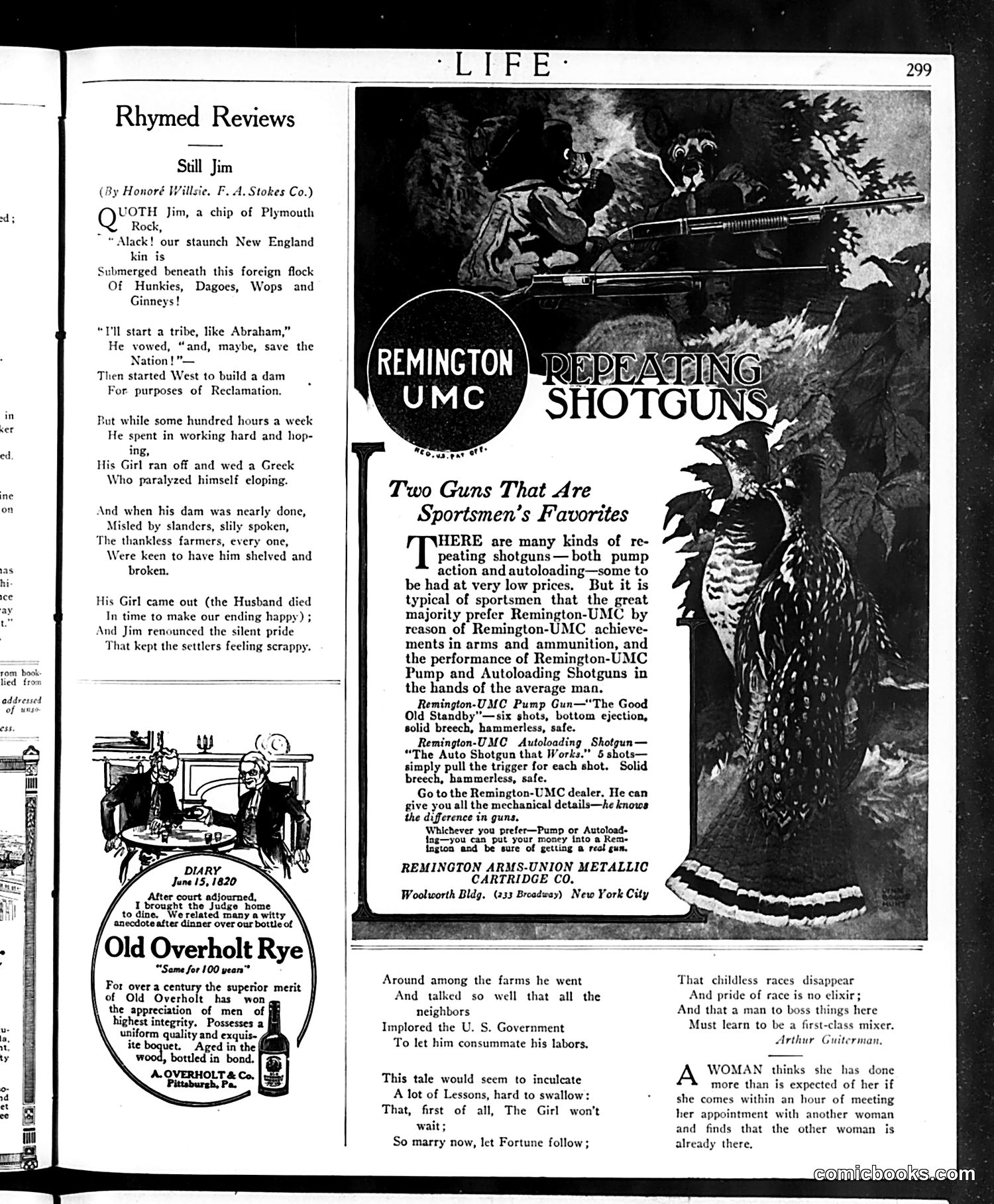
This page contains a book review in verse of "Still Jim" by Honoré Willsie, satirizing early 20th-century American anxieties about immigration and assimilation. **The Satire:** The poem mocks a New England protagonist who fears his heritage is being "submerged" by foreign immigrants ("Hunkies, Dagoes, Wops and Ginneys"—period slurs). Jim attempts to build a dam and establish a dynasty, but his plans collapse when his girlfriend elopes with a Greek man. The moral, delivered by columnist Arthur Guiterman, ridicules Jim's racial pride while celebrating practical assimilation: success requires being a "first-class mixer" rather than clinging to ethnic purity. **Modern Context:** The satire targets nativist anxieties of the era, using Jim's failed projects and romantic loss to undercut white Anglo-Saxon Protestant fears about demographic change. The poem advocates pragmatic integration over exclusionary nationalism—though from a perspective still steeped in ethnic stereotyping. The page also includes period advertisements for Remington shotguns and Old Overholt whiskey.
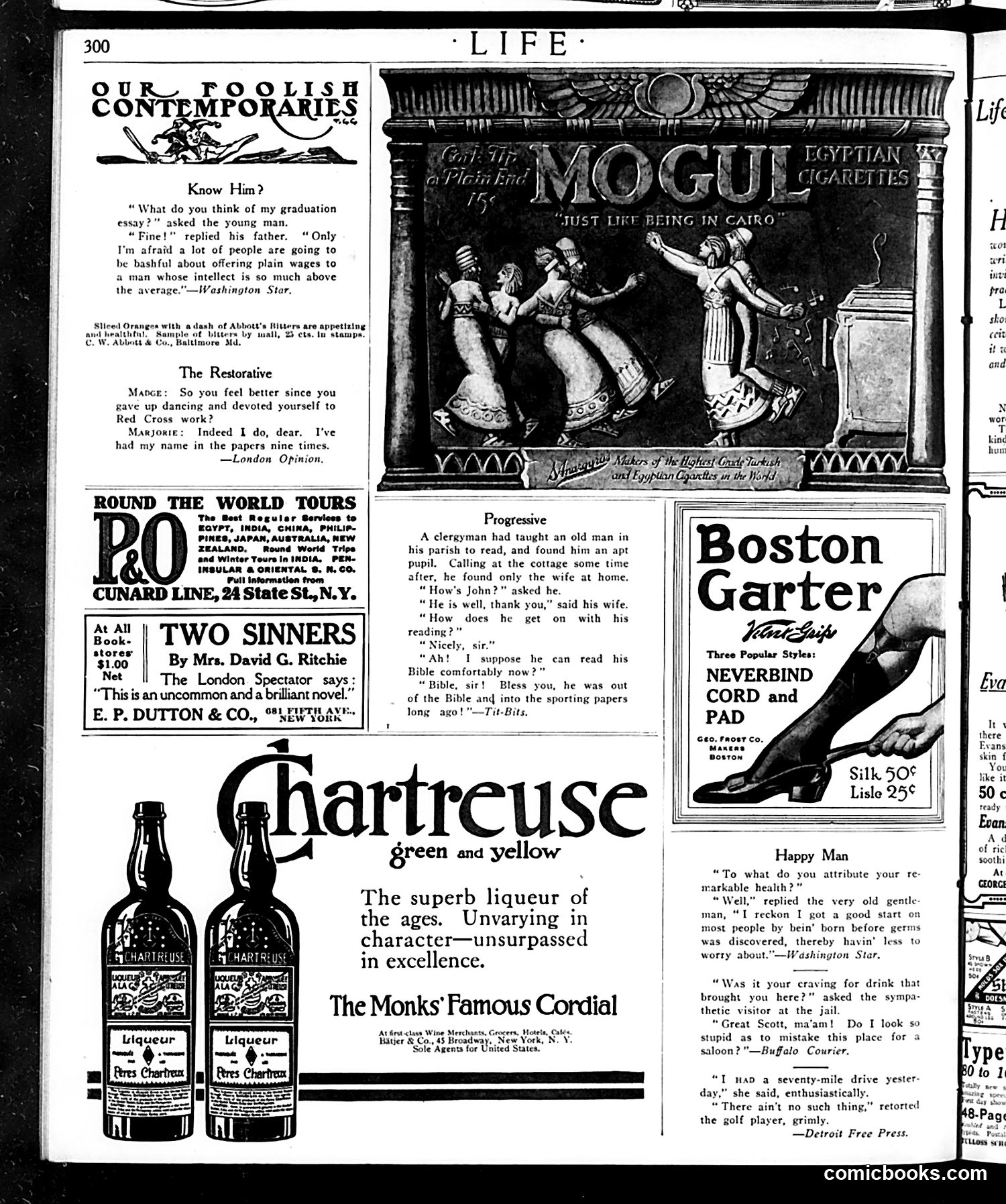
This is primarily a **humor and advertising page** from Life magazine (an early 20th-century satirical publication). The content consists of brief jokes rather than political cartoons. The humor pieces mock social pretensions and human nature: - A father warns his overqualified son that employers will be intimidated by his superior intellect - A woman brags about appearing in newspapers nine times through Red Cross work (vanity masquerading as charity) - An old man, taught to read by a clergyman, immediately abandons the Bible for sports papers (intellectual disappointment) - An elderly man credits his health to being born before "germs were discovered" (absurdist logic about modern anxieties) - A jail visitor mistakes a prisoner for someone seeking a saloon (dark humor about alcoholism) The large **Mogul Egyptian Cigarettes advertisement** dominates the upper center with Orientalist imagery typical of the era. Below are ads for liqueur, shoes, and book club offerings—standard period advertising. The satire targets class anxiety, social climbing, and the gap between aspirations and reality.
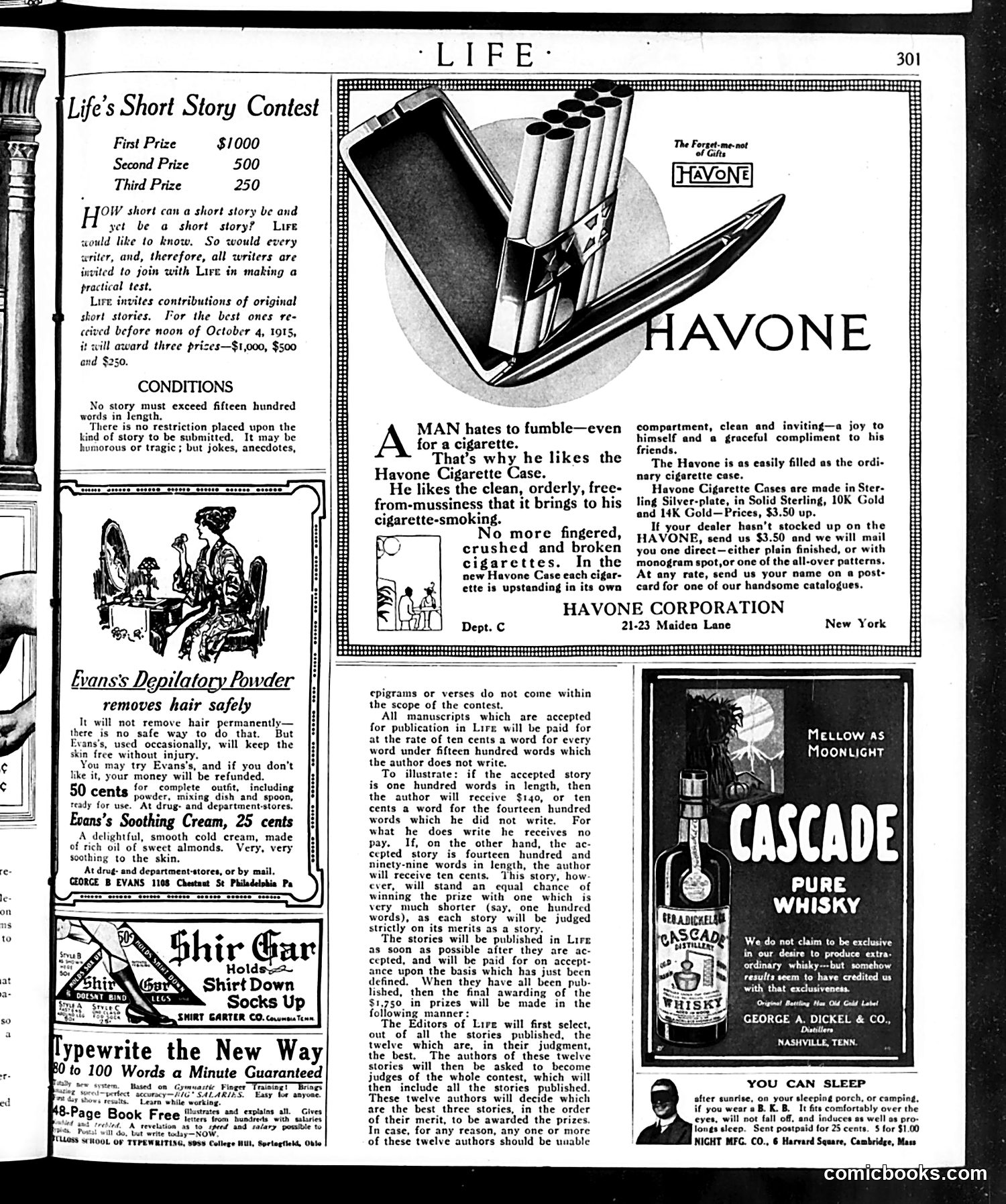
This page is primarily **advertising and contest announcements**, not political satire. The main content includes: **Life's Short Story Contest**: Life magazine invites writers to submit original stories under 1,500 words, offering prizes ($1,000, $500, $250). The contest rules feature satirical humor—notably, authors are paid ten cents per word they *don't* write. If a 100-word story is accepted, the author receives $1.40 for the 1,400 words omitted. This absurdist payment scheme mocks verbose writing and literary pretension. **Advertisements** dominate the page: Havone cigarette cases, Evans's depilatory powder, Cascade whisky, and typewriter courses. These are standard period advertisements with no political content. **No political cartoons** appear on this page. The small illustration accompanying the short story contest simply shows people in conversation, serving as filler decoration rather than satirical commentary.
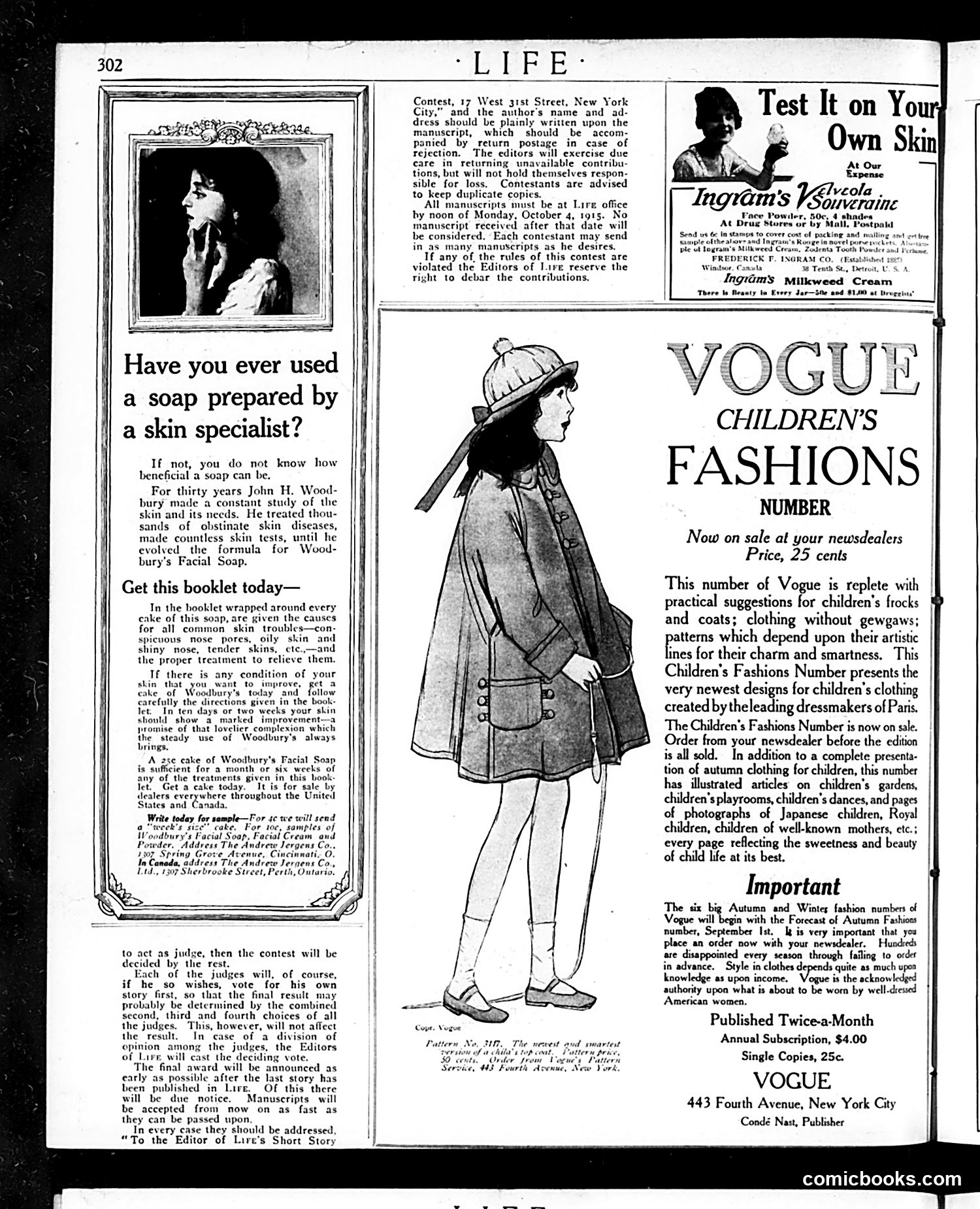
This page consists primarily of advertisements rather than political content or satire. The left side features an advertisement for Woodbury's Facial Soap, referencing Dr. John H. Woodbury, a real skin specialist who spent thirty years studying dermatology before creating his soap formula. The ad promises to cure common skin problems and offers a free booklet with treatment instructions. Above it appears an advertisement for Ingram's Milkweed Cream, another skincare product. The right side advertises Vogue's Children's Fashions issue, emphasizing practical children's clothing designs from Parisian dressmakers, including features on Japanese and Royal children's fashion. The top contains a literary contest announcement for Life magazine, inviting manuscript submissions by October 4, 1915. There is no political satire visible on this page—it is primarily commercial content typical of early 1900s magazine advertising.
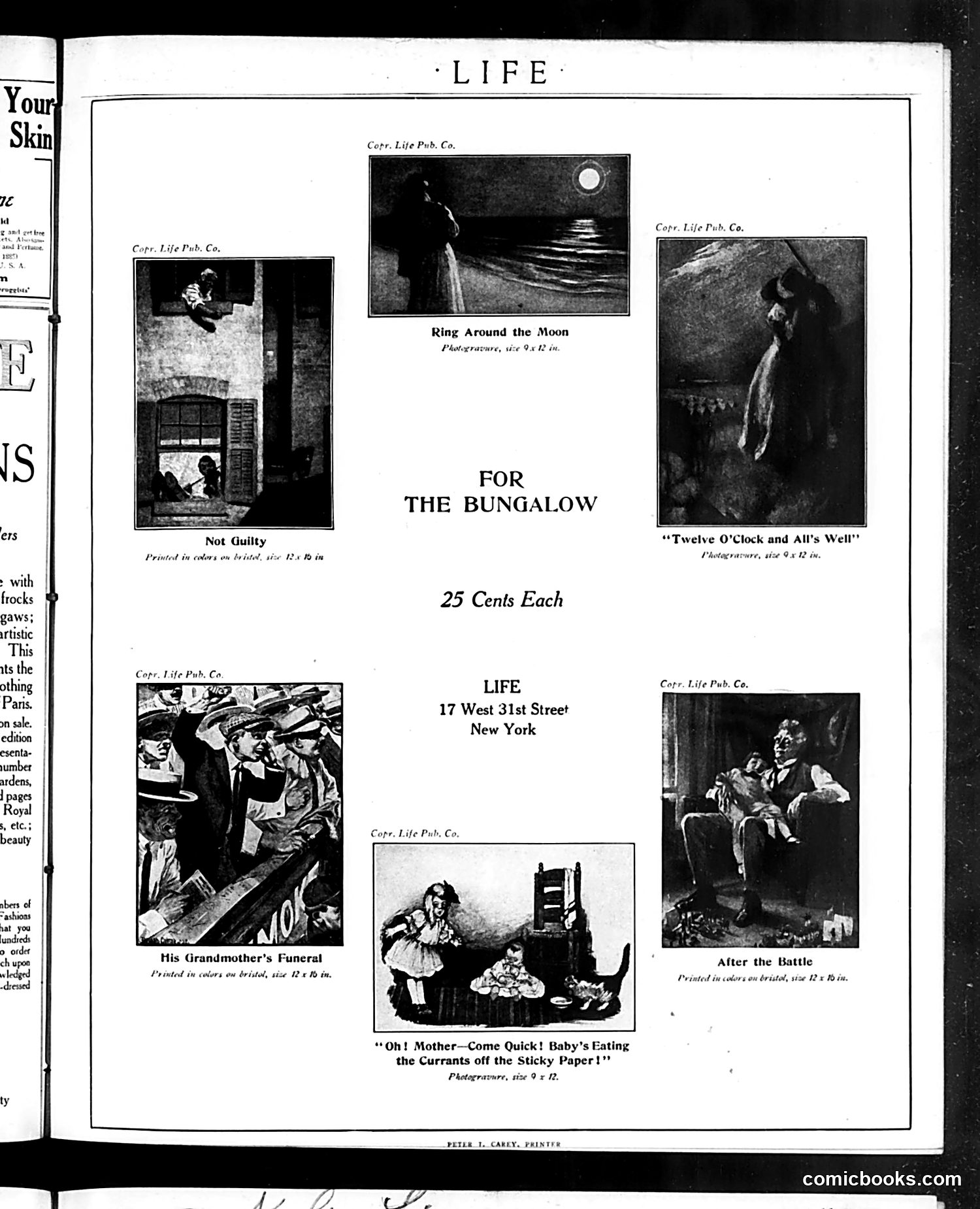
This is an **advertising page** for Life Publishing Company promoting five **art prints** available for home decoration ("For the Bungalow"), priced at 25 cents each. The prints appear to be sentimental and genre scenes typical of early 20th-century popular art: - **"Not Guilty"** and **"His Grandmother's Funeral"** depict domestic melodrama - **"Ring Around the Moon"** is a romantic nighttime scene - **"Twelve O'Clock and All's Well"** and **"After the Battle"** suggest narrative illustration - **"Oh! Mother—Come Quick!"** is comedic domestic humor about a child eating currants These were mass-produced photogravure and color-printed reproductions—affordable art for middle-class homes. The advertisement targets readers interested in affordable home decoration, reflecting early 1900s consumer culture where magazines sold both editorial content and related merchandise directly to subscribers.
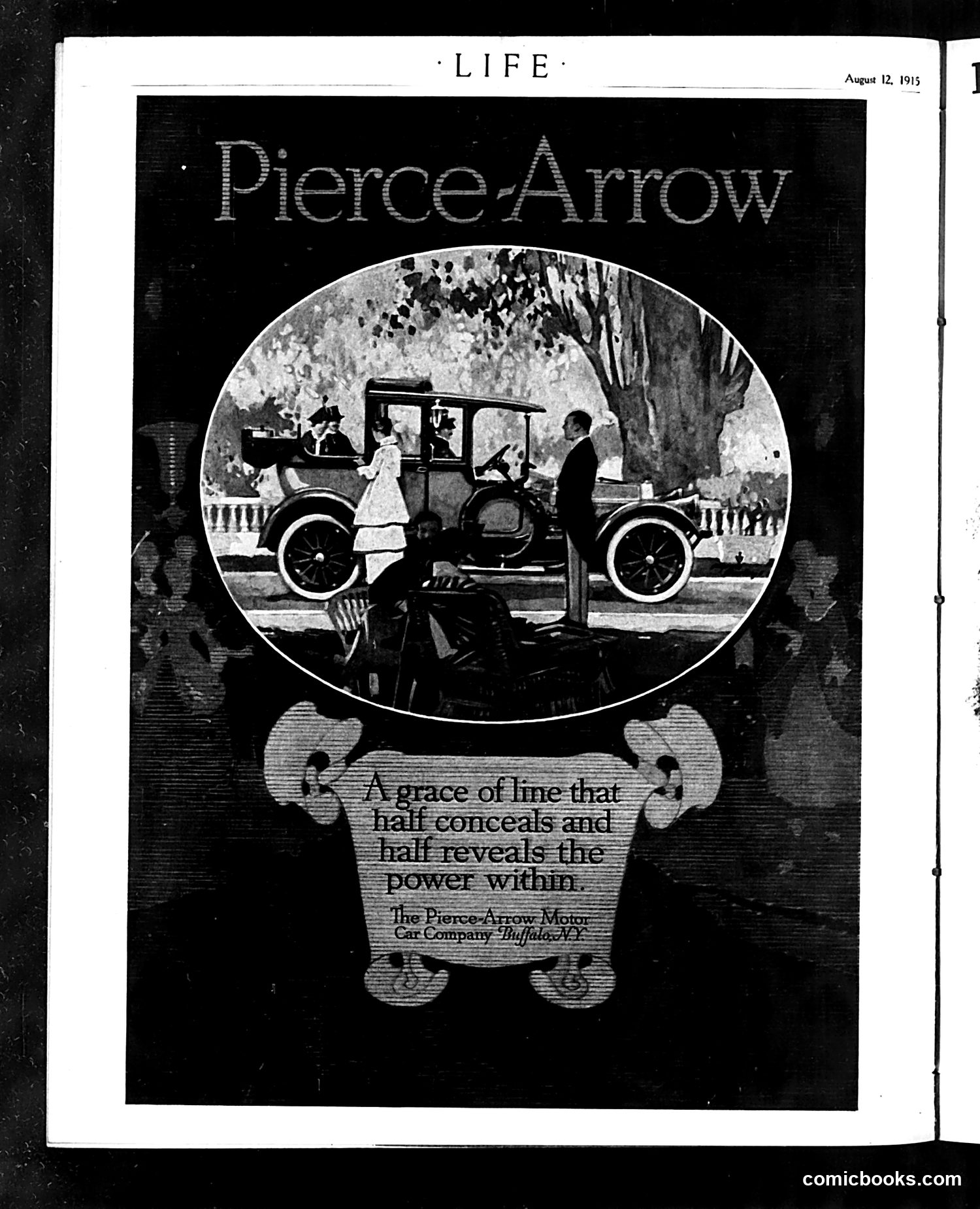
This is a full-page advertisement for the Pierce-Arrow Motor Car Company of Buffalo, New York, dated August 12, 1915. The ad features an elegant illustration of an early automobile with well-dressed passengers in a garden setting, framed in an oval. The tagline reads: "A grace of time that half conceals and half reveals the power within." This is not political satire but rather a luxury car advertisement emphasizing sophistication and hidden mechanical power. The refined artistic presentation and poetic language reflect early 20th-century marketing strategies targeting wealthy consumers. The design suggests elegance, modernity, and the promise of advanced engineering wrapped in graceful aesthetics—typical advertising rhetoric for high-end automobiles of the 1910s era.