
Life, 1915-08-12 · page 18 of 40
Life — August 12, 1915 — page 18: what you’re looking at
What you’re looking at
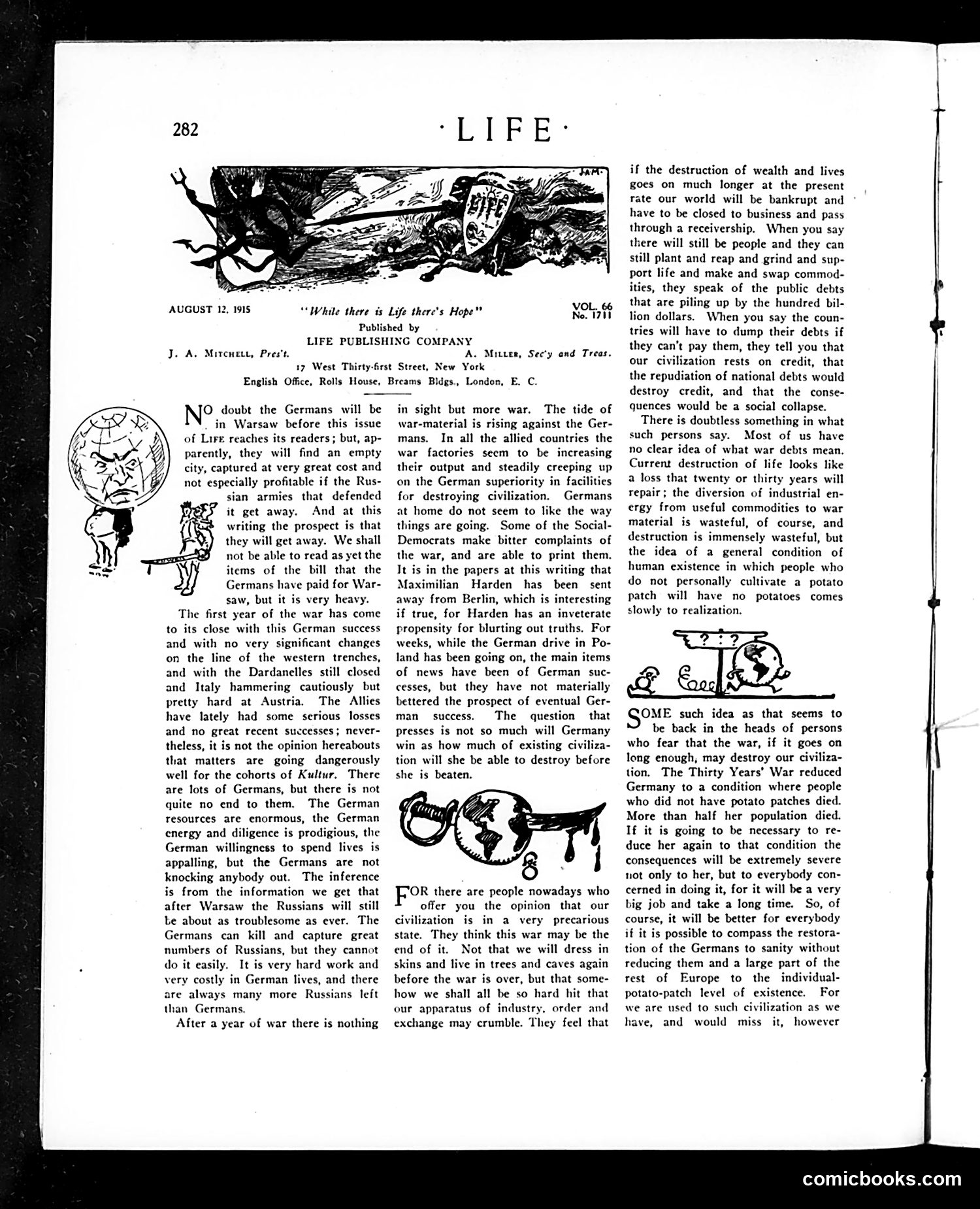
This editorial page discusses the first year of World War I, focusing on Germany's capture of Warsaw. The author argues that despite German military successes, their overall position remains unsustainable: they're inflicting massive casualties but can't decisively defeat Russia, while Allied war production is increasing. The satirical point centers on contemporary anxieties about civilization's collapse. The page mocks pessimists who fear the war will destroy Western civilization entirely—reducing society to subsistence living. The author counters this by distinguishing between potential financial bankruptcy (massive public debt) and actual civilizational collapse. The cartoons (appearing as decorative elements) appear to be generic wartime illustrations rather than specific political caricatures. The editorial's real target is defeatist thinking, arguing that while the war's costs are severe, civilization will survive—though reconstruction will be difficult and take considerable time.
📄 Transcribed text from this page (OCR, searchable)
Machine-transcribed from the original scan — historical spelling and the odd misread are preserved.
AUGUST 12, 1915 “While there is Life there's Hope" No. 1711 Published by LIFE PUBLISHING COMPANY J. A. Mirentet, Pres’t, A. Mutter, Sec’y and Treas. 17 West Thirty-first Street, New York English Office, Rolls House, Breams Bldgs, London, E. C. N° doubt the Germans will be in Warsaw before this issue of Lire reaches its readers; but, ap- parently, they will find an empty city, captured at very great cost and not especially profitable if the Rus- sian armies that defended it get away. And at this {i writing the prospect is that ) they will get away. We shall not be able to read as yet the yy items of the bill that the Germans have paid for War- saw, but it is very heavy. The first year of the war has come to its close with this German success and with no very significant changes on the line of the western trenches, and with the Dardanelles still closed and Italy hammering cautiously but pretty hard at Austria. The Allies have lately had some serious losses and no great recent successes; never- theless, it is not the opinion hereabouts that matters are going dangerously well for the cohorts of Kultur. There are lots of Germans, but there is not quite no end to them. The German resources are enormous, the German energy and diligence is prodigious, the German willingness to spend lives is appalling, but the Germans are not knocking anybody out. The inference is from the information we get that after Warsaw the Russians will still be about as troublesome as ever. The Germans can kill and capture great numbers of Russians, but they cannot do it easily. It is very hard work and very costly in German lives, and there are always many more Russians left than Germans. After a year of war there is nothing in sight but more war. The tide of war-material is rising against the Ger- mans. In all the allied countries the war factories seem to be increasing their output and steadily creeping up on the German superiority in facilities for destroying civilization. Germans at home do not seem to like the way things are going. Some of the Social- Democrats make bitter complaints of the war, and are able to print them, It is in the papers at this writing that Maximilian Harden has been sent away from Berlin, which is interesting if true, for Harden has an inveterate propensity for blurting out truths. For weeks, while the German drive in Po- land has been going on, the main items of news have been of German suc- cesses, but they have not materially bettered the prospect of eventual Ger- man success. The question that presses is not so much will Germany win as how much of existing civiliza- tion will she be able to destroy before she is beaten. For there are people nowadays who offer you the opinion that our civilization is in a very precarious state. They think this war may be the end of it. Not that we will dress in skins and live in trees and caves again before the war is over, but that some- how we shall all be so hard hit that our apparatus of industry, order and exchange may crumble. They feel that if the destruction of wealth and lives goes on much longer at the present rate our world will be bankrupt and have to be closed to business and pass through a receivership. When you say there will still be people and they can still plant and reap and grind and sup- port life and make and swap commod- ities, they speak of the public debts that are piling up by the hundred bil- lion dollars. When you say the coun- tries will have to dump their debts if they can’t pay them, they tell you that our civilization rests on credit, that the repudiation of national debts would destroy credit, and that the conse- quences would be a social collapse. There is doubtless something in what such persons say. Most of us have no clear idea of what war debts mean. Current destruction of life looks like a loss that twenty or thirty years will repair; the diversion of industrial en- ergy from useful commodities to war material is wasteful, of course, and destruction is immensely wasteful, but the idea of a general condition of human existence in which people who do not personally cultivate a potato patch will have no potatoes comes slowly to realization. @ cs Some such idea as that seems to be back in the heads of persons who fear that the war, if it goes on long enough, may destroy our civiliza- tion, The Thirty Years’ War reduced Germany to a condition where people who did not have potato patches died. More than half her population died. If it is going to be necessary to re- duce her again to that condition the consequences will be extremely severe not only to her, but to everybody con- cerned in doing it, for it will be a very big job and take a long time. So, of course, it will be better for everybody if it is possible to compass the restora- tion of the Germans to sanity without reducing them and a large part of the rest of Europe to the individual- potato-patch level of existence. For we are used to such civilization as we have, and would miss it, however comicbooks.com