
Life, 1915-08-12 · page 10 of 40
Life — August 12, 1915 — page 10: what you’re looking at
What you’re looking at
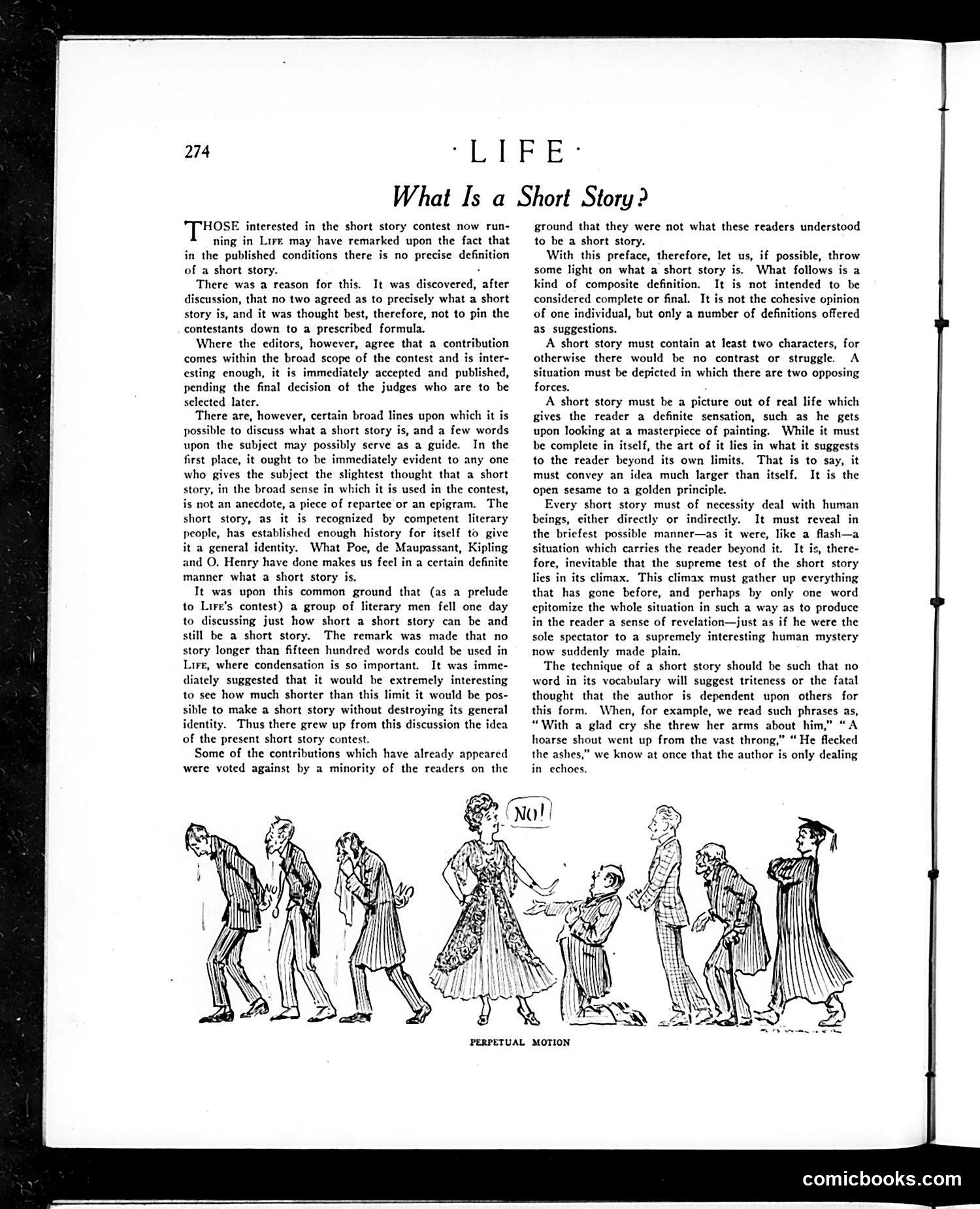
This page is primarily **editorial content**, not satire or political cartoon. It's an instructional essay defining what constitutes a short story for readers interested in Life magazine's short story contest. The sole illustration at the bottom, titled "PERPETUAL MOTION," appears to be a **humorous social commentary** showing a line of figures in various poses of argument or animated discussion, with one figure saying "NO!" The cartoon likely satirizes endless, circular debate or disagreement—possibly commenting on how definitions and standards (like those discussed in the essay above) spark perpetual disagreement among people. The illustration uses caricature and exaggerated body language to convey the absurdity of never-ending conflict.
📄 Transcribed text from this page (OCR, searchable)
Machine-transcribed from the original scan — historical spelling and the odd misread are preserved.
“LIFE- What Is a Short Story? HOSE interested in the short story contest now run- ning in Lire may have remarked upon the fact that in the published conditions there is no precise definition of a short story. . There was a reason for this. It was discovered, after discussion, that no two agreed as to precisely what a short story is, and it was thought best, therefore, not to pin the contestants down to a prescribed formula. Where the editors, however, agree that a contribution comes within the broad scope of the contest and is inter- esting enough, it is immediately accepted and published, pending the final decision of the judges who are to be selected later. There are, however, certain broad lines upon which it is possible to discuss what a short story is, and a few words upon the subject may possibly serve as a guide. In the first place, it ought to be immediately evident to any one who gives the subject the slightest thought that a short story, in the broad sense in which it is used in the contest, is not an anecdote, a piece of repartee or an epigram. The short story, as it is recognized by competent literary people, has established enough history for itself to give it a general identity. What Poe, de Maupassant, Kipling and O. Henry have done makes us feel in a certain definite manner what a short story is. It was upon this common ground that (as a prelude to Lire’s contest) a group of literary men fell one day to discussing just how short a short story can be and still be a short story. The remark was made that no story longer than fifteen hundred words could be used in Lire, where condensation is so important. It was imme- diately suggested that it would be extremely interesting to see how much shorter than this limit it would be pos- sible to make a short story without destroying its general identity. Thus there grew up from this discussion the idea of the present short story contest. Some of the contributions which have already appeared. were voted against by a minority of the readers on the ground that they were not what these readers understood to be a short story. With this preface, therefore, let us, if possible, throw some light on what a short story is. What follows is a kind of composite definition. It is not intended to be considered complete or final. It is not the cohesive opinion of one individual, but only a number of definitions offered as suggestions. A short story must contain at least two characters, for otherwise there would be no contrast or struggle. A situation must be depicted in which there are two opposing forces. A short story must be a picture out of real life which gives the reader a definite sensation, such as he gets upon looking at a masterpiece of painting. While it must be complete in itself, the art of it lies in what it suggests to the reader beyond its own limits. That is to say, it must convey an idea much larger than itself. It is the open sesame to a golden principle. Every short story must of necessity deal with human beings, either directly or indirectly. It must reveal in the briefest possible manner—as it were, like a flash—a situation which carries the reader beyond it. It is, there- fore, inevitable that the supreme test of the short story lies in its climax. This climax must gather up everything that has gone before, and perhaps by only one word epitomize the whole situation in such a way as to produce in the reader a sense of revelation—just as if he were the sole spectator to a supremely interesting human mystery now suddenly made plain. The technique of a short story should be such that no word in its vocabulary will suggest triteness or the fatal thought that the author is dependent upon others for this form. When, for example, we read such phrases as, “With a glad cry she threw her arms about him,” “A hoarse shout went up from the vast throng,” “ He flecked the ashes,” we know at once that the author is only dealing in echoes. PERPETUAL MOTION comicbooks.com