
Life, 1915-08-12 · page 22 of 40
Life — August 12, 1915 — page 22: what you’re looking at
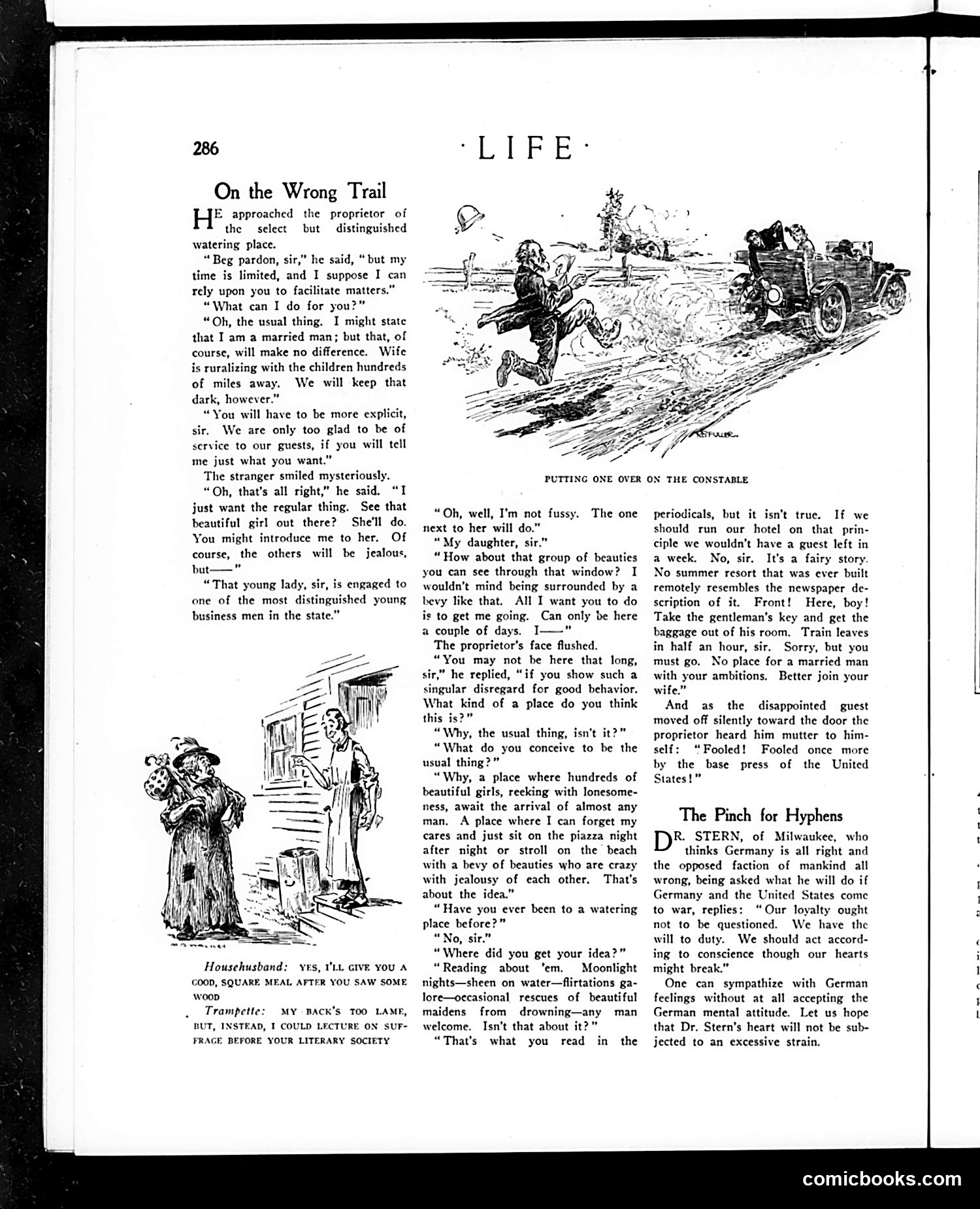
What you’re looking at
This satirical story mocks popular literary and journalistic depictions of American resort hotels. A married man arrives expecting the classic romance-novel fantasy: beautiful, lonely women waiting to flirt with male guests, moonlit beach scenes, and dramatic rescues. The proprietor deflates these illusions, revealing the gap between sensational newspaper and magazine accounts and reality. Resort hotels, he explains, would lose all guests if they operated as depicted in popular fiction. He ejects the man for his inappropriate behavior. The final joke—the guest blaming "the base press of the United States"—criticizes how periodicals romanticize and misrepresent ordinary places, creating false expectations. The satire targets both gullible readers who believe sensationalized accounts and the publications that publish them, suggesting the press bears responsibility for deceiving the public about reality.
📄 Transcribed text from this page (OCR, searchable)
Machine-transcribed from the original scan — historical spelling and the odd misread are preserved.
286 On the Wrong Trail E approached the proprietor of the select but distinguished watering place. “ Beg pardon, sir,” he said, “but my time is limited, and I suppose I can rely upon you to facilitate matters.” “What can I do for you?” “Oh, the usual thing. I might state that I am a married man; but that, of course, will make no difference. Wife is ruralizing with the children hundreds of miles away. We will keep that dark, however.” “You will have to be more explicit, sir. We are only too glad to be of service to our guests, if you will tell me just what you want.” The stranger smiled mysteriously. “Oh, that’s all right,” he said. “I just want the regular thing. See that beautiful girl out there? She'll do. You might introduce me to her. Of the others will be jealous, course, but—— “That young lady, sir, is engaged to one of the most distinguished young business men in the state.” Househusband: yes, 1'Lt. Give You A OOD, SQUARE MEAL AFTER YOU SAW SOME woop Trampette: MY BACK’S TOO LAME, BUT, INSTEAD, I COULD LECTURE ON SUF- FRAGE BEFORE YOUR LITERARY SOCIETY PUTTING ONE OVER ON THE CONSTABLE “Oh, well, I’m not fussy. The one next to her will do.” “My daughter, sir.” “How about that group of beauties you can see through that window? I wouldn’t mind being surrounded by a bevy like that. All I want you to do is to get me going. Can only be here a couple of days. . The proprietor’s face flushed. “You may not be here that long, sir,” he replied, “if you show such a singular disregard for good behavior. What kind of a place do you think this is?” “Why, the usual thing, isn’t it?” “What do you conceive to be the usual thing?” “Why, a place where hundreds of beautiful girls, reeking with lonesome- ness, await the arrival of almost any man. A place where I can forget my cares and just sit on the piazza night after night or stroll on the beach with a bevy of beauties who are crazy with jealousy of each other, That's about the idea.” “Have you ever been to a watering place before?” “No, sir.” “Where did you get your idea?” “Reading about ‘em. Moonlight nights—sheen on water—flirtations ga- lore—oecasional rescues of beautiful maidens from drowning—any man welcome. Isn't that about it?” “That's what you read in 5 the periodicals, but it isn't true. If we should run our hotel on that prin- ciple we wouldn't have a guest left in a week. No, sir. It's a fairy story. No summer resort that was ever built remotely resembles the newspaper de- scription of it. Front! Here, boy! Take the gentleman's key and get the baggage out of his room. Train leaves in half an hour, sir. Sorry, but you must go, No place for a married man with your ambitions. Better join your wife.” And as the disappointed guest moved off silently toward the door the proprietor heard him mutter to him- self: “Fooled! Fooled once more by the base press of the United States!” The Pinch for Hyphens R. STERN, of Milwaukee, who thinks Germany is all right and the opposed faction of mankind all wrong, being asked what he will do if Germany and the United States come to war, replies: “Our loyalty ought not to be questioned. We have the will to duty. We should act accord- ing to conscience though our hearts might break.” One can sympathize with German feelings without at all accepting the German mental attitude. Let us hope that Dr. Stern’s heart will not be sub- jected to an excessive strain. comicbooks.com