
Life, 1915-08-12 · page 14 of 40
Life — August 12, 1915 — page 14: what you’re looking at
What you’re looking at
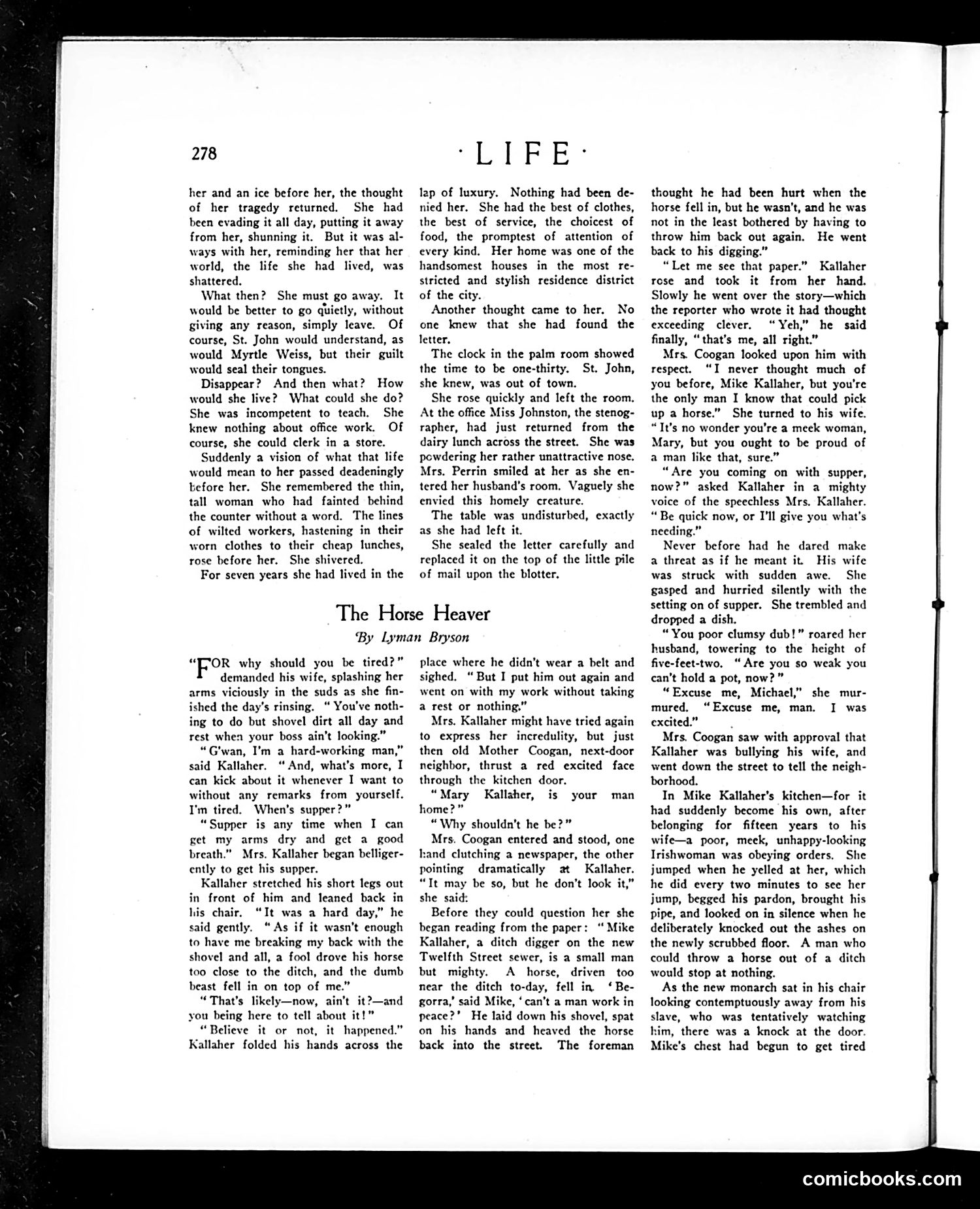
This page contains a short story titled "The Horse Heaver" by Brander Paterson. The narrative depicts a domestic dispute between Mike Kallsher and his wife over his work-related exhaustion. When his wife complains about his tiredness, Kallsher becomes defensive, insisting he needs rest without explanation. The story involves a neighbor, Mrs. Coogan, who mentions that Kallsher is "a ditch digger on the new Twelfth Street sewer"—apparently a source of embarrassment. When a horse falls into the ditch during work, Kallsher heroically saves it by hauling it back to the street, earning local admiration. The satire contrasts Kallsher's humble, backbreaking labor with his dignified response to being questioned about his work, suggesting themes about working-class pride and the dignity found in manual labor, however unglamorous.
📄 Transcribed text from this page (OCR, searchable)
Machine-transcribed from the original scan — historical spelling and the odd misread are preserved.
278 her and an ice before her, the thought of her tragedy returned. She had been evading it all day, putting it away from her, shunning it. But it was al- ways with her, reminding her that her world, the life she had lived, was shattered, What then? She must go away. It would be better to go quietly, without giving any reason, simply leave. Of course, St. John would understand, as would Myrtle Weiss, but their guilt would seal their tongues. Disappear? And then what? How would she live? What could she do? She was incompetent to teach. She knew nothing about office work. Of course, she could clerk in a store. Suddenly a vision of what that life would mean to her passed deadeningly before her. She remembered the thin, tall woman who had fainted behind the counter without a word. The lines of wilted workers, hastening in their worn clothes to their cheap lunches, rose before her. She shivered. For seven years she had lived in the ‘LIFE * lap of luxury. Nothing had been de- nied her, She had the best of clothes, the best of service, the choicest of food, the promptest of attention of every kind. Her home was one of the handsomest houses in the most re- stricted and stylish residence district of the city. Another thought came to her. No one knew that she had found the letter, The clock in the palm room showed the time to be one-thirty. St. John, she knew, was out of town. She rose quickly and left the room, At the office Miss Johnston, the stenog- rapher, had just returned from the dairy lunch across the street. She was powdering her rather unattractive nose. Mrs. Perrin smiled at her as she en- tered her husband's room. Vaguely she envied this homely creature. The table was undisturbed, exactly as she had left it. She sealed the letter carefully and replaced it on the top of the little pile of mail upon the blotter. The Horse Heaver ‘By Lyman Bryson “FoR why should you be tired?” demanded his wife, splashing her arms viciously in the suds as she fin- ished the day’s rinsing. “ You've noth- ing to do but shovel dirt all day and rest when your boss ain’t looking.” “G'wan, I’m a hard-working man,” said Kallaher. “And, what's more, I can kick about it whenever I want to without any remarks from yourself. I'm tired. When’s supper?” “Supper is any time when I can get my arms dry and get a good breath.” Mrs. Kallaher began belliger- ently to get his supper. Kallaher stretched his short legs out in front of him and leaned back in his chair, “It was a hard day,” he said gently. “As if it wasn’t enough to have me breaking my back with the shovel and all, a fool drove his horse too close to the ditch, and the dumb beast fell in on top of me.” “That's likely—now, ain't it?—and you being here to tell about it!” “Believe it or not, it happened.” Kallaher folded his hands across the place where he didn’t wear a belt and sighed, “But I put him out again and went on with my work without taking a rest or nothing.” Mrs. Kallaher might have tried again to express her incredulity, but just then old Mother Coogan, next-door neighbor, thrust a red excited face through the kitchen door. “Mary Kallaher, is home?” “Why shouldn't he be?” Mrs. Coogan entered and stood, one Land clutching a newspaper, the other pointing dramatically at Kallaher. “Tt may be so, but he don’t look it,” she said: Before they could question her she began reading from the paper: “ Mike Kallaher, a ditch digger on the new Twelfth Street sewer, is a small man but mighty. A horse, driven too near the ditch to-day, fell in. ‘Be- gorra,’ said Mike, ‘can’t a man work in peace?’ He laid down his shovel, spat on his hands and heaved the horse back into the street. The foreman your man thought he had been hurt when the horse fell in, but he wasn't, and he was not in the least bothered by having to throw him back out again. He went back to his digging.” “Let me see that paper.” Kallaher rose and took it from her hand. Slowly he went over the story—which the reporter who wrote it had thought exceeding clever. “Yeh,” he said finally, “that’s me, all right.” Mrs. Coogan looked upon him with respect. “I never thought much of you before, Mike Kallaher, but you're the only man I know that could pick up a horse.” She turned to his wife. “It's no wonder you're a meek woman, Mary, but you ought to be proud of a man like that, sure.” “Are you coming on with supper, now?” asked Kallaher in a mighty voice of the speechless Mrs. Kallaher. “Be quick now, or I'll give you what's needing.” Never before had he dared make a threat as if he meant it. His wife was struck with sudden awe. She gasped and hurried silently with the setting on of supper. She trembled and dropped a dish, “You poor clumsy dub!” roared her husband, towering to the height of five-feet-two. “Are you so weak you can’t hold a pot, now?” “Excuse me, Michael,” she mur- mured, “Excuse me, man. I was excited.” ‘ Mrs. Coogan saw with approval that Kallaher was bullying his wife, and went down the street to tell the neigh- borhood. In Mike Kallaher’s kitchen—for it had suddenly become his own, after belonging for fifteen years to his wife—a poor, meek, unhappy-looking Irishwoman was obeying orders, She jumped when he yelled at her, which he did every two minutes to see her jump, begged his pardon, brought his pipe, and looked on in silence when he deliberately knocked out the ashes on the newly scrubbed floor. A man who could throw a horse out of a ditch would stop at nothing. As the new monarch sat in his chair looking contemptuously away from his slave, who was tentatively watching him, there was a knock at the door. Mike’s chest had begun to get tired comicbooks.com