
Life, 1915-08-12 · page 30 of 40
Life — August 12, 1915 — page 30: what you’re looking at
What you’re looking at
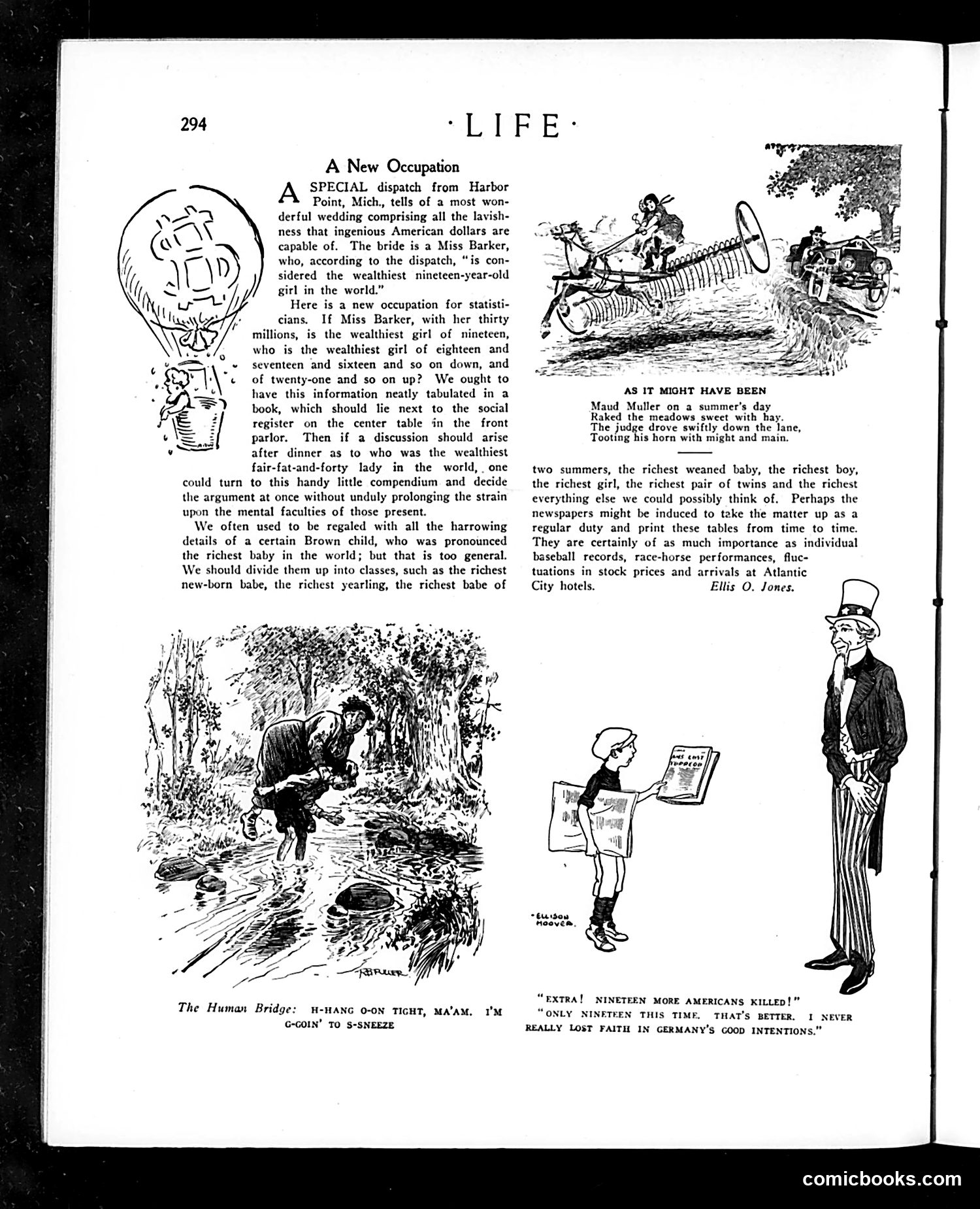
**"A New Occupation"** mocks wealthy American society's obsession with wealth rankings. The article proposes creating a detailed statistical compendium cataloging the richest people by age and gender — treating wealth like baseball statistics or stock prices. The satire suggests this reflects how American society prioritizes money above all else, treating financial status as legitimate news worthy of systematic tracking. **"The Human Bridge"** cartoon depicts a person clinging to another during a sneeze — social commentary on manners and physical indignity in close quarters. **"As It Might Have Been"** references John Greenleaf Whittier's 1856 poem "Maud Muller," reimagined here with a judge arriving by automobile, suggesting modernization of classic American literature. **The right cartoon** appears to reference World War I casualty reporting — the character's cynical comment about Germany killing "only nineteen" Americans this time (rather than more) satirizes either wartime propaganda or desensitization to mounting death tolls.
📄 Transcribed text from this page (OCR, searchable)
Machine-transcribed from the original scan — historical spelling and the odd misread are preserved.
A New Occupation SPECIAL dispatch from Harbor Point, Mich., tells of a most won- derful wedding comprising all the lavish- ness that ingenious American dollars are capable of. The bride is a Miss Barker, who, according to the dispatch, “is con- sidered the wealthiest nineteen-year-old girl in the world.” Here is a new occupation for statisti- cians. If Miss Barker, with her thirty millions, is the wealthiest girl of nineteen, who is the wealthiest girl of eighteen and seventeen and sixteen and so on down, and of twenty-one and so on up? We ought to have this information neatly tabulated in a book, which should lie next to the social register on the center table in the front parlor. Then if a discussion should arise after dinner as to who was the wealthiest fair-fat-and-forty lady in the world, one could turn to this handy little compendium and decide the argument at once without unduly prolonging the strain upon the mental faculties of those present. We often used to be regaled with all the harrowing details of a certain Brown child, who was pronounced the richest baby in the world; but that is too general. We should ide them up into classes, such as the richest new-born babe, the richest yearling, the richest babe of The Human Bridge: -HANG 0-0N TIGHT, MA’AM. I'M G-GOIN’ TO S-SNEEZE AS IT MIGHT HAVE BEEN Maud Muller on a summer's day Raked the meadows sweet with hay. The judge drove swiftly down the lane, Tooting his horn with might and main. two summers, the richest weaned baby, the richest boy, the richest girl, the richest pair of twins and the richest everything else we could possibly think of. Perhaps the newspapers might be induced to take the matter up as a regular duty and print these tables from time to time. They are certainly of as much importance as individual baseball records, race-horse performances, fluc- tuations in stock prices and arrivals at Atlantic City hotels. Ellis O. Jones. Hooves, “EXTRA! NINETEEN MORE AMERICANS KILLED!” “ONLY NINETEEN THIS TIME, THAT'S BETTER, I NE REALLY LOST FAITH IN GERMANY'S GOOD INTENTIONS.” comicbooks.com