
Life, 1915-08-12 · page 13 of 40
Life — August 12, 1915 — page 13: what you’re looking at
What you’re looking at
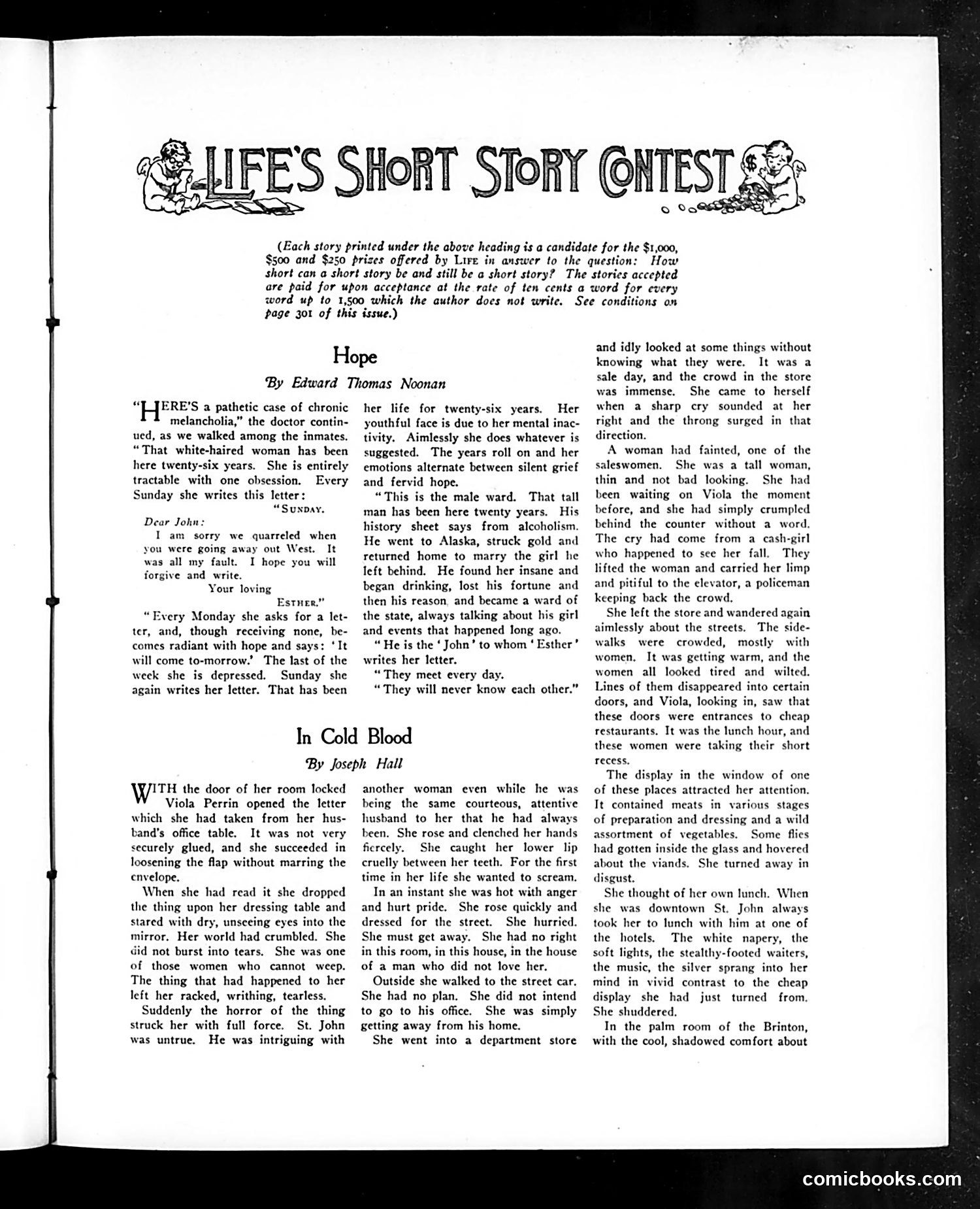
This page contains **no political cartoons**. Instead, it presents **Life's Short Story Contest**, offering monetary prizes ($1,000, $500, $250) for submitted short fiction. The page displays two contest entries: 1. **"Hope"** by Edward Thomas Noonan — about a woman with chronic melancholia in a mental ward, written to a patient named John through letters from his mother "Esther." 2. **"In Cold Blood"** by Joseph Hall — depicting a woman (Wisha Peris) who discovers her husband's infidelity and leaves him, wandering into a department store. Both appear to be serialized fiction entries competing for the contest prize. This is a **literary feature**, not political satire or editorial cartooning.
📄 Transcribed text from this page (OCR, searchable)
Machine-transcribed from the original scan — historical spelling and the odd misread are preserved.
ee E'S SHORT STORY @NTEST, eS (Each story printed under the above heading is a candidate for the $1,000, $500 and $250 prizes offered by Lire in answer to the question: How short can a short story be and still be a short story? The stories accepted are paid for upon acceptance at the rate of ten cents a word for every word up to 1,500 which the author does not write. page 301 of this issue.) Hope ‘By Edward Thomas Noonan “LIJERE'S a pathetic case of chronic melancholia,” the doctor contin- ued, as we walked among the inmates. “That white-haired woman has been here twenty-six years. She is entirely tractable with one obsession. Every Sunday she writes this letter: “Sunpay. Dear John: I am sorry we quarreled when you were going away out West. It was all my fault. I hope you will forgive and write. Your loving Estner.” “Every Monday she asks for a let- ter, and, though receiving none, be- comes radiant with hope and says: ‘It will come to-morrow.’ The last of the week she is depressed. Sunday she again writes her letter. That has been her life for twenty-six years. Her youthful face is due to her mental inac- tivity. Aimlessly she does whatever is suggested. The years roll on and her emotions alternate between silent grief and fervid hope. “This is the male ward. That tall man has been here twenty years. His history sheet says from alcoholism. He went to Alaska, struck gold and returned home to marry the girl he left behind. He found her insane and began drinking, lost his fortune and then his reason, and became a ward of the state, always talking about his girl and events that happened long ago. “He is the ‘John’ to whom ‘ Esther’ writes her letter. “They meet every day. “They will never know cach other.” In Cold Blood By Joseph Hall ITH the door of her room locked Viola Perrin opened the letter which she had taken from her hus- band’s office table. It was not very securely glued, and she succeeded in loosening the flap without marring the envelope. When she had read it she dropped the thing upon her dressing table and stared with dry, unseeing eyes into the mirror. Her world had crumbled. She did not burst into tears. She was one of those women who cannot weep. The thing that had happened to her left her racked, writhing, tearless. Suddenly the horror of the thing struck her with full force. St. John was untrue. He was intriguing with another woman even while he was being the same courteous, attentive husband to her that he had always been. She rose and clenched her hands fiercely. She caught her lower lip cruelly between her teeth. For the first time in her life she wanted to scream. In an instant she was hot with anger and hurt pride. She rose quickly and dressed for the street. She hurried. She must get away. She had no right in this room, in this house, in the house of a man who did not love her. Outside she walked to the street car. She had no plan. She did not intend to go to his office. She was simply getting away from his home. She went into a department store See conditions on and idly looked at some things without knowing what they were. It was a sale day, and the crowd in the store was immense. She came to herself when a sharp cry sounded at her right and the throng surged in that direction. A woman had fainted, one of the saleswomen. She was a tall woman, thin and not bad looking. She had been waiting on Viola the moment before, and she had simply crumpled behind the counter without a word. The cry had come from a cash-girl who happened to see her fall. They lifted the woman and carried her limp and pitiful to the elevator, a policeman keeping back the crowd, She left the store and wandered again aimlessly about the streets. The side- walks were crowded, mostly with women, It was getting warm, and the women all looked tired and wilted. Lines of them disappeared into certain doors, and Viola, looking in, saw that these doors were entrances to cheap restaurants. It was the lunch hour, and these women were taking their short recess. The display in the window of one of these places attracted her attention. It contained meats in various stages of preparation and dressing and a wild assortment of vegetables. Some flies had gotten inside the glass and hovered about the viands, She turned away in disgust. She thought of her own lunch. When she was downtown St. John always took her to lunch with him at one of the hotels. The white napery, the soft lights, the stealthy-footed waiters, the music, the silver sprang into her mind in vivid contrast to the cheap display she had just turned from. She shuddered. In the palm room of the Brinton, with the cool, shadowed comfort about comicbooks.com