
Life, 1915-08-12 · page 16 of 40
Life — August 12, 1915 — page 16: what you’re looking at
What you’re looking at
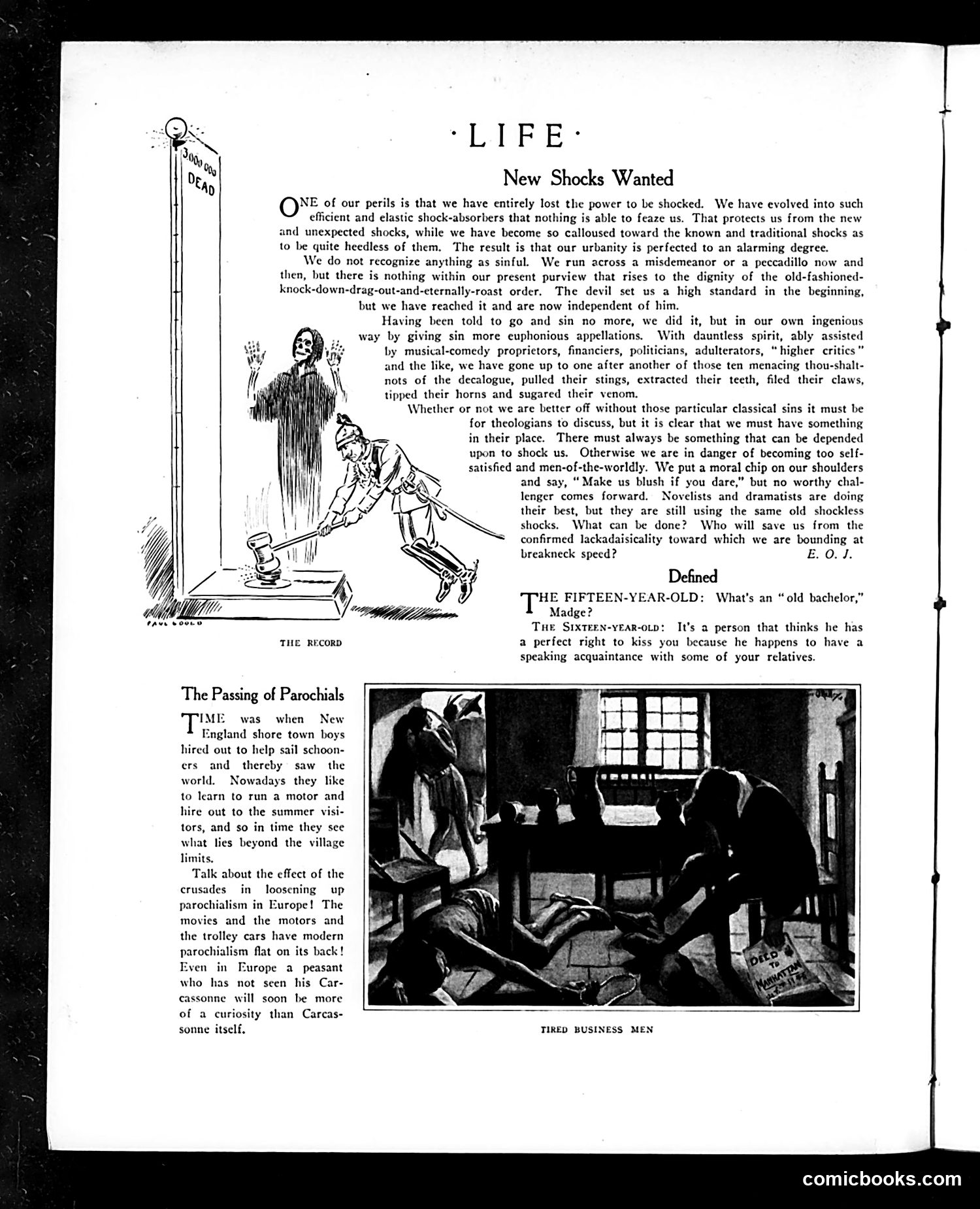
This satirical essay argues that modern society has become morally numb—so desensitized to scandal and vice that nothing shocks us anymore. The author laments that we've euphemistically renamed sins ("higher critics," "adulterators") rather than truly reformed, making transgression socially acceptable. The illustration shows Death looming over a skeletal figure being executed, symbolizing society's self-inflicted moral demise through complacency. The accompanying cartoons mock contemporary social changes: "Tired Business Men" depicts weary urbanites, while "The Passing of Parochials" suggests that modern transportation (motors, trolleys, movies) has eroded small-town insularity—previously, only crusaders traveled abroad; now even peasants explore beyond their villages. The "Defined" section offers wry definitions of old bachelors and young women, exemplifying the witty, tongue-in-cheek humor characteristic of *Life* magazine's social commentary.
📄 Transcribed text from this page (OCR, searchable)
Machine-transcribed from the original scan — historical spelling and the odd misread are preserved.
“LIFE: New Shocks Wanted O*XE of our perils is that we have entirely lost the power to be shocked. We have evolved into such efficient and elastic shock-absorbers that nothing is able to feaze us. That protects us from the new and unexpected shocks, while we have become so calloused toward the known and traditional shocks as to be quite heedless of them. The result is that our urbanity is perfected to an alarming degree. We do not recognize anything as sinful. We run across a misdemeanor or a peccadillo now and then, but there is nothing within our present purview that rises to the dignity of the old-fashioned- knock-down-drag-out-and-eternally-roast order. The devil set us a high standard in the beginning, but we have reached it and are now independent of him. Having been told to go and sin no more, we did it, but in our own ingenious way by giving sin more euphonious appellations. With dauntless spirit, ably assisted by musical-comedy proprietors, financiers, politicians, adulterators, “higher critics” and the like, we have gone up to one after another of those ten menacing thou-shalt- nots of the decalogue, pulled their stings, extracted their teeth, filed their claws, tipped their horns and sugared their venom. Whether or not we are better off without those particular classical sins it must be for theologians to discuss, but it is clear that we must have something in their place. There must always be something that can be depended upon to shock us. Otherwise we are in danger of becoming too self- satisfied and men-of-the-worldly. We put a moral chip on our shoulders and say, “ Make us blush if you dare,” but no worthy chal- lenger comes forward. Novelists and dramatists are doing their best, but they are still using the same old shockless shocks. What can be done? Who will save us from the Defined t =x_e—~, YY y= y y HE FIFTEEN-YEAR-OLD: What’s an “old bachelor,” AMD Mr | ccapigypuys ; Madge? TAS CRORE. Tue SIxTeEEN-YEAR-oLD: It’s a person that thinks he has THE RECORD a perfect right to kiss you because he happens to have a speaking acquaintance with some of your relatives. y/ confirmed lackadaisicality toward which we are bounding at Y iy] | ’ ; breakneck speed? E. 0. J. The Passing of Parochials IME was when New England shore town boys hired out to help sail schoon- ers and thereby saw the world. Nowadays they like to learn to run a motor and hire out to the summer visi- tors, and so in time they sce what lies beyond the village limits. Talk about the effect of the crusades in loosening up parochialism in Europe! The movies and the motors and the trolley cars have modern parochialism flat on its back! Even in Europe a peasant who has not seen his Car- cassonne will soon be more of a curiosity than Carcas- sonne itself, TIRED BUSINESS MEN comicbooks.com