
Life, 1915-08-12 · page 24 of 40
Life — August 12, 1915 — page 24: what you’re looking at
What you’re looking at
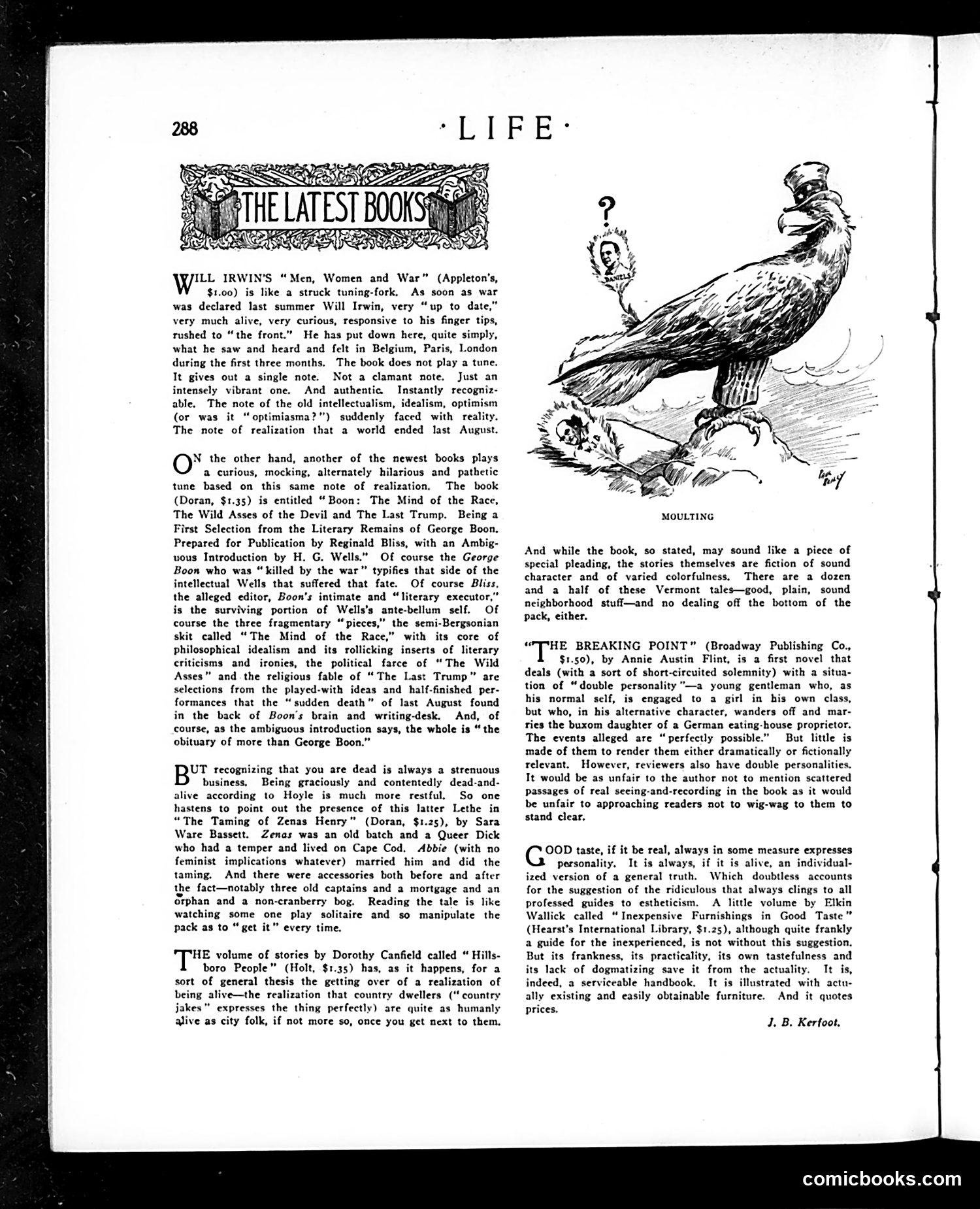
This page from *Life* magazine reviews several contemporary novels, mostly published around 1914-1915 during World War I's early months. The illustration labeled "MOULTING" depicts a bird shedding feathers—a metaphor for the intellectual and cultural transformation occurring as war shattered pre-war idealism. This visual accompanies discussion of Will Irwin's *Men, Women and War*, a firsthand account of the conflict's impact on established philosophical optimism. The reviews emphasize a common theme: the "realization that a world ended last August" (referring to war's declaration in 1914). H.G. Wells's *Boon* is presented as a satirical elegy for pre-war intellectualism—its protagonist "killed by the war" symbolizes ideas rendered obsolete by reality. Other novels reviewed (*The Breaking Point*, *Hillsboro People*) explore psychological transformation and social perception, reflecting the era's broader anxiety about how war fundamentally altered consciousness and certainty. The page's tone suggests cultured anxiety about modernity's disruption of established beliefs and values.
📄 Transcribed text from this page (OCR, searchable)
Machine-transcribed from the original scan — historical spelling and the odd misread are preserved.
ILL IRWIN'S “Men, Women and War” (Appleton’s, $1.00) is like a struck tuning-fork, As soon as war was declared last summer Will Irwin, very “up to date,” very much alive, very curious, responsive to his finger tips, rushed to “the front.” He has put down here, quite simply, what he saw and heard and felt in Belgium, Paris, London during the first three months, The book does not play a tune. It gives out a single note. Not a clamant note. Just an intensely vibrant one. And authentic. Instantly recogniz- able. The note of the old intellectualism, idealism, optimism (or was it “‘optimiasma?”) suddenly faced with reality. The note of realization that a world ended last August. N the other hand, another of the newest books plays a curious, mocking, alternately hilarious and pathetic tune based on this same note of realization. The book (Doran, $1.35) is entitled “Boon: The Mind of the Race, The Wild Asses of the Devil and The Last Trump. Being a First Selection from the Literary Remains of George Boon, Prepared for Publication by Reginald Bliss, with an Ambig- uous Introduction by H. G. Wells.” Of course the George Boon who was “killed by the war” typifies that side of the intellectual Wells that suffered that fate. Of course Bliss, the alleged editor, Boon’s intimate and “literary executor,” is the surviving portion of Wells’s ante-bellum self. Of course the three fragmentary “pieces,” the semi-Bergsonian skit called “The Mind of the Race,” with its core of philosophical idealism and its rollicking inserts of literary criticisms and ironies, the political farce of “The Wild Asses” and the religious fable of “The Last Trump” are selections from the played-with ideas and half-finished per- formances that the “sudden death” of last August found in the back of Boon’s brain and writing-desk. And, of course, as the ambiguous introduction says, the whole is “the obituary of more than George Boon.” UT recognizing that you are dead is always a strenuous business, Being graciously and contentedly dead-and- alive according to Hoyle is much more restful. So one hastens to point out the presence of this latter Lethe in “The Taming of Zenas Henry” (Doran, $1.25), by Sara Ware Bassett. Zenas was an old batch and a Queer Dick who had a temper and lived on Cape Cod. Abbie (with no feminist implications whatever) married him and did the taming. And there were accessories both before and after the fact—notably three old captains and a mortgage and an Orphan and a non-cranberry bog. Reading the tale is like watching some one play solitaire and so manipulate the pack as to “get it” every time. HE volume of stories by Dorothy Canfield called “ Hills- boro People” (Holt, $1.35) has, as it happens, for a sort of general thesis the getting over of a realization of being alive—the realization that country dwellers (country jakes” expresses the thing perfectly) are quite as humanly alive as city folk, if not more so, once you get next to them, MOULTING And while the book, so stated, may sound like a piece of special pleading, the stories themselves are fiction of sound character and of varied colorfulness. There are a dozen and a half of these Vermont tales—good, plain, sound neighborhood stuff—and no dealing off the bottom of the pack, either, “"THE BREAKING POINT” (Broadway Publishing Co., $1.50), by Annie Austin Flint, is a first novel that deals (with a sort of short-circuited solemnity) with a situa- tion of “double personality ”"—a young gentleman who, as his normal self, is engaged to a girl in his own class, but who, in his alternative character, wanders off and mar- ries the buxom daughter of a German eating-house proprietor. The events alleged are “perfectly possible.” But little is made of them to render them either dramatically or fictionally relevant. However, reviewers also have double personalities. Tt would be as unfair to the author not to mention scattered passages of real seeing-and-recording in the book as it would be unfair to approaching readers not to wig-wag to them to stand clear. OOD taste, if it be real, always in some measure expresses personality. It is always, if it is alive, an individual- ized version of a general truth. Which doubtless accounts for the suggestion of the ridiculous that always clings to all professed guides to estheticism. A little volume by Elkin Wallick called “Inexpensive Furnishings in Good Taste” (Hearst's International Library, $1.25), although quite frankly a guide for the inexperienced, is not without this suggestion. But its frankness, its practicality, its own tastefulness and its lack of dogmatizing save it from the actuality. It indeed, a serviceable handbook. It is illustrated with actu- ally existing and easily obtainable furniture. And it quotes prices. J. B. Kerfoot. comicbooks.com