
A complete issue · 40 pages · 1915
Life — July 29, 1915
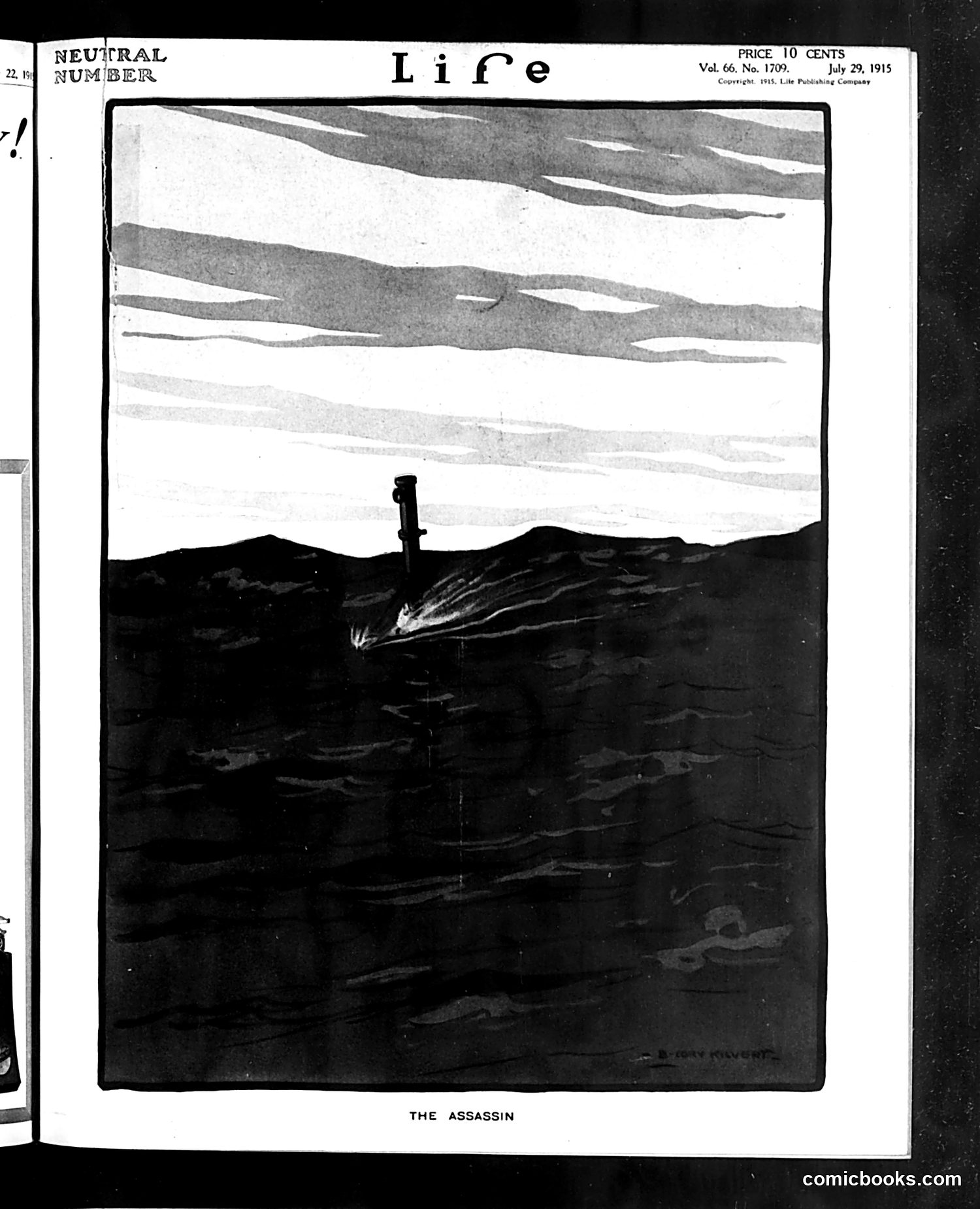
This political cartoon depicts a solitary figure standing in a desolate landscape beneath a stormy sky, titled "The Assassin." The darkened, barren terrain and ominous atmosphere suggest evil or violence. Given the 1915 publication date, this likely references World War I, which had begun the previous year. The figure appears to represent either a warring nation or the concept of militarism itself—personified as an assassin stalking across a devastated landscape. The contrast between the light sky and blackened earth emphasizes destruction. Life magazine, founded as a humorous publication, frequently offered political commentary on contemporary events. This cartoon's stark imagery critiques the violence and moral corruption associated with warfare during WWI's early, brutal phase.
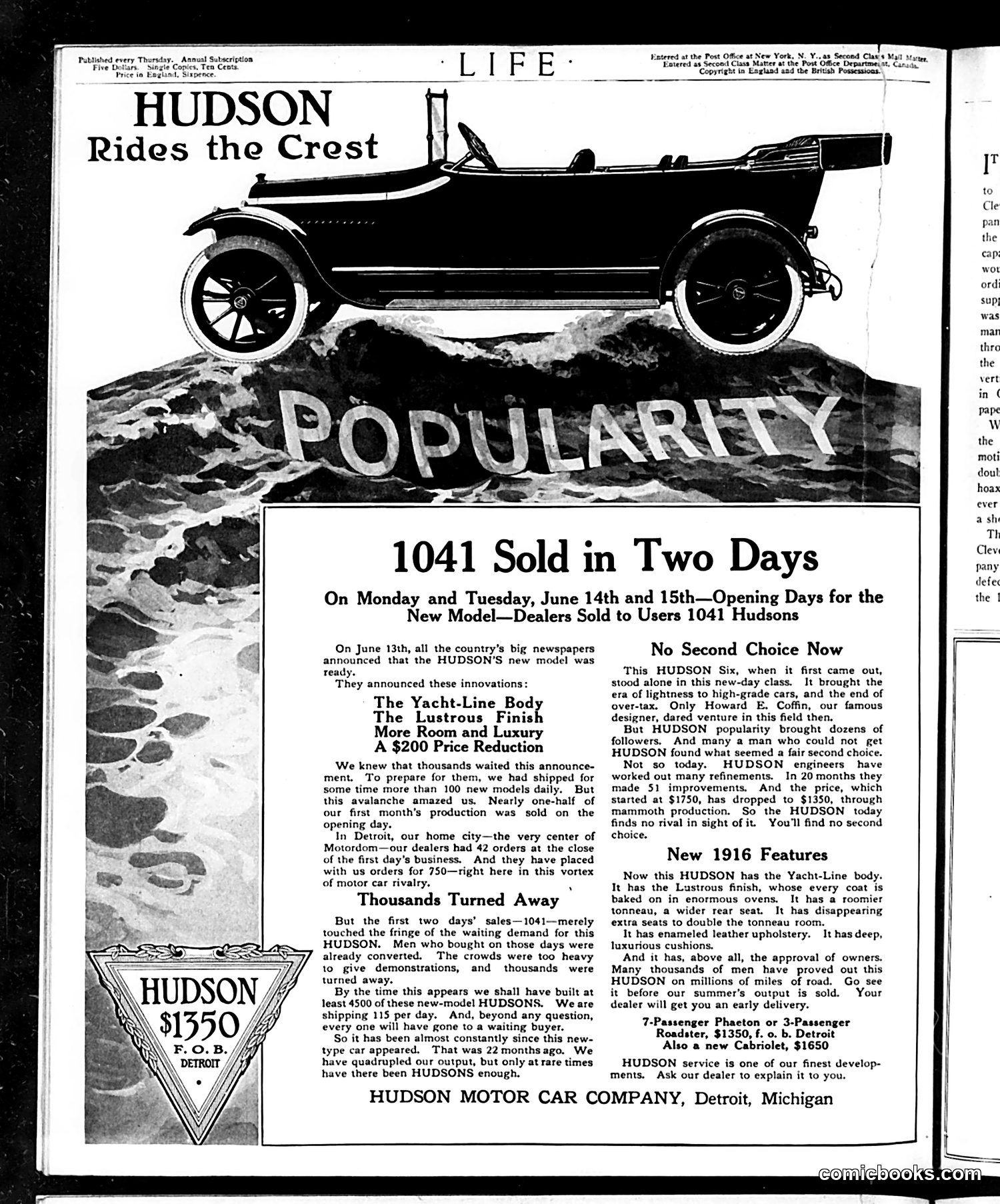
This page is primarily **advertising, not satire or political commentary**. It's a full-page Hudson Motor Car Company advertisement from *Life* magazine. The headline "HUDSON Rides the Crest" uses the visual metaphor of a car positioned atop a mountain wave labeled "POPULARITY" to convey the brand's market dominance. The advertisement boasts that 1,041 Hudsons sold in just two days (June 14-15) at the model's launch. The copy emphasizes technical innovations (Yacht-Line Body, Lustrous Finish) and price reduction ($150 drop to $1,350), positioning Hudson as offering superior value. There is no political satire here—this is straightforward automotive marketing exploiting the car's commercial success as a selling point.
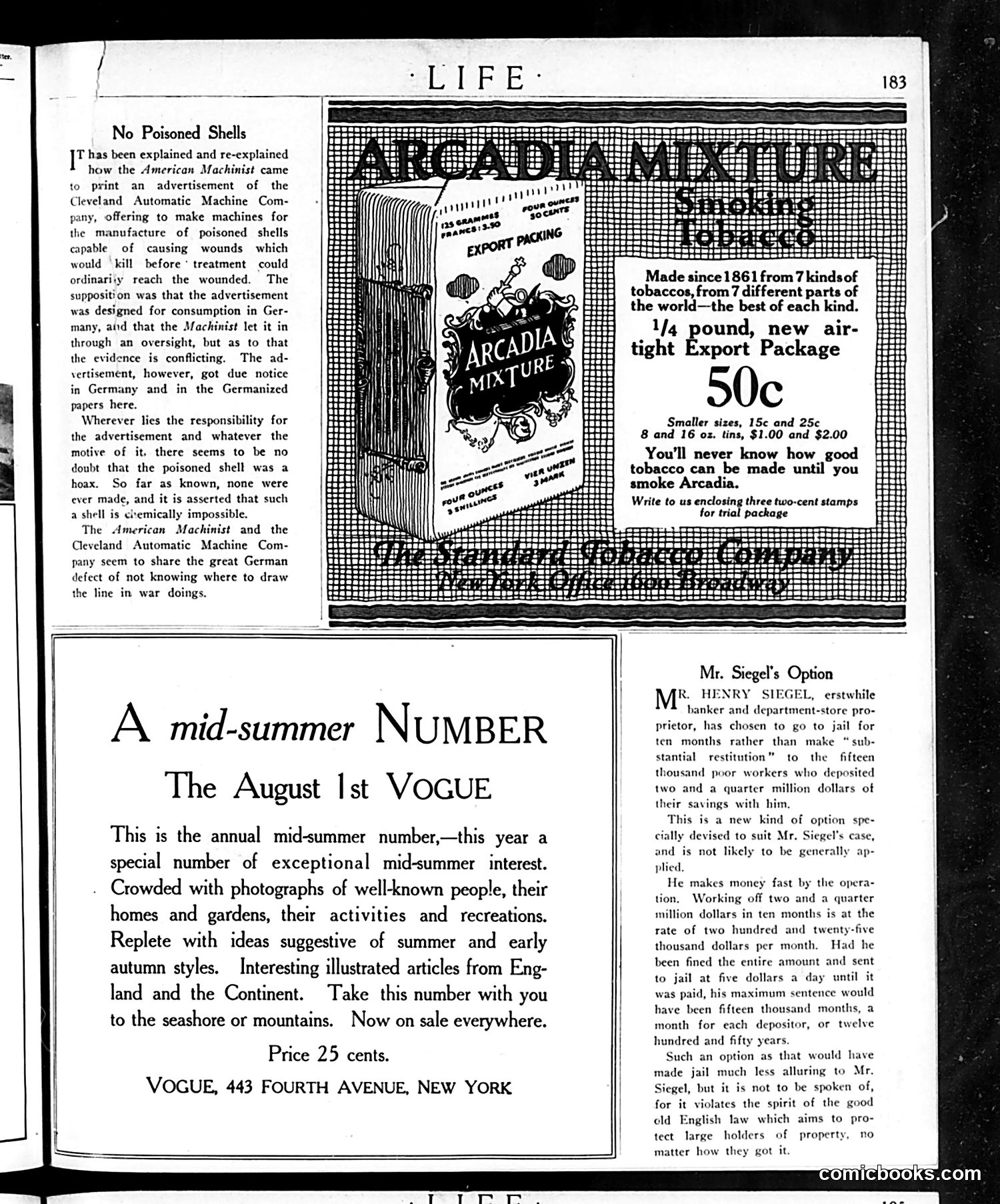
This page is primarily **advertising and editorial content** from *Life* magazine, not political satire. The top half features an **Arcadia Mixture tobacco advertisement** promoting smoking tobacco in various package sizes (50 cents for the main "Export Package"). The ad claims the blend uses "7 kinds of tobacco from 7 different parts of the world." Below is an **announcement for Vogue magazine's August 1st mid-summer issue**, promoting it as containing photographs of notable people, their homes, gardens, and summer/early autumn fashion ideas. The right column contains **"Mr. Siegel's Opinion,"** discussing Henry Siegel (a bankers and department-store proprietor) choosing jail over paying restitution to poor workers who deposited savings with him. The text critiques this as violating "English law" protecting large property holders. No significant political cartoon or satire appears on this page.
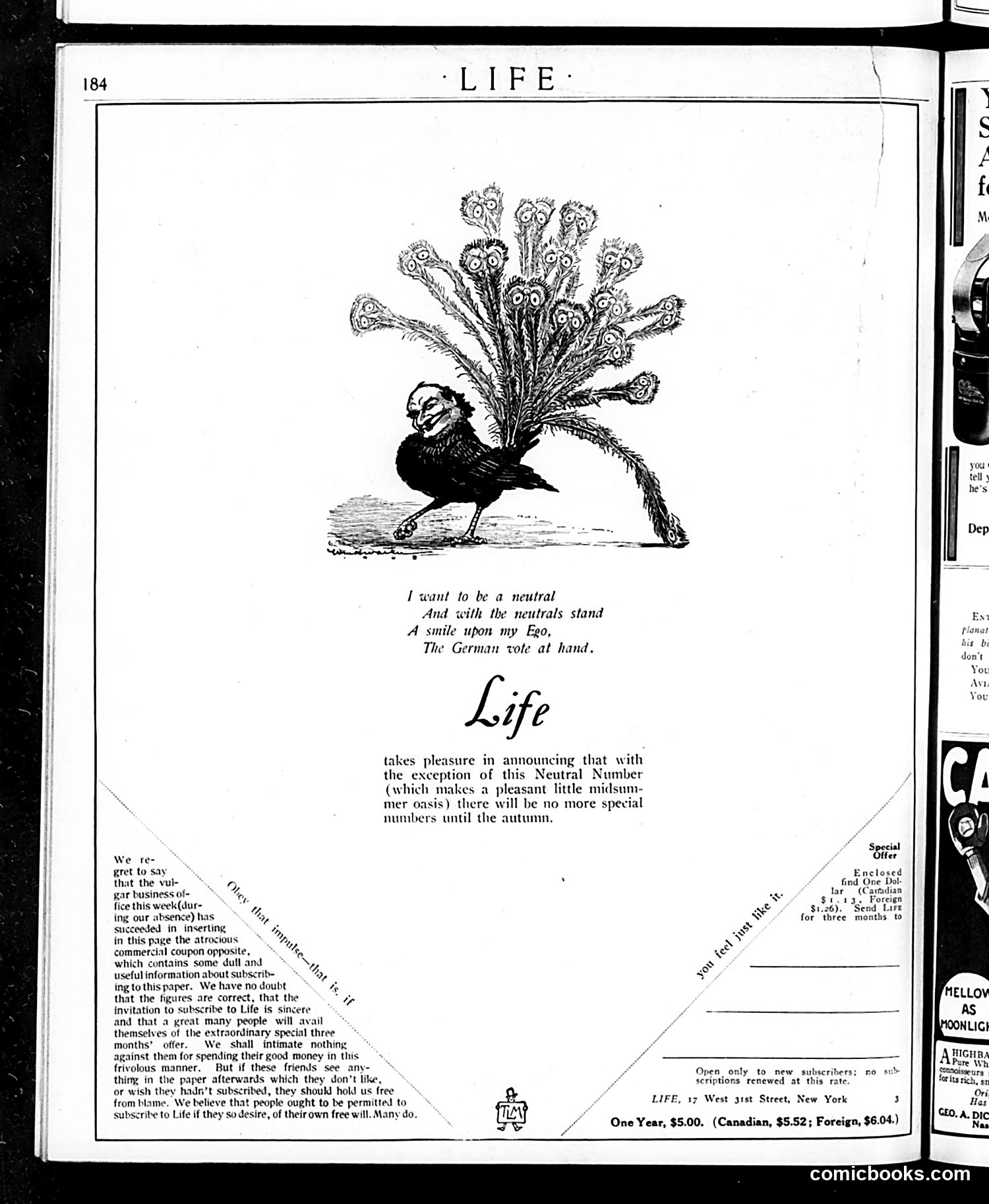
This page from *Life* magazine features a political cartoon depicting a human figure with a peacock's tail of flowers, accompanied by a quoted poem about neutrality and German votes. The cartoon satirizes American neutrality during World War I. The figure appears to represent either America or American leadership, depicted as vain and preening (the peacock imagery) while claiming neutrality. The poem's reference to "the German vote at hand" suggests the cartoon mocks politicians who maintained neutrality partly to appease German-American voters—a significant voting bloc. The satire criticizes this position as dishonest vanity: claiming neutrality while actually serving particular interests. The peacock's display symbolizes the absurdity of the neutral stance, treating it as mere posturing rather than genuine principle.
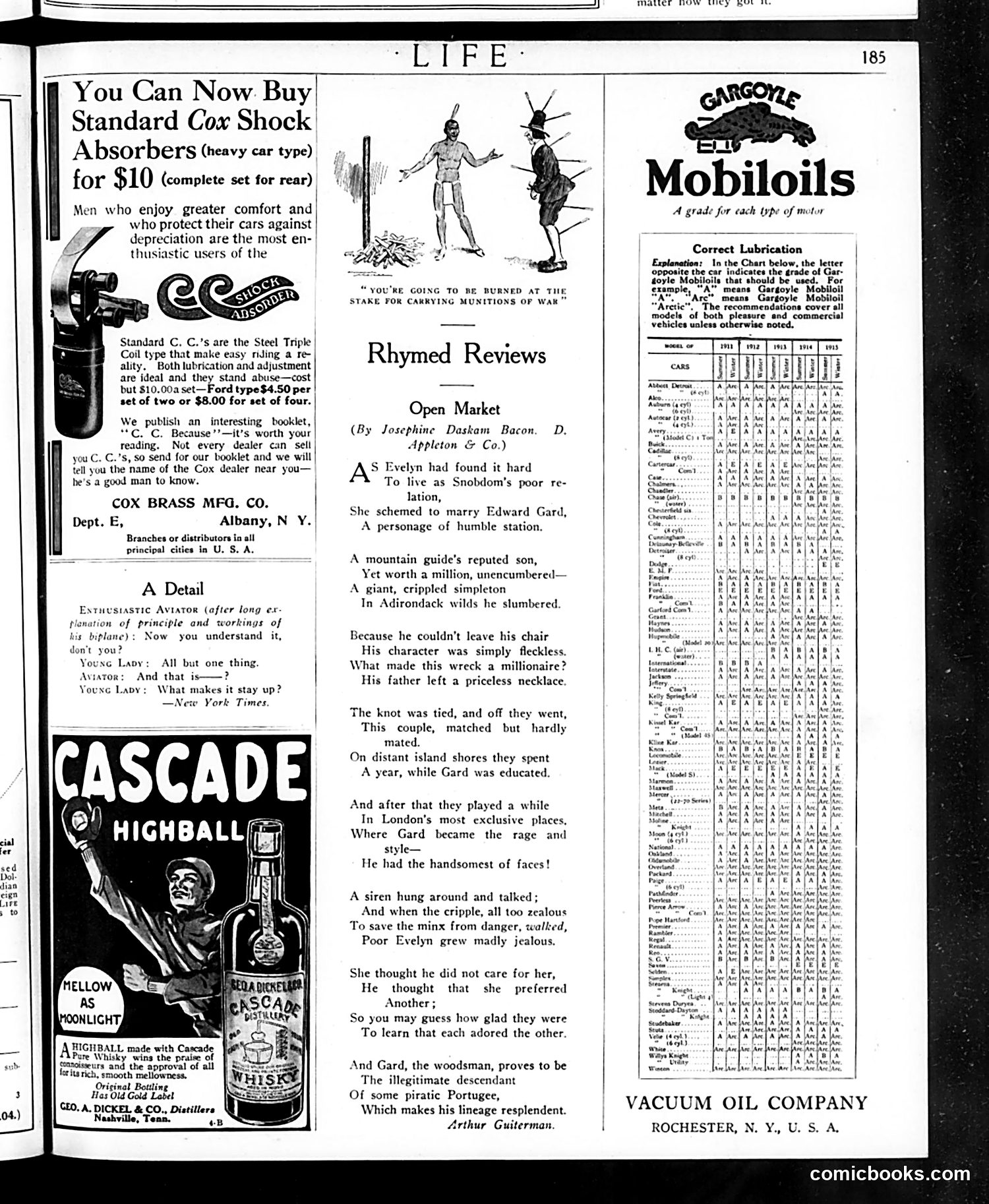
This page is primarily **advertising and commercial content** rather than political satire. The main items are: 1. **Cox Shock Absorbers ad** - promotes car parts for comfort and protection 2. **Gargoyle Mobiloils ad** - a lubrication products chart for various 1911-1915 automobile models 3. **Cascade Highball whiskey ad** - depicts a man in formal attire drinking, marketed as "mellow as moonlight" 4. **"Rhymed Reviews: Open Market"** - a satirical poem by Josephine Daskam Bacon about a poor woman (Eve) who marries a wealthy man (Edward Gard) for financial security, exploring themes of marriage and class The poem's satire critiques romantic marriages motivated by wealth rather than genuine affection, a common theme in early 20th-century social commentary.
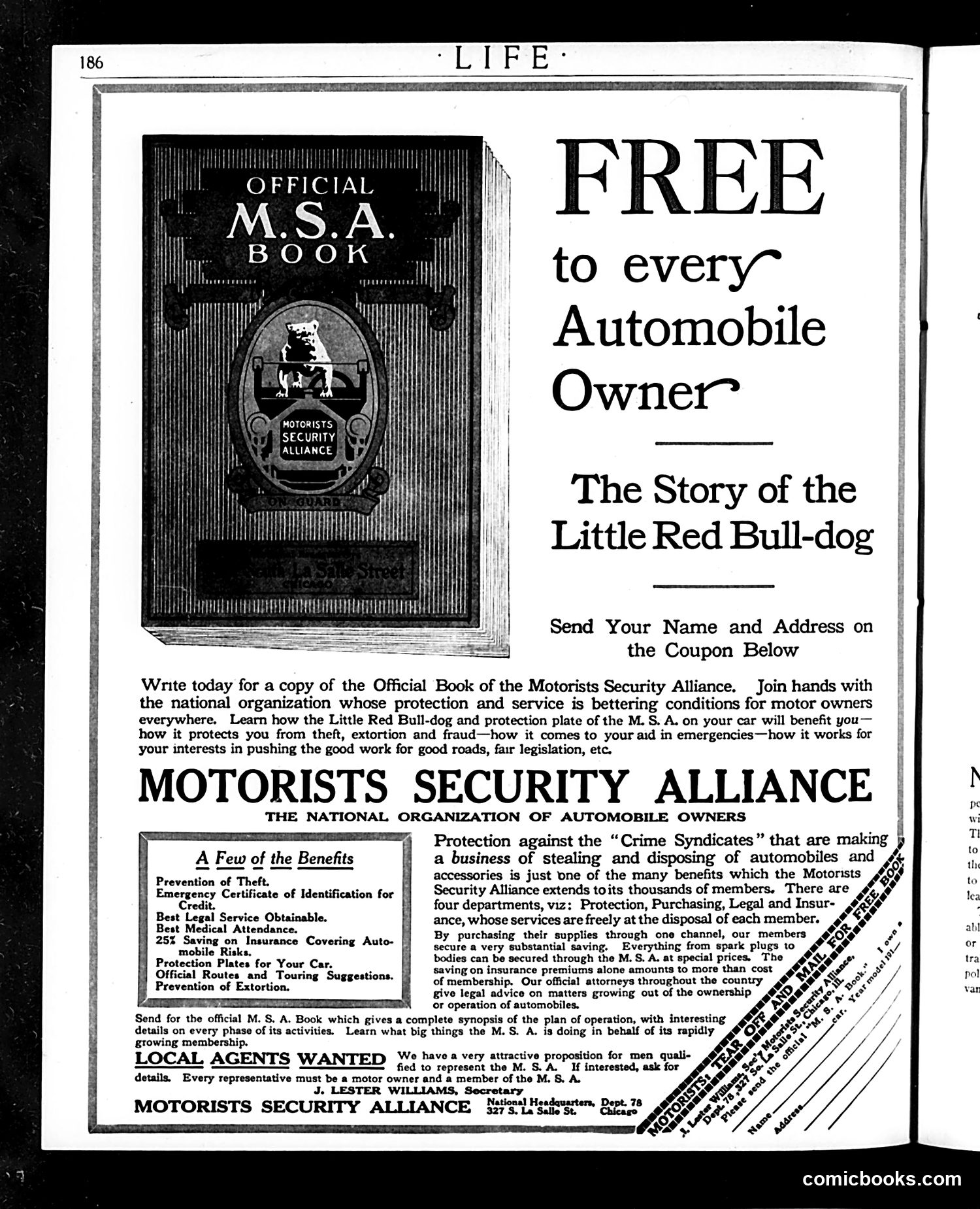
This page is **primarily an advertisement**, not political satire. It promotes the Motorists Security Alliance (M.S.A.), a national automobile owners' organization offering the "Official M.S.A. Book" and "The Story of the Little Red Bull-dog" free to car owners. The advertisement emphasizes member benefits including theft prevention, insurance coverage, legal services, and medical assistance. It highlights protection against "Crime Syndicates" stealing automobiles and accessories—reflecting early 20th-century concerns about organized auto theft rings. The page recruits local agents and solicits membership through a coupon. The "Little Red Bull-dog" likely served as the organization's mascot or symbol, though the specific reference isn't explained here. This represents typical early automotive-era consumer protection marketing.
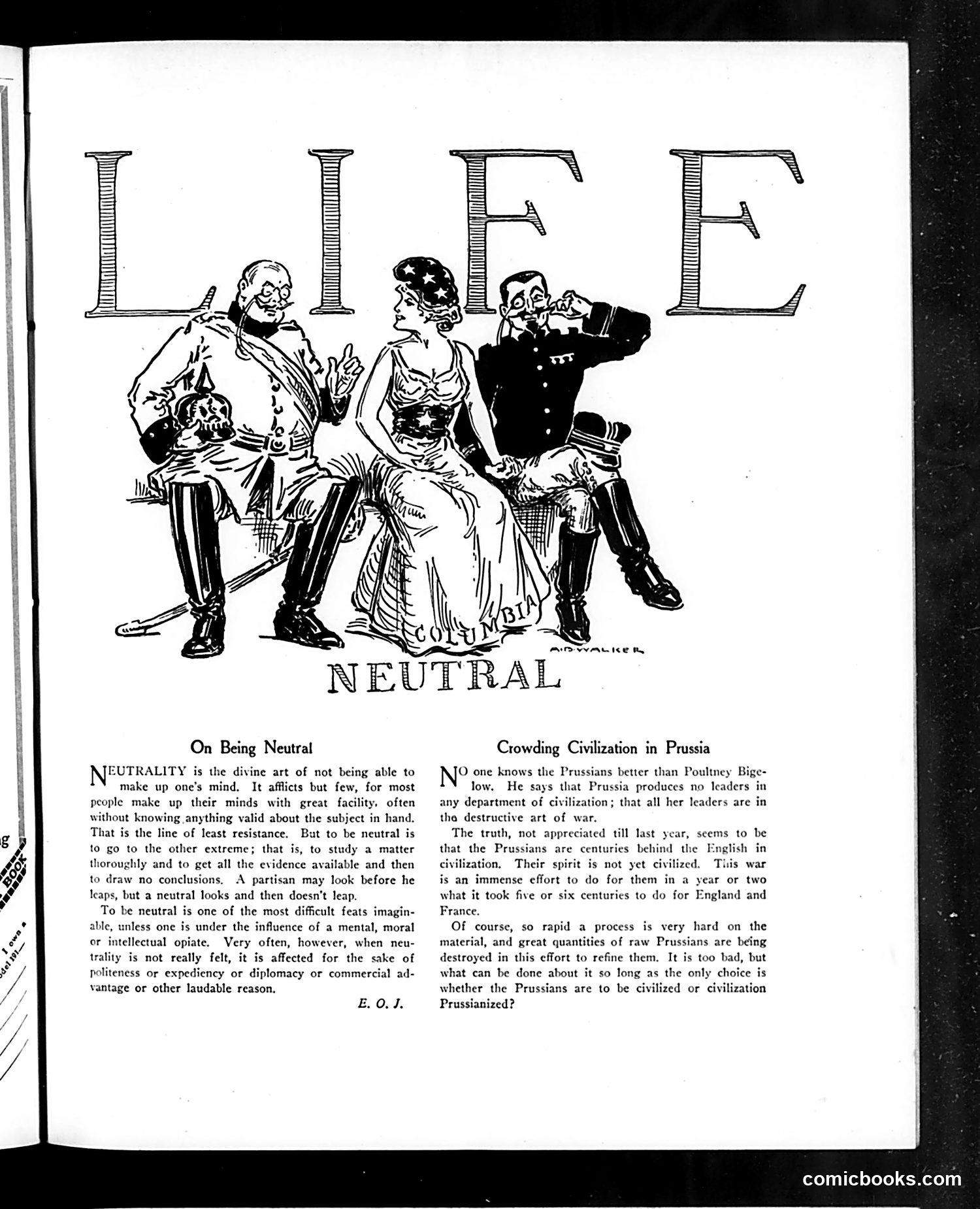
This cartoon satirizes American neutrality during World War I. The central female figure labeled "NEUTRAL" (representing the United States) sits between two military officers in formal uniforms—likely representing Allied and Central Powers—who gesture toward her while she maintains a composed, detached posture. The accompanying article "On Being Neutral" mocks the impossibility of true neutrality, arguing that remaining uninvolved requires studious avoidance of conclusions. The second article critiques Prussia's rapid "civilization" efforts, suggesting Germany cannot achieve in years what took other nations centuries. The satire targets America's claimed neutrality stance as impractical and naive—the cartoon visually demonstrates how difficult it is to remain truly neutral when surrounded by competing warring powers demanding alignment.
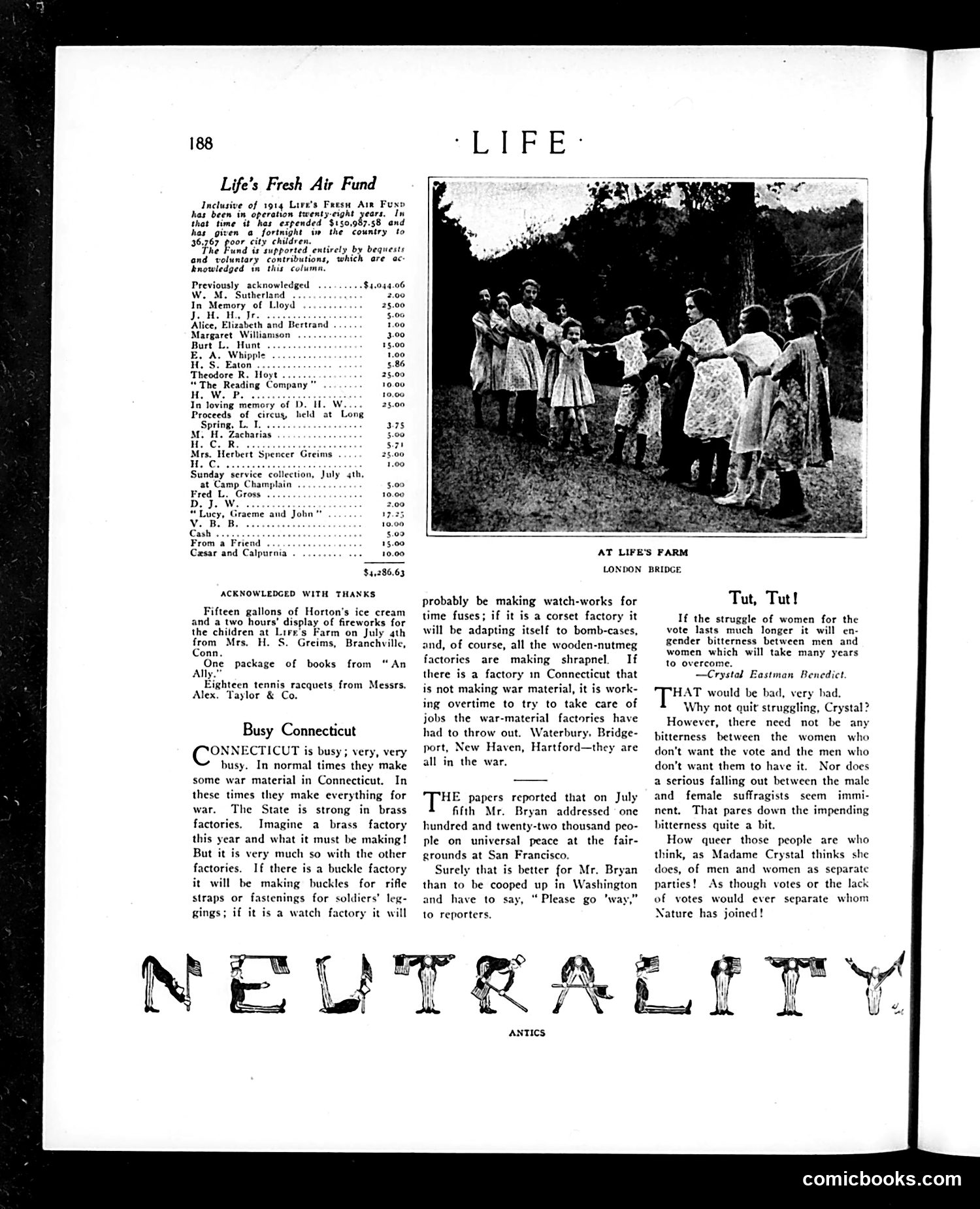
This page contains a fundraising notice for Life's Fresh Air Fund (established 1914), listing donor contributions totaling $1,286.63. The fund provided free country vacations for underprivileged children. The photograph shows children at Life's Farm near London Bridge, engaged in outdoor activities—consistent with the Fresh Air Fund's mission. The editorial section titled "Tut, Tut!" addresses women's suffrage and gender relations. It quotes Crystal Eastman Benedict criticizing those who oppose equal voting rights, arguing that women and men should be treated as equal citizens rather than "separate parties." The piece sarcastically challenges anti-suffrage sentiment by questioning why anyone would oppose women's participation in democracy. The decorative footer spells "NEUTRALITY" using figure-based letterforms—a reference to America's then-current official neutrality stance during World War I.
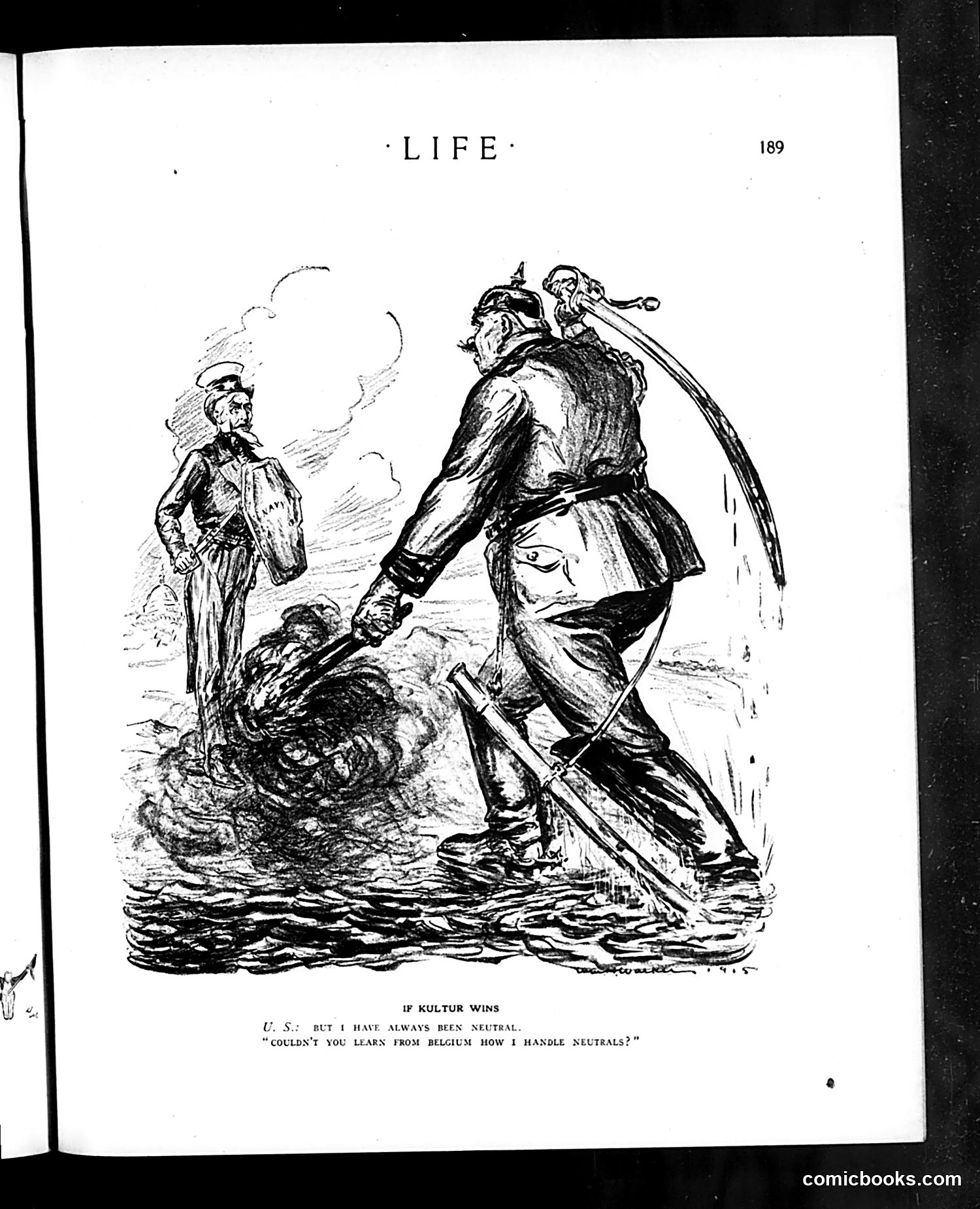
This cartoon satirizes American military neutrality during World War I. The central figure is Uncle Sam (identifiable by his military uniform and characteristic appearance), wielding a large sword while standing over a fallen soldier. A woman in classical dress labeled "Kultur" (German militarism) stands nearby. The caption reads: "If Kultur Wins. U.S.: But I have always been neutral. 'Couldn't you learn from Belgium how I handle neutrals?'" The joke targets American claims of neutrality while European powers, particularly Germany, wage war. Belgium's invasion despite its neutral status serves as the historical reference point—a warning that declaring neutrality provides no protection against aggressive militarism. The cartoon suggests Uncle Sam's sword contradicts his neutrality claims.
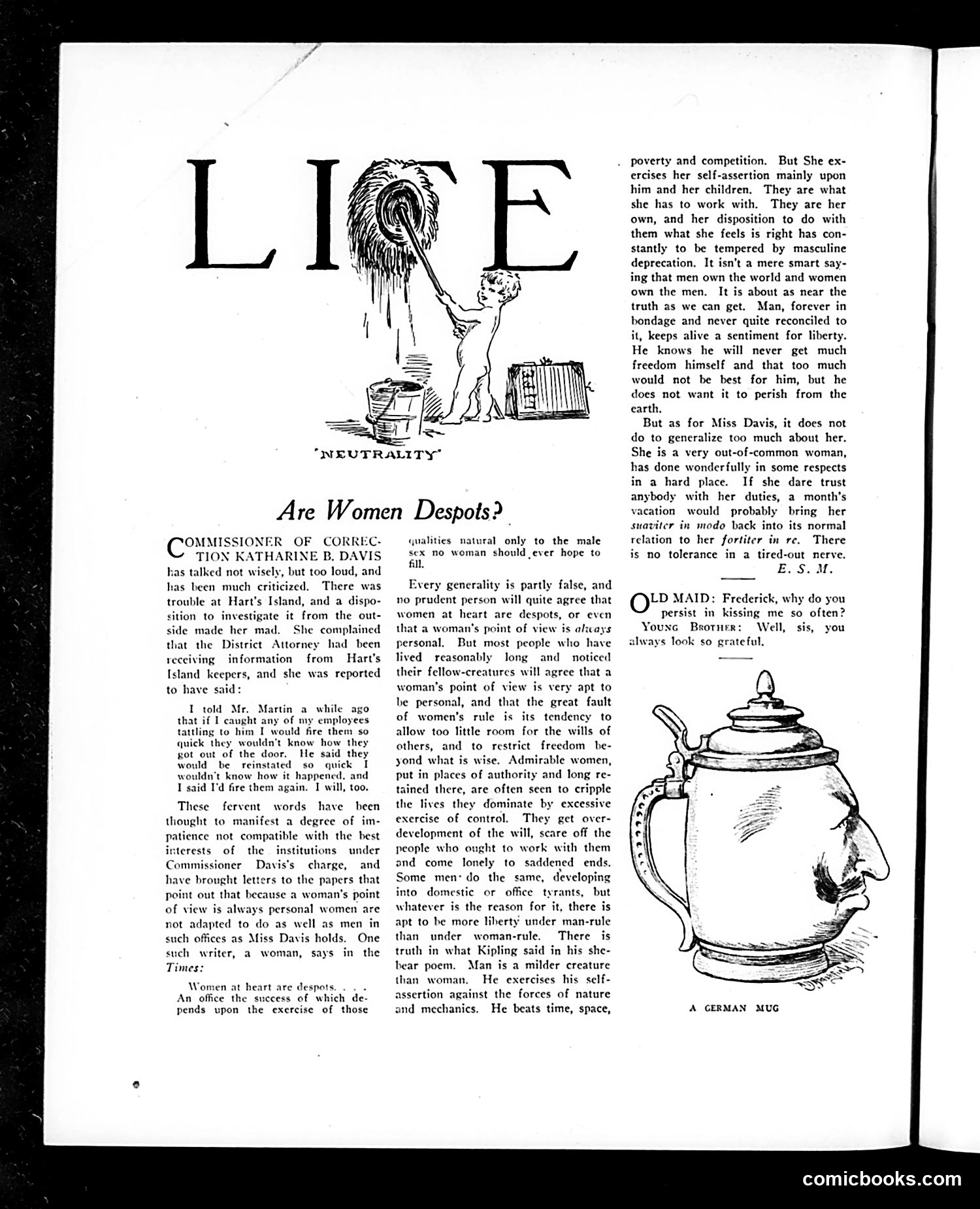
The cartoon depicts a woman (labeled "Neutrality") being pulled in opposite directions by two figures representing competing interests—likely warring nations or political factions. The image satirizes the impossibility of true neutrality during conflict. The accompanying article, "Are Women Despots?" by Commissioner of Correction Katharine Davis, argues against the common generalization that women are naturally submissive. Davis contends that women's points of view tend toward the personal rather than the institutional, and she critiques how women in positions of authority sometimes over-exercise control. The piece debates whether women are suited for governance and public roles, reflecting early-20th-century concerns about female authority and capability.
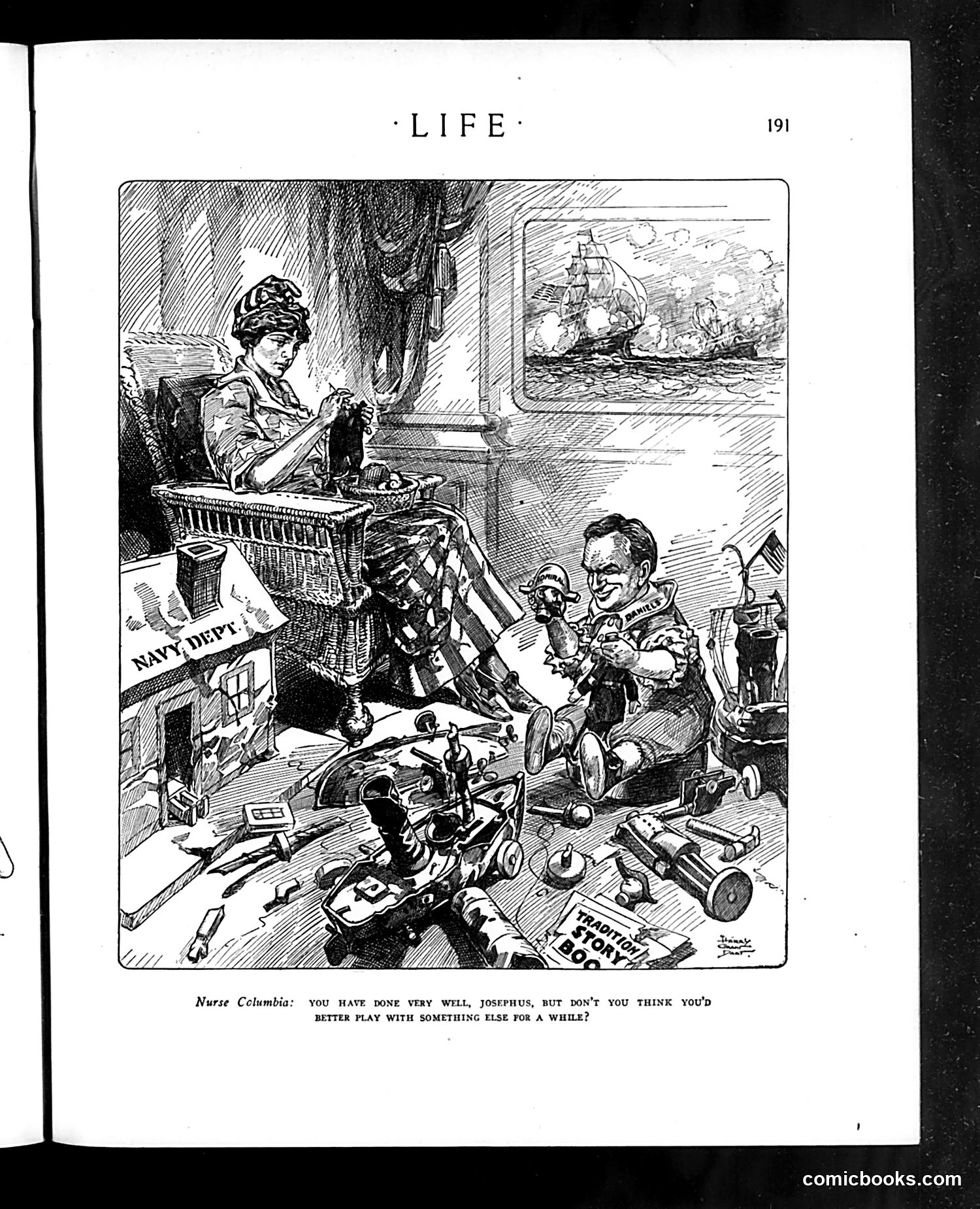
This Life magazine cartoon satirizes military spending and priorities. "Nurse Columbia" (representing America) scolds a man labeled "Josephus" — likely Secretary of the Navy Josephus Daniels — for playing excessively with toys, urging him to find other activities. The toys scattered around represent naval vessels and military equipment. Through the window, actual warships engage in battle, suggesting real military action demands attention. The satire criticizes Daniels for excessive focus on military toy-building (defense expenditure and shipbuilding programs) while actual warfare demands resources elsewhere. Columbia's maternal reproach positions military spending as childish distraction from more serious national concerns, a common Progressive-era critique of military budgets during the World War I period.
This short story contest entry satirizes corporate hypocrisy regarding business ethics. The plot centers on Mr. Slowitz, a dye company owner, who fires his employee Sloane—not for poor work, but because Sloane discovered a business secret (a formula) that Slowitz wanted to keep hidden. When Sloane threatens to take the formula to a competitor, Slowitz manipulates him with promises of rehiring and payment if he retrieves it from the rival Domestic Dye Works. The satire's point: Slowitz represents the ruthless businessman who preaches "business is business" while cynically exploiting ethics as a tool for profit. His casual disregard for his employee's dignity and his willingness to use deception illustrate the gap between business leaders' stated principles and actual practices—a common Progressive Era critique of American capitalism.
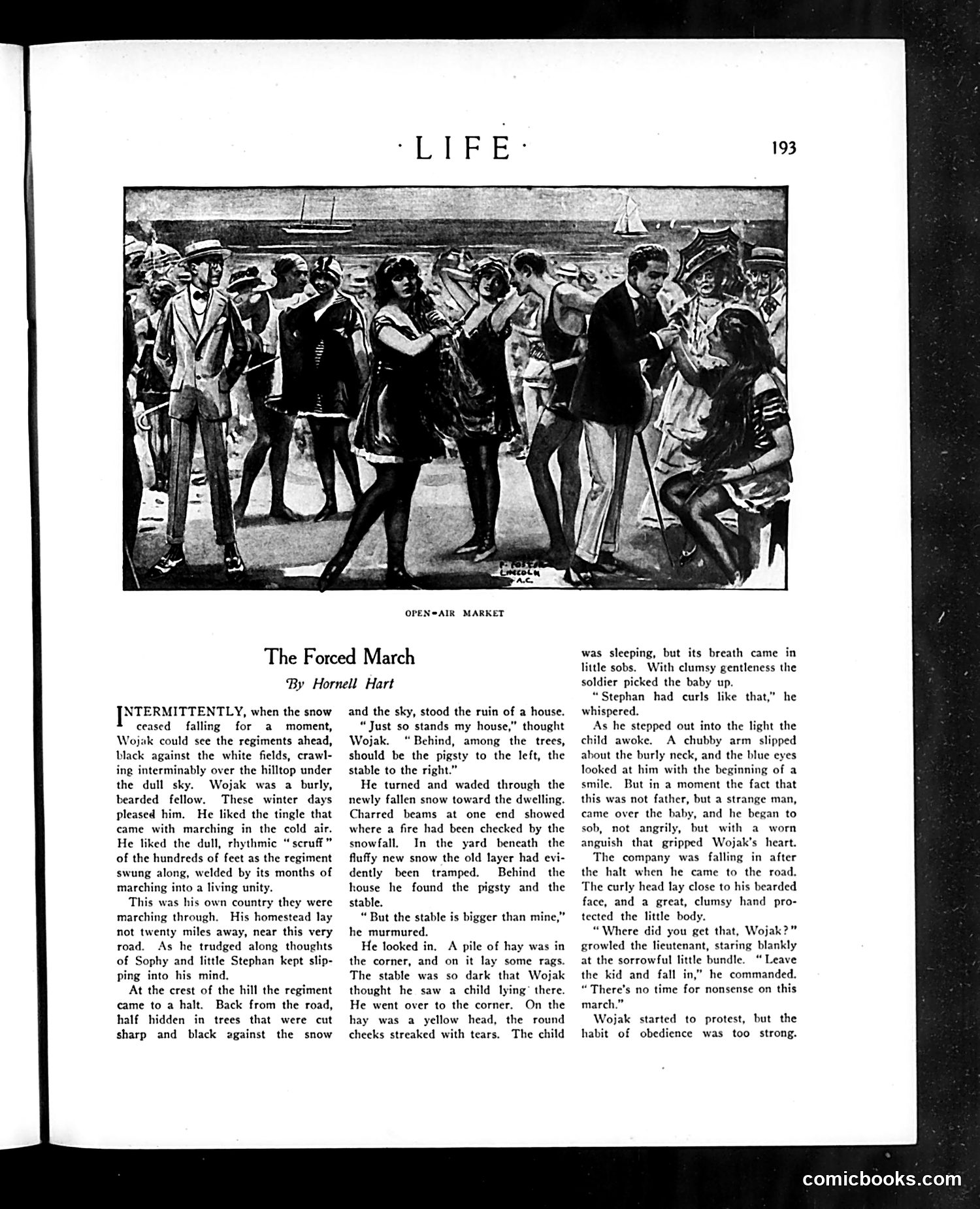
This page presents a short story rather than political satire. The narrative follows a soldier named Wojak during a military march in winter, who discovers an abandoned child in a ruined house. Despite the child's obvious distress and suffering, Wojak is ordered to abandon it and continue marching—hence "forced march." The illustration at top shows what appears to be a beach or marketplace scene with civilians in 1920s-style clothing, though its connection to the story text is unclear. The story's point seems to be critiquing military discipline and the human cost of war—the conflict between compassion for a suffering child and the absolute obedience demanded of soldiers. It's a sentimental anti-war commentary rather than political satire.
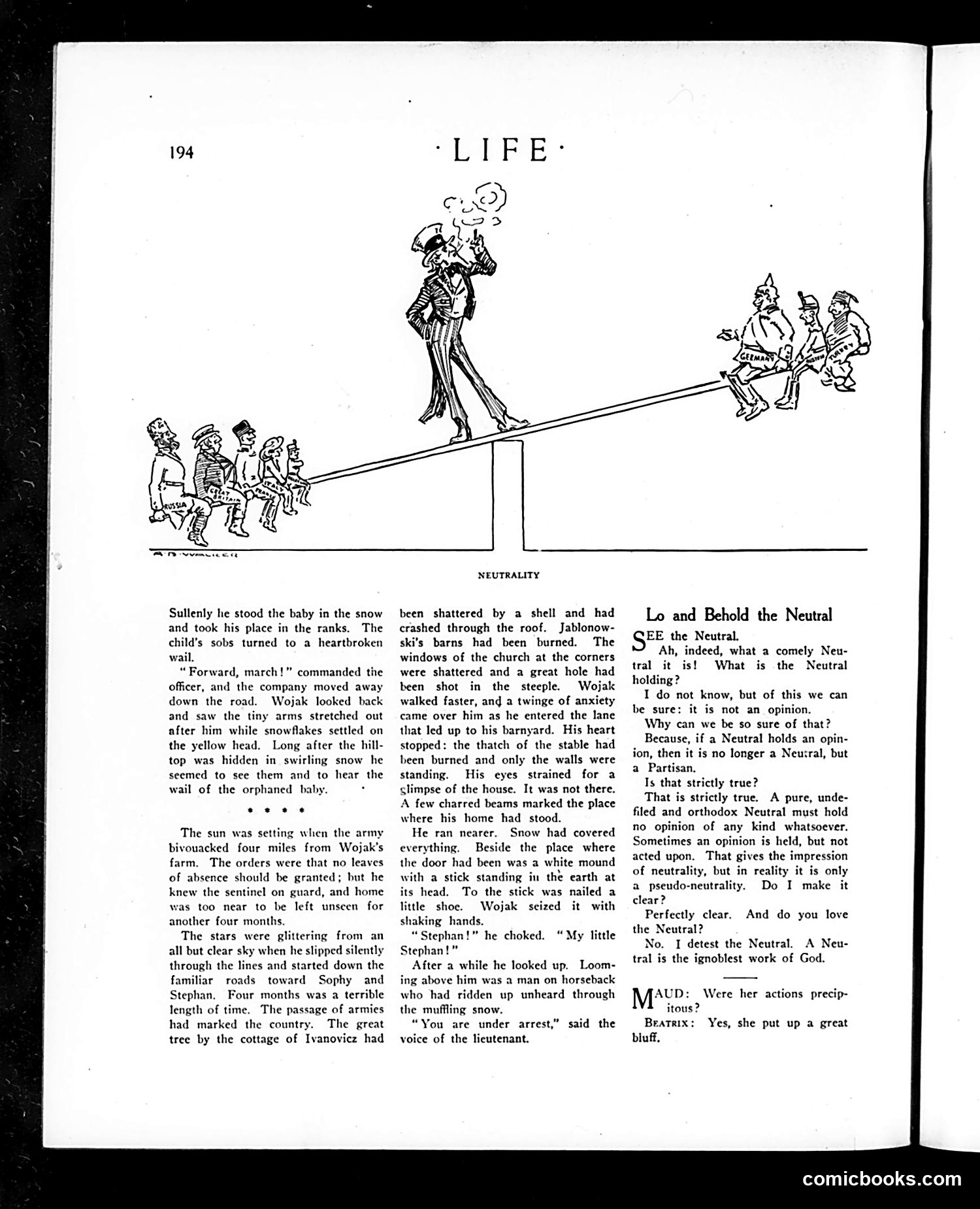
The main illustration depicts a seesaw/balance beam labeled "NEUTRALITY" at the fulcrum. On one side sits a well-dressed woman (appears to be a personification of "the Neutral"), while on the other side sit several small military figures. The imbalance of the image suggests the cartoon critiques the concept of neutrality itself. The text dialogue below explores this theme philosophically, with characters debating whether true neutrality is possible. One character argues a "pure, unfiled and orthodox Neutral must hold no opinion of any kind whatsoever," while another counters that neutrality is merely a "pseudo-neutrality"—a facade masking hidden bias. This likely references World War I-era American debates about maintaining neutrality versus entering the conflict, suggesting that claimed neutrality was inherently impossible or dishonest.
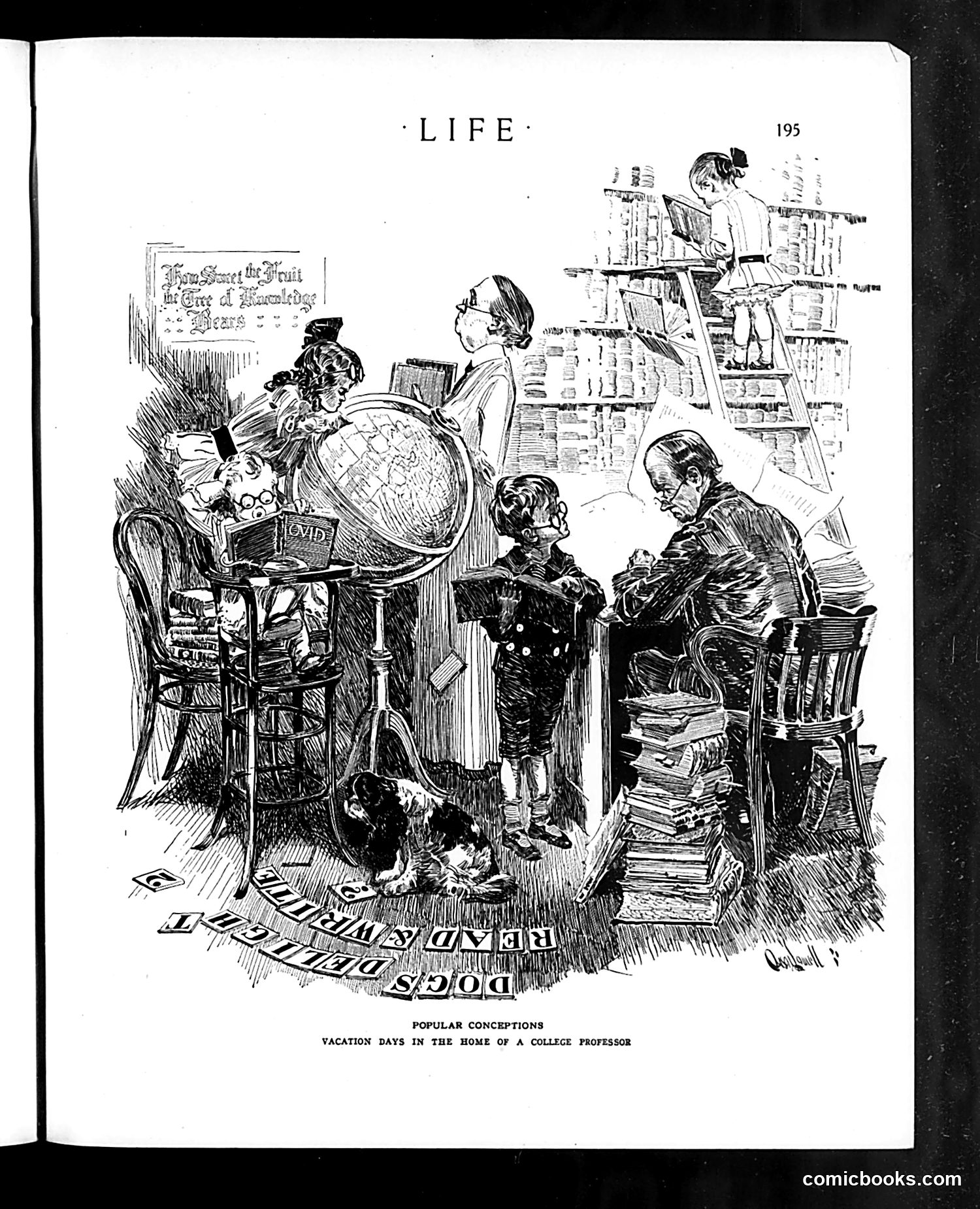
This satirical cartoon depicts a humorous domestic scene contrasting public perceptions with reality. The title suggests people imagine a college professor's vacation as intellectually refined and leisurely. However, the illustration shows chaos: a woman stands amid towering stacks of papers and books, children play underfoot, a man works at a desk surrounded by more papers, and someone climbs a ladder accessing even more materials. The satire mocks the false assumption that professors enjoy peaceful, restful vacations. Instead, the cartoon reveals they remain buried in academic work—grading, research, and administrative tasks—while managing household disruptions. It's a commentary on unrealistic public expectations about professorial life and the reality of their labor-intensive work.
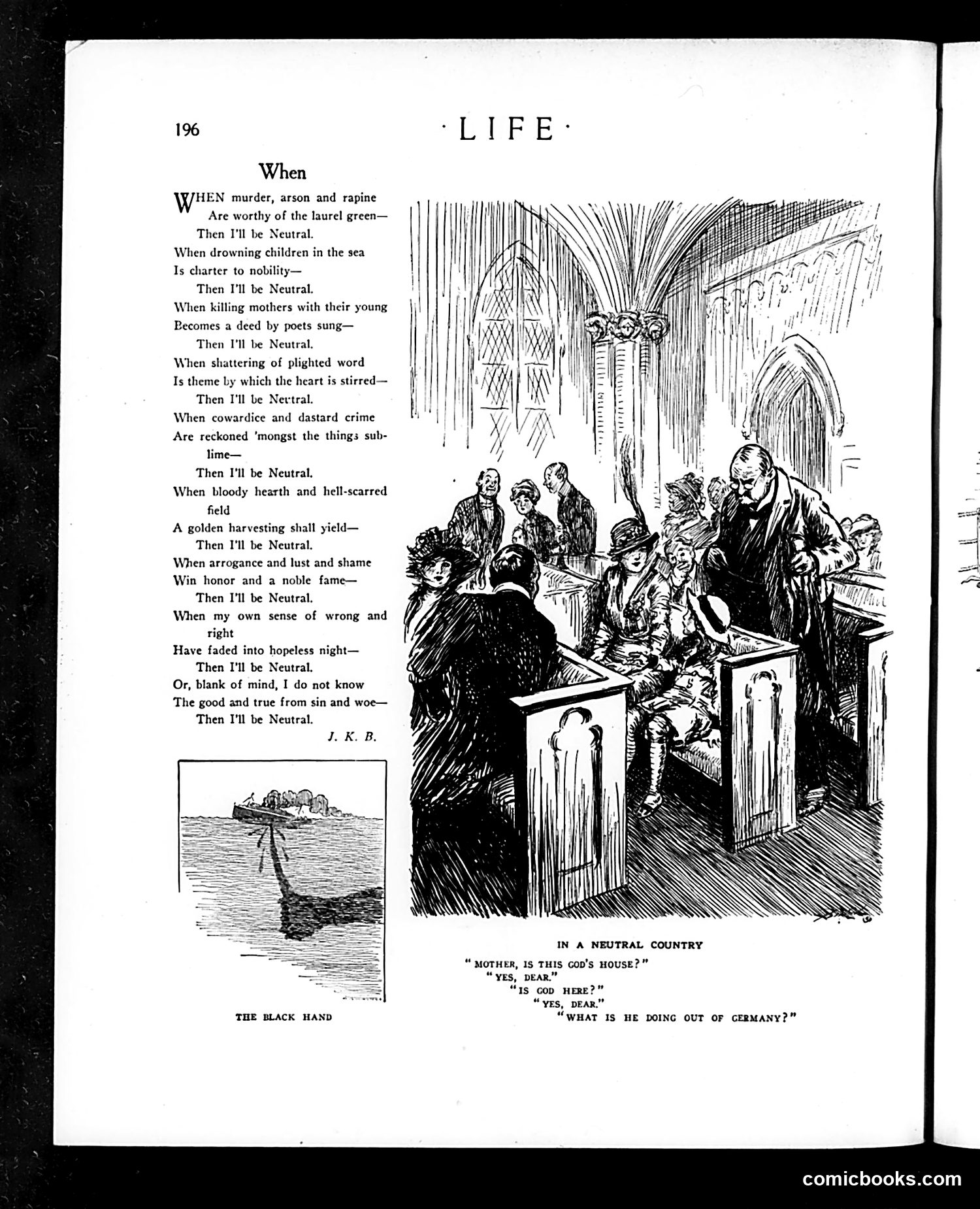
This page critiques **neutrality during World War I**, likely from 1914-1917. The poem "When" by J.K.B. sarcastically lists atrocities—murder, drowning children, killing mothers—arguing that only when such horrors become virtuous would neutrality be acceptable. The point: neutrality in the face of evil is morally bankrupt. The cartoon "In a Neutral Country" depicts a church scene where a child asks if it's "God's house," with the caption "What is he doing out of Germany?"—suggesting God has abandoned Germany due to its wartime brutality, or that German atrocities are so severe that even divine presence cannot remain. "The Black Hand" (lower left) likely references the Serbian nationalist group implicated in Archduke Franz Ferdinand's assassination, which sparked WWI. Together, these works pressure American readers to abandon neutrality and condemn German aggression, presenting neutrality as complicit with evil.
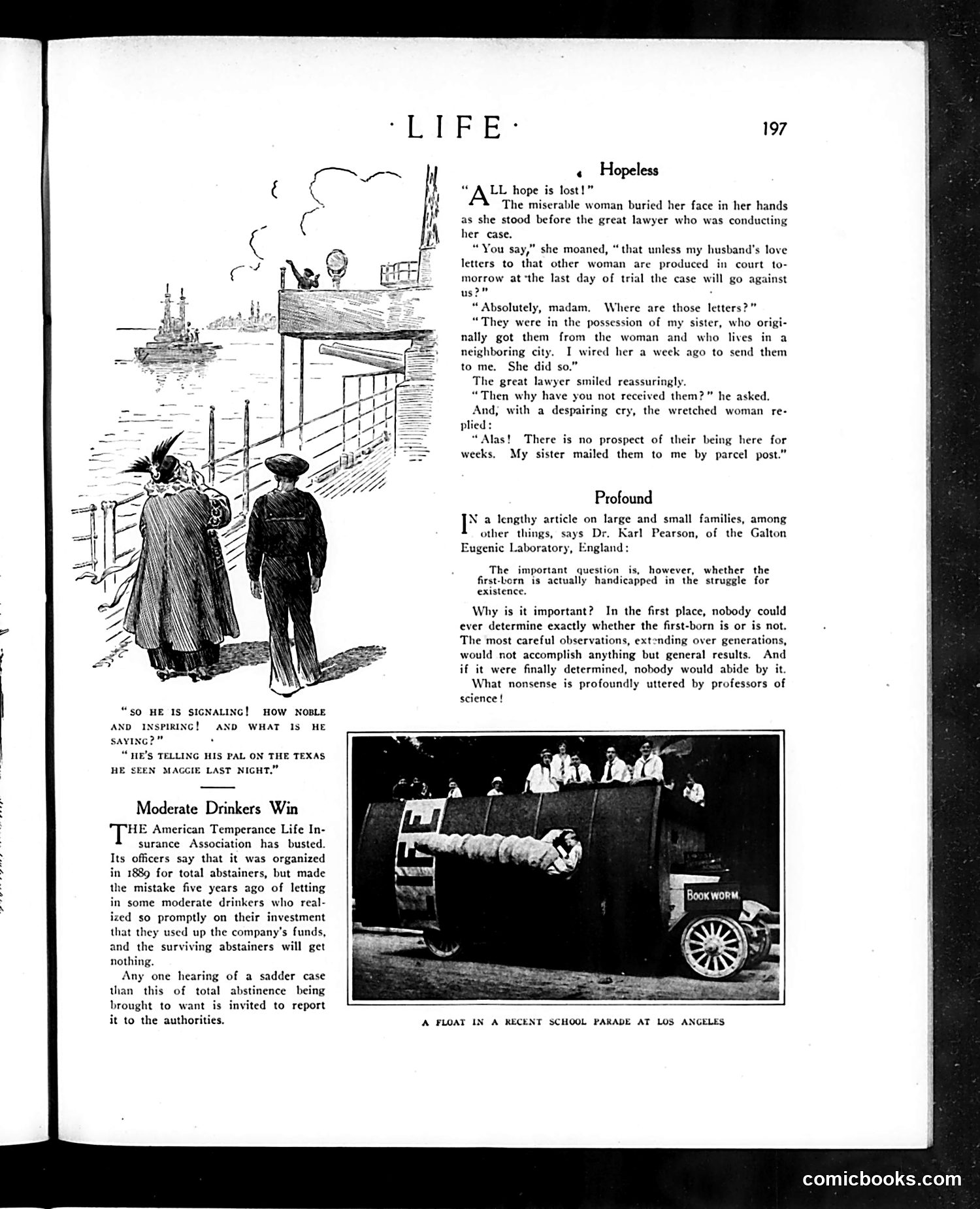
This page contains three distinct satirical pieces: **"Hopeless"** mocks the unreliability of parcel post. A woman's divorce case hinges on love letters her sister mailed weeks ago—which haven't arrived. The joke: the postal system is so slow that critical legal evidence may never reach court in time, undermining her lawsuit. **"Profound"** ridicules academic overreach. A scientist publishes lengthy theories about whether firstborns are disadvantaged in life—conclusions impossible to prove definitively and that nobody would follow anyway. The satire: professors waste time on unanswerable questions dressed up as serious science. **"Moderate Drinkers Win"** satirizes Prohibition-era temperance insurance. An organization created in 1889 to insure only total abstainers went bankrupt after admitting "moderate drinkers" five years prior—who promptly filed claims and exhausted funds. The irony: moderate drinking undermined abstinence-based charity. The accompanying illustration shows a "bookworm" float in a Los Angeles school parade, likely reinforcing intellectual themes on the page.
This editorial page discusses prospects for peace in World War I, then roughly a year old. The cartoons (small illustrations of figures) appear to satirize the naive hope for peace—one shows a dejected figure, another depicts the phrase "where at?" suggesting confusion about where peace negotiations might occur. The text argues peace is impossible until one side achieves decisive military victory or internal collapse forces settlement. It criticizes the notion that neutral conferences or diplomatic efforts can succeed when governments remain committed to their stated war aims. Notably, it predicts Germany will face severe political consequences after the war when its government must confront a "bereaved, impoverished and disappointed people"—an astute observation about post-war instability. The piece presents American neutrality as appropriate caution, warning against "officious" peace efforts that might squander diplomatic influence. The Latin phrase *vi et armis* ("by force of arms") emphasizes that only military resolution will end the conflict.
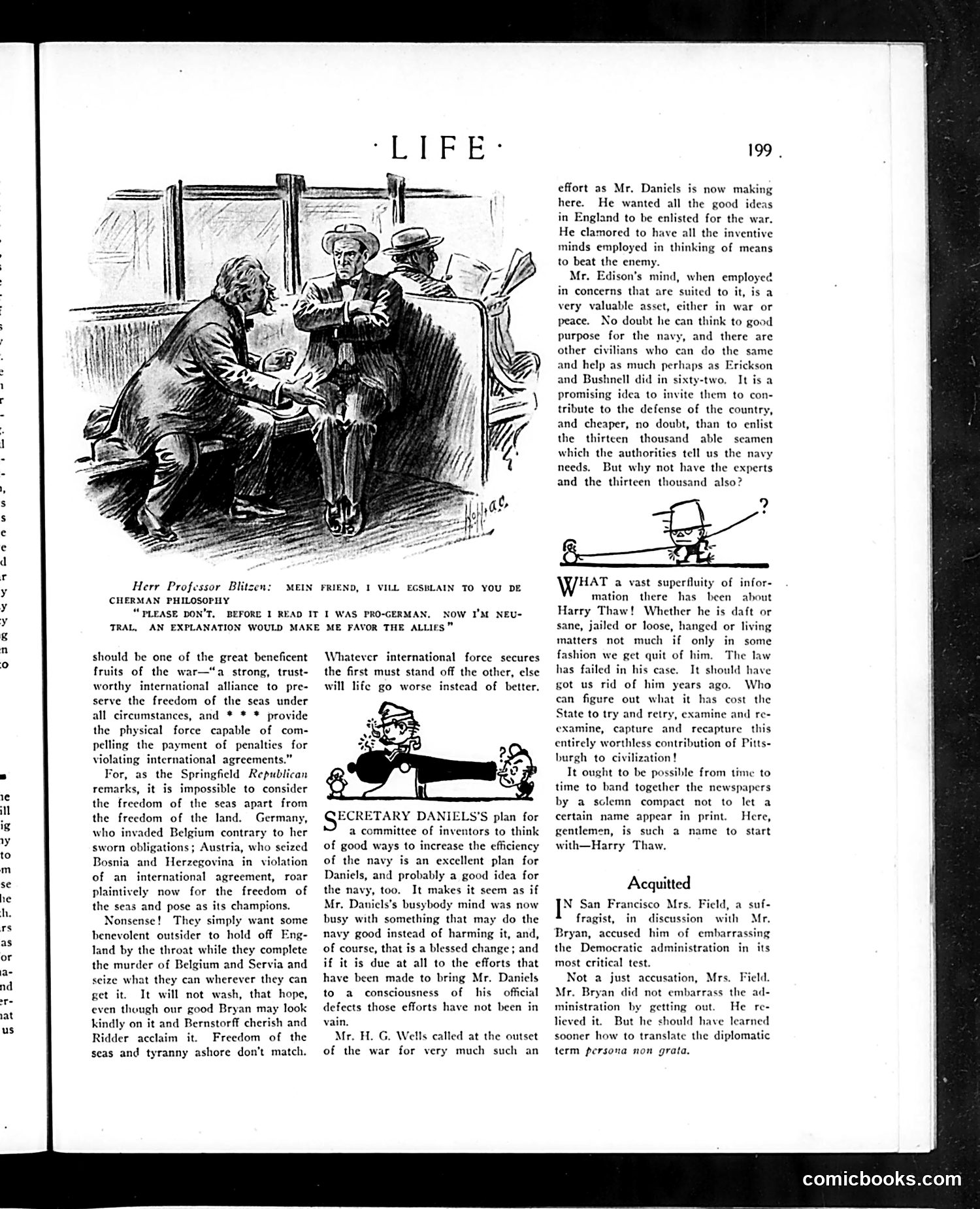
This page contains three separate satirical pieces from Life magazine during World War I: **"Herr Professor Blitzen"** mocks German philosophy through a dialogue joke: a German professor offers to explain German logic, but his listener warns that before hearing it, he was pro-German—hearing it would make him neutral. The satire attacks German justifications for invading Belgium and seizing other nations while hypocritically claiming to defend "freedom of the seas." **The Daniels/Edison section** praises Secretary of the Navy Josephus Daniels's plan to recruit inventors (including Thomas Edison) to improve naval efficiency, though sarcastically noting this redirects his "busybody mind" toward something actually useful rather than harmful. **"Harry Thaw"** expresses exasperation with media coverage of Thaw, a wealthy Pittsburgh man involved in a sensational murder case. The author argues the legal system has repeatedly failed to resolve his case and proposes newspapers sign a compact to stop printing his name entirely. All three pieces reflect wartime concerns, bureaucratic frustration, and the press's role in public discourse.
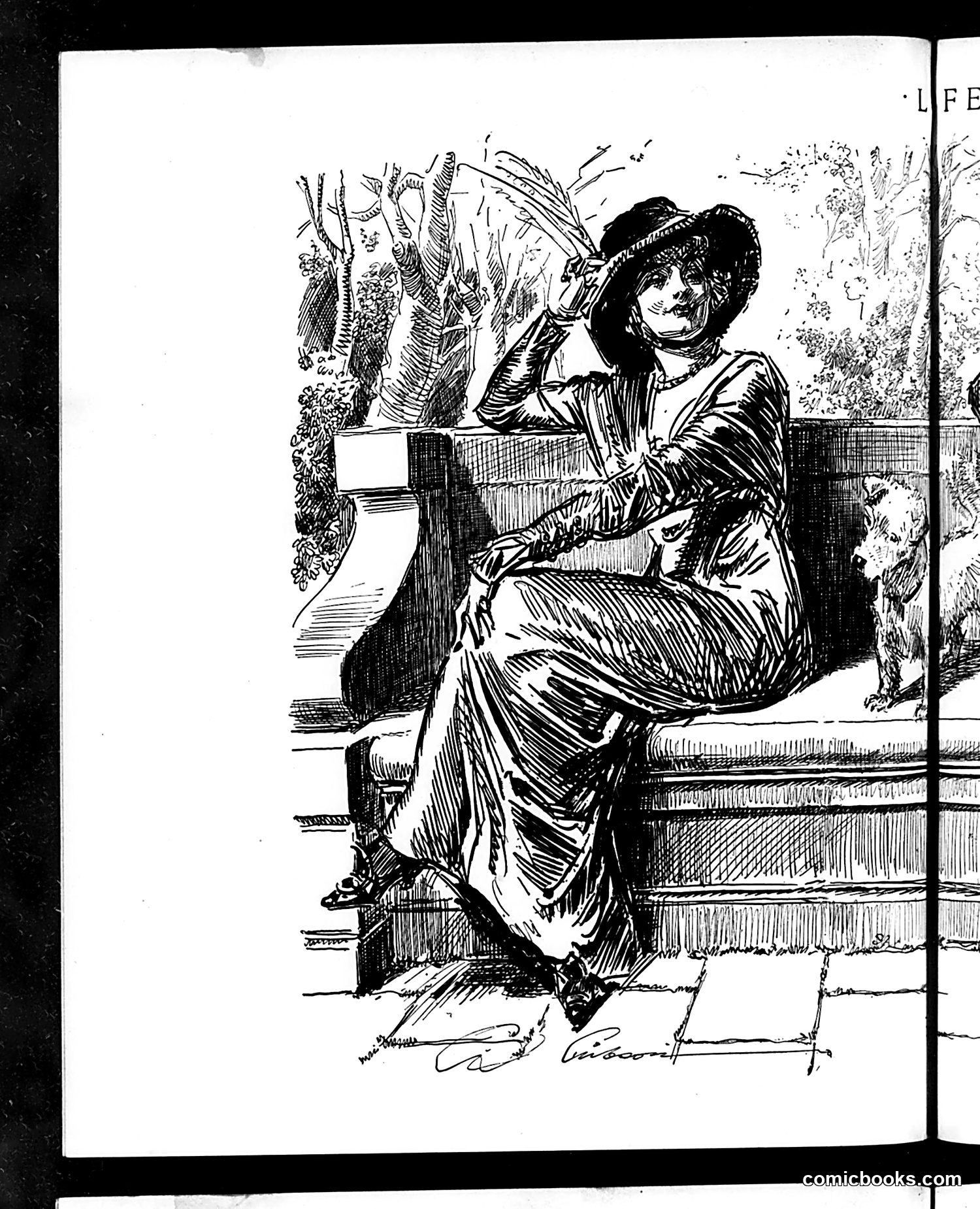
This pen-and-ink illustration depicts a fashionably dressed woman seated outdoors on what appears to be a garden bench or steps. She wears an elaborate hat, long dress with detailed drapery, and holds what looks like a small book or notebook. Ivy or climbing vines frame the left side of the composition, suggesting a leisure setting. The OCR text is largely illegible, making it difficult to identify specific political figures or determine the precise satirical target. However, the illustration's style and subject—a well-dressed woman in a contemplative pose—suggests this may comment on women's roles, leisure activities, or social aspirations during the early 20th century. Without clearer text or additional context, the specific joke or critique remains unclear.
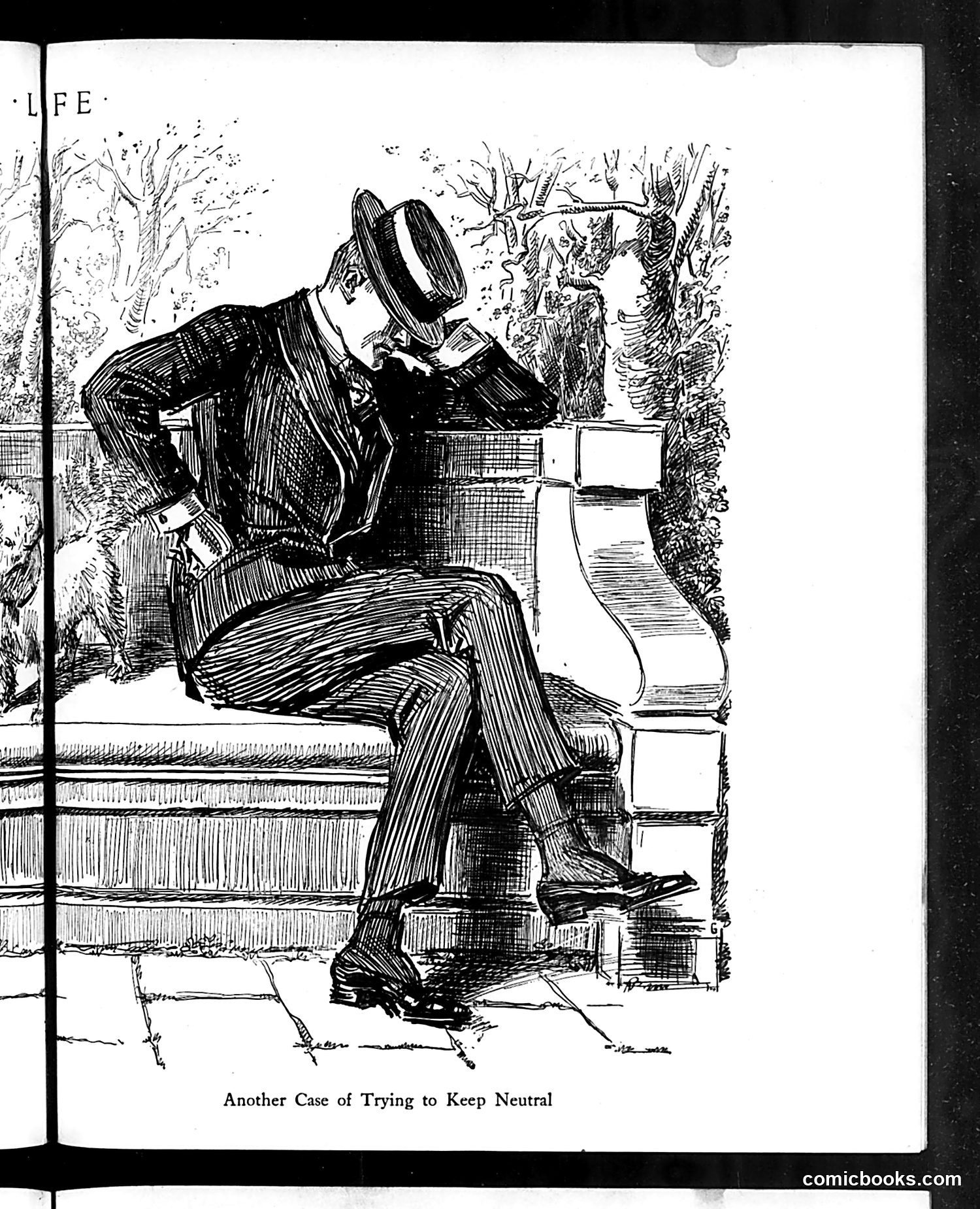
This political cartoon satirizes neutrality during a conflict. A well-dressed man in a suit and hat sits uncomfortably on a bench positioned between two opposing forces—suggested by the sketchy, violent imagery on either side of him. His body language shows tension and strain as he attempts to maintain a balanced, neutral position. The caption "Another Case of Trying to Keep Neutral" mocks the impossibility of remaining impartial when pressured by competing sides. The cartoon likely comments on American neutrality debates, possibly during World War I or II, when the U.S. faced pressure to choose sides. The figure's obvious discomfort suggests that "neutrality" is an unstable, unsustainable position—a common critique of fence-sitting during major geopolitical conflicts.
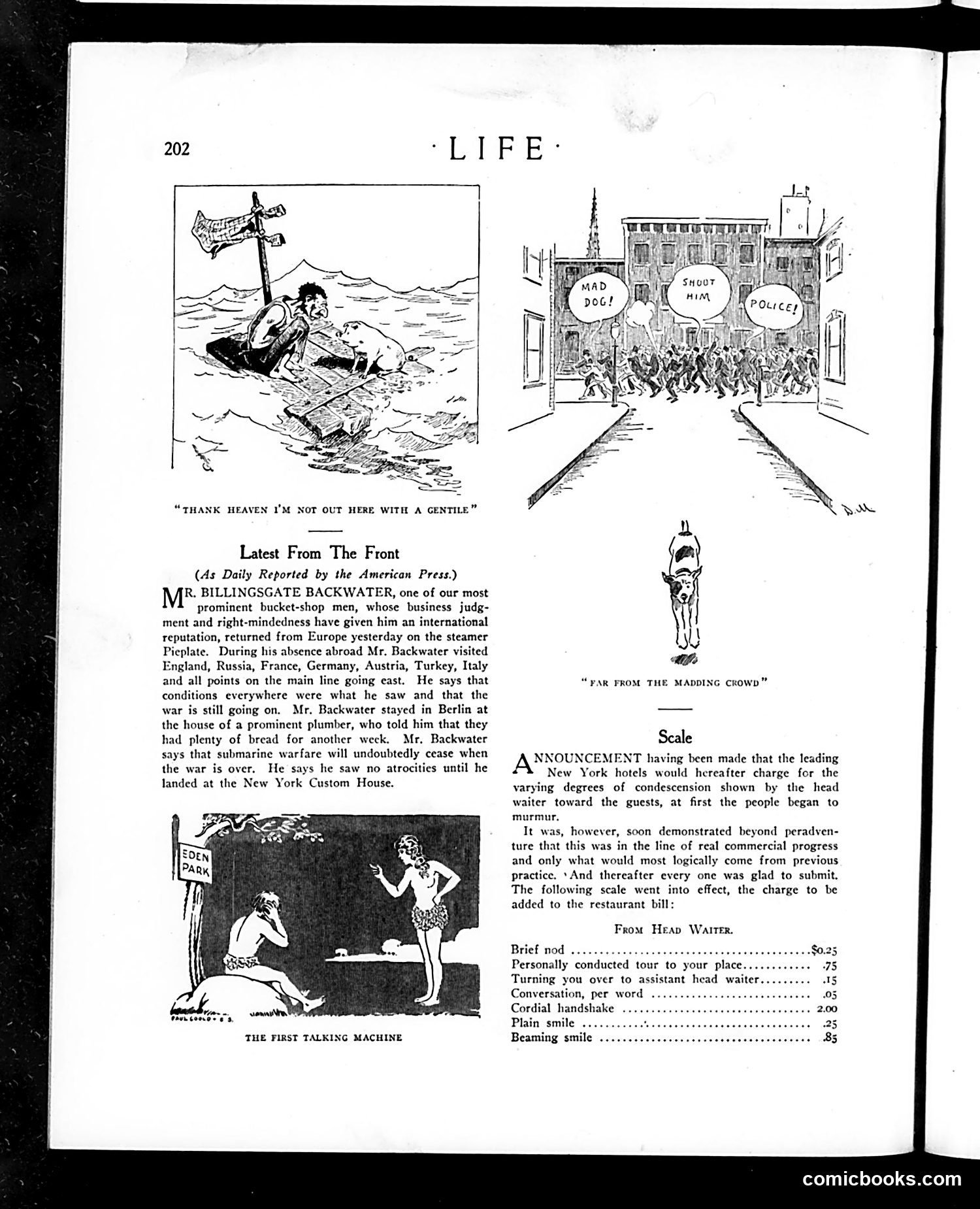
This Life magazine page satirizes post-WWI American society through three cartoons and accompanying text. **Top left cartoon**: A soldier in a trench expresses relief at not being with a "gentile," satirizing antisemitic attitudes and ethnic tensions within the military during World War I. **Top right cartoon**: Depicts urban chaos with crowds shouting "Mad dog!", "Shoot him!", and "Police!"—likely mocking sensationalist newspaper reporting and public hysteria, possibly referencing immigrant communities or labor unrest. **"Latest From The Front"**: Parodies vapid war reporting through a fictional Mr. Backwater, a stockbroker whose observations abroad are absurdly meaningless ("the war is still going on"). This mocks American businessmen and press coverage that reduced complex European conflict to superficial anecdotes. **Bottom section ("Scale")**: Satirizes New York hotels charging customers for varying degrees of waiter condescension—a sharp critique of class hierarchies and commercialization of social deference in the service industry.
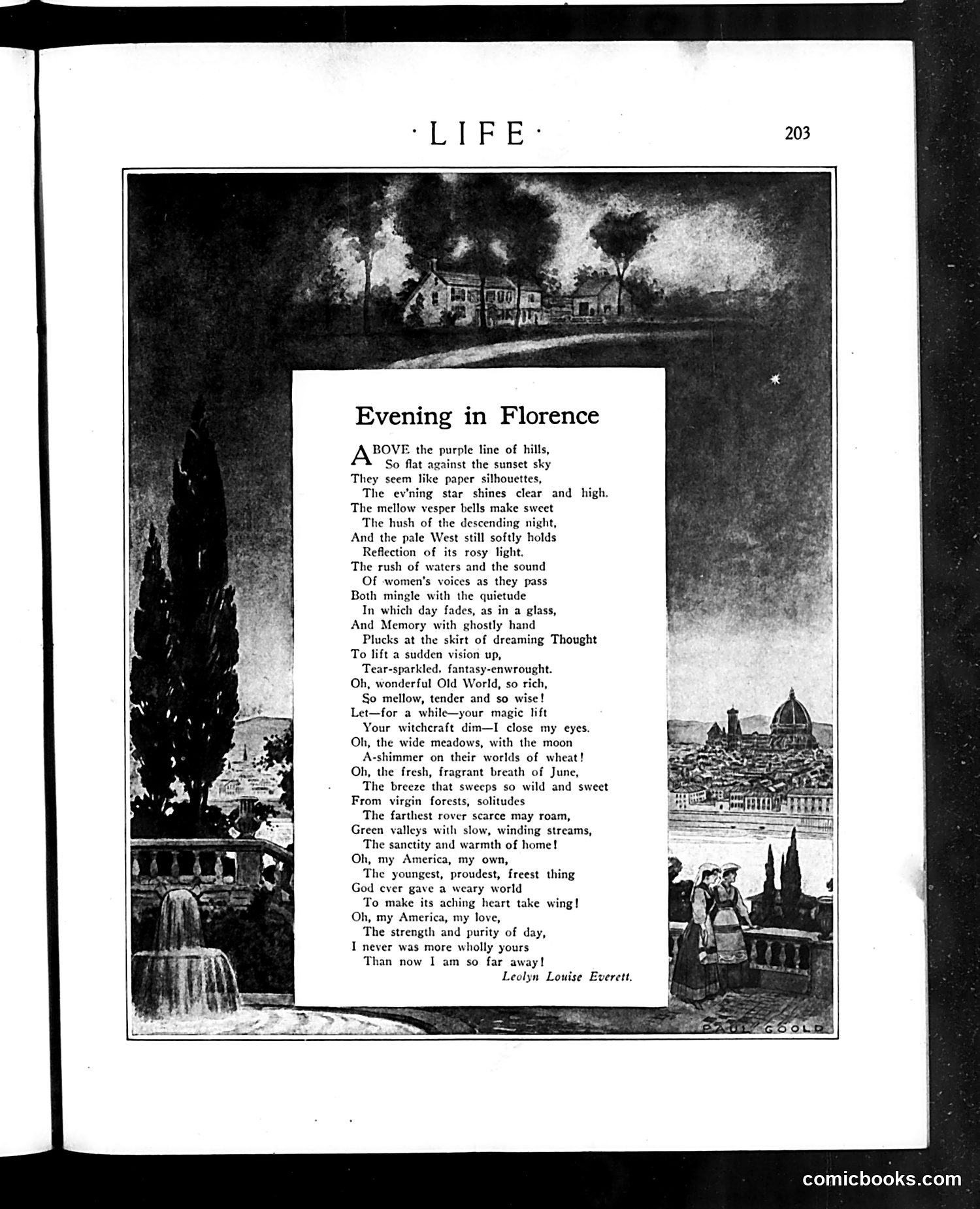
This is not a political cartoon but a sentimental poem by Leolyn Louise Everett, accompanied by illustrations of Italian scenes. The page reflects early 20th-century American nostalgia. The poem describes an expatriate—likely an American—in Florence, Italy, who becomes homesick while admiring the Old World's beauty. The speaker contrasts Europe's historical grandeur with passionate patriotism for America, which is praised as "the youngest, proudest, freest thing / God ever gave a weary world." The illustrations show Florentine landmarks (the cathedral, cypress trees, riverside views) framing the text. The satire, if present, is gentle: the poem mocks the romantic tendency to idealize foreign travel while ultimately affirming American superiority and values—a common theme reflecting early 1900s American exceptionalism and the tension between cosmopolitan European appreciation and patriotic nationalism.
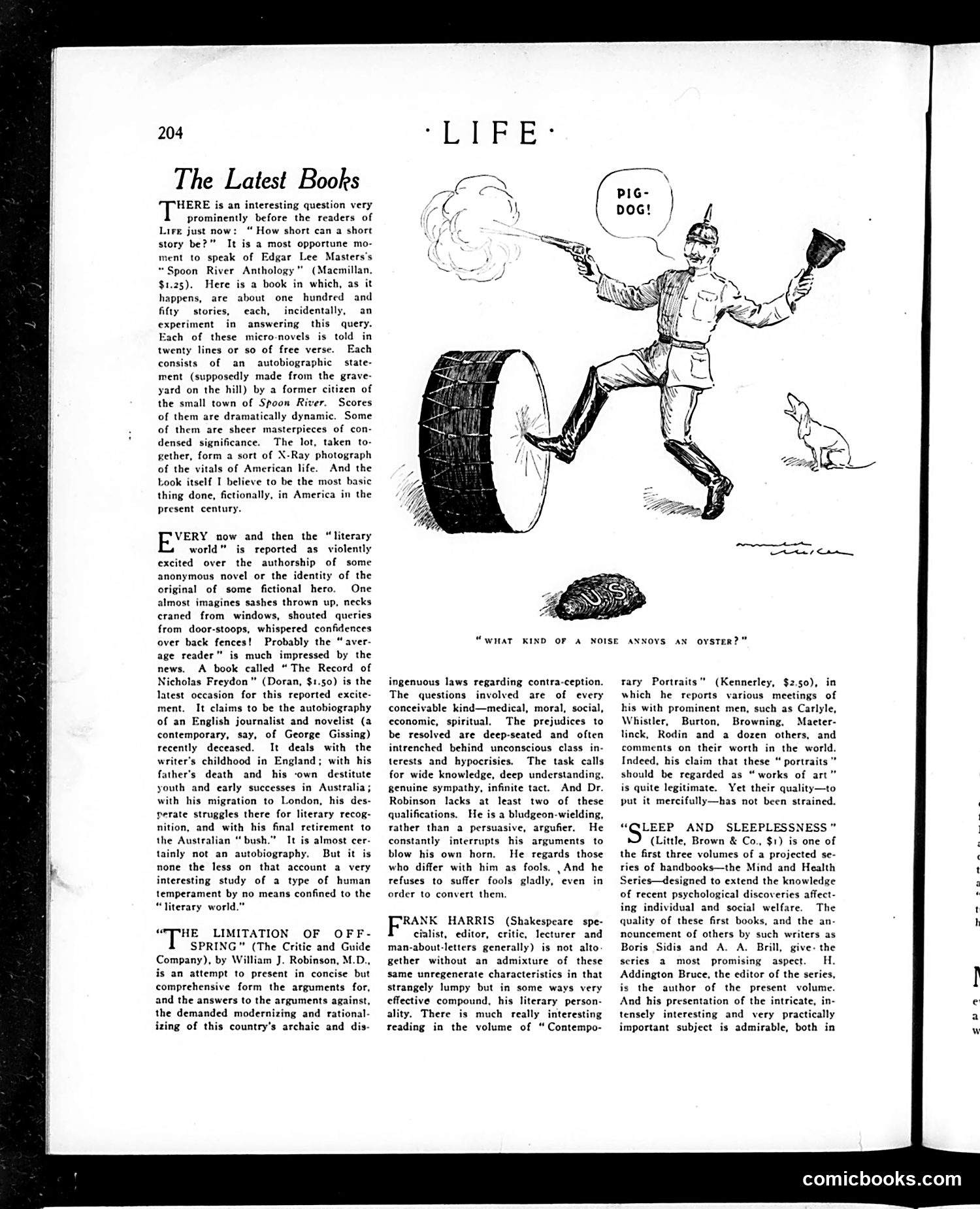
This page from *Life* magazine contains a book review section alongside a humorous cartoon. The illustration depicts a military or uniformed figure shouting "BIG DOG!" while gesturing wildly with a broom, confronting a small rabbit or hare. Below appears the caption "WHAT KIND OF A NOISE ANNOYS AN OYSTER?"—a playful nonsense phrase. The cartoon likely satirizes literary pretension or bombastic criticism. The figure's exaggerated posturing and theatrical gestures mock overwrought or self-important commentary on literature. The absurdist caption reinforces the joke: just as the question about what noise annoys an oyster is nonsensical, so too is the loud, blustering approach to discussing serious literary matters. The surrounding book reviews discuss substantive works like Edgar Lee Masters's *Spoon River Anthology* and philosophical texts on birth control, contrasting with the page's satirical visual humor.
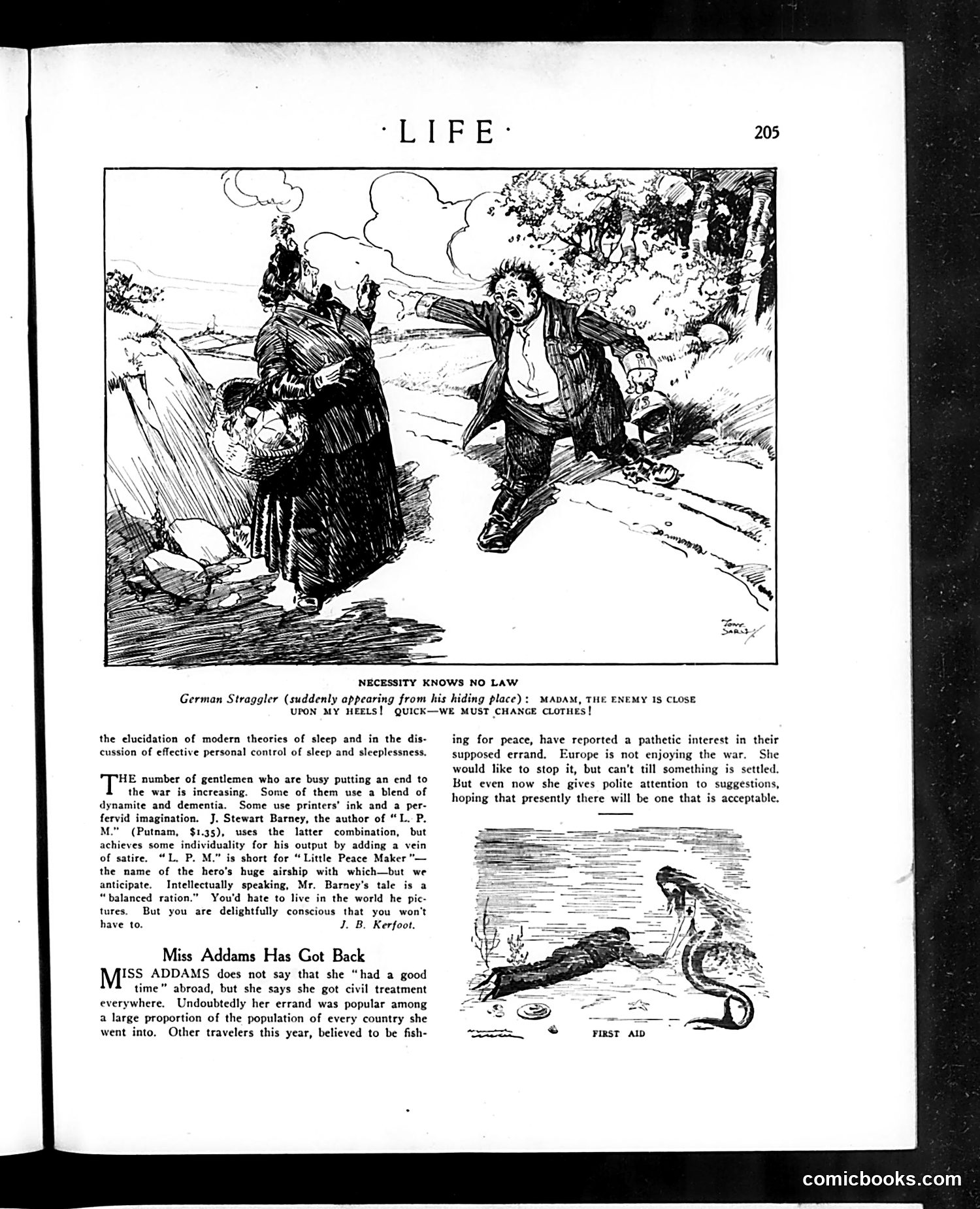
**Top Cartoon - "Necessity Knows No Law":** A German soldier, suddenly appearing from hiding, urgently demands that a civilian exchange clothes with him. The caption indicates the enemy is pursuing closely. This satirizes German military desperation during WWI—soldiers attempting to evade capture by disguising themselves as civilians, a violation of military law. The cartoon mocks both German military predicament and the lawlessness war produces. **Text Content:** The page reviews J. Stewart Barney's novel "L.P.M." (Little Peace Maker), featuring an airship attempting to end WWI. The reviewer notes the book uses satire to imagine a peace-seeking world readers are "delightfully conscious" they won't actually live in. A separate item references Jane Addams's return from European peace efforts, noting that while Europe desperately wants war to end, it cannot until "something is settled"—acknowledging peace negotiations' complexity during ongoing conflict. **Context:** This appears from WWI-era Life, when American satirical magazines combined entertainment with commentary on the war's absurdities and peace efforts.
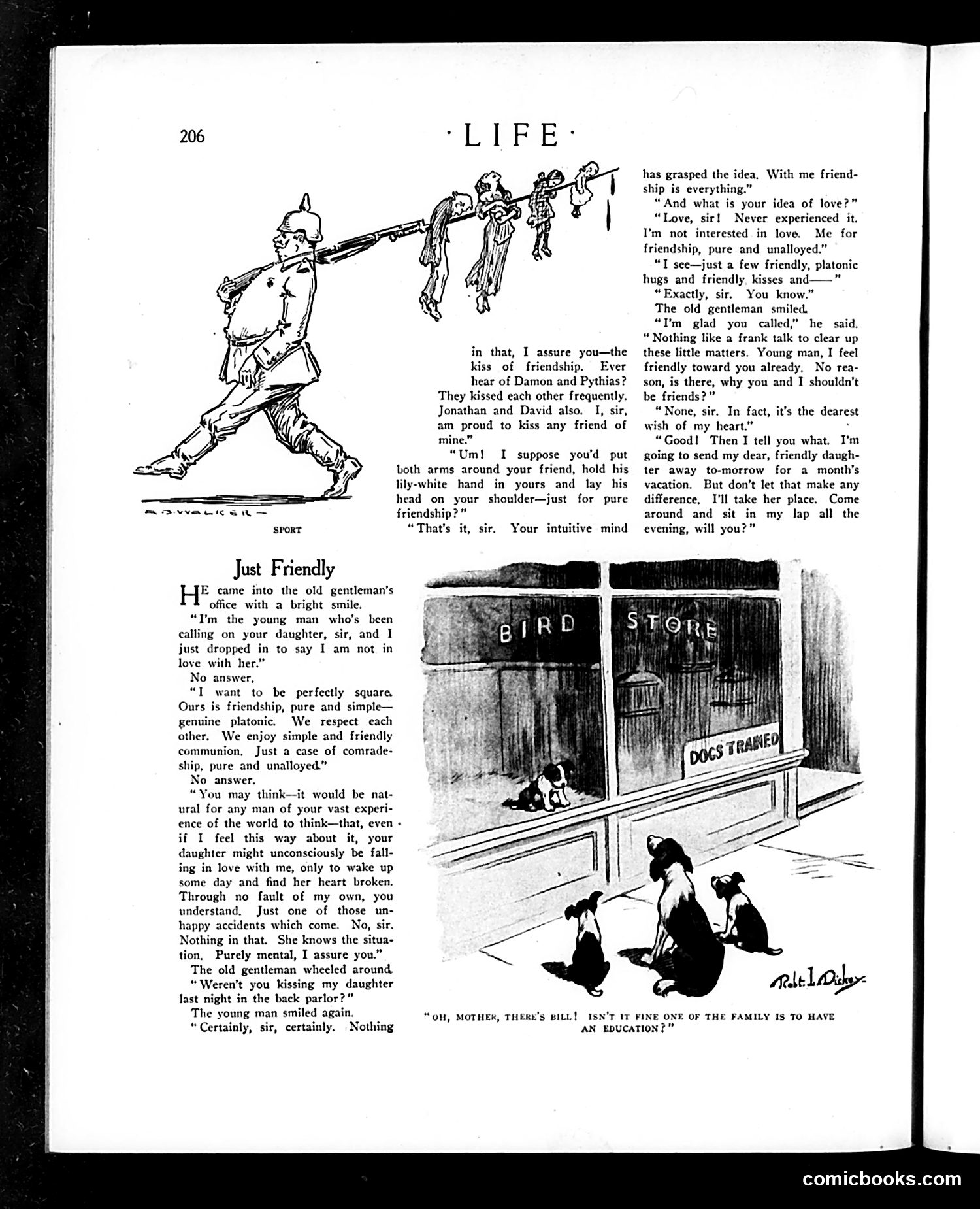
This story mocks a young man's transparent hypocrisy. He visits an old gentleman to insist he's "just friends" with his daughter—purely platonic, he claims, citing historical examples of male friendships involving kissing (Damon and Pythias, David and Jonathan). The satire exposes his obvious deception: he admits to kissing and embracing the daughter while denying romantic interest. When the father catches him in this contradiction, the young man doubles down with increasingly absurd justifications about "friendly" physical affection. The joke's payoff comes when the father—now understanding the young man's game—offers to be his "friend" too, proposing the young man sit in his lap. This ridicule forces the young man to face how ridiculous his claims sound when applied to men. The separate cartoon below satirizes parents' educational pretensions, showing dogs at a "Bird Store" window labeled "Dogs Trained."
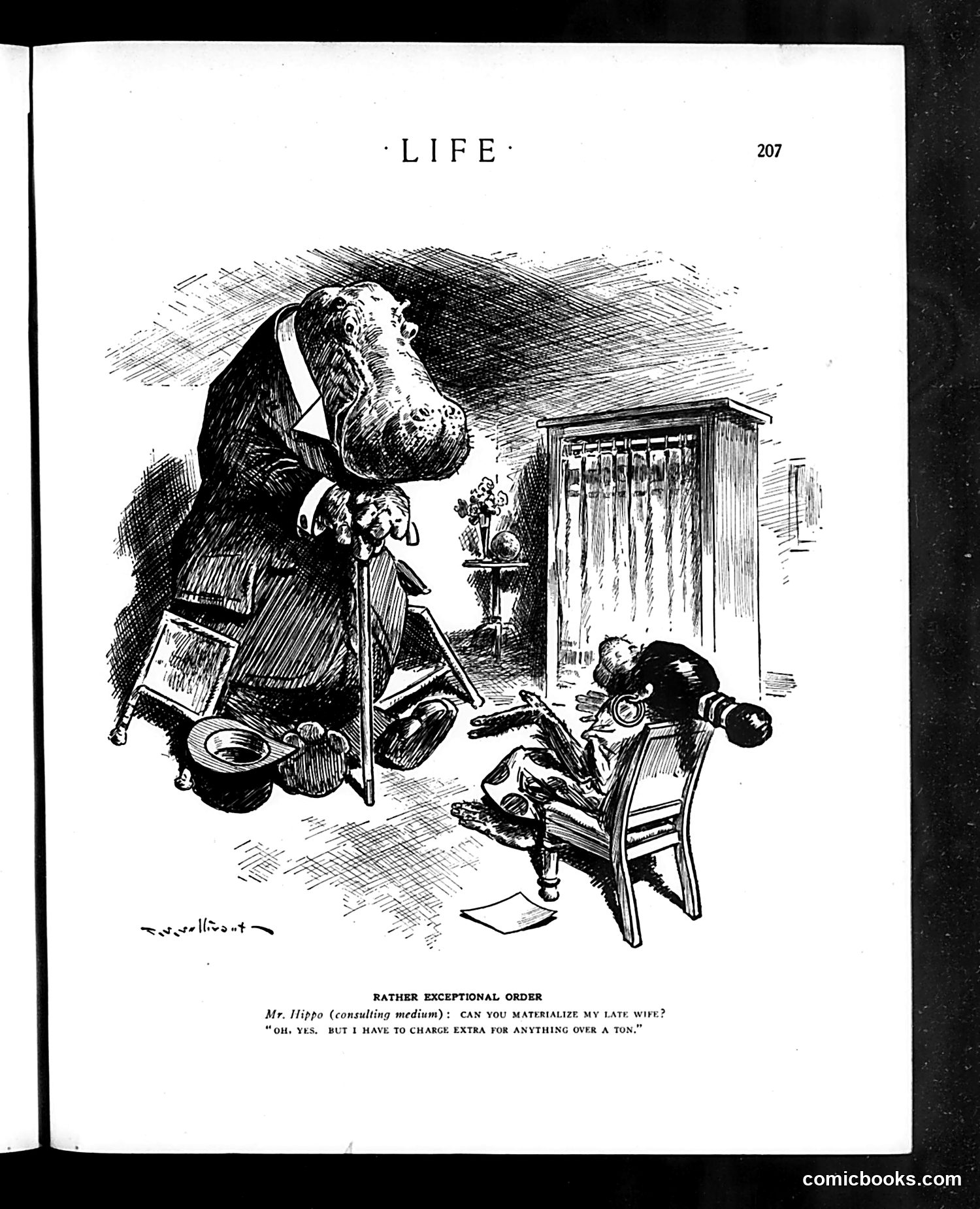
This cartoon satirizes spiritualism and séances, popular in early 20th-century America. A large hippopotamus consults a medium (spiritualist) to contact his deceased wife. The joke hinges on the medium's weight-based pricing: he charges extra for "anything over a ton," implying the hippo's late wife was extremely heavy. The humor targets both spiritualism itself—presented as fraudulent commerce—and the hippo's absurdly literal interpretation of supernatural services. The medium's casual, mercenary attitude suggests spiritualists were viewed as opportunistic charlatans exploiting grieving clients. The cartoon mocks both the gullible believers and the charlatans profiting from them during an era when séances were widespread middle and upper-class pursuits.
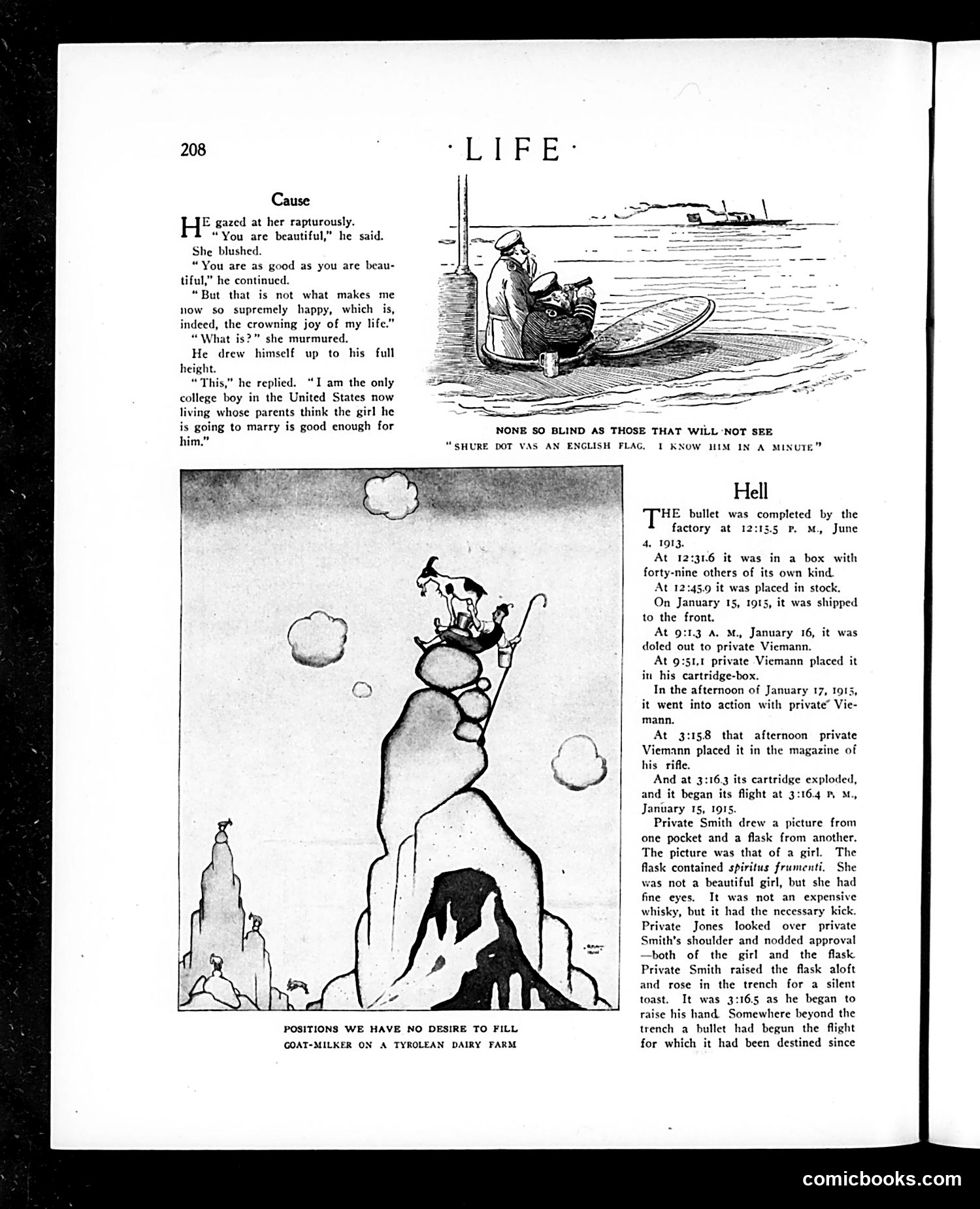
**"Cause" (top):** A young man boasts to his girlfriend that he's the only American college boy whose parents approve of the girl he'll marry. The joke mocks parental snobbery about romantic matches—the implicit criticism is that most parents are unreasonably judgmental about their sons' fiancées. **"Hell" (bottom):** This is darker satirical commentary on World War I. It traces a bullet's journey from manufacture (June 1913) through a soldier's hands, ending with a precise timestamp (3:16.5 P.M., January 17, 1915) when Private Smith raises a flask in a trench toast to his sweetheart—the exact moment the bullet reaches him. The story underscores the arbitrary cruelty of war: a manufactured object's predetermined path intersects with a soldier's final moment. The accompanying cartoon about "goat-milker" positions mocks military incompetence in assigning troops.
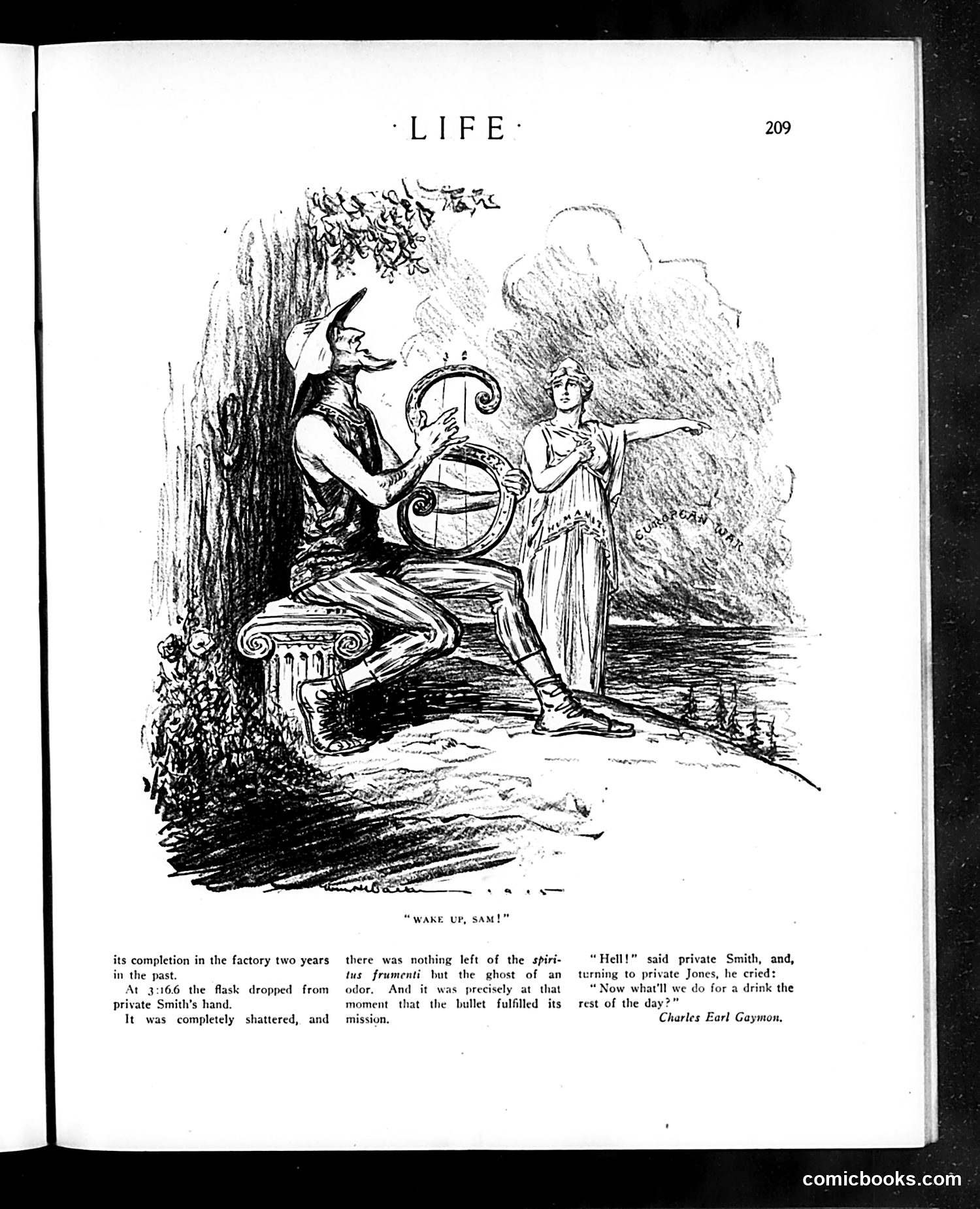
This satirical cartoon from *Life* magazine illustrates a darkly comedic military scene. The caption "Wake up, Sam!" suggests a soldier (Private Smith) has dozed off during wartime. The narrative describes a flask of liquor ("spiritus frumenti"—Latin for alcoholic spirits) dropping from Smith's hand and shattering at precisely 3:16.6, the same moment a bullet strikes its target, killing someone (likely an enemy soldier). The joke satirizes soldier priorities: rather than concern about the fatal shot, Smith's immediate reaction is frustration about losing his drink for the remainder of the day. This mocks both military drinking culture and the apparent indifference soldiers develop toward combat deaths—treating a lost alcohol supply as more significant than a casualty. The classical allegorical figures in the illustration (appearing to represent Mercury or similar) add ironic contrast to the gritty military reality described below.
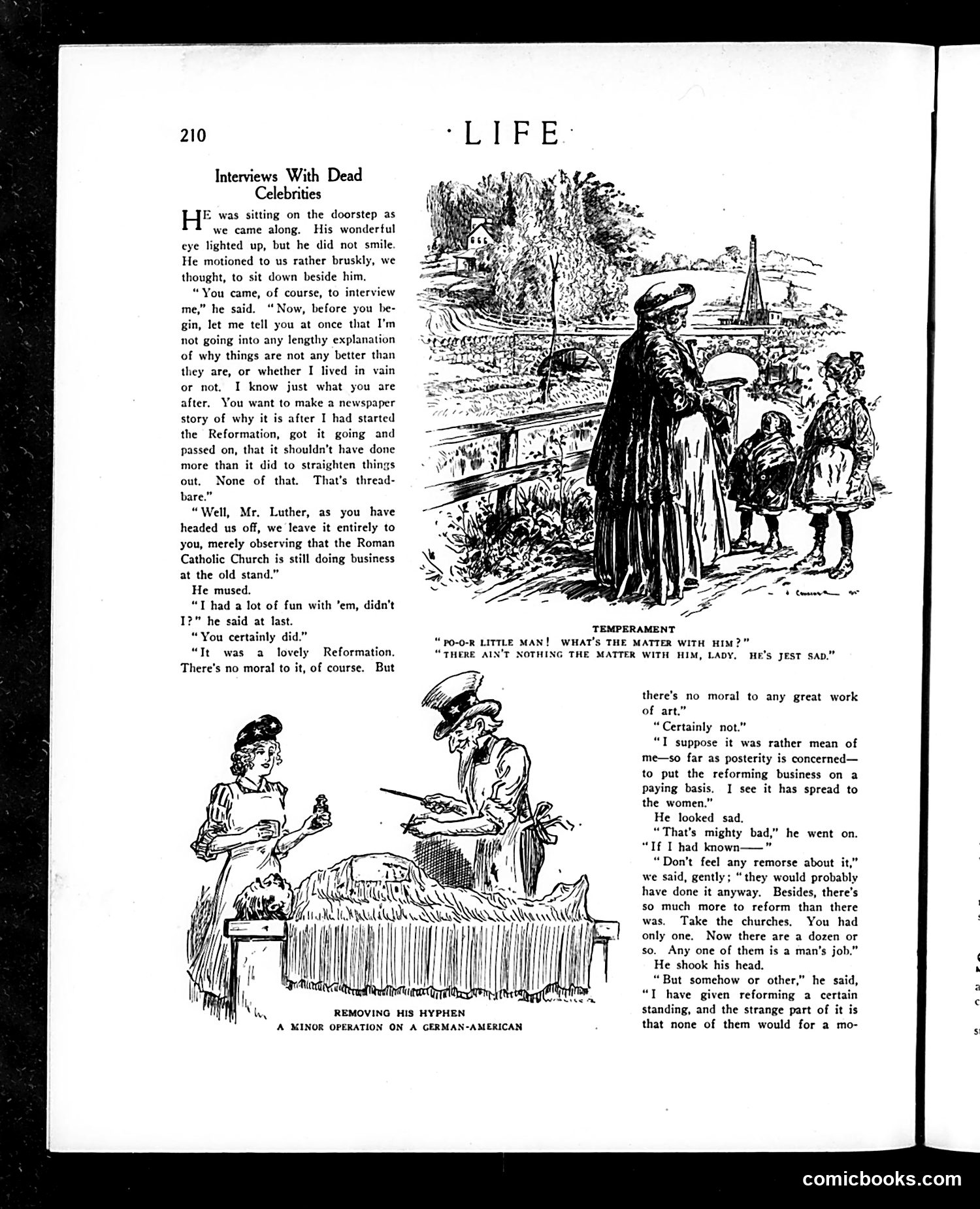
This satirical piece features Martin Luther as an interviewed ghost, reflecting on the unintended consequences of the Protestant Reformation. Luther defends his accomplishments ("a lovely Reformation") but grows melancholy learning the Catholic Church still thrives and that reformism has proliferated into endless causes—now even affecting women. The lower cartoon, "Removing His Hyphen," depicts a "German-American" figure being made sad by having his hyphenated identity surgically removed. This likely references WWI-era tensions: German-Americans faced discrimination and pressure to prove loyalty to America rather than maintaining dual identity. The procedure's emotional toll suggests the painful erasure of cultural heritage demanded by wartime nationalism. Both pieces use dark humor to critique institutional change and political conformity pressure.
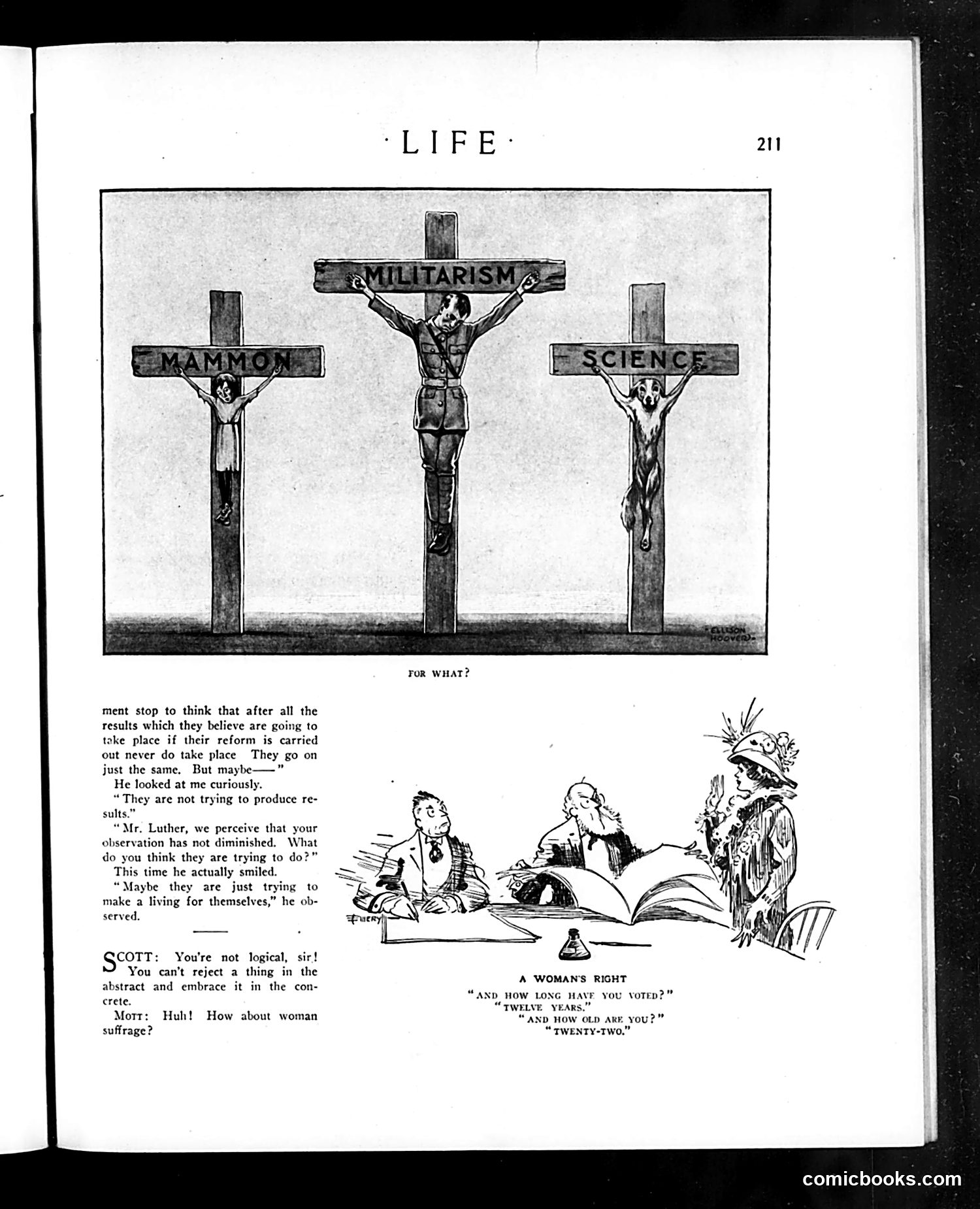
This page satirizes early 20th-century reform movements and women's suffrage. The top illustration depicts three crucifixes labeled "Mammon" (wealth/greed), "Militarism," and "Science"—representing forces the page's author views as destructively dominant in society, presented in mock-religious iconography. The dialogue below features characters debating whether reformers genuinely seek change or merely profit from reform movements. Scott and Mott's exchange mocks logical inconsistency: Mott argues one cannot reject something abstractly while accepting it concretely—then immediately uses women's suffrage as a counterexample, suggesting it's hypocritical or illogical. The cartoon "A Woman's Right" shows a woman claiming twenty-two years of voting experience when asked her age (twenty-two total), implying women voters are inexperienced or absurdly young. This ridicules women's suffrage as premature or foolish—a common anti-suffrage argument of that era.
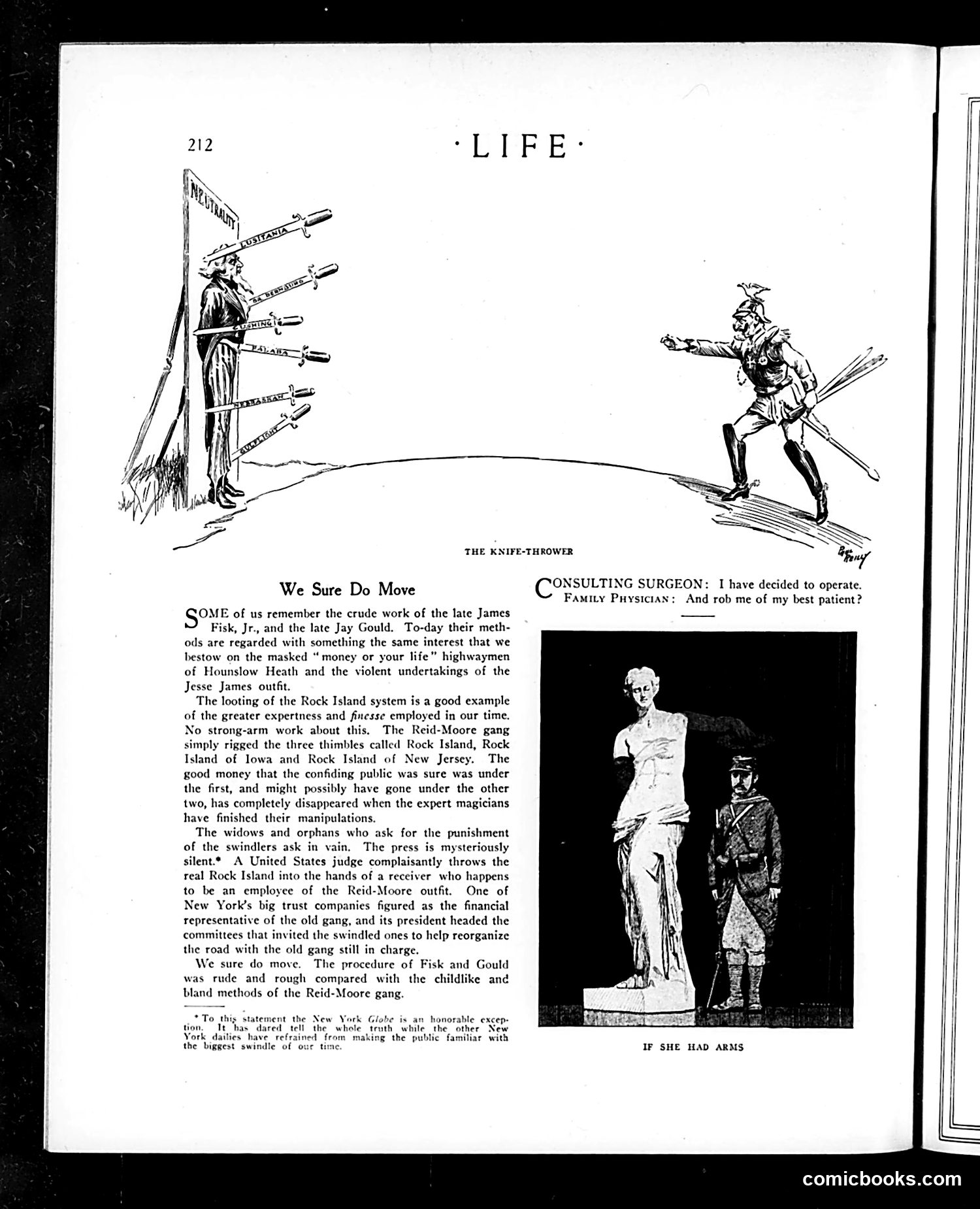
**"We Sure Do Move"** critiques the Reid-Moore gang's looting of Rock Island Railroad stock—comparing modern financial fraud to 19th-century outlaws like Fisk and Gould. The satirical point: contemporary swindlers use sophisticated manipulation ("finesse") rather than crude violence, making them harder to prosecute. The press stays silent, judges collude, and trust companies facilitate the theft while widows and orphans lose everything. Life argues that refined white-collar crime is actually *more* dangerous than historical banditry because it operates within legal structures. **"The Knife-Thrower"** (top) depicts a figure hurling weapons at a target—likely representing the same financial predators attacking the public's wealth. **"If She Had Arms"** (bottom right) shows Lady Justice as a statue, apparently defenseless—suggesting the legal system cannot or will not protect victims from these crimes. The cartoons collectively condemn systemic corruption where financial elites exploit legal processes while legitimate law enforcement remains passive.
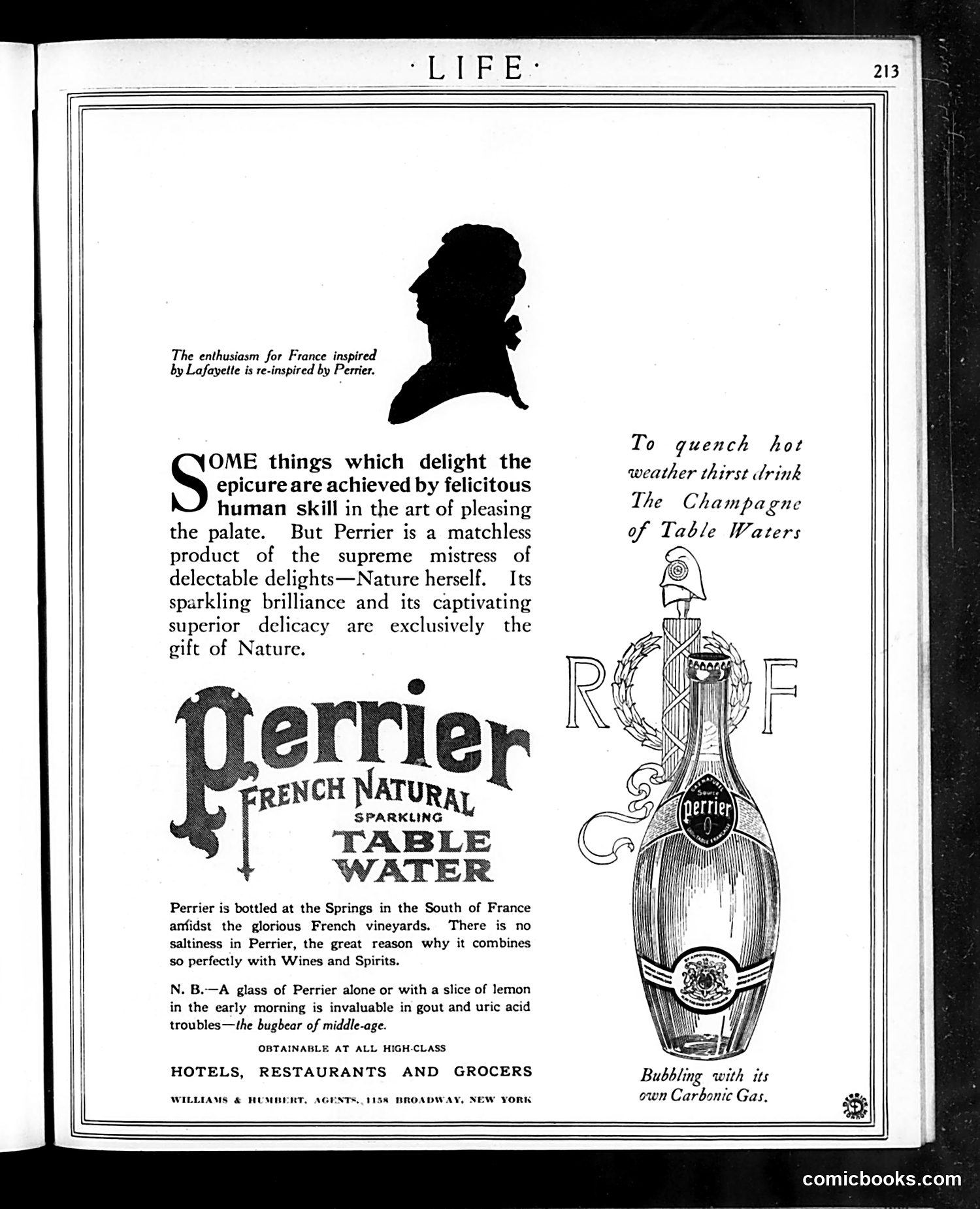
This is primarily a **Perrier sparkling water advertisement**, not a political cartoon. The silhouette at top depicts **Lafayette**, the French Revolutionary War hero, used to invoke French prestige and patriotism. The ad's strategy links Perrier to Lafayette-inspired "enthusiasm for France"—appealing to American Francophilia. The text emphasizes that Perrier is a "natural" product from southern France, positioning it as superior to artificially made beverages. The right side shows an ornate Perrier bottle with classical imagery. A note claims the water aids "gout and uric acid troubles—the bugbear of middle-age," marketing it as medicinal for wealthy, aging consumers ("high-class hotels, restaurants"). The satire is subtle: Life's readers would recognize the overwrought language ("supreme mistress of delectable delights—Nature herself") as mock-pretentious advertising speak, typical of the magazine's satirical tone toward consumer culture.
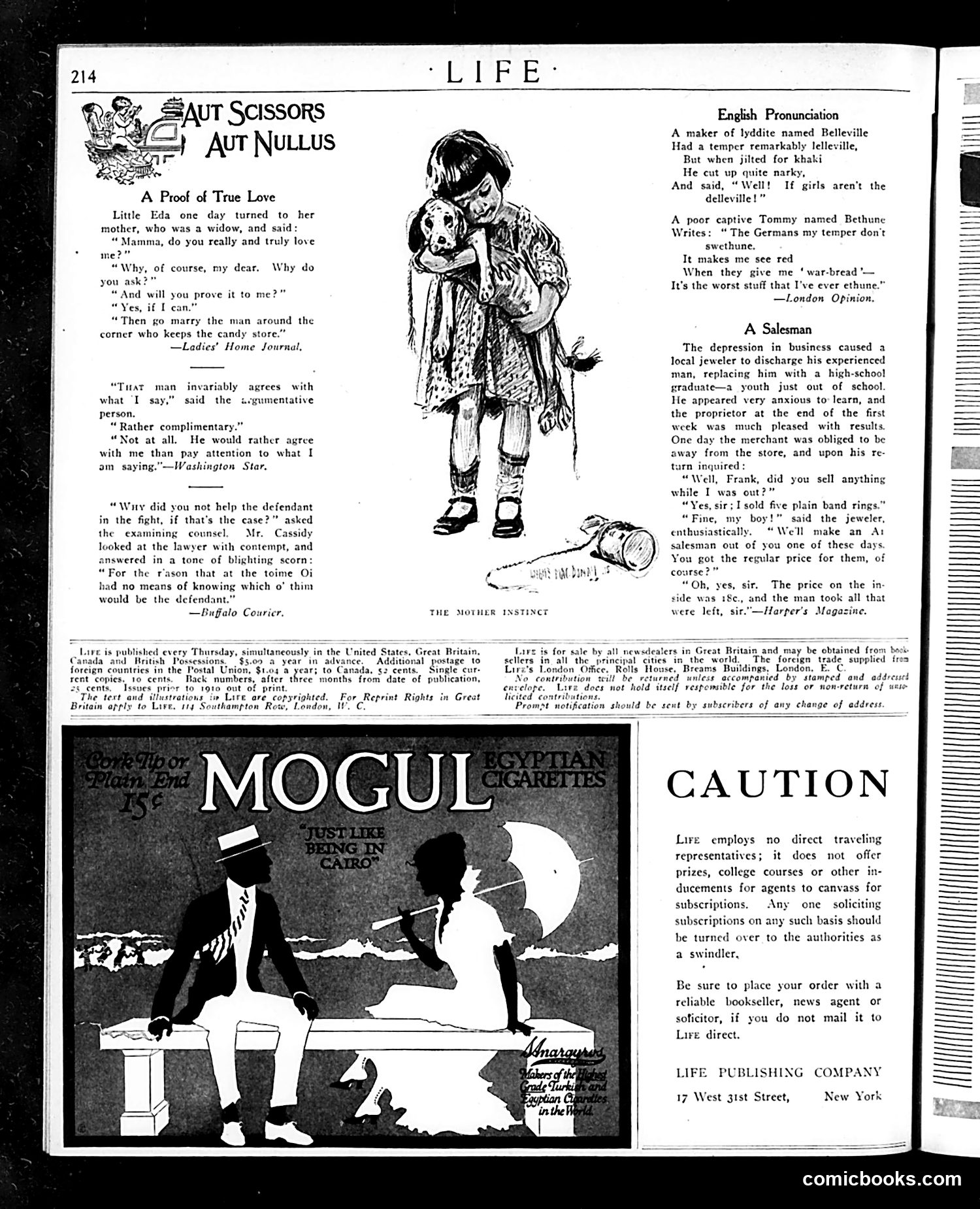
This page contains three brief humorous anecdotes and a Mogul Cigarettes advertisement. **The jokes** satirize human nature: a widow's "true love" requires marrying the candy store owner (implying mercenary motives); an argumentative man's companion agrees with him only to avoid listening; an Irish witness can't identify which fighter was the defendant because the outcome was uncertain. **The verse section** uses English pronunciation puns about wartime figures: "Belleville" (a explosives maker with a temper), "Bethune" (a British soldier complaining about German "war-bread"), mocking both military life and food shortages. **"A Salesman"** satirizes post-depression hiring: a jeweler replaces an experienced employee with a naive high-school graduate who naively sells expensive rings at marked-down prices, costing the business money through inexperience. **The Mogul advertisement** shows silhouettes of figures smoking, promoting Egyptian cigarettes as superior quality. The page is typical early-20th-century American humor—light, domestic, and occasionally touching on contemporary concerns like wartime conditions and economic hardship.
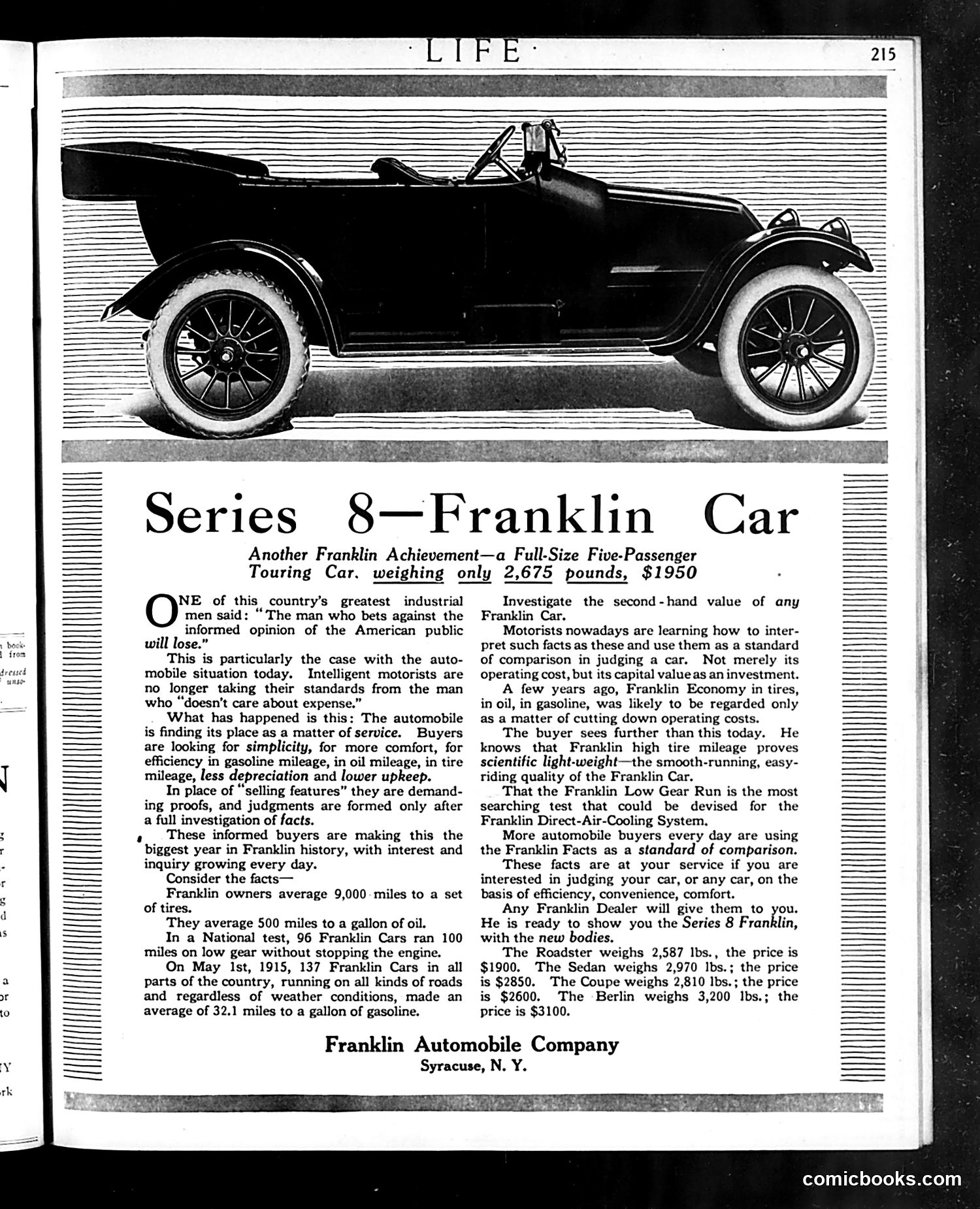
This is a full-page advertisement (not satire or cartoon) for the Franklin automobile, appearing in *Life* magazine around 1915. The page promotes the Series 8 Franklin, a five-passenger touring car priced at $1,950. The ad targets "informed buyers" who prioritize practical efficiency over luxury. It emphasizes measurable performance data—fuel economy (32.1 miles per gallon), tire durability (9,000 miles per set), and mechanical reliability (100 miles on low gear without stopping). The opening quote frames the message as aligned with "American public" opinion, appealing to rational consumer judgment rather than status-seeking. The ad positions Franklin cars as practical investments, not mere luxury goods—a significant sales pitch during the early automotive era when cars were still expensive, specialized purchases. The Franklin Automobile Company was based in Syracuse, New York, and produced air-cooled automobiles that competed with water-cooled models.
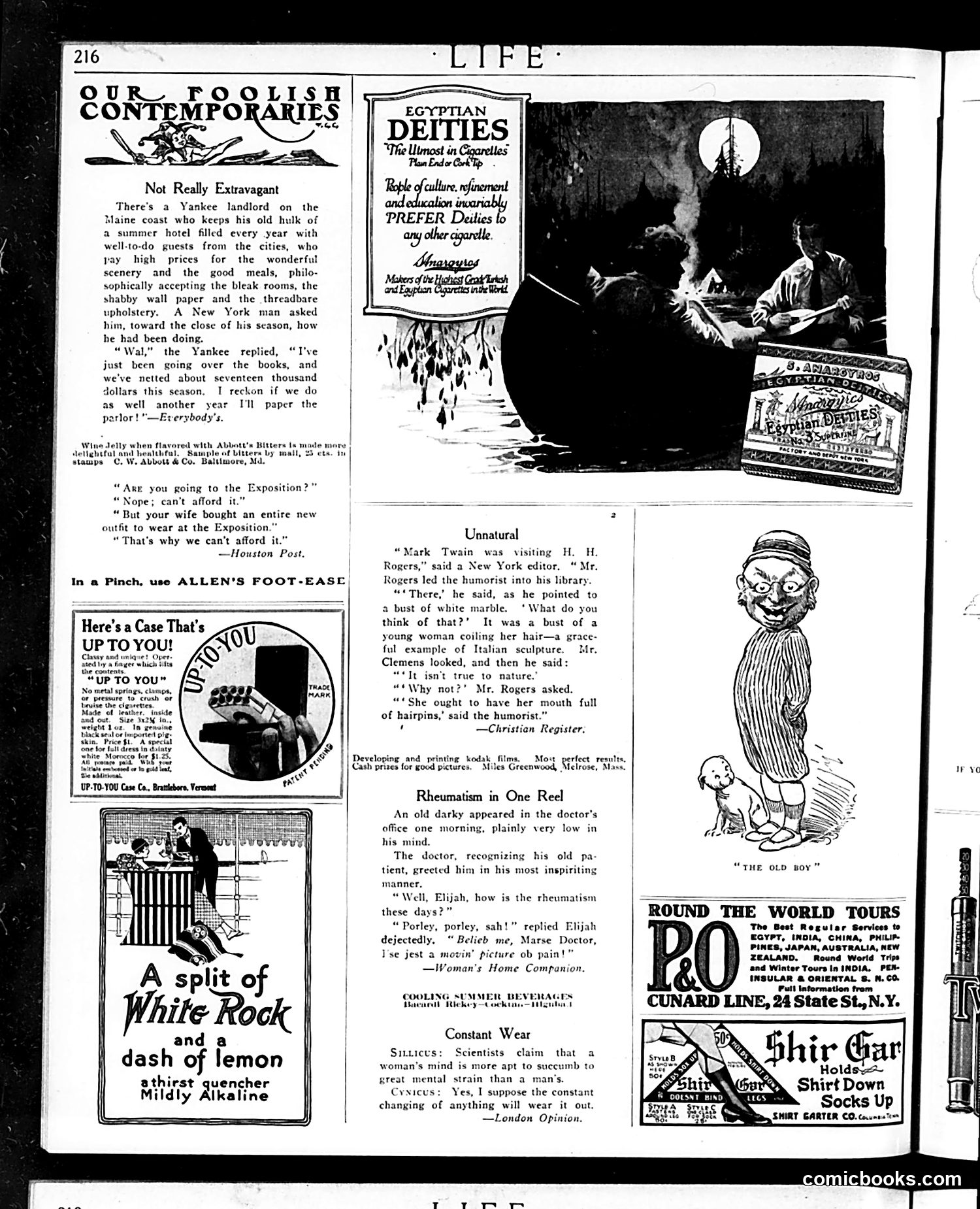
This page contains several brief humor pieces typical of early 20th-century American satire: **"Not Really Extravagant"**: A New England hotel keeper reveals he's netted $17,000 but won't renovate—satirizing rural Yankee frugality even amid prosperity. **Exposition Joke**: A man cannot afford the fair because his wife bought a new outfit *to attend* it—mocking couples' financial friction over unnecessary expenses. **Mark Twain Anecdote**: The famous humorist visits H.H. Rogers's library and criticizes a marble bust of a woman coiling her hair as "unnatural"—because she should have hairpins in her mouth. This jokes about Twain's reputation for witty, slightly irreverent commentary. **"Rheumatism in One Reel"**: An elderly Black man describes his pain as "a movin' picture ob pain"—a contemporary reference to the then-novel medium of cinema, using dialect humor common to the era. The page also contains period advertisements and brief one-liners about gender and mental strain. Overall, it reflects turn-of-the-century American middle-class preoccupations and entertainment conventions.
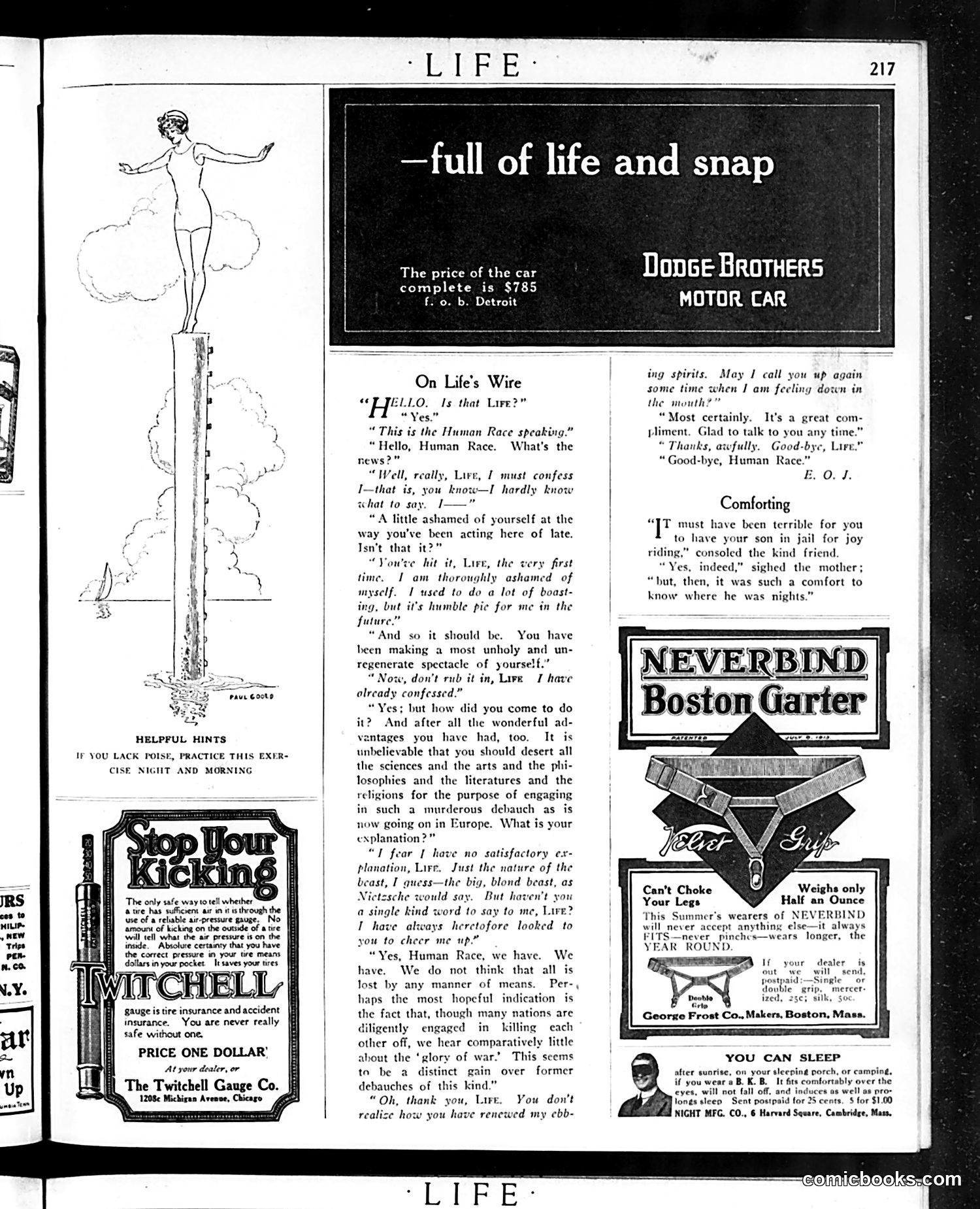
This page blends satirical editorial content with period advertisements. The main feature is "On Life's Wire," a dialogue between personified "Life" and the "Human Race" that serves as social commentary on World War I. The Human Race confesses shame for abandoning arts, sciences, and philosophy to engage in the "murderous debauch" occurring in Europe—a direct reference to WWI's carnage. Life offers consolation, noting that at least nations have stopped glorifying war as "glorious," suggesting some moral progress amid catastrophe. The page also includes humorous advertisements and a brief joke about a mother relieved her joy-riding son was in jail because "at least [she] know[s] where he was nights"—satirizing parental anxiety about youth behavior. The "Helpful Hints" section advertises tire gauges and other products typical of 1910s consumer culture. Overall, this is wartime satire layered beneath commercial content.
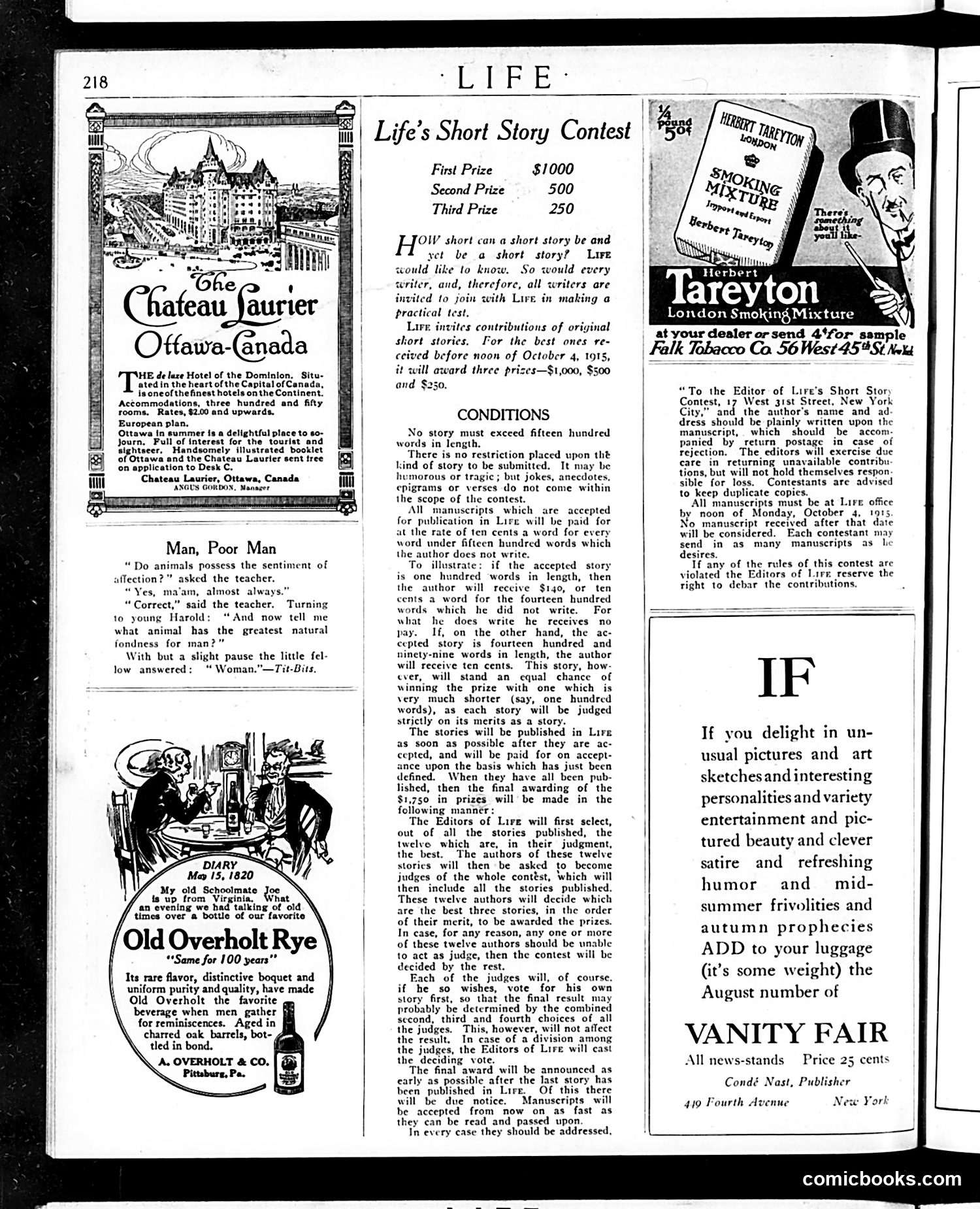
This page is primarily **advertisements and announcements** rather than political satire. The main content is **Life's Short Story Contest**, offering $1,000, $500, and $250 prizes for stories under 1,500 words, with submissions due October 4, 1915. The unusual payment scheme awards ten cents per word *not* written—incentivizing brevity. The page includes period advertising for: - **Château Laurier hotel** in Ottawa, Canada - **Old Overholt Rye whiskey** (dated "May 15, 1820") - **Tareyton London Smoking Mixture** tobacco There is one small joke titled "Man, Poor Man"—a teacher's exchange where a student answers that women have the "greatest natural fondness for man," a mild sexist quip typical of 1915 humor. The **IF** section promotes Vanity Fair magazine subscriptions. This is essentially a **promotional/advertisement page** with minimal satirical content.
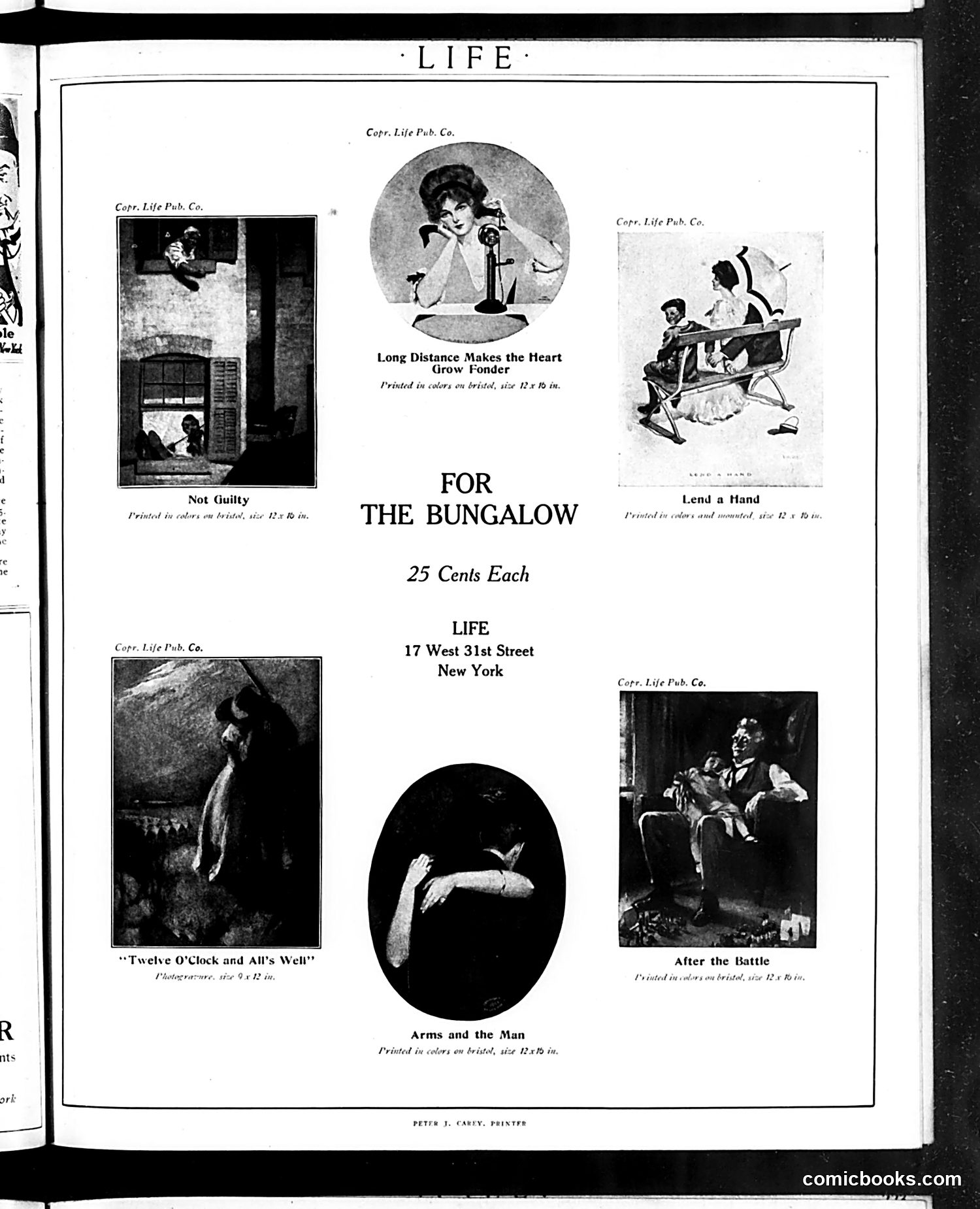
This is primarily an **advertising page** for Life magazine's print collection, not satirical political content. It advertises five available prints from "The Bungalow" series, each costing 25 cents, sold by Life Publishing at their New York address. The prints shown are titled: "Not Guilty," "Long Distance Makes the Heart Grow Fonder," "Lend a Hand," "Twelve O'Clock and All's Well," "Arms and the Man," and "After the Battle." The images appear to depict domestic and romantic scenes typical of early 20th-century sentimental illustration—couples on phones, women in domestic settings, figures in conversation. This represents Life's merchandising of popular sentimental artwork to readers, rather than the magazine's characteristic satirical commentary. The page functions as a catalog insert rather than editorial content.
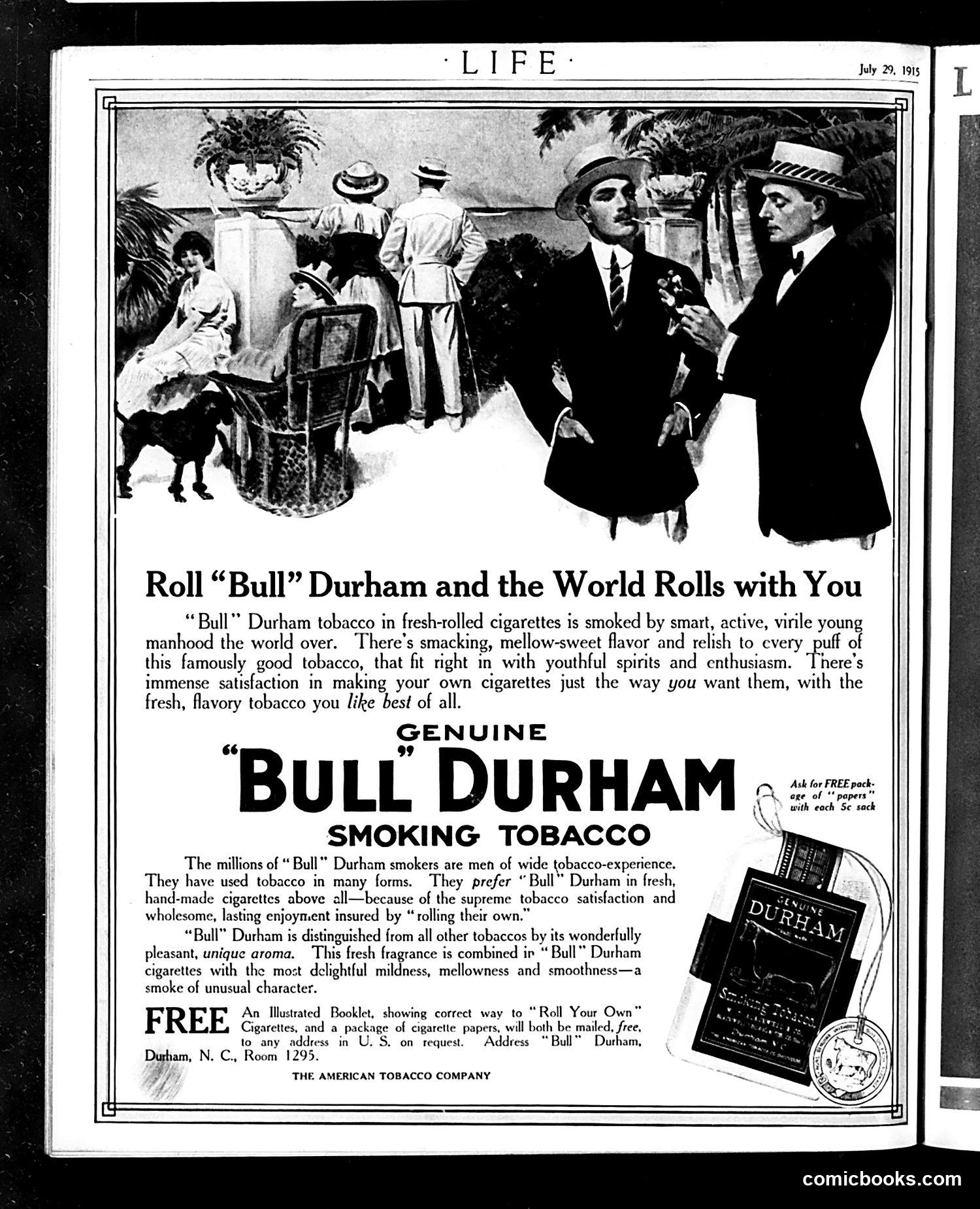
This is primarily a **cigarette advertisement**, not political satire. The illustration depicts an elegant social scene—likely a garden party or resort setting—where well-dressed men and women mingle. The ad targets "smart, active, virile young manhood," emphasizing that rolling one's own cigarettes with Bull Durham tobacco represents sophistication and masculine independence. The ad's appeal hinges on early 20th-century consumer culture: hand-rolling cigarettes was marketed as a superior, personalized alternative to mass-produced versions. The "FREE" booklet offering instructions on proper rolling technique reinforces this positioning. By modern standards, the most striking element is the unironic health language ("wholesome, lasting enjoyment"), reflecting pre-regulation tobacco marketing when health risks were unknown or unstated. The emphasis on "virile young manhood" would now read as crude gender targeting.